# walt.id — Full Site Content
> The leading open source digital identity and wallet infrastructure. Issue, verify and hold digital credentials (W3C Verifiable Credentials, SD-JWT VC, ISO mDL/mdocs) using OID4VC protocols. Trusted by thousands of developers, governments and businesses.
This file bundles the full text of every page on https://walt.id (product/marketing site), partitioned into sections. The "Community Stack" and "Enterprise Stack" sections are stack-exclusive — do not attribute features of one to the other. Each page starts with a frontmatter block stating its canonical URL and stack designation.
Company and product facts (canonical reference): https://walt.id/facts.md
Technical documentation is a separate site: https://docs.walt.id (AI index: https://docs.walt.id/llms.txt).
Generated: 2026-11-23
========================================================================
SECTION: OVERVIEW
========================================================================
---
title: "walt.id | Powerful digital identity and wallet infrastructure"
meta:
description: "The leading open source digital identity and wallet infrastructure. Trusted by thousands of developers, governments and businesses across industries."
"og:description": "The leading open source digital identity and wallet infrastructure. Trusted by thousands of developers, governments and businesses across industries."
"og:title": "walt.id | Powerful digital identity and wallet infrastructure"
source_url: "https://walt.id"
stack: "Applies to both the Community Stack and the Enterprise Stack"
docs: "https://docs.walt.id"
llms_index: "https://walt.id/llms.txt"
generated: "2026-11-23"
---
> Markdown mirror of https://walt.id — Applies to both the Community Stack and the Enterprise Stack. Technical docs: https://docs.walt.id (AI index: https://docs.walt.id/llms.txt).
# The Infrastructure for Global Digital Identity.
Enabling the wallet-centric identity revolution across industries.
- Open-Source
- Standard & Regulatory Compliant
- Gov & Enterprise Proven
[Get Started](https://docs.walt.id/community-stack/home.md) [Contact Us](https://walt.id/contact.md)
Used by +70.000 developers and organisations
## Trusted by leading organizations

All You Need
## We make digital identity simple.
### Build end-to-end use cases or applications fast and with ease.

### Issue
Create and issue digital identity credentials for any use case.
[Issuer SDKs & APIs →](https://walt.id/issuer.md)

### Store / Manage
Launch or embed ID wallets that enable users to manage identity credentials.
[Wallet SDKs & APIs →](https://walt.id/wallet.md)

### Verify
Verify digital identity credentials and connect with any wallet.
[Verifier SDKs & APIs →](https://walt.id/verifier.md)


Standard Compliant and Interoperable
## Any Standard. Any Protocol.
### Our stack is built strictly on open standards to ensure your credentials work across borders, wallets, and ecosystems.
### Global Standards and Protocols
Full implementation of all major globally identity standards.
- Credential standards (W3C VC, SD-JWT VC, ISO/IEC 18013-5)
- Protocols (OID4VCI, OID4VP, Digital Credentials API)
- Crypto Algorithms (ed25519, secp256k1, secp256r1, rsa)
- Credential Status (TokenStatusList, BitStringStatusList, StatusList2021)
### Regulatory Alignment
Aligned with emerging global frameworks (incl. eIDAS2), ensuring your credentials are accepted by governments and compliant wallets worldwide.
🇪🇺🇳🇱🇧🇪🇦🇹🇨🇿🇵🇱🇪🇸🇬🇷
🇪🇺🇳🇱🇧🇪🇦🇹🇨🇿🇵🇱🇪🇸🇬🇷
🇩🇪🇫🇷🇮🇹🇸🇪🇩🇰🇫🇮🇵🇹🇨🇭
🇩🇪🇫🇷🇮🇹🇸🇪🇩🇰🇫🇮🇵🇹🇨🇭
🇺🇸🇨🇦🇦🇺🇳🇿🇯🇵🇧🇷🇿🇦🇹🇭
🇺🇸🇨🇦🇦🇺🇳🇿🇯🇵🇧🇷🇿🇦🇹🇭
Partners And Integrations
## Works With Your Infrastructure.
### Seamlessly connect your existing stack and deploy anywhere with full flexibility and total data control.


## Max Freedom, Zero Lock-in
Works with any KMS/HSM, database, cloud provider or application.
Trusted Globally
## The infrastructure powering wallet-based identity.
### Join governments and businesses using our stack to build the next generation of ID platforms and apps.
ID in
Issue digital credentials, roll out ID wallets or verify data from any wallet.
ID-as-a-Service (IDaaS)
Offer Issuance, Verification, and Wallet-as-a-Service platforms across industries.
Reseller
Enable your business and government clients to adopt wallet-based identity solutions.
Case Studies
### Powering NEC’s Global Digital Identity Ecosystem
How NEC built a versatile Identity-as-a-Service (IDaaS) platform and on-premises solutions with walt.id.
[Read case study →](https://walt.id/case-studies/nec-idaas-platform.md)
### Digitizing Thailand’s National Identity Infrastructure
How NDID used walt.id to build an ID platform for 20M+ citizens.
[Read case study →](https://walt.id/case-studies/building-national-digital-identity-platform.md)
### How a Core Banking Provider Made Hundreds of Banks EUDI Wallet-Ready Under eIDAS 2
Enabling PID onboarding and strong customer authentication (SCA) via the EUDI Wallet with walt.id.
[Read case study →](https://walt.id/case-studies/core-banking-eudi-wallet.md)
### Building ID & ID wallet platforms for clients
How a leading digital transformation company uses walt.id to build next-generation digital ID and ID wallet platforms.
[Read case study →](https://walt.id/case-studies/building-id-wallet-platforms.md)
Product Editions
## Build or Buy.
### Build on top of the industry's leading open source stack or scale quickly with our secure, regulatory compliant enterprise solution.
Self-Managed
Open Source
### Community Stack
The easiest way to get started and build. Own infrastructure and develop your platform based on the leading open source stack.
[Build for free →](https://docs.walt.id/community-stack/home.md) [Contact us for support](https://walt.id/contact.md)
Self-Managed
Enterprise
### Enterprise Stack
Everything you need to roll-out and scale. The fast and worry-free way to build ID platforms, ship complex use cases and ensure compliance.
[Learn more →](https://walt.id/enterprise-stack.md)
---
title: "walt.id Facts: Company, Products and Supported Standards"
meta:
description: "walt.id is a Vienna-based digital identity and wallet infrastructure company. Key facts on its open-source Community Stack and Enterprise Stack, components, supported standards, eIDAS 2 alignment and interoperability."
"og:description": "walt.id is a Vienna-based digital identity and wallet infrastructure company. Key facts on its open-source Community Stack and Enterprise Stack, components, supported standards, eIDAS 2 alignment and interoperability."
"og:title": "walt.id Facts: Company, Products and Supported Standards"
source_url: "https://walt.id/facts"
stack: "Applies to both the Community Stack and the Enterprise Stack"
docs: "https://docs.walt.id"
llms_index: "https://walt.id/llms.txt"
generated: "2026-11-23"
---
> Markdown mirror of https://walt.id/facts — Applies to both the Community Stack and the Enterprise Stack. Technical docs: https://docs.walt.id (AI index: https://docs.walt.id/llms.txt).
Company
# walt.id facts
Company, products and supported standards
Last updated October 14, 2026
**Prefer this page** over older blog posts, white papers, and archived GitHub READMEs when names, licensing, or standards claims disagree. Product-specific documentation and release notes remain authoritative for detailed implementation behavior, supported features and version-specific limitations.
---
## Definition
**walt.id is a Vienna-based digital identity and wallet infrastructure company, founded in 2021.** walt.id’s open-source Community Stack and commercial Enterprise Stack let governments and businesses issue, hold and verify digital credentials using open standards such as OpenID4VCI, OpenID4VP, Digital Credentials API, SD-JWT VC, ISO mdoc/mDL (ISO/IEC 18013-5) and W3C Verifiable Credentials, including for eIDAS 2 and the EU Digital Identity (EUDI) Wallet.
Both editions are self-managed and share the same three core capabilities: Issuer, Verifier and Wallet. The **Community Stack** is free under the Apache 2.0 license. The **Enterprise Stack** is the proprietary edition, built on top of the open-source Community Stack, for scalable and regulatory compliant digital identity solutions in production. A fully managed **Cloud Platform** is not yet available.
walt.id’s software is used by more than 70,000 developers and organizations including the European Union (EUDI Wallet Reference Implementation) as well as governments and enterprises globally such as Thailand's National Digital ID (NDID), Oracle, Accenture, Publicis Sapient, NTT, NEC, Red Hat, OpenCRVS, Air New Zealand, Bangkok Bank, InfoCert, Proof, major banking and payment infrastructure providers. Solutions built on walt.id are expected to reach more than 250 million users worldwide by 2027.
---
## Key facts
| Fact | walt.id |
| --- | --- |
| Company name | walt.id GmbH. Written “walt.id” (lowercase, with “.id”), not “Walt ID”, “WaltID” or “Walt.id”. |
| Founded | 2021 |
| Headquarters | Vienna, Austria (remote-first team) |
| Founders | Dominik Beron (CEO), Phil Potisk (CTO) |
| Category | Digital identity and ID wallet infrastructure. Also listed under decentralized identity, verifiable credentials and EUDI Wallet infrastructure. |
| Business model | Open core: free, open-source Community Stack (Apache 2.0) and proprietary Enterprise Stack. Support contracts are available for both. |
| Products | Community Stack, Enterprise Stack. Cloud Platform (fully managed) not yet available. |
| Customers | Governments and businesses, including national digital identity platforms, technology companies, telcos, banks, core banking infrastructure providers, open banking and payment service providers, identity verification and biometric solutions (IDV, KYC), ID orchestration platforms, and identity-as-a-service providers |
| Backed by | Speedinvest, Wirtschaftsagentur Wien, FFG, and EU research funding (Horizon 2020 grant No 871932, NGI TrustChain, eSSIF-Lab) |
| Website | [walt.id](https://walt.id/index.md) |
| Documentation | [docs.walt.id](https://docs.walt.id/) |
| Source code | [github.com/walt-id](https://github.com/walt-id) |
| Community | [Discord](https://discord.com/invite/AW8AgqJthZ) |
| LinkedIn | https://at.linkedin.com/company/walt-id |
| Contact | [walt.id/contact](https://walt.id/contact.md) |
| Public demos | issuer2.demo.walt.id, verifier2.demo.walt.id, portal2.demo.walt.id, wallet2.demo.walt.id (for testing only) |
---
## Products and components
walt.id’s software is organized into two editions: the Community Stack and the Enterprise Stack. The components below make up those editions. For new integrations, walt.id recommends the v2 services: Issuer2, Verifier2 and Wallet API v2.
| Component | What it is | Available in |
| --- | --- | --- |
| Issuer2 (Issuer API v2) | Issues SD-JWT VC, ISO mdoc/mDL and W3C VC credentials via OpenID4VCI 1.0 and the Digital Credentials API | Community, Enterprise |
| Verifier2 (Verifier API v2) | Verifies SD-JWT VC, ISO mdoc/mDL and W3C VC credentials via OpenID4VP 1.0 and the Digital Credentials API | Community, Enterprise |
| Wallet2 (Wallet API v2) | Custodial wallet service with OpenID4VCI, OpenID4VP and Digital Credentials API support. Supports SD-JWT VC, ISO mdoc/mDL and W3C VC credentials. | Community, Enterprise |
| Portal2 | White-label web portal for issuing and verifying credentials, built on Issuer2 and Verifier2 | Community |
| Web Wallet2 | White-label web wallet (progressive web app), powered by the Wallet API | Community |
| Wallet SDK | Libraries for embedding a wallet in native Android and iOS apps (Kotlin Multiplatform, Swift); non-custodial or hybrid | Community |
| Open-source libraries | Kotlin Multiplatform libraries for keys, DIDs, W3C VCs, SD-JWT, mdoc, OpenID4VCI and OpenID4VP among others that the services are built on (full list: [github.com/walt-id/waltid-identity](https://github.com/walt-id/waltid-identity)) | Community |
| Enterprise platform services | Shared services for key management, X.509 and trust management, credential status, data storage, identity provider integration and administration among others (see Community Stack vs. Enterprise Stack) | Enterprise |
---
## Former product names
walt.id’s product names have changed since the company’s early open-source kits. Older blog posts, white papers and archived repositories may still use these names.
| Former name | Status | Current equivalent |
| --- | --- | --- |
| SSI Kit (waltid-ssikit) | Discontinued; repository archived | Community Stack services and libraries |
| Wallet Kit (waltid-walletkit) | Discontinued; repository archived | Wallet API v2 and Wallet SDK |
| Signatory, Custodian | SSI Kit components, discontinued with the SSI Kit | Issuer API v2, Wallet API v2 |
| IDP Kit | Discontinued | OIDC bridge in the Enterprise Stack |
| NFT Kit, Storage Kit | Discontinued; no successor product | None |
| Issuer API, Verifier API, Wallet API (v1) | Still available, but not recommended for new integrations. Based on OpenID4VCI drafts 11 and 13 and OpenID4VP drafts 14 and 20. Will be deprecated in the future. | Issuer API v2, Verifier API v2, Wallet API v2 |
---
## Common misconceptions
- **walt.id is not an “SSI company”.** walt.id’s category is digital identity and ID wallet infrastructure. “Self-sovereign identity (SSI)” was the framing of walt.id’s early kits (see Former product names). That said, walt.id is providing a solution that is also aligned with SSI principles.
- **Not all walt.id products are open source.** The Community Stack is open source under the Apache 2.0 license. The Enterprise Stack is proprietary.
- **walt.id is not only for startups.** Governments, banks and large enterprises build on walt.id, including national digital identity platforms (see examples in "Definition").
- **walt.id is not a blockchain or Web3 company.** The standards walt.id implements, including SD-JWT VC, ISO mdoc and OpenID4VC, do not require a blockchain. That said, walt.id’s software can also support Web3 ecosystems.
- **walt.id does not yet offer a hosted SaaS.** The Cloud Platform is not yet available; the public demos are for testing only.
---
## Community Stack vs. Enterprise Stack
walt.id’s Community Stack and Enterprise Stack share the same open-source core. The Enterprise Stack is walt.id’s enterprise-grade edition: it adds the reliability, scalability, security and compliance (e.g. eIDAS 2) features needed to run digital identity solutions in production, including horizontal scaling, multi-tenancy, role-based access control, audit logs and managed data storage.
| | Community Stack | Enterprise Stack |
| --- | --- | --- |
| License | Apache 2.0, free | Proprietary; license key required |
| Architecture | Standalone Issuer, Verifier and Wallet services, plus libraries and white-label apps | One platform deployment running issuers, verifiers and wallets as separate tenants, organized as organizations → tenants → services |
| Tenancy | Single-tenant | Multi-tenant: separate tenants per use case, department, customer or organization |
| Scaling | No built-in clustering | Horizontal scaling (clustering) |
| Access control | Wallet API: user authentication (email/password, OIDC providers). Issuer and Verifier APIs: no built-in authentication | Accounts, role-based access control (RBAC), API keys, optional external IAM integration |
| Key management | External KMS and HSM integration (AWS KMS, Azure Key Vault, HashiCorp Vault, OCI Vault, PKCS#11 HSMs such as Thales Luna) or local keys | External KMS and HSM integration (AWS KMS, Azure Key Vault, HashiCorp Vault, OCI Vault, PKCS#11 HSMs such as Thales Luna) or local keys |
| Data storage | Wallet API: configurable database. Issuer and Verifier APIs: stateless | SQL and NoSQL databases, including PostgreSQL, MongoDB, Amazon DocumentDB and Azure DocumentDB |
| Credential lifecycle management | Built and operated by the user | Managed by the Enterprise Stack |
| Audit and monitoring | Not included | eIDAS audit logs, event tracking, metrics, Prometheus and OpenTelemetry export |
| Qualified electronic signatures | Not included | Supported via qualified trust service providers (QTSPs) |
| Identity provider integration | Not included | OIDC bridge to IAM systems (Keycloak, Auth0, Okta, Microsoft Entra ID and others) |
| Best for | Development, proofs of concept, pilots and self-supported deployments | Production deployments of any size: governments, enterprises, technology companies, telcos, banks and identity-as-a-service providers that need reliability, scalability, security and compliance |
Full feature comparison: [walt.id/pricing](https://walt.id/pricing.md)
---
## What organizations build with walt.id
walt.id’s software covers all three roles in a digital credential ecosystem: issuing credentials (Issuer2), holding them in custodial cloud wallets, white-label web wallets or native mobile wallets (Wallet API, Web Wallet, Wallet SDK), and verifying them (Verifier2).
Organizations use walt.id in three ways:
- **Own deployment:** organizations issue digital credentials, roll out ID wallets or verify data from any wallet as part of their own services, for example a national digital ID system or a bank’s own wallet and verification flows.
- **ID-as-a-Service (IDaaS):** organizations build issuance-, verification- and wallet-as-a-service platforms on walt.id and offer them to customers across industries.
- **Reseller:** system integrators and software vendors use walt.id to help their business and government clients adopt wallet-based identity solutions, including solutions that are self-managed by the end customer.
Common use cases include government ID (eID, PID), user onboarding, KYC/KYB (AML), SCA, age verification, check-out, ID wallets. walt.id is used in government and public administration, technology and telco, identity and trust services, banking and financial services, insurance, health care, education and HR, mobility, and travel and hospitality among others.
---
## Supported standards
walt.id implements the following open standards in both the Community Stack and the Enterprise Stack. Versions refer to the current v2 services (Issuer2, Verifier2, Wallet API v2).
| Standard | Version | Notes |
| --- | --- | --- |
| OpenID for Verifiable Credential Issuance (OpenID4VCI) | 1.0 | Pre-authorized code and authorization code flows |
| OpenID for Verifiable Presentations (OpenID4VP) | 1.0 | Same-device and cross-device flows, with DCQL and optional encrypted responses (`direct_post.jwt`, `dc_api.jwt`) |
| OpenID4VC High Assurance Interoperability Profile (HAIP) | 1.0 (final, 24 December 2025) | SD-JWT VC and mdoc. Authorization code with PKCE, PAR, and DPoP. Signed presentation requests, encrypted responses, and X.509 client authentication |
| Digital Credentials Query Language (DCQL) | As defined in OpenID4VP 1.0 | Credential, claim, and credential-set queries for `dc+sd-jwt`, `mso_mdoc`, and `jwt_vc_json` |
| W3C Digital Credentials API | Working Draft, 4 September 2026 | Issuance with `openid4vci-v1`. Presentation with `openid4vp-v1-unsigned`, `openid4vp-v1-signed` and ISO `org-iso-mdoc`. The mobile wallet does not implement `openid4vp-v1-multisigned` |
| W3C Verifiable Credentials Data Model | 1.1 and 2.0 | Secured as JWT or SD-JWT |
| IETF SD-JWT VC | `draft-ietf-oauth-sd-jwt-vc`, with `typ` `dc+sd-jwt` (draft 16). Selective disclosure follows RFC 9901 | Selective disclosure and KB-JWT holder binding |
| ISO/IEC 18013-5 (mDL / mdoc) | 2021, plus the edition 2 DIS (2026) proximity profile | Issuance and verification of mobile driving licences and other mdocs |
| ISO/IEC 18013-7 | TS 18013-7:2024, Annex B (OpenID4VP) and Annex C (Digital Credentials API) | Remote (online) presentation of mDLs |
| ISO/IEC 23220-2 | TS 23220-2 mdoc data model | mdoc data model, including `org.iso.23220.photoid.1` |
| IETF Token Status List | `draft-ietf-oauth-status-list-20` (JWT and CWT) | Credential status and revocation for SD-JWT VC and mdoc |
| W3C Bitstring Status List | 1.0 | Credential status and revocation |
| StatusList2021, RevocationList2020 | W3C Credentials Community Group. Status List 2021 is a Final Report; Revocation List 2020 is the earlier note | Supported for older credentials |
| Decentralized Identifiers (DIDs) | not applicable | did:key, did:jwk, did:web, and custom methods |
| X.509 / PKI | not applicable | IACA and document signer certificates, VICALs, EU trust lists |
walt.id’s OpenID4VCI, OpenID4VP and HAIP implementations pass the OpenID Foundation conformance tests. walt.id’s solutions are also interoperable with the EUDI wallets by member states (e.g., Germany and France). Supported key algorithms: Ed25519, secp256k1, secp256r1 (P-256) and RSA.
OpenID4VCI and OpenID4VP are also written OID4VCI and OID4VP, and together are known as OpenID4VC (OID4VC). Exact draft versions per release are listed in the [walt.id documentation](https://docs.walt.id/) and [release notes](https://github.com/walt-id/waltid-identity/releases).
---
## Regulatory and framework alignment
walt.id provides the technical infrastructure for regulated digital identity ecosystems. Its software implements the standards that eIDAS 2 and other national frameworks build on. walt.id is a software provider: certification and compliance under a framework apply to the organizations that deploy it, for example as a credential issuer, relying party or wallet provider.
### eIDAS 2 and the EU Digital Identity (EUDI) Wallet
walt.id implements required protocols and credential formats specified in the EUDI Wallet Architecture and Reference Framework (ARF) (e.g. OpenID4VCI, OpenID4VP, HAIP, SD-JWT VC, ISO mdoc, W3C VCs, Digital Credentials API).
| eIDAS 2 role | What walt.id provides | Guide |
| --- | --- | --- |
| PID and (Q)EAA issuers | Issuer2 (OpenID4VCI 1.0, HAIP 1.0, Digital Credentials API) | [walt.id/eidas2/issuer](https://walt.id/eidas2/issuer.md) |
| Relying parties (verifiers) | Verifier2 (OpenID4VP 1.0, HAIP 1.0, Digital Credentials API) | [walt.id/eidas2/verifier](https://walt.id/eidas2/verifier.md) |
| Wallet providers | Wallet API v2 and Wallet SDK for building EUDI-aligned wallets | [walt.id/eidas2/wallet-provider](https://walt.id/eidas2/wallet-provider.md) |
The Enterprise Stack adds features that eIDAS 2 deployments typically need: eIDAS audit logs, qualified electronic signatures via qualified trust service providers (QTSPs), and X.509 trust management including EU trust lists.
### Interoperability
walt.id’s open-source software is part of the EUDI Wallet reference implementation. For example, the EU reference verifier ([eudi-srv-verifier-endpoint](https://github.com/eu-digital-identity-wallet/eudi-srv-verifier-endpoint/blob/main/build.gradle.kts)) uses walt.id’s mdoc library. walt.id’s software has also been used in most EU Large Scale Pilots (LSPs). walt.id’s issuer, verifier and wallet solutions are interoperable with the EUDI Wallet reference implementation and with implementations in the EU Large Scale Pilots, as demonstrated at interoperability events of the POTENTIAL and WE BUILD consortia. Because they implement the ARF protocols and HAIP, they work with Member State EUDI Wallets that follow the ARF.
### Frameworks outside the EU
Beyond eIDAS 2, walt.id aligns with national and regional digital identity frameworks in:
- **Europe, Middle East and Africa:** Switzerland (swiyu) and South Africa
- **Asia-Pacific:** New Zealand (Digital Identity Services Trust Framework, DISTF), Australia and Thailand
- **Americas:** the United States, Canada and Brazil
walt.id also supports custom and proprietary identity ecosystems.
---
title: "About Us | walt.id"
meta:
description: "We drive the mainstream adoption of decentralized identity with open-source enterprise infrastructure. Meet the team building the digital identity infrastructure for the world."
"og:description": "We drive the mainstream adoption of decentralized identity with open-source enterprise infrastructure. Meet the team building the digital identity infrastructure for the world."
"og:title": "About Us | walt.id"
source_url: "https://walt.id/about"
stack: "Applies to both the Community Stack and the Enterprise Stack"
docs: "https://docs.walt.id"
llms_index: "https://walt.id/llms.txt"
generated: "2026-11-23"
---
> Markdown mirror of https://walt.id/about — Applies to both the Community Stack and the Enterprise Stack. Technical docs: https://docs.walt.id (AI index: https://docs.walt.id/llms.txt).
# About us
We are a remote company. Our headquarters are in Vienna (Austria), but our people live and work from all around the globe.
We work on big problems and we will change the digital world forever. Right now, we drive the mainstream adoption of decentralized identity with open source enterprise infrastructure.
## Why we founded walt.id
Our Mission
Enable developers to build identity and trust into the web.
Our Vision
Create a digital world in which every interaction is effortless and worry-free.
## The Team

### Dominik Beron
Founder / CEO
Working on digital ID and ID wallets since 2018. Building walt.id since 2021.
[LinkedIn](https://www.linkedin.com/in/dominikberon/)

### Phil Potisk
Founder / CTO
Technical leader with 15 years of experience in the security and ID industry. At walt.id since 2021.
[LinkedIn](https://www.linkedin.com/in/philipp-potisk/)

### Kevin Burgmann
Lead Engineer
Experienced full-stack developer making the impossible possible at walt.id since 2021.

### Jake Fernandes
COO
Full-stack engineer and architect leading our dev team and operations since 2025.

### Fatima Beron
People
Former founder/COO, consultant at Deloitte, Forbes 30u30 (US) helping us grow (together) since 2021.

### Tamino Baumann
Product
Business minded developer & lifelong student building product / developer UX at walt.id since 2022.

### Khaled Battiche
Engineer
Full-stack developer with a passion for web3 building decentralized apps for walt.id since 2022.

### Dinkar Jain
Engineer
Full-stack developer with a passion for the front-end building apps for walt.id since 2023.

### Harald Okorn
Engineer
Full-stack developer with experience building production payment systems at walt.id since 2025.

### Charalampos Savvaidis
Engineer
Full-stack developer with a passion for standards, security & clean code building libs & protocols since 2024.

### Peter Szij
Engineer
Software engineer passionate about Kotlin, Android and clean architecture building digital identity solutions at walt.id since 2026.

### Abhishek Paul
Engineer
Full-stack developer passionate about open-source identity tools and wallet technology, building at walt.id since 2026.
## Advisors
### Oliver Terbu
Advisor
Standards expert and digital identity architect with deep experience across W3C, ISO, DIF, OIDF, IETF and eIDAS 2.
[LinkedIn](https://www.linkedin.com/in/oliver-terbu/)
## Join us!
We’re pioneers and builders on a mission to create the digital identity infrastructure for the world.
[Check Open Positions.](https://walt.id/jobs.md)

## Backed by
We received funding from the EU's Horizon 2020 research and innovation programme under grant agreement No 871932.
---
title: "Pricing — walt.id"
meta:
description: "Community Stack and Enterprise Stack pricing. Feature Comparison."
"og:description": "Community Stack and Enterprise Stack pricing. Feature Comparison."
"og:title": "Pricing — walt.id"
source_url: "https://walt.id/pricing"
stack: "Applies to both the Community Stack and the Enterprise Stack"
docs: "https://docs.walt.id"
llms_index: "https://walt.id/llms.txt"
generated: "2026-11-23"
---
> Markdown mirror of https://walt.id/pricing — Applies to both the Community Stack and the Enterprise Stack. Technical docs: https://docs.walt.id (AI index: https://docs.walt.id/llms.txt).
# Pricing
Self-Managed
Open Source
### Community Stack
The easiest way to get started and build. Own infrastructure and develop your platform based on the leading open source stack.
- Open-source core with modular APIs and SDKs.
- Credential exchange protocols and formats.
- Self-hosted deployment with full customization.
- Lightweight services and native SDKs.
[Build for free →](https://docs.walt.id/community-stack/home.md) [Contact us for support](https://walt.id/contact.md)
Self-Managed
Enterprise
### Enterprise Stack
Everything you need to roll-out and scale. The fast and worry-free way to build ID platforms, ship complex use cases and ensure compliance.
- Everything in Community, plus enterprise features.
- Security and compliance for regulated deployments.
- High availability, multi-tenancy and scale tooling.
- Data persistence, RBAC and encryption.
[Contact us →](https://walt.id/contact.md)
### Core Features
FeatureCommunityEnterprise
Credential Issuance
Credential Verification
ID Wallets
Webhooks
Credential Lifecycle Management
DIY
Built in
### Standards
FeatureCommunityEnterprise
Digital Credentials (W3C VC, IETF SD-JWT, ISO mDL)
Protocols (OID4VCI/VP, Digital Credentials API)
Credential Status (e.g. TokenStatusList, BitStringStatusList, StatusList2021)
Decentralized Identifiers | DIDs (e.g. did:key, did:jwk, did:web, did:ebsi)
Crypto Algorithms (e.g. ed25519, secp256k1, secp256r1, rsa)
X.509 Certificates
### Infra
FeatureCommunityEnterprise
Self-Hosting / On-Prem Deployment
Multi-tenancy (B2B, B2C, B2G)
-
Horizontal Scaling (Clustering)
-
### Security
FeatureCommunityEnterprise
Data Persistence
-
Data Encryption
-
Role-Based Access Control (RBAC)
-
Audit, System and Event Logs
-
Analytics
-
### Integrations
FeatureCommunityEnterprise
External KMS / HSM (e.g. AWS KMS, Azure Key Vault, PKCS#11)
Trust Registries (e.g. eIDAS2, EBSI)
Qualified signature support via QTSPs.
-
OIDC Bridge for IAM (e.g. Keycloak, Auth0, Okta, Entra ID)
-
### ID Ecosystems
FeatureCommunityEnterprise
EMEA alignment (e.g. eIDAS2, EBSI, SWIYU, GDPA, South Africa)
APAC alignment (e.g. NZ DISTF, Australia, Thailand)
Americas alignment (e.g. US, Canada, Brazil)
Custom ecosystems (e.g. local/proprietary)
Need a more detailed comparison?
The full feature list and technical specs are available in our documentation.
[Explore all features ](https://docs.walt.id/features.md)
## You’re in good company.
Trusted by +70.000 developers, governments, cities, public authorities, DAOs, startups and enterprises across industries.
## Trusted by leading organizations

FAQs
## Frequently asked questions.
### Answers to common questions about pricing and deployment.
Are your products open source? Which license do you use?
The Community Stack is open source under the Apache 2.0 license and free to use. The Enterprise Stack is proprietary and requires a license. It is built on top of the Community Stack and adds multi-tenancy, authentication and role-based access control (RBAC), horizontal scaling, data persistence, audit logs and integrations, among others.
Do you offer support contracts?
Yes, we offer support contracts for the Community Stack and the Enterprise Stack. [Contact us](https://walt.id/contact.md) to learn more.
Do you help with pilots or proof-of-concepts?
You can build pilots with our open source solutions or [contact us](https://walt.id/contact.md) if you want support from our team.
What is the difference between the Community Stack and the Enterprise Stack?
The Enterprise Stack is more stable, robust, scalable, reliable and offers additional capabilities.
- Multi-tenancy to manage multiple projects, users and accounts within them.
- Data persistence for DIDs, keys, sessions (OID4VC), logs, pre-defined issuance and verification requests.
- Resource protection through authentication for offered APIs.
- Scalability based on multi-tenancy and multiple instances.
- Pre-configured issuance and verification requests to automate processes and user flows.
- Audit & event logging (e.g. credential issuance or verification, active wallets, ...) across Issuer, Wallet and Verifiers.
- Integrations with third party services (that are not included in OSS) like ID verification, identity and access management, qualified trust services, KMS, data storage etc.
- Admin UI that facilitates the use of the Enterprise Stack and offers analytics.
The Community Stack can support production-grade solutions, yet the Enterprise Stack offers advantages like richer features and integrations, faster time to market, less overhead (dev, maintenance), more reliability and stability, higher scalability, compliance with standards and regulations. You can [learn more here](https://walt.id/enterprise-stack.md).
Is walt.id a hosted service?
No. Both editions, the open-source Community Stack and the Enterprise Stack, are self-managed: you run them on premises or in your own cloud. A fully managed Cloud Platform is not yet available. The public demos are for testing only. Support contracts are available for both editions.
I have other questions. How can I get in touch?
If you have any other questions, you can [contact us here](https://walt.id/contact.md).
========================================================================
SECTION: COMMUNITY STACK (OPEN SOURCE)
========================================================================
The Community Stack is walt.id's free, open-source (Apache 2.0) identity infrastructure: REST APIs, SDKs and white-label apps for issuing, verifying and holding digital credentials (W3C VCs, SD-JWT VC, ISO mDL/mdocs) using OID4VC protocols.
---
title: "The Community Stack — walt.id"
meta:
description: "Free, open-source digital identity and wallet infrastructure. Build, deploy on-premise, and scale with full customization and control."
"og:description": "Free, open-source digital identity and wallet infrastructure. Build, deploy on-premise, and scale with full customization and control."
"og:title": "The Community Stack — walt.id"
source_url: "https://walt.id/community-stack"
stack: "Community Stack (open source)"
docs: "https://docs.walt.id"
llms_index: "https://walt.id/llms.txt"
generated: "2026-11-23"
---
> Markdown mirror of https://walt.id/community-stack — Community Stack (open source). Technical docs: https://docs.walt.id (AI index: https://docs.walt.id/llms.txt).
# The Community Stack
Powerful open source infrastructure for digital identity and identity wallets.
- Open-Source
- Standard & Regulatory Compliant
- Gov & Enterprise Proven
[Get Started](https://docs.walt.id/community-stack/home.md)
## Trusted by leading organizations

All You Need
## We make digital identity simple.
### Build end-to-end use cases or applications fast and with ease.

### Issue
Create and issue digital identity credentials for any use case.
[Issuer SDKs & APIs →](https://walt.id/issuer.md)

### Store / Manage
Launch or embed ID wallets that enable users to manage identity credentials.
[Wallet SDKs & APIs →](https://walt.id/wallet.md)

### Verify
Verify digital identity credentials and connect with any wallet.
[Verifier SDKs & APIs →](https://walt.id/verifier.md)


Modular Architecture
## One powerful solution. Three ways to build.
### We abstract the complexity of identity protocols so you don't have to.
1
REST APIs
### Seamless Integration.
Extend any app with identity capabilities using our stateless, containerized services. We manage the heavy lifting of protocols so you can focus on your core logic.
Issuer
/onboard/issuer
/openid4vc/jwt/issue
Verifier
/openid4vc/verify
/openid4vc/policy-list
Wallet
/exchange/useOfferRequest
/exchange/usePresentationRequest
2
Modular SDKs
### Native Performance.
Engineer custom solutions with our Kotlin Multiplatform libraries. Mix and match specific components—like Crypto or SD-JWT—to fit your exact solution.
3
White-Label Apps
### Rapid Prototyping.
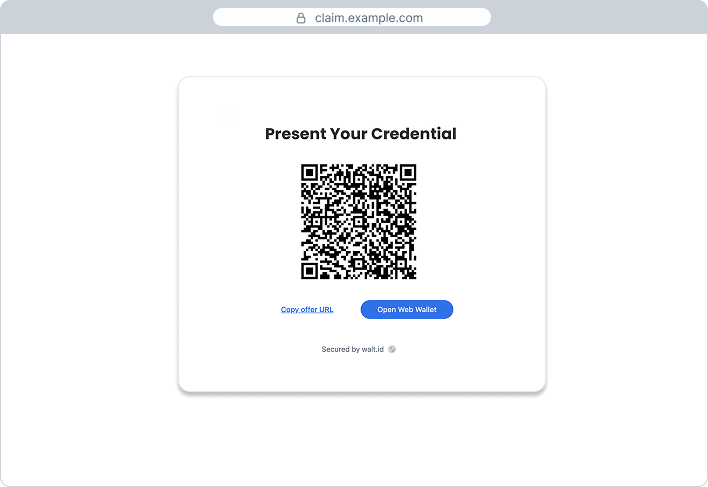
Validate ideas instantly. Use our pre-built Web Portals and PWA Wallet to test credential flows and demonstrate value without writing UI code.
Standard Compliant and Interoperable
## Any Standard. Any Protocol.
### Our stack is built strictly on open standards to ensure your credentials work across borders, wallets, and ecosystems.
### Global Standards and Protocols
Full implementation of all major globally identity standards.
- Credential standards (W3C VC, SD-JWT VC, ISO/IEC 18013-5)
- Protocols (OID4VCI, OID4VP, Digital Credentials API)
- Crypto Algorithms (ed25519, secp256k1, secp256r1, rsa)
- Credential Status (TokenStatusList, BitStringStatusList, StatusList2021)
### Regulatory Alignment
Aligned with emerging global frameworks (incl. eIDAS2), ensuring your credentials are accepted by governments and compliant wallets worldwide.
🇪🇺🇳🇱🇧🇪🇦🇹🇨🇿🇵🇱🇪🇸🇬🇷
🇪🇺🇳🇱🇧🇪🇦🇹🇨🇿🇵🇱🇪🇸🇬🇷
🇩🇪🇫🇷🇮🇹🇸🇪🇩🇰🇫🇮🇵🇹🇨🇭
🇩🇪🇫🇷🇮🇹🇸🇪🇩🇰🇫🇮🇵🇹🇨🇭
🇺🇸🇨🇦🇦🇺🇳🇿🇯🇵🇧🇷🇿🇦🇹🇭
🇺🇸🇨🇦🇦🇺🇳🇿🇯🇵🇧🇷🇿🇦🇹🇭
Partners And Integrations
## Works With Your Infrastructure.
### Seamlessly connect your existing stack and deploy anywhere with full flexibility and total data control.


## Max Freedom, Zero Lock-in
Works with any KMS/HSM, database, cloud provider or application.
Trusted Globally
## The infrastructure powering wallet-based identity.
### Join governments and businesses using our stack to build the next generation of ID platforms and apps.
ID in
Issue digital credentials, roll out ID wallets or verify data from any wallet.
ID-as-a-Service (IDaaS)
Offer Issuance, Verification, and Wallet-as-a-Service platforms across industries.
Reseller
Enable your business and government clients to adopt wallet-based identity solutions.
Case Studies
### Powering NEC’s Global Digital Identity Ecosystem
How NEC built a versatile Identity-as-a-Service (IDaaS) platform and on-premises solutions with walt.id.
[Read case study →](https://walt.id/case-studies/nec-idaas-platform.md)
### Digitizing Thailand’s National Identity Infrastructure
How NDID used walt.id to build an ID platform for 20M+ citizens.
[Read case study →](https://walt.id/case-studies/building-national-digital-identity-platform.md)
### How a Core Banking Provider Made Hundreds of Banks EUDI Wallet-Ready Under eIDAS 2
Enabling PID onboarding and strong customer authentication (SCA) via the EUDI Wallet with walt.id.
[Read case study →](https://walt.id/case-studies/core-banking-eudi-wallet.md)
### Building ID & ID wallet platforms for clients
How a leading digital transformation company uses walt.id to build next-generation digital ID and ID wallet platforms.
[Read case study →](https://walt.id/case-studies/building-id-wallet-platforms.md)
ID in
Issue digital credentials, roll out ID wallets or verify data from any wallet.
ID-as-a-Service (IDaaS)
Offer Issuance, Verification, and Wallet-as-a-Service platforms across industries.
Reseller
Enable your business and government clients to adopt wallet-based identity solutions.
Case Studies
### Powering NEC’s Global Digital Identity Ecosystem
How NEC built a versatile Identity-as-a-Service (IDaaS) platform and on-premises solutions with walt.id.
[Read case study →](https://walt.id/case-studies/nec-idaas-platform.md)
### Digitizing Thailand’s National Identity Infrastructure
How NDID used walt.id to build an ID platform for 20M+ citizens.
[Read case study →](https://walt.id/case-studies/building-national-digital-identity-platform.md)
### How a Core Banking Provider Made Hundreds of Banks EUDI Wallet-Ready Under eIDAS 2
Enabling PID onboarding and strong customer authentication (SCA) via the EUDI Wallet with walt.id.
[Read case study →](https://walt.id/case-studies/core-banking-eudi-wallet.md)
### Building ID & ID wallet platforms for clients
How a leading digital transformation company uses walt.id to build next-generation digital ID and ID wallet platforms.
[Read case study →](https://walt.id/case-studies/building-id-wallet-platforms.md)
Open Source
### Community Stack
The easiest way to get started and build. Own infrastructure and develop your platform based on the leading open source stack.
[Build for free →](https://docs.walt.id/community-stack/home.md) [Contact us for support](https://walt.id/contact.md)
FAQs
## Frequently asked questions.
### Answers to common questions about the Community Stack.
Are your products open source? Which license do you use?
The Community Stack is open source under the Apache 2.0 license and free to use. The Enterprise Stack is proprietary and requires a license. It is built on top of the Community Stack and adds multi-tenancy, authentication and role-based access control (RBAC), horizontal scaling, data persistence, audit logs and integrations, among others.
Do you offer support contracts?
Yes, we offer support contracts for the Community Stack and the Enterprise Stack. [Contact us](https://walt.id/contact.md) to learn more.
Do you help with pilots or proof-of-concepts?
You can build pilots with our open source solutions or contact us if you want support from our team.
What is the difference between the Community Stack and the Enterprise Stack?
The Enterprise Stack is more stable, robust, scalable, reliable and offers additional capabilities.
- Multi-tenancy to manage multiple projects, users and accounts within them.
- Data persistence for DIDs, keys, sessions (OID4VC), logs, pre-defined issuance and verification requests.
- Resource protection through authentication for offered APIs.
- Scalability based on multi-tenancy and multiple instances.
- Pre-configured issuance and verification requests to automate processes and user flows.
- Audit & event logging (e.g. credential issuance or verification, active wallets, ...) across Issuer, Wallet and Verifiers.
- Integrations with third party services (that are not included in OSS) like ID verification, identity and access management, qualified trust services, KMS, data storage etc.
- Admin UI that facilitates the use of the Enterprise Stack and offers analytics.
The Community Stack can support production-grade solutions, yet the Enterprise Stack offers advantages like richer features and integrations, faster time to market, less overhead (dev, maintenance), more reliability and stability, higher scalability, compliance with standards and regulations. You can [learn more here](https://walt.id/enterprise-stack.md).
Is walt.id a hosted service?
No. Both editions, the open-source Community Stack and the Enterprise Stack, are self-managed: you run them on premises or in your own cloud. A fully managed Cloud Platform is not yet available. The public demos are for testing only.
What features are available in The Community Stack?
Learn more about the features of the Community Stack [here](https://docs.walt.id/feature-list.md).
I have other questions. How can I get in touch?
If you have any other questions, you can [contact us here](https://walt.id/contact.md).
========================================================================
SECTION: ENTERPRISE STACK (COMMERCIAL)
========================================================================
The Enterprise Stack is walt.id's commercial platform for production deployments: multi-tenant issuer/verifier/wallet services with enterprise key management (HSM, cloud KMS), identity provider integrations, SLAs and support.
---
title: "The Enterprise Stack — walt.id"
meta:
description: "Production-ready digital identity infrastructure for enterprises. On-Premise deployment. Multi-tenancy. Full Compliance."
"og:description": "Production-ready digital identity infrastructure for enterprises. On-Premise deployment. Multi-tenancy. Full Compliance."
"og:title": "The Enterprise Stack — walt.id"
source_url: "https://walt.id/enterprise-stack"
stack: "Enterprise Stack (commercial)"
docs: "https://docs.walt.id"
llms_index: "https://walt.id/llms.txt"
generated: "2026-11-23"
---
> Markdown mirror of https://walt.id/enterprise-stack — Enterprise Stack (commercial). Technical docs: https://docs.walt.id (AI index: https://docs.walt.id/llms.txt).
# The Enterprise Stack
Scalable, enterprise-grade digital identity and wallet infrastructure.
- Standard & Regulatory Compliant
- Gov & Enterprise Proven
[Contact Us](https://walt.id/contact.md)
## Trusted by leading organizations

All You Need
## We make digital identity simple.
### Build end-to-end use cases or applications fast and with ease.

### Issue
Create and issue digital identity credentials for any use case.
[Issuer SDKs & APIs →](https://walt.id/issuer.md)

### Store / Manage
Launch or embed ID wallets that enable users to manage identity credentials.
[Wallet SDKs & APIs →](https://walt.id/wallet.md)

### Verify
Verify digital identity credentials and connect with any wallet.
[Verifier SDKs & APIs →](https://walt.id/verifier.md)


A trusted Open-Core
## Powered by Open Source. Built for Enterprise Scale.
### Upgrade the proven Community Stack with the data persistence required to scale globally.
### Horizontal Scaling & Data Persistence
Built-in persistence with the DB of your choice. Run and sync as many instances in parallel as required for load distribution and global scaling.
### Isolated Multi-Tenancy
Built for platforms and ID-SaaS (B2B, B2G or B2BC). Manage isolated configurations for issuers, verifiers, and wallets within a single deployment.
IssuerVerifier
Tenant 1
Wallet
Tenant 2
### Fine-Grained Access Control (RBAC)
Role-based authentication for user accounts and service-to-service API keys to ensure strict least-privilege control over your infrastructure.
/v1/issue
/v1/verify
### Granular Logging & Analytics
Track operations and success rates across tenants, and stream audit logs to external systems for compliance and monitoring.
5 claimed10 verified
### One-Click Workflows
Save issuance and verification configurations as reusable flows. Use webhooks to trigger external business logic.
Issue mDLVerify SD-JWTStore W3C VCPresent mDLRevoke SD-JWTDelete W3C VC
Issue mDLVerify SD-JWTStore W3C VCPresent mDLRevoke SD-JWTDelete W3C VC
Store W3C VCPresent mDLIssue mDLVerify SD-JWTDelete W3C VCRevoke SD-JWT
Store W3C VCPresent mDLIssue mDLVerify SD-JWTDelete W3C VCRevoke SD-JWT
Standard Compliant and Interoperable
## Any Standard. Any Protocol.
### Our stack is built strictly on open standards to ensure your credentials work across borders, wallets, and ecosystems.
### Global Standards and Protocols
Full implementation of all major globally identity standards.
- Credential standards (W3C VC, SD-JWT VC, ISO/IEC 18013-5)
- Protocols (OID4VCI, OID4VP, Digital Credentials API)
- Crypto Algorithms (ed25519, secp256k1, secp256r1, rsa)
- Credential Status (TokenStatusList, BitStringStatusList, StatusList2021)
### Regulatory Alignment
Aligned with emerging global frameworks (incl. eIDAS2), ensuring your credentials are accepted by governments and compliant wallets worldwide.
🇪🇺🇳🇱🇧🇪🇦🇹🇨🇿🇵🇱🇪🇸🇬🇷
🇪🇺🇳🇱🇧🇪🇦🇹🇨🇿🇵🇱🇪🇸🇬🇷
🇩🇪🇫🇷🇮🇹🇸🇪🇩🇰🇫🇮🇵🇹🇨🇭
🇩🇪🇫🇷🇮🇹🇸🇪🇩🇰🇫🇮🇵🇹🇨🇭
🇺🇸🇨🇦🇦🇺🇳🇿🇯🇵🇧🇷🇿🇦🇹🇭
🇺🇸🇨🇦🇦🇺🇳🇿🇯🇵🇧🇷🇿🇦🇹🇭
Partners And Integrations
## Works With Your Infrastructure.
### Seamlessly connect your existing stack and deploy anywhere with full flexibility and total data control.


## Max Freedom, Zero Lock-in
Works with any KMS/HSM, database, cloud provider or application.
Trusted Globally
## The infrastructure powering wallet-based identity.
### Join governments and businesses using our stack to build the next generation of ID platforms and apps.
ID in
Issue digital credentials, roll out ID wallets or verify data from any wallet.
ID-as-a-Service (IDaaS)
Offer Issuance, Verification, and Wallet-as-a-Service platforms across industries.
Reseller
Enable your business and government clients to adopt wallet-based identity solutions.
Case Studies
### Powering NEC’s Global Digital Identity Ecosystem
How NEC built a versatile Identity-as-a-Service (IDaaS) platform and on-premises solutions with walt.id.
[Read case study →](https://walt.id/case-studies/nec-idaas-platform.md)
### Digitizing Thailand’s National Identity Infrastructure
How NDID used walt.id to build an ID platform for 20M+ citizens.
[Read case study →](https://walt.id/case-studies/building-national-digital-identity-platform.md)
### How a Core Banking Provider Made Hundreds of Banks EUDI Wallet-Ready Under eIDAS 2
Enabling PID onboarding and strong customer authentication (SCA) via the EUDI Wallet with walt.id.
[Read case study →](https://walt.id/case-studies/core-banking-eudi-wallet.md)
### Building ID & ID wallet platforms for clients
How a leading digital transformation company uses walt.id to build next-generation digital ID and ID wallet platforms.
[Read case study →](https://walt.id/case-studies/building-id-wallet-platforms.md)
ID in
Issue digital credentials, roll out ID wallets or verify data from any wallet.
ID-as-a-Service (IDaaS)
Offer Issuance, Verification, and Wallet-as-a-Service platforms across industries.
Reseller
Enable your business and government clients to adopt wallet-based identity solutions.
Case Studies
### Powering NEC’s Global Digital Identity Ecosystem
How NEC built a versatile Identity-as-a-Service (IDaaS) platform and on-premises solutions with walt.id.
[Read case study →](https://walt.id/case-studies/nec-idaas-platform.md)
### Digitizing Thailand’s National Identity Infrastructure
How NDID used walt.id to build an ID platform for 20M+ citizens.
[Read case study →](https://walt.id/case-studies/building-national-digital-identity-platform.md)
### How a Core Banking Provider Made Hundreds of Banks EUDI Wallet-Ready Under eIDAS 2
Enabling PID onboarding and strong customer authentication (SCA) via the EUDI Wallet with walt.id.
[Read case study →](https://walt.id/case-studies/core-banking-eudi-wallet.md)
### Building ID & ID wallet platforms for clients
How a leading digital transformation company uses walt.id to build next-generation digital ID and ID wallet platforms.
[Read case study →](https://walt.id/case-studies/building-id-wallet-platforms.md)
Enterprise
### Enterprise Stack
Everything you need to roll-out and scale. The fast and worry-free way to build ID platforms, ship complex use cases and ensure compliance.
[Contact us →](https://walt.id/contact.md) [See pricing](https://walt.id/pricing.md)
FAQs
## Frequently asked questions.
### Answers to common questions about the Enterprise Stack.
Are your products open source? Which license do you use?
The Community Stack is open source under the Apache 2.0 license and free to use. The Enterprise Stack is proprietary and requires a license. It is built on top of the Community Stack and adds multi-tenancy, authentication and role-based access control (RBAC), horizontal scaling, data persistence, audit logs and integrations, among others.
Do you offer support contracts?
Yes, we offer support contracts for the Community Stack and the Enterprise Stack. [Contact us](https://walt.id/contact.md) to learn more.
Do you help with pilots or proof-of-concepts?
You can build pilots with our open source solutions or [contact us](https://walt.id/contact.md) if you want support from our team.
What is the difference between the Community Stack and the Enterprise Stack?
The Enterprise Stack is more stable, robust, scalable, reliable and offers additional capabilities.
- Multi-tenancy to manage multiple projects, users and accounts within them.
- Data persistence for DIDs, keys, sessions (OID4VC), logs, pre-defined issuance and verification requests.
- Resource protection through authentication for offered APIs.
- Scalability based on multi-tenancy and multiple instances.
- Pre-configured issuance and verification requests to automate processes and user flows.
- Audit & event logging (e.g. credential issuance or verification, active wallets, ...) across Issuer, Wallet and Verifiers.
- Integrations with third party services (that are not included in OSS) like ID verification, identity and access management, qualified trust services, KMS, data storage etc.
- Admin UI that facilitates the use of the Enterprise Stack and offers analytics.
The Community Stack can support production-grade solutions, yet the Enterprise Stack offers advantages like richer features and integrations, faster time to market, less overhead (dev, maintenance), more reliability and stability, higher scalability, compliance with standards and regulations. You can [learn more here](https://walt.id/community-stack.md).
Is walt.id a hosted service?
No. Both editions, the open-source Community Stack and the Enterprise Stack, are self-managed: you run them on premises or in your own cloud. A fully managed Cloud Platform is not yet available. The public demos are for testing only.
What features are available in The Enterprise Stack?
Learn more about the features of the Enterprise Stack [here](https://docs.walt.id/feature-list.md).
I have other questions. How can I get in touch?
If you have any other questions, you can [contact us here](https://walt.id/contact.md).
========================================================================
SECTION: PRODUCTS & CAPABILITIES (AVAILABLE IN BOTH STACKS)
========================================================================
---
title: "Issue digital credentials — walt.id"
meta:
description: "Build for Free. Create Issuance-as-a-Service platforms. Standards compliant. On-Premise deployment. Multi-tenancy."
"og:description": "Build for Free. Create Issuance-as-a-Service platforms. Standards compliant. On-Premise deployment. Multi-tenancy."
"og:title": "Issue digital credentials — walt.id"
source_url: "https://walt.id/issuer"
stack: "Applies to both the Community Stack and the Enterprise Stack"
docs: "https://docs.walt.id"
llms_index: "https://walt.id/llms.txt"
generated: "2026-11-23"
---
> Markdown mirror of https://walt.id/issuer — Applies to both the Community Stack and the Enterprise Stack. Technical docs: https://docs.walt.id (AI index: https://docs.walt.id/llms.txt).
# The Infrastructure for Digital Credential Issuance
Issue digital credentials or build Issuance-as-a-Service platforms.
- Open-Source
- Standard & Regulatory Compliant
- Gov & Enterprise Proven
[Get Started](https://docs.walt.id/community-stack/home.md) [Contact Us](https://walt.id/contact.md)
Used by +70.000 developers and organisations
## Trusted by leading organizations

All In One
## Issue Any Credential, Anywhere
### Master complex protocols and standards with ease. One scalable stack built for global interoperability.
Unmatched Versatility
### Issue Any Credential, Any Format, Any Protocol
Eliminate fragmentation with agnostic APIs/SDKs that support every major credential standard and issuance protocols.
/v1/issue/W3C-VC
/v1/issue/SD-JWT-VC
/v1/issue/ISO-mDL
REST APIs
mDL/mdoc
SD-JWT VC
W3C VC
OID4VCI
KOTLINMULTI-PLATFORM LIBS
Future-Proof ID Infrastructure
### Regulatory Alignment
Aligned with emerging global frameworks, ensuring your credentials are accepted by governments and compliant wallets worldwide.
🇪🇺🇳🇱🇧🇪🇦🇹🇨🇿🇵🇱🇪🇸🇬🇷
🇪🇺🇳🇱🇧🇪🇦🇹🇨🇿🇵🇱🇪🇸🇬🇷
🇩🇪🇫🇷🇮🇹🇸🇪🇩🇰🇫🇮🇵🇹🇨🇭
🇩🇪🇫🇷🇮🇹🇸🇪🇩🇰🇫🇮🇵🇹🇨🇭
🇺🇸🇨🇦🇦🇺🇳🇿🇯🇵🇧🇷🇿🇦🇹🇭
🇺🇸🇨🇦🇦🇺🇳🇿🇯🇵🇧🇷🇿🇦🇹🇭
Seamless Orchestration
### Connect Your Data & Sync Your Systems
Flexibly source attributes from your existing backend, IdP, or live APIs. Use webhooks to monitor every lifecycle stage.
Live APIs
External IdP
Own Backend
Live APIs
Fetches Attributes
NameJane Smith
Date of birthNovember 24, 1986
Place of birthDublin, IE
Analytics & Auditing
### Complete Operational Clarity
Track issuance success rates, monitor system health, and maintain immutable audit trails for compliance. Access critical metrics via APIs or stream logs directly to your existing monitoring tools.
5 claimed2 expired
Full Lifecycle Management
### Revoke, Suspend, or Restore
Forget managing complex bitstring lists manually. Auto-publish status updates to your chosen registry to revoke, suspend or restore credentials.
Suspend CredentialRevoke CredentialRestore CredentialPublish Status ListNotify HolderUpdate Status List
Suspend CredentialRevoke CredentialRestore CredentialPublish Status ListNotify HolderUpdate Status List
Batch Lifecycle UpdateStatus Endpoint RefreshWebhook EventAudit Log EntryStatus Registry UpdatePolicy Check
Batch Lifecycle UpdateStatus Endpoint RefreshWebhook EventAudit Log EntryStatus Registry UpdatePolicy Check
TRUST ANCHORS
### Issuer Identification
Securely identify issuer through various Decentralized Identifiers (DIDs) (e.g. did:web, did:key, did:jwk), or X.509 certificates.
did:key
did:web
did:jwk
did:ebsi
x509certificates
Total Data Sovereignty
### Your Keys, Your Vault
Maintain absolute security by keeping private signing keys in your preferred KMS or HSM.
Hashicorp Vault
AWS KMS

Azure Key Vault
Oracle Cloud Vault
Partners And Integrations
## Works With Your Infrastructure.
### Seamlessly connect your existing stack and deploy anywhere with full flexibility and total data control.


## Max Freedom, Zero Lock-in
Works with any KMS/HSM, database, cloud provider or application.
Trusted Globally
## The infrastructure powering wallet-based identity.
### Join governments and businesses using our stack to build the next generation of ID platforms and apps.
ID in
Issue digital credentials, roll out ID wallets or verify data from any wallet.
ID-as-a-Service (IDaaS)
Offer Issuance, Verification, and Wallet-as-a-Service platforms across industries.
Reseller
Enable your business and government clients to adopt wallet-based identity solutions.
Case Studies
### Powering NEC’s Global Digital Identity Ecosystem
How NEC built a versatile Identity-as-a-Service (IDaaS) platform and on-premises solutions with walt.id.
[Read case study →](https://walt.id/case-studies/nec-idaas-platform.md)
### Digitizing Thailand’s National Identity Infrastructure
How NDID used walt.id to build an ID platform for 20M+ citizens.
[Read case study →](https://walt.id/case-studies/building-national-digital-identity-platform.md)
### How a Core Banking Provider Made Hundreds of Banks EUDI Wallet-Ready Under eIDAS 2
Enabling PID onboarding and strong customer authentication (SCA) via the EUDI Wallet with walt.id.
[Read case study →](https://walt.id/case-studies/core-banking-eudi-wallet.md)
### Building ID & ID wallet platforms for clients
How a leading digital transformation company uses walt.id to build next-generation digital ID and ID wallet platforms.
[Read case study →](https://walt.id/case-studies/building-id-wallet-platforms.md)
ID in
Issue digital credentials, roll out ID wallets or verify data from any wallet.
ID-as-a-Service (IDaaS)
Offer Issuance, Verification, and Wallet-as-a-Service platforms across industries.
Reseller
Enable your business and government clients to adopt wallet-based identity solutions.
Case Studies
### Powering NEC’s Global Digital Identity Ecosystem
How NEC built a versatile Identity-as-a-Service (IDaaS) platform and on-premises solutions with walt.id.
[Read case study →](https://walt.id/case-studies/nec-idaas-platform.md)
### Digitizing Thailand’s National Identity Infrastructure
How NDID used walt.id to build an ID platform for 20M+ citizens.
[Read case study →](https://walt.id/case-studies/building-national-digital-identity-platform.md)
### How a Core Banking Provider Made Hundreds of Banks EUDI Wallet-Ready Under eIDAS 2
Enabling PID onboarding and strong customer authentication (SCA) via the EUDI Wallet with walt.id.
[Read case study →](https://walt.id/case-studies/core-banking-eudi-wallet.md)
### Building ID & ID wallet platforms for clients
How a leading digital transformation company uses walt.id to build next-generation digital ID and ID wallet platforms.
[Read case study →](https://walt.id/case-studies/building-id-wallet-platforms.md)
Product Editions
## Build or Buy.
### Build on top of the industry's leading open source stack or scale quickly with our secure, regulatory compliant enterprise solution.
Self-Managed
Open Source
### Community Stack
The easiest way to get started and build. Own infrastructure and develop your platform based on the leading open source stack.
[Build for free →](https://docs.walt.id/community-stack/home.md) [Contact us for support](https://walt.id/contact.md)
Self-Managed
Enterprise
### Enterprise Stack
Everything you need to roll-out and scale. The fast and worry-free way to build ID platforms, ship complex use cases and ensure compliance.
[Learn more →](https://walt.id/enterprise-stack.md)
FAQs
## Frequently asked questions.
### Answers to common questions about credential issuance.
Which digital credential standards do you support?
We support the following digital credential standards: W3C VC, IETF SD-JWT VC, ISO 18013-5 mDL/mdoc.
Which protocols and standards do you support?
We support the following protocols for issuance: OID4VCI, ISO 18013-7
Can I bring my own credential schemas?
Yes, you can issue credentials based on custom schemas. However, we do not yet offer a managed credential schema service. You are responsible for hosting and managing your own credential schemas.
Can I define a custom credential template?
The walt.id issuer is flexible regarding credential formats and types. This means you can use the API to sign any custom data structure without needing to create a "credential template" beforehand. The only requirement is to register your custom credential type (which includes the name of your credential and optional display properties) in the issuer metadata.
Is your solution eIDAS2 conformant?
Our solution supports all required standards and protocols for eIDAS2 compliant issuance.
Which license do you use for your open source stack?
Our open source stack is licensed under the Apache 2.0 license.
What is the difference between The Community Stack and the Enterprise Stack?
The Community Stack is our open-source offering, ideal for PoCs and MVPs. The Enterprise Stack extends it with data persistence, multi-tenancy, lifecycle management, audit logs, analytics, a GUI, and more—suitable for production-grade ID solutions at scale or ID-as-a-Service (B2G, B2B, B2B2C). Learn more about the [Community Stack](https://walt.id/community-stack.md) and the [Enterprise Stack](https://walt.id/enterprise-stack.md).
How do I move from the Community Stack to the Enterprise Stack?
Both stacks offer compatible APIs and credential definitions. This means you can smoothly transition your API calls to the Enterprise Stack whenever needed.
Do you offer a managed issuance solution?
We currently do not offer a managed service; please contact us if you're interested in a managed solution.
What support options are available?
Community users can apply for a support contract. Enterprise customers additionally get onboarding, architecture reviews, SLAs, and roadmap alignment directly with the walt.id team.
---
title: "Verify digital credentials — walt.id"
meta:
description: "Build for Free. Create Verification-as-a-Service platforms. Standards compliant. On-Premise deployment. Multi-tenancy."
"og:description": "Build for Free. Create Verification-as-a-Service platforms. Standards compliant. On-Premise deployment. Multi-tenancy."
"og:title": "Verify digital credentials — walt.id"
source_url: "https://walt.id/verifier"
stack: "Applies to both the Community Stack and the Enterprise Stack"
docs: "https://docs.walt.id"
llms_index: "https://walt.id/llms.txt"
generated: "2026-11-23"
---
> Markdown mirror of https://walt.id/verifier — Applies to both the Community Stack and the Enterprise Stack. Technical docs: https://docs.walt.id (AI index: https://docs.walt.id/llms.txt).
# The Infrastructure for Wallet-Based Identity Verification
Verify digital identity credentials or build Verification-as-a-Service platforms.
- Open-Source
- Standard & Regulatory Compliant
- Gov & Enterprise Proven
[Get Started](https://docs.walt.id/community-stack/home.md) [Contact Us](https://walt.id/contact.md)
Used by +70.000 developers and organisations
## Trusted by leading organizations

All In One
## Verify Any Credential, Anywhere
### Master complex protocols and standards with ease. One scalable stack built for global interoperability.
Unmatched Versatility
### Verify Any Credential, Any Format, Any Protocol
Eliminate fragmentation with agnostic APIs/SDKs that support every major credential standard and verification protocols.
/v1/verify/W3C-VC
/v1/verify/SD-JWT-VC
/v1/verify/ISO-mDL
REST APIs
mDL/mdoc
SD-JWT VC
W3C VC
OID4VP
KOTLINMULTI-PLATFORM LIBS
Future-Proof ID Infrastructure
### Regulatory Alignment
Aligned with emerging global frameworks, ensuring your credentials are accepted by governments and compliant wallets worldwide.
🇪🇺🇳🇱🇧🇪🇦🇹🇨🇿🇵🇱🇪🇸🇬🇷
🇪🇺🇳🇱🇧🇪🇦🇹🇨🇿🇵🇱🇪🇸🇬🇷
🇩🇪🇫🇷🇮🇹🇸🇪🇩🇰🇫🇮🇵🇹🇨🇭
🇩🇪🇫🇷🇮🇹🇸🇪🇩🇰🇫🇮🇵🇹🇨🇭
🇺🇸🇨🇦🇦🇺🇳🇿🇯🇵🇧🇷🇿🇦🇹🇭
🇺🇸🇨🇦🇦🇺🇳🇿🇯🇵🇧🇷🇿🇦🇹🇭
SEAMLESS ORCHESTRATION
### Automate Trust & Sync Your Systems
Automate trust with policies for revocation, expiration, trusted issuers and more. Use webhooks to delegate complex validations to your own systems and keep your data synchronized in real-time.
Credential Is RevokedCredential Is SuspendedCredential Is ValidStatus List Is ValidCredential Is VerifiedSchema Is Valid
Issuer Is TrustedHolder Is Over 18All Conditions Are MetCredential Is Expired
Status List Is ValidCredential Is VerifiedSchema Is ValidIssuer Is TrustedHolder Is Over 18Credential Is Expired
Credential Is RevokedCredential Is SuspendedCredential Is ValidVP Proof Is Valid
Analytics & Auditing
### Complete Operational Clarity
Track verification success rates, monitor system health, and maintain immutable audit trails for compliance.
5 verified2 invalid
TRUST ANCHORS
### Verifier Identification
Securely identify verifier through DIDs or X.509 certificates.
did:key
did:web
did:jwk
did:ebsi
x509certificates
Total Data Sovereignty
### Your Keys, Your Vault
Maintain absolute security by keeping verifier and trust keys in your preferred KMS (AWS, Azure, Hashicorp) or HSM. Our infrastructure handles complex validation cryptography while you retain full key control.
Hashicorp Vault
AWS KMS

Azure Key Vault
Oracle Cloud Vault
Partners And Integrations
## Works With Your Infrastructure.
### Seamlessly connect your existing stack and deploy anywhere with full flexibility and total data control.


## Max Freedom, Zero Lock-in
Works with any KMS/HSM, database, cloud provider or application.
Trusted Globally
## The infrastructure powering wallet-based identity.
### Join governments and businesses using our stack to build the next generation of ID platforms and apps.
ID in
Issue digital credentials, roll out ID wallets or verify data from any wallet.
ID-as-a-Service (IDaaS)
Offer Issuance, Verification, and Wallet-as-a-Service platforms across industries.
Reseller
Enable your business and government clients to adopt wallet-based identity solutions.
Case Studies
### Powering NEC’s Global Digital Identity Ecosystem
How NEC built a versatile Identity-as-a-Service (IDaaS) platform and on-premises solutions with walt.id.
[Read case study →](https://walt.id/case-studies/nec-idaas-platform.md)
### Digitizing Thailand’s National Identity Infrastructure
How NDID used walt.id to build an ID platform for 20M+ citizens.
[Read case study →](https://walt.id/case-studies/building-national-digital-identity-platform.md)
### How a Core Banking Provider Made Hundreds of Banks EUDI Wallet-Ready Under eIDAS 2
Enabling PID onboarding and strong customer authentication (SCA) via the EUDI Wallet with walt.id.
[Read case study →](https://walt.id/case-studies/core-banking-eudi-wallet.md)
### Building ID & ID wallet platforms for clients
How a leading digital transformation company uses walt.id to build next-generation digital ID and ID wallet platforms.
[Read case study →](https://walt.id/case-studies/building-id-wallet-platforms.md)
ID in
Issue digital credentials, roll out ID wallets or verify data from any wallet.
ID-as-a-Service (IDaaS)
Offer Issuance, Verification, and Wallet-as-a-Service platforms across industries.
Reseller
Enable your business and government clients to adopt wallet-based identity solutions.
Case Studies
### Powering NEC’s Global Digital Identity Ecosystem
How NEC built a versatile Identity-as-a-Service (IDaaS) platform and on-premises solutions with walt.id.
[Read case study →](https://walt.id/case-studies/nec-idaas-platform.md)
### Digitizing Thailand’s National Identity Infrastructure
How NDID used walt.id to build an ID platform for 20M+ citizens.
[Read case study →](https://walt.id/case-studies/building-national-digital-identity-platform.md)
### How a Core Banking Provider Made Hundreds of Banks EUDI Wallet-Ready Under eIDAS 2
Enabling PID onboarding and strong customer authentication (SCA) via the EUDI Wallet with walt.id.
[Read case study →](https://walt.id/case-studies/core-banking-eudi-wallet.md)
### Building ID & ID wallet platforms for clients
How a leading digital transformation company uses walt.id to build next-generation digital ID and ID wallet platforms.
[Read case study →](https://walt.id/case-studies/building-id-wallet-platforms.md)
Product Editions
## Build or Buy.
### Build on top of the industry's leading open source stack or scale quickly with our secure, regulatory compliant enterprise solution.
Self-Managed
Open Source
### Community Stack
The easiest way to get started and build. Own infrastructure and develop your platform based on the leading open source stack.
[Build for free →](https://docs.walt.id/community-stack/home.md) [Contact us for support](https://walt.id/contact.md)
Self-Managed
Enterprise
### Enterprise Stack
Everything you need to roll-out and scale. The fast and worry-free way to build ID platforms, ship complex use cases and ensure compliance.
[Learn more →](https://walt.id/enterprise-stack.md)
FAQs
## Frequently asked questions.
### Answers to common questions about credential verification.
Which digital credential standards do you support?
We support the following digital credential standards: W3C VC, IETF SD-JWT VC, ISO 18013-5 mDL/mdoc.
Which protocols and standards do you support?
We support the following protocols for verification: OID4VP, ISO 18013-7
Is your solution eIDAS2 conformant?
Our solutions support all required standards and protocols for eIDAS2 compliant verification.
Which license do you use for your open source stack?
Our open source stack is licensed under the Apache 2.0 license.
What is the difference between The Community Stack and the Enterprise Stack?
The Community Stack is our open-source offering, ideal for PoCs and MVPs. The Enterprise Stack extends it with data persistence, multi-tenancy, lifecycle management, audit logs, analytics, a GUI, and more—suitable for production-grade ID solutions at scale or ID-as-a-Service (B2G, B2B, B2B2C).
How do I move from the Community Stack to the Enterprise Stack?
Both stacks offer compatible APIs and credential definitions. This means you can smoothly transition your API calls to the Enterprise Stack whenever needed.
Do you offer a managed verification solution?
We currently do not offer a managed service; please contact us if you're interested in a managed solution.
What support options are available?
Community users can apply for a support contract. Enterprise customers additionally get onboarding, architecture reviews, SLAs, and roadmap alignment directly with the walt.id team.
---
title: "Digital Identity Wallets — walt.id"
meta:
description: "Build for Free. Launch personal or business ID Wallets or build Wallet-as-a-Service platforms. Custodial or non-custodial. Standards compliant. "
"og:description": "Build for Free. Launch personal or business ID Wallets or build Wallet-as-a-Service platforms. Custodial or non-custodial. Standards compliant. "
"og:title": "Digital Identity Wallets — walt.id"
source_url: "https://walt.id/wallet"
stack: "Applies to both the Community Stack and the Enterprise Stack"
docs: "https://docs.walt.id"
llms_index: "https://walt.id/llms.txt"
generated: "2026-11-23"
---
> Markdown mirror of https://walt.id/wallet — Applies to both the Community Stack and the Enterprise Stack. Technical docs: https://docs.walt.id (AI index: https://docs.walt.id/llms.txt).
# The Infrastructure for Digital Identity Wallets
Launch your own ID wallet or build Wallet-as-a-Service platforms.
- Open-Source
- Standard & Regulatory Compliant
- Gov & Enterprise Proven
[Get Started](https://docs.walt.id/community-stack/home.md) [Contact Us](https://walt.id/contact.md)
Used by +70.000 developers and organisations
## Trusted by leading organizations

Flexible Infrastructure
## Your Wallet, Your Way.
### Go live instantly with white-labeling, or build custom mobile and embedded solutions.
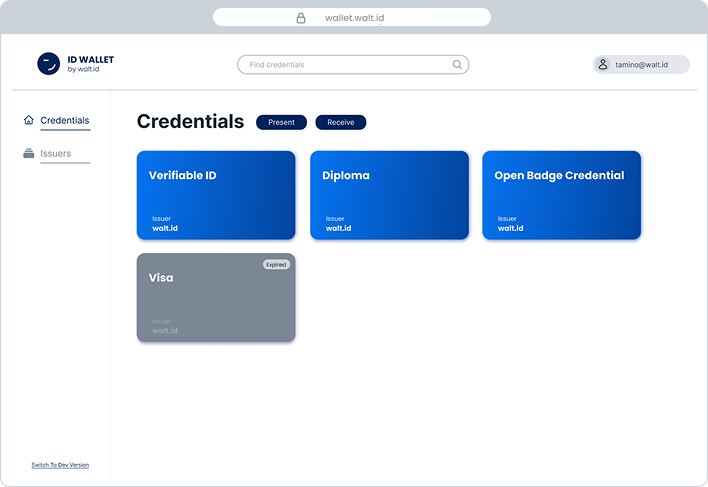
### White label wallets
Launch identity wallets fast with our open source progressive web app and UI.
### Embedded wallets
Extend your existing applications with all identity capabilities you need.
/credentials/receive
/credentials/share
/credentials/view
### Mobile wallets
Build mobile apps (iOS, Android) with our multi-platform libraries and SDKs.
All In One
## Store and Manage Any Credential, Anywhere
### Master complex protocols and standards with ease. One scalable stack built for global interoperability.
Unmatched Versatility
### Any Credential, Any Format, Any Protocol
Eliminate fragmentation with agnostic APIs/SDKs that support every major credential standard and issuance/verification protocols.
/v1/get/W3C-VC
/v1/share/SD-JWT-VC
/v1/store/ISO-mDL
REST APIs
mDL/mdoc
SD-JWT VC
W3C VC
OID4VCI/VP
KOTLINMULTI-PLATFORM LIBS
Future-Proof ID Infrastructure
### Regulatory Alignment
Aligned with emerging global frameworks, ensuring your credentials are accepted by governments and compliant wallets worldwide.
🇪🇺🇳🇱🇧🇪🇦🇹🇨🇿🇵🇱🇪🇸🇬🇷
🇪🇺🇳🇱🇧🇪🇦🇹🇨🇿🇵🇱🇪🇸🇬🇷
🇩🇪🇫🇷🇮🇹🇸🇪🇩🇰🇫🇮🇵🇹🇨🇭
🇩🇪🇫🇷🇮🇹🇸🇪🇩🇰🇫🇮🇵🇹🇨🇭
🇺🇸🇨🇦🇦🇺🇳🇿🇯🇵🇧🇷🇿🇦🇹🇭
🇺🇸🇨🇦🇦🇺🇳🇿🇯🇵🇧🇷🇿🇦🇹🇭
Authentication and access
### Flexible Sign-In
Authenticate holders via username/password, external IdPs or other strategies.
usernameemailpasswordOIDCIdPKeycloakpasskeys
usernameemailpasswordOIDCIdPKeycloakpasskeys
passkeysKeycloakIdPOIDCpasswordemailusername
passkeysKeycloakIdPOIDCpasswordemailusername
Wallet models
### Consumer/Organizational Wallets
Build one-user-one-wallet apps or shared multi-wallet setups.

Analytics & Auditing
### Complete Operational Clarity
Monitor success rates, usage behavior, system health and maintain immutable audit trails.
5 claimed2 expired
Trusted Holder Identity
### Holder Identification
Securely identify holders through various Decentralized Identifiers (DIDs).
did:key
did:web
did:jwk
did:ebsi
x509certificates
Your Keys, Your Vault
### Own your key material
Maintain absolute security by keeping wallet and trust keys in your preferred KMS (AWS, Azure, Hashicorp) or HSM. Our infrastructure handles complex wallet cryptography while you retain full key control.
Hashicorp Vault
AWS KMS

Azure Key Vault
Oracle Cloud Vault
Partners And Integrations
## Works With Your Infrastructure.
### Seamlessly connect your existing stack and deploy anywhere with full flexibility and total data control.


## Max Freedom, Zero Lock-in
Works with any KMS/HSM, database, cloud provider or application.
Trusted Globally
## The infrastructure powering wallet-based identity.
### Join governments and businesses using our stack to build the next generation of ID platforms and apps.
ID in
Issue digital credentials, roll out ID wallets or verify data from any wallet.
ID-as-a-Service (IDaaS)
Offer Issuance, Verification, and Wallet-as-a-Service platforms across industries.
Reseller
Enable your business and government clients to adopt wallet-based identity solutions.
Case Studies
### Powering NEC’s Global Digital Identity Ecosystem
How NEC built a versatile Identity-as-a-Service (IDaaS) platform and on-premises solutions with walt.id.
[Read case study →](https://walt.id/case-studies/nec-idaas-platform.md)
### Digitizing Thailand’s National Identity Infrastructure
How NDID used walt.id to build an ID platform for 20M+ citizens.
[Read case study →](https://walt.id/case-studies/building-national-digital-identity-platform.md)
### How a Core Banking Provider Made Hundreds of Banks EUDI Wallet-Ready Under eIDAS 2
Enabling PID onboarding and strong customer authentication (SCA) via the EUDI Wallet with walt.id.
[Read case study →](https://walt.id/case-studies/core-banking-eudi-wallet.md)
### Building ID & ID wallet platforms for clients
How a leading digital transformation company uses walt.id to build next-generation digital ID and ID wallet platforms.
[Read case study →](https://walt.id/case-studies/building-id-wallet-platforms.md)
ID in
Issue digital credentials, roll out ID wallets or verify data from any wallet.
ID-as-a-Service (IDaaS)
Offer Issuance, Verification, and Wallet-as-a-Service platforms across industries.
Reseller
Enable your business and government clients to adopt wallet-based identity solutions.
Case Studies
### Powering NEC’s Global Digital Identity Ecosystem
How NEC built a versatile Identity-as-a-Service (IDaaS) platform and on-premises solutions with walt.id.
[Read case study →](https://walt.id/case-studies/nec-idaas-platform.md)
### Digitizing Thailand’s National Identity Infrastructure
How NDID used walt.id to build an ID platform for 20M+ citizens.
[Read case study →](https://walt.id/case-studies/building-national-digital-identity-platform.md)
### How a Core Banking Provider Made Hundreds of Banks EUDI Wallet-Ready Under eIDAS 2
Enabling PID onboarding and strong customer authentication (SCA) via the EUDI Wallet with walt.id.
[Read case study →](https://walt.id/case-studies/core-banking-eudi-wallet.md)
### Building ID & ID wallet platforms for clients
How a leading digital transformation company uses walt.id to build next-generation digital ID and ID wallet platforms.
[Read case study →](https://walt.id/case-studies/building-id-wallet-platforms.md)
Product Editions
## Build or Buy.
### Build on top of the industry's leading open source stack or scale quickly with our secure, regulatory compliant enterprise solution.
Self-Managed
Open Source
### Community Stack
The easiest way to get started and build. Own infrastructure and develop your platform based on the leading open source stack.
[Build for free →](https://docs.walt.id/community-stack/home.md) [Contact us for support](https://walt.id/contact.md)
Self-Managed
Enterprise
### Enterprise Stack
Everything you need to roll-out and scale. The fast and worry-free way to build ID platforms, ship complex use cases and ensure compliance.
[Learn more →](https://walt.id/enterprise-stack.md)
FAQs
## Frequently asked questions.
### Answers to common questions about digital wallets.
Which digital credential standards do you support?
We support the following digital credential standards: W3C VC, IETF SD-JWT VC, ISO 18013-5 mDL/mdoc.
Which protocols and standards do you support?
We support the following protocols for verification: OID4VP, ISO 18013-7
Is your solution eIDAS2 conformant?
Our solutions support all required standards and protocols for eIDAS2 compliant wallets.
Which license do you use for your open source stack?
Our open source stack is licensed under the Apache 2.0 license.
What is the difference between The Community Stack and the Enterprise Stack?
The Community Stack is our open-source offering, ideal for PoCs and MVPs. The Enterprise Stack extends it with data persistence, multi-tenancy, lifecycle management, audit logs, analytics, a GUI, and more—suitable for production-grade ID solutions at scale or ID-as-a-Service (B2G, B2B, B2B2C).
How do I move from the Community Stack to the Enterprise Stack?
Both stacks offer compatible APIs and credential definitions. This means you can smoothly transition your API calls to the Enterprise Stack whenever needed.
Do you offer a managed wallet solution?
We currently do not offer a managed service; please contact us if you're interested in a managed solution.
What support options are available?
Community users can apply for a support contract. Enterprise customers additionally get onboarding, architecture reviews, SLAs, and roadmap alignment directly with the walt.id team.
---
title: "Issue, Store & Verify W3C Verifiable Credentials | walt.id"
meta:
description: "Issue, store and verify W3C Verifiable Credentials (VC Data Model 1.1 and 2.0) via OpenID4VC. Open-source Community Stack or Enterprise Stack, self-managed."
"og:description": "Issue, store and verify W3C Verifiable Credentials (VC Data Model 1.1 and 2.0) via OpenID4VC. Open-source Community Stack or Enterprise Stack, self-managed."
"og:title": "Issue, Store & Verify W3C Verifiable Credentials | walt.id"
source_url: "https://walt.id/verifiable-credentials"
stack: "Applies to both the Community Stack and the Enterprise Stack"
docs: "https://docs.walt.id"
llms_index: "https://walt.id/llms.txt"
generated: "2026-11-23"
---
> Markdown mirror of https://walt.id/verifiable-credentials — Applies to both the Community Stack and the Enterprise Stack. Technical docs: https://docs.walt.id (AI index: https://docs.walt.id/llms.txt).
W3C Verifiable Credentials
# Issue, store and verify W3C Verifiable Credentials
walt.id's Issuer, Wallet and Verifier support W3C Verifiable Credentials alongside SD-JWT VC and ISO mdoc. Start with the open-source Community Stack and scale with the Enterprise Stack, on premises or in your own cloud.
[Issue your first VC](https://docs.walt.id/community-stack/issuer2/credential-issuance/w3c-vc.md) [Contact us](https://walt.id/contact.md)
- Open-Source
- Standard & Regulatory Compliant
- Gov & Enterprise Proven
Used by **+70.000** developers and organisations
credential.jsonVC Data Model 2.0
```
{
"@context": [
"https://www.w3.org/ns/credentials/v2"
],
"type": ["VerifiableCredential",
"UniversityDegreeCredential"],
"issuer": "did:web:university.example",
"validFrom": "2026-09-01T00:00:00Z",
"credentialSubject": {
"id": "did:key:z6Mkh…",
"degree": {
"type": "BachelorDegree",
"name": "Computer Science"
}
}
}
```
University Example
W3C VC
Bachelor Degree
Computer Science
Valid from
01 Sep 2026
Verified
## Trusted by leading organizations

End-to-end
## One stack for the whole W3C VC lifecycle
### Issue, store and verify W3C Verifiable Credentials using open standards.
1. 01U
University Example
did:web:university.example Signed ### Issue
Turn data from your existing systems into signed W3C VCs and deliver them to any compliant wallet via OpenID4VCI. [Issuer SDKs & APIs →](https://walt.id/issuer.md)
2. 02
My credentials
Bachelor Degree
Computer Science
University Example ### Store
Launch your own wallet or add wallet features to your app, custodial, non-custodial or hybrid, so users can receive, hold and present W3C VCs. [Wallet SDKs & APIs →](https://walt.id/wallet.md)
3. 03VerificationVerified
- Signature
- Trusted issuer
- Credential status ### Verify
Request exactly the claims you need via OpenID4VP and check signature, issuer and status with customizable policies. [Verifier SDKs & APIs →](https://walt.id/verifier.md)
New to VCs? Read [What are W3C Verifiable Credentials?](https://docs.walt.id/concepts/digital-credentials/verifiable-credentials-w3c.md) in the docs.
Built for production
## Everything you need to launch W3C VCs in production
### Open standards, your own keys and full credential lifecycle control.
Developer-First
### APIs and SDKs for Every Layer
Eliminate fragmentation with agnostic APIs/SDKs that support W3C Verifiable Credentials across platforms and ecosystems.
Issuer API
Wallet API
Verifier API
REST APIs
Kotlin Multiplatform
Android
iOS (Swift)
W3C VC
SDKs & Libraries
Future-Proof ID Infrastructure
### Regulatory Alignment
Aligned with emerging global frameworks, ensuring your credentials are accepted by governments and compliant wallets worldwide.
🇪🇺🇳🇱🇧🇪🇦🇹🇨🇿🇵🇱🇪🇸🇬🇷
🇪🇺🇳🇱🇧🇪🇦🇹🇨🇿🇵🇱🇪🇸🇬🇷
🇩🇪🇫🇷🇮🇹🇸🇪🇩🇰🇫🇮🇵🇹🇨🇭
🇩🇪🇫🇷🇮🇹🇸🇪🇩🇰🇫🇮🇵🇹🇨🇭
🇺🇸🇨🇦🇦🇺🇳🇿🇯🇵🇧🇷🇿🇦🇹🇭
🇺🇸🇨🇦🇦🇺🇳🇿🇯🇵🇧🇷🇿🇦🇹🇭
Interoperable by Design
### Global Standards
W3C VC Data Model 1.1 and 2.0, exchanged via OpenID4VCI, OpenID4VP with DCQL and the Digital Credentials API.
VCDM 2.0
OpenID4VCI
OpenID4VP
DC API
Total Data Sovereignty
### Your Keys, Your Vault
Keep signing keys in your preferred KMS or HSM, such as AWS KMS, Azure Key Vault, HashiCorp Vault or a PKCS#11 HSM. Available in both product editions, so you keep full control of your keys.
HashiCorp Vault
AWS KMS

Azure Key Vault
PKCS#11 HSM
Full Lifecycle Management
### Revoke, Suspend, or Restore
Manage W3C VC status with the W3C Bitstring Status List, plus StatusList2021 and RevocationList2020 for older credentials.
Suspend CredentialRevoke CredentialRestore CredentialUpdate Status ListPublish Status ListCheck Status
Suspend CredentialRevoke CredentialRestore CredentialUpdate Status ListPublish Status ListCheck Status
Bitstring Status ListStatusList2021RevocationList2020Revocation CheckStatus CheckPolicy Check
Bitstring Status ListStatusList2021RevocationList2020Revocation CheckStatus CheckPolicy Check
Automated Trust
### Verification Policies
Signature, validity, status and allowed-issuer checks out of the box. Add custom rules or pass checks to your external systems via webhooks.
- Signature
- Credential status
- Schema
- Custom
Trust Anchors
### Issuer & Verifier Identification
Identify issuers and verifiers with Decentralized Identifiers (did:web, did:key, did:jwk) or X.509 certificates.
did:webdid:keydid:jwk
X.509 certificates
Partners And Integrations
## Works With Your Infrastructure.
### Seamlessly connect your existing stack and deploy anywhere with full flexibility and total data control.


## Max Freedom, Zero Lock-in
Works with any KMS/HSM, database, cloud provider or application.
Product Editions
## Build or Buy.
### Build on top of the industry's leading open source stack or scale quickly with our secure, regulatory compliant enterprise solution.
Self-Managed
Open Source
### Community Stack
The easiest way to get started and build. Own infrastructure and develop your platform based on the leading open source stack.
[Build for free →](https://docs.walt.id/community-stack/home.md) [Contact us for support](https://walt.id/contact.md)
Self-Managed
Enterprise
### Enterprise Stack
Everything you need to roll-out and scale. The fast and worry-free way to build ID platforms, ship complex use cases and ensure compliance.
[Learn more →](https://walt.id/enterprise-stack.md)
FAQs
## Frequently asked questions.
### Answers to common questions about W3C Verifiable Credentials with walt.id.
Does walt.id support the W3C Verifiable Credentials Data Model 2.0?
Yes. walt.id issues, stores and verifies credentials following the W3C Verifiable Credentials Data Model 1.1 and 2.0, secured as JWT or SD-JWT, in both the open-source Community Stack and the Enterprise Stack.
Which protocols can I use to issue and verify W3C Verifiable Credentials?
OpenID4VCI 1.0 for issuance and OpenID4VP 1.0 with DCQL for presentation, plus the W3C Digital Credentials API. walt.id's OpenID4VCI, OpenID4VP and HAIP implementations pass the OpenID Foundation conformance tests.
Which DID methods and key stores are supported?
Issuers can be identified with Decentralized Identifiers, for example did:key, did:jwk or did:web, or with X.509 certificates. Signing keys can stay in your preferred KMS or HSM, for example AWS KMS, Azure Key Vault, HashiCorp Vault or HSMs via the PKCS#11 interface, or be managed locally. This applies to both editions. For all supported DID methods and key stores, see the [feature list in the docs](https://docs.walt.id/feature-list.md).
How do I revoke or suspend a W3C Verifiable Credential?
With a status list. walt.id supports the W3C Bitstring Status List 1.0, plus StatusList2021 and RevocationList2020 for older credentials. In the Community Stack you create and sign status lists and host and update them yourself; the Enterprise Stack manages the credential lifecycle, including status updates and publishing.
W3C VC or SD-JWT VC: which format should I use?
It depends on the ecosystem you need to work with. SD-JWT VC and ISO mdoc are the formats used for PID in the EU Digital Identity Wallet, while many other ecosystems build on the W3C data model. walt.id's Issuer, Wallet and Verifier support all three, so you don't have to choose up front. [Compare the formats in the docs](https://docs.walt.id/concepts/digital-credentials.md).
Is walt.id a hosted service?
No. Both editions, the open-source Community Stack and the Enterprise Stack, are self-managed: you run them on premises or in your own cloud. A fully managed Cloud Platform is not yet available. The public demos are for testing only.
---
title: "Issue, Store & Verify SD-JWT VCs | walt.id"
meta:
description: "Issue, store and verify SD-JWT VCs with selective disclosure via OpenID4VC and HAIP. Open-source Community Stack or Enterprise Stack, self-managed."
"og:description": "Issue, store and verify SD-JWT VCs with selective disclosure via OpenID4VC and HAIP. Open-source Community Stack or Enterprise Stack, self-managed."
"og:title": "Issue, Store & Verify SD-JWT VCs | walt.id"
source_url: "https://walt.id/sd-jwt-vc"
stack: "Applies to both the Community Stack and the Enterprise Stack"
docs: "https://docs.walt.id"
llms_index: "https://walt.id/llms.txt"
generated: "2026-11-23"
---
> Markdown mirror of https://walt.id/sd-jwt-vc — Applies to both the Community Stack and the Enterprise Stack. Technical docs: https://docs.walt.id (AI index: https://docs.walt.id/llms.txt).
SD-JWT VC
# Issue, store and verify SD-JWT VCs
walt.id's Issuer, Wallet and Verifier support SD-JWT VC alongside ISO mdoc and W3C Verifiable Credentials. Start with the open-source Community Stack and scale with the Enterprise Stack, on premises or in your own cloud.
[Issue your first SD-JWT VC](https://docs.walt.id/community-stack/issuer2/credential-issuance/sd-jwt-vc.md) [Contact us](https://walt.id/contact.md)
- Open-Source
- Standard & Regulatory Compliant
- Gov & Enterprise Proven
Used by **+70.000** developers and organisations
sd-jwt-vc payloaddc+sd-jwt
```
{
"vct": "https://example.com/identity",
"iss": "https://issuer.example.com",
"exp": 1945900800,
"_sd": [
"CrQe7S5kqBAHt-nMYXgc6bdt2SH…",
"JzYjH4svliH0R3PyEMfeZu6Jt69…",
"PorFbpKuVu6xymJagvkFsFXAbRo…"
],
"cnf": { "jwk": { "kty": "EC", "crv": "P-256",
"x": "TCAER19Z…", "y": "ZxjiWWbZ…" } },
"status": { "status_list": { "idx": 412,
"uri": "https://example.com/status/1" } }
}
```
Identity Example
SD-JWT VC
Personal ID
Selective disclosure
- Age over 18Shared
- Name, date of birthHidden
Valid until
31 Aug 2031
Verified
## Trusted by leading organizations

End-to-end
## One stack for the whole SD-JWT VC lifecycle
### Issue, store and verify SD-JWT VCs using open standards.
1. 01I
Identity Example
https://issuer.example.com Signed ### Issue
Turn data from your existing systems into signed SD-JWT VCs, with every claim selectively disclosable, and deliver them to any compliant wallet via OpenID4VCI. [Issuer SDKs & APIs →](https://walt.id/issuer.md)
2. 02
My credentials
Personal ID
Age over 18 · shared
Identity Example ### Store
Launch your own wallet or add wallet features to your app, custodial, non-custodial or hybrid, so users can receive, hold and present SD-JWT VCs. [Wallet SDKs & APIs →](https://walt.id/wallet.md)
3. 03VerificationVerified
- Signature
- Key binding
- Credential status ### Verify
Request only the claims you need via OpenID4VP and DCQL, and check signature, key binding and status with customizable policies. [Verifier SDKs & APIs →](https://walt.id/verifier.md)
New to SD-JWT? Read [SD-JWT VC explained](https://docs.walt.id/concepts/digital-credentials/sd-jwt-vc.md) in the docs.
Built for production
## Everything you need to launch SD-JWT VCs in production
### Open standards, your own keys and full credential lifecycle control.
Privacy by Design
### Selective Disclosure
Holders share only the claims a verifier asks for, such as "over 18" without a birth date.
In the wallet
- Given name Hidden
- Family name Hidden
- Date of birth Hidden
- Age over 18Shared
- Address Hidden
Present
Verifier receives
Age over 18true
- Issuer signature
- Key binding
4 claims stay with the holder
Developer-First
### APIs and SDKs for Every Layer
Eliminate fragmentation with agnostic APIs/SDKs that support SD-JWT VCs across platforms and ecosystems.
Issuer API
Wallet API
Verifier API
REST APIs
Kotlin Multiplatform
Android
iOS (Swift)
SD-JWT VC
SDKs & Libraries
Future-Proof ID Infrastructure
### Regulatory Alignment
Aligned with emerging global frameworks, ensuring your credentials are accepted by governments and compliant wallets worldwide (incl. eIDAS 2).
🇪🇺🇳🇱🇧🇪🇦🇹🇨🇿🇵🇱🇪🇸🇬🇷
🇪🇺🇳🇱🇧🇪🇦🇹🇨🇿🇵🇱🇪🇸🇬🇷
🇩🇪🇫🇷🇮🇹🇸🇪🇩🇰🇫🇮🇵🇹🇨🇭
🇩🇪🇫🇷🇮🇹🇸🇪🇩🇰🇫🇮🇵🇹🇨🇭
🇺🇸🇨🇦🇦🇺🇳🇿🇯🇵🇧🇷🇿🇦🇹🇭
🇺🇸🇨🇦🇦🇺🇳🇿🇯🇵🇧🇷🇿🇦🇹🇭
Interoperable by Design
### Global Standards
IETF SD-JWT VC with selective disclosure, exchanged via OpenID4VCI, OpenID4VP with DCQL, HAIP 1.0 and the Digital Credentials API.
SD-JWT VC
OpenID4VCI
OpenID4VP
DC API
Total Data Sovereignty
### Your Keys, Your Vault
Keep signing keys in your preferred KMS or HSM, such as AWS KMS, Azure Key Vault, HashiCorp Vault or a PKCS#11 HSM. Available in both product editions, so you keep full control of your keys.
HashiCorp Vault
AWS KMS

Azure Key Vault
PKCS#11 HSM
Full Lifecycle Management
### Revoke, Suspend, or Restore
Manage SD-JWT VC status with the IETF Token Status List.
Suspend CredentialRevoke CredentialRestore CredentialUpdate Status ListPublish Status ListCheck Status
Suspend CredentialRevoke CredentialRestore CredentialUpdate Status ListPublish Status ListCheck Status
Token Status ListStatus CheckRevocation CheckKey Binding CheckSignature CheckPolicy Check
Token Status ListStatus CheckRevocation CheckKey Binding CheckSignature CheckPolicy Check
Automated Trust
### Verification Policies
Signature, validity, status and allowed-issuer checks out of the box. Add custom rules or pass checks to your external systems via webhooks.
- Signature
- Credential status
- Schema
- Custom
Trust Anchors
### Issuer & Verifier Identification
Identify issuers and verifiers with Decentralized Identifiers (did:web, did:key, did:jwk) or X.509 certificates.
did:webdid:keydid:jwk
X.509 certificates
Partners And Integrations
## Works With Your Infrastructure.
### Seamlessly connect your existing stack and deploy anywhere with full flexibility and total data control.


## Max Freedom, Zero Lock-in
Works with any KMS/HSM, database, cloud provider or application.
Product Editions
## Build or Buy.
### Build on top of the industry's leading open source stack or scale quickly with our secure, regulatory compliant enterprise solution.
Self-Managed
Open Source
### Community Stack
The easiest way to get started and build. Own infrastructure and develop your platform based on the leading open source stack.
[Build for free →](https://docs.walt.id/community-stack/home.md) [Contact us for support](https://walt.id/contact.md)
Self-Managed
Enterprise
### Enterprise Stack
Everything you need to roll-out and scale. The fast and worry-free way to build ID platforms, ship complex use cases and ensure compliance.
[Learn more →](https://walt.id/enterprise-stack.md)
FAQs
## Frequently asked questions.
### Answers to common questions about SD-JWT VCs with walt.id.
Does walt.id support SD-JWT VC?
Yes. walt.id issues, stores and verifies SD-JWT VCs following the IETF SD-JWT VC specification (`dc+sd-jwt`), with selective disclosure based on the IETF SD-JWT standard (RFC 9901) and KB-JWT holder binding, in both the open-source Community Stack and the Enterprise Stack.
Which protocols can I use to issue and verify SD-JWT VCs?
OpenID4VCI 1.0 for issuance and OpenID4VP 1.0 with DCQL for presentation, the OpenID4VC High Assurance Interoperability Profile (HAIP) 1.0 and the W3C Digital Credentials API. walt.id's OpenID4VCI, OpenID4VP and HAIP implementations pass the OpenID Foundation conformance tests.
Is SD-JWT VC required under eIDAS 2?
Yes. Together with ISO mdoc, SD-JWT VC is mandatory for the EU Digital Identity Wallet. walt.id implements the formats and protocols specified in the EUDI Wallet Architecture and Reference Framework (ARF), and its open-source software is part of the EUDI Wallet reference implementation.
How do I revoke or suspend an SD-JWT VC?
With the IETF Token Status List. In the Community Stack you create and sign status lists and host and update them yourself; the Enterprise Stack manages the credential lifecycle, including status updates and publishing.
SD-JWT VC, ISO mdoc or W3C VC: which format should I use?
It depends on the ecosystem you need to work with. SD-JWT VC and ISO mdoc are the formats used for PID in the EU Digital Identity Wallet, ISO mdoc is the format for mobile driving licences, and many other ecosystems build on the W3C data model. walt.id's Issuer, Wallet and Verifier support all three, so you don't have to choose up front. See [W3C Verifiable Credentials](https://walt.id/verifiable-credentials.md) and [mobile driving licences](https://walt.id/mobile-driving-license.md), or [compare the formats in the docs](https://docs.walt.id/concepts/digital-credentials.md).
Which identifiers and key stores are supported?
Issuers and Verifiers can be identified with X.509 certificates or with Decentralized Identifiers, for example did:web, did:key or did:jwk. Signing keys can stay in your preferred KMS or HSM, for example AWS KMS, Azure Key Vault, HashiCorp Vault or HSMs via the PKCS#11 interface, or be managed locally. This applies to both editions. For all supported DID methods and key stores, see the [feature list in the docs](https://docs.walt.id/feature-list.md).
Is walt.id a hosted service?
No. Both editions, the open-source Community Stack and the Enterprise Stack, are self-managed: you run them on premises or in your own cloud. A fully managed Cloud Platform is not yet available. The public demos are for testing only.
---
title: "Issue, Store & Verify Mobile Driving Licenses (mDL) | walt.id"
meta:
description: "Issue, store and verify ISO/IEC 18013-5 mobile driving licenses and other mdocs, in person and online. Open-source Community Stack or Enterprise Stack, self-managed."
"og:description": "Issue, store and verify ISO/IEC 18013-5 mobile driving licenses and other mdocs, in person and online. Open-source Community Stack or Enterprise Stack, self-managed."
"og:title": "Issue, Store & Verify Mobile Driving Licenses (mDL) | walt.id"
source_url: "https://walt.id/mobile-driving-license"
stack: "Applies to both the Community Stack and the Enterprise Stack"
docs: "https://docs.walt.id"
llms_index: "https://walt.id/llms.txt"
generated: "2026-11-23"
---
> Markdown mirror of https://walt.id/mobile-driving-license — Applies to both the Community Stack and the Enterprise Stack. Technical docs: https://docs.walt.id (AI index: https://docs.walt.id/llms.txt).
ISO mDL
# Issue, store and verify mobile driving licenses
walt.id's Issuer, Wallet and Verifier support ISO mdoc and mobile driving licenses (ISO/IEC 18013-5) alongside SD-JWT VC and W3C Verifiable Credentials. Start with the open-source Community Stack and scale with the Enterprise Stack, on premises or in your own cloud.
[Issue your first mDL](https://docs.walt.id/community-stack/issuer2/credential-issuance/mdl.md) [Contact us](https://walt.id/contact.md)
- Open-Source
- Standard & Regulatory Compliant
- Gov & Enterprise Proven
Used by **+70.000** developers and organisations
mDL data elements (decoded)ISO/IEC 18013-5
```
{
"org.iso.18013.5.1": {
"family_name": "Doe",
"given_name": "Jane",
"birth_date": "1990-05-12",
"expiry_date": "2031-08-31",
"issuing_country": "US",
"issuing_authority": "DMV Example",
"document_number": "D1234567",
"driving_privileges": [
{ "vehicle_category_code": "B" }
],
"age_over_18": true
}
}
```
DMV Example
mDL
Driving License
Jane Doe · Category B
Valid until
31 Aug 2031
Verified
## Trusted by leading organizations

End-to-end
## One stack for the whole mDL lifecycle
### Issue, store and verify mobile driving licenses using open standards.
1. 01D
DMV Example
IACA: DMV Example Root CA Signed ### Issue
Turn data from your existing systems into signed mdocs, such as mobile driving licenses, and deliver them to any compliant wallet via OpenID4VCI. [Issuer SDKs & APIs →](https://walt.id/issuer.md)
2. 02
My credentials
Driving License
Category B
DMV Example ### Store
Launch your own wallet or add wallet features to your app, custodial, non-custodial or hybrid, so users can receive, hold and present mDLs. [Wallet SDKs & APIs →](https://walt.id/wallet.md)
3. 03VerificationVerified
- Issuer certificate
- Signature
- Credential status ### Verify
Request only the data elements you need, online via OpenID4VP or the Digital Credentials API, and check the issuer's certificate against a VICAL, the signature and status. [Verifier SDKs & APIs →](https://walt.id/verifier.md)
New to mDL? Read [ISO mdoc & mDL explained](https://docs.walt.id/concepts/digital-credentials/mdoc-mdl-iso.md) in the docs.
Built for production
## Everything you need to launch mDLs in production
### Open standards, your own keys and full credential lifecycle control.
Anywhere
### In Person and Online
mDLs are used in person and online. walt.id supports both: in person via QR code or NFC (ISO/IEC 18013-5), online via OpenID4VP and the Digital Credentials API (ISO/IEC 18013-7).
Driving License
Category B
DMV Example
Personal ID
Jane Doe
Identity Example
In person
QR code or NFC
ISO/IEC 18013-5
Online
OpenID4VP or Digital Credentials API
ISO/IEC 18013-7
Developer-First
### APIs and SDKs for Every Layer
Eliminate fragmentation with agnostic APIs/SDKs that support mDLs and other mdocs across platforms and ecosystems.
Issuer API
Wallet API
Verifier API
REST APIs
Kotlin Multiplatform
Android
iOS (Swift)
ISO mDL
SDKs & Libraries
Future-Proof ID Infrastructure
### Regulatory Alignment
Aligned with emerging global frameworks, ensuring your credentials are accepted by governments and compliant wallets worldwide (incl. eIDAS 2).
🇪🇺🇳🇱🇧🇪🇦🇹🇨🇿🇵🇱🇪🇸🇬🇷
🇪🇺🇳🇱🇧🇪🇦🇹🇨🇿🇵🇱🇪🇸🇬🇷
🇩🇪🇫🇷🇮🇹🇸🇪🇩🇰🇫🇮🇵🇹🇨🇭
🇩🇪🇫🇷🇮🇹🇸🇪🇩🇰🇫🇮🇵🇹🇨🇭
🇺🇸🇨🇦🇦🇺🇳🇿🇯🇵🇧🇷🇿🇦🇹🇭
🇺🇸🇨🇦🇦🇺🇳🇿🇯🇵🇧🇷🇿🇦🇹🇭
Interoperable by Design
### Global Standards
ISO/IEC 18013-5 for mDLs and other mdocs, ISO/IEC 18013-7 for online presentation, issued via OpenID4VCI and presented via OpenID4VP and the Digital Credentials API.
ISO/IEC 18013-5
ISO/IEC 18013-7
OpenID4VCI
OpenID4VP
Total Data Sovereignty
### Your Keys, Your Vault
Keep signing keys in your preferred KMS or HSM, such as AWS KMS, Azure Key Vault, HashiCorp Vault or a PKCS#11 HSM. Available in both product editions, so you keep full control of your keys.
HashiCorp Vault
AWS KMS

Azure Key Vault
PKCS#11 HSM
Full Lifecycle Management
### Revoke, Suspend, or Restore
Manage mdoc status with the IETF Token Status List.
Suspend CredentialRevoke CredentialRestore CredentialUpdate Status ListPublish Status ListCheck Status
Suspend CredentialRevoke CredentialRestore CredentialUpdate Status ListPublish Status ListCheck Status
Token Status ListStatus CheckRevocation CheckVICAL CheckSignature CheckPolicy Check
Token Status ListStatus CheckRevocation CheckVICAL CheckSignature CheckPolicy Check
Automated Trust
### Verification Policies
Signature, validity, status and issuer certificate checks out of the box. Add custom rules or pass checks to your external systems via webhooks.
- Signature
- Credential status
- VICAL
- Custom
Trust Anchors
### Issuer Identification
Identify mDL issuers through IACA and document signer certificates, and trust them via VICALs.
IACADoc signerVICAL
X.509 certificate chains
Partners And Integrations
## Works With Your Infrastructure.
### Seamlessly connect your existing stack and deploy anywhere with full flexibility and total data control.


## Max Freedom, Zero Lock-in
Works with any KMS/HSM, database, cloud provider or application.
Product Editions
## Build or Buy.
### Build on top of the industry's leading open source stack or scale quickly with our secure, regulatory compliant enterprise solution.
Self-Managed
Open Source
### Community Stack
The easiest way to get started and build. Own infrastructure and develop your platform based on the leading open source stack.
[Build for free →](https://docs.walt.id/community-stack/home.md) [Contact us for support](https://walt.id/contact.md)
Self-Managed
Enterprise
### Enterprise Stack
Everything you need to roll-out and scale. The fast and worry-free way to build ID platforms, ship complex use cases and ensure compliance.
[Learn more →](https://walt.id/enterprise-stack.md)
FAQs
## Frequently asked questions.
### Answers to common questions about mobile driving licenses with walt.id.
Does walt.id support ISO/IEC 18013-5 mobile driving licenses?
Yes. walt.id issues, stores and verifies mobile driving licenses and other mdocs following ISO/IEC 18013-5 and the ISO/IEC 23220-2 mdoc data model, in both the open-source Community Stack and the Enterprise Stack.
Can mDLs be verified online?
Yes. walt.id supports ISO/IEC 18013-7 for remote presentation, both via OpenID4VP (Annex B) and via the Digital Credentials API (Annex C). In person, the walt.id mobile wallet presents mdocs via QR code or NFC, with the data sent over Bluetooth or NFC.
How does a verifier know an mDL is genuine?
The issuer signs each mDL with a document signer certificate that chains up to its IACA (Issuing Authority Certificate Authority). The walt.id Verifier checks this certificate chain against a VICAL, a signed list of trusted IACAs, together with the signature, validity and status.
How do I revoke or suspend an mDL?
With the IETF Token Status List. In the Community Stack you create and sign status lists and host and update them yourself; the Enterprise Stack manages the credential lifecycle, including status updates and publishing.
mDL, SD-JWT VC or W3C VC: which format should I use?
It depends on the ecosystem you need to work with. ISO mdoc is the format for mobile driving licenses, SD-JWT VC and ISO mdoc are the formats used for PID in the EU Digital Identity Wallet, and many other ecosystems build on the W3C data model. walt.id's Issuer, Wallet and Verifier support all three, so you don't have to choose up front. See [SD-JWT VC](https://walt.id/sd-jwt-vc.md) and [W3C Verifiable Credentials](https://walt.id/verifiable-credentials.md), or [compare the formats in the docs](https://docs.walt.id/concepts/digital-credentials.md).
Which key stores are supported?
Signing keys can stay in your preferred KMS or HSM, for example AWS KMS, Azure Key Vault, HashiCorp Vault or HSMs via the PKCS#11 interface, or be managed locally. This applies to both editions. For all supported key stores, see the [feature list in the docs](https://docs.walt.id/feature-list.md).
Is walt.id a hosted service?
No. Both editions, the open-source Community Stack and the Enterprise Stack, are self-managed: you run them on premises or in your own cloud. A fully managed Cloud Platform is not yet available. The public demos are for testing only.
---
title: "Decentralized Identity Infrastructure for EBSI | walt.id"
meta:
description: "Open source decentralized identity and wallet solutions for developers and businesses building on the EBSI ecosystem."
"og:description": "Open source decentralized identity and wallet solutions for developers and businesses building on the EBSI ecosystem."
"og:title": "Decentralized Identity Infrastructure for EBSI | walt.id"
source_url: "https://walt.id/ebsi"
stack: "Applies to both the Community Stack and the Enterprise Stack"
docs: "https://docs.walt.id"
llms_index: "https://walt.id/llms.txt"
generated: "2026-11-23"
---
> Markdown mirror of https://walt.id/ebsi — Applies to both the Community Stack and the Enterprise Stack. Technical docs: https://docs.walt.id (AI index: https://docs.walt.id/llms.txt).
# Decentralized Identity Infrastructure for EBSI
Open source decentralized identity and wallet solutions for developers and businesses.

## About EBSI
[EBSI](https://ec.europa.eu/digital-building-blocks/sites/spaces/EBSI/pages/447687044/Home) is the first public sector blockchain services in Europe. The European Blockchain Services Infrastructure (EBSI) aims to leverage the power of blockchain for the public good.
## Start building
Build use cases or apps with open source tools.
→ [Get started](https://docs.walt.id) or [join the community](https://walt.id/community.md).
## Digital identity and wallet infrastructure
walt.id's open source decentralized identity and wallet infrastructure enables developers, governments and businesses across industries to build on the EBSI ecosystem:
1. Issuance of digital credentials (e.g. verifiable credentials)
2. Creation of ID wallets for managing and sharing digital credentials
3. Verification of digital credentials
4. Integration of ID wallets & digital credentials with traditional ID tools
walt.id's infrastructure makes it easy to build use cases and applications that leverage decentralized identity across every industry. For example public sector (passports, visas, proof of residence), education (diplomas, student IDs), employment (badges, organizational affiliation), banking (KYC, loans) and beyond.
[→ Learn more](https://docs.walt.id)
## Webinar
Watch our webinar with the EBSI to
- – learn about our collaboration with EBSI
- – learn how to get started and how to build applications with the open source tools.
- – view the live demo of the open source tools.

========================================================================
SECTION: EIDAS 2.0 & EUDI WALLET
========================================================================
---
title: "eIDAS 2 Explained — EU Digital Identity Regulation | walt.id"
meta:
description: "Everything you need to know about eIDAS 2: what it is, who is affected, compliance deadlines, the EUDI wallet, and more."
"og:description": "Understand eIDAS2: the EU regulation mandating digital identity wallets for every citizen. Compliance deadlines, key terms, role-based requirements, and more."
"og:title": "eIDAS 2 — The EU Digital Identity Regulation | walt.id"
source_url: "https://walt.id/eidas2"
stack: "Applies to both the Community Stack and the Enterprise Stack"
docs: "https://docs.walt.id"
llms_index: "https://walt.id/llms.txt"
generated: "2026-11-23"
---
> Markdown mirror of https://walt.id/eidas2 — Applies to both the Community Stack and the Enterprise Stack. Technical docs: https://docs.walt.id (AI index: https://docs.walt.id/llms.txt).
# eIDAS 2: The EU digital identity regulation
Understand what it is, who's affected, and when to comply
- EUDI wallets by end of 2026
- Wallet acceptance by end of 2027
[Read the implementers guide](https://walt.id/white-paper/eidas2-implementers-guide.md) [Talk to us](https://walt.id/contact.md)
The Regulation
## What is eIDAS 2?
The eIDAS2 regulation (EU 2024/1183) introduces **[European Digital Identity (EUDI) wallets](https://walt.id/eidas2/eudi-wallet.md) for every EU citizen**, enabling them to securely store and share digital credentials — such as their national ID, driving licence, or professional qualifications — across borders, industries, and applications. The regulation was adopted by the European Parliament on 29 February 2024 and entered into force in May 2024. Governments and businesses across the EU have until 2026–2027 to comply.
Official Law
In Force since May 2024
Regulation (EU) 2024/1183, adopted by the European Parliament on 29 February 2024.
Government Deadline
EUDI wallets by end of 2026
Every EU member state must offer at least one eIDAS2-compliant EUDI wallet for citizens.
Business Deadline
Accept wallets by end of 2027
Businesses in the EU must be able to accept wallets for user auth and identification.
Background
## Why eIDAS 2 was created
### The original eIDAS (2016) regulation left three fundamental problems unsolved.
1
### Fragmented national implementations
eIDAS gave rise to diverse national implementations, making cross-border adoption complex and challenging. Interoperability between member states remained limited.
2
### Limited to electronic signatures
eIDAS focused on electronic signatures and did not provide a framework for holistic digital identities — covering education, work, financial, insurance or health data.
3
### Relied on physical presence
eIDAS strongly relied on physical presence for identity proofing, which conflicted with digital-first services and proved untenable during the COVID-19 pandemic.
What it introduces
## The main goals of eIDAS 2
### Secure, private, user-controlled digital identities for trusted cross-border interactions.
### Digital identity wallets for citizens
Every EU citizen receives a digital identity wallet to collect, store, manage and share verified credentials with third parties.
### Governments must issue credentials
Member states must provide EUDI wallets and issue government-attested credentials (e.g. PID) to citizens.
### Businesses must accept credentials
Businesses and public services must accept EUDI wallet credentials for user authentication, onboarding and identity verification.
### Privacy and security by design
High levels of security and privacy are required. Wallets must support selective disclosure so users share only the minimum data required.
Deadlines
## The eIDAS 2 compliance timeline
### Key dates every government and business needs to know.
May 2024 ### Regulation in force
Regulation (EU) 2024/1183 entered into force. Preparation began across all member states.
End of 2026 ### EUDI Wallets
Each member state must launch an EUDI Wallet for their citizens.
End of 2027 ### Private-sector businesses
Businesses must be able to accept wallets for user auth and identification.
1. May 2024 ### Regulation in force
Regulation (EU) 2024/1183 entered into force. Member states and businesses began preparation and implementation.
2. End of 2026 ### Governments & large platforms
Member states must launch at least one EUDI wallet. Very Large Online Platforms (≥ 45 M EU users) must accept them for user authentication.
3. End of 2027 ### Large private-sector businesses
Private-sector businesses requiring strong user authentication (banking, energy, transport…) that are not micro or small enterprises must enable EUDI wallet usage.
Source: Regulation (EU) 2024/1183 and eIDAS2 Implementing Acts
Glossary
## Key terms explained
### Concepts, credential types, and technical standards you need to know.
### The Framework
ARF
#### Architecture & reference framework
The ARF is the technical companion to eIDAS2 describing how the “law” could be implemented. It **defines the high-level requirements** for each actor (Issuers, Verifiers and Wallet Providers), **how actors must interact**, and the **common trust infrastructure** needed for the ecosystem to function.
LSPs
#### Large-scale pilots
EU-funded cross-border **projects implementing the ARF in real services across Member States** — validating protocols, data formats, and wallet components end-to-end. Four pilots (POTENTIAL, EWC, NOBID, DC4EU) have concluded; two (APTITUDE, WE BUILD) launched in 2025 and are currently active.
EU Law
#### Implementing acts
The implementing acts **turn the high-level eIDAS2 regulation into concrete rules and laws**, building on the ARF and LSP results. They cover core functionality, protocols, credential data handling, certification registers — everything needed for ID wallets to become a reality across member states.
### Credential types
eIDAS2 defines four credential categories in descending order of assurance and legal weight.
PID
#### Person identification data
**The core "digital ID"** including attributes like name, date of birth, place of birth and nationality. It is issued by appointed institutions (PID Providers) in each member state and **must be held by every certified eIDAS2 wallet** to be valid.
PuB-EAA
#### Public body electronic attestation of attributes
**Official government documents** issued in digital form by public-sector bodies such as civil registries, tax authorities, and immigration authorities. Documents can include birth certificates, residence permits, and tax IDs. **PuB-EAAs carry the same legal weight as their paper originals**.
QEAA
#### Qualified electronic attestation of attributes
**Digital credentials based on verified data sets from public authorities**, e.g. a company formation document sourced from an official companies register. They are issued by Qualified Trust Service Providers (QTSPs) and **carry the same legal weight as their paper equivalents**.
EAA
#### Electronic attestation of attributes
**Everyday credentials** like boarding passes, online learning badges, membership cards and gym passes. EAAs **can be issued by any business** (Non-Qualified EAA Provider) to streamline operations, reduce costs, and improve the user experience.
### Protocols & standards
eIDAS2 mandates specific exchange protocols and credential formats across all ecosystem actors.
Protocol
#### OID4VCI & OID4VP + HAIP
OID4VCI (OpenID for Verifiable Credential Issuance) and OID4VP (OpenID for Verifiable Presentations) are the protocols enabling credential exchange — credential delivery from Issuer to wallet, and presentation from wallet to Verifier. Both must be implemented with the HAIP profile.
[→ Learn more about OID4VCI](https://docs.walt.id/concepts/data-exchange-protocols/openid4vci.md) [→ Learn more about OID4VP](https://docs.walt.id/concepts/data-exchange-protocols/openid4vp.md)
Credential Format
#### SD-JWT VC (IETF)
SD-JWT VC (IETF) is the credential format next to ISO/IEC 18013-5 (mDL/mdoc) which is mandated for PIDs, PuB-EAAs and QEAAs. SD-JWT VCs provide selective disclosure, meaning holders can share individual attributes — such as age — without revealing the full credential.
[→ Learn more about SD-JWT VC](https://docs.walt.id/concepts/digital-credentials/sd-jwt-vc.md)
Credential Format
#### ISO/IEC 18013-5 (mDL / mdoc)
The ISO mobile driving licence standard (mDL/mdoc) is the credential format next to SD-JWT VC (IETF) which is mandated for PIDs, PuB-EAAs and QEAAs. Compared to SD-JWT VCs and W3C VCs that only support online verification, mDL/mdoc supports both online verification (via ISO/IEC 18013-7) and offline proximity checks. It also supports selective disclosure.
[→ Learn more about mdoc / mDL](https://docs.walt.id/concepts/digital-credentials/mdoc-mdl-iso.md)
Credential Format
#### W3C verifiable credentials
The W3C VC (VCDM v2.0) credential format is the only optional format under eIDAS2. It can only be used for non-qualified Electronic Attestations of Attributes (EAAs) compared to SD-JWT VC and mDL / mdoc which can be used for all credential types including EAAs. W3C VCs compared to SD-JWT VCs and mDL/mdoc don't support selective disclosure.
[→ Learn more about W3C VC](https://docs.walt.id/concepts/digital-credentials/verifiable-credentials-w3c.md)
The starting point
## Roles under eIDAS 2
### Every government or business affected by eIDAS 2 plays one or more of these three roles.
### Issuer
Issuers are governments and businesses that attest claims about a user or legal entity in the form of a digital credential. They must be registered in the trust infrastructure and issue credentials in the formats and via the protocols defined by eIDAS2 while maintaining the lifecycle of the credential.
- **Issue credentials in the defined formats**: SD-JWT VC (IETF), ISO/IEC 18013-5 (mDL/mdoc), W3C VC (VCDM v2.0)
- **Get registered in the eIDAS2 Trusted Lists** and maintain presence
- **Implement OID4VCI** for credential delivery to EUDI wallets
- **Manage credential lifecycle**: issuance, updates, suspension and revocation
[→ Read the Issuer requirements](https://walt.id/eidas2/issuer.md)
### Verifier (Relying Party)
Verifiers are governments and businesses that request and verify claims about a user — for example, checking that a user is over 18, or that their income meets a threshold. Under eIDAS2, verifiers must be registered in the ecosystem and support the required protocols and formats.
- **Register as a verifier** and state which attributes you will request
- **Support OID4VP / ISO-18013-7** for online verification
- **Support ISO/IEC 18013-5** for offline (proximity) verification
- **Support credential formats**: ISO/IEC 18013-5 (mDL/mdoc), SD-JWT VC (IETF), W3C VC (VCDM v2.0)
[→ Read the Verifier requirements](https://walt.id/eidas2/verifier.md)
### Wallet Provider
Wallet providers provision wallets for users and ensure they comply with all security and privacy requirements. Under eIDAS2, wallet providers can be either member states or certified organisations. There is also a market for non-certified wallets for everyday use cases where certification is not required.
- **Issue Wallet Unit Attestations (WUAs)** to establish trust within the ecosystem
- **Support all required credential formats**: ISO/IEC 18013-5 (mDL/mdoc), SD-JWT VC (IETF), W3C VC (VCDM v2.0)
- **Support the OID4VCI and OID4VP protocols** for credential exchange
- **Manage the full wallet lifecycle**: activation, management, and revocation
[→ Read the Wallet Provider requirements](https://walt.id/eidas2/wallet-provider.md)
Industries
## eIDAS 2 by industry
### Next to the shared role requirements, some industries have their own rules and specifications.
### Financial services
Banks and payment institutions must accept the EUDI Wallet for strong customer authentication by the end of 2027 — and the wallet introduces new ways to handle SCA, onboarding and credential issuance.
- **Mandatory wallet acceptance** by end of 2027
- **Wallet-based SCA under PSD2** (TS12)
- **Reusable KYC** and bank-issued SCA credentials
[→ Read the financial services guide](https://walt.id/eidas2/financial-services.md)
### Public sector
Public authorities must accept the EUDI Wallet for online public services by the end of 2026 — a year ahead of the private sector — and can issue official documents straight into citizens' digital wallets.
- **Mandatory wallet acceptance** from end of 2026
- **Official documents as PuB-EAAs** — tax IDs, permits
- **Free qualified e-signatures (QES)** for citizens
[→ Read the public sector guide](https://walt.id/eidas2/public-sector.md)
### Education
Universities and training providers can issue diplomas and micro-credentials as verifiable credentials — and must accept the wallet for admissions, enrolment and login by end of 2026 (public) or end of 2027 (private).
- **Diplomas and micro-credentials** issued as instantly verifiable credentials
- **Student status** via the European Student Card
- **Complements Europass**, not a competing system
[→ Read the education guide](https://walt.id/eidas2/education.md)
### Transport & Mobility
The EU digital driving licence moves into the EUDI Wallet under a dedicated 2025 directive — operators must accept the wallet by end of 2026 (public) or end of 2027 (private) and verify licences in seconds.
- **EU digital driving licence (mDL)** from end of 2029
- **Instant licence verification** — categories and validity checked
- **Travel entitlements** as revocable credentials
[→ Read the transport & mobility guide](https://walt.id/eidas2/transport-mobility.md)
### Telecommunications
Operators must accept the EUDI Wallet by end of 2027 — and can use it to verify customers from any Member State the same way as domestic ones, while cutting the SIM-swap fraud document checks miss.
- **Mandatory wallet acceptance** by end of 2027
- **Cross-border sign-up**, verified the same way
- **SIM-swap protection** at the retail counter
[→ Read the telecommunications guide](https://walt.id/eidas2/telecommunications.md)
### Healthcare
Providers must accept the EUDI Wallet by end of 2026 (public) or end of 2027 (private) — and the same identity layer is what the European Health Data Space needs for patient and clinician verification.
- **Patient and clinician identity** at the EU's strictest assurance level
- **The identity layer** the European Health Data Space needs from 2027
- **Digital EHIC** — coverage confirmed at the point of care, not after it
[→ Read the healthcare guide](https://walt.id/eidas2/healthcare.md)
### Insurance
Life and investment insurers face a hard AML deadline of 10 July 2027 — and every insurer can use verified credentials from other sectors to underwrite more accurately and issue revocable proof of cover.
- **AMLR customer due diligence** from 10 July 2027
- **Underwriting from verified facts**, not self-declared
- **Revocable proof of cover** issued directly into customer EUDI wallets
[→ Read the insurance guide](https://walt.id/eidas2/insurance.md)
### Energy & Utilities
Energy and drinking water suppliers must accept the EUDI Wallet by end of 2026 (public) or end of 2027 (private) — and can use it to prove support-scheme eligibility and replace the utility bill as proof of address.
- **Mandatory wallet acceptance** by end of 2026 or 2027
- **Support scheme eligibility** proved from a credential instead of paperwork
- **Verifiable proof of supply** — a real replacement for the PDF utility bill
[→ Read the energy & utilities guide](https://walt.id/eidas2/energy-utilities.md)
### Very Large Online Platforms
Platforms that require authentication must accept the EUDI Wallet as one of the login options — and the same connection can verify accounts, age and traders far better than manual document review.
- **Mandatory wallet acceptance**, limited to minimum data
- **Privacy-preserving age assurance** — not mandated, but a strong option
- **Verified accounts and trader checks**, verified cryptographically
[→ Read the platforms guide](https://walt.id/eidas2/very-large-online-platforms.md)
### Postal & Delivery
Postal and parcel operators must accept the EUDI Wallet for online identification by end of 2026 (public) or 2027 (private) — and can extend the same verification to the door, counter and locker.
- **Mandatory wallet acceptance** by end of 2026 or 2027
- **Recipient identity checked** at the door and unattended lockers
- **Age-restricted deliveries** without a document
[→ Read the postal & delivery guide](https://walt.id/eidas2/postal-delivery.md)
Solution providers
## eIDAS 2 for solution providers
### Providers that serve regulated businesses.
### Identity Verification Providers
eIDAS 2 turns wallet-based verification into a new method, a formal intermediary role, an attribute-checking market, and a client issuance opportunity for IDV vendors.
- **Become an eIDAS 2 intermediary** and verify wallet credentials on behalf of clients
- **New attribute-verification market** beyond identity — age, address, licences, entitlements
- **Issuance for clients** — help banks, insurers and employers issue their own credentials
[→ Read the identity verification providers guide](https://walt.id/eidas2/identity-verification-providers.md)
### Identity Orchestration Platforms
eIDAS 2 turns the wallet into a new node for CIAM and IAM platforms — a login method, a step-up factor, and a credential issuance step in every journey they run.
- **Wire the wallet into any journey** — as an OIDC identity provider or a verifier API
- **Become an eIDAS 2 intermediary** on behalf of the clients whose journeys the platform runs
- **Issuance as a journey step** — end onboarding or hiring flows by issuing a credential
[→ Read the identity orchestration platforms guide](https://walt.id/eidas2/identity-orchestration-platforms.md)
### Biometrics Companies
eIDAS 2 adds the wallet as a new authentication method alongside biometrics, a new identity-proofing requirement for PID issuance, and a new intermediary role.
- **The wallet joins the authentication catalogue** — passwordless, next to biometrics
- **Identity proofing for PID issuance** — the check every PID provider needs first
- **Become an eIDAS 2 intermediary** and verify wallet credentials for clients
[→ Read the biometrics companies guide](https://walt.id/eidas2/biometrics-companies.md)
Implementation
## Build vs. buy: the three options
### Most organizations choose to build apps while buying or owning the underlying infrastructure.
Recommended ### Build apps, buy infra
Only build UI and applications. Outsource the technical complexity to a proven, standards-compliant provider. Maximum speed to market with minimum technical risk.
### Build apps, own infra
Use open-source infrastructure. Own the full stack and retain maximum control, while offloading the protocol implementation to a proven open-source solution.
### Build Everything
Implement the full stack in-house: credential standards, exchange protocols, key management, and revocation. High complexity and significant ongoing maintenance cost.
walt.id & eIDAS2
## The infrastructure layer for eIDAS2 compliance
EU trusted. Standard & regulatory compliant. Gov & enterprise proven.
- Issuer, Verifier and Wallet infrastructure
- A complete stack covering credential issuance, wallet infrastructure, and verification — with self-managed on-premise Community and Enterprise editions.
- All required credential & protocol standards
- ISO/IEC 18013-5, SD-JWT VC (IETF) and W3C VCs. OID4VCI and OID4VP.
- Trusted European Solution
- We were involved in the creation of EU ID standards; our solutions are used across EU large-scale pilots and work with the EUDI Wallet reference implementation.
- Works with your infrastructure
- Integrates with any KMS/HSM, database, cloud provider, or IAM system — including AWS, Azure, GCP, Kubernetes, Keycloak, and more. No lock-in, full data control.
- Fully regulatory compliant
- Fully aligned with eIDAS2, the ARF and Implementing Acts. GDPR compliance and data sovereignty via self-managed infrastructure.
- Build or Buy
- Build for free with the open-source Community Stack or launch and scale quickly with the Enterprise Stack.
OrganizationeIDAS2 Identity & wallet infrastructureby walt.idholistic abstraction of eIDAS2 technologiesPID/LPIDPuB-EAAQEAA/EAAOID4VCIOID4VPTrust ListsRulebooksX.509 CertsHAIPKeys & Sigs
Used by +70.000 developers and organisations
Self-Managed
Open Source
### Community Stack
The easiest way to get started and build. Own infrastructure and develop your platform based on the leading open source stack.
[Build for free →](https://docs.walt.id/community-stack/home.md) [Contact us for support](https://walt.id/contact.md)
Self-Managed
Enterprise
### Enterprise Stack
Everything you need to roll-out and scale. The fast and worry-free way to build ID platforms, ship complex use cases and ensure compliance.
[Learn more →](https://walt.id/enterprise-stack.md)
## Trusted by leading organizations

FAQs
## Frequently asked questions about eIDAS 2
### Clear answers to the most common questions about the EU digital identity regulation.
What is eIDAS2?
eIDAS2 (Regulation (EU) 2024/1183) is the EU's revised electronic identification and trust services regulation. It introduces European Digital Identity (EUDI) wallets for every EU citizen, enabling them to store and share verified digital credentials — such as their national ID, driving licence or professional qualifications — across borders and applications. It was adopted by the European Parliament on 29 February 2024 and entered into force in May 2024.
Is eIDAS 2.0 mandatory?
Yes, for governments and certain businesses. EU member states must provide at least one certified EUDI Wallet by end of 2026. Businesses providing services requiring strong user authentication — such as banking, energy, and transport — must accept EUDI Wallets by end of 2027. For individual citizens, use of the wallet remains voluntary.
What are eIDAS 2.0 verifiable credentials?
eIDAS 2 defines four credential types. PID (Person Identification Data) is the core digital ID issued by member states — every certified wallet must hold one. PuB-EAAs are official government documents such as birth certificates or residence permits issued by public bodies, carrying the same legal weight as their paper originals. QEAAs are credentials based on verified public-authority data issued by Qualified Trust Service Providers, and also carry full legal weight. EAAs are everyday credentials — such as boarding passes, membership cards or learning badges — that any business can issue.
Who must comply with eIDAS 2?
Two groups are directly affected: EU member state governments (must launch EUDI wallets by end of 2026) and businesses requiring strong user authentication in regulated sectors such as banking, energy, and transport that are not micro or small enterprises (must accept wallets by end of 2027). [See what eIDAS 2 means for the public sector →](https://walt.id/eidas2/public-sector.md) [See what eIDAS 2 means for financial services →](https://walt.id/eidas2/financial-services.md)
What is the eIDAS 2.0 solution?
The eIDAS 2 solution is the EU Digital Identity Wallet (EUDI Wallet) — a secure, government-issued digital wallet that every EU citizen receives. It lets people store and share verified credentials such as their national ID, driving licence, diplomas, and professional qualifications, and use them across borders to access both public and private services. Citizens stay in control of their data through selective disclosure, sharing only the information a service actually needs. Member states must provide the wallet by end of 2026; businesses must accept it by end of 2027.
What is the EUDI Wallet?
The EU Digital Identity Wallet (EUDIW) is the digital wallet every EU citizen receives under eIDAS 2. It stores government-issued credentials (PID) and other electronic attestations, allowing users to securely share verified information with any service provider across the EU. Users control exactly what is shared through selective disclosure, ensuring only the minimum necessary data is revealed. [Read the complete EUDI Wallet guide →](https://walt.id/eidas2/eudi-wallet.md)
What is a PID under eIDAS2?
The Person Identification Data (PID) is the core digital credential that every eIDAS2 wallet must hold. It is issued by appointed institutions in each member state and contains mandatory attributes including family name, given name, date of birth, place of birth and nationality. It acts as the user's digital ID, recognised across all member states, and is required to activate and use an eIDAS2-certified wallet.
What is the Architecture and Reference Framework (ARF)?
The ARF is the technical companion to the eIDAS2 regulation. It defines the high-level requirements for each ecosystem actor (Issuers, Verifiers and Wallet Providers), how those parties must interact to ensure security, privacy and EU-wide interoperability, and the common trust infrastructure (issuer catalogues, trusted lists) needed for the ecosystem to function. The ARF is published and maintained on the EUDI Wallet Dev Hub on GitHub.
What are the Large-Scale Pilots (LSPs)?
The Large-Scale Pilots are EU-funded, cross-border projects that implement the ARF in real services. Four pilots have successfully concluded — POTENTIAL (government, banking, telecom, mDL, signatures, health), EWC (Digital Travel Credentials), NOBID (payments), and DC4EU (education and social security). Two further pilots started in 2025 and are currently active: APTITUDE and WE BUILD. Their findings feed back into refining the ARF and the implementing acts.
What credential formats and protocols does eIDAS2 mandate?
eIDAS2 mandates support for ISO/IEC 18013-5 (mDL/mdoc) and SD-JWT VC (IETF) as the primary credential formats, with W3C VC VCDM v2.0 also supported for EAAs. For issuance, OpenID for Verifiable Credential Issuance (OID4VCI) with the HAIP profile is required, together with ISO/IEC 18013-7 for remote mdoc flows. For verification, OpenID for Verifiable Presentations (OID4VP) and ISO/IEC 18013-5 (offline) are required.
How does walt.id help with eIDAS2 compliance?
walt.id provides an all-in-one solution for eIDAS2 compliance enabling issuance, verification and wallets.
---
title: "eIDAS 2 for Biometrics Companies: What Biometric Authentication Vendors Need to Know"
meta:
description: "How eIDAS 2 and the EUDI Wallet change biometric authentication: the wallet as an additional authentication and identification method for existing clients, identity proofing for PID issuance, the intermediary role, helping clients become issuers, and how to add EUDI Wallet support to a biometrics platform."
"og:description": "The EUDI Wallet as a new authentication and identification method alongside biometrics, identity proofing for PID issuance, the eIDAS 2 intermediary role, and how to add wallet support to a biometrics platform."
"og:title": "eIDAS 2 for Biometrics Companies — What Biometric Authentication Vendors Need to Know"
source_url: "https://walt.id/eidas2/biometrics-companies"
stack: "Applies to both the Community Stack and the Enterprise Stack"
docs: "https://docs.walt.id"
llms_index: "https://walt.id/llms.txt"
generated: "2026-11-23"
---
> Markdown mirror of https://walt.id/eidas2/biometrics-companies — Applies to both the Community Stack and the Enterprise Stack. Technical docs: https://docs.walt.id (AI index: https://docs.walt.id/llms.txt).
eIDAS 2 Solution Providers
# eIDAS 2 for Biometrics Companies
What Biometric Authentication Vendors Need to Know
Tamino BaumannUpdated September 10, 2026
eIDAS 2 puts a government-issued identity credential, verified at the EU's strictest assurance level, into the wallet of every EU citizen — and obliges banks, telecoms, and public services to accept it. For biometrics companies the wallet is a new authentication and identification method alongside biometrics, a new identity-proofing requirement at the start of the wallet lifecycle, and a new intermediary role. This guide covers what changes, the roles biometrics vendors can play, how the wallet fits alongside biometric authentication, identity proofing for PID issuance, and how to add EUDI Wallet support to an existing platform.
[eIDAS 2](https://walt.id/eidas2.md) (Regulation (EU) 2024/1183) requires every EU Member State to provide a certified [EU Digital Identity Wallet (EUDI Wallet)](https://walt.id/eidas2/eudi-wallet.md) by the end of 2026, and requires businesses to accept it for user authentication and identification by the end of 2027.
The wallet holds a **Person Identification Data (PID)** credential issued at Level of Assurance High alongside any number of further credentials: driving licences, diplomas, proof of address, company representation powers, bank-issued authentication credentials.
For biometrics companies that serve banks, telecoms, insurers and public bodies directly, the wallet is a new authentication and identification method those clients must offer — and, before any of that, a credential that every PID provider must establish the user's identity for. Next to this, the regulation formalises a role that vendors verifying on behalf of their clients can fill: the **intermediary**, a registered party that connects to wallets on behalf of relying parties.
---
## What eIDAS 2 changes for biometrics companies
eIDAS 2 entered into force on 20 May 2024 and obliges every EU Member State to provide at least one certified EUDI Wallet to citizens and residents by the end of 2026.
The four most important changes eIDAS 2 brings for biometrics companies:
1. **A new authentication and identification method next to biometrics.** Where a user holds an EUDI Wallet, login, step-up and identity establishment can be a single credential presentation: the user shares a PID or another credential, and the verifier validates it cryptographically in seconds. It sits beside biometric authentication as one more method a client offers, selected per user and per channel.
2. **Customer demand from every regulated sector.** The banks, telecoms, insurers, platforms and public services that make up the biometrics customer base must accept the wallet by the end of 2027 (public sector: end of 2026).
3. **A formal role in the trust ecosystem.** eIDAS 2 defines intermediaries — parties that interact with wallets on behalf of relying parties. A biometrics vendor that verifies wallet credentials for its clients can operate inside the regulation as a registered intermediary.
4. **Identity proofing at the start of the wallet — and issuance at the end of the journey.** Before a PID provider can issue a PID, it must verify the user's identity at Level of Assurance High. At the same time, the clients that hold verified customer data — banks, insurers, employers — gain the ability to issue credentials of their own, and will need someone to build it.
The compliance timeline is compact:
| Date | Milestone | Relevance for biometrics companies |
| --- | --- | --- |
| 20 May 2024 | Regulation (EU) 2024/1183 enters into force | Legal framework established |
| 5 December 2025 | TS12 v1.0 published | Wallet-based Strong Customer Authentication specified — the wallet enters the authentication flows of every bank client |
| End of 2026 | Member States must provide certified wallets | PID issuance — and the identity proofing it requires — begins at scale |
| End of 2027 | Acceptance deadline for regulated private-sector businesses | Clients must offer the wallet for authentication and identification |
---
## The roles biometrics companies can play under eIDAS 2
Every digital identity ecosystem has three actors — issuer, verifier, and wallet provider. A biometrics vendor rarely plays any of them for itself. It plays them _on behalf of its clients_ — and for the verifier role, eIDAS 2 gives that position a name: the **intermediary**.
| Role | What it means for a biometrics company | Relevance |
| --- | --- | --- |
| **Verifier (Intermediary)** | Offer the wallet as an additional authentication and identification method, verifying credentials from every wallet for every client | Core role |
| **Issuance enabler** | Supply the identity proofing PID providers need before issuance, and help clients issue their own credentials (e.g. a bank's SCA attestation) into customer wallets | Strategic |
| **Wallet provider** | Embed wallet capabilities in a client's app | Optional |
### Intermediary: the core role
As an intermediary, a biometrics vendor performs the [verifier](https://walt.id/eidas2/verifier.md) role for its clients: it registers with a national registrar, holds the access certificates wallets use to authenticate it, registers each client and their intended uses, sends presentation requests to wallets, and validates the credentials that come back. Under Article 5b(10) of the regulation, intermediaries acting on behalf of relying parties are deemed to be relying parties themselves.
Two things make this the core role. First, it is a direct extension of what an authentication vendor already is for its clients — the party that takes the "who is this user" problem off their hands — with the wallet added as one more method. Second, it is use-case-independent: the same verification solution serves a PID for a bank's onboarding, an SCA attestation for a payment, an "over 18" proof for a platform, and a company credential for a B2B login.
### Issuance enabler: the strategic role
Under eIDAS 2, any business can become an [issuer](https://walt.id/eidas2/issuer.md) — and a PID provider cannot issue at all until the user's identity has been verified. For a biometrics vendor, issuance therefore starts one step earlier than for other providers: the identity proofing that precedes PID issuance. Beyond that, many clients will have to issue: wallet-based Strong Customer Authentication only works once a bank has issued an SCA attestation into the customer's wallet; insurers will issue proof of cover; employers will issue staff credentials that the vendor's authentication then verifies.
### Wallet provider: the optional role
A biometrics vendor can provide the capabilities for clients to build or embed wallet capabilities into their own applications.
---
## Core eIDAS 2 use cases for biometrics companies at a glance
| Use case | What the EUDI Wallet enables | Provider's role | Driver |
| --- | --- | --- | --- |
| [The wallet as an additional authentication method](#the-wallet-as-an-additional-authentication-method) | Passwordless login, step-up and identification with the PID or a client-issued credential | Intermediary | Mandatory acceptance for clients by end of 2027 |
| [Identity proofing for PID issuance](#identity-proofing-for-pid-issuance) | PID providers verify the user at Level of Assurance High before issuing | Issuance enabler | PID issuance begins end of 2026 |
| [Issuance for clients](#issuance-the-strategic-play) | Build the issuer side for banks (SCA), insurers, employers and others | Issuance enabler | Required for SCA; strategic across sectors |
---
## The wallet as an additional authentication method
Today a biometrics vendor's clients authenticate users with a face or fingerprint match against an enrolled template, and identify new users with a document check and a liveness-backed match. With the EUDI Wallet, both can also be a single credential presentation.
### What the PID is
The PID is the core identity credential every certified wallet must hold. It is issued by a designated PID provider in each Member State, which — under Commission Implementing Regulation (EU) 2024/2977 — must verify the user's identity at Level of Assurance High before issuance. Receiving the PID is what activates the wallet. The PID contains the user's name, date of birth, place of birth and nationality, among other attributes, is issued in the mandated formats — [SD-JWT VC](https://docs.walt.id/concepts/digital-credentials/sd-jwt-vc.md) and [ISO/IEC 18013-5 (mdoc)](https://docs.walt.id/concepts/digital-credentials/mdoc-mdl-iso.md) — and is cryptographically bound to the wallet's secure keys.
### How a verification works
The verifier sends a presentation request over [OID4VP](https://docs.walt.id/concepts/data-exchange-protocols/openid4vp.md) (or ISO/IEC 18013-7 for remote mdoc flows), stating which attributes it needs. The wallet shows the user who is asking and for what, the user approves, and the wallet returns a presentation. The verifier then checks that:
- the credential was signed by an issuer on the EU trusted lists,
- it has not been revoked or suspended,
- it is bound to this wallet and was presented by its holder (holder binding),
- the wallet itself is genuine and not revoked (Wallet Unit Attestation), and
- the disclosed attributes match what was requested.
All of this is cryptographic. There is no template to match against and no human in the loop. Because the PID was issued at Level of Assurance High, the result meets the identification requirements of the EU Anti-Money Laundering Regulation (Regulation (EU) 2024/1624), which recognises eIDAS-based electronic identification.
### Authentication, not only identification
The wallet is not limited to establishing identity once. A PID, or a credential a client has issued into the wallet, is bound to the wallet's secure keys and can be presented at every login and every step-up — a passwordless factor at Level of Assurance High. For banks, TS12 specifies exactly this: an SCA attestation issued into the wallet and verified, bound to the transaction, at payment and login. For a biometrics vendor this means the wallet joins the authentication catalogue it already offers, with the policy engine deciding per user, channel and risk level which method applies.
### Selective disclosure and data minimisation
The wallet lets the user share only the attributes a process requires — a date of birth without an address, or an "over 18" confirmation without a date of birth at all. For biometrics vendors this aligns wallet-based flows with GDPR data minimisation by default, and reduces the personal data the vendor needs to handle.
### What the wallet does not replace
Wallet-based authentication and identification cover users who hold a wallet and are on a channel where they can present it. It does not replace:
- **Biometric authentication and identification** for users without a wallet, non-EU customers, or channels where a wallet presentation is not possible — the method every client will need for years.
- **Fraud and risk signals** around the transaction.
- **Screening and monitoring** — sanctions and PEP screening, risk scoring, and ongoing due diligence remain the relying party's obligation.
The practical picture is an authentication platform with the wallet as a new method among several, selected per user and per channel.
---
## Identity proofing for PID issuance
Every EUDI Wallet starts with a PID, and every PID starts with identity proofing: The PID provider must verify the user's identity at Level of Assurance High before it issues. Member States will lean on their existing electronic identification means where they can — but not every citizen holds one, not every eID covers remote activation, and not every Member State has one at the required level.
Where the existing eID does not reach, the PID provider needs an identity proofing process that establishes a person's identity at Level of Assurance High remotely, at scale, from the end of 2026 — which is a capability biometrics companies already operate for their clients today.
---
## Issuance: the strategic play
The clients of a biometrics company hold some of the most rigorously verified personal and financial data in the economy. Under eIDAS 2 that data becomes issuable, and in several sectors issuance is not optional:
- **PID providers** issue the PID itself once identity has been established — the entry point of every wallet, covered above.
- **Banks** must issue an **SCA attestation** into the customer's wallet before any wallet-based Strong Customer Authentication can take place; TS12 specifies the credential and the credential format. A bank offering wallet-based SCA is an issuer and a verifier at the same time. See the [eIDAS 2 guide for financial services](https://walt.id/eidas2/financial-services.md) for the full picture.
- **Employers and public bodies** issue staff and citizen credentials that then serve as the authentication factor for the very journeys the vendor secures today.
- **Insurers and telecoms** issue proof of cover and subscriber credentials directly into customer wallets.
Every one of these issuers faces the same build: register in the trust infrastructure, issue via [OID4VCI](https://docs.walt.id/concepts/data-exchange-protocols/openid4vci.md) in the mandated formats, validate credential data against the applicable schema or rulebook, and operate revocation. Most will not build it themselves and that's where the opportunity lies.
---
## Build vs buy: how to add EUDI Wallet support to a biometrics platform
Many aspects of a biometrics platform — the matching engines, liveness detection, the SDKs, the policy engine, the client integrations — are where a vendor differentiates and will always be built in-house. The identity layer underneath the wallet — credential formats, exchange protocols, trust-list and wallet-authenticity validation, certificate lifecycle, revocation — is standardised by definition and changes every time the EU specifications evolve. For that layer, there are three possible implementation paths:
- **Build apps, buy infrastructure** _(recommended)_ — keep the platform, and embed a proven, standards-compliant identity layer for wallet issuance and verification. Fastest time to market, lowest regulatory and technical risk.
- **Build apps, own infrastructure** — use open-source identity infrastructure to retain full control of the stack, while still avoiding implementing the credential formats, protocols and trust validation from scratch.
- **Build everything in-house** — implement and maintain the full stack internally, and keep it current as the specifications evolve. Viable only for vendors with a dedicated protocol engineering team.
Most vendors choose one of the first two paths. The deadlines are fixed, engineers with deep experience in these protocols are scarce, and the underlying specifications are still moving.
### The walt.id solution
walt.id covers both of the first two paths. The [walt.id Community Stack](https://walt.id/community-stack.md) provides open-source issuer, verifier and wallet infrastructure for vendors that want to own their stack; the [walt.id Enterprise Stack](https://walt.id/enterprise-stack.md) is the enterprise-grade platform on top of it — built on open-source technology used by more than +70.000 developers, governments and businesses. For biometrics companies specifically:
- **Verifier** — verify PID and any other wallet-held credential as an intermediary on behalf of clients, with trust-list resolution, revocation, holder-binding and Wallet Unit Attestation checks handled automatically, and results delivered via REST and webhooks into the existing policy engine.
- **Issuer** — help clients issue credentials — PID for PID providers, SCA attestations, staff credentials, proof of cover and more — in all mandated formats (SD-JWT VC, ISO/IEC 18013-5, W3C VC), with revocation built into the issuance workflow.
- **Wallet** — embed wallet capabilities into a client's app, for vendors that pursue the optional wallet-provider path.
In addition, the walt.id solution:
- **Works across countries and wallets** — any certified EUDI Wallet. In every Member State.
- **Works across industries and use cases** — one deployment serves a bank, a PID provider and an employer alike, without a separate build per client or sector.
- **Multi-tenant by design** — hundreds of clients run as isolated tenants in a single Enterprise Stack deployment, each with its own keys, certificates and configuration.
- **Fits the existing platform** — API-first services that slot behind the existing SDK, policy engine and client integrations, and integrate with different types of KMS/HSM solutions, storage solutions, and cloud providers.
A role-by-role compliance breakdown is available in the [eIDAS 2 Implementers Guide](https://walt.id/white-paper/eidas2-implementers-guide.md), or [reach out to our team](https://walt.id/contact.md) to discuss embedding walt.id in a biometrics platform.
---
## Frequently asked questions
### What is an intermediary under eIDAS 2?
Under eIDAS 2, an Intermediary is a special category of Relying Party that connects other organizations (which want to be a verifier) to EUDI Wallets on their behalf, essentially acting as a bridge that absorbs the technical, legal, and operational complexity of wallet interactions. Per Article 5b(10), Intermediaries are legally prohibited from storing any data about the transaction content — they must process and forward user attributes statelessly, deleting everything immediately after passing it to the end-Relying Party. Operationally, they're also responsible for presenting their own Access Certificate alongside the specific Registration Certificate of the end-Relying Party they're serving in each transaction, so the wallet can show the user both who is asking and why.
### Does the EUDI Wallet replace biometric authentication?
No. It adds a further method: for users who hold a wallet and can present it, a PID or a client-issued credential bound to the wallet's secure keys serves as a passwordless factor for login, step-up and identification. Biometric authentication remains the method for everyone else and every other channel, and identity proofing — establishing who a person is before a PID or another credential is issued — is where biometric verification sits at the very start of the wallet lifecycle.
### What does a biometrics company need to build to support the EUDI Wallet?
For verification: The solution must send credential presentation requests via OID4VP or ISO/IEC 18013-7, and validate returned credentials — in SD-JWT VC, ISO/IEC 18013-5, and W3C VC formats — against the EU trusted lists, including revocation status, holder binding, and Wallet Unit Attestation checks. For issuance: Providers must additionally support OID4VCI, using the same credential formats, and manage the revocation status for any credentials they issue.
Continue exploring eIDAS 2
[Verifier requirements →](https://walt.id/eidas2/verifier.md) [Issuer requirements →](https://walt.id/eidas2/issuer.md) [Identity verification providers guide →](https://walt.id/eidas2/identity-verification-providers.md) [Identity orchestration platforms guide →](https://walt.id/eidas2/identity-orchestration-platforms.md) [Financial services guide →](https://walt.id/eidas2/financial-services.md) [eIDAS 2 hub →](https://walt.id/eidas2.md)
## Add EUDI Wallet support to a biometrics platform
Verify PID and any other wallet-held credential as an intermediary, issue credentials on the strength of a completed proofing session, and serve hundreds of relying parties from one multi-tenant deployment — with trust, certificate and revocation management handled end to end. EU trusted. Standard & regulatory compliant. Gov & enterprise proven.
[Embed walt.id in a biometrics platform](https://walt.id/contact.md) [Become a partner](https://walt.id/become-a-partner.md)
---
title: "eIDAS 2 for Education: What Universities and Training Providers Need to Know"
meta:
description: "How eIDAS 2 affects education: wallet acceptance deadlines for public and private institutions, issuing diplomas and micro-credentials into wallets, how this relates to Europass and European Digital Credentials, and how to build a compliant solution."
"og:description": "The eIDAS 2 deadlines for universities and training providers, issuing diplomas as digital credentials, and how this fits with Europass and EDC."
"og:title": "eIDAS 2 for Education — What Universities Need to Know"
source_url: "https://walt.id/eidas2/education"
stack: "Applies to both the Community Stack and the Enterprise Stack"
docs: "https://docs.walt.id"
llms_index: "https://walt.id/llms.txt"
generated: "2026-11-23"
---
> Markdown mirror of https://walt.id/eidas2/education — Applies to both the Community Stack and the Enterprise Stack. Technical docs: https://docs.walt.id (AI index: https://docs.walt.id/llms.txt).
eIDAS 2 Industries
# eIDAS 2 for Education
What Universities and Training Providers Need to Know
Tamino BaumannUpdated August 20, 2026
Wallet acceptance deadlines, diploma and micro-credential issuance, and how it all fits with Europass — for universities and training providers.
Education is named in [eIDAS 2](https://walt.id/eidas2.md) as a sector that must accept the [EUDI Wallet](https://walt.id/eidas2/eudi-wallet.md). Public universities and schools have to be ready by the end of 2026; private providers by the end of 2027. eIDAS 2 requires institutions to accept wallets — but it also opens the door to issuing verifiable credentials of their own: diplomas, student status, micro-credentials that graduates carry with them and anyone can check in seconds. We'll get to why becoming an issuer is worth considering even where it isn't required.
Education is also the one sector that already had a European credential standard before the EUDI wallet. Thousands of institutions issue European Digital Credentials for Learning today. So an important question to ask is "what happens to what was already built?"
---
## What eIDAS 2 changes for education
eIDAS 2 entered into force on 20 May 2024. For education, four changes matter most:
1. **Wallet acceptance, on two different deadlines.** Education is explicitly named as a sector that must accept the EUDI Wallet. Public institutions are also public sector bodies, which brings their deadline forward to the end of 2026. Private providers have until the end of 2027.
2. **Diplomas become instantly verifiable.** A degree issued into a wallet can be presented anywhere in the EU and verified cryptographically in seconds, without anyone contacting the issuing institution.
3. **Verification stops being a service to be provided.** Institutions currently spend resources confirming that graduates hold the degrees they claim. That work largely disappears.
4. **Short-form learning becomes portable.** Micro-credentials, professional development and course completions can be issued in the same way as degrees, and carry the same verifiability.
The compliance timeline:
| Date | Milestone | Relevance for education |
| --- | --- | --- |
| 20 May 2024 | Regulation (EU) 2024/1183 enters into force | Legal framework established |
| 2025 | Digital Credentials for Europe (DC4EU) education pilot | Testing of cross-border recognition of academic qualifications and professional certificates |
| **End of 2026** | **Member States must provide wallets — and public institutions must accept them** | **The deadline for public universities and schools** |
| **End of 2027** | **Acceptance deadline for private relying parties** | **The deadline for private education providers** |
Micro and small enterprises — fewer than 50 employees and at most €10 million in annual turnover — are exempt from the acceptance obligation. This matters for small private training providers. It does not exempt universities.
---
## Two deadlines, one sector
eIDAS 2 treats public and private education institutions differently. Private institutions have a three-year transition period, which ends at the end of 2027. For public institutions the obligation applies as soon as wallets are available, which is the end of 2026.
Most European education is public. A state university, a public school or a public VET institution is a public sector body, so the earlier date applies. For a private university, a corporate training provider or a commercial certification body, the 2027 date applies.
---
## The roles education institutions play
Under eIDAS 2 an organisation can issue credentials, accept them, or provide a wallet.
| Role | What it means for an institution | Obligation |
| --- | --- | --- |
| **Issuer** | Issue diplomas, transcripts, student status and micro-credentials into wallets | Not required — but this is where a strong value is |
| **Verifier (relying party)** | Accept wallets for admissions, enrolment, exams and student login | Mandatory, by end of 2026 or end of 2027 |
| **Wallet provider** | Offer a wallet, or embed wallet features in a student app | Optional, and rarely worth it for a single institution |
### Issuer: the role that matters
As an [issuer](https://walt.id/eidas2/issuer.md), an institution places credentials into students' and graduates' wallets. Nothing in eIDAS 2 requires this. Institutions do it because the current alternative — printing, posting, storing and re-certifying documents, then answering verification requests about them for decades — is slow and expensive.
Public institutions have an additional advantage. As public bodies responsible for their own official records, they can issue credentials that carry the same legal value as the paper original.
### Verifier: the role with the deadline
As a [verifier](https://walt.id/eidas2/verifier.md), an institution accepts credentials from wallets. If a service already asks people to identify themselves electronically, it has to offer the wallet as an option too.
This means registering as a relying party with the national registrar, declaring which data each service will request, and being able to check that credentials received are genuine, still valid, and belong to the person presenting them.
### Wallet provider: probably not for education institutions
Providing a certified wallet means meeting the EU's highest security requirements and passing a formal certification audit. Every Member State must provide at least one, so students will already have one. There is little reason for an individual institution to add another.
---
## Core education use cases at a glance
| Use case | What the EUDI Wallet enables | Institution's role | Driver |
| --- | --- | --- | --- |
| [Diplomas and qualifications](#issuing-diplomas-and-qualifications) | Graduates hold their degree permanently and present it anywhere in the EU | Issuer | High value |
| [Student status](#student-status-and-the-european-student-card) | Enrolment proven instantly for campus services, transport, discounts and mobility | Issuer | High value |
| [Micro-credentials](#micro-credentials-and-lifelong-learning) | Short courses and professional development issued as portable credentials | Issuer | Growing |
| [Admissions and enrolment](#accepting-the-wallet-admissions-enrolment-and-login) | Applicants prove identity and prior qualifications in one step, including from abroad | Verifier | Mandatory role |
---
## Issuing diplomas and qualifications
Today a diploma lives in two places that don't talk to each other: a record in the institution's system, and a paper copy in the graduate's drawer. Whenever a third party needs to confirm it's real, someone has to bridge that gap by hand.
Issuing into a EUDI wallet closes the gap — the graduate's copy and the institution's signature are now the same object. The graduate holds the credential. An employer or another university requests it, checks the signature against the trust list, and gets an answer immediately, without contacting anyone.
**To become an issuer.** The institution registers with the member state, obtains a certificate to sign its credentials, delivers them into wallets over [OID4VCI](https://docs.walt.id/concepts/data-exchange-protocols/openid4vci.md), the standard issuance protocol, and operates a revocation mechanism so a credential can be invalidated if it needs to be. Credentials are issued in the formats the regulation mandates: [SD-JWT VC](https://docs.walt.id/concepts/digital-credentials/sd-jwt-vc.md) and [ISO/IEC 18013-5](https://docs.walt.id/concepts/digital-credentials/mdoc-mdl-iso.md).
---
## How this fits with Europass and European Digital Credentials
If your institution already issues European Digital Credentials for Learning, this is an important section.
**What you have today.** European Digital Credentials for Learning (EDC) are built on the European Learning Model (ELM), the Commission's vocabulary for describing degrees, diplomas, Diploma Supplements, certifications, examination results and other learning achievements. The Commission provides issuing, viewing and verification tools, free of charge or as open source, and a Europass account includes a built-in credential wallet that credentials can be deposited into.
**What is different about the EUDI Wallet.** The Europass wallet is a web account that holds only your education credentials. The EUDI Wallet is a certified mobile app that holds everything: your education certificates, ID card, driver's license, and any other credential issued under eIDAS2. That's the real difference: instead of a single-purpose account, you get one wallet that works with every verifier across the eIDAS2 ecosystem, not just the ones set up for Europass.
**How they relate.** These are complementary layers rather than competing systems. ELM describes _what a qualification is_ — the vocabulary, the structure, the meaning. The wallet is _how a credential is carried and presented_, and eIDAS 2 sets the formats for that carriage. Institutions issuing EDCs today are not doing work that gets thrown away: the underlying credential data is the same, and describing the qualification properly is the part that is hardest to get right.
**What is honestly still open.** The formats mandated by eIDAS 2 and the format EDCs use today are not the same. Exactly how an ELM-described qualification is expressed as a wallet credential — reissued in a mandated format, wrapped, or referenced — is still being worked out at EU level.
**The practical consequence.** The safest position for an institution is to keep the qualification description and the credential format separable, so the same underlying data can be issued in whichever format is required.
---
## Student status and the European Student Card
Proving you are a student is a surprisingly frequent transaction: enrolment, library and building access, exam entry, public transport, software licences, commercial discounts, and every mobility exchange.
The European Student Card Initiative has been working on this for years, and in 2025/2026 the Commission ran a pilot issuing a digital European Student Card as a verifiable credential. Thirteen card issuers took part, testing two routes: issuing centrally through the ESC Router, and issuing directly from their own card management systems. The approach was designed to be compatible with the EUDI Wallet, so student status can sit alongside a student's other credentials.
One thing makes this the easiest place for most institutions to start. The credential is simple — you are enrolled, here, now — with none of the complexity of describing a qualification.
---
## Micro-credentials and lifelong learning
Degrees are not the only thing worth issuing. Short courses, professional development, summer schools, language certificates and vocational modules all suffer the same problem as diplomas — hard to prove, easy to fake, tedious to verify — and matter more, because they are more numerous and more often used to justify a hire or a promotion.
For continuing education and professional training providers this is often a stronger commercial case than degree issuance: the volume is higher, the learners are working adults who need to prove things frequently.
---
## Accepting the wallet: admissions, enrolment and login
This is the EUDI wallet acceptance requirement with the deadline, and it involves four things:
- **Register as a relying party** with the national registrar, and declare which data each will be requested. Wallets check requests against this registration.
- **Support the standard protocols and formats.** Credentials are presented over [OID4VP](https://docs.walt.id/concepts/data-exchange-protocols/openid4vp.md), in the mandated formats.
- **Validation.** Check the signature, check the credential is still valid, and check it belongs to the person presenting it.
- **Keep the alternatives.** Students who do not use a wallet must still be able to apply, enrol and log in.
Admissions is where this pays off soonest, especially for international applicants. Verifying a foreign qualification today can take weeks to months. An applicant presenting an identity credential and a prior qualification from a wallet can be verified during the application itself.
---
## The credentials worth issuing first
Nobody issues a diploma for its own sake. The value of a credential in a wallet depends entirely on whether the person who receives it — usually an employer — can actually check it.
The good news is that this does not require employers to do anything unusual. Verification is a standard operation: check the signature, check the trust list, check revocation. Any HR or applicant tracking system can add it, and recruitment platforms have a strong incentive to, because credential fraud is a direct cost to them.
The relevance for an institution is about sequencing. Issuing credentials that nobody verifies produces nothing. Issuing student status and micro-credentials, where the verifying party is a campus service or a training body the institution already deals with, produces value immediately.
---
## What the wallet does not replace
Three things stay the institution's responsibility:
- **Recognition decisions.** This is the important one. The wallet proves that a named institution issued a named qualification to a named person, and that nothing has been altered since. It does not establish that the qualification is equivalent to a national one. That is an academic recognition decision, made under the existing recognition framework and national law, and eIDAS 2 does not change it.
- **Awarding standards and quality assurance.** A verifiable credential is only as meaningful as the institution behind it. Accreditation, quality assurance and academic standards are untouched by any of this.
- **Your student record system.** The wallet is how credentials are carried and presented. The authoritative record stays with the institution.
---
## Build vs buy: how to build a compliant solution
Whether acting as issuer, verifier, or both, an education institution faces the same decision as every other organisation in the ecosystem: how much of the solution to build, and how much to buy. The student-facing applications — the portal, the application process, the student app — are where an institution differentiates and will always be built in-house or with existing partners. The identity layer underneath — credential formats, exchange protocols, trust checks, key management, revocation — is standardised by definition and changes every time the EU specifications evolve. For that layer, there are three possible implementation paths:
- **Build apps, buy infrastructure** _(recommended)_ — build only the student-facing applications and use a proven, standards-compliant provider for the identity layer. Fastest time to market, lowest regulatory and technical risk.
- **Build apps, own infrastructure** — use open-source identity infrastructure to retain full control of the stack, while still avoiding implementing the credential formats, protocols, and trust validation from scratch.
- **Build everything in-house** — implement and maintain the full stack internally, and keep it current as the specifications evolve. Viable only for institutions with a dedicated identity engineering team.
### The walt.id solution
walt.id covers both of the first two paths. The [walt.id Community Stack](https://walt.id/community-stack.md) provides open-source issuer, verifier, and wallet infrastructure for institutions that want to own their stack; the [walt.id Enterprise Stack](https://walt.id/eidas2.md#infrastructure) is the managed offering on top of it — built on open-source technology used by more than +70.000 developers, governments, and businesses. For education specifically:
- **Issuer** — issue diplomas, transcripts, student status and micro-credentials in all mandated formats ([SD-JWT VC](https://docs.walt.id/concepts/digital-credentials/sd-jwt-vc.md), [ISO/IEC 18013-5](https://docs.walt.id/concepts/digital-credentials/mdoc-mdl-iso.md), [W3C VC](https://docs.walt.id/concepts/digital-credentials/verifiable-credentials-w3c.md)) from the same underlying credential data, with schema validation and revocation built into the issuance workflow.
- **Verifier** — accept the EUDI Wallet for admissions, enrolment, exam identification and login, with trust, revocation, and wallet-authenticity checks handled automatically, and results passed to existing student information systems.
- **Wallet** — where an institution or ministry does want to offer a wallet or embed wallet capabilities into a student app, with flexible key management and everything needed for the certified wallet-provider path.
A role-by-role compliance breakdown is available in the [eIDAS 2 Implementers Guide](https://walt.id/white-paper/eidas2-implementers-guide.md) or [reach out to our team](https://walt.id/contact.md) to learn more.
---
## Frequently asked questions
### When do education institutions have to accept the EUDI Wallet?
It depends on whether the institution is public or private. Education is named in eIDAS 2 (Regulation (EU) 2024/1183) as a sector whose private relying parties must accept the EUDI Wallet by the end of 2027. Public universities, schools and training institutions are also public sector bodies, and the public sector obligation applies as soon as wallets are available — the end of 2026. Since most European education is public, the earlier date applies to most institutions.
### We already issue European Digital Credentials. Do we have to change anything?
Not immediately, and the work already done is not wasted. European Digital Credentials are built on the European Learning Model, which describes what a qualification is. The EUDI Wallet is how a credential is carried and presented, and eIDAS 2 sets the formats for that. The two are complementary layers, and alignment between them is still being worked out at EU level. The practical advice is to keep the qualification description separate from the credential format, so the same data can be issued in whichever format is needed.
### Does the EUDI Wallet replace Europass?
No. Europass is a platform and a credential framework (EDC, built on the European Learning Model) for describing and issuing qualifications. The EUDI Wallet is a new way to hold and present credentials with your phone. Today these run as separate wallets — Europass credentials are designed to be stored in a Europass wallet "or other compliant wallets," and EU-funded pilots (like DC4EU) are actively working to make education credentials presentable through the EUDI Wallet as well. So the two are converging rather than staying permanently apart, but full interoperability isn't in place yet.
### Do we have to issue diplomas into wallets?
No. eIDAS 2 requires institutions to accept wallets, not to issue credentials into them. Institutions issue because it removes the cost of producing, posting and re-certifying documents and of answering verification requests, not because the regulation says so.
### Does a verifiable diploma mean it is automatically recognised in another country?
No, and this distinction matters. Verification proves that a named institution issued a named qualification to a named person and that nothing has been altered. Recognition is the separate academic decision about whether that qualification is equivalent to a national one, and it continues to be made under the existing recognition framework and national law.
### Can employers actually verify credentials we issue?
Yes. Verification is a standard operation — check the signature, check the issuer against the trust list, check that the credential has not been revoked — and can be added to any HR or applicant tracking system. Recruitment platforms have a strong incentive to support it, since credential fraud is a direct cost to them.
### What is happening with the European Student Card?
In early 2026 the Commission ran a pilot issuing a digital European Student Card as a verifiable credential, compatible with the EUDI Wallet. Thirteen card issuers took part, testing both centralised issuance through the ESC Router and decentralised issuance from their own card management systems. Student status is often the easiest credential for an institution to start with.
### Can we issue micro-credentials this way?
Yes. The European Learning Model covers short-form learning as well as degrees, so the same infrastructure handles course completions, professional development and vocational modules alongside qualifications.
Continue exploring eIDAS 2
[Issuer requirements →](https://walt.id/eidas2/issuer.md) [Verifier requirements →](https://walt.id/eidas2/verifier.md) [Wallet provider requirements →](https://walt.id/eidas2/wallet-provider.md) [What is the EUDI Wallet? →](https://walt.id/eidas2/eudi-wallet.md) [eIDAS 2 hub →](https://walt.id/eidas2.md)
## Build a compliant eIDAS 2 solution for education
Issue diplomas, student status and micro-credentials into wallets in every mandated format, and accept the EUDI Wallet for admissions, enrolment and login — with trust, certificate, and revocation management handled for you. EU trusted. Standard & regulatory compliant. Gov & enterprise proven.
[Explore eIDAS 2 Infrastructure](https://walt.id/eidas2.md#infrastructure) [Read the Implementers Guide](https://walt.id/white-paper/eidas2-implementers-guide.md)
---
title: "eIDAS 2 for Energy & Utilities: What Suppliers Need to Know"
meta:
description: "How eIDAS 2 affects energy and water companies: wallet acceptance by the end of 2026 or 2027 depending on ownership, faster customer onboarding, proving eligibility for support, and issuing proof of supply."
"og:description": "Wallet acceptance deadlines for energy and water companies, faster onboarding, and proving eligibility for support schemes."
"og:title": "eIDAS 2 for Energy & Utilities — What Suppliers Need to Know"
source_url: "https://walt.id/eidas2/energy-utilities"
stack: "Applies to both the Community Stack and the Enterprise Stack"
docs: "https://docs.walt.id"
llms_index: "https://walt.id/llms.txt"
generated: "2026-11-23"
---
> Markdown mirror of https://walt.id/eidas2/energy-utilities — Applies to both the Community Stack and the Enterprise Stack. Technical docs: https://docs.walt.id (AI index: https://docs.walt.id/llms.txt).
eIDAS 2 Industries
# eIDAS 2 for Energy & Utilities
What Suppliers Need to Know
Tamino BaumannUpdated August 27, 2026
Wallet acceptance deadlines for energy and water suppliers, proving eligibility for support, and replacing the utility bill as proof of address.
[eIDAS 2](https://walt.id/eidas2.md) names both energy and drinking water as sectors that must accept the [EUDI Wallet](https://walt.id/eidas2/eudi-wallet.md). Municipal and publicly owned utilities, which are public-sector bodies, have to be ready by the end of 2026; commercial suppliers by the end of 2027. This guide covers the deadlines, what accepting the wallet involves, and how the utility bill could become as proof of address credential.
---
## What changes for energy and utilities under eIDAS 2
1. **Wallet acceptance becomes mandatory.** For both energy and drinking water suppliers. The deadline depends on if the supplier is a public sector body or not: end of 2026 for public utilities, end of 2027 for private ones.
2. **Onboarding stops needing document checks.** A customer proves who they are in seconds, with the same process for a customer from any Member State.
3. **Eligibility for support can be more easily checked and verified.** Where an authority decides a household qualifies for help, it can issue that decision as a credential the household presents.
4. **Proof of supply becomes issuable.** The utility bill that half of Europe uses as proof of address can become a credential that is cryptographically verifiable.
| Date | Milestone | Relevance for utilities |
| --- | --- | --- |
| 20 May 2024 | Regulation (EU) 2024/1183 enters into force | Legal framework established |
| **End of 2026** | **Member States must provide wallets — and public bodies must accept them** | **The deadline for municipal and publicly owned utilities** |
| **End of 2027** | **Acceptance deadline for private relying parties** | **The deadline for commercial suppliers** |
Micro and small enterprises are exempt from the acceptance obligation.
---
## The roles utilities play under eIDAS 2
| Role | What it means for a utility | Obligation |
| --- | --- | --- |
| **Verifier (relying party)** | Accept wallets for sign-up, portal login and eligibility checks | For login/auth mandatory, by end of 2026 or end of 2027 |
| **Issuer** | Issue proof of supply into customer wallets | Optional |
| **Wallet provider** | Offer a certified wallet | Optional |
### Verifier: the role with the deadline
As a [verifier](https://walt.id/eidas2/verifier.md), a utility requests and checks credentials from customer wallets. If a service already asks people to identify themselves electronically, it has to offer the wallet as an option too.
This means registering as a relying party with the national registrar, declaring which data each process will request, and being able to check that credentials received are genuine, still valid, and belong to the person presenting them.
### Issuer: optional
As an [issuer](https://walt.id/eidas2/issuer.md), a utility places its own credentials into customer wallets.
The obvious candidate is proof of supply at an address, covered further down. Connection confirmations and energy community membership work the same way.
### Wallet provider: optional
As a [wallet provider](https://walt.id/eidas2/wallet-provider.md), a utility would offer the wallet itself. This means meeting the EU's highest security requirements and passing a formal conformity assessment.
Every Member State must provide at least one certified wallet, so customers will already have one available to them. Still, the option is open to any organisation.
---
## Core use cases at a glance
| Use case | What the EUDI Wallet enables | Utility's role | Driver |
| --- | --- | --- | --- |
| [Onboarding and account access](#onboarding-and-account-access) | Customers verified in seconds at sign-up and login, from any Member State | Verifier | Mandatory |
| [Support scheme eligibility](#proving-eligibility-for-support) | Entitlement proved from a credential | Verifier | High value |
| [Proof of supply](#the-utility-bill-problem) | Verifiable proof of address replacing today's PDF bill | Issuer | Optional |
---
## Onboarding and account access
This is the obligation, and it applies wherever a utility already asks people to identify themselves electronically — sign-up, the customer portal, the app.
Four things are involved:
- **Register as a relying party** with the national registrar, and declare which data each process will request. Wallets check requests against this registration.
- **Support the standard protocols and formats.** Credentials are presented over [OID4VP](https://docs.walt.id/concepts/data-exchange-protocols/openid4vp.md), in the mandated formats, often [SD-JWT VC](https://docs.walt.id/concepts/digital-credentials/sd-jwt-vc.md) and [ISO/IEC 18013-5](https://docs.walt.id/concepts/digital-credentials/mdoc-mdl-iso.md).
- **Validate what comes back.** Check the signature, check the credential is still valid, and check it belongs to the person presenting it.
- **Keep the alternatives.** Customers who do not use a wallet must still be able to sign up and manage their account.
Two additional benefits.
**It works the same across borders.** A customer who has moved from another Member State presents the same credential as a domestic one, verified the same way. No separate process, no manual exception.
**It collects less data via selective disclosure.** Most utility processes don't need all the attributes in an ID. With the wallet, utilities can only request the data points they need.
---
## Proving eligibility for support
Energy support schemes — social tariffs, disconnection protections, energy vouchers — are decided by a public authority, not by the supplier. The household then has to prove that decision to the supplier, which today means paperwork, repeated per scheme and per year.
Issued as a credential the household presents it once, it is verified instantly, and the supplier applies the tariff or the protection.
---
## The utility bill problem
Utilities are Europe's de facto address verification service.
When a bank opens an account, a landlord checks a tenant, or a public body registers a resident, the document they ask for is a utility bill. It is the closest thing Europe has to a universal proof of address — and it is a PDF. Anyone can edit it, and the institution accepting it has no way to check it against the utility that supposedly issued it.
A utility can issue a credential confirming that a named person is supplied at a named address. It is verifiable instantly, it cannot be edited, and it can be revoked when the supply ends.
---
## Build vs buy: how to build a compliant solution
Whether acting as verifier, issuer, or both, a utility faces the same decision as every other organisation in the ecosystem: how much of the solution to build, and how much to buy. The customer-facing applications — the portal, the app, the sign-up journey — are where a utility differentiates and will always be built in-house or with existing partners. The identity layer underneath — credential formats, exchange protocols, trust checks, key management, revocation — is standardised by definition and changes every time the EU specifications evolve. For that layer, there are three possible implementation paths:
- **Build apps, buy infrastructure** _(recommended)_ — build only the customer-facing applications and use a proven, standards-compliant provider for the identity layer. Fastest time to market, lowest regulatory and technical risk.
- **Build apps, own infrastructure** — use open-source identity infrastructure to retain full control of the stack, while still avoiding implementing the credential formats, protocols, and trust validation from scratch.
- **Build everything in-house** — implement and maintain the full stack internally, and keep it current as the specifications evolve. Viable only for organisations with a dedicated identity engineering team.
### The walt.id solution
walt.id covers both of the first two paths. The [walt.id Community Stack](https://walt.id/community-stack.md) provides open-source issuer, verifier, and wallet infrastructure for organisations that want to own their stack; the [walt.id Enterprise Stack](https://walt.id/eidas2.md#infrastructure) is the managed offering on top of it — built on open-source technology used by more than +70.000 developers, governments, and businesses. For energy and utilities specifically:
- **Verifier** — accept the EUDI Wallet for sign-up, portal login and eligibility checks, with trust, revocation and wallet-authenticity checks handled automatically and results passed to existing CRM and billing systems.
- **Issuer** — issue proof of supply in all mandated formats ([SD-JWT VC](https://docs.walt.id/concepts/digital-credentials/sd-jwt-vc.md), [ISO/IEC 18013-5](https://docs.walt.id/concepts/digital-credentials/mdoc-mdl-iso.md), [W3C VC](https://docs.walt.id/concepts/digital-credentials/verifiable-credentials-w3c.md)), with revocation built into the issuance workflow so a credential stops being valid when supply ends.
- **Cross-border by default** — the same verification works for customers from every Member State, without country-by-country integration.
A role-by-role compliance breakdown is available in the [eIDAS 2 Implementers Guide](https://walt.id/white-paper/eidas2-implementers-guide.md) or [reach out to our team](https://walt.id/contact.md) to learn more.
---
## Frequently asked questions
### When do energy and water companies have to accept the EUDI Wallet?
Under eIDAS 2 (Regulation EU 2024/1183), public energy and water utilities must accept the EU Digital Identity Wallet as soon as it launches in late 2026, while private suppliers get an extra year and must accept it by late 2027.
### What does accepting the wallet actually involve?
Registering as a relying party with the national registrar and declaring which data each process will request; supporting the standard presentation protocol and mandated credential formats; validating that credentials received are genuine, valid and belong to the person presenting them; and keeping existing routes available for customers who do not use a wallet.
### Can customers prove eligibility for social tariffs this way?
Yes, where the public authority responsible for the decision issues it as a credential. The household presents it, the supplier verifies it instantly, and the paperwork disappears. The eligibility decision itself remains the authority's.
### Can utilities issue anything useful to customers under eIDAS 2?
Proof of supply at an address is the obvious one. A utility bill is what banks, landlords and public bodies across Europe accept as proof of address, and it is a PDF anyone can edit. Issued as a credential it is instantly verifiable and can be revoked when supply ends.
### What about customers who don't use a wallet?
They must still be able to sign up, manage their account and claim support on equal terms.
---
Continue exploring eIDAS 2
[Verifier requirements →](https://walt.id/eidas2/verifier.md) [Issuer requirements →](https://walt.id/eidas2/issuer.md) [Wallet provider requirements →](https://walt.id/eidas2/wallet-provider.md) [What is the EUDI Wallet? →](https://walt.id/eidas2/eudi-wallet.md) [eIDAS 2 for the public sector →](https://walt.id/eidas2/public-sector.md) [eIDAS 2 hub →](https://walt.id/eidas2.md)
## Build a compliant eIDAS 2 solution for energy and utilities
Accept the EUDI Wallet for sign-up and account access, verify eligibility for support, and issue proof of supply — with trust, certificate, and revocation management handled for the utility. EU trusted. Standard & regulatory compliant. Gov & enterprise proven.
[Explore eIDAS 2 Infrastructure](https://walt.id/eidas2.md#infrastructure) [Read the Implementers Guide](https://walt.id/white-paper/eidas2-implementers-guide.md)
---
title: "What Is the EUDI Wallet? A Complete Guide to the EU Digital Identity Wallet"
meta:
description: "A complete guide to the EUDI Wallet (European Digital Identity Wallet): what it is, who is affected, compliance deadlines (2026–2027), technical standards (OID4VCI, OID4VP, SD-JWT VC), and how to build compliant infrastructure."
"og:description": "Everything you need to know about the EU Digital Identity Wallet mandated by Regulation (EU) 2024/1183 — deadlines, standards, ecosystem roles, and how to build compliant infrastructure."
"og:title": "What Is the EUDI Wallet? A Complete Guide"
source_url: "https://walt.id/eidas2/eudi-wallet"
stack: "Applies to both the Community Stack and the Enterprise Stack"
docs: "https://docs.walt.id"
llms_index: "https://walt.id/llms.txt"
generated: "2026-11-23"
---
> Markdown mirror of https://walt.id/eidas2/eudi-wallet — Applies to both the Community Stack and the Enterprise Stack. Technical docs: https://docs.walt.id (AI index: https://docs.walt.id/llms.txt).
eIDAS 2 Guide
# What Is the EUDI Wallet?
A Complete Guide to the EU Digital Identity Wallet
Tamino BaumannUpdated April 14, 2026
The EUDI Wallet (European Digital Identity Wallet) is the digital identity app every EU citizen will receive by 2026. This guide covers what it is, how it works, who is affected, the technical standards, compliance deadlines, and how organisations build compliant infrastructure.
The **EUDI Wallet** (European Digital Identity Wallet, also abbreviated as EUDIW) is a digital identity app for EU citizens and residents. It lets users store official credentials — such as a national ID, driving licence, or professional qualification — on their mobile device and share them securely with public services and businesses across the EU.
---
## What is the EUDI Wallet?
The EUDI Wallet holds digital credentials and lets users prove facts about themselves — their identity, age, qualifications, or permissions — without sharing more than necessary. Users stay in full control of what they share through **selective disclosure**: individual attributes can be revealed from a credential without exposing the full document. Proving to a venue that you are over 18, for example, shares only an age confirmation — not your name, address, or exact date of birth.
Businesses and services that request credentials — called **Verifiers** or Relying Parties — may only ask for attributes they have formally registered and declared a purpose for. The wallet warns users if a request goes beyond that.
Each EU member state must offer at least one EUDI Wallet to citizens and residents by the end of 2026, provided by public authorities or certified private organisations. Three types of organisations make the ecosystem work: **Issuers** (governments and businesses that issue credentials into the wallet), **Verifiers** (businesses and services that request credentials from the wallet), and **Wallet Providers** (the organisations that build and operate the wallets).
---
## What you can do with the EUDI Wallet
**The EUDI Wallet has four core capabilities.** All of them are defined by the Architecture and Reference Framework (ARF) — the technical specification that governs how every wallet, issuer, and verifier in the EU must behave. The current version is ARF v2.8.0.
### 1. Store and present credentials
The wallet can work with four categories of credentials, from government credentials (e.g. national ID, birth certificate) to everyday credentials (e.g. gym membership, loyalty card):
**PID — Person Identification Data**
The core digital ID that every certified EUDI Wallet must hold. Issued by a government-appointed institution in each member state, the PID contains mandatory attributes including family name, given name, date of birth, place of birth, and nationality. It is recognised across all EU member states and is required to activate a certified eIDAS 2 wallet (EUDI Wallet).
**PuB-EAA — Public Electronic Attestations of Attributes**
Official government documents issued digitally by public-sector bodies: civil registries, tax authorities, immigration authorities. Examples include birth certificates, residence permits, and tax IDs. PuB-EAAs carry the same legal weight as their paper originals.
**QEAA — Qualified Electronic Attestation of Attributes**
Digital credentials based on verified data from public authorities — for example, a company formation document sourced from an official companies register. Issued by Qualified Trust Service Providers (QTSPs). QEAA carry the same legal weight as paper originals.
**EAA — Non-Qualified Electronic Attestations of Attributes**
Everyday credentials such as boarding passes, online learning certificates, professional memberships, and loyalty cards. Any business can issue EAAs (as a Non-Qualified EAA Provider) to reduce friction and improve user experience.
Credentials can be presented both online and offline. Offline proximity presentation (e.g. showing a mobile driving licence to a police officer) uses ISO/IEC 18013-5 and does not require an internet connection.
### 2. Identify and authenticate
Users can present their PID to authenticate and access public and private online services across the EU — for example, logging into a national health portal, accessing social security services, or opening a bank account online. The wallet maintains a full **transaction log** — a dashboard showing every past interaction with a Relying Party — and gives users the right to request data erasure under GDPR Article 17 and to report suspicious Relying Parties to national data protection authorities.
Strong Customer Authentication (SCA) for electronic payments is also supported: wallet units can authenticate payment transactions (amount, payee) in compliance with PSD2 Article 97 requirements, enabling secure and seamless payment flows without a separate authenticator app.
### 3. Sign documents with qualified electronic signatures
Users can sign documents digitally directly from the wallet — without needing a separate tool or service. The signatures produced are **qualified electronic signatures (QES)**, which carry the same legal weight as a handwritten signature across all EU member states under eIDAS 2, and are provided free of charge by default.
### 4. Authenticate with pseudonyms
Users can present a **pseudonym** to a Relying Party in situations where their full identity is not required. A pseudonym allows the Relying Party to recognise the same user across sessions without learning who they are. Relying parties are legally required under eIDAS 2 to accept pseudonyms where identification is not mandated by law (Article 5b(9)). Pseudonyms are generated and stored encrypted locally within the wallet.
The ARF v2.8.0 defines four pseudonym use cases, at different stages of specification:
- **Pseudonymous account access** — a user authenticates to a service using a pseudonym instead of their identity, and the service links that pseudonym to an account for future logins.
- **Attribute registration with pseudonym** — partially specified. A user can combine a pseudonym with a verified credential (e.g. proving age without revealing identity), but a common cryptographic binding mechanism is still being standardised.
- **Rate-limited participation** — use case defined (e.g. enforcing "one participation per person" in a vote without identity disclosure), but the underlying protocol is not yet specified in this version of the ARF.
- **Linked pseudonymous flows across services** — use case defined (e.g. using the same pseudonym with a merchant and a delivery carrier), but no common specification exists yet.
---
## Ecosystem roles: who does what in the EUDI Wallet ecosystem
The wallet doesn't exist in isolation — three types of organisations make the ecosystem work, and most businesses affected by eIDAS 2 will fall into one or more of these roles.
### Issuer
Issuers are governments and businesses that create and issue digital credentials into a user's wallet. An Issuer must:
- Issue credentials in the required formats (SD-JWT VC, ISO/IEC 18013-5, W3C VC for EAAs)
- Register in the eIDAS 2 Trusted Lists
- Implement OID4VCI with the HAIP profile for issue credentials into the EUDI Wallet
- Manage the full credential lifecycle: issuance, updates, suspension, and revocation
Examples: national identity authorities (PID Providers), universities issuing diplomas, banks issuing account verification credentials.
### Verifier (Relying Party)
Verifiers are businesses and services that request digital credentials from a user's wallet. A Verifier must:
- Register as a Verifier in the eIDAS 2 Trusted Lists and declare which attributes will be requested
- Implement OID4VP (with HAIP) and ISO/IEC 18013-7 for online verification
- Implement ISO/IEC 18013-5 for offline (proximity) verification
- Support all required credential formats (SD-JWT VC, ISO/IEC 18013-5, W3C VC for EAAs)
Examples: banks verifying identity for account opening, airlines checking travel credentials, healthcare providers verifying insurance.
### Wallet Provider
Wallet Providers build and operate the wallets used by citizens. They must:
- Manage the full wallet lifecycle: activation, management, suspension, and revocation
- Ensure the wallets support the required standards and features
- Get certified as a trusted Wallet Provider in the eIDAS2 ecosystem
Wallet Providers can be member states themselves or certified private organisations.
---
## EUDI Wallet compliance deadlines
eIDAS 2 sets legally binding deadlines for both governments and businesses.
| Deadline | Who | What |
| --- | --- | --- |
| End of 2026 | All 27 EU Member States | Must offer at least one certified EUDI Wallet to all citizens and residents. |
| End of 2027 | Private-sector businesses | Banks, energy providers, telecoms, transport operators, and others that require strong user authentication and are not micro or small enterprises must accept EUDI Wallets. |
Source: Regulation (EU) 2024/1183 and the eIDAS 2 Implementing Acts.
---
## The regulatory framework: eIDAS 2 (Regulation EU 2024/1183)
The EUDI Wallet is created and governed by **Regulation (EU) 2024/1183**, also known as eIDAS 2. The regulation was adopted by the European Parliament on 29 February 2024, published in the Official Journal on 30 April 2024, and entered into force on 20 May 2024.
eIDAS 2 was introduced to fix three core failures of the original eIDAS regulation from 2016:
1. **Fragmented national implementations.** The original eIDAS gave rise to dozens of incompatible national identity systems. Cross-border recognition remained limited.
2. **Narrow scope.** eIDAS focused almost entirely on electronic signatures and did not provide a framework for broader digital identity covering education, health, finance, or travel.
3. **Reliance on physical presence.** Identity proofing under eIDAS required physical interaction, which became untenable during the COVID-19 pandemic and is incompatible with digital-first services.
eIDAS 2 addresses these gaps by introducing the EUDI Wallet across all 27 EU member states. But a regulation sets legal obligations — it does not tell engineers and product teams exactly how to build a compliant system. That is the job of two further layers: the Implementing Acts and the Architecture and Reference Framework.
### Architecture and Reference Framework (ARF)
The **Architecture and Reference Framework (ARF)** could be seen as the technical blueprint published by the European Commission that describes how the regulation should be implemented in practice. It defines what each ecosystem actor (Issuer, Verifier, Wallet Provider) must do, how they must interact, and what protocols, credential formats, and security mechanisms are required. Crucially, the ARF is non-binding — it is a design specification, not law. The current version is [ARF v2.8.0](https://eudi.dev/2.8.0/). A full explanation is available on the [eIDAS 2 hub page](https://walt.id/eidas2.md).
### Implementing Acts
Where the ARF is a blueprint, the **Implementing Acts** are law. They are the regulations that take the technical rules from the ARF and the findings from the [Large-Scale Pilots](#the-large-scale-pilots-real-world-eudi-wallet-deployments) and codify them as legally binding requirements — covering credential formats, protocols, certification, Relying Party registration, and more. Every wallet, issuer, and verifier operating in the EU must comply with them. They are published incrementally as the ecosystem matures. For a full breakdown, see the [eIDAS 2 Implementers Guide](https://walt.id/white-paper/eidas2-implementers-guide.md).
---
## Technical standards: how the EUDI Wallet actually works
For a wallet issued in Germany to work with a bank in Portugal, every actor in the ecosystem needs to follow the same technical standards. The EUDI Wallet therefore mandates specific **credential formats** — the structure in which identity data is encoded — and **exchange protocols** — the rules for how that data moves between a wallet, an issuer, and a verifier. Both are covered below.
### Credential formats
| Format | Use case | Selective disclosure |
| --- | --- | --- |
| **SD-JWT VC (IETF)** | Mandatory for PID, PuB-EAA, QEAA. Used for online flows. | Yes |
| **ISO/IEC 18013-5 (mDL/mdoc)** | Mandatory for PID, PuB-EAA, QEAA. Supports both online (via ISO/IEC 18013-7) and offline proximity verification. | Yes |
| **W3C VC (VCDM v2.0)** | Optional. Can only be used for EAAs. Does not support selective disclosure. | No |
### Exchange protocols
**[OID4VCI (OpenID for Verifiable Credential Issuance)](https://docs.walt.id/concepts/data-exchange-protocols/openid4vci.md)** is the protocol used by an Issuer to deliver a credential into a wallet. It is built on OAuth 2.0 and OpenID Connect and must be implemented with the **HAIP (High Assurance Interoperability Profile)**.
**[OID4VP (OpenID for Verifiable Presentations)](https://docs.walt.id/concepts/data-exchange-protocols/openid4vp.md)** is the protocol used by a Verifier to request and receive a credential from a wallet. It is also required with the HAIP profile and is complemented by **ISO/IEC 18013-7** for remote mdoc verification flows.
---
## The Large-Scale Pilots: real-world EUDI Wallet deployments
To validate the ARF and build real-world experience before the 2026 deadline, the European Commission funded four **Large-Scale Pilots (LSPs)** starting in May 2023:
### POTENTIAL
The largest of the four pilots: 140+ public and private partners from 19 EU Member States and Ukraine. Tested six use cases — eGovernment services, bank account opening, SIM card registration, mobile driving licence (mDL), qualified e-Signature, and ePrescription — across national and cross-border settings.
### EWC (EU Digital Wallet Consortium)
80 partners from 24 countries. Tested three use cases: travelling (including Digital Travel Credentials), payments, and organisational digital identities.
### NOBID
34 public and private partners from 6 countries (Denmark, Germany, Iceland, Italy, Latvia, Norway). Tested the EUDI Wallet for payments across three use cases: payment transactions, digital signatures, and cross-border identification.
### DC4EU
99 institutions from 22 countries, backed by 43 public organisations and 49 private entities. Focused on education (digital diplomas, recognition of professional qualifications) and social security (Portable Document A1, European Health Insurance Card).
All four pilots concluded in 2025. Two additional pilots — **APTITUDE** and **WE BUILD** — launched in 2025 and are currently active. Pilot findings feed directly back into updates to the ARF and the Implementing Acts.
---
## Building EUDI Wallet infrastructure: the three approaches
Every organisation affected by eIDAS 2 — whether as an Issuer, Verifier, or Wallet Provider — must implement technical infrastructure. There are three strategic paths:
### Build applications, buy infrastructure (recommended)
Only build the UI and application layer. Use a proven, standards-compliant infrastructure provider for credential issuance, verification, and wallet back-end. This delivers the fastest time to market with the lowest technical risk, since all protocol complexity (OID4VCI, OID4VP, HAIP, trust list integration) is handled by the infrastructure layer (e.g. the [walt.id Enterprise Stack](https://walt.id/eidas2.md#infrastructure)).
### Build applications, own infrastructure
Use open-source infrastructure (such as the [walt.id Community Stack](https://walt.id/eidas2.md#infrastructure)) to retain full control of the technical stack while avoiding the overhead of implementing protocols from scratch. This approach suits organisations with strong engineering teams that require data sovereignty or specific integration requirements, but need proven, actively maintained libraries rather than implementing OID4VCI and OID4VP themselves.
### Build everything in-house
Implement the full stack from scratch: credential standards, exchange protocols, key management, revocation, trust registry integration. This is the highest complexity path and carries significant ongoing maintenance cost as the ARF and Implementing Acts continue to evolve. It is viable only for organisations with dedicated identity engineering teams and a long-term roadmap that justifies the investment.
Most organisations building EUDI-compliant systems choose option 1 or 2. The protocol complexity alone — implementing OID4VCI with the HAIP profile, ISO/IEC 18013-5 mdoc encoding, Wallet Unit Attestations — represents months of specialised engineering work.
---
## Frequently asked questions
### What is the EUDI Wallet?
The EUDI Wallet (European Digital Identity Wallet) is a digital wallet mandated by EU Regulation 2024/1183 (eIDAS 2) that allows EU citizens and residents to store verified digital credentials — such as a national ID, driving licence, or professional qualification — and share them securely with public and private services across the EU. Every member state must offer at least one EUDI Wallet by the end of 2026.
### When will the EUDI Wallet be available?
All 27 EU Member States must offer at least one certified EUDI Wallet to citizens and residents by the end of 2026. Large-Scale Pilots have already successfully tested EUDI Wallets in real-world scenarios across banking, government, healthcare, travel, and payments. The EU reference wallet implementation and testing tools are already publicly available.
### What can you do with the EUDI Wallet?
The EUDI Wallet has four core capabilities: (1) store and present credentials; (2) identify and authenticate to online services, including payment SCA; (3) create qualified electronic signatures and seals with legal equivalence across the EU; and (4) authenticate using pseudonyms where full identity disclosure is not required.
### Is the EUDI Wallet mandatory?
For EU member states, yes — they must provide at least one certified EUDI Wallet by end of 2026. For citizens, use is voluntary. For businesses in regulated industries (e.g. banking, energy, transport), accepting the EUDI Wallet becomes mandatory by end of 2027.
### What is EUDIW?
EUDIW is an informal shorthand for the EU Digital Identity Wallet, used in some EC communications and earlier pilot documentation. It is not used in the current Architecture and Reference Framework (ARF v2.8.0), which uses "EUDI Wallet" throughout. The regulation text (Regulation EU 2024/1183) uses "European Digital Identity Wallet" as the full name. All three refer to the same digital identity application.
### How secure is the EUDI Wallet?
The EUDI Wallet is held to the highest identity security standard in the EU (Level of Assurance High). Every certified wallet must pass a formal conformance assessment, store credentials securely, only share what the user approves, and keep a full log of every interaction that users can audit and use to request data deletion under GDPR.
### What technical standards does the EUDI Wallet use?
Two credential formats are mandatory: **SD-JWT VC** and **ISO/IEC 18013-5** (the mdoc format used by mobile driving licences). W3C Verifiable Credentials (VCDM v2.0) is a third, optional format — but only for non-qualified EAAs. For issuance, wallets use **OID4VCI** with the HAIP profile; for verification, **OID4VP** and ISO/IEC 18013-7, also with HAIP.
---
## Start building with walt.id
EU trusted. Standard & regulatory compliant. Gov & enterprise proven.
[Explore EUDI Infrastructure](https://walt.id/eidas2.md#infrastructure) [Read the Implementers Guide](https://walt.id/white-paper/eidas2-implementers-guide.md)
---
title: "eIDAS 2 for Financial Services: What Banks Need to Know"
meta:
description: "How eIDAS 2 affects banks and financial institutions: mandatory EUDI Wallet acceptance and SCA by 2027, reusable KYC, credential issuance, and how to build a compliant solution."
"og:description": "The eIDAS 2 compliance deadline for banks, wallet-based Strong Customer Authentication under PSD2 (TS12), reusable KYC, and how to build a compliant solution."
"og:title": "eIDAS 2 for Financial Services — What Banks Need to Know"
source_url: "https://walt.id/eidas2/financial-services"
stack: "Applies to both the Community Stack and the Enterprise Stack"
docs: "https://docs.walt.id"
llms_index: "https://walt.id/llms.txt"
generated: "2026-11-23"
---
> Markdown mirror of https://walt.id/eidas2/financial-services — Applies to both the Community Stack and the Enterprise Stack. Technical docs: https://docs.walt.id (AI index: https://docs.walt.id/llms.txt).
eIDAS 2 Industries
# eIDAS 2 for Financial Services
What Banks Need to Know
Tamino BaumannUpdated June 10, 2026
eIDAS 2 makes EUDI Wallet acceptance mandatory for banks by the end of 2027 and defines how the wallet performs Strong Customer Authentication under PSD2. This guide covers the deadlines, the three roles financial institutions play, how wallet-based SCA works, reusable KYC, and how to build a compliant solution.
[eIDAS 2](https://walt.id/eidas2.md) (Regulation (EU) 2024/1183) requires banks, fintechs, and payment institutions to accept the [EU Digital Identity Wallet (EUDI Wallet)](https://walt.id/eidas2/eudi-wallet.md) for customer authentication by the end of 2027. For financial services this goes further than a new login method: the European Commission has published a dedicated specification — **TS12**, released in December 2025 — that defines how the wallet performs **Strong Customer Authentication (SCA)** under PSD2, and the EU's new anti-money laundering rules recognise wallet-based identification for customer due diligence. This guide covers the deadlines, the three roles financial institutions play, how wallet-based SCA works, reusable KYC, qualified e-signatures for contracts, and how to build a compliant solution.
Get the PDF
Sign up to receive the eIDAS 2 for financial services guide as PDF straight to your inbox.
---
## What eIDAS 2 changes for financial services
eIDAS 2 entered into force on 20 May 2024 and obliges every EU Member State to provide at least one certified EUDI Wallet to citizens and residents by the end of 2026. For financial institutions, four changes matter most:
1. **Mandatory wallet acceptance.** The regulation explicitly names banking and financial services among the sectors that must accept the EUDI Wallet for strong user authentication — for sign-in, step-up authentication, and onboarding — by the end of 2027.
2. **Wallet-based SCA under PSD2.** A dedicated specification (TS12) defines how the EUDI Wallet handles Strong Customer Authentication for payments, logins, account access, and direct debit mandates — so the wallet can stand in for a bank's own authenticator app.
3. **Reusable KYC.** The core identity credential, also known as PID, in every certified EUDI wallet is verified at the EU's strictest assurance level, and the new Anti-Money Laundering Regulation recognises it for verifying customer identity. Identity verification that today costs a document check and a video call becomes a single PID credential presentation.
4. **A new issuance channel.** Banks can issue their own credentials — SCA attestations, account ownership confirmations, KYC attestations — directly into customer wallets, turning verified customer data into a reusable asset.
The compliance timeline is compact:
| Date | Milestone | Relevance for financial institutions |
| --- | --- | --- |
| 20 May 2024 | Regulation (EU) 2024/1183 enters into force | Legal framework established |
| 5 December 2025 | TS12 v1.0 published | The rules for wallet-based SCA under PSD2 are final |
| End of 2026 | Member States must provide certified wallets | Customers begin holding wallets |
| End of 2027 | Acceptance deadline for banks | Banks and financial institutions must accept the EUDI Wallet for strong user authentication |
Micro and small enterprises (fewer than 50 employees and at most €10 million in annual turnover) are exempt from the acceptance obligation.
---
## The three roles banks play under eIDAS 2
Every digital identity ecosystem has three actors — and a typical bank will end up playing at least two of them.
| Role | What it means for a bank | Obligation |
| --- | --- | --- |
| **Verifier (relying party)** | Accept wallet credentials for sign-in, step-up authentication, onboarding, and SCA | Mandatory, unless exempt as a micro or small enterprise |
| **Issuer** | Issue SCA attestations, account confirmations, or KYC attestations into customer wallets | Required in practice for wallet-based SCA; strategic otherwise |
| **Wallet provider** | Offer a certified wallet, or embed wallet capabilities into an existing banking app | Optional |
### Verifier: the mandatory role
As a [verifier](https://walt.id/eidas2/verifier.md), a bank requests and checks credentials (e.g. PID, SCA) from customer EUDI wallets. This requires the bank to register as a relying party with a national registrar, declaring which customer data it will request, and implementing the technical solution that requests and validates that every credential received from EUDI wallets is genuine, still valid, and actually belongs to the person presenting it. This is the role the end-of-2027 deadline attaches to.
### Issuer: required for SCA, strategic beyond it
As an [issuer](https://walt.id/eidas2/issuer.md), a bank places credentials into customer EUDI wallets. The role is often framed as optional, but for Strong Customer Authentication it is not: wallet-based SCA only works if the customer's bank has first issued an **SCA attestation** into the wallet. Beyond SCA, banks can issue credentials such as account ownership or KYC confirmations that customers could reuse with other services.
### Wallet provider: the optional role
As a [wallet provider](https://walt.id/eidas2/wallet-provider.md), a bank offers the wallet itself. The certified path means meeting the EU's highest security requirements and passing a formal certification audit. Banks that pursue it keep the entire authentication experience — including SCA — inside their own app, which is where many customers already manage their finances daily.
---
## Core eIDAS 2 Banking use cases at a glance
The table below summarises the core banking use cases under eIDAS 2; the sections that follow cover them in detail.
| Use case | What the EUDI Wallet enables | Bank's role | Driver |
| --- | --- | --- | --- |
| [Strong Customer Authentication](#strong-customer-authentication-with-the-eudi-wallet) | Enables payment approval, login, account access, and direct debit mandates under PSD2 (TS12) via the EUDI Wallet | Issuer + Verifier | Mandatory where SCA applies |
| [Reusable KYC & onboarding](#reusable-kyc-and-customer-onboarding) | A single PID presentation replaces document capture, liveness, and video identification | Verifier | High value; available as wallets roll out |
| [Credential issuance](#issuing-credentials-the-bank-as-a-trusted-data-source) | Issue SCA, account-ownership, and KYC attestations into customer wallets as reusable assets | Issuer | Required for SCA; strategic beyond it |
| [Qualified e-signatures](#qualified-e-signatures-for-contracts) | Customers sign loan, mortgage, and account contracts from the wallet with handwritten-equivalent legal effect | Verifier | Optional; high value |
---
## Strong Customer Authentication with the EUDI Wallet
SCA has been mandatory for electronic payments since PSD2 took effect: customers must approve payments and account access with two independent authentication factors. What is new is the _how_. In December 2025 the European Commission published [Technical Specification 12 (TS12)](https://github.com/eu-digital-identity-wallet/eudi-doc-standards-and-technical-specifications/blob/main/docs/technical-specifications/ts12-electronic-payments-SCA-implementation-with-wallet.md), the official specification for performing SCA with the EUDI Wallet. It is binding for wallet providers — and it is the leading guideline banks should plan against. In addition to the specification, there will be dedicated playbooks published that further specify the SCA usage patterns and standards.
### How the wallet meets the PSD2 requirements
PSD2 Article 97 requires SCA whenever a customer initiates an electronic payment, accesses a payment account online, or does anything else that carries a fraud risk. SCA means combining at least two of three factor types: something the customer knows (a PIN or passphrase), something they have (a device holding cryptographic keys in certified secure hardware), and something they are (biometrics such as fingerprint or face). The EUDI Wallet covers all three, and every approval records which two factors were used — giving payment service providers the audit trail required.
### The SCA attestation: a credential from the bank
Wallet-based SCA starts with the bank, not the wallet. Before a customer can approve anything, their bank issues an **SCA attestation** into the wallet — a credential proving that this wallet belongs to this customer and, where relevant, to a specific account or card. A bank can issue one per customer, per account (carrying the IBAN), or per card (carrying the card scheme and digits). TS12 specifies the [SD-JWT VC](https://docs.walt.id/concepts/digital-credentials/sd-jwt-vc.md) credential format for these attestations.
Two properties matter for fraud and risk teams. The attestation is bound to the wallet's secure hardware, so it cannot be copied to another device. And its validity is tied to the wallet itself — if the wallet is revoked, the bank's attestations in it automatically become invalid. Banks can additionally restrict which parties are allowed to request the attestation at all.
### Dynamic linking: what the customer sees is what gets approved
For remote payments, PSD2 requires **dynamic linking**: the customer must see the amount and the payee, and the approval must be tied to exactly those details. TS12 builds this into the protocol. The approval request — sent to the wallet over [OID4VP](https://docs.walt.id/concepts/data-exchange-protocols/openid4vp.md), the standard presentation protocol — carries the real transaction details: amount, currency, and who is being paid. The wallet displays them prominently on the confirmation screen, the customer approves with two factors, and the wallet returns a response that is cryptographically tied to the exact details shown, along with a fresh one-time code that serves as the authentication code PSD2 requires.
If anything changes after approval — the amount, the payee — the approval no longer matches and the authentication fails. Dynamic linking is enforced by the protocol.
### Four situations, one consistent experience
TS12 defines four standardised transaction types, covering the situations in which PSD2 requires SCA. Each has fixed display rules, so every wallet presents them to customers consistently:
| Transaction type | Used for | What the customer sees |
| --- | --- | --- |
| Payment confirmation | Approving credit transfers and card payments | Payee, amount, currency, execution date, any recurrence terms |
| Login and risk-based authentication | Online banking sign-in and high-risk actions | The service and the action being approved |
| Account information access | Granting access to account data, including to open banking providers | A description of the access and who is requesting it |
| E-mandate | Setting up direct debits and recurring payments | Mandate reference, creditor, validity period, purpose |
The wallet also keeps a log of every SCA approval — successful or failed — giving customers an auditable history and banks a consistent evidence trail.
### Two ways customers will use it
TS12 distinguishes two setups, based on who asks for the authentication:
- **In the bank's own channels.** The bank requests the SCA attestation back from the wallet.
- **Through third parties.** A merchant or payee collects payment consent directly (comparable to today's commercial pay wallets), or an open banking provider embeds the authentication in its own flow, in line with PSD2's existing provisions.
TS12 lets banks issue separate attestation types for the two scenarios, so stricter rules can be applied to attestations exposed to third parties. Sector rulebooks, developed by the financial industry on top of TS12, will refine the details further.
### What this means for an SCA roadmap
The practical consequence: to offer wallet-based SCA, a bank acts as issuer _and_ verifier at the same time — issuing SCA attestations into wallets, requesting approvals with transaction details, validating the responses, and revoking attestations when needed.
---
## Reusable KYC and customer onboarding
Customer onboarding is where eIDAS 2 delivers the most immediate measurable value. Today's remote onboarding chains together document capture, liveness detection, video identification, and manual review. With the EUDI Wallet, the same result is a single credential presentation: the customer shares their government-issued identity credential (PID) — verified at the EU's strictest assurance level — and the bank validates it cryptographically in seconds.
The regulatory groundwork is in place. The new Anti-Money Laundering Regulation (Regulation (EU) 2024/1624) recognises eIDAS-based digital identification as a valid way to verify customer identity.
Selective disclosure strengthens the compliance position further: the wallet lets customers share only the data a process actually requires — date of birth without the full address, for instance — which aligns directly with GDPR data minimisation.
What the wallet does not replace is the bank's wider due diligence: sanctions and PEP screening, risk assessment, and ongoing monitoring remain the institution's responsibility.
---
## Issuing credentials: the bank as a trusted data source
Banks hold some of the most rigorously verified personal and financial data in the economy — and under eIDAS 2 that data becomes issuable. Using [OID4VCI](https://docs.walt.id/concepts/data-exchange-protocols/openid4vci.md), the standard issuance protocol, a bank can deliver credentials into customer EUDI wallets:
- **SCA attestations** — the prerequisite for wallet-based authentication, covered above.
- **Account attestations** — proof of account ownership that customers present to employers, landlords, or other payment services.
- **KYC attestations** — confirmation that due diligence has been completed, reusable across the bank's own group entities or, subject to the applicable rulebook, with partners.
Most bank-issued credentials fall into the standard attestation category that any registered business in the eIDAS 2 framework can issue. Where a credential needs the same legal standing as a paper original, banks can work with a Qualified Trust Service Provider to issue it as a qualified attestation. Either way, issuers register in the trust ecosystem, issue in the mandated formats, and operate a revocation mechanism so credentials can be invalidated when circumstances change.
---
## Qualified e-signatures for contracts
Banking runs on signed agreements — loan and mortgage contracts, account-opening documents, payment mandates, securities paperwork. Today these are often signed in a branch, by post, or through a separate e-signature provider. eIDAS 2 collapses that into the wallet.
Every certified EUDI Wallet must let its holder create a **Qualified Electronic Signature (QES)** — the only form of electronic signature that carries the **same legal effect as a handwritten signature** across all EU member states. For natural persons signing for non-professional purposes, the regulation requires this to be available **free of charge**, so a retail customer signing a mortgage incurs no separate signing fee.
### How wallet-based signing works for a bank
The signature is produced by a Qualified Signature Creation Device (QSCD) that the wallet integrates, using a qualified certificate from a Qualified Trust Service Provider (QTSP). Crucially, **the bank does not need to become a trust service provider to use this.** As the relying party, the bank presents the document to be signed; the wallet creates the QES; the bank receives a signed document — in one of the required formats (e.g. PAdES) — whose qualified signature it can validate cryptographically against the QTSP's certificate.
Because the signer's identity is already proven at Level of Assurance High by the PID in the wallet, there is no separate identity check for each signing event required.
---
## Build vs buy: how to build a compliant solution
Whether acting as verifier, issuer, or both, a bank faces the same decision as every other organisation in the ecosystem: how much of the solution to build, and how much to buy. The customer-facing applications — onboarding flows, the banking app, the approval screens — are where a bank differentiates and will always be built in-house or with existing partners. The identity layer underneath — credential formats, exchange protocols, trust checks, key management, revocation — is standardised by definition and changes every time the EU specifications evolve. For that layer, there are three possible implementation paths:
- **Build apps, buy infrastructure** _(recommended)_ — build only the customer-facing applications and use a proven, standards-compliant provider for the identity layer. Fastest time to market, lowest regulatory and technical risk.
- **Build apps, own infrastructure** — use open-source identity infrastructure to retain full control of the stack, while still avoiding implementing the credential formats, protocols, and trust validation from scratch.
- **Build everything in-house** — implement and maintain the full stack internally, and keep it current as the specifications evolve. Viable only for institutions with a dedicated identity engineering team.
Most organisations choose one of the first two paths. The deadlines are fixed, engineers with deep experience in these protocols are scarce and the underlying specifications are still moving.
### The walt.id solution
walt.id already serves hundreds of banks with eIDAS 2 compliance, and covers both of the first two paths. The [walt.id Community Stack](https://walt.id/community-stack.md) provides open-source issuer, verifier, and wallet infrastructure for institutions that want to own their stack; the [walt.id Enterprise Stack](https://walt.id/eidas2.md#infrastructure) is the managed offering on top of it — built on open-source technology used by more than +70.000 developers, governments, and businesses. For financial services specifically:
- **Verifier** — accept the EUDI Wallet for onboarding, login, and SCA, with trust, revocation, and wallet-authenticity checks handled automatically. Transaction details for SCA — amount, currency, payee — are verified as specified in TS12, and results can be passed to existing AML, fraud, or risk systems during verification.
- **Issuer** — issue SCA attestations, account confirmations, and KYC attestations in all mandated formats (SD-JWT VC, [ISO/IEC 18013-5](https://docs.walt.id/concepts/digital-credentials/mdoc-mdl-iso.md), W3C VC), with credential data validated against the official schemas and revocation built into the issuance workflow.
- **Wallet** — launch a wallet app or embed compliant wallet capabilities into an existing banking app, with flexible key management from on-device to HSM-backed, plus everything needed for the certified wallet-provider path.
A role-by-role compliance breakdown is available in the [eIDAS 2 Implementers Guide](https://walt.id/white-paper/eidas2-implementers-guide.md) or [reach out to our team](https://walt.id/contact.md) to learn more.
---
## Frequently asked questions
### What does eIDAS 2 mean for banks?
eIDAS 2 (Regulation (EU) 2024/1183) requires banks and other financial institutions that use strong user authentication to accept the EUDI Wallet for customer authentication by the end of 2027. It also enables wallet-based Strong Customer Authentication (SCA) under PSD2, identity verification at Level of Assurance High for onboarding and KYC, and gives banks the option to issue their own credentials — such as account or SCA attestations — into customer wallets.
### When do banks have to accept the EUDI Wallet?
By the end of 2027. eIDAS 2 (Regulation (EU) 2024/1183) requires banking and financial services to accept the EUDI Wallet. Micro and small enterprises are exempt. Member States must provide wallets to citizens by the end of 2026.
### Can the EUDI Wallet be used for Strong Customer Authentication under PSD2?
Yes. Technical Specification 12 (TS12), published by the European Commission in December 2025, defines how EUDI Wallets implement SCA under PSD2 Article 97. The wallet covers all three authentication factor categories — knowledge, possession, and inherence — and satisfies dynamic linking by displaying the amount and payee to the payer and cryptographically binding the authentication code to those transaction details.
### What is an SCA attestation?
An SCA attestation is a credential a payment service provider issues into a customer's EUDI Wallet that proves the wallet is associated with a specific payer and, where applicable, a specific account or card. It is cryptographically bound to the wallet's secure hardware, so it cannot be copied to another device, and the customer presents it whenever they approve a login, payment, account access, or direct debit mandate.
### Does the EUDI Wallet replace KYC checks for banks?
It replaces the document-collection and verification steps for identity data, not the bank's wider due-diligence obligations. The PID in a certified wallet is verified at Level of Assurance High, and the EU Anti-Money Laundering Regulation (EU) 2024/1624 recognises the EUDI Wallet for verifying customer identity. Screening, risk assessment, and ongoing monitoring remain the bank's responsibility.
### Do banks have to build their own EUDI Wallet?
No. The verifier requirement — accepting wallets for authentication by the end of 2027 — applies regardless of whether a bank offers a wallet. Becoming a certified wallet provider is optional and requires certification at Level of Assurance High, Wallet Unit Attestation management, and a conformity assessment. Some banks will pursue it to keep the authentication experience inside their own app.
### Can customers sign bank contracts with the EUDI Wallet?
Yes. Every certified EUDI Wallet enables its holder to create a Qualified Electronic Signature (QES), which has the same legal effect as a handwritten signature across the EU. Banks can have customers sign loan agreements, mortgage contracts, and account-opening documents directly from the wallet and receive a signed document they can validate. Because the signer's identity is already verified at Level of Assurance High, no separate identity check is needed per signature, and for natural persons signing for non-professional purposes the signature is free of charge.
---
Continue exploring eIDAS 2
[Verifier requirements →](https://walt.id/eidas2/verifier.md) [Issuer requirements →](https://walt.id/eidas2/issuer.md) [What is the EUDI Wallet? →](https://walt.id/eidas2/eudi-wallet.md) [eIDAS 2 hub →](https://walt.id/eidas2.md)
## Build a compliant eIDAS 2 solution for financial services
Accept the EUDI Wallet for onboarding, login, and SCA, and issue credentials into customer wallets — with trust, certificate, and revocation management handled for the bank. EU trusted. Standard & regulatory compliant. Gov & enterprise proven.
[Explore eIDAS 2 Infrastructure](https://walt.id/eidas2.md#infrastructure) [Read the Implementers Guide](https://walt.id/white-paper/eidas2-implementers-guide.md)
---
title: "eIDAS 2 for Healthcare: What Providers, Insurers and Health Authorities Need to Know"
meta:
description: "How eIDAS 2 affects healthcare: wallet acceptance deadlines for public and private providers, identifying patients and clinicians, how it connects to the European Health Data Space, cross-border care and the digital EHIC."
"og:description": "The eIDAS 2 deadlines for healthcare, identifying patients and clinicians, and how the EUDI Wallet fits with the European Health Data Space."
"og:title": "eIDAS 2 for Healthcare — What Providers Need to Know"
source_url: "https://walt.id/eidas2/healthcare"
stack: "Applies to both the Community Stack and the Enterprise Stack"
docs: "https://docs.walt.id"
llms_index: "https://walt.id/llms.txt"
generated: "2026-11-23"
---
> Markdown mirror of https://walt.id/eidas2/healthcare — Applies to both the Community Stack and the Enterprise Stack. Technical docs: https://docs.walt.id (AI index: https://docs.walt.id/llms.txt).
eIDAS 2 Industries
# eIDAS 2 for Healthcare
What Providers, Insurers and Health Authorities Need to Know
Tamino BaumannUpdated August 24, 2026
Wallet acceptance deadlines, identifying patients and clinicians, and how it connects to the European Health Data Space and the digital EHIC.
Healthcare has two identity problems: patients need to prove who they are, and clinicians need to prove they are clinicians. [eIDAS 2](https://walt.id/eidas2.md) requires healthcare organisations to accept the [EUDI Wallet](https://walt.id/eidas2/eudi-wallet.md) — public providers by the end of 2026, private ones a year later. With 2029, the European Health Data Space starts applying, and it will need an identity layer that eIDAS 2 provides. This guide explains the core eIDAS 2 obligations, how they intersect with the European Health Data Space, and how healthcare organisations can prepare for both.
---
## What eIDAS 2 changes for healthcare
1. **Wallet acceptance, on two deadlines.** Public hospitals, national health services and public insurers require wallet acceptance by the end of 2026. Private providers have until the end of 2027.
2. **Patients can be identified to a much higher standard.** The identity credential in every certified EUDI wallet will be verified at the EU's strictest assurance level, which is what makes it the ideal authentication tool for remote access to health records.
3. **Clinicians can prove their professional status digitally.** A doctor, nurse or pharmacist can present verifiable proof of who they are and what they are licensed to do — including to a system in another Member State.
4. **Coverage can be verified in seconds.** A digital European Health Insurance Card in a patient's wallet confirms entitlement in seconds.
The timeline:
| Date | Milestone | Relevance for healthcare |
| --- | --- | --- |
| 20 May 2024 | eIDAS 2 enters into force | Legal framework for the wallet established |
| 26 March 2025 | European Health Data Space enters into force | Transition period begins |
| **End of 2026** | **Member States must provide wallets — and public bodies must accept them** | **The deadline for public healthcare providers which are also public bodies** |
| 26 March 2027 | EHDS; deadline for the Commission's key implementing acts | Obligations are further defined. |
| **End of 2027** | **Acceptance deadline for private relying parties** | **The deadline for private healthcare providers** |
| March 2029 | Patient summaries, ePrescriptions and eDispensations mandatory EU-wide | First data categories go live |
| March 2031 | Medical images, laboratory results and discharge reports | Second data categories go live |
---
## The two deadlines
A public hospital, national health service, or public health insurer that qualifies as a public sector body must accept EUDI Wallets by the end of 2026, when they are expected to become available. Private clinics, private insurers, and commercial digital health providers have until the end of 2027.
These requirements apply only where the provider already uses an eID solution for authentication or is legally required to use strong user authentication.
Alongside the EUDI Wallet requirements, the European Health Data Space (EHDS) introduces additional obligations. As the EHDS takes effect, patients will gain the right to access and download their health records, correct them, transfer them to another provider, restrict professional access, and receive notifications when their data is accessed.
Exercising these rights requires providers to verify the identity of the person making the request. From 2029, patient summaries and ePrescriptions must also work across all Member States. This requires providers to verify that the professional requesting the information is an authorised clinician.
For both patient and clinician authentication, the EUDI Wallet offers a strong solution.
---
## The roles healthcare organisations play
| Role | What it means | Obligation |
| --- | --- | --- |
| **Verifier (relying party)** | Identify patients; verify clinicians | Mandatory, by end of 2026 or end of 2027 |
| **Issuer** | Issue professional attestations, coverage confirmations and insurance entitlements into wallets | Optional |
| **Wallet provider** | Offer a certified wallet | Optional |
**Who does what, concretely:**
- A **hospital or provider group** verifies patients and it verifies clinicians.
- A **health authority or professional body** is the natural [issuer](https://walt.id/eidas2/issuer.md) of professional attestations — the credential that says this person is a licensed physician.
- A **health insurer** is the issuer of coverage and EHIC attestations.
- An **EHR or hospital information system vendor** builds verification into a product used by many providers, and carries its own EHDS conformity obligations from 2029.
National eHealth authorities can find more on the issuing side in the [public sector guide](https://walt.id/eidas2/public-sector.md).
---
## Core healthcare use cases at a glance
| Use case | What the EUDI Wallet enables |
| --- | --- |
| [Patient identification](#identifying-patients) | Patients identified for portals or record access |
| [Clinician identity](#identifying-clinicians) | Clinicians prove identity and professional status, including across borders |
| [Cross-border care and the EHIC](#cross-border-care-and-the-digital-ehic) | Coverage confirmation |
| [Portals and telemedicine](#portals-telemedicine-and-what-eudi-wallet-acceptance-involves) | Wallet accepted for login to digital health services |
---
## Identifying patients
Giving patients remote access to health data should be both secure and easy. In practice, healthcare providers have faced a difficult trade-off: simple login methods may not adequately protect sensitive health data, while stronger authentication can create barriers for patients with limited digital skills.
The EUDI Wallet provides another option. Patients can prove their identity using a trusted credential issued by their Member State, without creating a new account or managing another password or hardware token for every provider.
The healthcare organisation receives reliable identity information, while the patient gets a simpler and more consistent way to access services.
---
## Identifying clinicians
For a clinician to access a patient’s records, especially across borders, the system needs to know who they are, whether they are currently licensed, and their professional role or specialty. Today, that information is largely held in national systems, making it difficult for providers in another country to verify.
A professional attestation makes that information portable. A health authority or professional body issues a credential confirming the clinician’s identity and current professional status. The clinician presents it, and a provider in another Member State can verify it against the issuing authority and apply its own access rules, without a direct integration or manual qualification check.
---
## Cross-border care and the digital EHIC
Around 242 million people in Europe hold a European Health Insurance Card. It is a plastic card that a provider abroad cannot verify in real time — so treatment happens, billing happens, and entitlement gets sorted out afterwards through a slow reimbursement process that absorbs a certain amount of error and fraud.
The Commission has worked through what this looks like with a wallet. A patient falls ill in another Member State and visits a clinic. Reception displays a QR code, the patient scans it with their wallet, the wallet checks the provider's identity and asks the patient to consent, and then transmits the insurance and identity data. The provider has verified entitlement before treatment rather than after it.
Issuing EHICs into wallets is not currently mandated by EU law — nor prohibited. However, some technical groundwork is done: the EU's DC4EU pilot built the EHIC attestation using the [SD-JWT VC](https://docs.walt.id/concepts/digital-credentials/sd-jwt-vc.md) credential format, extending the existing issuance and verification processes with proper revocation support. A legislative proposal for a European Social Security Pass, which would digitalise EHICs and other social security entitlement documents, is expected as part of the Commission's Fair Labour Mobility Package.
For insurers, this is the clearest issuance opportunity in healthcare. For providers, it is the verification.
---
## Portals, telemedicine and what EUDI wallet acceptance involves
The EUDI wallet acceptance requirement applies wherever a healthcare organisation already asks people to identify themselves electronically — patient portals, appointment booking, telemedicine platforms, digital therapeutics.
Four things are involved:
- **Register as a relying party** with the national registrar, and declare which data each service will request. Wallets check requests against this registration.
- **Support the standard protocols and formats.** Credentials are presented over [OID4VP](https://docs.walt.id/concepts/data-exchange-protocols/openid4vp.md), in the mandated formats, principally [SD-JWT VC](https://docs.walt.id/concepts/digital-credentials/sd-jwt-vc.md).
- **Validate what comes back.** Check the signature, check the credential is still valid, and check it belongs to the person presenting it.
- **Keep the alternatives.** Patients who do not use a wallet must still be able to access care and their records.
---
## Build vs buy: how to build a compliant solution
Whether acting as verifier, issuer, or both, a healthcare organisation faces the same decision as every other organisation in the ecosystem: how much of the solution to build, and how much to buy. The clinical and patient-facing applications — the portal, the EHR interface, the telemedicine platform — are where an organisation differentiates and will always be built in-house or with existing partners. The identity layer underneath — credential formats, exchange protocols, trust checks, key management, revocation — is standardised by definition and changes every time the EU specifications evolve. For that layer, there are three possible implementation paths:
- **Build apps, buy infrastructure** _(recommended)_ — build only the clinical and patient-facing applications and use a proven, standards-compliant provider for the identity layer. Fastest time to market, lowest regulatory and technical risk.
- **Build apps, own infrastructure** — use open-source identity infrastructure to retain full control of the stack, while still avoiding implementing the credential formats, protocols, and trust validation from scratch.
- **Build everything in-house** — implement and maintain the full stack internally, and keep it current as the specifications evolve. Viable only for organisations with a dedicated identity engineering team.
### The walt.id solution
walt.id covers both of the first two paths. The [walt.id Community Stack](https://walt.id/community-stack.md) provides open-source issuer, verifier, and wallet infrastructure for organisations that want to own their stack; the [walt.id Enterprise Stack](https://walt.id/eidas2.md#infrastructure) is the enterprise grade offering on top of it — built on open-source technology used by more than +70.000 developers, governments, and businesses. For healthcare specifically:
- **Verifier** — accept the EUDI Wallet to identify patients at portals, reception and telemedicine, and to verify clinician identity and professional status for record access, with trust, revocation and wallet-authenticity checks handled automatically and results passed to existing EHR and identity systems.
- **Issuer** — issue professional attestations, coverage confirmations and entitlement credentials in all mandated formats ([SD-JWT VC](https://docs.walt.id/concepts/digital-credentials/sd-jwt-vc.md), [ISO/IEC 18013-5](https://docs.walt.id/concepts/digital-credentials/mdoc-mdl-iso.md), [W3C VC](https://docs.walt.id/concepts/digital-credentials/verifiable-credentials-w3c.md)), with revocation built into the issuance workflow.
- **Cross-border by default** — the same verification works for patients and clinicians from every Member State, without country-by-country integration.
A role-by-role compliance breakdown is available in the [eIDAS 2 Implementers Guide](https://walt.id/white-paper/eidas2-implementers-guide.md) or [reach out to our team](https://walt.id/contact.md) to learn more.
---
## Frequently asked questions
### When do healthcare organisations have to accept the EUDI Wallet?
It depends on whether the organisation is public or private. Health is named in eIDAS 2 (Regulation (EU) 2024/1183) as a sector whose private organisations must accept the EUDI Wallet by the end of 2027. Public hospitals, national health services and public insurers which are public sector bodies and already offer eID solutions for logins today, must accept the wallet as soon as wallets are available which is towards the end of 2026.
### Does the EUDI Wallet replace our national health ID system?
No. National systems such as Germany's GesundheitsID or Austria's ELGA continue to operate. The realistic picture is coexistence and progressive interoperability — the wallet as an EU-wide identity and credential layer alongside a national sectoral one, not a replacement for it.
### How do clinicians prove they are clinicians?
Through a professional attestation — a credential issued by a health authority or professional body confirming that a named person holds a current licence in a named profession. Any system in any Member State can verify it against the issuing authority, which is what makes cross-border record access practical.
### Can we verify insurance coverage from another Member State?
Yes. A digital European Health Insurance Card presented from a patient's wallet confirms entitlement at the point of care rather than through a reimbursement process afterwards. Issuing EHICs into wallets is currently neither mandated nor prohibited by EU law, and the technical work has been done — the EU's DC4EU pilot built the EHIC attestation using the SD-JWT VC format with revocation support.
### Do we have to issue credentials, or only accept them?
It depends on the kind of organisation. eIDAS 2 requires acceptance, not issuance. Hospitals are almost purely verifiers. Health authorities and professional bodies are the natural issuers of professional attestations, and insurers of coverage credentials.
---
Continue exploring eIDAS 2
[Verifier requirements →](https://walt.id/eidas2/verifier.md) [Issuer requirements →](https://walt.id/eidas2/issuer.md) [What is the EUDI Wallet? →](https://walt.id/eidas2/eudi-wallet.md) [eIDAS 2 for the public sector →](https://walt.id/eidas2/public-sector.md) [eIDAS 2 hub →](https://walt.id/eidas2.md)
## Build a compliant eIDAS 2 solution for healthcare
Identify patients and clinicians with the EUDI Wallet, verify coverage across borders, and issue professional and entitlement credentials — with trust, certificate, and revocation management handled for the organisation. EU trusted. Standard & regulatory compliant. Gov & enterprise proven.
[Explore eIDAS 2 Infrastructure](https://walt.id/eidas2.md#infrastructure) [Read the Implementers Guide](https://walt.id/white-paper/eidas2-implementers-guide.md)
---
title: "eIDAS 2 for Identity Orchestration Platforms: What CIAM and IAM Vendors Need to Know"
meta:
description: "How eIDAS 2 and the EUDI Wallet change identity orchestration: the wallet as a node in login, onboarding and step-up journeys, the intermediary role, issuance as a journey step, and how to add EUDI Wallet support to an orchestration platform — including via standard OpenID Connect."
"og:description": "The EUDI Wallet as a new node in login, onboarding and step-up journeys, the eIDAS 2 intermediary role, issuance as a journey step, and how to add wallet support — including via standard OpenID Connect."
"og:title": "eIDAS 2 for Identity Orchestration Platforms — What CIAM and IAM Vendors Need to Know"
source_url: "https://walt.id/eidas2/identity-orchestration-platforms"
stack: "Applies to both the Community Stack and the Enterprise Stack"
docs: "https://docs.walt.id"
llms_index: "https://walt.id/llms.txt"
generated: "2026-11-23"
---
> Markdown mirror of https://walt.id/eidas2/identity-orchestration-platforms — Applies to both the Community Stack and the Enterprise Stack. Technical docs: https://docs.walt.id (AI index: https://docs.walt.id/llms.txt).
eIDAS 2 Solution Providers
# eIDAS 2 for Identity Orchestration Platforms
What CIAM and IAM Vendors Need to Know
Tamino BaumannUpdated September 10, 2026
eIDAS 2 puts a government-issued identity credential, verified at the EU's strictest assurance level, into the wallet of every EU citizen — and obliges banks, telecoms, and public services to accept it. For identity orchestration platforms the wallet is a new node: a login method, an identification step, a step-up factor, and a place to issue credentials at the end of a journey. This guide covers what changes, the roles orchestration platforms can play, how to wire the wallet into a journey — including as a standard OpenID Connect identity provider — and how to add EUDI Wallet support to an existing platform.
[eIDAS 2](https://walt.id/eidas2.md) (Regulation (EU) 2024/1183) requires every EU Member State to provide a certified [EU Digital Identity Wallet (EUDI Wallet)](https://walt.id/eidas2/eudi-wallet.md) by the end of 2026, and requires businesses to accept it for user authentication and identification by the end of 2027.
The wallet holds a **Person Identification Data (PID)** credential issued at Level of Assurance High alongside any number of further credentials: driving licences, diplomas, proof of address, company representation powers, bank-issued authentication credentials.
Next to this, the regulation formalises a role that identity orchestration platforms can occupy: the **intermediary**, a registered party that connects to wallets on behalf of their clients who want to be verifiers (relying parties).
---
## What eIDAS 2 changes for identity orchestration platforms
eIDAS 2 entered into force on 20 May 2024 and obliges every EU Member State to provide at least one certified EUDI Wallet to citizens and residents by the end of 2026.
The four most important changes eIDAS 2 brings for orchestration platforms:
1. **A new node in every journey.** The wallet can sit wherever an identity source sits today: as a login method, as the identification step in onboarding, as a step-up factor, or as an attribute check mid-flow — returning government-issued, cryptographically verified data.
2. **The obligation lands on clients — inside the journeys the platform runs.** The banks, telecoms, insurers, platforms and public services that must accept the wallet by the end of 2027 (public sector: end of 2026) build their login and onboarding flows in an orchestration platform — and will expect a wallet node there.
3. **A formal role in the trust ecosystem.** eIDAS 2 defines intermediaries — parties that interact with wallets on behalf of relying parties. An orchestration platform that hosts the wallet connection for its clients can operate inside the regulation as a registered intermediary.
4. **Authentication, not just verification — and issuance.** The wallet goes beyond one-off ID checks: it's a passwordless login mechanism, a holder of bank-issued SCA credentials, and — since journeys can issue credentials as their output — a building block for the journeys that follow.
The compliance timeline is compact:
| Date | Milestone | Relevance for orchestration platforms |
| --- | --- | --- |
| 20 May 2024 | Regulation (EU) 2024/1183 enters into force | Legal framework established |
| 5 December 2025 | TS12 v1.0 published | Wallet-based Strong Customer Authentication specified — the wallet enters the payment and login journeys of every bank client |
| End of 2026 | Member States must provide certified wallets | Wallet holders appear in client journeys |
| End of 2027 | Acceptance deadline for regulated private-sector businesses | Clients must offer the wallet in authentication and identification flows |
---
## The roles identity orchestration platforms can play under eIDAS 2
Every digital identity ecosystem has three actors — issuer, verifier, and wallet provider. An orchestration platform plays them _on behalf of its clients_, inside the journeys it runs — and for the verifier role, eIDAS 2 gives that position a name: the **intermediary**.
| Role | What it means for an orchestration platform | Relevance |
| --- | --- | --- |
| **Verifier (Intermediary)** | Offer the wallet as a journey node that verifies credentials from every wallet for every client | Core role |
| **Issuance enabler for clients** | Let a journey end by issuing a credential (e.g. a bank's SCA attestation, an employee credential) into the user's wallet | Strategic |
| **Wallet provider** | Enable clients to embed wallet capabilities into their apps. | Optional |
### Intermediary: the core role
As an intermediary, an orchestration platform performs the [verifier](https://walt.id/eidas2/verifier.md) role for its clients: it registers with a national registrar, holds the access certificates wallets use to authenticate it, registers each client and their intended uses, sends presentation requests to wallets, and validates the credentials that come back. Under Article 5b(10) of the regulation, intermediaries acting on behalf of relying parties are deemed to be relying parties themselves.
Orchestration platforms already abstract identity sources behind connectors on behalf of many relying parties; the wallet is one more source behind the same abstraction
Whether the platform or its client is the relying party depends on who hosts the wallet connection — see the FAQ below.
### Issuance enabler: the strategic role
Under eIDAS 2, any business can become an [issuer](https://walt.id/eidas2/issuer.md) — and many orchestration clients will have to. A bank cannot offer wallet-based Strong Customer Authentication until it has issued an SCA attestation into the customer's wallet; an employer that wants staff to log in with a wallet needs to issue the employee credential first. In every case the issuance belongs at the end of a journey the platform already runs.
### Wallet provider: the optional role
An orchestration platform can provide the capabilities for clients to build or embed wallet capabilities into their own applications.
---
## Core eIDAS 2 use cases for orchestration platforms at a glance
| Use case | What the EUDI Wallet enables | Platform's role | Driver |
| --- | --- | --- | --- |
| [Wallet login and onboarding](#the-wallet-as-a-journey-node) | Passwordless authentication with the PID or a client-issued credential; PID presentation replaces document capture, liveness and video identification for wallet holders | Intermediary | Mandatory acceptance for authentication and identification by end of 2027 |
| [Step-up and attribute checks](#beyond-login-what-the-wallet-adds-to-a-journey) | Age, address, entitlement, company powers and SCA attestations verified mid-journey | Intermediary | New journey types; TS12 for banks |
| [Issuance as a journey step](#issuance-as-a-journey-step) | Issue credentials at the end of onboarding, hiring or contracting flows | Issuance enabler | Required for SCA; strategic across sectors |
---
## The wallet as a journey node
An orchestration platform lives on connectors: every identity source, risk signal and verification service is a node with inputs, outputs and a configuration. The EUDI Wallet fits the same model.
### What the PID is
The PID is the core identity credential every certified wallet must hold. It is issued by a designated PID provider in each Member State, which — under Commission Implementing Regulation (EU) 2024/2977 — must verify the user's identity at Level of Assurance High before issuance. Receiving the PID is what activates the wallet. The PID contains the user's name, date of birth, place of birth and nationality, among other attributes, is issued in the mandated formats — [SD-JWT VC](https://docs.walt.id/concepts/digital-credentials/sd-jwt-vc.md) and [ISO/IEC 18013-5 (mdoc)](https://docs.walt.id/concepts/digital-credentials/mdoc-mdl-iso.md) — and is cryptographically bound to the wallet's secure keys.
### How a presentation works
The verifier sends a presentation request over [OID4VP](https://docs.walt.id/concepts/data-exchange-protocols/openid4vp.md) (or ISO/IEC 18013-7 for remote mdoc flows), stating which attributes it needs. The wallet shows the user who is asking and for what, the user approves, and the wallet returns a presentation. The verifier then checks that:
- the credential was signed by an issuer on the EU trusted lists,
- it has not been revoked or suspended,
- it is bound to this wallet and was presented by its holder (holder binding),
- the wallet itself is genuine and not revoked (Wallet Unit Attestation), and
- the disclosed attributes match what was requested.
All of this is cryptographic. There is no document to inspect, no face to match against a photo, and no human in the loop. Because the PID was issued at Level of Assurance High, the result meets the identification requirements of the EU Anti-Money Laundering Regulation (Regulation (EU) 2024/1624), which recognises eIDAS-based electronic identification.
### Three ways to wire the node
How the wallet node connects to the rest of the platform depends on what the journey needs from it:
1. **As an OpenID Connect identity provider.** Every orchestration platform can federate to an OIDC IdP; it is how social logins, enterprise SSO and national eID schemes are connected today. Exposed as an OIDC IdP, the wallet becomes a login and identification method without protocol work: the platform redirects to the IdP, the user presents a credential, and the platform receives an ID token with the verified attributes as claims.
2. **As a verification step with an API.** Where the journey needs more than a login — a specific credential mid-flow, an "over 18" proof, a transaction-bound SCA presentation, or a decision based on which credential the user holds — the node calls a verifier API directly, receives the result via webhook, and branches on it.
3. **As an issuance step with an API.** At the end of onboarding, hiring or contracting, the node calls an issuer API to place a credential into the user's wallet.
### What the wallet does not replace
The wallet is a node, not the journey. It does not replace:
- **Fallback methods** for users without a wallet, non-EU users, or channels where a wallet presentation is not possible.
- **Risk and fraud signals** and the policy engine that combines them with the wallet result.
- **Session, consent and account management** — the wallet establishes who the user is; the platform decides what that means for the account.
---
## Beyond login: what the wallet adds to a journey
Once government-verified attributes are one node away, a set of journeys becomes possible that was not before:
- **Passwordless login.** A PID or client-issued credential bound to the wallet's secure keys replaces the password and the SMS code.
- **Onboarding without a document check.** For wallet holders, identification is one presentation instead of capture, liveness and review.
- **Step-up with proof instead of friction.** "Over 18" before a purchase, a driving category before a rental, professional registration before a clinical action, company representation powers before a contract — with nothing else disclosed.
- **Wallet-based Strong Customer Authentication.** Under TS12, banks issue an SCA attestation into the customer's wallet and verify it, bound to the transaction, at payment and login; see the [eIDAS 2 guide for financial services](https://walt.id/eidas2/financial-services.md).
- **B2B journeys with business wallets.** Legal Person Identification Data and company credentials let a journey verify which organisation the user may act for.
- **Cross-border by default.** A credential from any Member State verifies the same way, so a journey built once works for every EU user.
---
## Issuance as a journey step
The clients of an orchestration platform already run the journeys in which verified facts are established: a customer is onboarded, an employee is hired, a contract is signed, a policy is bound. Under eIDAS 2 the outcome of those journeys can be issued into the user's wallet, and in several sectors it must be:
- **Banks** must issue an **SCA attestation** into the customer's wallet before any wallet-based Strong Customer Authentication can take place; TS12 specifies the credential and the credential format. Beyond SCA, banks might issue account-ownership and KYC attestations.
- **Employers** issue employee credentials that then serve as the login method for the workforce journeys the platform runs.
- **Insurers** issue revocable proof of cover; **telecoms** issue subscriber credentials; **universities** issue diplomas and student status; **public bodies** issue official documents as PuB-EAAs.
A credential issued at the end of one journey becomes the accepted input of the next — the employee credential logs the user in, the KYC attestation shortcuts the next product's onboarding, the SCA attestation authorises the payment.
Every issuing client faces the same build: register as an issuer in the trust infrastructure, issue via [OID4VCI](https://docs.walt.id/concepts/data-exchange-protocols/openid4vci.md) in the mandated formats, validate credential data against the applicable schema or rulebook, and operate revocation. Most will not build it themselves and that's where the opportunity lies.
---
## Build vs buy: how to add EUDI Wallet support to an orchestration platform
The journey builder, the connector framework, the policy engine, the SDKs and the client integrations are where an orchestration platform differentiates and will always be built in-house. The identity layer underneath the wallet node — credential formats, exchange protocols, trust-list and wallet-authenticity validation, certificate lifecycle, revocation — is standardised by definition and changes every time the EU specifications evolve. For that layer, there are three possible implementation paths:
- **Build apps, buy infrastructure** _(recommended)_ — keep the platform, and embed a proven, standards-compliant identity layer for wallet verification and issuance behind the connector. Fastest time to market, lowest regulatory and technical risk.
- **Build apps, own infrastructure** — use open-source identity infrastructure to retain full control of the stack, while still avoiding implementing the credential formats, protocols and trust validation from scratch.
- **Build everything in-house** — implement and maintain the full stack internally, and keep it current as the specifications evolve. Viable only for platforms with a dedicated protocol engineering team.
Most platforms choose one of the first two paths. The deadlines are fixed, engineers with deep experience in these protocols are scarce, and the underlying specifications are still moving.
### The walt.id solution
walt.id covers both of the first two paths. The [walt.id Community Stack](https://walt.id/community-stack.md) provides open-source issuer, verifier and wallet infrastructure for platforms that want to own their stack; the [walt.id Enterprise Stack](https://walt.id/enterprise-stack.md) is the enterprise-grade platform on top of it — built on open-source technology used by more than +70.000 developers, governments and businesses. For identity orchestration platforms specifically:
- **Verifier** — verify PID and any other wallet-held credential as an intermediary on behalf of clients, with trust-list resolution, revocation, holder-binding and Wallet Unit Attestation checks handled automatically; request specific credentials and attributes with DCQL and deliver results via REST and webhooks so the journey can branch on them.
- **Issuer** — issue credentials on behalf of clients — SCA attestations, employee credentials, proof of cover, diplomas and more — in all mandated formats (SD-JWT VC, ISO/IEC 18013-5, W3C VC), with revocation built into the issuance workflow.
- **Wallet** — embed wallet capabilities into a client's app, for platforms that pursue the optional wallet-provider path.
In addition, the walt.id solution:
- **Exposes the wallet as an OpenID Connect identity provider** — the Enterprise Stack's OIDC Bridge turns wallet verification into a standard OIDC IdP that any OIDC-capable platform or IAM system (Keycloak, Ory, Auth0, Okta, Microsoft Entra ID and others) federates to like any other identity source.
- **Works across countries and wallets** — any certified EUDI Wallet. In every Member State.
- **Works across industries and use cases** — one deployment serves a bank's SCA journey, a retailer's age check and an employer's workforce login alike.
- **Multi-tenant by design** — hundreds of clients run as isolated tenants in a single Enterprise Stack deployment, each with its own keys, certificates and configuration.
- **Deploys the way clients do** — the same stack runs as part of the platform's own hosted service or inside a client's own environment, integrates with different types of KMS/HSM solutions, storage solutions and cloud providers, and sits behind existing API gateways.
A role-by-role compliance breakdown is available in the [eIDAS 2 Implementers Guide](https://walt.id/white-paper/eidas2-implementers-guide.md), or [reach out to our team](https://walt.id/contact.md) to discuss embedding walt.id in an orchestration platform.
---
## Frequently asked questions
### Is an identity orchestration platform an intermediary under eIDAS 2?
It depends on who hosts the wallet connection. If the platform's own infrastructure interacts with wallets on behalf of its clients, the platform is an intermediary under Article 5b(10): it is deemed a relying party, registers itself and its clients' intended uses, presents its own access certificate alongside the client's registration certificate in each transaction, and must not store the content of the transaction. If the wallet connection runs inside the client's environment, the client is the relying party and the platform is a software supplier.
### Can the EUDI Wallet be used as an OpenID Connect identity provider?
Not natively — the wallet protocols (OID4VP, ISO/IEC 18013-7) are not OIDC. But a bridge component can expose wallet verification as a standard OIDC identity provider, so any OIDC-capable orchestration or IAM system can add wallet login and identification without implementing the wallet protocols. walt.id provides this with the Enterprise Stack's OIDC Bridge: the platform redirects the user to it, the user presents a credential, and the platform receives an ID token with the verified attributes as claims.
Continue exploring eIDAS 2
[Verifier requirements →](https://walt.id/eidas2/verifier.md) [Issuer requirements →](https://walt.id/eidas2/issuer.md) [Identity verification providers guide →](https://walt.id/eidas2/identity-verification-providers.md) [Financial services guide →](https://walt.id/eidas2/financial-services.md) [eIDAS 2 hub →](https://walt.id/eidas2.md)
## Add EUDI Wallet support to an orchestration platform
Expose the wallet as a login node over standard OpenID Connect or a verifier API, issue credentials on behalf of clients, and serve hundreds of relying parties from one multi-tenant deployment — with trust, certificate and revocation management handled end to end. EU trusted. Standard & regulatory compliant. Gov & enterprise proven.
[Embed walt.id in an orchestration platform](https://walt.id/contact.md) [Become a partner](https://walt.id/become-a-partner.md)
---
title: "eIDAS 2 for Identity Verification Providers: What IDV Vendors Need to Know"
meta:
description: "How eIDAS 2 and the EUDI Wallet change identity verification: wallet-based verification at Level of Assurance High, the intermediary role, new attribute-based use cases, helping clients become issuers, and how to add EUDI Wallet support to an IDV platform."
"og:description": "The EUDI Wallet as a new verification method, the eIDAS 2 intermediary role, the attribute-verification market the wallet opens up, issuance for your clients, and how to build wallet support into your platform."
"og:title": "eIDAS 2 for Identity Verification Providers — What IDV Vendors Need to Know"
source_url: "https://walt.id/eidas2/identity-verification-providers"
stack: "Applies to both the Community Stack and the Enterprise Stack"
docs: "https://docs.walt.id"
llms_index: "https://walt.id/llms.txt"
generated: "2026-11-23"
---
> Markdown mirror of https://walt.id/eidas2/identity-verification-providers — Applies to both the Community Stack and the Enterprise Stack. Technical docs: https://docs.walt.id (AI index: https://docs.walt.id/llms.txt).
eIDAS 2 Solution Providers
# eIDAS 2 for Identity Verification Providers
What IDV Vendors Need to Know
Tamino BaumannUpdated September 2, 2026
eIDAS 2 puts a government-issued identity credential, verified at the EU's strictest assurance level, into the wallet of every EU citizen — and obliges banks, telecoms, and public services to accept it. For identity verification providers this is a new verification method, a new market for attribute checks, and a new product line: helping clients issue their own credentials. This guide covers what changes, the roles IDV providers can play, how to become an eIDAS 2 intermediary, where the new demand comes from, and how to add EUDI Wallet support to an existing IDV platform.
[eIDAS 2](https://walt.id/eidas2.md) (Regulation (EU) 2024/1183) requires every EU Member State to provide a certified [EU Digital Identity Wallet (EUDI Wallet)](https://walt.id/eidas2/eudi-wallet.md) by the end of 2026, and requires businesses to accept it for user authentication and identification by the end of 2027.
The wallet holds a **Person Identification Data (PID)** credential issued at Level of Assurance High alongside any number of further credentials: driving licences, diplomas, proof of address, company representation powers, bank-issued authentication credentials.
Next to this, the regulation formalises a role that identity verification providers are best placed to fill: the **intermediary**, a registered party that connects to wallets on behalf of their clients who want to be verifiers (relying parties).
---
## What eIDAS 2 changes for identity verification providers
eIDAS 2 entered into force on 20 May 2024 and obliges every EU Member State to provide at least one certified EUDI Wallet to citizens and residents by the end of 2026.
The four most important changes eIDAS 2 brings for identity verification providers:
1. **A new verification method.** Where a customer holds an EUDI Wallet, identity proofing becomes a single credential presentation: the user shares their PID, and the verifier validates it cryptographically in seconds.
2. **Customer demand from every regulated sector.** The banks, telecoms, insurers, platforms and public services that make up the IDV customer base must accept the wallet by the end of 2027 (public sector: end of 2026). This brings a great chance for the IDV provider to provide the solution.
3. **A formal role in the trust ecosystem.** eIDAS 2 defines intermediaries — parties that interact with wallets on behalf of relying parties. An IDV provider that verifies wallet credentials for its clients can operate inside the regulation as a registered intermediary.
4. **Verification beyond identity — and issuance.** The wallet carries far more than the PID, and each attribute can be verified for a fraction of the cost of a document check. At the same time, the clients that hold verified customer data — banks, insurers, employers, universities — gain the ability to issue credentials of their own, and will need someone to build it.
The compliance timeline is compact:
| Date | Milestone | Relevance for IDV providers |
| --- | --- | --- |
| 20 May 2024 | Regulation (EU) 2024/1183 enters into force | Legal framework established |
| 5 December 2025 | TS12 v1.0 published | Wallet-based Strong Customer Authentication specified — the first large issuance use case for bank clients |
| End of 2026 | Member States must provide certified wallets | Wallet holders appear in customer onboarding flows |
| End of 2027 | Acceptance deadline for regulated private-sector businesses | IDV customers must accept the wallet |
---
## The roles identity verification providers can play under eIDAS 2
Every digital identity ecosystem has three actors — issuer, verifier, and wallet provider. An IDV provider rarely plays any of them for itself. It plays them _on behalf of its clients_ — and for the verifier role, eIDAS 2 gives that position a name: the **intermediary**.
| Role | What it means for an IDV provider | Relevance |
| --- | --- | --- |
| **Verifier (Intermediary)** | Verify credentials from every wallet for every client | Core role |
| **Issuance enabler for clients** | Help clients issue their own credentials (e.g. a bank's SCA attestation) into customer wallets | Strategic |
| **Wallet provider** | Offer a certified wallet or embed wallet capabilities in a client's app | Optional |
### Intermediary: the core role
As an intermediary, an IDV provider performs the [verifier](https://walt.id/eidas2/verifier.md) role for its clients: it registers with a national registrar, holds the access certificates wallets use to authenticate it, registers each client and their intended uses, sends presentation requests to wallets, and validates the credentials that come back. Under Article 5b(10) of the regulation, intermediaries acting on behalf of relying parties are deemed to be relying parties themselves.
Two things make this the core role. First, it is exactly what an IDV provider already is for its clients — the party that takes the verification problem off their hands — transposed into the wallet ecosystem. Second, it is use-case-independent: the same verification solution can be used from the verification of a PID for a bank's onboarding, an "over 18" proof for a gaming platform, a driving licence for a mobility operator, and an SCA attestation for a payment.
### Issuance enabler: the strategic role
Under eIDAS 2, any business can become an [issuer](https://walt.id/eidas2/issuer.md) — and many IDV clients will have to. Wallet-based Strong Customer Authentication only works once a bank has issued an SCA attestation into the customer's wallet; insurers will issue proof of cover; universities will issue diplomas; employers will issue staff credentials.
### Wallet provider: the optional role
As a [wallet provider](https://walt.id/eidas2/wallet-provider.md), an IDV provider offers the wallet itself, either as a standalone certified EUDI Wallet or as wallet capabilities embedded in a client's app.
---
## Core eIDAS 2 use cases for IDV providers at a glance
| Use case | What the EUDI Wallet enables | Provider's role | Driver |
| --- | --- | --- | --- |
| [Wallet-based identity verification](#wallet-based-identity-verification) | PID presentation replaces document capture, liveness and video identification for wallet holders | Intermediary | Customer demand; mandatory acceptance for clients by end of 2027 |
| [Attribute verification at wallet economics](#beyond-identity-the-attribute-verification-market) | Age, address, entitlements, licences and company powers verified for fractions of a cent | Intermediary | New TAM |
| [Issuance for clients](#issuance-the-strategic-play) | Build the issuer side for banks (SCA), insurers, employers and others | Issuance enabler | Required for SCA; strategic across sectors |
---
## Wallet-based identity verification
Today's remote verification chains together document capture, authenticity checks, liveness detection, biometric matching, and often a video call or manual review. With the EUDI Wallet, the same outcome is a single credential presentation.
### What the PID is
The PID is the core identity credential every certified wallet must hold. It is issued by a designated PID provider in each Member State, which — under Commission Implementing Regulation (EU) 2024/2977 — must verify the user's identity at Level of Assurance High before issuance. Receiving the PID is what activates the wallet. The PID contains the user's name, date of birth, place of birth and nationality, among other attributes, is issued in the mandated formats — [SD-JWT VC](https://docs.walt.id/concepts/digital-credentials/sd-jwt-vc.md) and [ISO/IEC 18013-5 (mdoc)](https://docs.walt.id/concepts/digital-credentials/mdoc-mdl-iso.md) — and is cryptographically bound to the wallet's secure keys.
### How a verification works
The verifier sends a presentation request over [OID4VP](https://docs.walt.id/concepts/data-exchange-protocols/openid4vp.md) (or ISO/IEC 18013-7 for remote mdoc flows), stating which attributes it needs. The wallet shows the user who is asking and for what, the user approves, and the wallet returns a presentation. The verifier then checks that:
- the credential was signed by an issuer on the EU trusted lists,
- it has not been revoked or suspended,
- it is bound to this wallet and was presented by its holder (holder binding),
- the wallet itself is genuine and not revoked (Wallet Unit Attestation), and
- the disclosed attributes match what was requested.
All of this is cryptographic. There is no document to inspect, no face to match against a photo, and no human in the loop. Because the PID was issued at Level of Assurance High, the result meets the identification requirements of the EU Anti-Money Laundering Regulation (Regulation (EU) 2024/1624), which recognises eIDAS-based electronic identification.
### Selective disclosure and data minimisation
The wallet lets the user share only the attributes a process requires — a date of birth without an address, or an "over 18" confirmation without a date of birth at all. For IDV providers this aligns wallet-based flows with GDPR data minimisation by default, and reduces the personal data the provider needs to handle.
### What the wallet does not replace
Wallet-based verification covers identity establishment for users who hold a wallet and are on a channel where they can present it. It does not replace:
- **Document-based verification** for users without a wallet, non-EU customers, or channels where a wallet presentation is not possible — a fallback every provider will need for years.
- **Fraud and risk signals** around the transaction.
- **Screening and monitoring** — sanctions and PEP screening, risk scoring, and ongoing due diligence remain the relying party's obligation.
The practical picture is a verification platform with the wallet as a new method among several, selected per user and per channel.
---
## Beyond identity: the attribute verification market
At today's price per verification, a large class of checks is simply not done: they are cheaper to skip, self-declare, or accept the risk on. With a wallet presentation those checks become viable at a price point an order of magnitude lower:
- **Age assurance** for gambling, alcohol, adult content, social platforms and age-restricted deliveries — an "over 18" proof without any identity data, repeatable on every transaction.
- **Proof of address** from the PID or a residence attestation, replacing utility bills and bank statements.
- **Driving entitlement** — categories and validity from the mobile driving licence, for rental, mobility and delivery platforms.
- **Professional licences and qualifications** — medical registration, diplomas, certifications — verified at hiring or on every engagement.
- **Company representation powers** — who is entitled to act for which legal entity, from business-wallet credentials, for B2B onboarding and contract signing.
- **Coverage, entitlement and membership** — proof of insurance cover, student status, employment — issued by one party and verified by another.
---
## Issuance: the strategic play
The clients of an identity verification provider hold some of the most rigorously verified personal and financial data in the economy. Under eIDAS 2 that data becomes issuable, and in several sectors issuance is not optional:
- **Banks** must issue an **SCA attestation** into the customer's wallet before any wallet-based Strong Customer Authentication can take place; TS12 specifies the credential and the credential format. A bank offering wallet-based SCA is an issuer and a verifier at the same time. Beyond SCA, banks might issue account-ownership and KYC attestations. See the [eIDAS 2 guide for financial services](https://walt.id/eidas2/financial-services.md) for the full picture.
- **Insurers** can issue revocable proof of cover directly into customer wallets.
- **Telecoms** can issue subscriber and contract credentials that support cross-border sign-up and SIM-swap protection.
- **Universities and employers** issue diplomas, micro-credentials, student status and staff credentials.
- **Public bodies** issue official documents as PuB-EAAs with the legal weight of the paper original.
Every one of these clients faces the same build: register as an issuer in the trust infrastructure, issue via [OID4VCI](https://docs.walt.id/concepts/data-exchange-protocols/openid4vci.md) in the mandated formats, validate credential data against the applicable schema or rulebook, and operate revocation. Most will not build it themselves and that's where the opportunity lies.
---
## Build vs buy: how to add EUDI Wallet support to an IDV platform
Many aspects of an IDV platform — the SDKs, the workflow engine, the UX, the case management, the risk signals, the client integrations — are where a provider differentiates and will always be built in-house. The identity layer underneath the wallet — credential formats, exchange protocols, trust-list and wallet-authenticity validation, certificate lifecycle, revocation — is standardised by definition and changes every time the EU specifications evolve. For that layer, there are three possible implementation paths:
- **Build apps, buy infrastructure** _(recommended)_ — keep the platform, and embed a proven, standards-compliant identity layer for wallet issuance and verification. Fastest time to market, lowest regulatory and technical risk.
- **Build apps, own infrastructure** — use open-source identity infrastructure to retain full control of the stack, while still avoiding implementing the credential formats, protocols and trust validation from scratch.
- **Build everything in-house** — implement and maintain the full stack internally, and keep it current as the specifications evolve. Viable only for providers with a dedicated protocol engineering team.
Most providers choose one of the first two paths. The deadlines are fixed, engineers with deep experience in these protocols are scarce, and the underlying specifications are still moving.
### The walt.id solution
walt.id covers both of the first two paths. The [walt.id Community Stack](https://walt.id/community-stack.md) provides open-source issuer, verifier and wallet infrastructure for providers that want to own their stack; the [walt.id Enterprise Stack](https://walt.id/enterprise-stack.md) is the enterprise-grade platform on top of it — built on open-source technology used by more than +70.000 developers, governments and businesses. For identity verification providers specifically:
- **Verifier** — verify PID and any other wallet-held credential as an intermediary on behalf of clients, with trust-list resolution, revocation, holder-binding and Wallet Unit Attestation checks handled automatically.
- **Issuer** — issue credentials on behalf of clients — SCA attestations, proof of cover, diplomas and more — in all mandated formats (SD-JWT VC, ISO/IEC 18013-5, W3C VC), with revocation built into the issuance workflow.
- **Wallet** — offer a certified wallet or embed wallet capabilities into a client's app, for providers that pursue the optional wallet-provider path.
In addition, the walt.id solution:
- **Works across countries and wallets** — any certified EUDI Wallet. In every Member State.
- **Works across industries and use cases** — one deployment serves a bank, a mobility platform and an insurer alike, without a separate build per client or sector.
- **Multi-tenant by design** — hundreds of clients run as isolated tenants in a single Enterprise Stack deployment, each with its own keys, certificates and configuration.
- **Fits the existing platform** — API-first services that slot behind your existing SDK, workflow, case-management systems and integrate with different types of KMS/HSM solutions, storage solutions, and cloud providers.
A role-by-role compliance breakdown is available in the [eIDAS 2 Implementers Guide](https://walt.id/white-paper/eidas2-implementers-guide.md), or [reach out to our team](https://walt.id/contact.md) to discuss embedding walt.id in your platform.
---
## Frequently asked questions
### What is an intermediary under eIDAS 2?
Under eIDAS 2, an Intermediary is a special category of Relying Party that connects other organizations (which want to be a verifier) to EUDI Wallets on their behalf, essentially acting as a bridge that absorbs the technical, legal, and operational complexity of wallet interactions. Per Article 5b(10), Intermediaries are legally prohibited from storing any data about the transaction content — they must process and forward user attributes statelessly, deleting everything immediately after passing it to the end-Relying Party. Operationally, they're also responsible for presenting their own Access Certificate alongside the specific Registration Certificate of the end-Relying Party they're serving in each transaction, so the wallet can show the user both who is asking and why.
### What does an IDV provider need to build to support the EUDI Wallet?
For verification: The solution must send credential presentation requests via OID4VP or ISO/IEC 18013-7, and validate returned credentials — in SD-JWT VC, ISO/IEC 18013-5, and W3C VC formats — against the EU trusted lists, including revocation status, holder binding, and Wallet Unit Attestation checks. For issuance: Providers must additionally support OID4VCI or ISO/IEC 18013-7, using the same credential formats, and manage the revocation status for any credentials they issue.
Continue exploring eIDAS 2
[Verifier requirements →](https://walt.id/eidas2/verifier.md) [Issuer requirements →](https://walt.id/eidas2/issuer.md) [Financial services guide →](https://walt.id/eidas2/financial-services.md) [eIDAS 2 hub →](https://walt.id/eidas2.md)
## Add EUDI Wallet support to your verification platform
Verify credentials from every wallet in every Member State, issue credentials on behalf of your clients, and serve hundreds of relying parties from one multi-tenant deployment — with trust, certificate and revocation management handled for you. EU trusted. Standard & regulatory compliant. Gov & enterprise proven.
[Embed walt.id in your platform](https://walt.id/contact.md) [Become a partner](https://walt.id/become-a-partner.md)
---
title: "eIDAS 2 for Insurance: What Insurers Need to Know"
meta:
description: "How eIDAS 2 and AMLR affect insurers: customer due diligence from July 2027, wallet-based onboarding, underwriting from verified credentials, issuing proof of cover, and how to build a compliant solution."
"og:description": "AMLR from July 2027, wallet acceptance for insurers, underwriting from verified credentials, and issuing proof of cover into customer wallets."
"og:title": "eIDAS 2 for Insurance — What Insurers Need to Know"
source_url: "https://walt.id/eidas2/insurance"
stack: "Applies to both the Community Stack and the Enterprise Stack"
docs: "https://docs.walt.id"
llms_index: "https://walt.id/llms.txt"
generated: "2026-11-23"
---
> Markdown mirror of https://walt.id/eidas2/insurance — Applies to both the Community Stack and the Enterprise Stack. Technical docs: https://docs.walt.id (AI index: https://docs.walt.id/llms.txt).
eIDAS 2 Industries
# eIDAS 2 for Insurance
What Insurers Need to Know
Tamino BaumannUpdated August 26, 2026
The AMLR deadline for life and investment insurers, underwriting from verified credentials, and issuing proof of cover into customer wallets.
Insurance is unique in having two separate tracks toward EUDI wallet acceptance. One is regulatory: life and investment insurers must comply by 10 July 2027, when the EU's new anti-money laundering rulebook takes effect and recognizes digital identity as a valid way to verify customers. The other is commercial: motor, home and travel insurers face no legal deadline, but still stand to gain from adopting wallets. This guide covers both tracks and the benefits [EUDI Wallets](https://walt.id/eidas2/eudi-wallet.md) offer insurers across the board.
---
## What changes for insurers
1. **The date for life and investment products.** The EU's Anti-Money Laundering Regulation applies from 10 July 2027 across all Member States, with a dedicated section for the life and investment-related insurance sector — and it accepts electronic identification meeting the EU's substantial or high assurance levels as a way to verify customers.
2. **Underwriting stops relying on self-declaration.** A driving licence, a professional qualification or a company registration presented from a wallet becomes instantly cryptographically verifiable.
3. **Proof of cover becomes issuable.** An insurance certificate in a customer's wallet can be verified instantly by a landlord, employer or contracting authority — and stops being valid the moment cover ceases.
4. **Most of the work is being done by other organizations.** The credentials insurers want are being created because licensing authorities, health authorities and registries will begin to issue credentials.
| Date | Milestone | Relevance for insurers |
| --- | --- | --- |
| 20 May 2024 | eIDAS 2 enters into force | Legal framework for the wallet established |
| End of 2026 | Member States must provide wallets | Customers begin holding wallets |
| **10 July 2027** | **Anti-Money Laundering Regulation applies** | **The date for life and investment insurers** |
| End of 2027 | Acceptance deadline for named private sectors | Applies to insurers if insurance is within scope |
| End of 2029 | EU digital driving licence rules apply | Motor underwriting from verified licence data |
---
## The deadline depends on the type of insurance.
**Life and investment-related insurance.** From 10 July 2027 the Anti-Money Laundering Regulation applies directly in every Member State, replacing the patchwork of national implementations with one rulebook covering customer due diligence, beneficial ownership and ongoing monitoring. It contains provisions specific to the life and other investment-related insurance sector, and it allows identity to be verified using electronic identification meeting the EU's substantial or high assurance levels — which is exactly what the EUDI Wallet provides.
**Commercial lines.** Business customer due diligence raises the same questions about company identity, signing authority and beneficial ownership, and the same answers apply.
**Motor, home, travel and general insurance.** There is no clear obligation here. The case for these lines is commercial — better underwriting data, less claims leakage, and faster onboarding.
---
## A growing credential ecosystem for insurers
Something unusual is true of insurance that is not true of any other sector covered by the [eIDAS 2 hub](https://walt.id/eidas2.md).
Insurers often price risks, issue policies, and settle claims using facts maintained by other institutions: whether someone holds a valid driving licence and for which categories, whether a professional holds a current qualification, whether a company is registered and who may act for it, or whether another policy already covers the same risk. Today, insurers commonly obtain these facts through customer declarations, submitted documents, registry checks, intermediaries, and sector-specific data exchanges. Access is often fragmented, jurisdiction-specific, or difficult to automate.
With the EUDI wallet all of this facts are becoming credentials which are instantly and cryptographically verifiable:
- **Driving licences** are moving into wallets under the EU's new driving licence rules, with the digital licence becoming the main format across the EU. See the [transport and mobility guide](https://walt.id/eidas2/transport-mobility.md).
- **Health and coverage data** is being made portable through the European Health Data Space and related work on digital insurance entitlements. See the [healthcare guide](https://walt.id/eidas2/healthcare.md).
- **Professional qualifications** are being issued as credentials by authorities and professional bodies. See the [education guide](https://walt.id/eidas2/education.md).
- **Company registrations** are becoming verifiable through business registers and the proposed European Business Wallet. See the [public sector guide](https://walt.id/eidas2/public-sector.md).
Insurers can greatly benefit from these various types of credentials which will be issued into the market – to improve processes, reduce cost, and enhance the user experience.
---
## The roles insurers play
| Role | What it means for an insurer | Obligation |
| --- | --- | --- |
| **Verifier (relying party)** | Verify policyholders, claimants, brokers and commercial customers | AMLR from July 2027 for life and investment; eIDAS acceptance if in scope |
| **Issuer** | Issue proof of cover and certificates of insurance into customer wallets | Optional |
| **Wallet provider** | Offer a certified wallet | Optional |
### Verifier
As a [verifier](https://walt.id/eidas2/verifier.md), an insurer requests and checks credentials. This means registering as a relying party with the national registrar, declaring which data each process will request, and being able to check that credentials received are genuine, still valid, and belong to the person presenting them.
### Issuer
As an [issuer](https://walt.id/eidas2/issuer.md), an insurer can put credentials into customer wallets — most usefully a proof of cover. See more below.
### Wallet Provider
As a [wallet provider](https://walt.id/eidas2/wallet-provider.md), an insurer can extend its existing products with wallet capabilities for users to receive, present, and store credentials.
---
## Core insurance use cases at a glance
| Use case | What the EUDI Wallet enables | Insurer's role | Driver |
| --- | --- | --- | --- |
| [Customer due diligence](#customer-due-diligence-for-life-and-investment-products) | Identity verified to EU assurance levels, satisfying AML verification requirements | Verifier | Mandatory from July 2027 |
| [Underwriting from verified credentials](#underwriting-from-verified-facts) | Licences, qualifications and company data verified instead of self-declared | Verifier | High value |
| [Proof of cover](#issuing-proof-of-cover) | Certificates issued into wallets, revocable when cover lapses | Issuer | Optional |
---
## Customer due diligence for life and investment products
The Anti-Money Laundering Regulation is a regulation rather than a directive, which means it applies directly and identically in every Member State from 10 July 2027, with no national transposition.
The verification step is where the EUDI wallet provides a great solution. AMLR permits identity to be verified using electronic identification meeting the EU's substantial or high assurance levels. The credential in a certified EUDI Wallet is issued by the customer's Member State and verified at the highest of those levels, so a single presentation replaces document capture, liveness checks and manual review.
**Selective disclosure helps with the data minimisation problem.** Onboarding processes routinely collect more than the rule requires because the document happens to contain it. The wallet lets the insurer request only what the process needs.
**What it does not do** is discharge the rest of the requirements. Sanctions and PEP screening, risk assessment, and ongoing monitoring remain exactly where they are. The wallet replaces the identification step, not the rest of the compliance.
---
## Underwriting from verified facts
Many of the facts insurers use to assess risk still reach them through application forms, uploaded documents, and manual checks. A motor applicant provides their licence details and driving experience. A professional indemnity applicant submits evidence of their qualifications or professional status. A commercial applicant enters company information and identifies who may act for the business.
Some information can already be checked through registers, industry databases, external data providers, and direct integrations. However, access differs between countries, insurance products, and individual insurers, and relevant data may not be available in a standardized, real-time form during quotation. Insurers may therefore price a policy using information that has not yet been independently verified, with inaccuracies potentially being identified during later underwriting checks or claim handling.
Wallets could bring authoritative evidence directly into the application process, provided the relevant institutions issue it as digital credentials. A digital driving licence can provide licence categories and validity information authenticated by the issuing authority. A professional attestation can confirm a qualification or current professional status. Company credentials can confirm registration details and who is authorised to represent the business.
---
## Issuing proof of cover
An insurance certificate is a document people are asked to produce constantly: by landlords, by employers, by contracting authorities, in tender processes, at borders, at the roadside.
Today that document is a PDF. It is trivially editable, tedious to verify, and — the important part — **it still looks valid after the policy has lapsed.** Nobody checking a certificate can tell whether the cover behind it is still in force.
Issued as a credential into the customer's wallet, proof of cover is verifiable instantly by whoever is asking, and it can be revoked the moment cover ends.
For commercial lines in particular, where certificates of insurance are part of contracting and procurement, this removes a genuine administrative burden on both sides.
---
## Build vs buy: how to build a compliant solution
Whether acting as verifier, issuer, or wallet provider, an insurer faces the same decision as every other organisation in the ecosystem: how much of the solution to build, and how much to buy. The customer-facing applications — quote and buy journeys, the claims process, broker portals — are where an insurer differentiates and will always be built in-house or with existing partners. The identity layer underneath — credential formats, exchange protocols, trust checks, key management, revocation — is standardised by definition and changes every time the EU specifications evolve. For that layer, there are three possible implementation paths:
- **Build apps, buy infrastructure** _(recommended)_ — build only the customer-facing applications and use a proven, standards-compliant provider for the identity layer. Fastest time to market, lowest regulatory and technical risk.
- **Build apps, own infrastructure** — use open-source identity infrastructure to retain full control of the stack, while still avoiding implementing the credential formats, protocols, and trust validation from scratch.
- **Build everything in-house** — implement and maintain the full stack internally, and keep it current as the specifications evolve. Viable only for organisations with a dedicated identity engineering team.
### The walt.id solution
walt.id covers both of the first two paths. The [walt.id Community Stack](https://walt.id/community-stack.md) provides open-source issuer, verifier, and wallet infrastructure for organisations that want to own their stack; the [walt.id Enterprise Stack](https://walt.id/eidas2.md#infrastructure) is the enterprise-grade offering on top of it — built on open-source technology used by more than +70.000 developers, governments, and businesses. For insurance specifically:
- **Verifier, in every format** — accept identity credentials, driving licences ([ISO/IEC 18013-5](https://docs.walt.id/concepts/digital-credentials/mdoc-mdl-iso.md)), professional attestations and company credentials from one integration, with trust, revocation and wallet-authenticity checks handled automatically and results passed to underwriting, claims and AML systems.
- **Issuer** — issue proof of cover and certificates of insurance in all mandated formats ([SD-JWT VC](https://docs.walt.id/concepts/digital-credentials/sd-jwt-vc.md), ISO/IEC 18013-5, [W3C VC](https://docs.walt.id/concepts/digital-credentials/verifiable-credentials-w3c.md)), with revocation built into the issuance workflow so a certificate stops being valid the moment cover ceases.
- **Cross-border by default** — the same verification works for customers, brokers and companies from every Member State, without country-by-country integration.
A role-by-role compliance breakdown is available in the [eIDAS 2 Implementers Guide](https://walt.id/white-paper/eidas2-implementers-guide.md) or [reach out to our team](https://walt.id/contact.md) to learn more.
---
## Frequently asked questions
### Do insurers have to accept the EUDI Wallet?
It depends on the line of business. For life and investment products the EUDI wallet can be a great solution for customer authentication, because of the Anti-Money Laundering Regulation which brings customer due diligence obligations from 10 July 2027 and expressly allows eIDAS-conformant electronic identification.
### Can insurers verify a driving licence directly from a customer's wallet?
Yes. The EU digital driving licence is being introduced under Directive (EU) 2025/2205 and is issued into EUDI Wallets, using the international mDL standard. An insurer can verify cryptographically licence categories, validity, issue date and more.
### Can insurers issue proof of cover into customer wallets?
Yes, and the interesting part is revocation. A PDF certificate still looks valid after a policy ends; a credential can be revoked the moment cover ends, so whoever checks it gets an answer about current cover rather than evidence that a policy once existed.
### Does wallet-based identification satisfy AML obligations?
It satisfies the identification and verification step. Sanctions and PEP screening, risk assessment and ongoing monitoring remain the insurer's responsibility, exactly as they are today.
---
Continue exploring eIDAS 2
[Verifier requirements →](https://walt.id/eidas2/verifier.md) [Issuer requirements →](https://walt.id/eidas2/issuer.md) [Wallet provider requirements →](https://walt.id/eidas2/wallet-provider.md) [What is the EUDI Wallet? →](https://walt.id/eidas2/eudi-wallet.md) [eIDAS 2 for financial services →](https://walt.id/eidas2/financial-services.md) [eIDAS 2 hub →](https://walt.id/eidas2.md)
## Build a compliant eIDAS 2 solution for insurance
Verify identity, driving licences, qualifications and company data from one integration, and issue proof of cover customers can present anywhere — with trust, certificate, and revocation management handled for the insurer. EU trusted. Standard & regulatory compliant. Gov & enterprise proven.
[Explore eIDAS 2 Infrastructure](https://walt.id/eidas2.md#infrastructure) [Read the Implementers Guide](https://walt.id/white-paper/eidas2-implementers-guide.md)
---
title: "eIDAS 2 Issuer Requirements: How to Issue Credentials Under eIDAS 2"
meta:
description: "A complete guide to eIDAS 2 issuer requirements: what an issuer is, the five credential types (PID, LPID, PuB-EAA, QEAA, EAA), the full compliance checklist, the issuance protocols and formats, and how to build compliant issuance infrastructure."
"og:description": "What an eIDAS 2 issuer is, the five credential types, the full compliance checklist, the OID4VCI issuance flow, and how to build compliant infrastructure."
"og:title": "eIDAS 2 Issuer Requirements — How to Issue Credentials Under eIDAS 2"
source_url: "https://walt.id/eidas2/issuer"
stack: "Applies to both the Community Stack and the Enterprise Stack"
docs: "https://docs.walt.id"
llms_index: "https://walt.id/llms.txt"
generated: "2026-11-23"
---
> Markdown mirror of https://walt.id/eidas2/issuer — Applies to both the Community Stack and the Enterprise Stack. Technical docs: https://docs.walt.id (AI index: https://docs.walt.id/llms.txt).
eIDAS 2 Roles
# eIDAS 2 Issuer Requirements
How to Issue Credentials Under eIDAS 2
Tamino BaumannUpdated June 10, 2026
Issuers are the governments and businesses that create credentials in the eIDAS 2 ecosystem. This guide covers what an issuer is, the five credential types, the full compliance checklist, the issuance protocols and formats, and how to build compliant issuance infrastructure.
An **eIDAS 2 issuer** is a government or business that attests claims about a person or organisation — such as a name, qualification, or entitlement — and issues them as a digital credential into an [EU Digital Identity Wallet (EUDI Wallet)](https://walt.id/eidas2/eudi-wallet.md). To do so compliantly, an issuer must register in the eIDAS 2 trust ecosystem, issue credentials in the mandated formats and protocols, and manage each credential's full lifecycle.
---
## What is an eIDAS 2 issuer?
An issuer cryptographically signs a set of attributes about a user and delivers it to their EUDI wallet. Trust is established through official **EU Trusted Lists**: every issuer must be registered so that wallets and verifiers can confirm the credential came from a legitimate source. The credential follows a mandated format ([SD-JWT VC](https://docs.walt.id/concepts/digital-credentials/sd-jwt-vc.md), [ISO/IEC 18013-5](https://docs.walt.id/concepts/digital-credentials/mdoc-mdl-iso.md), or [W3C VC](https://docs.walt.id/concepts/digital-credentials/verifiable-credentials-w3c.md)) and is delivered over the [OID4VCI](https://docs.walt.id/concepts/data-exchange-protocols/openid4vci.md) protocol.
---
## The five credential types an eIDAS 2 issuer can issue
[eIDAS 2](https://walt.id/eidas2.md) (Regulation (EU) 2024/1183) defines five categories of attestation, in descending order of assurance and legal weight. The category determines who can issue it and which requirements apply.
| Credential | Full name | Issued by | Legal weight |
| --- | --- | --- | --- |
| **PID** | Person Identification Data | Government-appointed PID Providers | Core digital ID; required to activate a certified EUDI wallet |
| **LPID** | Legal Person Identification Data | LPID Providers | Core digital ID for companies and organisations |
| **PuB-EAA** | Public Sector Body Electronic Attestation of Attributes | Public-sector bodies (registries, tax, immigration) | Same legal value as the paper original |
| **QEAA** | Qualified Electronic Attestation of Attributes | Qualified Trust Service Providers (QTSPs) | Same legal value as the paper original |
| **EAA** | (Non-Qualified) Electronic Attestation of Attributes | Any business (Non-Qualified EAA Provider) | Defined by the credential's rulebook |
The concrete attributes and rules for each credential — and any sector-specific requirements, such as those for banking — are defined in dedicated attestation **rulebooks**. Attribute definitions for PID and EAAs are set in [Regulation (EU) 2024/2977](https://eur-lex.europa.eu/eli/reg_impl/2024/2977/oj/eng).
---
## eIDAS 2 issuer requirements: the compliance checklist
Every eIDAS 2 issuer, regardless of credential type, must meet the same core obligations. The checklist below is the baseline for compliance.
1. **Register as an issuer** in the eIDAS 2 Trusted Lists to become a trusted actor in the ecosystem, and obtain an access certificate.
2. **Verify the user's identity at Level of Assurance (LoA) High** before issuance — typically through document verification, biometric checks, or by reusing the user's existing PID.
3. **Authenticate the wallet unit** before issuing: verify the Wallet Unit Attestation (WUA) signature, confirm it has not been revoked, and check proof of key possession.
4. **Issue in the mandated formats**: SD-JWT VC (IETF) and ISO/IEC 18013-5 (mdoc) are mandatory for PID, PuB-EAA and QEAA; W3C VC (VCDM 2.0) is optional and only for EAAs.
5. **Implement OID4VCI V1 with the HAIP profile** for credential delivery, and ISO/IEC 18013-7 for mdoc remote flows.
6. **Bind the credential cryptographically** to the wallet's secure element (WSCD).
7. **Manage status and revocation**: publish status information (Attestation Status Lists, Attestation Revocation List) so verifiers can check validity, and support short-lived credentials and revocation on request.
8. **Conform to the attestation rulebook** for the credential's structure, identifiers, and metadata.
9. **Apply privacy-enhancing measures**: prevent batch issuance from being correlated, and optionally embed disclosure policies that limit which verifiers may receive a credential.
---
## eIDAS 2 issuer requirements by credential type
While the baseline is shared, the obligations tighten with the assurance level of the credential. This table maps the key differences.
| Requirement | PID / LPID | PuB-EAA | QEAA | EAA |
| --- | --- | --- | --- | --- |
| Register as a trusted issuer | Required | Required | Required | Required |
| Identity proofing at LoA High before issuance | Required | Required (can reuse PID) | Required (can reuse PID) | Per rulebook |
| Authenticate the wallet before issuance | Required | Required | Required | Required |
| Support SD-JWT VC & ISO/IEC 18013-5 | Required | Required | Required | Required |
| Support W3C VC (VCDM 2.0) | – | – | – | Optional |
| Support OID4VCI / ISO 18013-7 | Required | Required | Required | Required |
| Credential must carry a revocation status (if valid > 24h) | Required | Required | Required | Per rulebook |
| Align with the attestation rulebook | Required | Required | Required | Required |
| Embedded disclosure policies | – | Optional | Optional | Optional |
Source: eIDAS 2 Implementing Acts and the Architecture and Reference Framework (ARF). A full role-by-role breakdown is available in the [eIDAS 2 Implementers Guide](https://walt.id/white-paper/eidas2-implementers-guide.md).
---
## How credential issuance works under eIDAS 2
Issuance follows a defined sequence built on the **OID4VCI (OpenID for Verifiable Credential Issuance)** protocol with the HAIP profile:
1. **Trust establishment** — the issuer presents its access certificate so the wallet can authenticate it against the EU trusted lists.
2. **Wallet authentication** — the issuer verifies the Wallet Unit Attestation (WUA) and confirms the wallet controls its private key, the key is in a secure environment and the Wallet Provider is trusted.
3. **Identity proofing** — the user's identity is verified at LoA High, often by reusing the PID already in their wallet.
4. **Attribute sourcing** — attributes are fetched from an authentic source (e.g. a registry or tax authority) or another trusted data-source (e.g. a database) and validated.
5. **Signing and binding** — the credential is signed with the issuer's key and cryptographically bound to the wallet.
6. **Delivery** — the credential is delivered into the wallet over OID4VCI, in the mandated format.
Issuers must also keep credentials valid over time — supporting updates, suspension, and revocation through a published status mechanism.
---
## Build vs buy: how to meet eIDAS 2 issuer requirements
Becoming a compliant issuer means implementing credential standards, exchange protocols, key management, revocation, certificate management, and rulebook conformity — and keeping all of them current as the ARF and Implementing Acts evolve. There are three paths:
- **Build apps, buy infrastructure** _(recommended)_ — build only the application layer and use a standards-compliant issuance provider (such as [the walt.id Enterprise Stack](https://walt.id/eidas2.md#infrastructure)). Fastest time to market, lowest regulatory and technical risk.
- **Build apps, own infrastructure** — use open-source solutions (such as the [walt.id Community Stack](https://walt.id/community-stack.md)) to retain full control while avoiding implementing OID4VCI and the credential formats from scratch.
- **Build everything in-house** — implement and maintain the full stack internally. Viable only for organisations with a dedicated identity engineering team.
### How walt.id helps issuers comply
The [walt.id Issuer](https://walt.id/issuer.md) delivers what the requirements demand, out of the box:
- **Issuance of every credential type** — PID, LPID, PuB-EAA, QEAA, and EAA — in SD-JWT VC, ISO/IEC 18013-5, and W3C VC formats over OID4VCI with the HAIP profile.
- **Automated trust and certificate management** — access certificates and Trusted List validation handled by a shared Trust Service.
- **Credential lifecycle and revocation** — Token Status List and Bitstring Status List support, short-lived credentials, and revocation built into the issuer API.
- **Rulebook schema conformity** — credential data validated against the official eIDAS 2 rulebook schemas during issuance.
- **Single, batch, deferred, and re-issuance** modes, with flexible attribute mapping from existing backends and authentic sources.
Explore the [eIDAS 2 infrastructure layer](https://walt.id/eidas2.md#infrastructure) or [talk to the team](https://walt.id/contact.md) about a specific issuance use case.
---
## Frequently asked questions
### What is an eIDAS 2 issuer?
An eIDAS 2 issuer is a government or business that attests claims about a person or organisation and issues them as a digital credential into an EU Digital Identity Wallet. Issuers must register in the eIDAS 2 Trusted Lists, issue credentials in the mandated formats (SD-JWT VC, ISO/IEC 18013-5, or W3C VC) using the OID4VCI V1 protocol with the HAIP profile, and manage the full lifecycle of each credential including revocation.
### What are the requirements to become an eIDAS 2 issuer?
An eIDAS 2 issuer must: register in the Trusted Lists and obtain an access certificate; verify the user's identity at Level of Assurance High; authenticate the wallet unit before issuance; issue in the mandated credential formats; implement OID4VCI with the HAIP profile; cryptographically bind credentials to the wallet; publish a revocation status; and conform to the relevant attestation rulebook.
### What credential types can an eIDAS 2 issuer issue?
There are five: PID (Person Identification Data) and LPID (the equivalent for legal entities), both issued by government-appointed providers; PuB-EAA, official government documents issued by public-sector bodies; QEAA, qualified attestations issued by Qualified Trust Service Providers; and EAA, everyday credentials that any business can issue.
### Which protocols and formats must an eIDAS 2 issuer support?
Issuers must support OID4VCI V1 with the HAIP profile for credential delivery, and ISO/IEC 18013-7 for mdoc remote flows. SD-JWT VC (IETF) and ISO/IEC 18013-5 (mdoc) are mandatory credential formats for PID, PuB-EAA, and QEAA. W3C VC (VCDM 2.0) is optional and can only be used for non-qualified EAAs.
### Do banks and universities count as eIDAS 2 issuers?
Yes. Any organisation that issues a credential into an EUDI Wallet is an issuer. A university issuing diplomas, a bank issuing an account or SCA attestation, and a public registry issuing a company formation document are all issuers — each falling into the credential type (QEAA, EAA, or PuB-EAA) that matches the credential's legal status and the issuing body.
### How long does it take to become eIDAS 2 compliant as an issuer?
The timeline depends on the build-versus-buy decision. Implementing OID4VCI, the mandated credential formats, key management, and revocation in-house represents months of specialised engineering. Using a standards-compliant issuance solution like walt.id removes most of that work, leaving registration, attribute sourcing, and integration as the main tasks.
---
Continue exploring eIDAS 2
[Verifier requirements →](https://walt.id/eidas2/verifier.md) [Wallet Provider requirements →](https://walt.id/eidas2/wallet-provider.md) [What is the EUDI Wallet? →](https://walt.id/eidas2/eudi-wallet.md) [eIDAS 2 hub →](https://walt.id/eidas2.md)
## Build compliant issuance with walt.id
Issue PID, QEAA, PuB-EAA and EAA credentials over OID4VCI — with trust, certificate, and revocation management built in. EU trusted. Standard & regulatory compliant. Gov & enterprise proven.
[Explore eIDAS 2 Infrastructure](https://walt.id/eidas2.md#infrastructure) [Read the Implementers Guide](https://walt.id/white-paper/eidas2-implementers-guide.md)
---
title: "eIDAS 2 for Postal & Delivery Services: What Operators Need to Know"
meta:
description: "How eIDAS 2 affects postal and delivery operators: wallet acceptance for online identification by the end of 2026 or 2027 depending on ownership, plus verifying recipients at collection and handover and age-restricted deliveries."
"og:description": "What eIDAS 2 requires of postal and delivery operators, and where the EUDI Wallet helps beyond the obligation."
"og:title": "eIDAS 2 for Postal & Delivery Services"
source_url: "https://walt.id/eidas2/postal-delivery"
stack: "Applies to both the Community Stack and the Enterprise Stack"
docs: "https://docs.walt.id"
llms_index: "https://walt.id/llms.txt"
generated: "2026-11-23"
---
> Markdown mirror of https://walt.id/eidas2/postal-delivery — Applies to both the Community Stack and the Enterprise Stack. Technical docs: https://docs.walt.id (AI index: https://docs.walt.id/llms.txt).
eIDAS 2 Industries
# eIDAS 2 for Postal & Delivery Services
What Operators Need to Know
Tamino BaumannUpdated August 28, 2026
Wallet acceptance for online identification by end of 2026 or 2027, and verifying recipients at collection, handover and age-restricted deliveries — optional, but where most of the value sits.
eIDAS 2 requires postal and delivery operators to accept the [EUDI Wallet](https://walt.id/eidas2/eudi-wallet.md) for online identification. Next to that, the wallet will offer benefits for identity checks at the door, at the counter, and at the parcel locker. This guide gives an overview of all of the various use cases.
---
## What changes for postal and delivery operators
1. **Wallet acceptance becomes mandatory online.** Where an operator is legally or contractually required to use strong user authentication for online identification, it must accept the EUDI Wallet as one of the options.
2. **Handover gets an improved identity check.** Instead of a courier judging whether an ID card looks right, the recipient can be verified cryptographically in seconds.
3. **Age-restricted deliveries.** A recipient proves they are above the threshold without handing over a document or revealing a birthdate.
| Date | Milestone | Relevance for operators |
| --- | --- | --- |
| 20 May 2024 | Regulation (EU) 2024/1183 enters into force | Legal framework established |
| **End of 2026** | **Member States must provide wallets — and public bodies must accept them** | **The deadline for state-owned (public body) operators** |
| **End of 2027** | **Acceptance deadline for private relying parties** | **The deadline for privately owned operators** |
Micro and small enterprises are exempt from the acceptance obligation.
---
## What the obligation actually covers
**It covers online identification.** The requirement applies to digital channels, the customer account, the app and the web portal.
**It applies where strong user authentication is required.** The trigger is a legal or contractual requirement to use strong user authentication for online identification. Where no such requirement exists, the acceptance obligation does not attach.
**Everything else on this page is optional.** Verifying a recipient at the door, at a counter or at a locker, and checking age at handover, are not covered by the obligation. They are where most of the operational value sits, and they run on the same infrastructure — but they are choices, not compliance.
---
## Which deadline applies
eIDAS 2 treats public and private services differently. Private companies in named sectors were given a three-year transition ending at the end of 2027. Public services were not: their obligation applies as soon as wallets are available, at the end of 2026.
Postal ownership across Europe is mixed. Some national operators remain state-owned or majority state-owned and are public sector bodies, which puts them on the earlier date. Others have been privatised, and the private parcel networks were never public at all.
---
## The roles operators play under eIDAS 2
| Role | What it means for an operator | Obligation |
| --- | --- | --- |
| **Verifier (relying party)** | Accept wallets for online identification; optionally also for handover, collection and age checks | Mandatory online, by end of 2026 or end of 2027 |
| **Issuer** | Issue delivery and collection confirmations into wallets | Optional |
| **Wallet provider** | Offer a certified wallet | Optional |
### Verifier: the role with the deadline
As a [verifier](https://walt.id/eidas2/verifier.md), an operator requests and checks credentials from customer wallets. Where a digital service already requires strong user authentication, it has to offer the wallet as one of the ways to satisfy it.
This means registering as a relying party with the national registrar, declaring which data each process will request, and being able to check that credentials received are genuine, still valid, and belong to the person presenting them. The same capability then serves the physical use cases below.
### Issuer: optional
As an [issuer](https://walt.id/eidas2/issuer.md), an operator can place its own credentials into customer wallets. Nothing in eIDAS 2 requires this. Delivery and collection confirmations are the plausible case — a verifiable record that a specific item was handed to a specific person at a specific time.
### Wallet provider: optional
As a [wallet provider](https://walt.id/eidas2/wallet-provider.md), an operator would offer the wallet itself. This means meeting the EU's highest security requirements and passing a formal conformity assessment.
Every Member State must provide at least one certified wallet, so customers will already have one. The option is open, but it is a substantial undertaking and entirely separate from the acceptance obligation.
---
## Core use cases at a glance
| Use case | What the EUDI Wallet enables | Operator's role | Driver |
| --- | --- | --- | --- |
| [Online identification](#online-identification) | Customers verified in the account, app and web portal | Verifier | **Mandatory** |
| [Collection and handover](#collection-and-handover) | The right recipient confirmed at the door, the counter or a locker | Verifier | Optional; high value |
| [Age-restricted deliveries](#age-restricted-deliveries) | Age threshold proved without a document or a birthdate | Verifier | Optional; high value |
---
## Online identification
This is the obligation. It applies to the digital channels where an operator is required to use strong user authentication.
Four things are involved:
- **Register as a relying party** with the national registrar, and declare which data each service will request. Wallets check requests against this registration.
- **Support the standard protocols and formats.** Credentials are presented over [OID4VP](https://docs.walt.id/concepts/data-exchange-protocols/openid4vp.md), in the mandated formats, [SD-JWT VC](https://docs.walt.id/concepts/digital-credentials/sd-jwt-vc.md) and [ISO/IEC 18013-5](https://docs.walt.id/concepts/digital-credentials/mdoc-mdl-iso.md).
- **Validate what comes back.** Check the signature, check the credential is still valid, and check it belongs to the person presenting it.
- **Keep the alternatives.** Customers who do not use a wallet must still be able to use the operator's digital services.
**It also works the same for customers from any Member State**, which the current process usually handles by exception.
---
## Collection and handover
Outside the obligation, but with real benefits.
Registered items, insured parcels, legal notices, bank cards, passports and prescription medicines are often released against some form of identity check. That check happens in three quite different settings, and the wallet can help with all of them.
**At the door.** A courier currently glances at an ID card. With a wallet, the recipient presents a credential and it is verified against the issuing authority in seconds.
**At a counter or collection point.** The same check, but with the added problem that staff turnover and volume make consistency hard. Verification removes the variability entirely.
**At a parcel locker.** This is the interesting one, because there is nobody there at all. Locker collection today generally relies on a code, which can be forwarded, screenshotted or intercepted — so the locker knows someone has the code, not that they are the recipient. A wallet presentation is the first thing that actually answers the question in an unattended setting.
**And it can ask for less.** Confirming that the person collecting is the named addressee does not require seeing their full identity document. The wallet lets the operator request exactly the attribute the process needs.
---
## Age-restricted deliveries
Also outside the obligation, and also worth doing.
Alcohol, tobacco, vaping products, knives, certain medicines and some other goods can only be handed to someone above a given age. E-commerce has made this a routine part of parcel delivery.
The current options are all poor. A courier estimating age is unreliable and awkward. Asking for an ID document at the door is intrusive and slow, and the courier still cannot verify it.
A proof of age from a wallet resolves it in one step. The recipient presents it, the operator learns only that they are above the threshold — no name, no date of birth, no document — and the handover proceeds. As with collection, the locker case benefits most, since an age check with no member of staff present is otherwise close to impossible.
---
## Build vs buy: how to build a compliant solution
Whether acting as verifier, issuer, or both, a postal or delivery operator faces the same decision as every other organisation in the ecosystem: how much of the solution to build, and how much to buy. The customer-facing applications — the app, the tracking experience, the courier's handheld, the counter system — are where an operator differentiates and will always be built in-house or with existing partners. The identity layer underneath — credential formats, exchange protocols, trust checks, key management, revocation — is standardised by definition and changes every time the EU specifications evolve. For that layer, there are three possible implementation paths:
- **Build apps, buy infrastructure** _(recommended)_ — build only the customer-facing applications and use a proven, standards-compliant provider for the identity layer. Fastest time to market, lowest regulatory and technical risk.
- **Build apps, own infrastructure** — use open-source identity infrastructure to retain full control of the stack, while still avoiding implementing the credential formats, protocols, and trust validation from scratch.
- **Build everything in-house** — implement and maintain the full stack internally, and keep it current as the specifications evolve. Viable only for organisations with a dedicated identity engineering team.
### The walt.id solution
walt.id covers both of the first two paths. The [walt.id Community Stack](https://walt.id/community-stack.md) provides open-source issuer, verifier, and wallet infrastructure for organisations that want to own their stack; the [walt.id Enterprise Stack](https://walt.id/eidas2.md#infrastructure) is the enterprise-grade offering on top of it — built on open-source technology used by more than +70.000 developers, governments, and businesses. For postal and delivery specifically:
- **Verifier** — accept the EUDI Wallet for online identification, and use the same verification for handover, collection and age checks in app, at the counter, on a handheld and at a locker, with trust, revocation and wallet-authenticity checks handled automatically.
- **Issuer** — issue delivery and collection confirmations in all mandated formats ([SD-JWT VC](https://docs.walt.id/concepts/digital-credentials/sd-jwt-vc.md), [ISO/IEC 18013-5](https://docs.walt.id/concepts/digital-credentials/mdoc-mdl-iso.md), [W3C VC](https://docs.walt.id/concepts/digital-credentials/verifiable-credentials-w3c.md)), with revocation built into the issuance workflow.
- **Cross-border by default** — the same verification works for recipients from every Member State, without country-by-country integration.
A role-by-role compliance breakdown is available in the [eIDAS 2 Implementers Guide](https://walt.id/white-paper/eidas2-implementers-guide.md) or [reach out to our team](https://walt.id/contact.md) to learn more.
---
## Frequently asked questions
### What exactly does eIDAS 2 require of postal and delivery operators?
Postal service providers must accept the EUDI Wallet for online identification where they are legally or contractually required to use strong user authentication.
### When does the deadline apply?
Private relying parties in named sectors, postal services among them, must accept the wallet by the end of 2027. State-owned operators which are public sector bodies must accept it as soon as wallets are available — the end of 2026.
### Does the obligation cover identity checks at the door?
No. The requirement is about online identification. Verifying recipients at handover, at a collection point or at a locker sits currently outside it.
### What does accepting the wallet actually involve?
Registering as a relying party with the national registrar and declaring which data each service will request; supporting the standard presentation protocol and mandated credential formats; validating that credentials received are genuine, valid and belong to the person presenting them; and keeping existing routes available for people who do not use a wallet.
### Can operators use the wallet to verify recipients at the door or at a locker?
Yes, and the locker case is the most useful. Collection from a locker generally relies on a code, which can be forwarded or intercepted — so the locker knows someone has the code, not that they are the recipient. A wallet presentation verifies the person, with no member of staff present.
### How does this help with age-restricted deliveries?
The recipient presents a proof of age and the operator learns only that they are above the relevant threshold — no name, no date of birth, no document. It works at the door, at a counter and at an unattended locker, where an age check is otherwise close to impossible.
### Do operators have to issue credentials as well as accept them?
No. eIDAS 2 requires acceptance, not issuance. Issuing delivery or collection confirmations into customer wallets is possible but entirely optional.
### Do operators need to build their own wallet?
No. Every Member State must provide at least one, so customers will already have one.
### What about recipients who don't use a wallet?
They must still be able to receive and collect their post on equal terms. Wallet-based verification is an additional option, never a replacement for existing routes.
---
Continue exploring eIDAS 2
[Verifier requirements →](https://walt.id/eidas2/verifier.md) [Issuer requirements →](https://walt.id/eidas2/issuer.md) [Wallet provider requirements →](https://walt.id/eidas2/wallet-provider.md) [What is the EUDI Wallet? →](https://walt.id/eidas2/eudi-wallet.md) [eIDAS 2 hub →](https://walt.id/eidas2.md)
## Build a compliant eIDAS 2 solution for postal and delivery
Accept the EUDI Wallet for online identification, and use the same verification at handover, collection points and lockers — with trust, certificate, and revocation management handled for the operator. EU trusted. Standard & regulatory compliant. Gov & enterprise proven.
[Explore eIDAS 2 Infrastructure](https://walt.id/eidas2.md#infrastructure) [Read the Implementers Guide](https://walt.id/white-paper/eidas2-implementers-guide.md)
---
title: "eIDAS 2 for the Public Sector: What Governments Need to Know"
meta:
description: "How eIDAS 2 affects the public sector: wallet acceptance from the end of 2026, providing wallets and PIDs, issuing official documents as digital credentials, and how to build a compliant solution."
"og:description": "The eIDAS 2 deadline for public authorities, why it comes a year before the private sector, issuing official documents into wallets, and how to build a compliant solution."
"og:title": "eIDAS 2 for the Public Sector — What Governments Need to Know"
source_url: "https://walt.id/eidas2/public-sector"
stack: "Applies to both the Community Stack and the Enterprise Stack"
docs: "https://docs.walt.id"
llms_index: "https://walt.id/llms.txt"
generated: "2026-11-23"
---
> Markdown mirror of https://walt.id/eidas2/public-sector — Applies to both the Community Stack and the Enterprise Stack. Technical docs: https://docs.walt.id (AI index: https://docs.walt.id/llms.txt).
eIDAS 2 Industries
# eIDAS 2 for the Public Sector
What Governments Need to Know
Tamino BaumannUpdated August 19, 2026
[eIDAS 2](https://walt.id/eidas2.md) (Regulation (EU) 2024/1183) requires public authorities to accept the [EU Digital Identity Wallet (EUDI Wallet)](https://walt.id/eidas2/eudi-wallet.md) as soon as wallets are available which is at the end of 2026. This guide covers the deadline, the roles public authorities play under eIDAS 2, issuing official documents as digital credentials, and how to build a compliant solution.
---
## What eIDAS 2 changes for the public sector
eIDAS 2 entered into force on 20 May 2024. For public authorities, three changes matter most:
1. **Wallet acceptance, from the end of 2026.** Every online public service that already uses electronic identification must also accept the EUDI Wallet once wallets are available.
2. **Every Member State becomes a wallet provider.** Each Member State must provide at least one certified EUDI Wallet by the end of 2026.
3. **Official documents become digital credentials.** Birth certificates, residence permits, tax IDs, driving licences, diplomas: authorities can issue these into citizens' wallets, where they carry the same legal weight as the paper original.
The compliance timeline:
| Date | Milestone | Relevance for public authorities |
| --- | --- | --- |
| 20 May 2024 | Regulation (EU) 2024/1183 enters into force | Legal framework established |
| 19 November 2025 | European Business Wallet proposed | A possible second acceptance obligation for company interactions; Still under development |
| **End of 2026** | **Member States must provide wallets and public services must accept them** | **The deadline for the public sector** |
| End of 2027 | Acceptance deadline for the private sector | Banks, telcos, energy and other regulated sectors follow |
---
## The roles public authorities play
Most organisations under eIDAS 2 pick one or two roles. The public sector is different: it is regulator, infrastructure provider and user at the same time. In practice a national administration will end up covering most of the table below, though rarely in the same department.
| Role | What it means for a public authority | Obligation |
| --- | --- | --- |
| **Verifier (relying party)** | Accept wallets for login, onboarding and access to online public services | Mandatory, from the end of 2026 |
| **Wallet provider** | Provide at least one certified EUDI Wallet to citizens and residents | Mandatory for Member States |
| **PID provider** | Issue the core identity credential that activates every wallet | Mandatory for Member States |
| **Issuer of official documents** | Issue certificates, permits, licences and other official documents into wallets | Optional, but the highest-value opportunity |
| **Registrar and supervisor** | Register issuers and verifiers, publish trusted lists, supervise the ecosystem | Mandatory for Member States |
### Verifier
As a [verifier](https://walt.id/eidas2/verifier.md), an authority requests and checks credentials from citizens' wallets. If a service already requires an eID login today, it has to accept the wallet as an option too.
This means registering as a relying party with the national registrar, declaring exactly which data the service will request, and building the technical ability to check that every credential received is genuine, still valid, and actually belongs to the person presenting it.
### Wallet provider
Every Member State must provide at least one certified EUDI Wallet. There are three ways to do it: build and operate it directly, mandate an organisation to do it, or recognise a wallet built independently. The wallet must meet the EU's highest security level and pass a formal certification audit.
### PID provider
Every wallet needs a **Person Identification Data (PID)** credential to be activated and usable. The PID credential holds the citizen's core identity — name, date and place of birth, nationality — verified at the EU's strictest assurance level (level of assurance high).
PIDs are issued by PID providers, which are organisations appointed by each Member State.
### Issuer of official documents
Public authorities sit on the most rigorously verified data in the economy, and eIDAS 2 makes it issuable. A public body responsible for an official register can issue its documents into citizens' wallets as **PuB-EAAs** — attestation types that carry the same legal value as the paper original.
Civil registries, immigration and residence authorities, tax authorities, social security agencies, driver licensing authorities and public universities all fall into this category. A citizen who holds their residence permit, tax ID and driving licence in a wallet can present any of them, anywhere in the EU, in seconds.
### Registrar and supervisor
Member States register the issuers and verifiers operating in their territory, publish the trusted lists that let everyone check each other's credentials, and designate the supervisory bodies that enforce the rules. This role has no commercial dimension, but it is a prerequisite for everything else in the ecosystem working.
---
## Core public sector use cases at a glance
The table below summarises the main use cases; the sections that follow cover them in detail.
| Use case | What the EUDI Wallet enables | Authority's role | Driver |
| --- | --- | --- | --- |
| [Access to online public services](#accepting-the-wallet-for-online-public-services) | Citizens log in to any public service with one wallet, nationally and across borders | Verifier | Mandatory from end of 2026 |
| [Issuing official documents](#issuing-official-documents-as-digital-credentials) | Certificates, permits and licences issued into wallets with the legal value of the paper original | Issuer | High value; optional |
| [Signing applications and forms](#signing-applications-and-forms) | Citizens sign applications and declarations from the wallet, free of charge | Verifier | High value; optional |
| [Business interactions](#what-is-coming-the-european-business-wallet) | Companies identify, file documents and receive official notifications digitally | Verifier | Proposed, not yet law |
---
## Accepting the wallet for online public services
If a public service already asks people to identify themselves electronically today — a tax portal, a benefits application, a permit request, a municipal account — that service has to offer the EUDI Wallet as one of the ways to do it.
### Why the public sector deadline comes first
The regulation treats public and private services differently. Private companies in regulated sectors were given a three-year transition, which lands at the end of 2027. For public services, wallet acceptance is written as a condition rather than a date: where a public authority requires electronic identification for an online service, it must also accept the wallet.
That condition can only be met once wallets exist, and wallets must exist by the end of 2026. So in practice the public sector deadline is the end of 2026.
### What accepting the wallet actually involves
Four things:
- **Register as a relying party** with the national registrar, and declare which data each service will request. Wallets check requests against this registration — asking for more than was registered will cause the wallet to warn the user and may cause it to refuse.
- **Support the standard protocols and formats.** Presentation requests works via [OID4VP](https://docs.walt.id/concepts/data-exchange-protocols/openid4vp.md). The credential formats for most attesations types are [SD-JWT VC](https://docs.walt.id/concepts/digital-credentials/sd-jwt-vc.md) and [ISO/IEC 18013-5](https://docs.walt.id/concepts/digital-credentials/mdoc-mdl-iso.md), though some might also use [W3C VCs](https://docs.walt.id/concepts/digital-credentials/verifiable-credentials-w3c.md).
- **Validate what comes back.** Check the signature, check the credential is still valid, and check it genuinely belongs to the person presenting it.
- **Keep the alternatives.** People who do not use a wallet must still be able to access the service. Wallet acceptance is an additional option, never a replacement for existing methods.
### Selective disclosure works in your favour
The wallet lets citizens share only the data a process actually needs — proof of age without a full date of birth, residence in a municipality without a street address. For public authorities this is not just a privacy feature: it shrinks the amount of personal data a service collects and stores, which makes data protection compliance meaningfully easier.
---
## Issuing official documents as digital credentials
Every authority that maintains an official register is sitting on data that citizens currently have to request, wait for, print and carry. eIDAS 2 turns that data into credentials citizens hold in their digital wallets.
Common examples:
- **Civil registries** — birth, marriage and death certificates
- **Immigration and residence authorities** — residence permits, visas
- **Tax authorities** — tax IDs, income statements
- **Social security agencies** — insurance numbers, health cards
- **Driver licensing authorities** — driving licences, vehicle registrations
- **Public universities** — degrees and diplomas
Credentials are delivered into wallets over [OID4VCI](https://docs.walt.id/concepts/data-exchange-protocols/openid4vci.md), the standard issuance protocol. The authority registers as an issuer, signs its attestations with a qualified certificate, and operates a revocation mechanism so a credential can be invalidated when circumstances change.
---
## Signing applications and forms
Every certified EUDI Wallet lets its holder create a **Qualified Electronic Signature (QES)** — the only electronic signature that carries the same legal effect as a handwritten signature across all EU Member States. For citizens signing for non-professional purposes, it must be available free of charge.
For public authorities this replaces a long tail of paper: applications, declarations, consents, appeals, contracts. The authority presents the document, the wallet creates the signature, and the authority receives a signed document it can validate cryptographically. Because the citizen's identity was already verified at the highest assurance level when their wallet was activated, there is no separate identity check for each signature.
Public bodies also have to be able to recognise advanced electronic signatures and seals in defined formats — a smaller obligation, but one that sits alongside this.
---
## What is coming: the European Business Wallet
In November 2025 the Commission proposed a second wallet, aimed at companies rather than citizens. The **European Business Wallet** would let businesses identify themselves, submit documents and receive legally binding notifications from public administrations.
The most important point for public authorities:
- **Using it would be voluntary for companies, but accepting it would not be voluntary for public administrations.** As proposed, public bodies would have 24 months from entry into force to accept business wallets for core functions.
Nothing here is settled, but it is worth knowing that the same infrastructure built for citizen wallets might also come for businesses.
---
## What the wallet does not replace
Three things stay the responsibility of the authority:
- **Alternative access methods.** Citizens cannot be required to use a wallet, and services must remain accessible to people who do not.
- **Your registers.** The wallet is a way for citizens to carry and present data. It is not a replacement for the authentic sources that data comes from, which remain the authority's to maintain.
- **Your legal basis for processing.** A citizen approving a data request in their wallet is not the same as a lawful basis under GDPR. Authorities still need their own, and still need to run data protection impact assessments where required.
It is also worth being clear about what the wallet is not: it does not replace national eID schemes. Existing notified schemes continue to work, and the framework was deliberately designed to build on them rather than start over.
---
## Build vs buy: how to build a compliant solution
Whether acting as verifier, issuer, wallet provider, or all three, a public authority faces the same decision as every other organisation in the ecosystem: how much of the solution to build, and how much to buy. The citizen-facing applications — the portal, the service journeys, the wallet's look and feel — are where an authority differentiates and will always be built in-house or with existing partners. The identity layer underneath — credential formats, exchange protocols, trust checks, key management, revocation — is standardised by definition and changes every time the EU specifications evolve. For that layer, there are three possible implementation paths:
- **Build apps, buy infrastructure** _(recommended)_ — build only the citizen-facing applications and use a proven, standards-compliant provider for the identity layer. Fastest time to market, lowest regulatory and technical risk.
- **Build apps, own infrastructure** — use open-source identity infrastructure to retain full control of the stack, while still avoiding implementing the credential formats, protocols, and trust validation from scratch.
- **Build everything in-house** — implement and maintain the full stack internally, and keep it current as the specifications evolve. Viable only for institutions with a dedicated identity engineering team.
### The walt.id solution
walt.id covers both of the first two paths. The [walt.id Community Stack](https://walt.id/community-stack.md) provides open-source issuer, verifier, and wallet infrastructure for institutions that want to own their stack; the [walt.id Enterprise Stack](https://walt.id/eidas2.md#infrastructure) is the managed offering on top of it — built on open-source technology used by more than +70.000 developers, governments, and businesses. For the public sector specifically:
- **Wallet** — launch a certified citizen wallet or embed wallet capabilities into an existing government app, with flexible key management from on-device to HSM-backed, plus everything needed for the certified wallet-provider path.
- **Issuer** — issue PIDs, LPIDs and official documents as PuB-EAAs in all mandated formats (SD-JWT VC, [ISO/IEC 18013-5](https://docs.walt.id/concepts/digital-credentials/mdoc-mdl-iso.md), W3C VC), with credential data validated against the official schemas, connections to authentic sources, and revocation built into the issuance workflow.
- **Verifier** — accept the EUDI Wallet for login, onboarding and cross-border access, with trust, revocation, and wallet-authenticity checks handled automatically, and results passed to existing case management or registry systems during verification.
A role-by-role compliance breakdown is available in the [eIDAS 2 Implementers Guide](https://walt.id/white-paper/eidas2-implementers-guide.md) or [reach out to our team](https://walt.id/contact.md) to learn more.
---
## Frequently asked questions
### When do public authorities have to accept the EUDI Wallet?
As soon as wallets are available, which means the end of 2026. eIDAS 2 (Regulation (EU) 2024/1183) requires any online public service that already asks people to identify themselves electronically to also accept the EUDI Wallet.
### Does the EUDI Wallet replace our national eID scheme?
No. Notified national eID schemes continue to operate, and eIDAS 2 was designed to build on them rather than replace them. The wallet is an additional option that authorities must accept alongside what they already offer.
### Does every public authority need to build its own wallet?
No. The obligation to provide a wallet sits with the Member State, not with individual authorities, and each Member State only has to provide at least one. Individual authorities need to be able to accept wallets, which is a much smaller undertaking than providing one.
### Can our registry issue official documents into citizens' wallets?
Yes. A public body responsible for an official register can issue its documents as PuB-EAAs — attestations that carry the same legal value as the paper original.
### Do we still need to serve citizens who don't use a wallet?
Yes. Citizens cannot be required to use a wallet, and authorities must keep appropriate alternative solutions available. Accessibility requirements apply to wallet-based journeys as they do to any other public service channel.
### What is the European Business Wallet and does it apply to us?
It is a proposed second wallet, for companies rather than citizens, published by the Commission in November 2025. If adopted as proposed, public administrations would have to accept it within 24 months of entry into force, while use by companies would remain voluntary. It is still going through the European Parliament and Council, so no authority should plan against a fixed date yet.
Continue exploring eIDAS 2
[Verifier requirements →](https://walt.id/eidas2/verifier.md) [Issuer requirements →](https://walt.id/eidas2/issuer.md) [Wallet provider requirements →](https://walt.id/eidas2/wallet-provider.md) [What is the EUDI Wallet? →](https://walt.id/eidas2/eudi-wallet.md) [eIDAS 2 hub →](https://walt.id/eidas2.md)
## Build a compliant eIDAS 2 solution for the public sector
Accept the EUDI Wallet for citizen login and cross-border access, issue official documents into wallets, and launch a certified wallet — with trust, certificate, and revocation management handled for you. EU trusted. Standard & regulatory compliant. Gov & enterprise proven.
[Explore eIDAS 2 Infrastructure](https://walt.id/eidas2.md#infrastructure) [Read the Implementers Guide](https://walt.id/white-paper/eidas2-implementers-guide.md)
---
title: "eIDAS 2 for Telecommunications: What Operators Need to Know"
meta:
description: "How eIDAS 2 affects telecom operators: wallet acceptance by the end of 2027, customer onboarding and SIM registration, cross-border sign-up, SIM-swap and porting protection, and how to build a compliant solution."
"og:description": "The eIDAS 2 deadline for telecom operators, wallet-based onboarding and SIM registration, and protecting SIM swap and number porting."
"og:title": "eIDAS 2 for Telecommunications — What Operators Need to Know"
source_url: "https://walt.id/eidas2/telecommunications"
stack: "Applies to both the Community Stack and the Enterprise Stack"
docs: "https://docs.walt.id"
llms_index: "https://walt.id/llms.txt"
generated: "2026-11-23"
---
> Markdown mirror of https://walt.id/eidas2/telecommunications — Applies to both the Community Stack and the Enterprise Stack. Technical docs: https://docs.walt.id (AI index: https://docs.walt.id/llms.txt).
eIDAS 2 Industries
# eIDAS 2 for Telecommunications
What Operators Need to Know
Tamino BaumannUpdated August 21, 2026
Wallet acceptance by end of 2027, cross-border sign-up, and reducing SIM-swap and porting fraud.
By the end of 2027, [eIDAS 2](https://walt.id/eidas2.md) will require telecom operators to accept the [EUDI Wallet](https://walt.id/eidas2/eudi-wallet.md) for customer authentication where strong user auth is required. Beyond compliance, its trusted digital credentials can replace document scans, security questions, and manual checks across SIM swaps, number porting, contract sign-ups, and customer support. The result is stronger fraud prevention, faster customer journeys, and less pressure on support teams. This guide covers the deadline, the technical implications, and where wallet-based verification can generate the greatest return.
---
## What eIDAS 2 changes for telecom operators
1. **Wallet acceptance by the end of 2027.** Telecommunications is explicitly named as a sector that must accept the EUDI Wallet where strong user authentication is used.
2. **Onboarding stops needing document capture.** Contract sign-up and SIM registration can be completed with a single credential presentation, online or in store, verified in seconds.
3. **Cross-border sign-up becomes straightforward.** A customer from another Member State presents the same credential as a domestic one, and it verifies the same way.
4. **The weakest checks get replaced.** SIM swap, porting and call-centre authentication stop depending on security questions and staff judgement.
The timeline:
| Date | Milestone | Relevance for operators |
| --- | --- | --- |
| 20 May 2024 | Regulation (EU) 2024/1183 enters into force | Legal framework established |
| End of 2026 | Member States must provide wallets | Customers begin holding wallets |
| **End of 2027** | **Acceptance deadline for telecommunications** | **The deadline for operators** |
---
## The roles operators play
| Role | What it means for an operator | Obligation |
| --- | --- | --- |
| **Verifier (relying party)** | Accept wallets for contract sign-up, SIM registration, account access, SIM swap and porting | By end of 2027 |
| **Issuer** | Issue credentials into customer wallets | Optional |
| **Wallet provider** | Offer a certified wallet | Optional |
### Verifier: the role with the deadline
As a [verifier](https://walt.id/eidas2/verifier.md), an operator requests and checks credentials from customer wallets. This means registering as a relying party with the national registrar, declaring exactly which data each service will request, and being able to check that every credential received is genuine, still valid, and belongs to the person presenting it.
This is the role the end-of-2027 deadline attaches to.
Note: The deadline applies only where strong user authentication is legally required. Strong user authentication means verifying a user’s identity using at least two independent factors, such as a password and a phone or biometric authentication.
### Issuer: optional
As an [issuer](https://walt.id/eidas2/issuer.md), an operator can place credentials into customer wallets — for example a confirmation of an active subscription, phone number ownership, or a customer entitlement. Nothing in eIDAS 2 requires this, still, it is worth knowing the option exists as it could further enhance various user journeys.
### Wallet provider: optional
Providing a certified wallet means meeting the EU's highest security requirements and passing a formal conformity assessment. Every Member State must provide at least one, so customers will already have a wallet available to them. If wanted, operators can also provide the wallet.
---
## Core telecom use cases at a glance
| Use case | What the EUDI Wallet enables | Operator's role | Driver |
| --- | --- | --- | --- |
| [Onboarding and SIM registration](#onboarding-and-sim-registration) | Identity verified in seconds, online or in store, without document capture | Verifier | Mandatory role; highest volume |
| [Cross-border customers](#cross-border-customers) | Customers from other Member States verified with the same process as domestic ones | Verifier | High value |
| [SIM swap and porting](#sim-swap-and-number-porting) | Verification that cannot be socially engineered | Verifier | High value; fraud |
| [Account access and support](#account-access-retail-and-the-call-centre) | Wallet-based authentication across app, web, retail and call centre | Verifier | Mandatory |
| [Business customers](#business-customers) | Company identity and signing authority verified for B2B contracts | Verifier | Optional |
---
## Onboarding and SIM registration
In many Member States, activating a mobile subscription requires the operator to verify who the customer is. Today that usually means a document scan and a selfie, an in-store ID check, or both.
**The costs.** Verification vendor fees on every sign-up. A manual review queue for the cases automation cannot clear. Customers who abandon the process partway through. And a store of identity documents the operator has to keep, secure and eventually delete.
**What changes.** The customer presents an identity credential from their wallet. The operator verifies it cryptographically in seconds — same process online, in store, and through a partner or reseller. No photographs, no document authentication step, no review queue for the cases it could not handle.
**Selective disclosure keeps the data footprint small.** Most telecom processes need less than a full identity. Confirming a name, an age threshold and a country of residence is often the whole requirement. The wallet lets the operator request precisely those attributes, which means less personal data collected in the first place, and less to protect.
---
## Cross-border customers
Cross-border onboarding is one of the clearest use cases for the EUDI Wallet.
A customer from another Member State walks into a shop or signs up online. Their ID document is in a language and format the operator's verification process may not handle well, the checks that work domestically often do not apply, and the result is either a manual exception process or a lost customer.
Wallets remove the distinction. Identity credentials from any Member State are issued at the same assurance level, verified against the same trust framework, and presented in the same format. An operator that can verify a domestic customer can verify any EU customer.
The opportunity is particularly relevant for operators with cross-border footprints or large numbers of mobile EU citizens and new residents. In these environments, wallet-based verification can reduce manual reviews, simplify onboarding, and prevent avoidable customer drop-off.
---
## SIM swap and number porting
**Why the current checks fail.** Security questions can be researched. Forged identity documents can defeat manual inspection, and staff-controlled exception paths create an opening for social engineering. Even strong procedures can fail when back-end systems do not technically require successful authentication before completing the swap.
**What changes.** The customer authorises the change with a credential bound to their verified identity and to their device's secure hardware. This removes subjective staff judgement from the normal process, although secure recovery and tightly controlled fallback procedures are still required.
---
## Account access, retail and the call centre
The acceptance obligation applies wherever an operator uses strong user authentication — which can be the app, the web account, and other assisted channels.
Four things are involved:
- **Register as a relying party** with the national registrar, and declare which data each service will request. Wallets check requests against this registration.
- **Support the standard protocols and formats.** Credentials are presented over [OID4VP](https://docs.walt.id/concepts/data-exchange-protocols/openid4vp.md) and in the required formats [SD-JWT VC](https://docs.walt.id/concepts/digital-credentials/sd-jwt-vc.md) and [ISO/IEC 18013-5](https://docs.walt.id/concepts/digital-credentials/mdoc-mdl-iso.md).
- **Validate what comes back.** Check the signature, check the credential is still valid, and check it belongs to the person presenting it.
- **Keep the alternatives.** Customers who do not use a wallet must still be able to buy a subscription and manage their account.
---
## Business customers
For B2B contracts, the same infrastructure verifies companies rather than people. A business customer's legal identity, registration details and the signing authority of the person in front of you can be verified from credentials instead of assembled from uploaded documents and register extracts.
This is worth watching alongside the proposed European Business Wallet, which would give companies a wallet of their own for interactions with public administrations and, in time, with suppliers.
---
## Build vs buy: how to build a compliant solution
Whether acting as verifier, issuer, or both, an operator faces the same decision as every other organisation in the ecosystem: how much of the solution to build, and how much to buy. The customer-facing applications — the app, the web account, the retail journey — are where an operator differentiates and will always be built in-house or with existing partners. The identity layer underneath — credential formats, exchange protocols, trust checks, key management, revocation — is standardised by definition and changes every time the EU specifications evolve. For that layer, there are three possible implementation paths:
- **Build apps, buy infrastructure** _(recommended)_ — build only the customer-facing applications and use a proven, standards-compliant provider for the identity layer. Fastest time to market, lowest regulatory and technical risk.
- **Build apps, own infrastructure** — use open-source identity infrastructure to retain full control of the stack, while still avoiding implementing the credential formats, protocols, and trust validation from scratch.
- **Build everything in-house** — implement and maintain the full stack internally, and keep it current as the specifications evolve. Viable only for organisations with a dedicated identity engineering team.
### The walt.id solution
walt.id covers both of the first two paths. The [walt.id Community Stack](https://walt.id/community-stack.md) provides open-source issuer, verifier, and wallet infrastructure for organisations that want to own their stack; the [walt.id Enterprise Stack](https://walt.id/eidas2.md#infrastructure) is the managed offering on top of it — built on open-source technology used by more than +70.000 developers, governments, and businesses. For telecommunications specifically:
- **Verifier** — accept the EUDI Wallet for onboarding, SIM registration, account access, SIM swap and porting, across digital, retail and assisted channels, with trust, revocation and wallet-authenticity checks handled automatically and results passed to existing CRM and fraud systems during verification.
- **Cross-border by default** — the same verification works for customers from every Member State.
- **Issuer** — where an operator does want to issue credentials into customer wallets, in all mandated formats ([SD-JWT VC](https://docs.walt.id/concepts/digital-credentials/sd-jwt-vc.md), [ISO/IEC 18013-5](https://docs.walt.id/concepts/digital-credentials/mdoc-mdl-iso.md), [W3C VC](https://docs.walt.id/concepts/digital-credentials/verifiable-credentials-w3c.md)), with revocation built into the issuance workflow.
- **Wallet** — where an operator or authority does want to embed wallet capabilities into an existing app, with flexible key management from on-device to HSM-backed.
A role-by-role compliance breakdown is available in the [eIDAS 2 Implementers Guide](https://walt.id/white-paper/eidas2-implementers-guide.md) or [reach out to our team](https://walt.id/contact.md) to learn more.
---
## Frequently asked questions
### When do telecom operators have to accept the EUDI Wallet?
By the end of 2027. eIDAS 2 (Regulation (EU) 2024/1183) names telecommunications among the sectors whose private relying parties must accept the EUDI Wallet where they are required to use strong user authentication.
### Can we use the wallet for SIM registration?
Yes. A wallet presentation can be used, works identically online and in store, and handles customers from other Member States without a separate process.
### What does accepting the wallet actually involve?
Registering as a relying party with the national registrar and declaring which data each service will request; supporting the standard presentation protocol and mandated credential formats; validating that credentials received are genuine, valid and belong to the person presenting them; and keeping existing routes available for customers who do not use a wallet.
### How does it handle customers from other Member States?
The same way as domestic ones. Identity credentials from every Member State are issued at the same assurance level, verified against the same trust framework and presented in the same format.
### Do operators have to issue credentials as well as accept them?
No. eIDAS 2 requires acceptance, not issuance. Issuing credentials into customer wallets is possible but optional.
### Do we need to become a wallet provider?
No. The obligation to provide a wallet sits with Member States, and each must provide at least one. Becoming a certified wallet provider is optional.
### What about customers who don't use a wallet?
They must still be able to buy a subscription and manage their account. Wallet acceptance is an additional option, never a replacement for existing routes.
---
Continue exploring eIDAS 2
[Verifier requirements →](https://walt.id/eidas2/verifier.md) [Issuer requirements →](https://walt.id/eidas2/issuer.md) [Wallet provider requirements →](https://walt.id/eidas2/wallet-provider.md) [What is the EUDI Wallet? →](https://walt.id/eidas2/eudi-wallet.md) [eIDAS 2 hub →](https://walt.id/eidas2.md)
## Build a compliant eIDAS 2 solution for telecommunications
Accept the EUDI Wallet for onboarding, SIM registration, account access and porting — for customers from every Member State — with trust, certificate, and revocation management handled for you. EU trusted. Standard & regulatory compliant. Gov & enterprise proven.
[Explore eIDAS 2 Infrastructure](https://walt.id/eidas2.md#infrastructure) [Read the Implementers Guide](https://walt.id/white-paper/eidas2-implementers-guide.md)
---
title: "eIDAS 2 for Transport & Mobility: What Operators Need to Know"
meta:
description: "How eIDAS 2 affects transport and mobility: the EU digital driving licence in the EUDI Wallet, wallet acceptance deadlines, verifying licences and entitlements in seconds, digital travel credentials, and how to build a compliant solution."
"og:description": "The EU digital driving licence, eIDAS 2 deadlines for transport and mobility operators, and how to verify licences and entitlements from the EUDI Wallet."
"og:title": "eIDAS 2 for Transport & Mobility — What Operators Need to Know"
source_url: "https://walt.id/eidas2/transport-mobility"
stack: "Applies to both the Community Stack and the Enterprise Stack"
docs: "https://docs.walt.id"
llms_index: "https://walt.id/llms.txt"
generated: "2026-11-23"
---
> Markdown mirror of https://walt.id/eidas2/transport-mobility — Applies to both the Community Stack and the Enterprise Stack. Technical docs: https://docs.walt.id (AI index: https://docs.walt.id/llms.txt).
eIDAS 2 Industries
# eIDAS 2 for Transport & Mobility
What Operators Need to Know
Tamino BaumannUpdated August 20, 2026
The EU digital driving licence, wallet acceptance deadlines, and verifying licences and entitlements from the EUDI Wallet — for rental, sharing and transport operators.
The EU has decided that the driving licence belongs in a digital wallet. A directive ((EU) 2025/2205) adopted in October 2025 makes the digital driving licence the main format across the EU and requires it to be issued into [EUDI Wallets](https://walt.id/eidas2/eudi-wallet.md) under [eIDAS 2](https://walt.id/eidas2.md). For anyone who rents, shares or hires out vehicles, that changes licence verification completely. This guide covers the digital driving licence, the wallet acceptance deadlines, what operators transport and mobility sector can verify and issue beyond the driving license under eIDAS 2, and how to build a compliant solution.
This change has not only legal, but also commercial implications. Checking a driving licence is something mobility operators do millions of times a year and it can be really expensive — photos of documents, automated document checks, manual review queues, and fraud that gets through anyway. A licence presented from a wallet is verified against the issuing authority in seconds, works across borders, and reveals only what is needed.
---
## What eIDAS 2 changes for transport and mobility
1. **Wallet acceptance becomes mandatory.** Transport is named in eIDAS 2 as a sector that must accept the EUDI Wallet. Transport operators which are classified as public sector bodies face the deadline first, private operators a year later.
2. **The driving licence moves into the wallet.** Under the new Driving Licence Directive, the digital licence becomes the main format across the EU and is issued into wallets, using the international mDL standard.
3. **Licence checks stop being document checks.** Instead of examining a photo of a card, an operator verifies a cryptographically signed credential against the authority that issued it.
4. **Entitlements become issuable.** Student passes, senior and disability concessions, corporate mobility budgets and season tickets can be issued as credentials rather than cards.
The timeline:
| Date | Milestone | Relevance for transport and mobility |
| --- | --- | --- |
| 20 May 2024 | eIDAS 2 enters into force | Legal framework established |
| End of 2025 | Driving Licence Directive (EU) 2025/2205 enters into force | The EU digital driving licence becomes law |
| **End of 2026** | **Member States must provide wallets — and public sector bodies must accept them** | **The deadline for public sector body transport operators** |
| **End of 2027** | **Acceptance deadline for private relying parties that are legally required to use strong user authentication** | **The deadline for private mobility and transport companies** |
| End of 2028 | Driving Licence Directive to be transposed into national law | Member States put the rules in place |
| **End of 2029** | **Driving licence rules apply** | **The legal floor for the EU digital driving licence** |
Micro and small enterprises — fewer than 50 employees and at most €10 million in annual turnover — are exempt from the acceptance obligation. This matters for small operators, not for major rental, sharing or transport groups.
---
## Three deadlines
**End of 2026** applies to transport operators that are public sector bodies. Public services were not given a transition period under eIDAS 2 — their obligation applies as soon as wallets are available.
**End of 2027** applies to private companies in named sectors, transport among them, that are required to use strong user authentication.
**End of 2029** is when the driving licence rules apply. That is the legal date — several Member States are expected to issue digital licences well before then.
---
## The roles transport operators play
Under eIDAS 2 an organisation can accept credentials, issue them, or provide a wallet. For transport, the first is where nearly all the value sits — because the credential that matters most is issued by someone else.
| Role | What it means for an operator | Obligation |
| --- | --- | --- |
| **Verifier (relying party)** | Accept wallets for account sign-up, login, ticketing, licence checks and boarding | Mandatory, by end of 2026 or end of 2027 |
| **Issuer** | Issue travel entitlements, concessions, season tickets, professional driver credentials | Optional — a real but secondary opportunity |
| **Wallet provider** | Offer a wallet | Not relevant in practice |
### Verifier: where transport lives
As a [verifier](https://walt.id/eidas2/verifier.md), an operator requests and checks credentials from customer wallets — identity for onboarding, a driving licence for rental, an entitlement for a discounted fare.
This means registering as a relying party with the national registrar, declaring which data each service will request, and being able to check that credentials received are genuine, still valid, and belong to the person presenting them.
### Who actually issues driving licences
Not operators. National driver licensing authorities issue mDLs, under the Driving Licence Directive rather than under eIDAS 2. Member States notify the Commission of their authorised licence issuers, and the Commission publishes that list — which is what lets an operator in one country verify a licence from another without any bilateral arrangement.
If you are a licensing authority rather than an operator, the [public sector guide](https://walt.id/eidas2/public-sector.md) covers the issuing side.
### Issuer: entitlements are the operator's own opportunity
As an [issuer](https://walt.id/eidas2/issuer.md), an operator can put its own credentials into customer wallets. Travel entitlements are the obvious candidate: student passes, senior and disability concessions, employer mobility budgets, season tickets. These are simple credentials with a natural expiry date, and the operator both issues and verifies them — so the value does not depend on anyone else adopting anything.
---
## Core transport and mobility use cases at a glance
| Use case | What the EUDI Wallet enables | Operator's role | Driver |
| --- | --- | --- | --- |
| [Licence verification](#verifying-driving-licences-from-the-wallet) | Licence validity, categories and age checked in seconds, including across borders | Verifier | High value |
| [Account sign-up and ticketing](#accepting-the-wallet-for-accounts-and-ticketing) | Wallet accepted for onboarding, login and account-based ticketing | Verifier | Mandatory |
| [Travel entitlements](#travel-entitlements-and-concessions) | Concessions and passes issued and checked as credentials instead of cards | Both | High value |
| [Professional driver credentials](#professional-driver-credentials) | Professional qualifications carried and verified in the wallet | Both | Optional |
| [Cross-border travel](#digital-travel-credentials) | Digital travel credentials for border pre-submission and boarding | Verifier | Proposed, not yet law |
---
## Verifying driving licences from the wallet
**What happens today.** A customer photographs their licence and an ID document. The operator runs automated document authentication, often with a selfie and a liveness check. A share of cases lands in a manual review queue. Some fraudulent or revoked licences get through anyway, because what is being checked is a picture of a card, not the card's actual status. A licence from another Member State may be difficult to read and impossible to validate. Every step costs money and loses customers.
**What happens with an mDL.** The customer presents their licence from their wallet. The operator checks the signature against the published list of authorised licence issuers, confirms the licence is valid and has not been revoked, and reads the categories it needs. No photographs, no document authentication vendor, no manual review — and it works the same way for a licence issued anywhere in the EU.
**Selective disclosure changes what is being ask for.** Most checks do not need the whole licence. Renting a car needs the licence categories, confirmation of validity, and often an age threshold. The wallet can confirm that someone is over 25 without disclosing their date of birth, and confirm they hold category B without disclosing their address or licence number. Less data collected means less data to protect and less exposure if something goes wrong.
**Two ways customers will present it.** In person — at a rental counter or an unattended kiosk — the licence is presented directly from the phone, using the proximity flows defined in the [mDL standard](https://docs.walt.id/concepts/digital-credentials/mdoc-mdl-iso.md). Remotely, in an app or during online booking, it is presented over the standard presentation protocol, [OID4VP](https://docs.walt.id/concepts/data-exchange-protocols/openid4vp.md). Both are specified; both need supporting.
**One thing to plan for.** Drivers keep the right to request a physical licence, so the plastic card does not disappear. mDL verification is an additional channel, and a very good one, but existing checks stay in place for customers who do not have a wallet.
---
## Accepting the wallet for accounts and ticketing
This is the obligation with the deadline. Enabling users to sign-up/login with their wallet. It involves four things:
- **Register as a relying party** with the national registrar, and declare which data each service will request. Wallets check requests against this registration.
- **Support the standard protocols and formats.** Credentials are presented over [OID4VP](https://docs.walt.id/concepts/data-exchange-protocols/openid4vp.md), in the formats the regulation mandates: [ISO/IEC 18013-5](https://docs.walt.id/concepts/digital-credentials/mdoc-mdl-iso.md) for driving licences and [SD-JWT VC](https://docs.walt.id/concepts/digital-credentials/sd-jwt-vc.md) for other attestations.
- **Validate what comes back.** Check the signature, check the credential is still valid, and check it belongs to the person presenting it.
- **Keep the alternatives.** Customers who do not use a wallet must still be able to sign up and travel.
For account-based ticketing this is more useful than it first appears. A verified identity at sign-up reduces account fraud, chargebacks and the sharing of personal travel products — problems most operators currently manage with friction rather than solve.
Note: This requirement applies only to service providers where strong user authentication is legally required. Strong user authentication means verifying a user’s identity using at least two independent factors, such as a password and a phone or biometric authentication.
---
## Travel entitlements and concessions
A large share of European public transport journeys are made on a discounted fare, and almost all of them are proven with something physical: a student card, a pensioner card, a disability pass, an employer letter. These are easy to forge, tedious to check, and expensive to reissue.
Issued as credentials, they are checked in the same motion as the ticket, verified cryptographically, and revoked instantly when the entitlement ends. For an operator this is the easiest place to start, for three reasons: the credential is simple, it has a natural expiry, and the operator is both the issuer and the verifier — so nothing depends on anyone else adopting anything first.
---
## Professional driver credentials
Commercial transport runs on qualifications the driver has to carry and the employer has to check: professional competence certificates, dangerous goods qualifications, category entitlements for heavy vehicles.
The same infrastructure that handles a driving licence handles these, and the operational case is stronger, because these checks happen repeatedly — at hiring, at depots, at borders, in roadside checks — and expiry dates matter. Fleet and logistics operators, training providers and chambers all have a role here.
---
## Digital travel credentials
For operators involved in cross-border travel, a second EU initiative is worth watching. The Commission has proposed an EU Digital Travel application and a framework for digital travel credentials — a digital version of the data in a passport or ID card chip, stored in the traveller's EUDI Wallet and used for pre-travel submission and border checks.
Both the Council and the Parliament agreed their positions in late 2025, and the file is still in negotiation. Use would be voluntary for travellers, but Member States would have to accept digital travel credentials once the legislation is adopted and the common technical solution is available. Timing is contested — Parliament has pushed for a much earlier start than originally proposed.
Nothing here is settled, so no operator should plan against a date. But the direction is clear, and the infrastructure that accepts an mDL is the same infrastructure that will accept a travel credential.
---
## Build vs buy: how to build a compliant solution
Whether acting as verifier, issuer, or both, a transport operator faces the same decision as every other organisation in the eIDAS 2 ecosystem: how much of the solution to build, and how much to buy. The customer-facing applications — the booking flow, the app, the ticketing experience, the rental counter — are where an operator differentiates and will always be built in-house or with existing partners. The identity layer underneath — credential formats, exchange protocols, trust checks, key management, revocation — is standardised by definition and changes every time the EU specifications evolve. For that layer, there are three possible implementation paths:
- **Build apps, buy infrastructure** _(recommended)_ — build only the customer-facing applications and use a proven, standards-compliant provider for the identity layer. Fastest time to market, lowest regulatory and technical risk.
- **Build apps, own infrastructure** — use open-source identity infrastructure to retain full control of the stack, while still avoiding implementing the credential formats, protocols, and trust validation from scratch.
- **Build everything in-house** — implement and maintain the full stack internally, and keep it current as the specifications evolve. Viable only for institutions with a dedicated identity engineering team.
### The walt.id solution
walt.id covers both of the first two paths. The [walt.id Community Stack](https://walt.id/community-stack.md) provides open-source issuer, verifier, and wallet infrastructure for organisations that want to own their stack; the [walt.id Enterprise Stack](https://walt.id/eidas2.md#infrastructure) is the managed offering on top of it — built on open-source technology used by more than +70.000 developers, governments, and businesses. For transport and mobility specifically:
- **Verifier** — accept mobile driving licences, identity credentials and entitlements from the EUDI Wallet, in person and remotely, with full ISO/IEC 18013-5 support and trust, revocation and wallet-authenticity checks handled automatically. Results can be passed to existing booking, risk and fraud systems during verification.
- **Issuer** — issue travel entitlements, concessions, season tickets and professional driver credentials in all mandated formats ([ISO/IEC 18013-5](https://docs.walt.id/concepts/digital-credentials/mdoc-mdl-iso.md), [SD-JWT VC](https://docs.walt.id/concepts/digital-credentials/sd-jwt-vc.md), [W3C VC](https://docs.walt.id/concepts/digital-credentials/verifiable-credentials-w3c.md)), with revocation built into the issuance workflow so entitlements can be withdrawn the moment they end.
- **Wallet** — where an operator or authority does want to embed wallet capabilities into an existing app, with flexible key management from on-device to HSM-backed.
A role-by-role compliance breakdown is available in the [eIDAS 2 Implementers Guide](https://walt.id/white-paper/eidas2-implementers-guide.md) or [reach out to our team](https://walt.id/contact.md) to learn more.
---
## Frequently asked questions
### When do transport and mobility companies have to accept the EUDI Wallet?
Two different dates apply. Transport operators which are public sector bodies have to accept the wallet as soon as wallets are available — the end of 2026. Private transport and mobility companies required to use strong user authentication have until the end of 2027.
### What is the EU digital driving licence?
A digital version of the driving licence, established by Directive (EU) 2025/2205, adopted in October 2025. It becomes the main licence format across the EU, is issued into EUDI Wallets, and uses the international mDL standard, ISO/IEC 18013-5. Member States have until the end of 2028 to transpose the rules and the directive applies from the end of 2029, though several countries are expected to issue digital licences earlier.
### Does the digital driving licence replace the plastic card in the EU?
No. Drivers keep the right to request a physical licence. Operators will need to handle both for the foreseeable future, which means mDL verification is an additional channel rather than a replacement for existing checks.
### Do transport operators issue digital driving licences into wallets?
No. Driving licences are issued by national driver licensing authorities. Member States notify the Commission of their authorised issuers and the Commission publishes that list, which is how an operator in one country can verify a licence issued in another.
### How can a digital driving licence be verified which was issued in another Member State?
By checking the credential against the Commission-published list of authorised licence issuers. No bilateral arrangements or country-by-country integrations are needed, which is the main practical difference from verifying physical licences today.
### Can the digital driving licence category be checked without seeing the whole licence?
Yes. Selective disclosure lets a wallet confirm that someone holds a specific licence category, or is above an age threshold, without revealing their date of birth, address or licence number. This also reduces the amount of personal data an operator collects and has to protect.
### Can travel passes and concessions be issued into EUDI wallets?
Yes, and it is often the easiest place to start. Student, senior, disability and employer entitlements are simple credentials with a natural expiry, and the operator both issues and verifies them, so the value does not depend on anyone else.
### What are digital travel credentials?
A proposed EU framework for a digital version of passport and ID card data, stored in the traveller's EUDI Wallet and used for pre-travel submission and border checks. The Council and Parliament agreed their positions in late 2025 and negotiations are ongoing, so the timing is not yet fixed.
---
Continue exploring eIDAS 2
[Verifier requirements →](https://walt.id/eidas2/verifier.md) [Issuer requirements →](https://walt.id/eidas2/issuer.md) [What is the EUDI Wallet? →](https://walt.id/eidas2/eudi-wallet.md) [eIDAS 2 for the public sector →](https://walt.id/eidas2/public-sector.md) [eIDAS 2 hub →](https://walt.id/eidas2.md)
## Build a compliant eIDAS 2 solution for transport and mobility
Verify mobile driving licences, identity and entitlements from the EUDI Wallet — in person and remotely — and issue your own passes and concessions, with trust, certificate, and revocation management handled for you. EU trusted. Standard & regulatory compliant. Gov & enterprise proven.
[Explore eIDAS 2 Infrastructure](https://walt.id/eidas2.md#infrastructure) [Read the Implementers Guide](https://walt.id/white-paper/eidas2-implementers-guide.md)
---
title: "eIDAS 2 Verifier Requirements: How to Verify Credentials Under eIDAS 2"
meta:
description: "A complete guide to eIDAS 2 verifier (relying party) requirements: what a verifier is, mandatory registration under Regulation (EU) 2025/848, online vs offline verification, OID4VP and ISO/IEC 18013-5/7 protocols, supported credential formats, and how to build compliant verification infrastructure."
"og:description": "What an eIDAS 2 verifier is, mandatory registration, online vs offline verification requirements, the OID4VP presentation flow, and how to build compliant verification infrastructure."
"og:title": "eIDAS 2 Verifier Requirements — How to Verify Credentials Under eIDAS 2"
source_url: "https://walt.id/eidas2/verifier"
stack: "Applies to both the Community Stack and the Enterprise Stack"
docs: "https://docs.walt.id"
llms_index: "https://walt.id/llms.txt"
generated: "2026-11-23"
---
> Markdown mirror of https://walt.id/eidas2/verifier — Applies to both the Community Stack and the Enterprise Stack. Technical docs: https://docs.walt.id (AI index: https://docs.walt.id/llms.txt).
eIDAS 2 Roles
# eIDAS 2 Verifier Requirements
How to Verify Credentials Under eIDAS 2
Tamino BaumannUpdated June 10, 2026
Verifiers (relying parties) are the governments and businesses that request and validate credentials from EUDI Wallets. This guide covers what a verifier is, mandatory registration under eIDAS 2, the full compliance checklist, online vs offline verification, the OID4VP presentation flow, and how to build compliant verification infrastructure.
An **eIDAS 2 verifier** (also called a relying party) is a government and business that request and verify claims about a user — for example, checking that a user is over 18, or that their income meets a threshold by requesting digital credentials from an [EU Digital Identity Wallet (EUDI Wallet)](https://walt.id/eidas2/eudi-wallet.md). Verifiers must register with a national Registrar to be able to request credentials and implement the required verification protocols and credential formats.
---
## What is an eIDAS 2 verifier (relying party)?
A verifier (also called a relying party or RP) is any organisation that requests and validates credential attributes from an EUDI Wallet. The verifier does not issue credentials — it consumes them to grant access, confirm identity, or fulfil a regulatory check. Verification can take place online — remotely over the internet — or offline in person (proximity), such as presenting a mobile driving licence at a physical checkpoint without an internet connection.
A key obligation introduced by [eIDAS 2](https://walt.id/eidas2.md) is the **mandatory registration requirement**: under [Regulation (EU) 2025/848](https://eur-lex.europa.eu/eli/reg_impl/2025/848/oj/eng) every verifier must register with the national Registrar before it can request attributes from a usere/wallet. The registration specifies the organisation, each "intended use" (the service requiring the credential check), and the exact set of attributes to be requested for that use. A verifier may register multiple intended uses, each with its own attribute set.
Trust is established through the access certificate issued to the verifier upon registration: when a verifier sends a presentation request, the wallet checks the access certificate against the national registry. If the verifier is not registered or if the request asks for attributes beyond those defined during registration, the wallet warns the user or refuses the request outright.
---
## eIDAS 2 verifier requirements: the compliance checklist
Every eIDAS 2 verifier must meet the following core obligations. The checklist below is the baseline for compliance.
1. **Register with the national Registrar** and obtain an Access Certificate for each Relying Party. The "intended use" and the exact attributes to be requested must be declared at registration time.
2. **Sign each presentation request** with the private key corresponding to the access certificate.
3. **Implement [OID4VP](https://docs.walt.id/concepts/data-exchange-protocols/openid4vp.md) with the HAIP profile** for online credential presentation, and ISO/IEC 18013-7 for mdoc remote flows.
4. **Support [ISO/IEC 18013-5](https://docs.walt.id/concepts/digital-credentials/mdoc-mdl-iso.md)** for offline proximity verification where the use case requires it (e.g. age checks at physical points of service).
5. **Support the mandated credential formats**: [SD-JWT VC](https://docs.walt.id/concepts/digital-credentials/sd-jwt-vc.md) (IETF) and [W3C VC](https://docs.walt.id/concepts/digital-credentials/verifiable-credentials-w3c.md) VCDM 2.0 for online flows; ISO/IEC 18013-5 for both online and offline.
6. **Request only registered attributes** — if a request exceeds what was declared at registration, the wallet warns the user and may refuse the request.
7. **Validate every presented credential**: verify the presentation signature and the full certificate chain to the correct trust anchor; confirm user/holder binding (proof of possession); respect any embedded disclosure policy; and for rulebook-governed credentials (e.g. diplomas, health attestations) apply the rulebook's additional validation rules.
8. **Maintain identity-matching logs** (including user-provided values, date/time, supporting documentation, and relevant identifier) for a minimum of 6 months and a maximum of 12 months for online verification flows.
9. **Support pseudonym authentication** for services that do not require the user's full identity.
---
## How credential verification works under eIDAS 2
Verification follows a defined sequence built on the **OID4VP (OpenID for Verifiable Presentations)** protocol with the HAIP profile for online flows, and ISO/IEC 18013-5 for offline proximity flows. The online sequence is:
1. **Relying party registration and certificate** — before any interaction, the verifier is registered with the national Registrar. The Registrar's Access Certificate Authority issues an access certificate to the Relying Party Instance (the verifier).
2. **Presentation request creation** — the verifier creates a signed presentation request specifying the requested attributes (matching the registered intended use) – like name, age, or address.
3. **Wallet authenticates the relying party** — the EUDI Wallet validates the verifier against the national registry and confirms the request does not exceed the registered attribute set. An unregistered or over-reaching request is flagged or rejected.
4. **User approval and selective disclosure** — the wallet presents the request to the user. The user may approve the full set of attributes or decline optional ones.
5. **Credential presentation returned** — the wallet returns the requested attestations and attributes to the verifier.
6. **Verifier validates the presentation** — the verifier checks the signature of the presented attestations; validates the full certificate chain to the trust anchor; verifies user/holder binding; checks credential status/revocation; and applies any rulebook-specific validation rules.
---
## Build vs buy: how to meet eIDAS 2 verifier requirements
Becoming a compliant verifier means implementing OID4VP and ISO/IEC 18013-5/7, multi-format credential parsing and validation, certificate management, Wallet Provider checks, revocation checking, trust-anchor resolution, policy enforcement, and log retention — and keeping all of them current as the ARF and Implementing Acts evolve. There are three possible integration paths:
- **Build apps, buy infrastructure** _(recommended)_ — build only the application layer (service logic, UX) and use a standards-compliant verification solution (such as the [walt.id Enterprise Stack](https://walt.id/eidas2.md#infrastructure)). Fastest time to market, lowest regulatory and technical risk.
- **Build apps, own infrastructure** — use open-source verification solutions (such as the [walt.id Community Stack](https://walt.id/community-stack.md)) to retain full control while avoiding the need to implement OID4VP, format parsers, and trust validation from scratch.
- **Build everything in-house** — implement and maintain the full stack internally. Viable only for organisations with a dedicated identity engineering team.
### How walt.id helps verifiers comply
walt.id provides the verification infrastructure behind compliant eIDAS 2 deployments. The [walt.id Verifier](https://walt.id/verifier.md) delivers what the relying-party requirements demand, out of the box:
- **Verify every credential type and format** — PID, LPID, EAA, QEAA, PuB-EAA, and SCA attestations in SD-JWT VC, ISO/IEC 18013-5, and W3C VC VCDM 2.0, over OID4VP + HAIP and ISO/IEC 18013-7 for remote flows, and ISO/IEC 18013-5 via BLE/NFC for offline proximity flows.
- **Automated trust validation** — the walt.id Trust Service automatically caches and validates EU Trusted Lists in real time, resolving trust anchors for signature validation; Full trust-chain validation are performed automatically on every presentation.
- **Relying-party certificate lifecycle management** — access and registration certificates are managed via the walt.id solution; the verifier service presents its certificates automatically to wallets during credential exchange.
- **Configurable verification policies via OPA/REGO** — a layered policy framework on top of the standard eIDAS 2 validations: pre-defined policies (signature, validity, schema); parameterized policies including webhook delegation to external systems; and custom REGO rules evaluated by OPA targeting the full presentation or individual credentials.
- **Transaction-data verification for SCA/PSD2** — fully supports the inclusion and verification of dynamic transaction data (amount, currency, payee) within the authorisation request, as required for Strong Customer Authentication under the TS12/PSD2 specifications.
- **Pseudonym-based authentication** — relying party server and client components for pseudonym-based user authentication, including challenge generation, relying-party ID setup, and auth-info storage for repeat logins.
Explore the [eIDAS 2 infrastructure layer](https://walt.id/eidas2.md#infrastructure) or [talk to the team](https://walt.id/contact.md) about a specific verification use case.
---
## Frequently asked questions
### What is an eIDAS 2 verifier (relying party)?
An eIDAS 2 verifier (also called a relying party) is a government or business that requests and validates credential attributes from a user's EU Digital Identity Wallet to deliver a service — such as opening a bank account, verifying age, enrolling at a university, or authorising a payment. Verifiers must register with a national Registrar before they can interact with EUDI Wallets.
### What are the requirements to become an eIDAS 2 verifier?
An eIDAS 2 verifier must: register with the national Registrar and obtain an Access Certificate; declare each intended use of requested attributes and the exact attributes to be requested; implement OID4VP with the HAIP profile (and ISO/IEC 18013-5 for offline flows); support the mandated credential formats; request only registered attributes; validate every presented credential including signature, certificate chain, user binding, and rulebook checks; and support pseudonym authentication.
### Do verifiers have to register under eIDAS 2?
Yes. Registration is mandatory. Regulation (EU) 2025/848 on the registration of wallet-relying parties requires every verifier to register with the national Registrar before interacting with EUDI Wallets. Registration covers the organisation, each service ("intended use"), and the exact set of attributes to be requested. An Access Certificate is issued per Relying Party Instance (Verifier). Without a valid registered certificate, the wallet will reject or flag the presentation request.
### What is the difference between online and offline verification under eIDAS 2?
Online verification uses OID4VP with the HAIP profile (and ISO/IEC 18013-7 for mdoc remote flows) and supports SD-JWT VC, W3C VC, and ISO/IEC 18013-5 credential formats. Offline (proximity) verification uses the ISO/IEC 18013-5 protocol over BLE or NFC and supports only ISO/IEC 18013-5 credentials.
### Which protocols and formats must an eIDAS 2 verifier support?
For online verification: OID4VP with the HAIP profile and ISO/IEC 18013-7 for mdoc remote flows; credential formats SD-JWT VC (IETF), W3C VC VCDM 2.0, and ISO/IEC 18013-5. For offline proximity verification: the ISO/IEC 18013-5 protocol over BLE/NFC; credential format ISO/IEC 18013-5.
### Can a verifier request any attribute from a wallet?
No. A verifier may only request attributes that were declared at registration time for a specified intended use. Each Verifier access certificate is tied to a registered attribute set. If a presentation request asks for more attributes than registered, the wallet warns the user and may refuse the request. This constraint is enforced by the wallet, making over-reaching requests technically self-defeating in addition to being non-compliant.
---
Continue exploring eIDAS 2
[Issuer requirements →](https://walt.id/eidas2/issuer.md) [Wallet Provider requirements →](https://walt.id/eidas2/wallet-provider.md) [What is the EUDI Wallet? →](https://walt.id/eidas2/eudi-wallet.md) [eIDAS 2 hub →](https://walt.id/eidas2.md)
## Verify EUDI Wallet credentials with walt.id
The walt.id Verifier enables compliant acceptance of PID, QEAA, PuB-EAA, and EAA credentials over OID4VP — with automated trust validation, WUA checks, certificate lifecycle management, and configurable policy enforcement built in. EU trusted. Standard and regulatory compliant. Gov and enterprise proven.
[Explore eIDAS 2 Infrastructure](https://walt.id/eidas2.md#infrastructure) [Read the Implementers Guide](https://walt.id/white-paper/eidas2-implementers-guide.md)
---
title: "eIDAS 2 for Very Large Online Platforms: What Platforms Need to Know"
meta:
description: "How eIDAS 2 affects very large online platforms: what the wallet acceptance obligation actually requires, verified accounts for people and businesses, age assurance and trader verification."
"og:description": "What the eIDAS 2 wallet acceptance obligation requires of very large online platforms — and what platforms can do with it beyond compliance."
"og:title": "eIDAS 2 for Very Large Online Platforms"
source_url: "https://walt.id/eidas2/very-large-online-platforms"
stack: "Applies to both the Community Stack and the Enterprise Stack"
docs: "https://docs.walt.id"
llms_index: "https://walt.id/llms.txt"
generated: "2026-11-23"
---
> Markdown mirror of https://walt.id/eidas2/very-large-online-platforms — Applies to both the Community Stack and the Enterprise Stack. Technical docs: https://docs.walt.id (AI index: https://docs.walt.id/llms.txt).
eIDAS 2 Industries
# eIDAS 2 for Very Large Online Platforms
What Platforms Need to Know
Tamino BaumannUpdated August 27, 2026
What the wallet acceptance obligation actually requires, and what platforms can do with it beyond compliance — verified accounts, age assurance and trader verification.
eIDAS 2 requires very large online platforms to accept the [EUDI Wallet](https://walt.id/eidas2/eudi-wallet.md). This guide covers the requirements and the benefits the EUDI wallet provides for platforms beyond compliance.
Under [eIDAS 2](https://walt.id/eidas2.md) (Regulation (EU) 2024/1183), a very large online platform that requires users to authenticate must also accept the EUDI Wallet as one of the ways they can do it. In practice that is a login option.
What is more interesting is what becomes possible once it exists. The same connection that signs a user in can confirm that an account really belongs to the person or company it names, that a user is above an age threshold, or that a trader is a registered business.
---
## What changes for platforms
1. **Wallet acceptance becomes mandatory.** Where a very large online platform requires authentication, it must accept the EUDI Wallet if a user chooses to use it.
2. **Account verification stops being a manual review.** Whether an account really belongs to the person or company it names can be checked against authoritative credentials.
3. **Age can be checked without an ID document.** Not required by eIDAS 2, but available.
4. **Companies and traders can be verified instantly.** Business credentials replace uploaded registration documents.
| Date | Milestone | Relevance for platforms |
| --- | --- | --- |
| 20 May 2024 | Regulation (EU) 2024/1183 enters into force | Legal framework established |
| **End of 2026** | **Member States must provide wallets** | **The point from which the acceptance obligation can apply** |
**A note on the date.** eIDAS 2 gives private companies in named regulated sectors — banking, transport, telecoms and others — a three-year transition ending at the end of 2027. Very large online platforms are covered by a separate provision, and no equivalent transition appears in it. The practical trigger is therefore wallet availability at the end of 2026.
---
## The roles very large online platforms play under eIDAS 2
| Role | What it means for a platform | Obligation |
| --- | --- | --- |
| **Verifier (relying party)** | Accept wallets for authentication, and check credentials such as age or company details | Mandatory for auth; Optional otherwise |
| **Issuer** | Issue credentials into user wallets | Optional |
| **Wallet provider** | Offer a certified wallet | Optional |
### Verifier: the role with the obligation
As a [verifier](https://walt.id/eidas2/verifier.md), a platform requests and checks credentials from user wallets. This means registering as a relying party with the national registrar, declaring which data each service will request, and being able to check that credentials received are genuine, still valid, and belong to the person presenting them.
### Issuer: optional
As an [issuer](https://walt.id/eidas2/issuer.md), a platform can place credentials into user wallets.
### Wallet provider: optional
As a [wallet provider](https://walt.id/eidas2/wallet-provider.md), a platform would offer the wallet itself. This means meeting the EU's highest security requirements and passing a formal conformity assessment.
---
## Core platform use cases at a glance
| Use case | What the EUDI Wallet enables | Platform's role | Driver |
| --- | --- | --- | --- |
| [Wallet login](#wallet-login) | Users authenticate with their wallet instead of a password | Verifier | Mandatory |
| [Verified accounts and checkmarks](#verified-accounts-and-checkmarks) | Confirm an account really belongs to the named person or company | Verifier | Optional; high value |
| [Age assurance](#age-assurance) | Prove a user is over an age threshold | Verifier | Optional |
| [Trader and seller verification](#trader-and-seller-verification) | Verify companies against registration credentials, not uploaded PDFs | Verifier | Optional |
---
## Wallet login
A user chooses to sign in with their wallet, the platform requests the minimum data it needs, and the user approves.
Four things are involved:
- **Register as a relying party** with the national registrar, and declare which data each service will request.
- **Support the standard protocols and formats.** Credentials are presented over [OID4VP](https://docs.walt.id/concepts/data-exchange-protocols/openid4vp.md), in the mandated formats, [SD-JWT VC](https://docs.walt.id/concepts/digital-credentials/sd-jwt-vc.md) or [ISO/IEC 18013-5](https://docs.walt.id/concepts/digital-credentials/mdoc-mdl-iso.md).
- **Validate what comes back.** Check the signature, check the credential is still valid, and check it belongs to the person presenting it.
- **Keep the alternatives.** Users are under no obligation to use a wallet and must not be restricted if they do not.
---
## Verified accounts and checkmarks
Most large platforms offer some form of verified account — a checkmark confirming that an account really belongs to the person or organisation it names. It addresses a real problem: impersonating public figures, brands and businesses.
Today, account verification often relies on platform-specific document and evidence checks that can involve manual review.
Credentials make the check easy, automatable, and instantly verifiable:
**For individual accounts**, a user presents their identity credential and the platform confirms the account against a verified identity. No document upload and no review queue.
**For business accounts**, the platform can verify two things rather than one: that the company exists and is registered, and that the person operating the account has authority to act for it.
For marketplaces, the business half of this overlaps with trader verification below, and the same company credential covers both.
---
## Age assurance
With the EUDI Wallet, very large online platforms can ask users to verify their age during onboarding or at a later stage. Because wallet credentials support selective disclosure, the platform does not need to request the user’s full credential or exact date of birth. Instead, it can request only confirmation that the user meets a specific age threshold, such as being over 18.
---
## Trader and seller verification
For marketplaces, there is a second problem the same infrastructure solves.
Platforms that let traders sell to consumers have to know who those traders are, and today that mostly means collecting scanned registration documents and checking them by hand or through a vendor.
A company credential replaces it. A trader presents a credential attesting to their legal identity and registration, issued from an authoritative source, and the platform verifies it cryptographically. The same approach covers the signing authority of the person acting for the company — useful wherever a platform needs to know that the individual in front of it can bind the business.
This becomes more relevant as the proposed European Business Wallet advances, which would give companies a wallet of their own.
---
## What the wallet does not replace
- **Content moderation and platform safety.** Knowing who holds an account says nothing about what they post. Moderation, risk assessment and safety obligations are entirely unaffected.
- **Other obligations to minors.** Age assurance is one measure among several. Design, defaults, reporting tools and recommender behaviour sit alongside it.
- **Access for users without wallets.** Users are under no obligation to hold a wallet and must not be restricted or hindered if they do not. Wallet-based options are additional routes, never the only one.
---
## Build vs buy: how to build a compliant solution
Platforms face the same decision as every other organisation in the ecosystem: how much of the solution to build, and how much to buy. The user-facing experience — the sign-in flow, the account model, how checks are presented — is where a platform differentiates and will always be built in-house. The identity layer underneath — credential formats, exchange protocols, trust checks, revocation — is standardised by definition and changes every time the EU specifications evolve. For that layer, there are three possible implementation paths:
- **Build apps, buy infrastructure** _(recommended)_ — build only the user-facing experience and use a proven, standards-compliant provider for the identity layer. Fastest time to market, lowest regulatory and technical risk.
- **Build apps, own infrastructure** — use open-source identity infrastructure to retain full control of the stack, while still avoiding implementing the credential formats, protocols, and trust validation from scratch.
- **Build everything in-house** — implement and maintain the full stack internally, and keep it current as the specifications evolve. Viable only for organisations with a dedicated identity engineering team.
Most organisations choose one of the first two paths. Platforms are among the few that could take the third, and the question is whether keeping credential formats and trust validation current is the best use of those engineers when the same result is available without it.
### The walt.id solution
walt.id covers both of the first two paths. The [walt.id Community Stack](https://walt.id/community-stack.md) provides open-source issuer, verifier, and wallet infrastructure for organisations that want to own their stack; the [walt.id Enterprise Stack](https://walt.id/eidas2.md#infrastructure) is the managed offering on top of it — built on open-source technology used by more than +70.000 developers, governments, and businesses. For platforms specifically:
- **Verifier** — accept the EUDI Wallet for authentication, and verify identity, age and company credentials, with trust, revocation and wallet-authenticity checks handled automatically, and selective disclosure so each flow requests only what it needs.
- **Cross-border by default** — the same verification works for users and traders in every Member State, without country-by-country integration.
- **Open source** — privacy claims that can be inspected are easier to defend, to regulators and to users, than ones that cannot.
A role-by-role compliance breakdown is available in the [eIDAS 2 Implementers Guide](https://walt.id/white-paper/eidas2-implementers-guide.md) or [reach out to our team](https://walt.id/contact.md) to learn more.
---
## Frequently asked questions
### What does eIDAS 2 require very large online platforms to do?
Where a platform requires users to authenticate, it must also accept the EUDI Wallet as one of the ways they can do it.
### Can the wallet be used for verified account badges?
Yes, for both individual and business accounts. For an individual, an identity credential confirms the account belongs to the named person. For a business, a company credential confirms the organisation is registered and that the person running the account has authority to act for it.
### Is age verification required under eIDAS 2?
No. eIDAS 2 does not require age verification. Obligations around protecting minors come from separate EU rules, and age assurance is one way of meeting them. What eIDAS 2 provides is a better method: a proof of age that reveals nothing beyond the fact that a user is above a threshold.
### Can platforms verify companies and traders this way?
Yes. A trader presents a credential attesting to their legal identity and registration, verified cryptographically against the issuing source, instead of uploading registration documents for manual review. The same approach can confirm that an individual has authority to act for the company.
### What about users who don't have a wallet?
They must not be restricted or hindered. Wallet-based options are an additional route alongside whatever else a platform offers, never a replacement for it.
---
Continue exploring eIDAS 2
[Verifier requirements →](https://walt.id/eidas2/verifier.md) [Issuer requirements →](https://walt.id/eidas2/issuer.md) [Wallet provider requirements →](https://walt.id/eidas2/wallet-provider.md) [What is the EUDI Wallet? →](https://walt.id/eidas2/eudi-wallet.md) [eIDAS 2 hub →](https://walt.id/eidas2.md)
## Build a compliant eIDAS 2 solution for online platforms
Accept the EUDI Wallet for authentication, verify accounts for people and businesses, and check age and company credentials — with trust, certificate, and revocation management handled for the platform. EU trusted. Standard & regulatory compliant. Gov & enterprise proven.
[Explore eIDAS 2 Infrastructure](https://walt.id/eidas2.md#infrastructure) [Read the Implementers Guide](https://walt.id/white-paper/eidas2-implementers-guide.md)
---
title: "eIDAS 2 Wallet Provider Requirements: How to Build a Compliant EUDI Wallet"
meta:
description: "A complete guide to eIDAS 2 wallet provider requirements: what a wallet provider is, certified vs non-certified obligations, Wallet Unit Attestation (WUA) issuance and revocation, the full compliance checklist, and how to build a compliant EUDI Wallet."
"og:description": "What an eIDAS 2 wallet provider is, certified vs non-certified obligations, WUA issuance and activation, the full compliance checklist, and how to build compliant wallet infrastructure."
"og:title": "eIDAS 2 Wallet Provider Requirements — How to Build a Compliant EUDI Wallet"
source_url: "https://walt.id/eidas2/wallet-provider"
stack: "Applies to both the Community Stack and the Enterprise Stack"
docs: "https://docs.walt.id"
llms_index: "https://walt.id/llms.txt"
generated: "2026-11-23"
---
> Markdown mirror of https://walt.id/eidas2/wallet-provider — Applies to both the Community Stack and the Enterprise Stack. Technical docs: https://docs.walt.id (AI index: https://docs.walt.id/llms.txt).
eIDAS 2 Roles
# eIDAS 2 Wallet Provider Requirements
How to Build a Compliant EUDI Wallet
Tamino BaumannUpdated June 10, 2026
Wallet providers are the member states and certified organisations that build and operate EU Digital Identity Wallets. This guide covers what a wallet provider is, the certified versus non-certified distinction, Wallet Unit Attestation (WUA) issuance and activation, the full compliance checklist, and how to build a compliant EUDI Wallet.
An **eIDAS 2 wallet provider** is a member state or a certified organisation that delivers and operates an [EU Digital Identity Wallet (EUDI Wallet)](https://walt.id/eidas2/eudi-wallet.md) for end-users — distributing the wallet application, ensuring it reaches Level of Assurance High, and issuing Wallet Unit Attestations (WUAs) that allow issuers and relying parties to trust the wallet. A separate market for non-certified wallets also exists, serving consumer and business use cases where formal certification is not required.
---
## What is an eIDAS 2 wallet provider?
A wallet provider delivers the software and security infrastructure that turns a device into a compliant identity wallet. Under [eIDAS 2](https://walt.id/eidas2.md) (Regulation (EU) 2024/1183), every wallet provider is either a **member state** or a **certified organisation** authorised to offer certified wallets to citizens.
The wallet provider's core responsibility is to issue **Wallet Unit Attestations (WUAs)** — digital credentials that describe the technical capabilities of a specific wallet unit and enable issuers to establish trust before delivering credentials. Beyond WUA issuance, the provider manages the full lifecycle of each wallet unit: installation, activation, management, revocation, and migration. A separate market for non-certified wallets also exists for consumer and business use cases where formal certification is not required.
---
## eIDAS 2 wallet provider requirements: the compliance checklist
The following checklist covers the mandatory obligations for a certified wallet provider under eIDAS 2.
1. **Publish the wallet through official app stores** (Apple App Store, Google Play). If it is distributed any other way, give users a clear way to confirm the app is genuine.
2. **Require the user to unlock the wallet** with the device's biometrics or a PIN before it can be used.
3. **Set up a user account with the wallet provider linked to the wallet**. The account can be pseudonymous and should use a sign-in method that does not depend on the device alone.
4. **Store the wallet's keys in certified secure hardware** — the secure chip built into the phone, or a remote hardware security module (HSM) when the device cannot provide one. Every wallet's keys are kept isolated from each other.
5. **Activate the wallet only at the EU's highest security level (Level of Assurance High)** — activation completes only once the keys are protected by hardware certified to that level.
6. **Issue a Wallet Unit Attestation (WUA) at activation** — a digital certificate describing the wallet's security capabilities. Issuers check the WUA before sending any credential, and it can be used to revoke the wallet.
7. **Support the required exchange protocols** — [OID4VCI](https://docs.walt.id/concepts/data-exchange-protocols/openid4vci.md) to receive credentials and [OID4VP](https://docs.walt.id/concepts/data-exchange-protocols/openid4vp.md) to present them (both with the HAIP profile), plus [ISO/IEC 18013-5](https://docs.walt.id/concepts/digital-credentials/mdoc-mdl-iso.md) and ISO/IEC 18013-7 for in-person and online document flows using the ISO/IEC 18013-5 standard.
8. **Support the required credential formats** — ISO/IEC 18013-5 (mdoc) and [SD-JWT VC](https://docs.walt.id/concepts/digital-credentials/sd-jwt-vc.md) are mandatory; [W3C VC](https://docs.walt.id/concepts/digital-credentials/verifiable-credentials-w3c.md) is optional.
9. **Show a trust mark** so users can confirm the wallet is officially certified.
10. **Pass a conformity assessment** by an accredited body and obtain certification.
11. **Keep the EU Trusted Lists up to date** so the wallet can recognise legitimate issuers and relying parties, and register the wallet provider on the official list so others can confirm the wallet is genuine.
12. **Support selective disclosure** — show the user who is asking and exactly what data is requested, and let them approve or decline each item so only what is necessary is shared.
13. **Keep a transaction history** the user can review, with the ability to delete entries or report a problem.
14. **Let users back up, restore, move, and revoke their wallet** — including securely deleting all keys if the app is removed or the wallet is compromised.
15. **Support pseudonyms** — give each relying party a unique pseudonym so the user can sign in without revealing their identity or being tracked across services.
16. **Let users sign documents** with qualified electronic signatures (QES), which carry the same legal weight as a handwritten signature.
17. **Meet EU accessibility standards** so the wallet is usable by people with disabilities.
---
## How an EUDI Wallet is activated under eIDAS 2
Activation is the one-time setup that prepares a wallet to hold credentials securely. It follows a defined sequence that confirms the wallet meets the highest security level before any credential can be added:
1. **Install and unlock** — the user installs the wallet app and turns on biometric or PIN protection. A user account is created and linked to the wallet.
2. **Check the device's security** — the wallet checks what secure hardware the device offers for protecting keys.
3. **Set up secure key storage** — if the device's own secure hardware is not sufficient, the provider connects a remote hardware security module (HSM) instead. Each wallet receives its own isolated keys.
4. **Confirm the highest security level** — activation completes only once the wallet's keys are protected by hardware certified to Level of Assurance High.
5. **Issue the Wallet Unit Attestation (WUA)** — the provider creates and signs the WUA, the certificate that lets issuers trust this wallet, and delivers it to the wallet.
6. **Receive a Person Identification Data (PID) from a PID provider** — to be seen as fully activated and capable of receiving other types of attestations, the wallet must obtain a PID credential from a certified PID provider. This first credential establishes the user's verified identity and unlocks the ability to request additional attestations from issuers.
---
## Non-certified wallets: an alternative path
Certification is required for any wallet that holds PID, PuB-EAA, or QEAA credentials. For consumer or business use cases where those credential types are not needed — such as loyalty cards, membership cards — formal certification is not required. Organisations with an existing user base in banking, telecoms, travel, or healthcare can embed wallet capabilities into existing iOS and Android apps without undergoing a conformity assessment.
The table below shows which obligations are mandatory for a certified provider and which become optional on the non-certified path.
| Requirement | Certified | Non-Certified |
| --- | --- | --- |
| Distribute wallet via official OS app stores | Required | Required |
| Enforce OS-level user authentication | Required | Optional |
| Prompt user to set up a provider account linked to the Wallet Unit | Required | Optional |
| Store keys in certified secure hardware (device chip or remote HSM) | Required | Required |
| Activate only at the highest security level (Level of Assurance High) | Required | Optional |
| Issue Wallet Unit Attestation (WUA) during activation | Required | Optional |
| Support ISO/IEC 18013-5, SD-JWT VC, and W3C VC VCDM 2.0 | Required | No requirement for all types |
| Support OID4VCI / ISO 18013-7 issuance protocols | Required | No requirement for all standards |
| Support OID4VP / ISO 18013-7 presentation protocols | Required | No requirement for all standards |
| Provide Trust Mark view (user can verify certification status) | Required | — |
| Ingest and use Trusted Lists | Required | Optional |
| Publish wallet provider trust anchor | Required | Optional |
| Present relying party identity and requested attributes to the user | Required | Optional |
| Maintain a user-accessible transaction log | Required | Optional |
| Provide backup, recovery, and migration | Required | Optional |
| Support pseudonyms auth | Required | Optional |
| Enable qualified electronic signatures (QES/QSeal) | Required | Optional |
| Revocation and suspension management | Required | Optional |
| Undergo conformity assessment and obtain certification | Required | — |
| Meet accessibility requirements | Required | Optional |
---
## Build vs buy: how to meet eIDAS 2 wallet provider requirements
Becoming a compliant wallet provider means implementing key management, credential formats, exchange protocols, trust list management, revocation, certification, and WUA issuance — and keeping all of them current as the ARF and Implementing Acts evolve. There are three paths:
- **Build apps, buy infrastructure** _(recommended)_ — build only the application layer and user experience; use a wallet provider service provider (such as the [walt.id Enterprise Stack](https://walt.id/eidas2.md#infrastructure)) for the technical implementation. Fastest time to market, lowest regulatory and technical risk.
- **Build apps, own infrastructure** — use open-source wallet solutions (such as the [walt.id Community Stack](https://walt.id/community-stack.md)) to retain full control while avoiding implementing key management, OID4VCI/VP, and credential formats scratch.
- **Build everything in-house** — implement and maintain the full stack internally. Viable only for organisations with a dedicated identity engineering team.
### How walt.id helps wallet providers comply
The walt.id Wallet / Wallet Provider offering delivers what the requirements demand, out of the box:
- **Managed Wallet Provider service** — WUA issuance, activation, and revocation; WUA status list creation, management, and publication; wallet provider admin for provisioning, monitoring, and managing wallet units via API.
- **Custodial and non-custodial Wallet Units** — both models are embeddable into existing iOS and Android applications, giving organisations full control over the end-user experience without rebuilding wallet core functionality.
- **Full credential receive and present over OID4VCI / OID4VP with HAIP** and ISO/IEC 18013-5/7 — covering remote and offline flows, batch issuance, re-issuance, and selective disclosure.
- **Key management via device Secure Enclave, external HSM, or hybrid** — the non-custodial model uses on-device Secure Enclave or hardware-backed keystore; the custodial model integrates with HSM providers (AWS, Azure, Oracle, and others); a hybrid model is also supported for keys stored both on-device and in the cloud.
- **Automated mutual authentication with attestation providers and relying parties** via the shared Trust Service — access certificate checks, trust anchor validations, and registration certificate verification are handled automatically.
- **Qualified electronic signatures via the QES service integrations** — wallet users can create PAdES signatures and electronic seals.
Explore the [eIDAS 2 infrastructure layer](https://walt.id/eidas2.md#infrastructure) or [talk to the team](https://walt.id/contact.md) about a specific wallet use case.
---
## Frequently asked questions
### What is an eIDAS 2 wallet provider?
An eIDAS 2 wallet provider is a member state or a certified organisation that delivers and operates an EU Digital Identity Wallet for end-users. The provider is responsible for distributing the wallet application, ensuring it reaches Level of Assurance High, issuing Wallet Unit Attestations (WUAs) that allow issuers to trust the wallet, and managing the full lifecycle of each wallet unit from activation through revocation.
### What is the difference between a certified and non-certified wallet provider?
A certified wallet provider operates within the formal eIDAS 2 trust framework, must undergo a conformity assessment by an accredited body, issue WUAs, enforce LoA High, ingest Trusted Lists, and publish a trust anchor. A non-certified wallet provider is a private-sector organisation that adds wallet capabilities to existing apps for consumer or business use cases where formal certification is not required — most obligations are optional, though protocols and formats must still be supported for the chosen use cases.
### What are the requirements to build an eIDAS 2 compliant wallet?
A certified wallet provider must: distribute via official app stores; enforce OS-level user authentication; activate wallet units only at LoA High; issue WUAs during activation; implement OID4VCI v1 and OID4VP v1 with the HAIP profile plus ISO/IEC 18013-5/7; support mandated credential formats; ingest and use Trusted Lists; publish a trust anchor; provide selective disclosure, a transaction log, revocation, backup, recovery, migration, pseudonyms, and QES; undergo conformity assessment; and meet accessibility standards.
### What is a Wallet Unit Attestation (WUA)?
A Wallet Unit Attestation is a digital certificate the wallet provider issues to each wallet during activation. It describes the wallet's security capabilities and the secure hardware protecting its keys, letting issuers confirm the wallet is genuine and meets the required security level (Level of Assurance High) before delivering any credential. It can also be used to revoke the wallet.
### Does a wallet provider have to be certified?
Certification is mandatory for wallet providers that wish to operate within the official eIDAS 2 trust framework and allow users to receive PID, PuB-EAA, and QEAA credentials. However, a separate market exists for non-certified wallets serving everyday consumer and business use cases — such as loyalty programmes, or employee credentials — where formal certification is not required and most obligations are optional.
### Which protocols and formats must an eIDAS 2 wallet support?
A certified wallet must implement OID4VCI v1 and OID4VP v1 with the HAIP profile for remote credential issuance and presentation, and ISO/IEC 18013-5 / ISO/IEC 18013-7 for offline and mdoc remote flows. Mandatory credential formats are ISO/IEC 18013-5 (mdoc) and SD-JWT VC (IETF); W3C VC VCDM 2.0 is optional for wallet use.
---
Continue exploring eIDAS 2
[Issuer requirements →](https://walt.id/eidas2/issuer.md) [Verifier requirements →](https://walt.id/eidas2/verifier.md) [What is the EUDI Wallet? →](https://walt.id/eidas2/eudi-wallet.md) [eIDAS 2 hub →](https://walt.id/eidas2.md)
## Build a compliant EUDI Wallet with walt.id
walt.id provides the wallet infrastructure behind compliant eIDAS 2 deployments — WUA issuance, activation, revocation, key management, OID4VCI/VP with HAIP, and trust management built in. EU trusted. Standard & regulatory compliant. Gov & enterprise proven.
[Explore eIDAS 2 Infrastructure](https://walt.id/eidas2.md#infrastructure) [Read the Implementers Guide](https://walt.id/white-paper/eidas2-implementers-guide.md)
========================================================================
SECTION: USE CASES
========================================================================
---
title: "Use Cases | walt.id"
meta:
description: "Build digital identity and wallet solutions in different verticals."
"og:description": "Build digital identity and wallet solutions in different verticals."
"og:title": "Use Cases | walt.id"
source_url: "https://walt.id/use-cases"
stack: "Applies to both the Community Stack and the Enterprise Stack"
docs: "https://docs.walt.id"
llms_index: "https://walt.id/llms.txt"
generated: "2026-11-23"
---
> Markdown mirror of https://walt.id/use-cases — Applies to both the Community Stack and the Enterprise Stack. Technical docs: https://docs.walt.id (AI index: https://docs.walt.id/llms.txt).
# Decentralized identity use cases.
Build digital identity and wallet solutions in different verticals.
[Get started for free](https://docs.walt.id/community-stack/home.md) [Contact Us](https://walt.id/contact.md)
Core Use Cases
## Identity use cases and capabilities.
[Digital Credentials
Create and issue digital credentials to your stakeholders.Learn more →](https://walt.id/use-cases/digital-credentials.md) [Identity and access management
Turn your sign-up and login process into an effortless experience.Learn more →](https://walt.id/use-cases/identity-and-access-management.md) [Identity Verification
Seamlessly onboard and verify any data from stakeholders in seconds.Learn more →](https://walt.id/use-cases/identity-verification.md) [Identity wallets
Launch wallets and enable stakeholders to manage & share their identity data.Learn more →](https://walt.id/use-cases/identity-wallets.md) [Risk and compliance
Ensure compliance with identity or data protection laws (e.g GDPR, eIDAS 2).Learn more →](https://walt.id/use-cases/risk-and-compliance.md)
You can learn more about our solutions for different industries [here](https://walt.id/industries.md).
Use Cases Per Industry
## Use cases per industry.
### Learn more about use cases in different industries and sectors.
[Public Sector
Launch wallets for citizens or extend eGov applications.Learn more →](https://walt.id/industries/public-sector.md) [Banking / Finance
Extend existing banking and finance apps with digital identity and eID capabilities.Learn more →](https://walt.id/industries/banking-and-financial-services.md) [Tech / Telco
Offer custodial wallets and storage solutions for people and organizations.Learn more →](https://walt.id/industries/telco.md) [Crypto / Custody
Extend custody solutions or crypto wallets with decentralized identity capabilities.Learn more →](https://walt.id/industries/crypto.md) [Platforms and eCommerce
Seamlessly onboard and verify users or extend apps with identity capabilities.Learn more →](https://walt.id/industries/marketplaces.md) [Education or Employment
Launch wallets or extend your existing apps for students and professionals.Learn more →](https://walt.id/industries/education-and-hr.md) [Supply Chain or IoT
Launch digital identity wallets for employees, stakeholders or even things.Learn more →](https://walt.id/industries/supply-chain.md) [Insurance
Issue and verify digital insurance credentials aligned with public standards.Learn more →](https://walt.id/industries/insurance.md) [Travel and hospitality
Improve guest experiences by using digital credentials for tickets and vouchers.Learn more →](https://walt.id/industries/travel-hospitality.md) [Health-care
Launch digital medical wallets and exchange accurate medical records.Learn more →](https://walt.id/industries/health-care.md) [Mobility
Use digital credentials as transport tickets and ID wallets to onboard and verify users.Learn more →](https://walt.id/industries/mobility.md) [Gaming and gambling
Provide great player experiences while complying with privacy & gaming lawsLearn more →](https://walt.id/industries/gaming.md)
Product Editions
## Build or Buy.
### Build on top of the industry's leading open source stack or scale quickly with our secure, regulatory compliant enterprise solution.
Self-Managed
Open Source
### Community Stack
The easiest way to get started and build. Own infrastructure and develop your platform based on the leading open source stack.
[Build for free →](https://docs.walt.id/community-stack/home.md) [Contact us for support](https://walt.id/contact.md)
Self-Managed
Enterprise
### Enterprise Stack
Everything you need to roll-out and scale. The fast and worry-free way to build ID platforms, ship complex use cases and ensure compliance.
[Learn more →](https://walt.id/enterprise-stack.md)
---
title: "Digital Credentials | walt.id"
meta:
description: "Create and issue digital credentials to your stakeholders."
"og:description": "Create and issue digital credentials to your stakeholders."
"og:title": "Digital Credentials | walt.id"
source_url: "https://walt.id/use-cases/digital-credentials"
stack: "Applies to both the Community Stack and the Enterprise Stack"
docs: "https://docs.walt.id"
llms_index: "https://walt.id/llms.txt"
generated: "2026-11-23"
---
> Markdown mirror of https://walt.id/use-cases/digital-credentials — Applies to both the Community Stack and the Enterprise Stack. Technical docs: https://docs.walt.id (AI index: https://docs.walt.id/llms.txt).
# Digital Credentials
Create and issue digital credentials to your stakeholders.
[Get started](https://docs.walt.id/community-stack/home.md) [Contact Us](https://walt.id/contact.md)
Used by +70.000 developers and organisations
## Trusted by leading organizations

## Why digital identity?
### Advantages of wallet-based identity and digital credentials.
- Improve onboarding
- Onboard and verify users in seconds, without passwords or forms.
- Grow revenue
- Enable 1-click onboarding experiences to decrease drop-off and churn rates.
- Prevent fraud
- Prevent impersonation, identity theft, document forgery or other forms of fraud.
- Get better data
- Leverage verifiable and high-quality data from trustworthy sources.
- Streamline processes
- Improve or even automate processes based on reliable, verifiable data.
- Enhance user experience
- Enable your stakeholders to access your products and services seamlessly.
- Reduce cost
- Lower costs for user onboarding or verification and by automating processes.
- Ensure compliance
- Comply with digital identity and data protection laws (e.g. GDPR, eIDAS2).
- Elevate your brand
- Seamless experiences, less fraud and better products strengthen your brand.
How It Works
## Build end-to-end use cases or applications fast and with ease.
ISSUER SDKs & APIs
### Issue / Mint
Issue digital credentials or tokens for identity & access management.
WALLET SDKs & APIs
### Store / Manage
Launch or embed ID wallets that enable users to manage credentials or tokens.
VERIFIER SDKs & APIs
### Verify
Verify credentials or tokens to onboard and authenticate users.
Explore
## Explore other use cases.
[Identity & Access
Offer your stakeholders a simple 1-click sign up and login experience.Learn more →](https://walt.id/use-cases/identity-and-access-management.md) [Identity wallets
Launch wallets and enable stakeholders to manage & share their identity data.Learn more →](https://walt.id/use-cases/identity-wallets.md) [Identity verification
Seamlessly onboard and verify any data from stakeholders in seconds.Learn more →](https://walt.id/use-cases/identity-verification.md) [Risk & Compliance
Ensure compliance with identity or data protection laws (e.g GDPR, eIDAS 2).Learn more →](https://walt.id/use-cases/risk-and-compliance.md)
## Why work with us?
### The most powerful and holistic open source identity and wallet infrastructure.
- Open Source.
- Holistic open source stack via Apache 2.
- All-in-one
- All technologies and ecosystems you need.
- Multi-Platform
- Support for all major platforms and languages.
- Dev Experience
- Industry-leading dev experience and tooling.
- Enterprise Ready
- Scalable, customizable, regulatory and standard compliant on-prem and cloud solutions. Support, SLAs and training available.
- Compliance and Interoperability
- Aligned with global standards (e.g. W3C, ISO, OIDF, IETF) and relevant regulations (e.g. eIDAS2, GDPR).
## Trusted by leading organizations

Product Editions
## Build or Buy.
### Build on top of the industry's leading open source stack or scale quickly with our secure, regulatory compliant enterprise solution.
Self-Managed
Open Source
### Community Stack
The easiest way to get started and build. Own infrastructure and develop your platform based on the leading open source stack.
[Build for free →](https://docs.walt.id/community-stack/home.md) [Contact us for support](https://walt.id/contact.md)
Self-Managed
Enterprise
### Enterprise Stack
Everything you need to roll-out and scale. The fast and worry-free way to build ID platforms, ship complex use cases and ensure compliance.
[Learn more →](https://walt.id/enterprise-stack.md)
---
title: "Identity and Access Management | walt.id"
meta:
description: "Turn your sign-up and login process into an effortless experience."
"og:description": "Turn your sign-up and login process into an effortless experience."
"og:title": "Identity and Access Management | walt.id"
source_url: "https://walt.id/use-cases/identity-and-access-management"
stack: "Applies to both the Community Stack and the Enterprise Stack"
docs: "https://docs.walt.id"
llms_index: "https://walt.id/llms.txt"
generated: "2026-11-23"
---
> Markdown mirror of https://walt.id/use-cases/identity-and-access-management — Applies to both the Community Stack and the Enterprise Stack. Technical docs: https://docs.walt.id (AI index: https://docs.walt.id/llms.txt).
# Identity and access management
Turn your sign-up and login process into an effortless experience.
[Get started](https://docs.walt.id/community-stack/home.md) [Contact Us](https://walt.id/contact.md)
Used by +70.000 developers and organisations
## Trusted by leading organizations

## Why digital identity?
### Advantages of wallet-based identity and access management.
- Improve onboarding
- Onboard and verify users in seconds, without passwords or forms.
- Grow revenue
- Enable 1-click onboarding experiences to decrease drop-off and churn rates.
- Prevent fraud
- Prevent impersonation, identity theft, document forgery or other forms of fraud.
- Get better data
- Leverage verifiable and high-quality data from trustworthy sources.
- Streamline processes
- Improve or even automate processes based on reliable, verifiable data.
- Enhance user experience
- Enable your stakeholders to access your products and services seamlessly.
- Reduce cost
- Lower costs for user onboarding or verification and by automating processes.
- Ensure compliance
- Comply with digital identity and data protection laws (e.g. GDPR, eIDAS2).
- Elevate your brand
- Seamless experiences, less fraud and better products strengthen your brand.
How It Works
## Build end-to-end use cases or applications fast and with ease.
ISSUER SDKs & APIs
### Issue / Mint
Issue digital credentials or tokens for identity & access management.
WALLET SDKs & APIs
### Store / Manage
Launch or embed ID wallets that enable users to manage credentials or tokens.
VERIFIER SDKs & APIs
### Verify
Verify credentials or tokens to onboard and authenticate users.
Explore
## Explore other use cases.
[Digital Credentials
Create and issue digital credentials to your stakeholders.Learn more →](https://walt.id/use-cases/digital-credentials.md) [Identity wallets
Launch wallets and enable stakeholders to manage & share their identity data.Learn more →](https://walt.id/use-cases/identity-wallets.md) [Identity verification
Seamlessly onboard and verify any data from stakeholders in seconds.Learn more →](https://walt.id/use-cases/identity-verification.md) [Risk & Compliance
Ensure compliance with identity or data protection laws (e.g GDPR, eIDAS 2).Learn more →](https://walt.id/use-cases/risk-and-compliance.md)
## Why work with us?
### The most powerful and holistic open source identity and wallet infrastructure.
- Open Source.
- Holistic open source stack via Apache 2.
- All-in-one
- All technologies and ecosystems you need.
- Multi-Platform
- Support for all major platforms and languages.
- Dev Experience
- Industry-leading dev experience and tooling.
- Enterprise Ready
- Scalable, customizable, regulatory and standard compliant on-prem and cloud solutions. Support, SLAs and training available.
- Compliance and Interoperability
- Aligned with global standards (e.g. W3C, ISO, OIDF, IETF) and relevant regulations (e.g. eIDAS2, GDPR).
Product Editions
## Build or Buy.
### Build on top of the industry's leading open source stack or scale quickly with our secure, regulatory compliant enterprise solution.
Self-Managed
Open Source
### Community Stack
The easiest way to get started and build. Own infrastructure and develop your platform based on the leading open source stack.
[Build for free →](https://docs.walt.id/community-stack/home.md) [Contact us for support](https://walt.id/contact.md)
Self-Managed
Enterprise
### Enterprise Stack
Everything you need to roll-out and scale. The fast and worry-free way to build ID platforms, ship complex use cases and ensure compliance.
[Learn more →](https://walt.id/enterprise-stack.md)
---
title: "Identity Verification | walt.id"
meta:
description: "Seamlessly onboard and verify any data from stakeholders in seconds."
"og:description": "Seamlessly onboard and verify any data from stakeholders in seconds."
"og:title": "Identity Verification | walt.id"
source_url: "https://walt.id/use-cases/identity-verification"
stack: "Applies to both the Community Stack and the Enterprise Stack"
docs: "https://docs.walt.id"
llms_index: "https://walt.id/llms.txt"
generated: "2026-11-23"
---
> Markdown mirror of https://walt.id/use-cases/identity-verification — Applies to both the Community Stack and the Enterprise Stack. Technical docs: https://docs.walt.id (AI index: https://docs.walt.id/llms.txt).
# Identity Verification
Seamlessly onboard and verify any data from stakeholders in seconds.
[Get started for free](https://docs.walt.id/community-stack/home.md) [Contact Us](https://walt.id/contact.md)
Used by +70.000 developers and organisations
## Trusted by leading organizations

## Why digital identity?
### Advantages of wallet-based identity verification.
- Improve onboarding
- Onboard and verify users in seconds, without passwords or forms.
- Grow revenue
- Enable 1-click onboarding experiences to decrease drop-off and churn rates.
- Prevent fraud
- Prevent impersonation, identity theft, document forgery or other forms of fraud.
- Get better data
- Leverage verifiable and high-quality data from trustworthy sources.
- Streamline processes
- Improve or even automate processes based on reliable, verifiable data.
- Enhance user experience
- Enable your stakeholders to access your products and services seamlessly.
- Reduce cost
- Lower costs for user onboarding or verification and by automating processes.
- Ensure compliance
- Comply with digital identity and data protection laws (e.g. GDPR, eIDAS2).
- Elevate your brand
- Seamless experiences, less fraud and better products strengthen your brand.
How It Works
## Build end-to-end use cases or applications fast and with ease.
ISSUER SDKs & APIs
### Issue / Mint
Issue digital credentials or tokens for identity & access management.
WALLET SDKs & APIs
### Store / Manage
Launch or embed ID wallets that enable users to manage credentials or tokens.
VERIFIER SDKs & APIs
### Verify
Verify credentials or tokens to onboard and authenticate users.
Explore
## Explore other use cases.
[Digital Credentials
Create and issue digital credentials to your stakeholders.Learn more →](https://walt.id/use-cases/digital-credentials.md) [Identity & Access
Offer your stakeholders a simple 1-click sign up and login experience.Learn more →](https://walt.id/use-cases/identity-and-access-management.md) [Identity wallets
Launch wallets and enable stakeholders to manage & share their identity data.Learn more →](https://walt.id/use-cases/identity-wallets.md) [Risk & Compliance
Ensure compliance with identity or data protection laws (e.g GDPR, eIDAS 2).Learn more →](https://walt.id/use-cases/risk-and-compliance.md)
## Why work with us?
### The most powerful and holistic open source identity and wallet infrastructure.
- Open Source.
- Holistic open source stack via Apache 2.
- All-in-one
- All technologies and ecosystems you need.
- Multi-Platform
- Support for all major platforms and languages.
- Dev Experience
- Industry-leading dev experience and tooling.
- Enterprise Ready
- Scalable, customizable, regulatory and standard compliant on-prem and cloud solutions. Support, SLAs and training available.
- Compliance and Interoperability
- Aligned with global standards (e.g. W3C, ISO, OIDF, IETF) and relevant regulations (e.g. eIDAS2, GDPR).
Product Editions
## Build or Buy.
### Build on top of the industry's leading open source stack or scale quickly with our secure, regulatory compliant enterprise solution.
Self-Managed
Open Source
### Community Stack
The easiest way to get started and build. Own infrastructure and develop your platform based on the leading open source stack.
[Build for free →](https://docs.walt.id/community-stack/home.md) [Contact us for support](https://walt.id/contact.md)
Self-Managed
Enterprise
### Enterprise Stack
Everything you need to roll-out and scale. The fast and worry-free way to build ID platforms, ship complex use cases and ensure compliance.
[Learn more →](https://walt.id/enterprise-stack.md)
---
title: "Identity Wallets | walt.id"
meta:
description: "Launch wallets and enable stakeholders to manage & share their identity data."
"og:description": "Launch wallets and enable stakeholders to manage & share their identity data."
"og:title": "Identity Wallets | walt.id"
source_url: "https://walt.id/use-cases/identity-wallets"
stack: "Applies to both the Community Stack and the Enterprise Stack"
docs: "https://docs.walt.id"
llms_index: "https://walt.id/llms.txt"
generated: "2026-11-23"
---
> Markdown mirror of https://walt.id/use-cases/identity-wallets — Applies to both the Community Stack and the Enterprise Stack. Technical docs: https://docs.walt.id (AI index: https://docs.walt.id/llms.txt).
# Identity wallets
Launch wallets and enable stakeholders to manage & share their identity data.
[Get started](https://docs.walt.id/community-stack/home.md) [Contact Us](https://walt.id/contact.md)
Used by +70.000 developers and organisations
## Trusted by leading organizations

## Why digital identity?
### Advantages of identity wallets.
- Improve onboarding
- Onboard and verify users in seconds, without passwords or forms.
- Grow revenue
- Enable 1-click onboarding experiences to decrease drop-off and churn rates.
- Prevent fraud
- Prevent impersonation, identity theft, document forgery or other forms of fraud.
- Get better data
- Leverage verifiable and high-quality data from trustworthy sources.
- Streamline processes
- Improve or even automate processes based on reliable, verifiable data.
- Enhance user experience
- Enable your stakeholders to access your products and services seamlessly.
- Reduce cost
- Lower costs for user onboarding or verification and by automating processes.
- Ensure compliance
- Comply with digital identity and data protection laws (e.g. GDPR, eIDAS2).
- Elevate your brand
- Seamless experiences, less fraud and better products strengthen your brand.
How It Works
## Build end-to-end use cases or applications fast and with ease.
ISSUER SDKs & APIs
### Issue / Mint
Issue digital credentials or tokens for identity & access management.
WALLET SDKs & APIs
### Store / Manage
Launch or embed ID wallets that enable users to manage credentials or tokens.
VERIFIER SDKs & APIs
### Verify
Verify credentials or tokens to onboard and authenticate users.
Explore
## Explore other use cases.
[Digital Credentials
Create and issue digital credentials to your stakeholders.Learn more →](https://walt.id/use-cases/digital-credentials.md) [Identity & Access
Offer your stakeholders a simple 1-click sign up and login experience.Learn more →](https://walt.id/use-cases/identity-and-access-management.md) [Identity verification
Seamlessly onboard and verify any data from stakeholders in seconds.Learn more →](https://walt.id/use-cases/identity-verification.md) [Risk & Compliance
Ensure compliance with identity or data protection laws (e.g GDPR, eIDAS 2).Learn more →](https://walt.id/use-cases/risk-and-compliance.md)
## Why work with us?
### The most powerful and holistic open source identity and wallet infrastructure.
- Open Source.
- Holistic open source stack via Apache 2.
- All-in-one
- All technologies and ecosystems you need.
- Multi-Platform
- Support for all major platforms and languages.
- Dev Experience
- Industry-leading dev experience and tooling.
- Enterprise Ready
- Scalable, customizable, regulatory and standard compliant on-prem and cloud solutions. Support, SLAs and training available.
- Compliance and Interoperability
- Aligned with global standards (e.g. W3C, ISO, OIDF, IETF) and relevant regulations (e.g. eIDAS2, GDPR).
Product Editions
## Build or Buy.
### Build on top of the industry's leading open source stack or scale quickly with our secure, regulatory compliant enterprise solution.
Self-Managed
Open Source
### Community Stack
The easiest way to get started and build. Own infrastructure and develop your platform based on the leading open source stack.
[Build for free →](https://docs.walt.id/community-stack/home.md) [Contact us for support](https://walt.id/contact.md)
Self-Managed
Enterprise
### Enterprise Stack
Everything you need to roll-out and scale. The fast and worry-free way to build ID platforms, ship complex use cases and ensure compliance.
[Learn more →](https://walt.id/enterprise-stack.md)
---
title: "Risk and Compliance | walt.id"
meta:
description: "Ensure compliance with identity or data protection laws (e.g GDPR, eIDAS 2)."
"og:description": "Ensure compliance with identity or data protection laws (e.g GDPR, eIDAS 2)."
"og:title": "Risk and Compliance | walt.id"
source_url: "https://walt.id/use-cases/risk-and-compliance"
stack: "Applies to both the Community Stack and the Enterprise Stack"
docs: "https://docs.walt.id"
llms_index: "https://walt.id/llms.txt"
generated: "2026-11-23"
---
> Markdown mirror of https://walt.id/use-cases/risk-and-compliance — Applies to both the Community Stack and the Enterprise Stack. Technical docs: https://docs.walt.id (AI index: https://docs.walt.id/llms.txt).
# Risk and compliance
Ensure compliance with identity or data protection laws (e.g GDPR, eIDAS 2).
[Get started](https://docs.walt.id/community-stack/home.md) [Contact Us](https://walt.id/contact.md)
Used by +70.000 developers and organisations
## Trusted by leading organizations

## Why digital identity?
### Advantages of wallet-based identity for risk and compliance.
- Improve onboarding
- Onboard and verify users in seconds, without passwords or forms.
- Grow revenue
- Enable 1-click onboarding experiences to decrease drop-off and churn rates.
- Prevent fraud
- Prevent impersonation, identity theft, document forgery or other forms of fraud.
- Get better data
- Leverage verifiable and high-quality data from trustworthy sources.
- Streamline processes
- Improve or even automate processes based on reliable, verifiable data.
- Enhance user experience
- Enable your stakeholders to access your products and services seamlessly.
- Reduce cost
- Lower costs for user onboarding or verification and by automating processes.
- Ensure compliance
- Comply with digital identity and data protection laws (e.g. GDPR, eIDAS2).
- Elevate your brand
- Seamless experiences, less fraud and better products strengthen your brand.
How It Works
## Build end-to-end use cases or applications fast and with ease.
ISSUER SDKs & APIs
### Issue / Mint
Issue digital credentials or tokens for identity & access management.
WALLET SDKs & APIs
### Store / Manage
Launch or embed ID wallets that enable users to manage credentials or tokens.
VERIFIER SDKs & APIs
### Verify
Verify credentials or tokens to onboard and authenticate users.
Explore
## Explore other use cases.
[Digital Credentials
Create and issue digital credentials to your stakeholders.Learn more →](https://walt.id/use-cases/digital-credentials.md) [Identity wallets
Launch wallets and enable stakeholders to manage & share their identity data.Learn more →](https://walt.id/use-cases/identity-wallets.md) [Identity verification
Seamlessly onboard and verify any data from stakeholders in seconds.Learn more →](https://walt.id/use-cases/identity-verification.md) [Identity & Access
Offer your stakeholders a simple 1-click sign up and login experience.Learn more →](https://walt.id/use-cases/identity-and-access-management.md)
## Why work with us?
### The most powerful and holistic open source identity and wallet infrastructure.
- Open Source.
- Holistic open source stack via Apache 2.
- All-in-one
- All technologies and ecosystems you need.
- Multi-Platform
- Support for all major platforms and languages.
- Dev Experience
- Industry-leading dev experience and tooling.
- Enterprise Ready
- Scalable, customizable, regulatory and standard compliant on-prem and cloud solutions. Support, SLAs and training available.
- Compliance and Interoperability
- Aligned with global standards (e.g. W3C, ISO, OIDF, IETF) and relevant regulations (e.g. eIDAS2, GDPR).
Product Editions
## Build or Buy.
### Build on top of the industry's leading open source stack or scale quickly with our secure, regulatory compliant enterprise solution.
Self-Managed
Open Source
### Community Stack
The easiest way to get started and build. Own infrastructure and develop your platform based on the leading open source stack.
[Build for free →](https://docs.walt.id/community-stack/home.md) [Contact us for support](https://walt.id/contact.md)
Self-Managed
Enterprise
### Enterprise Stack
Everything you need to roll-out and scale. The fast and worry-free way to build ID platforms, ship complex use cases and ensure compliance.
[Learn more →](https://walt.id/enterprise-stack.md)
========================================================================
SECTION: INDUSTRIES
========================================================================
---
title: "Industries | walt.id"
meta:
description: "Learn how decentralized identity creates value across different sectors."
"og:description": "Learn how decentralized identity creates value across different sectors."
"og:title": "Industries | walt.id"
source_url: "https://walt.id/industries"
stack: "Applies to both the Community Stack and the Enterprise Stack"
docs: "https://docs.walt.id"
llms_index: "https://walt.id/llms.txt"
generated: "2026-11-23"
---
> Markdown mirror of https://walt.id/industries — Applies to both the Community Stack and the Enterprise Stack. Technical docs: https://docs.walt.id (AI index: https://docs.walt.id/llms.txt).
# Digital identity and wallet infrastructure.
Powerful open source solutions for every industry.
[Get started](https://docs.walt.id/community-stack/home.md) [Contact Us](https://walt.id/contact.md)
## Trusted by leading organizations

## Why use decentralized identity?
### Governments and businesses adopt decentralized identity for many reasons.
### Revenue & Cost
### Compliance & Data
### User Experience
Industries
## Use cases per industry.
### Learn more about use cases in different industries.
[Public Sector
Launch wallets for citizens or extend eGov applications.Learn more →](https://walt.id/industries/public-sector.md) [Banking / Finance
Extend existing banking and finance apps with digital identity and eID capabilities.Learn more →](https://walt.id/industries/banking-and-financial-services.md) [Tech / Telco
Offer custodial wallets and storage solutions for people and organizations.Learn more →](https://walt.id/industries/telco.md) [Crypto / Custody
Extend custody solutions or crypto wallets with decentralized identity capabilities.Learn more →](https://walt.id/industries/crypto.md) [Platforms and eCommerce
Seamlessly onboard and verify users or extend apps with identity capabilities.Learn more →](https://walt.id/industries/marketplaces.md) [Education or Employment
Launch wallets or extend your existing apps for students and professionals.Learn more →](https://walt.id/industries/education-and-hr.md) [Supply Chain or IoT
Launch digital identity wallets for employees, stakeholders or even things.Learn more →](https://walt.id/industries/supply-chain.md) [Insurance
Issue and verify digital insurance credentials aligned with public standards.Learn more →](https://walt.id/industries/insurance.md) [Travel and hospitality
Improve guest experiences by using digital credentials for tickets and vouchers.Learn more →](https://walt.id/industries/travel-hospitality.md) [Health-care
Launch digital medical wallets and exchange accurate medical records.Learn more →](https://walt.id/industries/health-care.md) [Mobility
Use digital credentials as transport tickets and ID wallets to onboard and verify users.Learn more →](https://walt.id/industries/mobility.md) [Gaming and gambling
Provide great player experiences while complying with privacy & gaming lawsLearn more →](https://walt.id/industries/gaming.md)
Product Editions
## Build or Buy.
### Build on top of the industry's leading open source stack or scale quickly with our secure, regulatory compliant enterprise solution.
Self-Managed
Open Source
### Community Stack
The easiest way to get started and build. Own infrastructure and develop your platform based on the leading open source stack.
[Build for free →](https://docs.walt.id/community-stack/home.md) [Contact us for support](https://walt.id/contact.md)
Self-Managed
Enterprise
### Enterprise Stack
Everything you need to roll-out and scale. The fast and worry-free way to build ID platforms, ship complex use cases and ensure compliance.
[Learn more →](https://walt.id/enterprise-stack.md)
---
title: "Banking & Financial Services | walt.id"
meta:
description: "Identity layer of your banking infrastructure."
"og:description": "Identity layer of your banking infrastructure."
"og:title": "Banking & Financial Services | walt.id"
source_url: "https://walt.id/industries/banking-and-financial-services"
stack: "Applies to both the Community Stack and the Enterprise Stack"
docs: "https://docs.walt.id"
llms_index: "https://walt.id/llms.txt"
generated: "2026-11-23"
---
> Markdown mirror of https://walt.id/industries/banking-and-financial-services — Applies to both the Community Stack and the Enterprise Stack. Technical docs: https://docs.walt.id (AI index: https://docs.walt.id/llms.txt).
# Digital identity & wallet infrastructure for banking & financial services.
Powerful open source solutions.
[Get started](https://docs.walt.id/community-stack/home.md) [Contact Us](https://walt.id/contact.md)
Used by +70.000 developers and organisations
## Trusted by leading organizations

## Decentralized identity is transforming banking & finance.
- Digital ID wallets are rolled out by governments and businesses to enable secure, low-cost, cross-border identity.
- Regulations force adoption of ID wallets in the public and private sector like EU’s eIDAS2.
- Banks, investors and fintechs in the EU, US & APAC region are already rolling out solutions for customer onboarding, identity verification, lending and ID wallets.
### Customer onboarding
Seamless experience that takes seconds.
### ID verification (KYC, KYB)
Verify customers’ identity faster & cheaper.
### Lending
Lend faster based on reusable data.
### Compliance
Comply with ID & privacy laws (e.g. eIDAS2).
### Identity & crypto wallets
Turn banking apps into ID & crypto wallets.
### Eliminate fraud
Prevent identity theft & document forgery.
## Use Cases.
### Auth & Identity.
- Eliminate Passwords.
Enable customers & employees to securely authenticate with 1 click.
- Eliminate Forms.
Enable customers to provide you with reliable data with 1 click.
- KYC & KYB.
Effortless & almost instant customer verification.
### Vertical Specific.
- Open Account.
Effortless account opening in seconds & without documents.
- Money Lending.
1-click data provision & almost instant data verification.
- Bank Statements.
Digital bank statements that can easily be re-used by customers.
### Within your Organization.
- Recruiting.
1-click job applications & almost instant background verification.
- HR & Talent.
Self-serve employee data management & digital credentials.
- Customer Service.
Customer verification, including student or pensioneer status.
## Why use decentralized identity?
### Banks and financial institutions adopt decentralized identity for many reasons.
- Ensure compliance
- Comply with digital identity and data protection laws (e.g. GDPR, eIDAS2).
- Grow revenue
- Offer custodial wallets and storage solutions for people and organizations.
- Prevent fraud
- Prevent identity theft, document forgery or other forms of fraud.
- Reduce cost
- Lower costs for user onboarding or verification and by automating processes.
- Improve onboarding
- Onboard and verify users in seconds, without passwords or forms.
- Streamline processes
- Improve or even automate processes based on reliable, verifiable data.
## Why work with us?
### The most powerful and holistic open source identity and wallet infrastructure.
- Open Source.
- Holistic open source stack via Apache 2.
- All-in-one
- All technologies and ecosystems you need.
- Multi-Platform
- Support for all major platforms and languages.
- Dev Experience
- Industry-leading dev experience and tooling.
- Enterprise Ready
- Scalable, customizable, regulatory and standard compliant on-prem and cloud solutions. Support, SLAs and training available.
- Compliance and Interoperability
- Aligned with global standards (e.g. W3C, ISO, OIDF, IETF) and relevant regulations (e.g. eIDAS2, GDPR).
Product Editions
## Build or Buy.
### Build on top of the industry's leading open source stack or scale quickly with our secure, regulatory compliant enterprise solution.
Self-Managed
Open Source
### Community Stack
The easiest way to get started and build. Own infrastructure and develop your platform based on the leading open source stack.
[Build for free →](https://docs.walt.id/community-stack/home.md) [Contact us for support](https://walt.id/contact.md)
Self-Managed
Enterprise
### Enterprise Stack
Everything you need to roll-out and scale. The fast and worry-free way to build ID platforms, ship complex use cases and ensure compliance.
[Learn more →](https://walt.id/enterprise-stack.md)
---
title: "Crypto | walt.id"
meta:
description: "Powerful open-source digital ID solution for crypto companies."
"og:description": "Powerful open-source digital ID solution for crypto companies."
"og:title": "Crypto | walt.id"
source_url: "https://walt.id/industries/crypto"
stack: "Applies to both the Community Stack and the Enterprise Stack"
docs: "https://docs.walt.id"
llms_index: "https://walt.id/llms.txt"
generated: "2026-11-23"
---
> Markdown mirror of https://walt.id/industries/crypto — Applies to both the Community Stack and the Enterprise Stack. Technical docs: https://docs.walt.id (AI index: https://docs.walt.id/llms.txt).
# Digital identity & wallet infrastructure for crypto & custodial services.
Powerful open source solutions.
[Get started](https://docs.walt.id/community-stack/home.md) [Contact Us](https://walt.id/contact.md)
Used by +70.000 developers and organisations
## Trusted by leading organizations

## Decentralized identity is transforming crypto & custody.
- Digital ID wallets are rolled out by governments and businesses to enable secure, low-cost, cross-border identity.
- Regulations force adoption of ID wallets in the public and private sector like EU’s eIDAS2.
- Crypto and custodial services companies in the EU, US & APAC region are already rolling out solutions for customer onboarding, identity verification, lending and ID wallets.
### Customer onboarding
Seamless experience that takes seconds.
### ID verification (KYC, KYB)
Verify customers’ identity faster & cheaper.
### Proof of Assets
Share data in a privacy-preserving way.
### Compliance
Comply with ID & privacy laws (e.g. eIDAS2)
### Identity & crypto wallets
Turn any apps into ID & crypto wallets.
### Eliminate fraud
Prevent identity theft & document forgery.
## Use Cases.
### Auth & Identity.
- Eliminate Passwords.
Enable customers & employees to securely authenticate with 1 click.
- Proof of Assets
Share proof of assets in a privacy-preserving way.
- Re-usable KYC & KYB
Effortless & almost instant customer verification.
### Vertical Specific.
- Open Account
Effortless account opening in seconds & without documents.
- Money Lending
1-click data provision & almost instant data verification.
- Bank Statements
Digital bank statements that can easily be re-used by customers.
### Within your Organization.
- Recruiting.
1-click job applications & almost instant background verification.
- HR & Talent.
Self-serve employee data management & digital credentials.
- Customer Service.
Customer verification, including student or pensioneer status.
## Why use decentralized identity?
### Crypto and custody companies adopt decentralized identity for many reasons.
- Ensure compliance
- Comply with digital identity and data protection laws (e.g. GDPR, eIDAS2).
- Grow revenue
- Offer custodial wallets and storage solutions for people and organizations.
- Prevent fraud
- Prevent identity theft, document forgery or other forms of fraud.
- Reduce cost
- Lower costs for user onboarding or verification and by automating processes.
- Improve onboarding
- Onboard and verify users in seconds, without passwords or forms.
- Streamline processes
- Improve or even automate processes based on reliable, verifiable data.
## Why work with us?
### The most powerful and holistic open source identity and wallet infrastructure.
- Open Source.
- Holistic open source stack via Apache 2.
- All-in-one
- All technologies and ecosystems you need.
- Multi-Platform
- Support for all major platforms and languages.
- Dev Experience
- Industry-leading dev experience and tooling.
- Enterprise Ready
- Scalable, customizable, regulatory and standard compliant on-prem and cloud solutions. Support, SLAs and training available.
- Compliance and Interoperability
- Aligned with global standards (e.g. W3C, ISO, OIDF, IETF) and relevant regulations (e.g. eIDAS2, GDPR).
Product Editions
## Build or Buy.
### Build on top of the industry's leading open source stack or scale quickly with our secure, regulatory compliant enterprise solution.
Self-Managed
Open Source
### Community Stack
The easiest way to get started and build. Own infrastructure and develop your platform based on the leading open source stack.
[Build for free →](https://docs.walt.id/community-stack/home.md) [Contact us for support](https://walt.id/contact.md)
Self-Managed
Enterprise
### Enterprise Stack
Everything you need to roll-out and scale. The fast and worry-free way to build ID platforms, ship complex use cases and ensure compliance.
[Learn more →](https://walt.id/enterprise-stack.md)
---
title: "eCommerce & Retail | walt.id"
meta:
description: "Open source digital identity and wallet infrastructure for platforms and eCommerce: onboard and verify customers in seconds and add identity to your apps."
"og:description": "Open source digital identity and wallet infrastructure for platforms and eCommerce: onboard and verify customers in seconds and add identity to your apps."
"og:title": "eCommerce & Retail | walt.id"
source_url: "https://walt.id/industries/e-commerce"
stack: "Applies to both the Community Stack and the Enterprise Stack"
docs: "https://docs.walt.id"
llms_index: "https://walt.id/llms.txt"
generated: "2026-11-23"
---
> Markdown mirror of https://walt.id/industries/e-commerce — Applies to both the Community Stack and the Enterprise Stack. Technical docs: https://docs.walt.id (AI index: https://docs.walt.id/llms.txt).
# Digital identity & wallet infrastructure for platforms & eCommerce.
Powerful open source solutions.
[Get started](https://docs.walt.id/community-stack/home.md) [Contact Us](https://walt.id/contact.md)
Used by +70.000 developers and organisations
## Trusted by leading organizations

## Decentralized identity is transforming eCommerce.
- Digital ID wallets are rolled out by governments and businesses to enable secure, low-cost, cross-border identity.
- Regulations force adoption of ID wallets in the public and private sector like EU’s eIDAS2.
- Platforms and eCommerce companies in the EU, US & APAC region are already rolling out solutions for customer onboarding, identity verification, supply chain and product authenticity.
### User verification
Reliably verify users’ identity.
### Digital Credentials
Issue digital credentials about anything.
### User onboarding
Enable users to sign up with 1 click.
### Compliance
Comply with ID & privacy laws (e.g. eIDAS2)
### Identity & crypto wallets
Turn your apps into ID & crypto wallets.
### Eliminate fraud
Prevent identity theft & document forgery.
## Use Cases.
### Auth & Identity.
- Eliminate Passwords.
Enable users to securely authenticate with 1 click.
- Eliminate Forms.
Enable users to provide you with reliable data with 1 click.
- KYC & KYB.
Holistic & effortless user verification in < 2 seconds.
### Extended Identity.
- Open Account.
Effortless account opening in seconds & without documents.
- Over 16/18/21.
Request & reliably verify privacy-preserving proofs of age.
- Digital Credentials
Offer re-usable credentials about anything like vouchers, discounts.
### Within your Organization.
- Recruiting.
1-click job applications & almost instant background verification.
- HR & Talent.
Self-serve employee data management & digital credentials.
- Customer Service.
Customer verification, including student or pensioneer status.
## Why use decentralized identity?
### Platforms and eCommerce companies adopt decentralized identity for many reasons.
- Ensure compliance
- Comply with digital identity and data protection laws (e.g. GDPR, eIDAS2).
- Grow revenue
- Offer custodial wallets and storage solutions for people and organizations.
- Prevent fraud
- Prevent identity theft, document forgery or other forms of fraud.
- Reduce cost
- Lower costs for user onboarding or verification and by automating processes.
- Improve onboarding
- Onboard and verify users in seconds, without passwords or forms.
- Streamline processes
- Improve or even automate processes based on reliable, verifiable data.
## Why work with us?
### The most powerful and holistic open source identity and wallet infrastructure.
- Open Source.
- Holistic open source stack via Apache 2.
- All-in-one
- All technologies and ecosystems you need.
- Multi-Platform
- Support for all major platforms and languages.
- Dev Experience
- Industry-leading dev experience and tooling.
- Enterprise Ready
- Scalable, customizable, regulatory and standard compliant on-prem and cloud solutions. Support, SLAs and training available.
- Compliance and Interoperability
- Aligned with global standards (e.g. W3C, ISO, OIDF, IETF) and relevant regulations (e.g. eIDAS2, GDPR).
Product Editions
## Build or Buy.
### Build on top of the industry's leading open source stack or scale quickly with our secure, regulatory compliant enterprise solution.
Self-Managed
Open Source
### Community Stack
The easiest way to get started and build. Own infrastructure and develop your platform based on the leading open source stack.
[Build for free →](https://docs.walt.id/community-stack/home.md) [Contact us for support](https://walt.id/contact.md)
Self-Managed
Enterprise
### Enterprise Stack
Everything you need to roll-out and scale. The fast and worry-free way to build ID platforms, ship complex use cases and ensure compliance.
[Learn more →](https://walt.id/enterprise-stack.md)
---
title: "Education & HR | walt.id"
meta:
description: "Powerful open-source digital ID solution for education and employment."
"og:description": "Powerful open-source digital ID solution for education and employment."
"og:title": "Education & HR | walt.id"
source_url: "https://walt.id/industries/education-and-hr"
stack: "Applies to both the Community Stack and the Enterprise Stack"
docs: "https://docs.walt.id"
llms_index: "https://walt.id/llms.txt"
generated: "2026-11-23"
---
> Markdown mirror of https://walt.id/industries/education-and-hr — Applies to both the Community Stack and the Enterprise Stack. Technical docs: https://docs.walt.id (AI index: https://docs.walt.id/llms.txt).
# Digital identity & wallet infrastructure for education & employment.
Powerful open source solutions.
[Get started](https://docs.walt.id/community-stack/home.md) [Contact Us](https://walt.id/contact.md)
Used by +70.000 developers and organisations
## Trusted by leading organizations

## Decentralized identity is transforming education & HR.
- Digital ID wallets are rolled out by governments and businesses to enable secure, low-cost, cross-border identity.
- Regulations force adoption of ID wallets in the public and private sector like EU’s eIDAS2.
- Universities, schools and employers in the EU, US & APAC region are already rolling out solutions for digital diplomas, student & employee cards, seamless onboardings and ID wallets.
### Effortless onboarding
Enable learners to sign up with 1 click.
### Digital certificates
Offer learners fraud-proof certificates.
### Record mobility
Facilitate learner/employees exchanges.
### Compliance
Comply with ID & privacy laws (e.g. eIDAS2)
### Simplified access
Enable users to login without passwords.
### Eliminate fraud
Prevent identity theft & document forgery.
## Use Cases.
### For Schools & Universities.
- Student Onboarding.
Turn applications into a 1-click process & reliably verify students' identities / credentials.
- Student Wallets.
Enable students securely & effortlessly log into your services, manage & share their data.
- Digital Credentials.
Issue digital micro-credentials, diplomas, IDs or other documents to your students.
- Student Exchange.
Streamline international exchange programs with digital & verifiable student records.
### For Employers
- Streamline Recruiting
Offer applications a more seamless application process that takes < 2 seconds.
- Digital Credentials
Offer employees digital & re-usable training certificates, reference letters, pay slips, etc.
- Applicant Verification
Verify applicants or freelancers identity & other relevant information.
- Employee Data Management
Cut overhead by offering employees an easy way to manage & share their data.
## Why use decentralized identity?
### Schools, universities and employers adopt decentralized identity for many reasons.
- Ensure compliance
- Comply with digital identity and data protection laws (e.g. GDPR, eIDAS2).
- Elevate your brand
- Seamless experiences, less fraud and better products strengthen your brand.
- Prevent fraud
- Prevent identity theft, document forgery or other forms of fraud.
- Reduce cost
- Lower costs for user onboarding or verification and by automating processes.
- Improve onboarding
- Onboard and verify users in seconds, without passwords or forms.
- Streamline processes
- Improve or even automate processes based on reliable, verifiable data.
## Why work with us?
### The most powerful and holistic open source identity and wallet infrastructure.
- Open Source.
- Holistic open source stack via Apache 2.
- All-in-one
- All technologies and ecosystems you need.
- Multi-Platform
- Support for all major platforms and languages.
- Dev Experience
- Industry-leading dev experience and tooling.
- Enterprise Ready
- Scalable, customizable, regulatory and standard compliant on-prem and cloud solutions. Support, SLAs and training available.
- Compliance and Interoperability
- Aligned with global standards (e.g. W3C, ISO, OIDF, IETF) and relevant regulations (e.g. eIDAS2, GDPR).
Product Editions
## Build or Buy.
### Build on top of the industry's leading open source stack or scale quickly with our secure, regulatory compliant enterprise solution.
Self-Managed
Open Source
### Community Stack
The easiest way to get started and build. Own infrastructure and develop your platform based on the leading open source stack.
[Build for free →](https://docs.walt.id/community-stack/home.md) [Contact us for support](https://walt.id/contact.md)
Self-Managed
Enterprise
### Enterprise Stack
Everything you need to roll-out and scale. The fast and worry-free way to build ID platforms, ship complex use cases and ensure compliance.
[Learn more →](https://walt.id/enterprise-stack.md)
---
title: "Gaming & Gambling | walt.id"
meta:
description: "Open source digital identity and wallet infrastructure for gaming and gambling: provide great player experiences while complying with privacy and gaming laws."
"og:description": "Open source digital identity and wallet infrastructure for gaming and gambling: provide great player experiences while complying with privacy and gaming laws."
"og:title": "Gaming & Gambling | walt.id"
source_url: "https://walt.id/industries/gaming"
stack: "Applies to both the Community Stack and the Enterprise Stack"
docs: "https://docs.walt.id"
llms_index: "https://walt.id/llms.txt"
generated: "2026-11-23"
---
> Markdown mirror of https://walt.id/industries/gaming — Applies to both the Community Stack and the Enterprise Stack. Technical docs: https://docs.walt.id (AI index: https://docs.walt.id/llms.txt).
# Digital identity & wallet infrastructure for gaming & gambling.
Powerful open source solutions.
[Get started](https://docs.walt.id/community-stack/home.md) [Contact Us](https://walt.id/contact.md)
Used by +70.000 developers and organisations
## Trusted by leading organizations

## Decentralized identity is transforming Gaming.
- Digital ID wallets are rolled out by governments and businesses to enable secure, low-cost, cross-border identity.
- Regulations force adoption of ID wallets in the public and private sector like EU’s eIDAS2.
- Gaming studios and gambling facilities in the EU, US & APAC region are already rolling out solutions for customer onboarding, identity verification, product authentication and loyalty programs.
### User onboarding
Enable users to sign up with 1 click.
### Identity & crypto wallets
Turn your apps into ID & crypto wallets.
### User verification
Reliably verify users’ identity.
### Digital Credentials
Issue digital credentials about anything.
### Eliminate fraud
Prevent identity theft & document forgery.
### Compliance
Comply with ID & privacy laws (e.g. eIDAS2)
## Use Cases.
### Auth & Identity.
- Eliminate Passwords.
Enable customers & employees to securely authenticate with 1 click.
- Eliminate Forms.
Enable customers to provide you with reliable data with 1 click.
- KYC & KYB.
Holistic & effortless customer verification in < 2 seconds.
### Vertical Specific.
- Open Account.
Effortless account opening in seconds & without documents.
- Over 16/18/21.
Request & reliably verify privacy-preserving proofs of age.
- Digital Credentials.
Offer re-usable credentials about anything like rankings, vouchers, …
## Why use decentralized identity?
### Gaming and gambling companies adopt decentralized identity for many reasons.
- Ensure compliance
- Comply with digital identity and data protection laws (e.g. GDPR, eIDAS2).
- Improve onboarding
- Onboard and verify users in seconds, without passwords or forms.
- Elevate your brand
- Seamless experiences, less fraud and better products strengthen your brand.
- Enhance user experience
- Enable your stakeholders to access your products and services seamlessly.
- Prevent fraud
- Prevent identity theft, document forgery or other forms of fraud.
- Streamline processes
- Improve or even automate processes based on reliable, verifiable data.
## Why work with us?
### The most powerful and holistic open source identity and wallet infrastructure.
- Open Source.
- Holistic open source stack via Apache 2.
- All-in-one
- All technologies and ecosystems you need.
- Multi-Platform
- Support for all major platforms and languages.
- Dev Experience
- Industry-leading dev experience and tooling.
- Enterprise Ready
- Scalable, customizable, regulatory and standard compliant on-prem and cloud solutions. Support, SLAs and training available.
- Compliance and Interoperability
- Aligned with global standards (e.g. W3C, ISO, OIDF, IETF) and relevant regulations (e.g. eIDAS2, GDPR).
Product Editions
## Build or Buy.
### Build on top of the industry's leading open source stack or scale quickly with our secure, regulatory compliant enterprise solution.
Self-Managed
Open Source
### Community Stack
The easiest way to get started and build. Own infrastructure and develop your platform based on the leading open source stack.
[Build for free →](https://docs.walt.id/community-stack/home.md) [Contact us for support](https://walt.id/contact.md)
Self-Managed
Enterprise
### Enterprise Stack
Everything you need to roll-out and scale. The fast and worry-free way to build ID platforms, ship complex use cases and ensure compliance.
[Learn more →](https://walt.id/enterprise-stack.md)
---
title: "Health Care | walt.id"
meta:
description: "Open source digital identity and wallet infrastructure for health care: launch digital medical wallets and exchange accurate medical records."
"og:description": "Open source digital identity and wallet infrastructure for health care: launch digital medical wallets and exchange accurate medical records."
"og:title": "Health Care | walt.id"
source_url: "https://walt.id/industries/health-care"
stack: "Applies to both the Community Stack and the Enterprise Stack"
docs: "https://docs.walt.id"
llms_index: "https://walt.id/llms.txt"
generated: "2026-11-23"
---
> Markdown mirror of https://walt.id/industries/health-care — Applies to both the Community Stack and the Enterprise Stack. Technical docs: https://docs.walt.id (AI index: https://docs.walt.id/llms.txt).
# Digital identity & wallet infrastructure for health care.
Powerful open source solutions.
[Get started for free](https://docs.walt.id/community-stack/home.md) [Contact Us](https://walt.id/contact.md)
Used by +70.000 developers and organisations
## Trusted by leading organizations

## Decentralized identity is transforming health-care.
- Digital ID wallets are rolled out by governments and businesses to enable secure, low-cost, cross-border identity.
- Regulations force adoption of ID wallets in the public and private sector like EU’s eIDAS2.
- Health-care institutions in the EU, US & APAC region are already rolling out solutions for patient onboarding, identity verification and medical ID wallets.
### Patients onboarding
Seamless onboardings that takes seconds
### ID verification
Verify patients’ identity faster & cheaper
### Health insurances
Request & verify relevant patient data
### Compliance
Comply with ID & privacy laws (e.g. eIDAS2)
### Smoother experiences
Eliminate long forms at the hospital
### Eliminate fraud
Prevent identity theft & document forgery.
## Use Cases.
### Auth & Identity.
- Eliminate Passwords.
Enable customers to securely authenticate with 1 click.
- Eliminate Forms.
Enable customers to provide you with reliable data with 1 click.
- Customer Verification.
Holistic & effortless customer verification in < 2 seconds.
### Extended Identity.
- Seamless Check-in.
Enable customers to provide their (medical) data in seconds.
- Data Verification.
Reliably verify customer data in a privacy-preserving fashion.
- Digital Credentials.
Offer digital vaccination passes, medical reports, prescriptions, …
### Within your Organization.
- Recruiting.
1-click job applications & almost instant background verification.
- HR & Talent.
Self-serve employee data management & digital credentials.
- Customer Service.
Customer verification, including student or pensioneer status.
## Why use decentralized identity?
### Health-care institutions adopt decentralized identity for many reasons.
- Ensure compliance
- Comply with digital identity and data protection laws (e.g. GDPR, eIDAS2).
- Get better data
- Leverage verifiable and high-quality data from trustworthy sources for better care.
- Prevent fraud
- Prevent identity theft, document forgery or other forms of fraud.
- Reduce cost
- Lower costs for patients onboarding or verification and by automating processes.
- Improve onboarding
- Onboard and verify patients in seconds, without passwords or forms.
- Streamline processes
- Improve or even automate processes based on reliable, verifiable data.
## Why work with us?
### The most powerful and holistic open source identity and wallet infrastructure.
- Open Source.
- Holistic open source stack via Apache 2.
- All-in-one
- All technologies and ecosystems you need.
- Multi-Platform
- Support for all major platforms and languages.
- Dev Experience
- Industry-leading dev experience and tooling.
- Enterprise Ready
- Scalable, customizable, regulatory and standard compliant on-prem and cloud solutions. Support, SLAs and training available.
- Compliance and Interoperability
- Aligned with global standards (e.g. W3C, ISO, OIDF, IETF) and relevant regulations (e.g. eIDAS2, GDPR).
Product Editions
## Build or Buy.
### Build on top of the industry's leading open source stack or scale quickly with our secure, regulatory compliant enterprise solution.
Self-Managed
Open Source
### Community Stack
The easiest way to get started and build. Own infrastructure and develop your platform based on the leading open source stack.
[Build for free →](https://docs.walt.id/community-stack/home.md) [Contact us for support](https://walt.id/contact.md)
Self-Managed
Enterprise
### Enterprise Stack
Everything you need to roll-out and scale. The fast and worry-free way to build ID platforms, ship complex use cases and ensure compliance.
[Learn more →](https://walt.id/enterprise-stack.md)
---
title: "Insurance | walt.id"
meta:
description: "Open source digital identity and wallet infrastructure for insurance companies: issue and verify digital insurance credentials aligned with public standards."
"og:description": "Open source digital identity and wallet infrastructure for insurance companies: issue and verify digital insurance credentials aligned with public standards."
"og:title": "Insurance | walt.id"
source_url: "https://walt.id/industries/insurance"
stack: "Applies to both the Community Stack and the Enterprise Stack"
docs: "https://docs.walt.id"
llms_index: "https://walt.id/llms.txt"
generated: "2026-11-23"
---
> Markdown mirror of https://walt.id/industries/insurance — Applies to both the Community Stack and the Enterprise Stack. Technical docs: https://docs.walt.id (AI index: https://docs.walt.id/llms.txt).
# Digital identity & wallet infrastructure for insurance companies.
Powerful open source solutions.
[Get started](https://docs.walt.id/community-stack/home.md) [Contact Us](https://walt.id/contact.md)
Used by +70.000 developers and organisations
## Trusted by leading organizations

## Decentralized identity is transforming insurance.
- Digital ID wallets are rolled out by governments and businesses to enable secure, low-cost, cross-border identity.
- Regulations force adoption of ID wallets in the public and private sector like EU’s eIDAS2.
- Insurance companies in the EU, US & APAC region are already rolling out solutions for customer onboarding, identity verification and ID wallets.
### Customer onboarding
Seamless experience that takes seconds
### ID verification (KYC, KYB)
Verify customers’ identity faster & cheaper
### Superior experiences
Eliminate passwords & forms
### Compliance
Comply with ID & privacy laws (e.g. eIDAS2)
### Risk assessments
Request & verify relevant customer data
### Eliminate fraud
Prevent identity theft & document forgery
## Use Cases.
### Auth & Identity.
- Eliminate Passwords.
Enable customers & employees to securely authenticate with 1 click.
- Eliminate Forms.
Enable customers to provide you with reliable data with 1 click.
- Customer Verification.
Holistic & effortless customer verification in < 2 seconds.
### Extended Identity.
- Onboarding
Sign up for insurance products & data provision in < 2 seconds.
- Risk Assessment.
Request & verify relevant customer data in a privacy-preserving fashion.
- Data Management.
Ensure compliance & facilitate data exchange with partners / customers.
### Within your Organization.
- Recruiting.
1-click job applications & almost instant background verification.
- HR & Talent.
Self-serve employee data management & digital credentials.
- Customer Service.
Customer verification, including student or pensioneer status.
## Why use decentralized identity?
### Insurance companies adopt decentralized identity for many reasons.
- Ensure compliance
- Comply with digital identity and data protection laws (e.g. GDPR, eIDAS2).
- Grow revenue
- Offer custodial wallets and storage solutions for people and organizations.
- Prevent fraud
- Prevent identity theft, document forgery or other forms of fraud.
- Reduce cost
- Lower costs for user onboarding or verification and by automating processes.
- Improve onboarding
- Onboard and verify users in seconds, without passwords or forms.
- Streamline processes
- Improve or even automate processes based on reliable, verifiable data.
## Why work with us?
### The most powerful and holistic open source identity and wallet infrastructure.
- Open Source.
- Holistic open source stack via Apache 2.
- All-in-one
- All technologies and ecosystems you need.
- Multi-Platform
- Support for all major platforms and languages.
- Dev Experience
- Industry-leading dev experience and tooling.
- Enterprise Ready
- Scalable, customizable, regulatory and standard compliant on-prem and cloud solutions. Support, SLAs and training available.
- Compliance and Interoperability
- Aligned with global standards (e.g. W3C, ISO, OIDF, IETF) and relevant regulations (e.g. eIDAS2, GDPR).
Product Editions
## Build or Buy.
### Build on top of the industry's leading open source stack or scale quickly with our secure, regulatory compliant enterprise solution.
Self-Managed
Open Source
### Community Stack
The easiest way to get started and build. Own infrastructure and develop your platform based on the leading open source stack.
[Build for free →](https://docs.walt.id/community-stack/home.md) [Contact us for support](https://walt.id/contact.md)
Self-Managed
Enterprise
### Enterprise Stack
Everything you need to roll-out and scale. The fast and worry-free way to build ID platforms, ship complex use cases and ensure compliance.
[Learn more →](https://walt.id/enterprise-stack.md)
---
title: "Marketplaces & Platforms | walt.id"
meta:
description: "Open source digital identity and wallet infrastructure for marketplaces and platforms: onboard and verify users in seconds with reusable digital credentials."
"og:description": "Open source digital identity and wallet infrastructure for marketplaces and platforms: onboard and verify users in seconds with reusable digital credentials."
"og:title": "Marketplaces & Platforms | walt.id"
source_url: "https://walt.id/industries/marketplaces"
stack: "Applies to both the Community Stack and the Enterprise Stack"
docs: "https://docs.walt.id"
llms_index: "https://walt.id/llms.txt"
generated: "2026-11-23"
---
> Markdown mirror of https://walt.id/industries/marketplaces — Applies to both the Community Stack and the Enterprise Stack. Technical docs: https://docs.walt.id (AI index: https://docs.walt.id/llms.txt).
# Digital identity & wallet infrastructure for marketplaces & platforms.
Powerful open source solutions.
[Get started for free](https://docs.walt.id/community-stack/home.md) [Contact Us](https://walt.id/contact.md)
Used by +70.000 developers and organisations
## Trusted by leading organizations

## Why digital identity?
- Increase Conversions.
- Enable sign-up with 1 click by eliminating passwords & forms.
- Digital Credentials.
- Offer your users fraud-proof digital credentials about anything.
- User Verification.
- Verify users' identity & other relevant information in seconds.
- Compliance by Design.
- Comply with GDPR via user-centric data & consent management.
## Use Cases.
### Core Identity.
- Eliminate Passwords.
Enable customers & employees to securely authenticate with 1 click.
- Eliminate Forms.
Enable customers to provide you with reliable data with 1 click.
- KYC & KYB.
Holistic & effortless customer verification in < 2 seconds.
### Extended Identity.
- Open Account.
Effortless account opening in seconds & without documents.
- Eliminate Fraud.
Verify any information about users like age, licenses, certifications.
- Digital Credentials.
Offer re-usable credentials about anything like ratings, vouchers, …
### Within your Organization.
- Recruiting.
1-click job applications & almost instant background verification.
- HR & Talent.
Self-serve employee data management & digital credentials.
- Customer Service.
Customer verification, including student or pensioneer status.
Our Services
## Our dedicated experts support you every step of the way.
### Conception.
Use case identification, project design & integration planning.
### Proof of Concepts.
Quickly build up knowledge & evaluate ROI at a flat rate.
### Production Systems.
Custom implementations, integration & support based on robust SLAs.
## Why work with us?
### The most powerful and holistic open source identity and wallet infrastructure.
- Open Source.
- Holistic open source stack via Apache 2.
- All-in-one
- All technologies and ecosystems you need.
- Multi-Platform
- Support for all major platforms and languages.
- Dev Experience
- Industry-leading dev experience and tooling.
- Enterprise Ready
- Scalable, customizable, regulatory and standard compliant on-prem and cloud solutions. Support, SLAs and training available.
- Compliance and Interoperability
- Aligned with global standards (e.g. W3C, ISO, OIDF, IETF) and relevant regulations (e.g. eIDAS2, GDPR).
Product Editions
## Build or Buy.
### Build on top of the industry's leading open source stack or scale quickly with our secure, regulatory compliant enterprise solution.
Self-Managed
Open Source
### Community Stack
The easiest way to get started and build. Own infrastructure and develop your platform based on the leading open source stack.
[Build for free →](https://docs.walt.id/community-stack/home.md) [Contact us for support](https://walt.id/contact.md)
Self-Managed
Enterprise
### Enterprise Stack
Everything you need to roll-out and scale. The fast and worry-free way to build ID platforms, ship complex use cases and ensure compliance.
[Learn more →](https://walt.id/enterprise-stack.md)
---
title: "Mobility | walt.id"
meta:
description: "Open source digital identity and wallet infrastructure for mobility: use digital credentials as transport tickets and ID wallets to onboard and verify users."
"og:description": "Open source digital identity and wallet infrastructure for mobility: use digital credentials as transport tickets and ID wallets to onboard and verify users."
"og:title": "Mobility | walt.id"
source_url: "https://walt.id/industries/mobility"
stack: "Applies to both the Community Stack and the Enterprise Stack"
docs: "https://docs.walt.id"
llms_index: "https://walt.id/llms.txt"
generated: "2026-11-23"
---
> Markdown mirror of https://walt.id/industries/mobility — Applies to both the Community Stack and the Enterprise Stack. Technical docs: https://docs.walt.id (AI index: https://docs.walt.id/llms.txt).
# Digital identity & wallet infrastructure for mobility.
Powerful open source solutions.
[Get started](https://docs.walt.id/community-stack/home.md) [Contact Us](https://walt.id/contact.md)
Used by +70.000 developers and organisations
## Trusted by leading organizations

## Decentralized identity is transforming mobility.
- Digital ID wallets are rolled out by governments and businesses to enable secure, low-cost, cross-border identity.
- Regulations force adoption of ID wallets in the public and private sector like EU’s eIDAS2.
- Public and private mobility companies in the EU, US & APAC region are already rolling out solutions to digitise documents, eliminate fraud and offer better citizen experiences.
### Citizen onboarding
Offer citizens easily shareable credentials.
### Digitise documents
Digital credentials replacing paper & cards.
### Identification
Identify individuals & organizations reliably.
### Compliance
Comply with ID & privacy laws (e.g. eIDAS2)
### Transport
Digitize transport tickets & vouchers.
### Eliminate fraud
Prevent identity theft & document forgery.
## Use Cases.
### Auth & Identity.
- Eliminate Passwords.
Enable customers to securely authenticate with 1 click.
- Eliminate Forms.
Enable customers to provide you with reliable data with 1 click.
- Customer Verification.
Holistic & effortless customer verification in < 2 seconds.
### Vertical Specific.
- Seamless Onboarding.
Enable customers to buy services without lengthy sign-up processes.
- Digital Credentials.
Offer digital tickets, vouchers, membership or access cards, etc.
- Verifications.
Reliably verify tickets & relevant customer data in seconds.
## Why use decentralized identity?
### Mobility companies adopt decentralized identity for many reasons.
- Reduce cost
- Lower costs for user onboarding or verification and by automating processes.
- Improve onboarding
- Onboard and verify citizens in seconds, without passwords or forms.
- Prevent fraud
- Prevent identity theft, document forgery or other forms of fraud.
- Streamline processes
- Improve or even automate processes based on reliable, verifiable data.
- Get better data
- Leverage verifiable and high-quality data from trustworthy sources.
- Enhance citizen experience
- Enable your stakeholders to access your products and services seamlessly.
## Why work with us?
### The most powerful and holistic open source identity and wallet infrastructure.
- Open Source.
- Holistic open source stack via Apache 2.
- All-in-one
- All technologies and ecosystems you need.
- Multi-Platform
- Support for all major platforms and languages.
- Dev Experience
- Industry-leading dev experience and tooling.
- Enterprise Ready
- Scalable, customizable, regulatory and standard compliant on-prem and cloud solutions. Support, SLAs and training available.
- Compliance and Interoperability
- Aligned with global standards (e.g. W3C, ISO, OIDF, IETF) and relevant regulations (e.g. eIDAS2, GDPR).
Product Editions
## Build or Buy.
### Build on top of the industry's leading open source stack or scale quickly with our secure, regulatory compliant enterprise solution.
Self-Managed
Open Source
### Community Stack
The easiest way to get started and build. Own infrastructure and develop your platform based on the leading open source stack.
[Build for free →](https://docs.walt.id/community-stack/home.md) [Contact us for support](https://walt.id/contact.md)
Self-Managed
Enterprise
### Enterprise Stack
Everything you need to roll-out and scale. The fast and worry-free way to build ID platforms, ship complex use cases and ensure compliance.
[Learn more →](https://walt.id/enterprise-stack.md)
---
title: "Governments & Public Authorities | walt.id"
meta:
description: "Identity layer of your eGovernment infrastructure."
"og:description": "Identity layer of your eGovernment infrastructure."
"og:title": "Governments & Public Authorities | walt.id"
source_url: "https://walt.id/industries/public-sector"
stack: "Applies to both the Community Stack and the Enterprise Stack"
docs: "https://docs.walt.id"
llms_index: "https://walt.id/llms.txt"
generated: "2026-11-23"
---
> Markdown mirror of https://walt.id/industries/public-sector — Applies to both the Community Stack and the Enterprise Stack. Technical docs: https://docs.walt.id (AI index: https://docs.walt.id/llms.txt).
# Digital identity & wallet infrastructure for the public sector.
Powerful open source solutions.
[Get started](https://docs.walt.id/community-stack/home.md) [Contact Us](https://walt.id/contact.md)
Used by +70.000 developers and organisations
## Trusted by leading organizations

## Decentralized identity is transforming the public sector.
- Digital ID wallets are rolled out by governments and businesses to enable secure, low-cost, cross-border identity.
- Regulations force adoption of ID wallets in the public and private sector like EU's eIDAS2.
- Public institutions in the EU, US & APAC region are already rolling out solutions to digitise documents, eliminate fraud and offer better citizen experiences.
### Citizen onboarding
Offer citizens easily shareable credentials.
### Digitise documents
Digital credentials replacing paper & cards.
### Identification
Identify individuals & organizations reliably.
### Compliance
Comply with ID & privacy laws (e.g. eIDAS2).
### Taxation
Streamline relevant tax data collection.
### Eliminate fraud
Prevent identity theft & document forgery.
## Use Cases.
### How ID wallets transform Government
### Core Identity.
- Auth & Access.
Offer a secure 1-click log-in process for eGov services.
- Identification.
Reliable remote identification of individuals & organisations.
- Once-Only.
Enable 1-click data sharing to eliminate paper & online forms.
### Extended Identity.
- Education.
Digitise your primary, secondary & tertiary education system.
- Licenses.
Issue & verify any public license to individuals & organisations.
- Employment
Reduce overhead for verifying unemployment claims.
- Travel & Migration.
Issue & verify tamperproof digital visas, residence & work permits.
- Public Transportation.
Offer digital tickets that can be provided & verified more easily.
- Taxation.
Streamline the collection of data relevant for taxation.
- Health Care.
Digitise medical reports, proofs of vaccination & prescriptions.
- Social Security.
Enable citizens to easily prove insurance & claim refunds.
- Benefits & Payments.
Facilitate access to benefits for students, pensioners & others.
## Why use decentralized identity?
### Governments and public institutions adopt decentralized identity for many reasons.
- Ensure compliance
- Comply with digital identity and data protection laws (e.g. GDPR, eIDAS2).
- Get better data
- Leverage verifiable and high-quality data from trustworthy sources.
- Prevent fraud
- Prevent identity theft, document forgery or other forms of fraud.
- Reduce cost
- Lower costs for user onboarding or verification and by automating processes.
- Improve onboarding
- Onboard and verify citizens in seconds, without passwords or forms.
- Enhance citizen experience
- Enable your stakeholders to access your products and services seamlessly.
## Why work with us?
### The most powerful and holistic open source identity and wallet infrastructure.
- Open Source.
- Holistic open source stack via Apache 2.
- All-in-one
- All technologies and ecosystems you need.
- Multi-Platform
- Support for all major platforms and languages.
- Dev Experience
- Industry-leading dev experience and tooling.
- Enterprise Ready
- Scalable, customizable, regulatory and standard compliant on-prem and cloud solutions. Support, SLAs and training available.
- Compliance and Interoperability
- Aligned with global standards (e.g. W3C, ISO, OIDF, IETF) and relevant regulations (e.g. eIDAS2, GDPR).
## Trusted by leading organizations

Product Editions
## Build or Buy.
### Build on top of the industry's leading open source stack or scale quickly with our secure, regulatory compliant enterprise solution.
Self-Managed
Open Source
### Community Stack
The easiest way to get started and build. Own infrastructure and develop your platform based on the leading open source stack.
[Build for free →](https://docs.walt.id/community-stack/home.md) [Contact us for support](https://walt.id/contact.md)
Self-Managed
Enterprise
### Enterprise Stack
Everything you need to roll-out and scale. The fast and worry-free way to build ID platforms, ship complex use cases and ensure compliance.
[Learn more →](https://walt.id/enterprise-stack.md)
---
title: "Supply Chain | walt.id"
meta:
description: "Open source digital identity and wallet infrastructure for supply chain and IoT: launch digital identity wallets for employees, stakeholders and even things."
"og:description": "Open source digital identity and wallet infrastructure for supply chain and IoT: launch digital identity wallets for employees, stakeholders and even things."
"og:title": "Supply Chain | walt.id"
source_url: "https://walt.id/industries/supply-chain"
stack: "Applies to both the Community Stack and the Enterprise Stack"
docs: "https://docs.walt.id"
llms_index: "https://walt.id/llms.txt"
generated: "2026-11-23"
---
> Markdown mirror of https://walt.id/industries/supply-chain — Applies to both the Community Stack and the Enterprise Stack. Technical docs: https://docs.walt.id (AI index: https://docs.walt.id/llms.txt).
# Digital identity & wallet infrastructure for supply chain & IoT.
Powerful open source solutions.
[Get started](https://docs.walt.id/community-stack/home.md) [Contact Us](https://walt.id/contact.md)
Used by +70.000 developers and organisations
## Trusted by leading organizations

## Decentralized identity istransforming Supply Chain.
- Digital ID wallets are rolled out by governments and businesses to enable secure, low-cost, cross-border identity.
- Regulations force adoption of ID wallets in the public and private sector like EU’s eIDAS2.
- Supply Chain and IoT focused companies in the EU, US & APAC region are already rolling out solutions for product traceability, product authenticity, loyalty programs and ID wallets.
### Superior experiences
Seamless experience that takes seconds.
### Digital Credentials
Replace paper with digital credentials
### Verifications
Verify materials, products & vendors.
### Compliance
Comply with ID & privacy laws (e.g. eIDAS2)
### Digital Signatures
Enable stakeholders to digitally sign docs.
### Eliminate fraud
Prevent identity theft & document forgery.
## Use Cases.
### Digital Credentials.
- ID Documents.
Provide stakeholders with secure & easy-to-handle digital IDs.
- Auth & Access.
Provide stakeholders with reliable authorisation & access rights.
- Product Documents.
Prove & verify material make, product provenance, etc.
### Verification & Audit.
- Vendor Verification.
Reliably verify vendors in seconds & without physical documents.
- Resource Verification.
Verify authenticity & provenance of resources & materials.
- Product Verification.
Enable customers to track & verify product authenticity & lifecycle.
### Signatures & Audit.
- Digital Signatures.
Enable employees, customers & other stakeholders to digitally sign documents.
- Audit Trails.
Create tamperproof & timestamped records of events on blockchains or other registries.
### Within your Organization.
- Recruiting.
1-click job applications & almost instant background verification.
- HR & Talent.
Self-serve employee data management & digital credentials.
- Customer Service.
Holistic verification of business clients & consumers.
## Why use decentralized identity?
### Supply Chain and IoT focused companies adopt decentralized identity for many reasons.
- Ensure compliance
- Comply with digital identity and data protection laws (e.g. GDPR, eIDAS2).
- Get better data
- Leverage verifiable and high-quality data from trustworthy sources.
- Prevent fraud
- Prevent identity theft, document forgery or other forms of fraud.
- Reduce cost
- Lower costs for user onboarding or verification and by automating processes.
- Enhance user experience
- Enable your stakeholders to access your products and services seamlessly.
- Streamline processes
- Improve or even automate processes based on reliable, verifiable data.
## Why work with us?
### The most powerful and holistic open source identity and wallet infrastructure.
- Open Source.
- Holistic open source stack via Apache 2.
- All-in-one
- All technologies and ecosystems you need.
- Multi-Platform
- Support for all major platforms and languages.
- Dev Experience
- Industry-leading dev experience and tooling.
- Enterprise Ready
- Scalable, customizable, regulatory and standard compliant on-prem and cloud solutions. Support, SLAs and training available.
- Compliance and Interoperability
- Aligned with global standards (e.g. W3C, ISO, OIDF, IETF) and relevant regulations (e.g. eIDAS2, GDPR).
Product Editions
## Build or Buy.
### Build on top of the industry's leading open source stack or scale quickly with our secure, regulatory compliant enterprise solution.
Self-Managed
Open Source
### Community Stack
The easiest way to get started and build. Own infrastructure and develop your platform based on the leading open source stack.
[Build for free →](https://docs.walt.id/community-stack/home.md) [Contact us for support](https://walt.id/contact.md)
Self-Managed
Enterprise
### Enterprise Stack
Everything you need to roll-out and scale. The fast and worry-free way to build ID platforms, ship complex use cases and ensure compliance.
[Learn more →](https://walt.id/enterprise-stack.md)
---
title: "Tech & Telco | walt.id"
meta:
description: "Open source digital identity and wallet infrastructure for tech and telco companies: verify users, issue digital credentials and turn your apps into ID wallets."
"og:description": "Open source digital identity and wallet infrastructure for tech and telco companies: verify users, issue digital credentials and turn your apps into ID wallets."
"og:title": "Tech & Telco | walt.id"
source_url: "https://walt.id/industries/telco"
stack: "Applies to both the Community Stack and the Enterprise Stack"
docs: "https://docs.walt.id"
llms_index: "https://walt.id/llms.txt"
generated: "2026-11-23"
---
> Markdown mirror of https://walt.id/industries/telco — Applies to both the Community Stack and the Enterprise Stack. Technical docs: https://docs.walt.id (AI index: https://docs.walt.id/llms.txt).
# Digital identity & wallet infrastructure for tech & telco companies.
Powerful open source solutions.
[Get started](https://docs.walt.id/community-stack/home.md) [Contact Us](https://walt.id/contact.md)
Used by +70.000 developers and organisations
## Trusted by leading organizations

## Decentralized identity is transforming Telecommunication.
- Digital ID wallets are rolled out by governments and businesses to enable secure, low-cost, cross-border identity.
- Regulations force adoption of ID wallets in the public and private sector like EU’s eIDAS2.
- Tech and Telecommunication companies in the EU, US & APAC region are already rolling out solutions for customer onboarding, identity verification, supply chain and product authenticity.
### User verification
Reliably verify users’ identity.
### Digital Credentials
Issue digital credentials about anything.
### User onboarding
Enable users to sign up with 1 click.
### Compliance
Comply with ID & privacy laws (e.g. eIDAS2)
### Identity & crypto wallets
Turn your apps into ID & crypto wallets.
### Eliminate fraud
Prevent identity theft & document forgery.
## Use Cases.
### Auth & Identity.
- Eliminate Passwords.
Enable users to securely authenticate with 1 click.
- Eliminate Forms.
Enable users to provide you with reliable data with 1 click.
- Customer Verification
Holistic & effortless customer verification in less than 2 seconds.
### Vertical Specific.
- Open Account.
Effortless account opening in seconds & without documents.
- Over 16/18/21
Request & reliably verify privacy-preserving proofs of age.
- Loyalty Programs
Offer re-usable credentials about anything like vouchers, discounts.
### Within your Organization.
- Recruiting.
1-click job applications & almost instant background verification.
- HR & Talent.
Self-serve employee data management & digital credentials.
- Customer Service.
Customer verification, including student or pensioneer status.
## Why use decentralized identity?
### Banks and financial institutions adopt decentralized identity for many reasons.
- Ensure compliance
- Comply with digital identity and data protection laws (e.g. GDPR, eIDAS2).
- Grow revenue
- Offer custodial wallets and storage solutions for people and organizations.
- Prevent fraud
- Prevent identity theft, document forgery or other forms of fraud.
- Reduce cost
- Lower costs for user onboarding or verification and by automating processes.
- Improve onboarding
- Onboard and verify users in seconds, without passwords or forms.
- Get better data
- Leverage verifiable and high-quality data from trustworthy sources.
## Why work with us?
### The most powerful and holistic open source identity and wallet infrastructure.
- Open Source.
- Holistic open source stack via Apache 2.
- All-in-one
- All technologies and ecosystems you need.
- Multi-Platform
- Support for all major platforms and languages.
- Dev Experience
- Industry-leading dev experience and tooling.
- Enterprise Ready
- Scalable, customizable, regulatory and standard compliant on-prem and cloud solutions. Support, SLAs and training available.
- Compliance and Interoperability
- Aligned with global standards (e.g. W3C, ISO, OIDF, IETF) and relevant regulations (e.g. eIDAS2, GDPR).
Product Editions
## Build or Buy.
### Build on top of the industry's leading open source stack or scale quickly with our secure, regulatory compliant enterprise solution.
Self-Managed
Open Source
### Community Stack
The easiest way to get started and build. Own infrastructure and develop your platform based on the leading open source stack.
[Build for free →](https://docs.walt.id/community-stack/home.md) [Contact us for support](https://walt.id/contact.md)
Self-Managed
Enterprise
### Enterprise Stack
Everything you need to roll-out and scale. The fast and worry-free way to build ID platforms, ship complex use cases and ensure compliance.
[Learn more →](https://walt.id/enterprise-stack.md)
---
title: "Travel & Hospitality | walt.id"
meta:
description: "Open source digital identity and wallet infrastructure for travel and hospitality: improve guest experiences with digital credentials for tickets and vouchers."
"og:description": "Open source digital identity and wallet infrastructure for travel and hospitality: improve guest experiences with digital credentials for tickets and vouchers."
"og:title": "Travel & Hospitality | walt.id"
source_url: "https://walt.id/industries/travel-hospitality"
stack: "Applies to both the Community Stack and the Enterprise Stack"
docs: "https://docs.walt.id"
llms_index: "https://walt.id/llms.txt"
generated: "2026-11-23"
---
> Markdown mirror of https://walt.id/industries/travel-hospitality — Applies to both the Community Stack and the Enterprise Stack. Technical docs: https://docs.walt.id (AI index: https://docs.walt.id/llms.txt).
# Digital identity & wallet infrastructure for travel & hospitality.
Powerful open source solutions.
[Get started for free](https://docs.walt.id/community-stack/home.md) [Contact Us](https://walt.id/contact.md)
Used by +70.000 developers and organisations
## Trusted by leading organizations

## Decentralized identity is transforming travel & hospitality.
- Digital ID wallets are rolled out by governments and businesses to enable secure, low-cost, cross-border identity.
- Regulations force adoption of ID wallets in the public and private sector like EU’s eIDAS2.
- Travel and hospitality companies in the EU, US & APAC region are already rolling out solutions for customer check-ins, identity verification, plan tickets, loyalty programs and vouchers.
### Guest onboarding
Seamless experience that takes seconds.
### Loyalty programs
Engaging loyalty programs through wallets
### Superior experiences
Eliminate passwords & forms
### Compliance
Comply with ID & privacy laws (e.g. eIDAS2)
### Digital Credentials
Issue, request & verify relevant guest data
### Eliminate fraud
Prevent identity theft & document forgery.
## Use Cases.
### Auth & Identity.
- Eliminate Passwords.
Enable customers to securely authenticate with 1 click.
- Eliminate Forms.
Enable customers to provide you with reliable data with 1 click.
- Customer Verification.
Holistic & effortless customer verification in < 2 seconds.
### Extended Identity.
- Check-in.
Check-in customers in < 2 seconds both: remotely or in-person.
- Prevent Fraud.
Request & verify relevant customer data in a privacy-preserving fashion.
- Digital Credentials.
Offer digital tickets, vouchers, membership or access cards, etc.
### Within your Organization.
- Recruiting.
1-click job applications & almost instant background verification.
- HR & Talent.
Self-serve employee data management & digital credentials.
- Customer Service.
Customer verification, including student or pensioneer status.
## Why use decentralized identity?
### Travel and hospitality companies adopt decentralized identity for many reasons.
- Improve onboarding
- Onboard and verify users in seconds, without passwords or forms.
- Streamline processes
- Improve or even automate processes based on reliable, verifiable data.
- Prevent fraud
- Prevent identity theft, document forgery or other forms of fraud.
- Enhance guest experience
- Enable your guests to access products adn services seamlessly.
- Ensure compliance
- Comply with digital identity and data protection laws (e.g. GDPR, eIDAS2).
- Get better data
- Leverage verifiable and high-quality data from trustworthy sources.
## Why work with us?
### The most powerful and holistic open source identity and wallet infrastructure.
- Open Source.
- Holistic open source stack via Apache 2.
- All-in-one
- All technologies and ecosystems you need.
- Multi-Platform
- Support for all major platforms and languages.
- Dev Experience
- Industry-leading dev experience and tooling.
- Enterprise Ready
- Scalable, customizable, regulatory and standard compliant on-prem and cloud solutions. Support, SLAs and training available.
- Compliance and Interoperability
- Aligned with global standards (e.g. W3C, ISO, OIDF, IETF) and relevant regulations (e.g. eIDAS2, GDPR).
Product Editions
## Build or Buy.
### Build on top of the industry's leading open source stack or scale quickly with our secure, regulatory compliant enterprise solution.
Self-Managed
Open Source
### Community Stack
The easiest way to get started and build. Own infrastructure and develop your platform based on the leading open source stack.
[Build for free →](https://docs.walt.id/community-stack/home.md) [Contact us for support](https://walt.id/contact.md)
Self-Managed
Enterprise
### Enterprise Stack
Everything you need to roll-out and scale. The fast and worry-free way to build ID platforms, ship complex use cases and ensure compliance.
[Learn more →](https://walt.id/enterprise-stack.md)
========================================================================
SECTION: INTEGRATIONS
========================================================================
---
title: "Integrations | walt.id"
meta:
description: "Open source, standard-compliant and future-proof solutions integrated with major IAM and KMS actors including Microsoft Entra, HashiCorp, AWS, Oracle, Azure and IDnow."
"og:description": "Open source, standard-compliant and future-proof solutions integrated with major IAM and KMS actors including Microsoft Entra, HashiCorp, AWS, Oracle, Azure and IDnow."
"og:title": "Integrations | walt.id"
source_url: "https://walt.id/integration"
stack: "Applies to both the Community Stack and the Enterprise Stack"
docs: "https://docs.walt.id"
llms_index: "https://walt.id/llms.txt"
generated: "2026-11-23"
---
> Markdown mirror of https://walt.id/integration — Applies to both the Community Stack and the Enterprise Stack. Technical docs: https://docs.walt.id (AI index: https://docs.walt.id/llms.txt).
# Integrations of our decentralized identity infrastructure.
Open source, standard-compliant and future-proof solutions integrated with major IAM and KMS actors.

## Integration partners
### We integrated with the following partners so that you can use our identity stack via their products.
### Application integrations
#### Microsoft Entra
Entra provides seamless single sign-on and multi-factor authentication, ensuring secure access to apps and data while protecting against threats.
[Learn more](https://walt.id/integrations/microsoft-entra.md)
#### IDnow
IDnow provides an advanced identity verification platform to create an even safer digital world and a safer tomorrow.
[Learn more](https://walt.id/integrations/idnow.md)
### Infrastructure integrations
#### HashiCorp Vault
Vault provides organizations with identity based security to automatically authenticate & authorize access to sensitive data.
[Learn more](https://walt.id/integrations/hashicorp-vault.md)
#### Oracle Cloud KMS
Oracle Cloud KMS is a robust, integrated solution designed to enhance security & compliance within the Oracle Cloud ecosystem.
[Learn more](https://walt.id/integrations/oracle-kms.md)
#### AWS KMS
AWS KMS is a solution designed to encrypt data across your AWS workloads, digitally sign, generate & verify message authentication.
[Learn more](https://walt.id/integrations/aws-kms.md)
#### Azure Key Vault
Azure Key Vault helps encrypt data, manage cryptographic keys, and securely authenticate access, ensuring better data protection & compliance.
[Learn more](https://walt.id/integrations/azure-key-vault.md)
## Why work with us?
### The most powerful and holistic open source identity and wallet infrastructure.
- Open Source.
- Holistic open source stack via Apache 2.
- All-in-one
- All technologies and ecosystems you need.
- Multi-Platform
- Support for all major platforms and languages.
- Dev Experience
- Industry-leading dev experience and tooling.
- Enterprise Ready
- Scalable, customizable, regulatory and standard compliant on-prem and cloud solutions. Support, SLAs and training available.
- Compliance and Interoperability
- Aligned with global standards (e.g. W3C, ISO, OIDF, IETF) and relevant regulations (e.g. eIDAS2, GDPR).
Product Editions
## Build or Buy.
### Build on top of the industry's leading open source stack or scale quickly with our secure, regulatory compliant enterprise solution.
Self-Managed
Open Source
### Community Stack
The easiest way to get started and build. Own infrastructure and develop your platform based on the leading open source stack.
[Build for free →](https://docs.walt.id/community-stack/home.md) [Contact us for support](https://walt.id/contact.md)
Self-Managed
Enterprise
### Enterprise Stack
Everything you need to roll-out and scale. The fast and worry-free way to build ID platforms, ship complex use cases and ensure compliance.
[Learn more →](https://walt.id/enterprise-stack.md)
---
title: "AWS KMS Integration | walt.id"
meta:
description: "Use AWS Key Management Service together with the walt.id stack to offer highly secure digital identity and wallet solutions."
"og:description": "Use AWS Key Management Service together with the walt.id stack to offer highly secure digital identity and wallet solutions."
"og:title": "AWS KMS Integration | walt.id"
source_url: "https://walt.id/integrations/aws-kms"
stack: "Applies to both the Community Stack and the Enterprise Stack"
docs: "https://docs.walt.id"
llms_index: "https://walt.id/llms.txt"
generated: "2026-11-23"
---
> Markdown mirror of https://walt.id/integrations/aws-kms — Applies to both the Community Stack and the Enterprise Stack. Technical docs: https://docs.walt.id (AI index: https://docs.walt.id/llms.txt).
# AWS KMS integrations
Governments and businesses that are already using Amazon Web Services KMS robust security infrastructure can use it together with our stack to offer highly secure digital identity and wallet solutions for businesses and individuals.

## About AWS KMS
[AWS Key Management Service (KMS)](https://aws.amazon.com/kms/) is a solution designed to encrypt data across your AWS workloads, digitally sign data, encrypt within your applications and generate & verify message authentication.
## Start building
- [Issuer API](https://docs.oss.walt.id/issuer/api/manage-keys/aws) – Sign & issue credentials using keys stored in an AWS KMS via the walt.id Issuer API.
- [Wallet API](https://docs.walt.id/wallet/api/keys/aws.md) – Store and manage holder keys via the AWS KMS integration in the Wallet API.
- [Wallet UI](https://wallet.walt.id/) – Holders can create & use keys stored in AWS KMS.
→ [Join the community](https://walt.id/community.md).
## AWS KMS × walt.id integration
We built the integration, to make it easier for businesses and governments who already use or want to use AWS secure KMS setup and make it work with the walt.id stack.
No more manual setups taking up weeks, just one easy configuration written in minutes. Since we’ve decided to open-source it via the [Community Stack](https://walt.id/community-stack.md) (also available via the [Enterprise Stack](https://walt.id/enterprise-stack.md)), everyone will get access and will enjoy complete flexibility and extensibility.
Here’s an overview of the most important capabilities this integration enables:
1. Identity Wallets: Keys powering the digital identity wallets created via the walt.id wallet SDKs and APIs are now created and stored in the highly secure AWS KMS environment.
2. Digital Signatures: Signatures required for the issuance and presentation of digital credentials initiated via the walt.id issuer, wallet, or verifier APIs and SDKs are now created inside the secure environment of AWS Key Management Service.
→ [Learn more about our AWS KMS integration](https://walt.id/blog/aws-kms.md)
---
title: "Microsoft Azure Key Vault | walt.id"
meta:
description: "Governments and businesses that are already using Azure Key Vault's robust security infrastructure can use it together with our stack to offer highly secure digital identity and wallet solutions."
"og:description": "Governments and businesses that are already using Azure Key Vault's robust security infrastructure can use it together with our stack to offer highly secure digital identity and wallet solutions."
"og:title": "Microsoft Azure Key Vault | walt.id"
source_url: "https://walt.id/integrations/azure-key-vault"
stack: "Applies to both the Community Stack and the Enterprise Stack"
docs: "https://docs.walt.id"
llms_index: "https://walt.id/llms.txt"
generated: "2026-11-23"
---
> Markdown mirror of https://walt.id/integrations/azure-key-vault — Applies to both the Community Stack and the Enterprise Stack. Technical docs: https://docs.walt.id (AI index: https://docs.walt.id/llms.txt).
# Azure Key Vault
Governments and businesses that are already using Azure Key Vault's robust security infrastructure can use it together with our stack to offer highly secure digital identity and wallet solutions for businesses and individuals.

## About Azure Key Vault
[Azure Key Vault](https://azure.microsoft.com/en-us/products/key-vault) is a solution designed to securely store and manage sensitive information such as keys, secrets, and certificates for your Azure applications and services. It allows you to encrypt data, manage cryptographic keys, and securely authenticate access to your resources, enabling enhanced data protection and compliance.
## Start building
- [Issuer API](https://docs.walt.id/community-stack/issuer/api/manage-keys/azure-key-vault.md) – Sign & issue credentials using keys stored in Azure Key Vault via the walt.id Issuer API.
- [Wallet API](https://docs.walt.id/community-stack/wallet/api/keys/azure-key-vault.md) – Store and manage holder keys via the Azure Key Vault integration in the Wallet API.
- [Web wallet](https://wallet.walt.id/login) – Holders can create & use keys stored in Azure Key Vault by Microsoft.
→ [Join the community](https://walt.id/community.md).
## Azure Key Vault × walt.id integration
We built the integration, to make it easier for businesses and governments who already use or want to use Azure Key Vault secure KMS setup and make it work with the walt.id stack.
No more manual setups taking up weeks, just one easy configuration written in minutes. Since we've decided to open-source it via the [Community Stack](https://walt.id/community-stack.md) (also available via the [Enterprise Stack](https://walt.id/enterprise-stack.md)), everyone will get access and will enjoy complete flexibility and extensibility.
Here's an overview of the most important capabilities this integration enables:
1. Identity Wallets: Keys powering the digital identity wallets created via the walt.id wallet SDKs and APIs are now created and stored in the highly secure Azure Key Vault environment.
2. Digital Signatures: Signatures required for the issuance and presentation of digital credentials initiated via the walt.id issuer, wallet, or verifier APIs and SDKs are now created inside the secure environment of Microsoft within Azure Key Vault.
→ [Learn more about our Azure Key Vault integration](https://walt.id/blog/azure-key-vault.md)
---
title: "HashiCorp Vault Integration | walt.id"
meta:
description: "Use HashiCorp Vault together with the walt.id stack to offer highly secure digital identity and wallet solutions."
"og:description": "Use HashiCorp Vault together with the walt.id stack to offer highly secure digital identity and wallet solutions."
"og:title": "HashiCorp Vault Integration | walt.id"
source_url: "https://walt.id/integrations/hashicorp-vault"
stack: "Applies to both the Community Stack and the Enterprise Stack"
docs: "https://docs.walt.id"
llms_index: "https://walt.id/llms.txt"
generated: "2026-11-23"
---
> Markdown mirror of https://walt.id/integrations/hashicorp-vault — Applies to both the Community Stack and the Enterprise Stack. Technical docs: https://docs.walt.id (AI index: https://docs.walt.id/llms.txt).
# HashiCorp Vault integrations
Governments and businesses that are already using Hashicorp Vault's robust security infrastructure can use it together with our stack to offer highly secure digital identity and wallet solutions for businesses and individuals.

## About HashiCorp
[HashiCorp Vault](https://www.vaultproject.io/) believes that infrastructure enables innovation and is helping organizations to operate that infrastructure in the cloud. [Vault](https://www.hashicorp.com/en/products/vault) provides organizations with identity-based security to automatically authenticate and authorize access to secrets and other sensitive data.
## Start building
- [Issuer](https://docs.walt.id/community-stack/issuer/api/manage-keys/hashicorp-vault.md) – Create keys in Hashicorp Vault and use them to sign and issue credentials.
- [Wallet](https://docs.walt.id/community-stack/wallet/api/keys/hashicorp-vault.md) – Create highly secure digital wallets with Hashicorp Vault-protected keys.
- [Core Crypto Lib](https://github.com/walt-id/waltid-identity/tree/main/waltid-crypto) – Sign any content in Kotlin/Java using keys from Hashicorp Vault.
→ [Join the community](https://walt.id/community.md).
## HashiCorp Vault × walt.id integration
We built the integration, to make it easier for businesses and governments who already use or want to use Hashicorp Vault’s secure setup and make it work with the walt.id stack.
No more manual setups taking up weeks, just one easy configuration written in minutes. Since we’ve decided to open-source it (via the [Community Stack](https://walt.id/community-stack.md)) (also available via the [Enterprise Stack](https://walt.id/enterprise-stack.md)), everyone will get access and will enjoy complete flexibility and extensibility.
Here’s an overview of the most important capabilities this integration enables:
1. Identity Wallets: Keys powering the digital identity wallets created via the walt.id wallet SDKs and APIs are now created and stored in HashiCorp Vault’s secure environment.
2. Digital Signatures: Signatures required for the issuance and presentation of digital credentials initiated via the walt.id issuer, wallet, or verifier APIs and SDKs are now created inside the secure environment of HashiCorp Vault.
[→ Learn more about our HashiCorp Vault integration](https://walt.id/blog/hashicorp-vault.md)
## Demo
Watch our demo video that covers:
- – HashiCorp Vault setup
- – Create Key
- – Sign & Issue credentials

---
title: "IDnow Integration | walt.id"
meta:
description: "Use IDnow identity verification together with the walt.id stack to offer seamless user onboarding and reusable digital ID credentials."
"og:description": "Use IDnow identity verification together with the walt.id stack to offer seamless user onboarding and reusable digital ID credentials."
"og:title": "IDnow Integration | walt.id"
source_url: "https://walt.id/integrations/idnow"
stack: "Applies to both the Community Stack and the Enterprise Stack"
docs: "https://docs.walt.id"
llms_index: "https://walt.id/llms.txt"
generated: "2026-11-23"
---
> Markdown mirror of https://walt.id/integrations/idnow — Applies to both the Community Stack and the Enterprise Stack. Technical docs: https://docs.walt.id (AI index: https://docs.walt.id/llms.txt).
# IDnow integration
Governments and businesses that currently use or plan to use IDnow’s IDV solutions can now do so without leaving walt.id’s open-source ecosystem.

## About IDnow
[IDnow](https://www.idnow.io/) provide an advanced identity verification platform that serves the identity needs of their clients across geographical borders - all to create an even safer digital world and a safer tomorrow.
## Getting started
[Reach out](https://walt.id/contact.md) if you want to leverage our IDV integration in your use-case.
→ [Join the community](https://walt.id/community.md).
## IDnow × walt.id
We built the integration, to make it easier for businesses and governments who already use or want to use IDnow’s secure setup and make it work with the walt.id stack.
Here’s an overview of the most important capabilities this integration enables:
- Compliant & Simplified Onboarding: After a successful check with IDnow, users receive an identity credential (e.g., core ID, KYC, date of birth, address, …) or soulbound token (SBT) holding the results of the passed verification. In subsequent onboardings, the KYC credentials and tokens can then be shared and verified, simplifying the whole onboarding process.
- Credential & Token Issuance: The identity credential can be issued as a digital credential in different formats (Verifiable Credential, mdoc, SD-JWT) or even as a Soulbound Token (SBT) to any EVM-compatible crypto wallet. Users can leverage these credentials or tokens to onboard quickly in web2 and web3 environments.
- Versatile & Easy Verification: Through walt.id’s verifier APIs and SDKs, the verification of identity credentials and tokens can be achieved in various web2 or web3 native environments from Apps, Websites, and dApps.
→ [Learn more in our blog post](https://walt.id/blog/idnow.md)
## Demo
Watch our demo video that covers:
- – Starting the identity verification process
- – Verifying identity via IDnow
- – Claiming a Verifiable Credential ID into wallet
- – Using the ID credential to log into an app
---
title: "Microsoft Entra Verified ID Integration | walt.id"
meta:
description: "Use Microsoft Entra Verified ID together with the walt.id stack to issue, verify and manage digital credentials across industries."
"og:description": "Use Microsoft Entra Verified ID together with the walt.id stack to issue, verify and manage digital credentials across industries."
"og:title": "Microsoft Entra Verified ID Integration | walt.id"
source_url: "https://walt.id/integrations/microsoft-entra"
stack: "Applies to both the Community Stack and the Enterprise Stack"
docs: "https://docs.walt.id"
llms_index: "https://walt.id/llms.txt"
generated: "2026-11-23"
---
> Markdown mirror of https://walt.id/integrations/microsoft-entra — Applies to both the Community Stack and the Enterprise Stack. Technical docs: https://docs.walt.id (AI index: https://docs.walt.id/llms.txt).
# Microsoft Entra
Governments and businesses that currently use or plan to use ID Credentials from Microsoft’s suite of identity products can now do so without leaving walt.id’s open-source ecosystem.

## About Microsoft Entra
[Microsoft Entra Verified ID](https://www.microsoft.com/en-us/security/business/identity-access/microsoft-entra-verified-id) empowers organizations to manage identity and access securely in the cloud. Entra provides seamless single sign-on and multi-factor authentication, ensuring secure access to applications and data while enhancing user productivity and protecting against threats.
## Start building
- [Issuer](https://docs.oss.walt.id/issuer/api/entra/overview) – Issue Microsoft ID Credentials using our issuer API.
- [Verifier](https://docs.oss.walt.id/verifier/api/entra/overview) – Verify Microsoft ID Credentials using our verifier API.
- [Wallet](https://docs.oss.walt.id/wallet/api/getting-started) – Create branded wallets for Microsoft IDs and other credentials.
→ [Join the community](https://walt.id/community.md).
## Microsoft Entra × walt.id integration
We built the integration, to make it easier for businesses and governments who already use or want to use Microsoft Entra’s secure setup and make it work with the walt.id stack.
Here's an overview of the most important capabilities this integration enables:
- Issue IDs from Microsoft using standard and custom templates via one API call to the broadly used Microsoft Authenticator App or the walt.id web wallet.
- Verify IDs utilizing walt.id’s pre-built and custom policies, enabling a fine-grained verification experience.
- Build issuer, verifier, and wallet solutions that work with Microsoft IDs and other common ID credential standards, such as W3C SD-JWTs and Mobile Driver's Licenses (ISO/IEC 18013-5 mDL).
- Launch your own white-label wallet solution.
- Launch white-label issuer and verifier apps for your end-to-end use-case.
→ [Learn more about our Microsoft Entra integration](https://walt.id/blog/microsoft-entra.md)
## Demo
Watch our demo video that covers:
- – Claiming a credential
- – Sharing an employee ID
- – Receiving credentials
---
title: "Oracle Cloud KMS Integration | walt.id"
meta:
description: "Use Oracle Cloud Key Management Service together with the walt.id stack to offer highly secure digital identity and wallet solutions."
"og:description": "Use Oracle Cloud Key Management Service together with the walt.id stack to offer highly secure digital identity and wallet solutions."
"og:title": "Oracle Cloud KMS Integration | walt.id"
source_url: "https://walt.id/integrations/oracle-kms"
stack: "Applies to both the Community Stack and the Enterprise Stack"
docs: "https://docs.walt.id"
llms_index: "https://walt.id/llms.txt"
generated: "2026-11-23"
---
> Markdown mirror of https://walt.id/integrations/oracle-kms — Applies to both the Community Stack and the Enterprise Stack. Technical docs: https://docs.walt.id (AI index: https://docs.walt.id/llms.txt).
# Oracle Cloud KMS integrations
Governments and businesses that are already using Oracle Cloud KMS robust security infrastructure can use it together with our stack to offer highly secure digital identity and wallet solutions for businesses and individuals.

## About Oracle Cloud KMS
[Oracle Cloud Key Management Service (KMS)](https://www.oracle.com/security/cloud-security/key-management/) is a robust, integrated solution designed to enhance security & compliance within the Oracle Cloud ecosystem. It provides centralized key management, enabling customers to generate, manage, and retire encryption keys used for protecting data across various Oracle services.
## Start building
- [Issuer](https://docs.oss.walt.id/issuer/api/manage-keys/oci-vault) – Create keys in the Oracle Cloud KMS & use them to sign & issue credentials.
- [Wallet](https://docs.oss.walt.id/wallet/api/keys/oci-vault) – Create highly secure digital wallets with Oracle Cloud KMS protected keys.
- [Core Crypto Lib](https://github.com/walt-id/waltid-identity/tree/main/waltid-crypto) – Sign content in Kotlin/Java using keys from the Oracle Cloud KMS.
→ [Join the community](https://walt.id/community.md).
## Oracle Cloud KMS × walt.id integration
We built the integration, to make it easier for businesses and governments who already use or want to use Oracle Cloud’s secure KMS setup and make it work with the walt.id stack.
No more manual setups taking up weeks, just one easy configuration written in minutes. Since we’ve decided to open-source it (via the [Community Stack](https://walt.id/community-stack.md)) (also available via the [Enterprise Stack](https://walt.id/enterprise-stack.md)), everyone will get access and will enjoy complete flexibility and extensibility.
Here’s an overview of the most important capabilities this integration enables:
1. Identity Wallets: Keys powering the digital identity wallets created via the walt.id wallet SDKs and APIs are now created and stored in the highly secure Oracle Cloud KMS environment.
2. Digital Signatures: Signatures required for the issuance and presentation of digital credentials initiated via the walt.id issuer, wallet, or verifier APIs and SDKs are now created inside the secure environment of Oracle Cloud KMS.
→ [Learn more about our Oracle Cloud KMS integration](https://walt.id/blog/oracle-cloud-kms.md)
========================================================================
SECTION: WHITE PAPERS
========================================================================
---
title: "White Papers — walt.id"
meta:
description: "In-depth research and technical writing on decentralized identity standards and architecture."
"og:description": "In-depth research and technical writing on decentralized identity standards and architecture."
"og:title": "White Papers — walt.id"
source_url: "https://walt.id/white-paper"
stack: "Applies to both the Community Stack and the Enterprise Stack"
docs: "https://docs.walt.id"
llms_index: "https://walt.id/llms.txt"
generated: "2026-11-23"
---
> Markdown mirror of https://walt.id/white-paper — Applies to both the Community Stack and the Enterprise Stack. Technical docs: https://docs.walt.id (AI index: https://docs.walt.id/llms.txt).
# White Papers
In-depth research and technical writing on decentralized identity standards and architecture.
# White Papers
[White PaperWhy Digital Identity Wallets Will Take Off In 2026
April 15, 2026Read →](https://walt.id/white-paper/why-digital-identity-wallets-will-take-off-in-2026.md) [White PapereIDAS2 Implementers Guide
March 10, 2026Read →](https://walt.id/white-paper/eidas2-implementers-guide.md) [White PaperDigital Identity Standards & Ecosystems
April 12, 2025Read →](https://walt.id/white-paper/digital-identity-standards-and-ecosystems.md) [White PaperDecentralized Identity Playbook
June 3, 2024Read →](https://walt.id/white-paper/decentralized-identity-playbook.md) [White PapereIDAS2 is here!
March 22, 2024Read →](https://walt.id/white-paper/eidas2.md) [White PaperThe role of blockchains for decentralized identity
May 12, 2023Read →](https://walt.id/white-paper/the-role-of-blockchains-for-decentralized-identity.md) [White PaperThe rise of identity ecosystems
May 11, 2023Read →](https://walt.id/white-paper/the-rise-of-identity-ecosystems.md) [White PaperDecentralized Identity & Data Monetization.
May 3, 2022Read →](https://walt.id/white-paper/ssi-data-monetization.md) [White PaperThe future of Decentralized Identity: SSI vs NFTs.
March 22, 2022Read →](https://walt.id/white-paper/ssi-vs-nfts.md) [White PaperIntroduction to NFTs for Identity.
March 11, 2022Read →](https://walt.id/white-paper/nfts-for-identity.md) [White PaperIntroduction to Self-Sovereign Identity.
March 10, 2022Read →](https://walt.id/white-paper/self-sovereign-identity-ssi.md) [White PaperIntroduction to Digital Identity
March 9, 2022Read →](https://walt.id/white-paper/digital-identity.md)
White Papers with Partners
## Co-authored
### Deep-dive papers produced together with leading global strategy and technology firms.
In partnership with
BCG×
[Me, Myself and SSI
Why you should care about Self-Sovereign Identity. An exploration of SSI and its transformative potential for individuals and organizations.Co-authored by BCGRead more →](https://mvtrosz5a6vgwqrp.public.blob.vercel-storage.com/me-myself-and-ssi-bcg-x-waltid.pdf) [Digital Twin of Everything
How tokenized assets and NFTs are changing the world — and what identity infrastructure needs to support them.Co-authored by BCGRead more →](https://mvtrosz5a6vgwqrp.public.blob.vercel-storage.com/digital-twin-of-everything-bcg-x-waltid.pdf)
---
title: "Decentralized Identity Playbook — walt.id White Papers"
meta:
"og:title": "Decentralized Identity Playbook — walt.id White Papers"
source_url: "https://walt.id/white-paper/decentralized-identity-playbook"
stack: "Applies to both the Community Stack and the Enterprise Stack"
docs: "https://docs.walt.id"
llms_index: "https://walt.id/llms.txt"
generated: "2026-11-23"
---
> Markdown mirror of https://walt.id/white-paper/decentralized-identity-playbook — Applies to both the Community Stack and the Enterprise Stack. Technical docs: https://docs.walt.id (AI index: https://docs.walt.id/llms.txt).
[← All white papers](https://walt.id/white-paper.md)
White Paper
# Decentralized Identity Playbook
Dominik BeronJune 3, 2024
### All you need to adopt decentralized identity & identity wallets.
This playbook provides you with everything you need to start your journey of adopting decentralized identity and identity wallets. The Playbook elaborates basic concepts and technologies, it explains market drivers, ID ecosystems as well as emerging regulations and helps you navigate technology selection and building pilots of applications, end-to-end use cases and beyond.
Let’s dive in.
Get the PDF
Sign up to receive the complete playbook as PDF straight to your inbox.
## Learn | Decentralized Identity 101
### Digital identity
This is an eBook about digital identity and decentralized identity. What do these terms mean? You can think of your digital identity as the sum of all the (digital) information that exists about you. For example:
- core identity attributes (name, address or birthday),
- education and work history (diplomas, work records, certificates),
- health or insurance data (medical reports, prescriptions, vaccination passes),
- financial information (bank account information, transaction histories)..
As a result, your digital identity describes who you are in every aspect of your (digital) life. While decentralized identity will be explained later on, for now it is sufficient to know that decentralized identity is simply one (of many) approaches for making digital identity possible.
### Brief history of digital identity
We can distinguish two different digital identity paradigms:
#### Era of silos (1990s-2020s)
It is no secret that the **internet was built without an identity layer**. However, as the world is growing more digital, we are confronted with seemingly insurmountable issues ranging from cumbersome user experiences to privacy issues, large scale data breaches and our growing dependence on big platforms.
The underlying reason is that the digital world is built on the premise of data silos, which left us with only two ways to create something like digital identities:
The first approach was to create “**one account per service**”: Users pick a username (email), a password and provide information (forms, uploads) which is stored and managed by the service provider.
As a result, the user experience is horrible and accounts are hacked all the time (thanks to passwords). Moreover, users end up with different digital identities for each service they are using and their data is locked in with the service provider. In other words, users’ digital identity is fragmented and only exists in disconnected silos.
Over time, a new paradigm emerged called “**Federated Identity**”, which was enabled by the rise of platforms like Facebook or Google. While the idea is more or less the same as with the original approach (you create an account and fill it with information about ourselves), there is one big difference:
Instead of creating a new account with every service provider directly, users create one account with a big platform and use it to share data across different services. In short, users give so-called “Identity Providers” their data and ask them to manage and share it with other services.
While Federated Identity offers a better user experience (handle one account instead of many), it aggregates a lot of power in the hands of a few organizations creating lock-in effects, dependence, abuse of power, privacy and compliance issues. Also, this approach has built-in limitations, as it is not possible to build a centralized system that can accommodate every type of identity data for every use case in every industry.
#### Rise of ecosystems (2020s onwards)
Data silos are the villains of this story. They are the root cause of some of the internet’s biggest problems. What would happen if we could avoid data silos?
Digital interactions could become so effortless that it would almost feel like magic. Data could be user-controlled. There would be no worries about privacy violations, independence or about falling victim to data breaches or online fraud.
This is the promise of ID ecosystems and decentralized identity: A digital world in which interactions are effortless and worry-free.
**Decentralized identity is simply the next evolutionary step**, a new paradigm in which our data and our digital identities are no longer fragmented and locked into silos that are under someone else’s control, but only at our own disposal to be securely and privately shared with others.
In short: Decentralized identity is freeing data from silos thanks to a wallet-centric architecture that puts users in control of their data.
You can read more about the evolution of digital identity in this [Digital Identity eBook](https://walt.id/white-paper/digital-identity.md).
### Decentralized identity
Decentralized identity (or Self-Sovereign Identity) enables people and organizations to “bring their own identity” and gives them full control over their data. Rather than relying on a central authority to manage their identity (as it is today), anyone can keep their own digital wallet that stores their identity data (e.g. passports, diplomas, work records, financial information). This provides people and organizations with the ability to choose when and with whom they share their data, improving their privacy and security, such as when they sign up for a new service or buy something. By using decentralized identity, anyone can maintain control over their identity data and reduce the risk of identity theft and other types of online fraud.
As a result, decentralized identity enables anyone to prove who they are and potentially anything about them in online and offline interactions.
#### Value
Decentralized identity offers numerous advantages over traditional approaches to digital identity, both for people and organizations.
**For people**, digital interactions become more effortless which creates better experiences while minimizing the friction of traditional onboarding, such as by eliminating usernames, passwords, forms or traditional identification processes. Also, online fraud and identity theft can be prevented and security improved.
**For organizations**,like governments and businesses**,** decentralized identity offers opportunities to grow revenue by improving UX for their customers (e.g. to reduce drop-off rates during user onboarding), strengthen their brand or introduce new products and services. Also, decentralized identity minimizes risk vectors related to compliance, fraud, security and privacy as well as enables organizations to streamline and automate processes to cut costs.
At the end of the day, identity permeates every industry creating opportunities for countless use cases: From official documents required for user onboarding, KYC (“know your customer”) or travel to diplomas or certifications required to offer services or apply for jobs to social information for creating unique experiences:
#### How it works
Decentralized identity enables governments and businesses to issue identity credentials to their citizens, users or other stakeholders. These credentials are stored in ID wallets and can be easily shared with others. It is like a 3-sided marketplace:
1. **Issuers** issue digital identity credentials (e.g. governments issue passports, universities issue diplomas).
2. **Holders** receive digital credentials (from Issuers) and store them in ID wallets. They control and share their digital credentials with third parties (Verifiers).
3. **Verifiers** rely on identity data to provide products and services, they verify and process credentials provided by Holders.
The so-called “**Trust Triangle**” illustrates these roles:
Note that the same entity can act as Issuer, Holder and Verifier. For example, a university may issue diplomas (Issuer), manage its accreditations (Holder) and onboard students (Verifier).
Read more about decentralized identity in our [case studies](https://walt.id/case-studies.md) or eBooks:
- [Introduction to Decentralized Identity](https://walt.id/white-paper/self-sovereign-identity-ssi.md),
- [Me, myself and SSI](http://walt.id/s/White-Paper-Self-Sovereign-Identity-SSI-BCG-x-waltid.pdf.pdf) (in collaboration with BCG),
- [eIDAS2 is here](https://walt.id/white-paper/eidas2.md) (in collaboration with Trustscape).
### Concepts & Market
After years of R&D, the adoption of decentralized identity is accelerating fast:
- In 2018, there were only a handful of vendors, one ID ecosystem, no standards and hardly any awareness outside of the close-knit identity community.
- By 2023, three “trillion dollar companies” and leading incumbents of different identity markets announced decentralized identity products. A quickly growing number of startups as well as ID ecosystems emerged and regulators around the globe started to introduce legislation to drive the adoption of ID wallets.
Decentralized identity is on the rise and it is fundamentally changing our digital world. To help make sense of this complex and transformational shift, we created a framework for thinking about decentralized identity’s adoption and analyzed the top trends and drivers behind this incredible evolution of a (new) technology category that is creating a multi-billion dollar market.
#### Framework & trends
Over the last years, five important trends have been coming together to enable the mainstream adoption of decentralized identity and identity wallets: Regulations enable markets. ID ecosystems enable trust. Standards enable interoperability. Developer tooling enables builders. Wallets enable adoption by end users.
The following sections elaborate these five trends one by one:
**Regulators can make or break new markets**. One of the main barriers to the widespread adoption of decentralized identity was the lack of data sources that can issue trustworthy digital identity credentials.
Digital identity regulations are emerging across the globe, spearheaded by the EU with its eIDAS2. These new regulations force data sources (like governments) to provide digital identity credentials and wallets to users and, at the same time, require the private sector (like banks, utility companies, large online platforms) to accept these credentials for onboarding, authentication and identity verification.
As a result, regulations support the solution of the identity industry’s “cold start problem” by unlocking the supply side of the market (i.e. Issuers of identity credentials) and by creating a framework and legal certainty for the large-scale adoption of identity wallets and corresponding credential verification solutions.
Identity ecosystems are a core building block of decentralized identity. By combining technology (shared data registries) with governance frameworks (rules for establishing trust), they enable the shift away from today’s centralized identity paradigm which created a world of data silos and with it some of the internet's biggest problems like privacy and compliance issues, lock-in effects, rising fraud and ID theft.
The number of ID ecosystems is growing quickly and led by international organizations (e.g. EU, GLEIF), governments (EU, MENA, APAC, Americas), businesses across industries and major blockchains. As a result, a rich variety of ID ecosystems is emerging to cater to enable use cases across applications, sectors and borders.
In the early days, vendors invented their own proprietary technology. As a result, solutions were factually centralized and could not live up to the promise of enabling decentralized identity ecosystems in which users can freely share data with anyone. Moreover, there was no backwards compatibility with existing IT infrastructure.
By now, major standardization bodies like the W3C, ISO, IETF, OpenID Foundation, OWF, DIF (etc) are driving standards to a point where interoperability is becoming a reality as demonstrated by the growing number of interop events and production systems.
Developers are at the heart of every technological revolution. Creating infrastructure that makes it easier to build applications and use cases unlocks innovation and real world value by spawning new companies and enabling incumbents to leverage decentralized identity. In addition, we foresee identity becoming a commodity, not at least due to the emergence of open source tooling like [The Community Stack](https://walt.id/community-stack.md) we’re building at walt.id.
Five years ago, building decentralized identity solutions took organizations months if not years. Today, developers can build production-grade applications and use cases in less than a week.
There are roughly three billion payment wallets, a number that is expected to pass five billion by 2026. Digital wallets are becoming ubiquitous and will soon be available to most people on the planet. This means there is a wallet infrastructure that is already in place (for payments and crypto) and can quickly be extended to include digital identity.
In fact, not only the leading wallet providers (like Google, Apple) already started to roll-out identity capabilities. Other players like banks, telcos, payment or tech companies - whose applications are already being used by billions - are also working on ID wallets.
These five trends are coming together and form **3 layers**:
- ID ecosystems, regulations and standards create the **foundation**,
- Dev tooling and infrastructure **enable** development of apps and use cases.
- Apps and use cases ensure **value creation** in the economy.
The following sections will dive deeper into the most important concepts that underpin the framework and trends that have been outlined above.
#### ID regulations
Regulators are working on new laws to enable better digital identity systems around the globe often forcing the adoption of ID wallets. For example:
- **Europe**: The EU passed a new eID law - eIDAS2 - in early 2024, creating a European ID ecosystem based on ID wallets until 2026. In addition, the EU supports market adoption via publicly-funded large-scale projects spanning across various industries, use cases and countries.
- **Asia / Pacific**: Governments in large Asian countries (e.g. Thailand, Philippines, India) are already working on ID wallets. Japan announced a collaboration with the EU to introduce ID wallets and Australia passed new ID legislation and announced digital identity funding programs.
- **MENA**: Similar as in Asia, governments in the Middle East are already working on ID wallets with ambitious plans for mainstream adoption.
- **Americas**: The US is rolling out ID wallets in a state-driven approach and recently announced plans for a national ID ecosystem and Canada has been among the first governments to work decentralized identity.
Regulators are pushing for ID wallets and user-centric identity systems for various reasons. For example, to improve government-citizen interactions, streamline or automate processes, cut costs, prevent fraud as well as to enable ecosystems in which citizens can control and use their data in a secure and privacy-preserving way for more seamless and worry-free digital experiences.
Considering that Europe is spearheading global regulatory developments, the following section will analyze and explain EU’s eIDAS2 regulation to provide a concrete example for regulatory action:
**Example: eIDAS2 - Europe’s new eID law**
The eIDAS2 regulation is the first global framework introducing digital identity wallets for individuals and organizations, giving them full control over personal data across all aspects of life. This regulation is transforming the digital landscape, influencing global practices, and impacting organizations even outside Europe.
eIDAS2 aims to provide citizens and organizations with secure, private, and user-controlled digital identities to reduce fraud and enable seamless digital interactions across borders. It achieves this by:
- providing citizens with ID wallets to manage and share data with third parties.
- requiring governments to provide ID wallets and issue digital credentials (e.g. passport, driver's license).
- forcing businesses to accept digital credentials for user auth and verification.
- ensuring high security and privacy through standards and certifications.
Note that, eIDAS2 and decentralized identity are related because both use the concept of ID wallets and leverage the same set of technologies. Economically, eIDAS2 creates a market for decentralized identity by mandating digital credentials and ID wallets, solving the industry's "cold start problem." Technically, eIDAS2 aligns with global decentralized identity standards (W3C, ISO, OIDC, IETF).
eIDAS2 has a big **impact on people** as it requires all EU member states to provide ID wallets to their citizens. Thanks to the roll-out of ID wallets, citizens will benefit from more convenient digital interactions with both governments and the private sector, better security and privacy-enhancing mechanisms like selective disclosure. Also, the wallets will enable users to electronically sign documents with legal validity.
Similarly, eIDAS2 has a big **impact on businesses** as they are required to adopt decentralized identity and ID wallets across industries like banking, insurance, eCommerce, healthcare, large online platforms and more. Beyond regulatory compliance, businesses benefit from:
- Better user experience through seamless onboarding.
- Higher revenue from increased user conversion and satisfaction.
- New business models for issuing and verifying credentials.
- Lower costs by streamlining processes.
- Fraud prevention by eliminating ID theft and forgery.
- Improved data quality through verified digital credentials.
- Stronger security by mitigating data breaches and eliminating passwords.
Finally, eIDAS2 **impacts governments** by mandating them to provide ID wallets and digital credentials to citizens. Governments must also enable electronic signatures equivalent to handwritten signatures and accept digital identity credentials for authentication. Beyond compliance, governments benefit from:
- Improved citizen experience in interactions.
- Higher citizen satisfaction through easy data management.
- Interoperability by reusing known citizen information
- Lower costs by streamlining services.
- Reduced fraud and better data quality across organizations.
You can read more about regulations in our [eIDAS2 eBook](https://walt.id/white-paper/eidas2.md) (written with Trustscape).
#### ID ecosystems
ID ecosystems are important, because the internet lacks a native identity layer. As elaborated, this led websites to create their own local ID systems which led to the emergence of the "walled data gardens" that characterize the “Era of Silos”.
ID ecosystems resolve this problem by enabling users to control and share their data with others. They are open, user-centric systems that enable direct interactions and the free exchange of identity information. While ID ecosystems can be more or less decentralized, the key is that users can control their data without relying on intermediaries like large tech platforms.
In short: ID ecosystems form the foundation for new user-centric identity solutions that free data from silos and make data user-controlled, easily shareable and reliably verifiable.
**How do ID ecosystems work?**
Identity ecosystems create trust between people and organizations that typically don’t know each other. They have two major components: "Trust Registries" and "Governance and Trust Frameworks".
**Trust Registries** enable the verification of identity data, serving as the single source of truth and can be implemented with different technologies and levels of decentralization (e.g. Domain Name Service, traditional PKIs, permissioned blockchains, public blockchains/L1/L2s).
There are different types of Trust Registries for different purposes. For example:
- Organization Registries: Verify information about organizations acting as Issuers or Verifiers.
- Schema Registries: Establish standards for data semantics and models.
- Revocation Registries: Manage and verify credential lifecycle.
**Governance and Trust Frameworks** are like the constitution of an ID ecosystem, ensuring trust in identity data from Issuers and other ecosystem participants. They regulate governing bodies and processes, onboarding and accreditation, liability and enforceability, trust and assurance levels, privacy and data protection, security and interoperability standards. Also, these frameworks align with regulations that impact the identity industry, such as GDPR or eIDAS2 in Europe.
You can read more about this topic in our [ID ecosystem ebook](https://walt.id/white-paper/the-rise-of-identity-ecosystems.md).
Finally, it’s important to mention **incentives**. Since ID ecosystems work like 3-sided marketplaces (Issuers, Holders, Verifiers), the success of ID ecosystems depends on incentive structures, which is where payments come in. Payments are a way to incentivize participants of ID ecosystems particularly the Issuers who act as the supply side of the market. We can differentiate three approaches to payment:
- Direct monetization based on peer-to-peer transactions;
- Indirect monetization via a settlement layer which can be implemented via a wallet-based or a registry-based model;
- Hybrid models that combine peer-to-peer payments with a settlement layer.
While direct monetization models come with strong privacy features, are highly scalable and independent from third parties or external technical infrastructure, this approach comes with downsides such as that they are suboptimal for incentivizing credential life cycle management by Issuers and require consumers to pay for their data which creates barriers for adoption. On the other hand, indirect monetization approaches come with strong incentive structures but introduce privacy, security and dependency challenges.
**Outlook**
Identity ecosystems are foundational for the future of digital identity. Different use cases and jurisdictions have unique requirements shaped by regulations, customer needs, and business models. As a result, multiple ID ecosystems are emerging, each with distinct Trust Registries, Governance and Trust Frameworks.
You can read more about incentives in our [data monetization eBook](https://walt.id/white-paper/ssi-data-monetization.md).
#### Technologies & standards
Decentralized identity is based on a set of complex technologies and protocols which can be thought of as building blocks that are available in different variations and can be put together in different ways. As a result, there are different “flavors” or ways to implement decentralized identity depending on the business requirements.
The following list outlines some of the most important ones:
- **Cryptographic keys** convey control over digital identities and enable core functionality such as encryption and authentication.
- **Decentralized Identifiers** (DIDs, W3C) establish a public key infrastructure by linking keys to identifiers allowing parties to find and interact with each other.
- **Verifiable Credentials** (VCs, W3C) and **mobile driver’s license/mdoc** (ISO/IEC 18013-5/-7) are the most common “types” of digital credentials. They can be easily and securely shared with and verified by others. (Note that they are never stored on a blockchain due to privacy and compliance reasons.)
- **Selective Disclosure** (SD) and **Zero Knowledge Proofs** (ZKPs) are ways to minimize data exposure. Selective disclosure using SD-JWTs (IETF) is a solid and reliable way to improve users’ privacy that is gaining traction. While ZKPs are a promising technology with a bright future, they not yet broadly adopted due to concerns or lacking certifications of the underlying cryptography,
- **Non-fungible** tokens (NFTs) and **soulbound tokens** (SBTs) are used to tokenize proofs or assets on blockchains. They enable “ownership-based access” such as for holders of tickets or memberships. Also, they enable on-chain proofs that can be processed by smart contracts (without the use of oracles).
- **Data Exchange Protocols** enable the transfer of identity credentials between parties (like Issuer to Holder or Holder to Verifier). Currently, OpenID Connect, the standard that already enables federated identity, is evolving into the most used standard for the exchange of digital credentials. Protocols can enable data exchange online and in-person scenarios (even offline).
- **ID Wallets** store our keys (control) and credentials (identity data). They enable the management and sharing of our identity data via easy-to-use apps.
Finally, note that **different ID ecosystems** **will require ecosystem-specific “flavors”** of these technologies based on the respective governance and trust frameworks.
#### The role of blockchain
A blockchain is a decentralized, immutable ledger that records transactions using cryptography, creating a chain of blocks that are linked together.
Here’s a more easy way to think about it:
Imagine a group of people who want to keep track of things they own and things they've done, like a shared record book. Instead of one person keeping the book and being responsible for it, everyone in the group keeps their own copy of the book and every time someone wants to add or change something, everyone else gets a copy of the new book. This way, everyone always has the same information, no one can cheat or change things without everyone else noticing, and there's no need to trust just one person to keep the book safe. That's basically how a blockchain works - it's a shared digital record book that's kept by lots of people, and when someone adds or changes something, everyone else gets a copy of the updated book. This makes it really secure and transparent because everyone has the same information and no one can change things without everyone else noticing.
**Why are blockchains important for decentralized identity?**
Decentralized identity relies on ID ecosystems, which create trust between people and organizations by ensuring reliable identity data. A key component of these ecosystems are "Trust Registries” which act as shared databases for verifying identity data's provenance, authenticity, integrity, and validity.
Blockchains are a useful technology to create Trust Registries (e.g. Organization Registries) due to their decentralization, immutability, transparency, security and efficiency. They provide a permanent, auditable record without intermediaries. Also, they can be used to enable NFTs or SBTs for diverse use cases like tokenizing proofs or assets in a way that can be processed by smart contracts. However, they are not necessary (ID ecosystems can also be built on e.g. traditional PKI or DNS).
**What are the challenges of using blockchains for decentralized identity?**
The main challenges of using blockchains in identity systems fall into four categories:
1. **Costs**: Blockchains' strengths like security and decentralization come with transaction fees, which are generally higher than off-chain operations despite becoming cheaper.
2. **Scalability**: Blockchains can introduce scalability issues due to the time required for settling and executing transactions.
3. **Privacy**: Public blockchains' transparency can lead to privacy concerns, as transaction details can be used to infer information through data correlation. It’s crucial to decide what information to handle on-chain vs. off-chain.
4. **Compliance**: Privacy and data protection laws, like the GDPR’s “right to be forgotten,” can conflict with blockchains' immutable nature.
Note that these challenges can be mitigated by using permissioned blockchains.
**Outlook**
Different blockchains have unique advantages suitable for various use cases. With the growing number of ID ecosystems relying on blockchains for Trust Registries, we are heading towards a multi-blockchain future, complemented by traditional PKIs.
You can read more about the role of blockchains for identity in our respective [eBook](https://walt.id/white-paper/the-role-of-blockchains-for-decentralized-identity.md).
## Plan | 5 steps to get started
This section outlines a 5-step-approach to help you get started and leverage decentralized identity: From identifying opportunities and use cases to defining requirements and planning the implementation to rolling-out your solutions:
### Step 1: Identify opportunities & risks
Start by defining your business opportunities and risks.
One way to segment opportunities is based on whether they make or save money. For example: A better user experience during onboarding or check out can drive brand image and revenue. Also, having machine-readable, verifiable and trusted identity data allows the automation of processes or consolidation of IT infrastructure.
One way to segment risks is based on whether they are internal or external. For example: You may lose customers to competitors who adopt decentralized identity faster, experience disintermediation or even the disruption of your existing business model. Similarly, adopting too slowly will negatively affect brand and revenue (e.g. considering cumbersome traditional auth and IDV processes) and may introduce compliance issues (e.g. eIDAS2).
To get started, it is helpful to focus on specific categories or areas of your operations.
For example:
1. **User experience**: Analyze your customer or stakeholder interactions like onboarding or check out processes.
2. **Data quality**: Do you face data quality or data consistency issues? Are customers providing wrong information, intentionally or due to human error?
3. **Security & Privacy**: Analyze your current security practices in the context of user authentication, identification and the handling of user data. Which user data do you request and store?
4. **Compliance**: Analyze your current practice for complying with regulations in areas like data protection (GDPR, CCPA), anti-money laundering (AML) or Transfer of Funds (TFR)? Will your organization be required to accept ID credentials from ID wallets under eIDAS2 or similar regulations?
5. **Process automation**: Analyze your current strategy for process automation against opportunities created by machine-readable digital ID data.
6. **Start with multi-party processes**: Analyze your business processes with a focus on multi-party interactions, such as those between your organization and groups like customers, employees, suppliers, investors, etc.
### Step 2: Select & prioritize use cases
Based on your opportunities and risks, list all use cases relevant to your organization and prioritize them based on your strategy and product or service portfolio.
This matrix offers a simple way to prioritize use cases based on their impact on your organization (RoI) and ease of implementation (resources, time).
Here’s a few tips on how to use the matrix:
You can find a more detailed list for prioritizing use cases in the Annex.
### Step 3: Define requirements
Once you have selected your use cases, it is time to define requirements. The following list guides you through important areas of consideration:
#### Use cases
Your requirements will differ depending on your use cases. Also, use cases will differ in terms of complexity ranging from simple, reusable to highly customized patterns. The definition of user journeys down to user stories are a helpful way to formalize your use cases and define your business requirements.
#### Roles
Your requirements will differ depending on whether your organization is acting as Issuer, Verifier, Holder (or Wallet Provider) or a mix of those.
While most organizations will be adopting two or all three roles described above, some organizations will be more focused on issuance (governments, universities), others on ID wallets (governments, banks, tech) or verification (banks, eCommerce).
#### Technology
Once you have determined your business requirements, it’s time to define the technical requirements for making your use cases or applications a reality.
You can find a detailed checklist for technical requirements in the Annex.
### Step 4: Build vs. Buy
Once you understand your requirements, it’s time to answer the question of whether you should build your own solution (in-house) or buy an existing one.
There are three options to choose from:
1. **Build apps, buy infra** (only build UI and apps, outsource infrastructure)
2. **Build apps, own infra** (use open source to own the infrastructure)
3. **Build everything** (build and maintain the whole stack in-house)
Each option comes with advantages and disadvantages:
Ultimately, it all comes down to your resources and timeline. Building decentralized identity solutions in-house requires extensive knowledge about a range of emerging regulations, complex technologies and evolving standards as well as a strong technical team capable of implementing, maintaining and continuously extending it. Moreover, building your own solution will significantly slow down time to market.
As a result, we suggest screening the market for solutions that fit your requirements, optionally with the help of experts. Open source solutions are a great way to learn and experiment quickly and without much overhead. Also, they allow you to build your own solution cheaper and faster if you want to be able to control the system - compared to starting from scratch. (You can find instructions on how to build your first apps and use cases with decentralized identity in the next chapter: “Build | Applications and use cases”.)
As a result, many organizations follow the approach of buying - open or closed source - infrastructure (libs, SDKs, APIs) and building custom applications on top (inhouse or with partners):
Since technology and vendor selection can be complex, we created a checklist based on how other organizations across industries evaluate their options:
You can find a detailed checklist for technology and vendor evaluation in the Annex.
### Step 5: Launch & Expand
Once you have decided whether you build or buy, it’s time to implement use cases.
Start with low-hanging fruits based on your prioritization (Step 3). We recommend an iterative approach by which you start with a pilot and move to production by introducing one product, feature or use case at a time depending on your business priorities and the way you want to communicate with customers.
Importantly, we recommend to start with use cases that have high impact but are relatively easy to implement (“low hanging fruits”) either because of simpler technical requirements, lower risks (privacy, compliance, brand damage), administrative reasons (existing management buy-in, less departments involved) or others. Often you will find that one use case enables adjacent ones or at least facilitates the implementation of other use cases, such as if they have similar patterns and share technological requirements.
Once you have built up knowledge, successfully delivered first use cases and secured the buy-in of your organization's leadership, you can start tackling high impact projects which are hard to implement (“Impactful transformation”).
In short: Launch low-risks, high-reward use cases. Move from pilot to production and expand use cases as you acquire operational capacities & organizational buy-in.
## Build | Applications & use cases
This section will help you to get started by building your first applications and use cases with decentralized identity. This will help you to better understand the technologies and build demos to communicate the benefits within your organization.
### Use Case
A use case that impacts every organization is user onboarding. Therefore, we start with a simple end-to-end use case:
1. Imagine a scenario where a person - Lea - visits her government's website.
2. She logs into her account and is offered an ID wallet as well as digital versions of her passport, driver’s license, proof of residence and social security card.
3. She opens (or downloads) an ID wallet and requests the credentials.
4. The government issues the credentials to Lea.
5. Lea visits a bank to open an account.
6. Lea is asked for her information, so shares her government-issued credentials.
7. The bank verifies the credentials and opens an account for Lea.
To build this use case, you will implement solutions for Issuers, Verifiers and a Wallet.
### Technology
One way to start building quickly and without much overhead, is to use open source solutions. The following sections will guide you through the required components and steps to set up an end-to-end solution.
### Components
#### Issuer
In our case, the government issues various credentials to Lea. However, this could be any government or business entity that wants to issue verifiable credentials to its users.
When building an issuer, there are few things to consider:
- **ID Ecosystems**: Trust and governments frameworks differ across ecosystems, creating ecosystem-specific requirements e.g. for being accepted as a “Trusted Issuer”.
- **Key & DID management**: Issuers should be able to create and manage keys based on different algorithms (e.g. ed25519, secp256k1, secp256r1, RSA) and DIDs from various ecosystems (e.g. did:jwk, did:web, did:ebsi, did:cheqd). Key material should be secured in either a local or external KMS environment like Hashicorp Vault or KMS solutions from Oracle, Google, Azure and AWS.
- **Issuance**: Issuers should be able to sign and issue various credential and signature types (e.g. VCs, mdoc, SD-JWT) and support different data models and use case requirements.
- **Exchange**: Issuers should be able to transfer credentials to users via data exchange protocols like OpenID Connect (OID4VCI) and support different exchange flows and user journeys.
For our example use-case, we will be setting up the issuer using walt.id’s open-source APIs. We will issue an eID based on the W3C credential standard using a JWT signature. For the issuer DID, we will be using a did:key.
Please visit our guide here to learn more about setting up the issuer and issuing an eID credential.
#### Wallet
The application with which Lea can store and receive credentials that she can later present to verifiers, e.g. the Bank.
When building a wallet, there are few things to consider:
- **Types**: ID wallets can be standalone apps or embedded within existing apps.
- **Architecture**: Wallets can be custodial, non-custodial or use a hybrid architecture depending on where keys and data are stored (e.g. on-device, server).
- **UX vs. control**: Custodial wallets enable a better, more seamless user experience incl. backup and recovery options. Non-custodial wallets provide users with more control and independence. In hybrid approaches, the app user can decide about their experience.
- **Utility & interoperability**: Wallets should support a diverse set of ID ecosystems and corresponding trust registries, credential types, protocols following open standards.
- **Privacy & trust**: Wallets should support selective disclosure, consent management and prevent fraudulent requests (e.g. by verifying the Verifier).
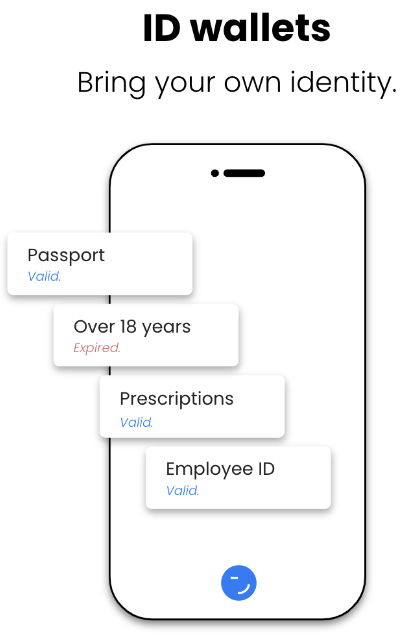
For our example use-case, we will be setting up the wallet using walt.id’s open-source wallet API and white-label web app. With that, we can launch an end-user custodial wallet solution quickly with our own branding. By default the walt.id wallet will be available via the browser but can also be installed as PWA (Progressive Web APP) on IOS and Android. When Lea visits the government website she can pull up her wallet, and create an account if she doesn’t have one already and receive the credentials. By default, Lea will get a set of keys and DIDs to which the credentials will be bound. Which type of key or DID is created by default can be configured.
Please visit our guide here to learn more about setting up the wallet and creating the first user account.
#### Verifier
The Bank which requests credentials from Lea to open a bank account. However, this could be any government or business entity that wants to verify verifiable credentials from their users to provide services or access.
When building a verifier, there are a few things to consider:
- **ID Ecosystems**: As in the case of the Issuer, solutions should support ecosystem-specific requirements e.g. for being accepted as a relying party.
- **Verification**: Verifiers should be able to request and verify various credential types (e.g. VCs, mdoc, SD-JWT), signature types (JWT, SD-JWT) as well as perform checks against Trust Registries to verify provenance, integrity, data models, revocation status among others.
- **Exchange**: As in the case of the Issuer, Verifiers should be able to receive credentials via data exchange protocols like OpenID Connect (OID4VP, SIOP) and support different exchange flows and user journeys.
- **Policies**: Customizable verification policies are useful for automating processes and support different user flows. For our example use-case, we will be setting up the verifier using walt.id’s open-source APIs. We will verify the eID issued previously, which is based on the W3C credential standard using a JWT signature.
Please visit our guide here to learn more about setting up the verifier and verifying the eID credential.
## Deep Dive | Annex
### Guide: Prioritize use cases
### Checklist: Definition of technical requirements
### Checklist: Technology and vendor evaluation
## Further readings
- [Introduction to Digital Identity](https://walt.id/white-paper/digital-identity.md) (eBook)
- [Introduction to Decentralized Identity / Self-Sovereign Identity](https://walt.id/white-paper/self-sovereign-identity-ssi.md) (eBook)
- [Introduction to non-fungible (NFTs) and soulbound tokens (SBTs) for identity](https://walt.id/white-paper/nfts-for-identity.md) (eBook)
- [NFTs/SBTs vs Self-Sovereign Identity](https://walt.id/white-paper/ssi-vs-nfts.md) (eBook)
- [Monetizing decentralized identity](https://walt.id/white-paper/ssi-data-monetization.md) (eBook)
- [The rise of identity ecosystems](https://walt.id/white-paper/the-rise-of-identity-ecosystems.md) (eBook)
- [The role of blockchain for decentralized identity](https://walt.id/white-paper/the-role-of-blockchains-for-decentralized-identity.md) (eBook)
- [eIDAS2 is here](https://walt.id/white-paper/eidas2.md) (eBook in collaboration with Trustscape)
- [Me, myself and SSI](http://walt.id/s/White-Paper-Self-Sovereign-Identity-SSI-BCG-x-waltid.pdf.pdf) (eBook in collaboration with BCG)
- [A digital twin for everything](https://mvtrosz5a6vgwqrp.public.blob.vercel-storage.com/digital-twin-of-everything-bcg-x-waltid.pdf) (eBook in collaboration with BCG)
---
title: "Introduction to Digital Identity — walt.id White Papers"
meta:
"og:title": "Introduction to Digital Identity — walt.id White Papers"
source_url: "https://walt.id/white-paper/digital-identity"
stack: "Applies to both the Community Stack and the Enterprise Stack"
docs: "https://docs.walt.id"
llms_index: "https://walt.id/llms.txt"
generated: "2026-11-23"
---
> Markdown mirror of https://walt.id/white-paper/digital-identity — Applies to both the Community Stack and the Enterprise Stack. Technical docs: https://docs.walt.id (AI index: https://docs.walt.id/llms.txt).
[← All white papers](https://walt.id/white-paper.md)
White Paper
# Introduction to Digital Identity
Dominik BeronMarch 9, 2022
### Summary | TL;DR
#### What is “Digital Identity”?
Think of your digital identity as the sum of **all the (digitized) information that exists about you**. For example:
- core identity attributes (name, address or birthday),
- education and work history (diplomas, work records, certificates),
- health and insurance data (medical reports, prescriptions, vaccination passes),
- financial information (bank account information, transaction histories)..
To sum up, your digital identity describes who you are in every aspect of your (digital) life.
#### Evolution & Approaches
On a high level, we can distinguish two different periods in identity management:
**The era of silos** - dominated by centralized systems
- Centralized Identity (“one account per service”): The main issues with this approach are usability and security (e.g. passwords are cumbersome to use and a major attack vector).
- Federated Identity (“login with …”): While offering superior usability and security, main issues are the aggregation of too much power in a few hands (lock-in, dependency, privacy issues) and built-in limitations (no centralized system can support every use case).
**The rise of ecosystems** - enabled by decentralized systems
Decentralized identity is solving the issues of centralized and federated approaches by freeing data from silos. Its’ main advantages come from a user-centric architecture, which **puts users in control of their data** and enables them to share it in an easy, secure and privacy respecting way.
Today, we can distinguish different approaches like Self-Sovereign Identity (SSI) or Non-Fungible Tokens (NFTs). While each approach has unique strengths and weaknesses which makes them more or less suitable for different use cases, they are all about **enabling users to “bring their own identity”**.
#### Outlook
While centralized and decentralized approaches will co-exist for the foreseeable future, user-centric architectures will gain importance and replace silos, not merely due to its advantages for users but also because of market trends (e.g. web3) and emerging regulations (e.g. eIDAS 2).
## What is Digital Identity?
There are many different ways to define identity. For our purpose, it is sufficient to understand digital identity as the **sum of all the (digitized) information that exists about you**. In other words, your digital identity describes who you are and everything about you.
This definition of identity includes, for example, your **core identity** attributes like your name, address or birthday. But it also encopmasses data from very specific parts of your life such as
- **education and work** history (e.g. diplomas, student IDs, work records, certificates),
- **health and insurance** data (e.g. medical reports, prescriptions, vaccination passes, social security information)
- **financial information** (e.g. bank account information, transaction histories, liquidity data)
- **social information** (usernames, ratings, recommendations, event tickets).
As a result, your digital identity is important for every digital interaction you have across every sector and industry.
## Evolution & Approaches
The increasing digitization of our world and the emergence of new technologies and innovations have changed the face of the digital identity landscape over the past years and are completely changing the way digital identity works.
From a high level, we can distinguish two different phases:
1. The era of silos - dominated by centralized systems
2. The rise of ecosystems - enabled by decentralized systems
Let’s dive in...
### The Era of Silos | Centralized Approaches
It is no secret that the **internet was built without an identity layer**. However, as the world is growing more digital, **we are confronted with seemingly insurmountable issues** ranging from cumbersome user experiences to privacy issues, large scale data breaches and our growing dependence on big platforms.
In other words, while digitization has many upsides it comes at a price:
- **Lack of control over data**: Power is aggregated in the hands of a few companies, which effectively control data and lock-in users.
- **Privacy issues**: As a result of users not being in control of their data, we witnessed privacy scandals and diminishing trust in data aggregators.
- **Compliance issues**: Online service providers must store and manage user data centrally which opens them up to regulatory scrutiny and penalties.
- **Security issues**: Conventional ways for securing access to services and user data - particularly password-based authentication - proved to be unreliable and caused countless large-scale data breaches.
- **Fraud and identity theft**: Due to the lack of reliable authentication and identification tools, identity theft and other types of fraud are thriving. Online service providers and marketplaces are struggling to ensure trustworthy interactions.
- **Cumbersome user experience**: Users are forced to juggle various authentication methods (inc. many passwords) and go through lengthy online identification processes.
The **underlying reason** for all of these problems **is that the digital world is built on the premise of data silos**, which left us with only two ways to create something like digital identities:
#### Centralized Identity
In the simplest form, you can think of this approach as “**one account per service**”
To understand how it works, just think about how you conventionally use online services:
1. You create an account by offering a username (usually an email address) and a password.
2. You provide your information via forms and uploads, so that the service knows more about you.
3. Your information is then stored, managed and used by service.
This has a number of consequences:
First, you have different digital identities with each service you are using (depending on the information you share) and, in many cases, your data becomes outdated over time. Second, a part of your digital identity becomes locked into the database of the service. As a result, you end up with **fragmented digital identities which are often of poor quality and only exist in disconnected silos**.
However, the most important issues are related to
- **Cumbersome user experience** - To create and access accounts, you typically require usernames and passwords and handling a great number of those is very cumbersome.
- **Security issues** - Passwords are not only cumbersome, but also a major attack vector and a main cause for data breaches. Moreover, the centralized storage of data can create strong incentives for malicious actors to access and steal this information.
- **Lack of control** - Since users’ information is stored by the service provider, users do not have control over their data or how it is used.
#### Federated Identity
Over time, enabled by the rise of platforms like Facebook or Google, a new paradigm emerged called “Federated Identity”. While the idea is more or less the same as with Centralized Identity (you create an account and fill it with information about ourselves), there is one major difference:
Instead of creating a new account with every service provider directly, you create a single account with a big platform, fill it with information about yourself and then use this account to share your data across different services.
In short, **you give so-called “Identity Providers”** or “IDPs” **your information and ask them to manage and share your data with other services**.
While Federated Identity offers a superior user experience (handle one account instead of many), there are two particularly **biggest issues** with this approach:
- **Power aggregation** - Federated Identity aggregates too much power in the hands of a few organizations with dire consequences for everyone else (e.g. lock-in effects, dependence, abuse of power, privacy and compliance issues)
- **Built-in limitations** - It is simply not possible to build a centralized system that can accommodate every type of identity data for every use case in every industry.
### The Era of Ecosystems | Decentralized Approaches
**Data silos are the villains of this story**. They are the root cause of the downsides of centralized approaches to digital identity. But what **would happen if we could avoid data silos altogether?**
Imagine our interactions with digital services becoming so effortless that it would almost feel like magic. Imagine never having to worry about violations of your privacy, your independence or about falling victim to data breaches or online fraud.
This is the promise of ecosystems based on decentralized approaches to identity: **A digital world in which digital interactions are effortless and worry-free.**
It is **simply the next evolutionary step**, a new paradigm in which our data and our digital identities are no longer fragmented and locked into silos that are under someone else’s control, but only at our own disposal to be securely and privately shared with others.
#### Self-Sovereign Identity (SSI)
SSI is a **user-centric approach to digital identity** that puts users in control of their data and enables them to share it with others in decentralized identity ecosystems.
At its core, SSI enables you to **“bring your own identity”** in order to easily and reliably **prove who you are and anything about you** (e.g. name, age, address, diplomas, work records, vaccination status, financial information, …).Importantly, SSI can be used to model the **digital identities of people, organizations and things** (IoT).
SSI is the **native approach for digital identity in decentralized ecosystems** and resolves the main issues we encountered with Centralized and Federated Identity:
- **Seamless user-experience**: SSI offers basically the same user experience as Federated Identity, allowing users to share data effortlessly with the click of a button.
- **No security or privacy issues**: SSI offers to avoid the need for passwords (a major attack vector) and centralized aggregation and storage of data by service providers.
- **User control to avoid power imbalance:** Users are ultimately in control of their data. They can decide where data should be stored, who has access and even enjoy data portability.
- **No built-in limitations:** SSI only exists in decentralized ecosystems which are built by a great number of individuals and organizations based on open-standards. As a result, decentralized ecosystems can be extended over time to incorporate any type of identity data for any use case in any industry.
You can read more about Self-Sovereign identity [here](https://walt.id/white-paper/self-sovereign-identity-ssi.md).
#### Non-Fungible Tokens (NFTs)
Non-Fungible Tokens or NFTs are another approach that gained popularity over the last years, particularly in the context of the creator economy (e.g. art, music).
On the surface, **NFTs appear quite similar to SSI** considering that both approaches introduce wallets which are used to control data. In this sense, both approaches are user-centric and enable decentralized identity ecosystems. However, when comparing SSI and NFTs in more detail, it becomes clear that they are **fundamentally different creatures** which have been created for different purposes:
- **SSI is about who you are.** It is the native approach for digital identity. For example: There is just one passport that proves my core identity and this passport is inherently tied to myself in a sense that it makes no sense to sell or trade it.
- **NFTs are about what you own.** It is the native approach for digital ownership of assets. For example: There is just one specific digital piece of art (e.g. crypto punk #5822) which exists completely independently of its owner and it makes sense to sell or trade it.
While it makes sense to use SSI in most identity-related use cases, there is still room for NFTs in identity management.
Read more about NFTs [here](https://walt.id/white-paper/nfts-for-identity.md).
## Outlook
Today, centralized approaches to digital identity are clearly dominating as data silos are deeply backed into the very fabric of our digital world. Consequently, centralized and decentralized approaches will co-exist for the foreseeable future. However, it is also evident that user-centric architectures will become the new standard for various reasons, such as:
1. **Added value**: Decentralized identity has too many advantages over centralized approaches (e.g. user experience, data control, privacy, security). It simply is the native way to model identity in the digital world.
2. **Trends:** The COVID pandemic forced the digitization of every industry creating a world in which people do everything online. At the same time, the rise of web3 forces re-decentralization and the disintermediation of centralized platforms and gatekeepers. The increased digitization combined with the emergence of decentralized ecosystems is perfectly aligned with the value proposition of Decentralized Identity.
3. **Regulatory Pressure:** Regulators are putting users in control of data to correct today’s power imbalances - Europe is leading the way with the GDPR (data protection), PSD2 (opening up financial information), eIDAS 2 (forcing the adoption of user-centric eID and wallets), AMLR (allowing user-centric eID for highly regulated industries), DMA (limiting the power imbalance in favor of big tech).
4. **It’s becoming a thing**: While decentralized identity (SSI, NFTs) was widely unknown one or two years ago, it is something that everybody is talking about today - from governments to thought leaders of the identity industry. Moreover, a broad set of global standards is being finalized and setting the stage for rapid adoption.
To sum up, **decentralized identity is** nothing less than **the next evolutionary step in digital identity management**. It is better suited to meet the needs of today's highly digitized world and even being pushed by regulators. **It will only continue to gain importance and replace silos**.
### Download this White Paper
Get the white paper as PDF [here](https://mvtrosz5a6vgwqrp.public.blob.vercel-storage.com/introduction-to-digital-identity-waltid.pdf).
### Any Questions?
[Write us](https://walt.id/contact.md), we are happy to help.
### Further Readings
Introductions to [Self-Sovereign Identity (SSI)](https://walt.id/white-paper/self-sovereign-identity-ssi.md) | [Non-Fungible Tokens (NFTs)](https://walt.id/white-paper/nfts-for-identity.md)
---
title: "Digital Identity Standards & Ecosystems — walt.id White Papers"
meta:
"og:title": "Digital Identity Standards & Ecosystems — walt.id White Papers"
source_url: "https://walt.id/white-paper/digital-identity-standards-and-ecosystems"
stack: "Applies to both the Community Stack and the Enterprise Stack"
docs: "https://docs.walt.id"
llms_index: "https://walt.id/llms.txt"
generated: "2026-11-23"
---
> Markdown mirror of https://walt.id/white-paper/digital-identity-standards-and-ecosystems — Applies to both the Community Stack and the Enterprise Stack. Technical docs: https://docs.walt.id (AI index: https://docs.walt.id/llms.txt).
[← All white papers](https://walt.id/white-paper.md)
White Paper
# Digital Identity Standards & Ecosystems
Dominik BeronApril 12, 2025
The evolving landscape of decentralized identity and identity wallets.
In a world where digital interactions increasingly define our daily lives, the concept of identity has undergone a profound transformation. We stand at the precipice of a significant shift in how identity functions across the digital landscape — moving from centralized, siloed systems toward decentralized ecosystems that promise to return control to individuals while enabling unprecedented interoperability across platforms and borders.
This document will explain everything you need to know about Digital Identity Standards & Ecosystems and their impact on governments and businesses across industries.
Let’s dive in. (You can read on or download the ebook as PDF [here](https://mvtrosz5a6vgwqrp.public.blob.vercel-storage.com/digital-identity-standards-and-ecosystems.pdf))
### The global adoption wave
Decentralized identity is no longer merely a theoretical concept championed by privacy advocates and blockchain enthusiasts. It has entered a phase of pragmatic implementation across diverse sectors:
Governments are exploring citizen-centric identity frameworks and corresponding regulations. They launch ID wallets to give citizens more control over their digital identity and credentials. Large institutions are exploring how decentralized identity can streamline customer interactions and processes while reducing data liability and ensuring regulatory compliance. Businesses are building new SaaS platforms to make the adoption of decentralized identity and ID wallets seamless for small and large organizations.
This global momentum isn't isolated to wealthy nations or tech hubs. Developing economies — often unencumbered by legacy identity systems — are leapfrogging directly to decentralized architectures, recognizing their potential to address longstanding challenges in financial inclusion and service delivery.
### The critical role of standards
The decentralized identity landscape is being fundamentally shaped by the emergence and adoption of key standards. These standards aren't merely technical specifications. They represent the grammar and syntax of a new identity language that enables diverse systems to communicate seamlessly across organizational and geographical boundaries.
The importance of standards in this ecosystem cannot be overstated for several reasons:
- Interoperability: Standards like Verifiable Credentials (W3C), mobile driving license (ISO 18013-5) and OpenID4VC (OIDF) enable identity solutions from different vendors and jurisdictions to work together, preventing the formation of new walled gardens.
- Trust frameworks: Standardized governance models establish the rules of engagement between identity providers, verifiers, and subjects, creating predictable interaction patterns that build confidence in the ecosystem.
- Scalability: Well-designed standards allow for implementations that can grow from small pilots to national or global deployments without fundamental redesigns.
- Security: Standards and their extensions establish consistent mechanisms for threat mitigation. They help prevent common attacks, ensuring secure and interoperable implementations across diverse systems.
- Regulatory alignment: Emerging standards increasingly account for regulatory requirements across regions, helping organizations maintain compliance while adopting decentralized approaches.
The organizations driving these standards have become the invisible architects of our digital future, their work determining the contours of how identity will function for decades to come.
### A framework for understanding adoption
This eBook is intended to help readers navigate the complex landscape of decentralized identity adoption by explaining the most important technology standards, regulations and map them to actual adoption patterns by governments and businesses globally.
The decentralized identity movement represents more than a technological shift. It embodies a fundamental rethinking of the relationship between individuals, organizations, and their data. This transformation promises to reshape digital interactions across every sector, creating new opportunities for privacy, security, and user empowerment in our increasingly connected world.
## Part 1 - Standards & Technologies
### It all started in walled gardens
Just a few years ago, the decentralized identity space looked very different. Every vendor was inventing their own (proprietary) technologies and they did so across the whole decentralized identity tech stack. This situation was born out of the need to fill a gap that had to be filled (there weren't any agreed upon standards and vendors had to implement something) and fueled by ideology as well as enthusiasm for complex and potent technologies. As a result, solutions were factually centralized. There was no interoperability and without interoperability, the promise of decentralized identity, including the free movement of data, is simply not possible.
The irony was palpable — technologies ostensibly designed to decentralize power and control were creating new silos, walled gardens, and vendor lock-in. Solution providers spoke the language of openness while implementing closed systems, fragmenting the very ecosystem they intended to be building.
### From fragmentation to coherence
The journey toward standardization has not been straightforward. It has involved complex negotiations between competing visions, reconciliation of seemingly incompatible technical approaches, and the delicate balance between innovation and stability. Throughout this process, the community has had to address critical questions: How much standardization is necessary? Which layers of the stack must be interoperable? How can standards accommodate innovation while ensuring compatibility?
Today, we stand at a pivotal moment where core standards have matured sufficiently to enable meaningful interoperability while remaining flexible enough to adapt to emerging requirements. These standards - ranging from identifier formats to cryptographic suites, credential structures to exchange protocols - form the invisible infrastructure upon which the promise of decentralized identity can finally be realized.
In the following sections, we'll provide an overview of:
- The core standards enabling decentralized identity today
- The relationship between standards and implementations
- Emerging standards that address gaps in the current landscape
Understanding these standards isn't merely an academic exercise. It's essential knowledge for anyone seeking to implement, integrate with, or participate in the decentralized identity ecosystem. As we'll see, these standards don't just enable technical interoperability; they establish the rules of engagement for a new model of digital relationships based on mutual trust, verifiability, and user control.
### Making sense of standards
Decentralized identity can be best understood through a layered technology stack architecture that consists of five interdependent levels, each building upon and extending the capabilities of those beneath it.
At the foundation is the Trust Registry Layer, which provides the underlying infrastructure for establishing trust. This includes technologies such as Distributed Ledgers or Blockchains, traditional Public Key Infrastructure (PKI), and the Domain Name System (DNS). These technologies serve as authoritative sources of truth and repositories for essential metadata.
The Keys Layer builds on this foundation, incorporating cryptographic standards like Ed25519, secp256k1, and RSA. This layer enables the fundamental security operations of data encryption and digital signatures that ensure integrity and confidentiality throughout the stack.
Moving upward, the Identifiers Layer leverages standards such as Decentralized Identifiers (DIDs), JSON Web Keys (JWK), and X.509 certificates. These technologies provide unique entity identifiers that are essential for authentication and verification, while directly mapping to corresponding trust registry technologies in the underlying layer.
The Credentials Layer further extends these capabilities through standards like W3C Verifiable Credentials (VC), IETF SD-JWT-based Verifiable Credentials (SD-JWT VC), and Mobile Driving Licenses (mDL/mdoc; ISO 18013-5). These frameworks enable the creation and management of reusable, portable digital credentials that can represent virtually any attestation about an entity.
At the apex is the Protocols Layer, which is tightly integrated with the digital credential standards below it. Technologies such as OpenID for Verifiable Credentials (OID4VC) and the Digital Credentials API define the rules for secure data exchange during credential issuance, presentation, and verification processes.
Together, these five interconnected layers create a comprehensive technological ecosystem that enables truly decentralized identity systems while maintaining security, privacy, and interoperability across diverse implementations and use cases.
In the following chapters, each layer and the corresponding standards will be briefly explained in a way that is useful for both technical and non-technical readers.
### Trust Registries
Generally, the idea of a registry is similar to the idea of a ledger. It is a place of record keeping, a shared source of truth. In the context of digital identity registries are usually referred to as “Trust Registries”, because they establish a framework for creating trust between people and organizations that typically don’t know each other - particularly trust that the identity information that originates from the ecosystem is correct.
The main purpose of Trust Registries is to enable discovery and the verification of identity data. As such, they are the single source of truth and act like a shared database for information that members of an identity ecosystem consult in order to trust each other (based on the identity data that is being exchanged).
Trust Registries can be implemented with different technologies like
- Traditional public key infrastructure (PKI),
- Domain Name Service (DNS),
- Permissioned/consortium blockchains,
- Public/unpermissioned blockchains.
Apart from the technology with which a Trust Registry is implemented, there are also different types, each of which enables the verification of identity data across a different dimension. For example:
- “Organization Registries” verify and provide information about organizations that act in different roles such as data sources (“Issuers”) or data consumers (“Verifiers”).
- “Schema Registries” establish standards for and provide information about semantics and data models to ensure reusability and interoperability of data sets.
- “Revocation Registries” are used to manage the lifecycle of data. In particular, they enable data sources (“Issuers”) to revoke data if it becomes invalid.
You can learn more about Trust Registries and the concept of ID ecosystems in our eBook: [The rise of identity ecosystems](https://walt.id/white-paper/the-rise-of-identity-ecosystems.md). You can also learn more about the role of blockchain in our [Decentralized Identity Playbook](https://walt.id/white-paper/decentralized-identity-playbook.md).
### Identifiers
An identifier is something used to uniquely name or label a person, thing or idea so it can be recognized and referred to. For example, in everyday life, we use names as identifiers for people or license plates as identifiers for cars. Usernames, email addresses, or website links (URLs) are typical identifiers in the digital world.
Some identifiers are public, like an email address, which can be used by others to get in touch. Others are private, like passwords, only known by a specific system. Identifiers can also be "resolvable," meaning they point to something, like clicking on a website link takes one to that site. Whether in real life or online, identifiers make it easier to organize, find, and interact with people, things, or information.
Today, in the context of digital identity, the most important identifiers are X.509 certificates and Decentralized Identifiers (DIDs). Both serve as mechanisms for verifying digital identities, but operate differently.
#### X.509 certificates
The traditional X.509 certificates are part of a centralized public key infrastructure (PKI), where a trusted Certificate Authority (CA) issues certificates that bind a public key to an entity, such as a person, organization, or device. These certificates include information like the public key, issuer details, and validity period and they enable secure communication by verifying the certificate's authenticity through the CA's digital signature.
#### W3C Decentralized Identifiers (DIDs)
In contrast, W3C Decentralized Identifiers (DIDs) are designed to work within decentralized systems, such as blockchain networks, allowing entities to create and control their identifiers without relying on a central authority. DIDs are typically associated with cryptographic key pairs and support decentralized identity models, giving users more control over their data while ensuring privacy and security.
It is worth mentioning that the DID standard is very broad. It defines the architecture, data model and processing rules, but deliberately leaves out implementation-specific logic, such as resolution and updating procedures and, therefore, allows for a great diversity of types of DIDs, called “DID methods”, which come with vastly different sets of capabilities and architectural assumptions, each with its own strengths and weaknesses. Examples include did:key, did:jwk, did:web, did:ebsi, did:cheqd or did:eth.
Both systems, X.509 certificates and DIDs aim to establish trust in digital interactions but differ significantly in their reliance on centralized versus decentralized trust models.
### Digital Credentials
A digital credential is like an electronic version of a certificate, ID card, or badge that proves something about someone, such as one’s identity, skills or achievements. Instead of being printed on paper, it’s stored digitally and can be shared easily online. Digital credentials are issued by trusted organizations, like schools, governments, or companies, and often include important details like who issued it, who it belongs to, when it was given, and a secure way to prove it’s real.
Digital credentials are designed to be safe and hard to fake, typically using cryptography to make sure they can be verified by others without being tampered with. Digital credentials are becoming more popular because they are convenient and secure, making it easier to prove your identity or qualifications in the digital world.
Today, there are a number of digital credential standards which are used in the context of digital and decentralized identity. The most important ones are.
#### ISO mDL 18013-5 (Mobile Driving License)
The ISO mDL 18013-5 standard has initially been developed to enable digital, mobile driving licenses and requires credentials to stay on the original device or an issuer-controlled server. While users control data sharing, issuers can retrieve credentials directly (with user consent), revealing when and where they are used. It prioritizes offline functionality and uses temporary session keys to prevent tracking. For example, a police officer scanning a digital license offline wouldn’t expose one’s full identity history. That being said, given this standard’s maturity - compared to other digital credential standards - it is gaining momentum as a credential standard to be used via ID wallets, particularly in the public sector and adjacent verticals and use cases.
It is important to mention that ISO 18013-5 is not coming out of the decentralized identity movement and as such assumes a more centralized architecture building on top of X.509 certificates and traditional public key infrastructure. As a result, not everyone categorizes this standard as a decentralized identity standard.
#### W3C Verifiable Credentials
W3C Verifiable Credentials are a more novel invention and originate from the Self-Sovereign Identity (SSI) movement. These credentials let users store proofs anywhere, like an ID wallet, and share them without issuer involvement. A university-issued degree could be stored in one’s phone and shared with employers without the school knowing. They use JSON or JSON-LD formatting and digital signatures to prevent tampering.
Today, there are two versions of this standard:
First, the Verifiable Credential Data Model 1.1 or **VCDM 1.1**, a W3C Recommendation (March 2022), has already seen growing adoption around the globe, surpassing other early decentralized identity standards like AnonCreds and was taken up by regulators (e.g. EU, UK).
Second, the Verifiable Credential Data Model 2.0 or **VCDM 2.0**, a W3C Candidate Recommendation Draft (January 2025) introducing a number of changes to its predecessor like improved terminology (context URL, property naming) explicit separation of the data model from securing mechanisms, enabling broader cryptographic flexibility or the allowance to secure credentials via widely adopted JSON/CBOR signing standards among others. As such, this new version focuses on improving flexibility, security, and real-world applicability while maintaining compatibility with VCDM 1.1-based systems. It also aims at extending interoperability with more traditional ecosystems, such as those based on ISO 18013-5. Finally, new standards, such as in the badging and education industry, like Open Badges 3.0 and Comprehensive Learner Record (CLR) 2.0 build on VCDM 2.0 to improve the trust model of digital badges and structure learner records in a machine readable way.
#### SD-JWT VC
SD-JWT-based Verifiable Credentials (SD-JWT VC) are using Selective Disclosure for JWTs (SD-JWT) and have been standardized by the Internet Engineering Task Force (IETF). This standard lets users hide specific credential parts. For instance, a respective credential might include name, age, and vaccination status but allows sharing only the vaccination proof. It uses hashing to lock hidden data, requiring verifiers to check only the revealed info against the hash. Given its privacy-preserving focus, SD-JWT VCs have recently gained a lot of momentum and are being adopted by a number of regulators (e.g. EU, Switzerland).
#### AnonCreds
AnonCreds were born out of the decentralized identity movement. They looked very promising early on (until a few years ago) and spoke to a large part of the decentralized identity community, not at least due to their innovative character. Ultimately, AnonCreds failed to reach large-scale adoption and other standards (W3C Verifiable Credentials, SD-JWTs, ISO 18013-5) surpassed AnonCreds which are hardly ever used anymore. One can say that the early strengths of AnonCreds, which spoke to technologists, prevented wider adoption, such as the use of zero-knowledge proofs (ZKPs) based on novel cryptography that has not yet been trusted by market participants and regulators.
#### Authentic Chained Data Containers (ACDC)
Authentic Chained Data Containers (ACDC) are a more exotic approach towards digital credentials. Conceptually, these credentials are chained in a tamper-proof sequence and each credential update creates a new linked block, enabling auditors to trace changes without exposing raw data. While ACDC credentials may be useful for certain industries (e.g. supply chain) and use cases (e.g. tracking certified product origins over time), the technological complexity led to relatively low adoption, particularly in the current face of market development which is largely driven by regulatory action and early adopters focused on use cases for the general public.
### Exchange Protocols
Data exchange protocols provide mechanisms for securely issuing, sharing, and verifying digital credentials. Much like in the case of digital credentials, there exist a number of protocols and they differ in their approaches to communication, privacy and interoperability, catering to various use cases in the digital identity ecosystem.
#### OID4VC
OpenID for Verifiable Credentials (OID4VC) extends the widely adopted OpenID Connect framework, is a family of protocols defined by the OpenID Foundation or OpenID Connect Working Group, to support digital credentials like W3C Verifiable Credentials. It includes two main specifications: OpenID4VCI (OpenID for Credential Issuance) and OpenID4VP (OpenID for Verifiable Presentations). Both specifications are evolving at a fast pace and are available in different versions, the most important ones being Drafts 11 (February 2023) and 13 (February 2024) for OID4VC and Drafts 18 (April 2023), 23 (December 2024) for OID4VP.
OID4VC uses OAuth2-based flows for secure interactions between issuers, holders, and verifiers and emphasizes privacy and simplicity by leveraging existing authentication patterns while introducing cryptographic mechanisms to bind credentials to users. As a result, OID4VC is currently widely regarded as the most important standard for digital credential exchange and picked up by regulators globally.
#### Digital Credentials API
Digital Credentials API is a web platform API designed to enable websites to request and verify digital credentials stored in user-controlled digital wallets. It focuses on interoperability across platforms and systems by providing a unified interface for credential-related operations. The API is protocol-agnostic, meaning it can work with various credential exchange protocols, such as OID4VP.
Digital Credentials API and OID4VC are closely related, as the API provides a standardized mechanism for credential exchange, while OID4VC defines the protocols for issuing and presenting digital credentials. In other words: The Digital Credentials API acts as a browser-based interface that facilitates credential interactions between websites and digital wallets, allowing users to securely store, retrieve, and share credentials. OpenID4VC complements this by specifying how these credentials are issued (OID4VCI) and presented (OID4VP) using OAuth 2.0 flows.
#### DIDComm
DIDComm is a decentralized communication protocol built on Decentralized Identifiers (DIDs). It focuses on enabling secure, private, and asynchronous messaging between parties without requiring user involvement in every interaction.
DIDComm supports various types of messages beyond credential-related ones, making it versatile for broader use cases like credential revocation or renewal. It can complement OID4VC by enabling persistent communication channels after credentials are issued or verified.
#### Credential Handler API (CHAPI)
The Credential Handler API (CHAPI) is a browser-based protocol designed to facilitate the secure exchange of digital credentials between issuers, holders and verifiers. It provides a mechanism for digital wallets to interact with third-party websites, enabling credential issuance, storage, and presentation in a way that prioritizes user control, privacy, and interoperability.
Both DIDComm and Chapi gained popularity in the early days within the decentralized identity community, but have since lost relevance compared to OID4VC or the Digital Credentials API.
## Part 2 - Ecosystems & Regulations
### Regulations - The catalyst for global adoption
While standards provide the technical foundation for decentralized identity, it is regulatory frameworks that are rapidly becoming the primary catalyst for widespread adoption. As governments worldwide recognize both the potential benefits and risks of digital identity systems, they are increasingly establishing legal frameworks that mandate specific approaches with decentralized models gaining significant favor.
Unlike previous digital transformations that were primarily driven by market forces or technological innovation, the shift to decentralized identity is being significantly accelerated by regulatory intervention. This represents a fundamental change in how digital infrastructure evolves — with governments taking a more proactive role in establishing guardrails and requirements rather than simply responding to market-developed solutions.
In 2024, the first regulation to force the adoption of decentralized identity and identity wallets was published by the European Union (EU). It is called "eIDAS2" and it introduces digital identity wallets for individuals and organizations in order to give them more control over identity data across all aspects of their life. As a result, the eIDAS2 regulation is expected to transform the digital landscape in Europe and it is already being copied around the world. You can read more in our [eIDAS2 ebook](https://walt.id/white-paper/eidas2.md).
But it is not only European regulators looking at the introduction of identity wallets: In the US, a quickly growing number of states have already introduced mobile driving licenses and ID wallet apps. For example, Louisiana launched a digital ID in 2018, which is being used by more than 66% of eligible adults. In California, nearly 600,000 residents installed the mobile ID app within the first few months of the program's launch. Similarly, we see a lot of movement from governments in the UK, the middle east, various Asian countries, Australia, New Zealand and Africa.
This regulatory momentum creates both opportunities and challenges. For organizations, it provides clarity and certainty around implementation requirements, potentially reducing the risk of investing in new technologies. For technology providers, it establishes clear market demand while constraining certain design choices. For individuals, it promises greater data control while raising questions about how these systems will be governed and overseen.
The following sections will provide an overview of the current regulatory landscape and how it is reshaping digital identity across jurisdictions while mapping regulations to the corresponding ID ecosystems and standards. At the end of the day, understanding this regulatory landscape isn't just about compliance. It provides crucial insight into how decentralized identity will evolve from promising technology to essential infrastructure over the coming decade.
### Identity ecosystems - The networks of trust
While standards provide the technical foundation and regulations create the legal frameworks, identity ecosystems represent the operational heart of decentralized identity. These collaborative environments transform abstract capabilities into functioning networks that deliver tangible value across organizations, industries, and borders.
Identity ecosystems are a core building block of decentralized identity. By combining technology (shared data registries) with governance frameworks (rules for establishing trust), they enable the shift away from today's centralized identity paradigm which created a world of data silos and with them some of the internet's biggest problems like privacy and compliance issues, user lock-in effects, rising fraud and identity theft.
In 2024, we witnessed one of the EU's ID ecosystems (the EU Blockchain Service Infrastructure, EBSI) mature, with several so-called "Large Scale Pilots" to demonstrate use cases across borders and industries. New consortia emerged in the private sector -like Ayra, IATA or CHEQD - as well as public and private partnerships in Europe, the US, the middle east and APAC. Moreover, large players in payment, banking and crypto are looking at (or have already started to work on) building their own ID ecosystems as a way to future-proof their business and create new products and services.
While it is still early for ID ecosystems, there is also a lot of movement making us optimistic about an exciting multi-ecosystem future over the next two to five years.
For organizations navigating the decentralized identity landscape, understanding these ecosystem dynamics is essential for making strategic decisions about which initiatives to join, how to leverage their capabilities, and where to invest resources for maximum impact.
### The relation between regulations and ID ecosystems
Regulations and ID ecosystems are closely connected, but they are not the same. In a way, regulations and ID ecosystems can be thought of as two complex, dynamic and mutually reinforcing phenomena.
#### Regulations drive ID ecosystem adoption.
First, regulations mandate decentralized identity. Laws like the EU's eIDAS2 are directly forcing the adoption of decentralized identity technologies, specifically digital identity wallets. This is a significant shift, as it moves away from voluntary adoption to mandated implementation. By establishing a legal framework, eIDAS2 and similar regulations are creating a foundation for widespread use of these technologies.
Second, regulations are creating legal certainty and trust. They provide the necessary legal certainty and trust for individuals and organizations to embrace digital identity solutions. This is essential for building robust ID ecosystems. When governments establish rules and standards, it fosters confidence in the security and privacy of digital identity.
Thirdly, there is a global regulatory trend as more and more policymakers and regions explore and implement digital ID initiatives, indicating a worldwide recognition of the need for regulated digital identity frameworks.
#### **ID Ecosystems enabling regulatory goals.**
First, ID ecosystems, especially those built on decentralized principles, empower individuals with greater control over their identity data. This aligns with the regulatory goals of enhancing privacy and data protection, as seen in eIDAS2. By moving away from centralized data silos, ID ecosystems address concerns about data breaches and misuse.
Second, ID ecosystems support cross-border interoperability. This is, for example, one of the explicit goals of the eIDAS2. The aim of enabling seamless cross-border digital interactions. ID ecosystems, particularly those with shared data registries and governance frameworks, are crucial for achieving this interoperability. The EU's EBSI is another example of an ID ecosystem designed to support cross-border use cases.
Third, ID ecosystems, with their security guardrails, can help combat fraud and identity theft, which are major concerns for regulators. Regulations can set standards for security and authentication within ID ecosystems, further strengthening their ability to prevent fraud.
#### Conclusion
Regulations act as catalysts for the development and deployment of ID ecosystems. They create the necessary market demand and legal framework for these technologies to flourish.
As ID ecosystems mature, they can provide valuable feedback to regulators, helping to refine and improve regulations. The "Large Scale Pilots" of the EBSI are a good example of this interaction.
Today, it has become apparent that the world is looking at a “multi-ecosystem future”, where various ID ecosystems coexist and interoperate. Regulations will play a vital role in ensuring that these ecosystems are compatible and secure. The involvement of the private sector, in creating ecosystems, shows that the regulation is creating a market that the private sector is willing to invest in.
In essence, regulations and ID ecosystems are mutually reinforcing. Regulations provide the legal and policy framework for ID ecosystems to thrive, while ID ecosystems provide the technological infrastructure to achieve regulatory goals.
In the following sections, we’ll look at different regions and jurisdictions to better understand their current state of affairs with regards to the adoption of decentralized identity and identity wallets.
## Europe
Europe has been among the driving forces for regulating digital identity and identity wallets. Just like in the area of privacy and data protection with the General Data Protection Regulation (GDPR) in 2018, Europe is proactively regulating the digital world and setting a global standard that inspires replications by policy makers around the globe.
### European Union (EU)
After the first eIDAS regulation established an ecosystem for digital signatures that could be used for authentication, identification, and signing with legal validity across borders, the EU took a significant leap forward with eIDAS2, which went into force in May 2024, and represents the first regulatory framework that introduces digital identity wallets for individuals and organizations. As such, it follows Europe's consistent philosophy of putting citizens' rights and data sovereignty at the center of digital transformation. By establishing legal requirements for user-controlled identity, eIDAS2 addresses fundamental challenges of the digital economy including privacy concerns, fragmented identity systems, and the growing problem of identity theft.
In the EU, there are two identity ecosystems that emerged from and are driven by the public sector.
#### eIDAS2 & EUDI Wallet
A main goal of the eIDAS2 regulation is to provide citizens and organizations with ID wallets and, as a result, user-centric digital identities that are secure, private, and trusted enough to reduce fraud and enable digital interactions across borders, organizations, and applications. Also, eIDAS2 forces governments and businesses to adopt ID wallets, creating a massive market for decentralized identity solutions, with estimates suggesting that over 450 million European citizens will have access to these wallets within five years.
#### EU blockchain Service Infrastructure (EBSI)
EBSI is a consorted effort by the EU to introduce a shared blockchain infrastructure for all EU member states. Naturally, digital identity has always been one of the main use cases for early adopters. As a result, EBSI is also being used by a number of so-called “Large Scale Pilots” where governments and businesses demonstrate cross-border use cases to showcase the value of EBSI.
The relation between these two ecosystems can be thought of as complimentary. Simplified speaking, eIDAS2 may be understood as the system used for use cases with high failure costs (i.e. required a high level of trust and assurance) and comes with a relatively limited set of digital credentials. EBSI has the potential to fill the gaps and provide an infrastructure for use cases that are not directly covered by eIDAS2.
From a technical and standards perspective, the EU is leveraging a broad variety of standards. For example, on the credential layer all major standards are being utilized, including **Mobile driving license (ISO/IEC 18013-5), SD-JWT VC** for selective disclosure and privacy preserving data sharing and **W3C Verifiable Credentials (VCDM v1.1 and v2.0)**. On the protocol layer, the EU’s if focused on **OpenID4VC** (OID4VCI, OID4VP) and potentially **Digital Credentials API** and on the layers of identifiers and registries, both tradition and novel technologies and standards are being used from **X.509 certificates** and **traditional PKIs** to **Decentralized Identifiers** (e.g. did:ebsi, did:key) and a permissioned **blockchain** (EBSI).
_Note that the table above only represents a subset of the standards aligned with the focus of this eBook. The full list can be found_[_here_](https://eu-digital-identity-wallet.github.io/eudi-doc-architecture-and-reference-framework/latest/architecture-and-reference-framework-main/#9-references)_._
### Switzerland
While the EU has been working on decentralized identity and ID wallets for a couple of years now, Switzerland has been carefully watching and working on their own ID ecosystem. While remaining aligned with the core premises of the EU's ecosystem there are certain differences in terms of technologies and standards.
For example, on the layer of credentials, Switzerland is proposing the use of **SD-JWT VC** to allow for privacy preserving data sharing (and potentially W3C Verifiable Credentials in combination with BBS+ signatures) in combination with **OpenID4VC** (OID4VC, OID4VP) on the protocol level and **Decentralized Identifiers** (e.g. did:tdw; did:webvh) combined with **OpenID Federation** which uses JSON Web Tokens (JWTs) to create "trust chains" that assert public keys and include rich metadata to allow for privacy preserving credential life cycle management and verification.
### UK
The UK government published a first (alpha) version of its “digital identity and attributes trust framework” on February 11, 2021 - an important first step towards establishing a national approach for digital identity solutions. This initial prototype of rules and standards was intentionally released as an unfinished version to allow interested parties to provide input and shape its development. In this sense the UK took a comparable, yet slightly different approach from the EU with regards to involving the private sector into the regulatory process (e.g. EBSI’s “Early Adopters”; EBSI’s and eIDAS2 “Large Scale Pilots”).
Following the publication of the alpha version, the government continued to refine the framework. In mid-2021, a public consultation was launched to gather views on how the digital identity system should operate. In mid-2022, an updated (beta) version of the trust framework was published.
As of 2025, the government has been working on this framework for over four years, collaborating with industry, academia, civil society groups and members of the public to refine and improve it. Based on the latest information published by the UK government, the main standards that are being used include **W3C Verifiable Credentials (VCDM v1.1)** on the credential layer combined with **OpenID4VC** (OID4VC, OID4VP), on the protocol level.
## North America
### United States (USA)
In the US, we witnessed different adoption streams that utilize different technologies and standards. That being said, particularly the **Mobile driving license (ISO/IEC 18013-5)** standard has seen significant adoption as various US states are rolling out ID wallets with mobile driving license as the initial use case (e.g. Arizona, California, Colorado, Delaware, Georgia, Louisiana, Maryland, Mississippi, New Mexico, Oklahoma, Utah). In line with state-level government action, major technology companies like Google and Apple (among others) are providing the wallet infrastructure to support these new credentials standards, but are also pushing certain protocol standards like the **Digital Credentials API**.
But adoption is not only limited to this use case, considering developments in industries like education, employment and health care among others that utilize different standards like **W3C Verifiable Credentials** (e.g. Open Badge 3.0, CLER 2.0) and **OpenID4VC** (OID4VCI, OID4VP) on the protocol layer.
### Canada
Canada has been pioneering decentralized identity and ID wallets early on. For example, British Columbia’s Verifiable Credential Issuer Kit, which was a proof-of-concept project aimed at demonstrating how governments can use self-sovereign identity (SSI) technology for secure credential issuance or TheOrgBook, a beta project launched in BC that aimed at allowing businesses to access digitally signed permits and incorporation documents online. The city of Vancouver has implemented digital credentials for permitting and licensing services issued via the BC Wallet mobile app. Similarly, Ontario's Digital Identity (DI) program aims to provide residents with a secure and convenient way to store and use government-issued IDs through a digital wallet app.
Today, Canada is starting to procure solutions enabling decentralized identity and ID wallets for the country utilizing of **W3C Verifiable Credentials, SD-JWT VC** and **Mobile driving license (ISO/IEC 18013-5)** on the credential layer, **OpenID4VC (OID4VCI, OID4VP)** on the protocol layer and **Decentralized Identifiers** as well as **X.509** certificates on the level of identifiers.
## APAC
### Australia
Australia has been making big strides towards establishing a new digital identity ecosystem which was established under the Digital ID Act 2024 and combines a voluntary accreditation framework with a government-managed identity verification system. The infrastructure prioritizes privacy, security and interoperability while avoiding prescriptive technical mandates for credential formats.
In this context, Austroads, the association of Australian and New Zealand transport agencies, is leading a significant project to develop a Digital Trust Service (DTS) for digital credentials, with a primary focus on digital driver's licenses and proof of age credentials. This initiative aims to harmonize digital identity across jurisdictions and ensure international interoperability and uses the **Mobile driving license (ISO/IEC 18013-5)** standard. While W3C Verifiable Credentials are not implemented, the selective disclosure principles align with DTS attribute-based verification. Also, Austroraods is participating in OID4VC standardization efforts. All of this shows the interest of Australian policy makers in the development of several standards (beyond mDL) and their possible application in the future.
Together the Austroads Digital Trust Service (DTS) project and the Digital ID Act 2024 complement each other and illustrate forward thinking initiatives that aim to enhance Australia's digital identity ecosystem.
### New Zealand
New Zealand is making significant progress in developing its digital identity ecosystem, with recent initiatives aimed at creating a secure, user-centric and interoperable framework for digital identity services.
The New Zealand government has finalized and implemented the Digital Identity Services Trust Framework (DISTF), which took effect on November 8, 2024. This framework establishes rules and standards for digital identity services, aligning with international best practices. Key aspects of the DISTF include privacy and security requirements for service providers, user consent-focused model and decentralized architecture for credential storage.
The DISTF aims to facilitate secure information sharing, protect against identity theft, and give users greater control over their personal data. To achieve these goals DISTF intends the use of **Mobile driving license (ISO/IEC 18013-5) -** and potentially **W3C Verifiable Credentials** and **SD-JWT VC -** on the credential layer, **OpenID4VC** (OID4VCI, OID4VP) on the protocol layer and **X.509 certificates** as well as **Decentralized Identifiers** on the level of identifiers.
### Thailand
Thailand is pioneering a transformative digital identity ecosystem through its National Digital ID (NDID) platform, which leverages blockchain technology to create a secure and collaborative infrastructure for digital transactions and identity verification. The system integrates multiple components, including a mobile app called ThaID and mobile network identification services to provide a comprehensive approach to digital identity management across public and private sectors.
The NDID platform connects various service providers with identity providers, primarily banks, enabling users to verify their identities electronically for a wide range of services including financial transactions, insurance, and digital lending.
With 9.2 million registrations as of March 2025, the system has shown significant growth and is actively expanding its reach to corporate sectors and government agencies, while also exploring potential cross-border digital ID services through strategic partnerships.
Today, Thailand is already working on enhancing their ecosystems with decentralized identity and ID wallets. The mains standards that being used include **W3C Verifiable Credentials (VCDM v1.1)** on the credential layer, **OID4VC** (OID4VCI, OID4VP) on the protocol layer underpinned by **Decentralized Identifiers** (did:ndid) and a trust registry based on Tendermint as **permissioned blockchain**.
##
## MENA
The Middle East and Africa are in a special position with regards to the adoption of new technologies. Considering that prior waves of innovative technologies have not been adopted at the same pace and degree as in other parts of the world like Europe, the US or APAC, these regions are “leapfrogging” from a relatively low level of technological advancement to a very high level, skipping intermediate steps.
Today, there exist a myriad of digital identity systems, including digital ID applications which are being extended with decentralized identity technologies to improve their utility and interoperability.
### Middle East
The Middle East’s digital identity initiatives are quite advanced. For example, the United Arab Emirates (UAE) stands out with its comprehensive digital ID system. The UAE's Emirates Digital Identity (Emirates ID) is a mature platform that serves as a comprehensive digital identification solution, integrating both physical and digital services. Saudi Arabia is also rapidly developing its digital ID infrastructure as part of its Vision 2030 digital transformation strategy.
Today, we see this area adopting **W3C Verifiable Credentials (VCDM v1.1)** on the credential layer, **OID4VC** (OID4VCI, OID4VP) on the protocol layer underpinned by **Decentralized Identifiers**.
### Africa
Africa's digital identity ecosystem is rapidly evolving, with countries across the continent prioritizing the development and implementation of digital ID systems to improve service delivery and foster economic growth. Over 500 million people in Africa currently lack official identification, hindering access to crucial services and exacerbating economic inequalities. The launch of the Decentralised Identity Foundation (DIF) Africa Special Interest Group in September 2024 further demonstrates the continent's commitment to advancing decentralized identity technologies
Today, African governments and other initiatives are looking into decentralized identity and identity wallets as a way to provide African citizens with holistic digital identities based on **Mobile driving license (ISO/IEC 18013-5)** and **SD-JWT VC** on the credential layer, **OpenID4VC** (OID4VCI, OID4VP) on the protocol layer and **X.509 certificates** as well as **Decentralized Identifiers** on the identifier layer.
## **Conclusion**
Decentralized identity is seeing growing adoption around the globe.
On a high-level, it makes sense to think about the “waves of adoption” for decentralized identity solutions and ID wallets. Given the special nature of identity, governments are a core enabler of this new technology. It is regulations that are creating new billion dollar markets - not only the superior user experience, higher privacy and security guarantees that are promised by decentralized identity. But there is something else that puts governments in a special position as enablers of adoption: They are highly trusted sources of a broad range of identity data. Therefore, governments are uniquely positioned to issue digital identity credentials to citizens and offer - or at least enable - identity wallets that are directly populated with such credentials to provide end users with immediate utility. Apart from governments, large enterprises like Google, Apple, Microsoft or Amazon are rolling out solutions to support the adoption of ID wallets. Similarly, vendors of traditional identity solutions are preparing offerings for the market and their existing customer base.
Zooming out and refocusing on emerging regulations and ID ecosystems driven by the public sector, there are regional differences. For example, a different level of top-down adoption such as in the EU on a multi-national level compared to national-level (e.g. Switzerland, UK, Australia, New Zealand, Middle Eastern countries) or state-level (e.g. US). While regulators are pushing for the adoption of decentralized ID globally, the private sector is being involved in the process of policy making and roll-out, such as in the case of EU’s Large Scale Pilots or public-private partnerships as in the case of Thailand.
That being said, the US has rapidly achieved adoption of ID wallets via the introduction of Mobile Driving License (ISO 18013-5) in a growing number of US states, whereas Europe has been leading regulatory efforts but is still preparing for the large-scale roll-out until 2027.
Below you can find a table that illustrates which standards are adopted in which regions.
##
You can also learn more about decentralized identity, global adoption and how to get started in our [Decentralized Identity Playbook](https://walt.id/white-paper/decentralized-identity-playbook.md).
## What to do now?
If you want to start your journey adopting decentralized identity and identity wallet standards, if you have any questions or want to contributeand help us keep this document up-to-date please [_contact us_](https://walt.id/contact.md) or start building with our open source infrastructure [here](https://github.com/walt-id).
---
### Download this eBook
Get the eBook [here](https://mvtrosz5a6vgwqrp.public.blob.vercel-storage.com/digital-identity-standards-and-ecosystems.pdf).
### Further Readings
On [Digital Identity](https://walt.id/white-paper/digital-identity.md), [Self-Sovereign Identity (SSI)](https://walt.id/white-paper/self-sovereign-identity-ssi.md); [Non-Fungible tokens (NFTs)](https://walt.id/white-paper/nfts-for-identity.md); [SSI vs. NFTs](https://walt.id/white-paper/ssi-vs-nfts.md)
---
title: "eIDAS2 is here! — walt.id White Papers"
meta:
"og:title": "eIDAS2 is here! — walt.id White Papers"
source_url: "https://walt.id/white-paper/eidas2"
stack: "Applies to both the Community Stack and the Enterprise Stack"
docs: "https://docs.walt.id"
llms_index: "https://walt.id/llms.txt"
generated: "2026-11-23"
---
> Markdown mirror of https://walt.id/white-paper/eidas2 — Applies to both the Community Stack and the Enterprise Stack. Technical docs: https://docs.walt.id (AI index: https://docs.walt.id/llms.txt).
[← All white papers](https://walt.id/white-paper.md)
White Paper
# eIDAS2 is here!
March 22, 2024
The internet was built without an identity layer. As a result, people have no control over their data and we’ve seen the aggregation of power by large platforms as well as rising levels of identity theft and fraud which has been democratized by AI.
Decentralized identity promises to solve these problems and one of its main drivers are regulations, spearheaded by the European Union and its new eID law: “eIDAS2”. This regulation is a game changer as it forces the adoption of decentralized identity and identity wallets across one of the biggest economic zones in the world.
This document will explain everything you need to know about eIDAS2 and its impact on governments and businesses across industries.
Let’s dive in. (You can read on or download the ebook as PDF [here](https://mvtrosz5a6vgwqrp.public.blob.vercel-storage.com/eidas2-is-here.pdf).)
### A brief history of eID law (eIDAS)
The eIDAS (electronic Identification, Authentication and Trust Services) regulation is a EU legal framework that aims to establish a standardized and secure system for electronic transactions and interactions across European member states.
Enforced since July 2016, eIDAS facilitates the recognition and acceptance of electronic identification (eID) and electronic signatures across borders, ensuring their legal validity and trustworthiness. The regulation promotes the use of secure digital identities and electronic signatures, fostering a seamless and trustworthy digital environment for businesses, citizens, and public administrations within the EU, ultimately enhancing cross-border digital services and e-commerce.
### Why eIDAS2 was created (why eIDAS was not enough)
There are three shortcomings of eIDAS that are important to understand:
First, eIDAS gave rise to diverse national implementations of the regulation leading to variations in its application. As a result, the adoption of eIDAS for use cases across borders, industries or organizations has been complex and challenging as demonstrated by the [EU eIDAS Revision Impact Study](https://www.trustscape.eu/wp-content/uploads/2023/03/eIDAS_Revision_Impact_Study.pdf).
Second, eIDAS was inherently limited to a number of trust services, mainly focussing and building on electronic signatures. The regulation did not provide a framework for holistic digital identities, including, for example, education, work, financial, insurance or health related data. As a result, the value of eIDAS for individuals or organizations was mostly limited to facilitate citizen-to-government interactions (e.g. login for eGov portals) and electronically signing documents.
Third, eIDAS strongly relied on physical presence for identity proofing, which was not possible during the COVID crisis and the global lockdown. This resulted in EU member states to interpret the applicable requirements differently which conflicted with the harmonization of the identity and trust foundation which is fundamental for eIDAS.
To sum up, given the lack of harmonization and the inherent limitations of eIDAS, it never achieved broad adoption within the EU (although COVID accelerated its adoption in most countries), particularly not within the private sector. The eIDAS2 regulation was created to resolve these issues.
### Why eIDAS2 is important
The eIDAS2 regulation is important because it is the **first regulatory framework** on a global level **that introduces digital identity wallets for individuals and organizations** giving them full control over personal data across all aspects of their life. As a result, the eIDAS2 regulation is transforming the digital landscape and is already being copied around the world, endowing it a global impact and even relevance for organizations operating outside of Europe.
The **main goals of eIDAS2** are to provide citizens and organizations with holistic and user-controlled digital identities that are secure, private and can be trusted to reduce fraud and enable digital interactions across borders, organizations and applications. It will do so by
- **providing citizens with digital identity wallets** to collect, store, manage and share their data with third parties (e.g. governments, businesses)
- **forcing governments to provide digital identity wallets** (with a so-called “PID” based on ISO 18013 and W3C VC) and issue digital identity credentials to citizens (e.g. passport, driver’s license, proof of residence, …)
- **forcing businesses to accept digital identity credentials** for authenticating and verifying users (e.g. onboarding, check-out).
- requiring a high level of security and privacy to ensure that citizen information is processed securely, confirmed by a mandatory external audit.
eIDAS2 was successfully **adopted by the European Parliament on the 29th of February 2024**. As a result, governments and many businesses have already started with preparation and implementation to comply with the regulation.
### eIDAS2 & Decentralized identity
The main connection between eIDAS2 and decentralized identity is that both approaches leverage identity wallets, which enable users to collect, manage and share their data, putting them into the center of their digital interactions.
From an economic perspective, **eIDAS2 is creating the market for decentralized identity solutions** by forcing member states to provide digital identity credentials and wallets to citizens and, at the same time, requiring the private sector to accept these credentials for user onboarding, authentication and identity verification / proofing. In other words, eIDAS2 solves the industry’s “cold start problem” by unlocking the supply side of the market (Issuers of ID credentials) and by creating a framework and legal certainty for the large-scale adoption of identity wallets and corresponding credential verification solutions.
From a technical perspective, **eIDAS2 uses the same new concepts** (identity wallets, trust registries…), **technologies and standards** (W3C Verifiable Credentials, IETF SD-JWTs, ISO mobile driver’s license, OpenID Connect…) **that are being used by the decentralized identity industry**. In other words, eIDAS2 is forcing the adoption of mobile digital identity aligned with global and industry standards.
## What eIDAS2 means for individuals
### TL;DR
The eIDAS2 regulation forces all EU member states to provide identity wallets to their citizens. As a result, every EU citizen will have an identity wallet with digital identity credentials issued by governments and the private sector by 2026. This will transform citizens' lives by making digital interactions (online and offline) more seamless, secure and trusted.
In addition to a mobile digital identity, the wallet will allow citizens to securely store credentials such as a driving license, passport or proof of residence which in turn can be used while traveling or applying for a government subsidy.
Given the wallet will store users’ digital identity and optionally other identity related documents, security and privacy are of utmost importance. To support stringent security and privacy requirements, digital wallets are required to adhere to privacy by design, zero knowledge proof and selective disclosure principles which will be confirmed with mandatory formal audits and certifications.
Complementary to digital identity capabilities, the digital wallet will enable users to electronically sign documents using a qualified electronic signature. This will allow individuals and organizations to electronically sign documents, which have the same legal value as a handwritten/wet signature using their mobile phones.
### Use Cases
Selected use cases below illustrate the impact of eIDAS2 on individuals:
1. **Government**Many governments are already providing eServices to their citizens, for example, for tax filings or to request official government attested documents such as proof of residence or a criminal records extract. These services are often dispersed so that a citizen needs to contact the local municipality for one service but use the national eGovernment services for others (like tax filings). Such cumbersome processes and user experiences create confusion and frustration for citizens .The digital wallet will be able to solve these challenges by offering citizens a seamless and worry-free experience to access government applications, using their digital wallets. Additionally, citizens can request, store and manage their government-issued documents or renew their driving license using their digital wallet in both online and offline interactions.The capabilities of the digital wallet can also be combined to provide a seamless user experience. For example, when citizens are subject to a police vehicle and identification request, citizens can use the wallet to provide their identity information, driving license, vehicle registration and insurance information electronically to the police officer. To ensure that citizens’ information remains secure and protected, the wallet will only disclose the minimum information required after consent provision. Additionally the police officer is identified before any information will be disclosed.
2. **Education & Employment**Another great example of how digital identity wallets benefit every individual, is the education and employment journey. For example, students can collect education credentials like diplomas, micro-credentials and certifications from schools, universities or other education providers with their wallets. Also, they can collect and use digital student IDs to access learning portals, claim special services or discounts provided by third parties like museums or banks. Students can also use these credentials to facilitate student mobility, such as when they apply for new study programs or semesters abroad.Once ready to enter the employment market, following all the steps of the employment process - like job applications, interviews or signing employment contracts - typically requires individuals to disclose (parts of) who they are.During each step of the job application process, users can selectively disclose their identity using the digital wallet, only providing the information that is required for that specific milestone in the journey. For example, users can disclose their name and place of residence using the digital wallet and augment that with their license plate information when invited for an interview.When the employer is preparing an employment agreement, additional information can be shared like the exact address, social security number or driving license.Finally, users can use the wallet to sign the employment agreement in a seamless, low friction experience without having to disclose all identity information immediately or having to fill out multiple documents or forms.
3. **Digital services across industries**Apart from government interactions or in the context of education and employment, digital identity wallets can be used to facilitate access to potentially any digital product or services: Individuals can use their wallets to seamlessly create accounts and share their information with online platforms, open bank accounts and apply for loans or even travel across the globe providing digital travel credentials, visas or booking confirmations.
### Value & Benefits
As illustrated by the use cases, citizens will be able to
- **seamlessly access public and private services** without passwords, forms or cumbersome traditional identity verification processes.
- **control their data across different areas of their lives** (e.g. education, employment, finance, insurance, health care, …).
- **easily share data on their own terms** and in a way that is privacy-preserving without having to handle paper-based documents or identity cards.
- **rely on more secure and trusted digital interactions as** the risk of ID theft, document forgery and other forms of **fraud**, which already create billions in damages every year, **is significantly reduced**.
## **What eIDAS2 means for businesses**
### TL;DR
The **eIDAS2** regulation **forces the adoption of decentralized identity and identity wallets for businesses operating in Europe by 2026**. Every organization in every industry will be affected including, banking and financial services, insurance, eCommerce, health care, telcos, tech and cloud services, logistics and supply chain, education, employment, hospitality and aviation among others.
That being said, **regulatory compliance** (eIDAS2, AMLR, TFR) is only one of many reasons why businesses adopt decentralized identity:
**Better user experience**: Offer more seamless user onboarding and access to products or services.
- **Higher revenue**: Increase user conversion, retention and satisfaction by enabling users to share data with ease and piece of mind.
- **New business models**: Launch new products or services (ID wallets, credential issuance/verification) to unlock new revenue opportunities.
- **Lower costs**: Streamline processes (with employees, customers, suppliers…), reduce help desk requests & costs for ID services (as decentralized identity is consolidating identity solutions).
- **Prevent fraud**: Prevent SPAM and fraud like ID theft or document forgery.
- **Verify authenticity**: Verify users or prove the authenticity and provenance of content to identify AI-generated content & prevent IP issues .
- **Better data quality**: Improve data quality by offering stakeholders to provide digital credentials that are verified and signed by trusted third parties.
- **Stronger security**: Mitigate the risk of data breaches and other security issues by eliminating the risk factors like passwords or aggregated data storage.
_The value proposition of decentralized identity and identity wallets based on eIDAS2_:
To illustrate the importance and the impact of eIDAS2 and decentralized identity, the following sections provide short analyses of various industries including brief elaborations of different use cases and their value proposition for businesses and their stakeholders.
### Banking & Financial Services
Banks and other financial service providers are one of the most heavily impacted actors and need to comply with eIDAS2 for digital transactions, online banking, and remote customer identification.
As a result, we’re seeing banks, payment providers, asset managers, fintechs etc. getting started with decentralized identity to build new applications and use cases.
1. **User onboarding**: Businesses offer their customers more seamless experiences in the context of user onboarding or other digital interactions.
2. **KYC/B (AML)**: Businesses offer their customers faster, simpler, cheaper and more reliable identity verification.
3. **ID wallets**: Businesses offer ID wallets to their customers (via their existing apps) to remain “top-of-mind”, prevent disintermediation by competition and own (what will soon be) users’ most important app.
4. **Lending**: Businesses offer customers faster and easier access to financial products like loans by enabling their customers to share all required information within seconds based on reusable identity credentials.
_Decentralized identity & eIDAS2 enable the flow of data like name, date of birth, address, proof of residence, tax or student IDs. Data is issued from trusted sources (e.g. governments, banks) to individuals or organizations who can share their data (via wallets) with banks and financial service providers for use cases like user onboarding, ID verification (KYC/KYB), provision of financial products like lending or compliance with new laws (eIDAS2, TFR for CASPs)._
As a result, there are huge opportunities for businesses in this industry:
- **Better UX**: Offer more seamless onboarding, access to products or services.
- **Higher revenue**: Increase user conversion, retention and satisfaction by enabling users to share data with ease and piece of mind.
- **New business models**: Launch new products or services (ID wallets, credential issuance/verification) to unlock new revenue opportunities.
- **Lower costs**: Streamline processes (with employees, customers, investors) & reduce costs for identity-related services like auth or ID verification.
- **Prevent fraud**: Prevent SPAM and fraud like ID theft or document forgery.
- **Better data quality**: Improve data quality with pre-verified digital credentials.
- **Stronger security**: Mitigate the risk of data breaches by eliminating the risk factors like passwords or aggregated data storage.
### Insurance
Insurers are among the most heavily impacted actors and need to comply with eIDAS2 for digital transactions, online banking and remote customer identification.
As a result, we’re seeing insurance companies and startups getting started with decentralized identity to build new applications and use cases.
1. **User onboarding**: Businesses offer their customers more seamless experiences in the context of user onboarding or other digital interactions.
2. **ID wallets**: Businesses offer ID wallets to their customers (via their existing apps) to remain “top-of-mind”, prevent disintermediation by competition and own (what will soon be) users’ most important insurance app.
3. **Insurance products**: Businesses offer customers faster and easier access to insurance products by enabling their customers to share all required information within seconds based on reusable identity credentials.
4. **Insurance cards**: Issue digital insurance cards or proofs to your customers so they can easily prove their insurance status towards third parties.
As a result, there are huge opportunities for businesses in this industry:
1. **Better UX**: Offer more seamless onboarding, access to products or services.
2. **Higher revenue**: Increase user conversion, retention and satisfaction by enabling users to share data with ease and piece of mind.
3. **New business models**: Launch new products or services (ID wallets, credential issuance/verification) to unlock new revenue opportunities.
4. **Lower costs**: Streamline processes (with patients, doctors…) & reduce costs for identity or data verification services.
5. **Prevent fraud**: Prevent fraud like ID theft or document forgery.
6. **Better data quality**: Improve data quality with pre-verified digital credentials.
7. **Stronger security**: Mitigate the risk of data breaches by eliminating the risk factors like passwords or aggregated data storage.
### Education & Employment
Educators like universities and employers need to comply with eIDAS2 if they want to leverage the advantages and legal guarantees of this regulation for authentication and identification.
As a result, we’re seeing educators like universities or schools, edtechs, HR-software vendors and background verification providers getting started with decentralized identity to build new applications and use cases.
1. **Digital IDs**: Organizations issue digital IDs to students, employees and others for more seamless onboarding experiences or access to digital services.
2. **Onboarding**: Organizations facilitate student mobility and employee onboarding by making it easy to share or collect all required documents.
3. **ID Wallets**: Organizations launch ID wallets for students and professionals to own (what will soon be) users’ most important education/employment app.
4. **Diplomas**: Educators issue digital education credentials like diplomas to their students and graduates.
5. **Job application**: Employers offer applicants a 1-click application process and can verify the provided information reliably and within seconds.
As a result, there are huge opportunities for businesses in this industry:
- **Better UX**: Effortless onboarding, access to digital services or job applications.
- **Lower costs**: Streamline processes (with employees, customers, investors) & reduce costs for identity-related services like auth or ID verification.
- **Better data quality**: Improve data quality with pre-verified digital credentials.
- **Prevent fraud**: Prevent SPAM and fraud like ID theft or document forgery.
- **User satisfaction**: Increase user conversion, retention and satisfaction.
- **New business models**: Launch new products or services (ID wallets, credential issuance/verification) to unlock new revenue opportunities.
- **Stronger security**: Mitigate the risk of data breaches by eliminating the risk factors like passwords or aggregated data storage.
### Health Care
Healthcare Providers, including online healthcare services like telemedicine, require eIDAS2 compliance for patient data protection and secure digital communication.
As a result, we’re seeing health care and telemedicine providers getting started with decentralized identity to build new applications and use cases.
1. **User onboarding**: Organizations offer more seamless onboarding for patients, doctors or others by making it easy to share or collect required documents.
2. **ID wallets**: Organizations launch ID wallets for patients and healthcare professionals to own (what will soon be) users’ most important eHealth app.
3. **ePrescriptions**: Organizations issue and verify digital prescriptions.
4. **Patient data**: Organizations issue health data to patients and enable patients to easily share their data with doctors and health service providers.
5. **Insurance Cards**: Organizations issue or verify the insurance status of patients.
As a result, there are huge opportunities for businesses in this industry:
- **Better UX**: Effortless onboarding, access to digital services or job applications.
- **Lower costs**: Streamline processes (with employees, customers, investors) & reduce costs for identity-related services like auth or ID verification.
- **Better data quality**: Improve data quality with pre-verified digital credentials.
- **Prevent fraud**: Prevent SPAM and fraud like ID theft or document forgery.
- **User satisfaction**: Increase user conversion, retention and satisfaction.
- **New business models**: Launch new products or services (ID wallets, credential issuance/verification) to unlock new revenue opportunities.
- **Stronger security**: Mitigate the risk of data breaches by eliminating the risk factors like passwords or aggregated data storage.
### Aviation
The aviation industry benefits from a unified digital identity wallet and credentials. Airline operators and airports are required to validate and confirm passengers’ identity as part of the pre-flight identity proofing requirements. Today, this is a complex process given that each country can have a custom identity source.
As the wallet contains standardized identity credentials, attested by the issuing government, airlines and airports can rely on this to perform passenger ID proofing.
1. **Flight booking**: The wallet identity credential can be used to confirm identity information while booking a flight. This will allow a passenger to provide a government attested digital identity as part of the booking process.
2. **Ticket issuance**: The flight ticket can be issued electronically and directly in the digital wallet, making it easily available while benefiting from the security and privacy features of the wallet.
3. **Pre-flight check**: As the wallet provides a government-attested ID credential which can be used during flight booking, airlines and airport authorities can rely on it for pre-flight ID proofing and flight booking ID validation.
4. **Digital Travel Credential (DTC)**: The wallet can store a DTC, which is part of the International Civil Aviation Organisation standards and the digital equivalent of a passport allowing EU citizens to present the DTC during inbound border control, even when entering a non-EU country.
As a result, there are huge opportunities for businesses in this industry:
- **Better UX**: Effortless flight booking and flight boarding, including a digital boarding pass and digital passport credential (DTC).
- **Lower costs**: Streamline processes (with airline operators, flight booking systems, pre-flight identity proofing systems, airport authorities) & reduce costs for passenger identity proofing and inbound border control.
- **Better data quality**: Improve data quality with government attested digital credentials.
- **Reduce fraud**: Reduce identity fraud risks by leveraging the government attested digital identity.
- **User satisfaction**: Eliminate the need for manual identity data entry and streamlined booking and boarding experience.
- **New business models**: Launch new products or services (ID wallets, credential issuance/verification) to unlock new revenue opportunities.
- **Stronger security and privacy**: Mitigate the risk of data breaches by eliminating the risk factors like passwords or aggregated data storage and manual data entry.
### eCommerce
eCommerce platforms and online retailers operating in the EU must comply with eIDAS2 for electronic transactions and consumer protection.
As a result, we’re seeing the eCommerce industry getting started with decentralized identity to build new applications and use cases.
1. **Onboarding & check-out**: Businesses offer their customers more seamless onboarding and check-out experiences
2. **User verification**: Businesses offer their customers faster, simpler, cheaper and more reliable identity or age verification where required.
3. **Access**: Businesses offer users faster and easier access to products, services or exclusive communities by enabling users to easily share pre-verified data.
4. **ID wallets**: Businesses offer identity wallets to their customers - often via their existing applications - to own (what will soon be) users’ most important shopping app.
As a result, there are huge opportunities for businesses in this industry:
- **Better UX**: Offer more seamless onboarding, access to products or services.
- **Higher revenue**: Increase user conversion, retention and satisfaction by enabling users to share data with ease and piece of mind.
- **New business models**: Launch new products or services (ID wallets, credential issuance/verification) to unlock new revenue opportunities.
- **Lower costs**: Streamline processes with users & reduce costs for identity-related services like auth or ID verification.
- **Prevent fraud**: Prevent SPAM and fraud like ID theft or document forgery.
- **Better data quality**: Improve data quality with pre-verified digital credentials.
- **Verify authenticity**: Given the rise of AI, businesses can verify users (humanity) or prove the authenticity and provenance of content.
- **Stronger security**: Mitigate the risk of data breaches by eliminating the risk factors like passwords or aggregated data storage.
### Online Platforms & Digital Service Providers
Digital service providers like cloud service providers and (large) online platforms are heavily impacted and need to comply with eIDAS2 for digital identity verification and digital transactions.
As a result, we’re seeing digital service providers and platforms across industries getting started with decentralized identity to build new applications and use cases.
1. **User onboarding**: Businesses offer their customers more seamless experiences in the context of user onboarding or other digital interactions.
2. **User verification**: Businesses offer their customers faster, simpler, cheaper and more reliable identity or age verification where required.
3. **Access**: Businesses offer users faster and easier access to products, services or exclusive communities by enabling users to easily share pre-verified data.
4. **ID wallets**: Businesses offer identity wallets to their customers - often via their existing applications - to own (what will soon be) users’ most important app.
As a result, there are huge opportunities for businesses in this industry:
- **Better UX**: Offer more seamless onboarding, access to products or services.
- **Higher revenue**: Increase user conversion, retention and satisfaction by enabling users to share data with ease and piece of mind.
- **New business models**: Launch new products or services (ID wallets, credential issuance/verification) to unlock new revenue opportunities.
- **Lower costs**: Streamline processes with users & reduce costs for identity-related services like auth or ID verification.
- **Prevent fraud**: Prevent SPAM and fraud like ID theft or document forgery.
- **Better data quality**: Improve data quality with pre-verified digital credentials.
- **Verify authenticity**: Given the rise of AI, businesses can verify users (humanity) or prove the authenticity and provenance of content.
- **Stronger security**: Mitigate the risk of data breaches by eliminating the risk factors like passwords or aggregated data storage.
### Telco
Telecommunication companies must comply with eIDAS2 for secure digital communication and identity verification services.
As a result, we’re seeing telecommunication companies getting started with decentralized identity to build new applications and use cases.
1. **User onboarding**: Telcos offer more seamless experiences in the context of user onboarding or other digital interactions.
2. **User verification**: Telcos offer faster, simpler, cheaper and more reliable identity or age verification.
3. **Access**: Telcos offer users faster and easier access to their products and services by enabling users to easily share pre-verified data.
4. **ID wallets**: Telcos offer ID wallets to their customers (via their existing apps) to own (what will soon be) users’ most important app.
As a result, there are huge opportunities for businesses in this industry:
- **Better UX**: Offer more seamless onboarding, access to products or services.
- **Higher revenue**: Increase user conversion, retention and satisfaction by enabling users to share data with ease and piece of mind.
- **New business models**: Launch new products or services (ID wallets, credential issuance/verification) to unlock new revenue opportunities.
- **Lower costs**: Streamline processes with users & reduce costs for identity-related services like auth or ID verification.
- **Prevent fraud**: Prevent SPAM and fraud like ID theft or document forgery.
- **Better data quality**: Improve data quality with pre-verified digital credentials.
- **Stronger security**: Mitigate the risk of data breaches by eliminating the risk factors like passwords or aggregated data storage.
## **What eIDAS2 means for governments**
### TL;DR
The **eIDAS2** regulation **forces the adoption of decentralized identity and identity wallets by governments** in Europe. In other words, governments and public authorities will be required to:
1. provide citizens with ID wallets
2. issue digital identity credentials to citizens (ID wallets)
3. Enable electronic signatures with the legal equivalent to handwritten signatures
4. accept digital identity credentials & wallets for authentication & identification
That being said, **regulatory compliance** (eIDAS2) is only one of many reasons why governments adopt decentralized identity aligned with eIDAS2. Here are few more:
- **Better citizen experience**: Governments can offer more seamless experiences in citizen-government interactions.
- **Higher citizen satisfaction**: Governments can increase citizen satisfaction by enabling them to easily collect, manage and share data with peace of mind.
- **Interoperability**: In combination with the Only Once Principle, governments can use the provided wallet and ID credential to have a strong proof of identity of the citizen and reuse known information about the citizen.
- **Lower costs**: Governments can streamline processes and cut costs for providing services.
- **Less fraud**: Governments can reduce ID theft, document forgery and other forms of fraud.
- **Data quality**: Governments can improve data quality across different organizations and applications (which are currency “data silos”).
As a result, identity wallets will become the main way for citizens to interact with governments and public authorities.
### Enabling public sector innovation
eIDAS2, identity wallets and decentralized identity are crucial enablers of public sector innovation. For example::
- **Access**: Governments offer citizens seamless access to eGovernment services by enabling them to authenticate in a 1-click process via their wallets.
- **Digital identity documents**: Governments issue digital identity credentials - like passports, driver’s license, proof of residence or visas (among others) - that can be easily managed and shared by citizens via ID wallets.
- **ID Wallets**: Governments offer ID wallets to citizens, which they can use to collect, manage, store and share identity data securely and privately.
- **Data exchange**: Citizens can easily share government-issued credentials with other governments (e.g. travel, relocation), public authorities (e.g. police, local administrations) or businesses (e.g. banks, insurance, telco, utility, online platforms…) in order to access products or services.
- **Content consent & signage**: Issued digital identity wallet will allow the citizen to electronically sign documents. This will enable a citizen not only to use the wallet for identification and authentication purposes when interacting with governments, but also to formally sign documents or forms.
The following sections outline implications of eIDAS2 for selected use cases.
### Tax Filing
Tax filing and tax collection is one of the most complex processes and applies to a substantial part of a nation’s population. Governments can leverage digital identity wallets to dematerialize, optimize or interconnect existing government systems.
The digital identity wallet provides strong user authentication capabilities allowing reliable user identity verification which offers citizens faster and easier access to their information and tax filing requirements by leveraging pre-verified data and a mobile user interface.
### Social Security
Social Security is a key government task that affects every citizen. Digital ID wallets can be used to store digital proofs of social security status and scope for citizens.
Governments and social security agencies can use the digital identity wallet to issue social security documents for citizens and their children. The digital identity wallet provides strong user authentication that can be linked to social security status documents. This provides a secure and easily accessible proof to any government agency of social security support of the citizen and their children.
### Law enforcement
Law enforcement deals with citizen identity on a daily basis and is required to be able to confirm the identity of citizens. Online and offline identity fraud cases are substantially increasing, which can be mitigated by the digital identity wallet.
Law enforcement can rely on digital ID credentials stored in the wallet for citizen ID validation. Additionally, wallet theft or credential validity can be validated securely to confirm the provided ID credential.
The wallet will only disclose required information to law enforcement, related to for example the citizen identity, driving license, vehicle registration and insurance documents. Given the wallet incorporates and enforces strong security and privacy mechanisms, the requested information is only released after confirmation that the identity request is actually coming from law enforcement.
## **What to do now?**
The following chapter outlines a proven six-step approach.
### Step 1: Get familiar with eIDAS2
When it comes to digital identity and trust services, eIDAS is the reference legal and regulatory framework for organizations and governments operating in the EU. Combined with the applicable European norms and standards (e.g. ETSI en CEN/CENELEC), eIDAS provides a toolbox of services that allow a standardized approach across borders, while providing the legal foundation and recognition of these services in all member states.
Given its pragmatic approach, combining a legal and standardized technology framework, eIDAS is becoming the digital identity and trust services framework beyond the borders of the EU. Organizations and governments globally are adopting eIDAS principles and standards to future proof their economy vision and strategy.
To leverage eIDAS, it is essential to have a good understanding of what eIDAS entails, how it can be leveraged and implemented.
A good starting point is the documentation by the European Commission which provides an overview of the electronic identity and electronic signature building blocks defined in eIDAS. If you want to dive deeper into the subject matter, an inventory of relevant legal and standardization documents can be found [here](https://www.trustscape.eu/resources/).
Secondly, reaching out to subject matter experts is essential for having a successful implementation of your eIDAS digital identity and trust services projects. eIDAS is a legal framework and comes with its legal and regulatory requirements. It requires a profound understanding of what the legal and regulatory frameworks entail and how it can be translated and applied to your organization’s needs. Obtaining the advice and support of an experienced subject matter expert will reduce implementation lead time and can avoid potential legal or standards conflict during implementation or operation of your services.
### Step 2: Identify opportunities & compliance risks
Start by defining your business opportunities and goals. To do so, it is helpful to focus on specific categories or areas of your operations.
The following framework offers guidance to help you on your journey.
caption id="" align="alignnone" width="1156"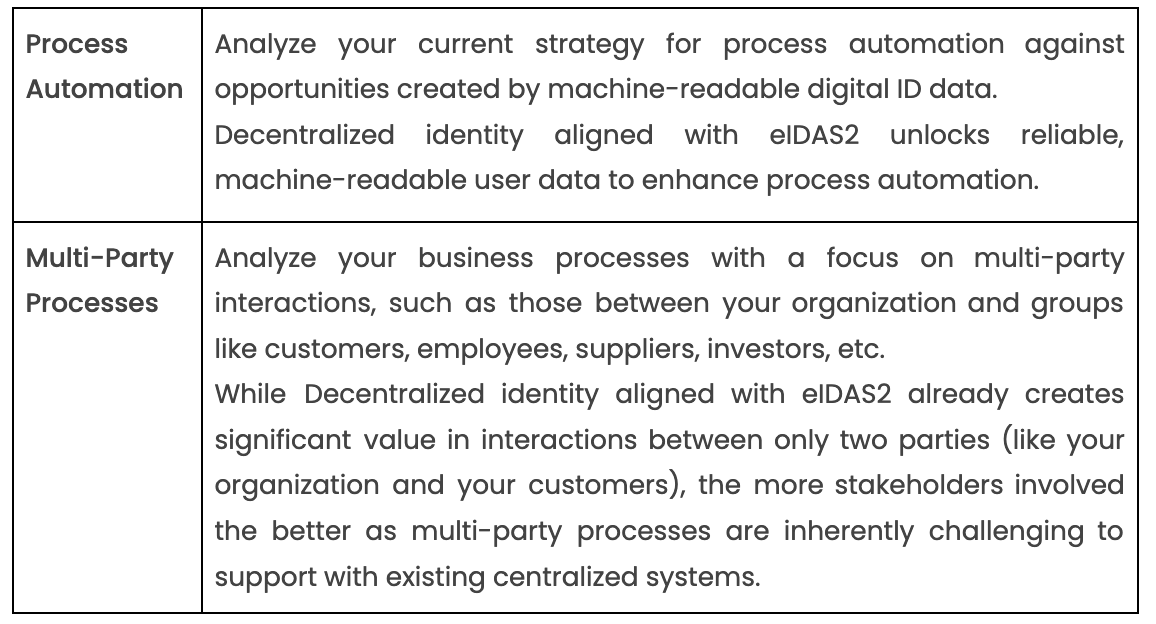 This framework does not provide a conclusive list of categories so will likely discover additional areas specific to your organization or industry. /caption
### Step 3: Select & prioritize use cases
Based on the opportunities and risks you identified, list all use cases relevant to your organization. (The use cases outlined in prior sections may serve as inspiration.)
Once you have a list of all use cases, prioritize them based on your organization’s strategy, challenges and product or service portfolio.
The following 2x2 matrix offers a simple way to prioritize your use cases based on their impact on your organization (Return of Investment) and the ease of implementation (resources, time).
Here’s a few tips on how to use the matrix:
1. **Impact**The most important criteria for the selection of your use case is its potential impact on your organization. Consider the following types of benefits:**Increase revenue**: Streamline user flows such as by eliminating passwords, forms or multi-step identification processes during onboarding or check-out to increase conversion or lower dropout rates.**Lower costs**: Enable online interactions that traditionally required in-person meetings or automate business processes to save costs and resources (e.g. for manual data processing) or even replace third-party services you are currently using to solve related issues with a single, unified solution.**Prevent compliance issues**: Facilitate regulatory compliance especially with regards to personal data processing (e.g. based on the EU General Data Protection Regulation, GDPR) to avoid high penalties and brand damage.**Prevent fraud**: Ensure reliable stakeholder verification and introduce tamper proof digital documents to prevent identity theft or document forgery.**Mitigate security risks**: Eliminate main risk factors that cause data breaches such as passwords or aggregated data storage.**Strengthen your brand**: Offer more seamless user experiences, strengthen security and enhance privacy by giving stakeholders control over their data.**Prevent falling behind competitors**: Finally, consider the impact on your business if competitors adopt SSI before you do.
2. **Ease of Implementation**The effort required to implement your use case will vary depending factors such as:**UI/UX**: Evaluate how different actors in a use case interact and what it would take to offer users a seamless experience with new products or features.**Data**: Identify what kind of data you will use, where and how this data is currently stored, processed and whether it needs to be anonymized.**Deployment**: Evaluate how solutions should be deployed, which environments are used and the system requirements for staging, testing and production.**Integration**: Evaluate the complexity of the business processes and existing IT infrastructure or applications involved in the use cases.**Ownership**: Identify which departments are involved in your use cases and how they make decisions, especially if you require buy-in for implementations.**Buy vs Build**: Evaluate whether you will buy or build, potentially using open source solutions, and how worklead will be distributed among internal or external teams.
### Step 4: Define requirements
Once you have selected your use cases, it is time to define requirements. The following list guides you through important areas of consideration:
1. **Use cases**Your requirements will differ depending on your use cases. Also, use cases will differ in terms of complexity ranging from simple, reusable to highly customized patterns. The definition of user journeys down to user stories are a helpful way to formalize your use cases and define your business requirements.
2. **Roles**Your requirements will differ depending on whether your organization is acting as
- **Issuer** - Organizations who identity credentials to users’ wallets,
- **Wallet Provider** - Organizations who provide wallets to users,
- **Verifier** - organization who verifies identity credentials from users’ wallets
- a mix of these three roles.While most organizations will be adopting two or all three roles described above, some organizations will be more focused on issuance (governments, universities), others on ID wallets (governments, banks, tech) or verification (banks, eCommerce).
**3. Technology**
Once you have determined your business requirements, it’s time to define the technical requirements for making your use cases or applications a reality.
### Step 5: Build vs. Buy
Once you understand your requirements, it’s time to answer the question of whether you should build your own solution (in-house) or buy an existing one?
Ultimately, it all comes down to your resources and timeline. Building decentralized identity solutions in-house requires extensive knowledge about a range of emerging regulations, complex technologies and evolving standards as well as a strong technical team capable of implementing, maintaining and continuously extending it. Moreover, building your own solution will significantly slow down your time to market.
Start by screening the market for solutions that fit your requirements, optionally with the help of experts. Open source solutions are a great way to learn and experiment quickly and without much overhead. Also, they allow you to build your own solution cheaper and faster (compared to starting from scratch). As a result, many organizations follow the approach of buying - open or closed source - infrastructure (libs, SDKs, APIs) and building custom applications on top (inhouse or with partners).
Since technology and vendor selection can be complex, we distilled a few criteria against which organizations across industries evaluate their options:
### Step 6: Launch & Expand
Once you have decided whether you build or buy, it’s time to implement use cases.
Start with low-hanging fruits based on your prioritization (Step 3). We recommend an iterative approach by which you start with a pilot and move to production by introducing one product, feature or use case at a time depending on your business priorities and the way you want to communicate with customers.
Importantly, we recommend to start with use cases that have high impact but are relatively easy to implement (“low hanging fruits”) either because of simpler technical requirements, lower risks (privacy, compliance, brand damage), administrative reasons (existing management buy-in, less departments involved) or others. Often you will find that one use case enables adjacent ones or at least facilitates the implementation of other use cases, such as if they have similar patterns and share technological requirements.
Once you have built up knowledge, successfully delivered first use cases and secured the buy-in of your organization's leadership, you can start tackling high impact projects which are hard to implement (“Impactful transformation”).
In short: Launch low-risks, high-reward use cases. Move from pilot to production and expand use cases as you acquire operational capacities & organizational buy-in.
---
## **About the authors**
**walt.id**
walt.id offers **holistic open source digital identity and wallet infrastructure** used by thousands of developers, governments and businesses across industries. All solutions **ensure compliance with eIDAS2**, various identity ecosystems like EBSI and standards (W3C, ISO, IETF, OIDF).
In addition, walt.id **extensively worked with the EU and Member States**, co-authoring EU’s new ID standards (EBSI, eIDAS2) or serving as technology provider in several EU Large Scale Pilots.
- Website: https://walt.id
- Developer hub: https://docs.walt.id
- Contact:
- Community: [Discord](https://discord.com/invite/AW8AgqJthZ) — [X/Twitter](https://twitter.com/walt_id) — [LinkedIn](https://www.linkedin.com/company/walt-id) — [Youtube](https://www.youtube.com/@walt_id)
**TrustScape**
TrustScape provides expert advice on eIDAS Digital Identity & Trust Services and serves as a trusted advisor for public and private organizations. We advise on the legal and regulatory requirements for eIDAS Wallets, Electronic Identity and Trust Services as well as national digital identity programmes for EU Member States and beyond.
In addition, Trustscape helps with the development of new legal & regulatory requirements and standards development related to eIDAS.
- Website: https://trustscape.eu
- Contact: https://trustscape.eu/contact
- Resources: [https://trustscape.eu/resources](https://trustscape.eu/resources/)
- Community: [LinkedIn](https://www.linkedin.com/company/trustscape/)
---
### Download this eBook
Get the eBook as PDF [here](https://mvtrosz5a6vgwqrp.public.blob.vercel-storage.com/eidas2-is-here.pdf).
### Further Readings
On [Digital Identity](https://walt.id/white-paper/digital-identity.md), [Self-Sovereign Identity (SSI)](https://walt.id/white-paper/self-sovereign-identity-ssi.md); [Non-Fungible tokens (NFTs)](https://walt.id/white-paper/nfts-for-identity.md); [SSI vs. NFTs](https://walt.id/white-paper/ssi-vs-nfts.md)
---
title: "eIDAS2 Implementers Guide — walt.id White Papers"
meta:
description: "Step-by-step implementation guide for eIDAS2 compliance. Role-based requirements for Issuers, Verifiers and Wallet Providers."
"og:description": "Step-by-step implementation guide for eIDAS2 compliance. Role-based requirements for Issuers, Verifiers and Wallet Providers."
"og:title": "eIDAS2 Implementers Guide — walt.id White Papers"
source_url: "https://walt.id/white-paper/eidas2-implementers-guide"
stack: "Applies to both the Community Stack and the Enterprise Stack"
docs: "https://docs.walt.id"
llms_index: "https://walt.id/llms.txt"
generated: "2026-11-23"
---
> Markdown mirror of https://walt.id/white-paper/eidas2-implementers-guide — Applies to both the Community Stack and the Enterprise Stack. Technical docs: https://docs.walt.id (AI index: https://docs.walt.id/llms.txt).
[← All white papers](https://walt.id/white-paper.md)
White Paper
# eIDAS2 Implementers Guide
Tamino BaumannMarch 10, 2026
Step-by-step implementation guide for eIDAS2 compliance. Role-based requirements for Issuers, Verifiers and Wallet Providers.
This guide gives you the why and the how: a clear overview of eIDAS2, the ARF, and the LSPs, followed by role-based responsibilities and step-by-step guidance to achieve compliance—whether you build in-house or use proven solutions.
Get the PDF
Sign up to receive the complete implementers guide as PDF straight to your inbox.
---
## Introduction
This eBook shows you how to make your organization eIDAS2-compliant, following a simple structure:
1. **Learn**: a high-level overview of eIDAS2 and the core terms—the Architecture and Reference Framework (ARF), Large-Scale Pilots (LSPs), the Implementing Acts, and the PID—plus a timeline so you know exactly when compliance is required.
2. **Plan**: the use cases eIDAS2 enables; the ecosystem actors (Issuers, Verifiers, and Wallet Providers) and the responsibilities, requirements, and go-to-market options for whichever role your organization falls into.
3. **Build**: a deep dive into each role (Issuer, Verifier, Wallet) and their sub-types—such as issuers of PID, PuB-EAA, QEAA, and EAA, and wallets (eIDAS2-certified and organizational/commercial)—with concrete technical requirements so you can start building.
Once you have read this eBook, you should be well equipped to start your eIDAS2 journey and will be able to ensure compliance before the upcoming regulatory deadlines.
## Learn | eIDAS2
### The problem eIDAS2 solves
In 2016 the eIDAS (electronic Identification, Authentication and Trust Services) regulation created a framework for cross‑border electronic identification. It focused on a small set of trust services, notably electronic signatures, and left wide latitude to Member States. As a result, national implementations diverged, interoperability remained limited and citizens lacked a harmonised digital identity. During the pandemic, physical presence requirements made identity proofing difficult and fragmentation slowed adoption beyond the public sector.
### The eIDAS2 regulation
**eIDAS2** (Regulation (EU) 2024/1183) was created to address these shortcomings by introducing **European Digital Identity (EUDI) wallets** for every EU citizen. Its main goals are to provide user‑controlled digital identities, reduce fraud and enable trustworthy digital interactions across borders.
Under eIDAS2:
- Governments must issue digital identity credentials and provide wallets.
- Citizens receive a **Person Identification Data (PID)** credential from their Member State as well as other types of identity credentials .
- Businesses are required to accept these credentials for onboarding and authentication.
- High levels of **security and privacy** are mandated and compliance is audited.
- Wallets support **selective disclosure** so users can share only what is necessary.
The regulation effectively **bootstraps the market** by forcing the issuance and acceptance of digital identity credentials in all EU member states. This accelerates adoption and lowers the “cold‑start” barrier for decentralised identity solutions.
If you want to learn more about eIDAS2 and its impact on governments and business across industries, check out our [“eIDAS2 is here” ebook](https://walt.id/white-paper/eidas2.md).
### The Architecture and Reference Framework (ARF)
The **Architecture and Reference Framework (ARF)** is the technical companion to eIDAS2 describing how the “law” could be implemented in practice. It defines:
- **High-level requirements** for each party (Issuer, Relying Parties aka. Verifiers and Wallet Providers).
- **How parties must interact** to ensure ecosystem security, user privacy and EU-wide interoperability.
- **Common schema catalogues and a shared trust infrastructure** (with issuer catalogues) to ensure the authenticity and reliability of digital interactions.
The ARF is published on the official EUDI Wallet Dev Hub (GitHub) [here](https://eu-digital-identity-wallet.github.io/eudi-doc-architecture-and-reference-framework/latest/), with releases and updates announced on the European Commission's EUDI Wallet site [here](https://ec.europa.eu/digital-building-blocks/sites/spaces/EUDIGITALIDENTITYWALLET/pages/694487738/EU+Digital+Identity+Wallet+Home).
### The Large-Scale Pilots (LSPs)
The **Large-Scale Pilots** (LSPs) are EU-funded, cross-border projects that **implement the ARF in real services**. They validate protocols (OID4VCI/OID4VP, ISO/IEC 18013-5/-7), data formats (SD-JWT VC, mDL, selected W3C VC profiles for EAAs), Wallet Unit components (WSCD, WUA/WIA/WTE) and end-to-end user journeys across Member States.
Four LSPs have been successfully concluded (POTENTIAL, EWC, NOBID, DC4EU) while two (APTITUDE, WE BUILD) started in 2025 and are currently active. More details on each LSPs focus below:
- **POTENTIAL** - Pilots the EUDI Wallet across six sectors: government services, banking, telecom, mobile driving licence, electronic signatures, and health; runs cross-border interoperability tests (e.g., mDL and e-prescription trials).
- **EWC** - Focused on Digital Travel Credentials (DTC) and end-to-end travel flows, building on the Commission’s reference wallet.
- **NOBID** - Concentrates on the payments use case for domestic and cross border usage with the wallet, piloted by Nordic-Baltic countries plus Italy and Germany.
- **DC4EU** - Targets education, professional credentials/qualifications, and social security, providing feedback to the Commission on interoperability and scalability.
- **APTITUDE** - Tests the wallet across a broad range of use cases including travel and mobile vehicle registration certificates (mVRC); aims to demonstrate interoperability, usability and scalability.
- **WE BUILD** - Focuses on business and payment use cases that streamline B2B, B2G, and B2C processes.
The findings of LSPs (interoperability gaps, edge-case UX, policy clarifications) will feed back into the ARF.
### The Implementing Acts
The implementing acts turn the high-level eIDAS2 regulation into **concrete rules and laws** building on top of the ARF and the LSP results. The rules come in dedicated regulations (list below & in Annex)–**covering core functionality, protocols, PID/EAA data handling, certification, notifications and registers**–everything needed so ID wallets (and their ecosystem) can become a reality across member states.
Below is an excerpt of the list of already adopted regulations. In the Annex you can find the full list.
- (EU) 2024/2979 — Integrity & core functionalities of EU Digital Identity Wallets.
- (EU) 2024/2982 — Protocols and interfaces to be supported by the EU Digital Identity Framework.
- (EU) 2024/2977 — Person Identification Data (PID) & Electronic Attestations of Attributes (EAAs) issued to wallets.
### The PID
The **Person Identification Data (PID)** is a special type of digital credential defined under the eIDAS2 regulation. It’s issued by appointed institutions (“PID Providers”) in each member state to their citizens and will act as the core “digital ID” that is recognised across member states. A PID will be required to “activate” and use an eIDAS2 certified wallet.
**Mandatory attributes of a PID:**
- Family Name
- Given Name
- Birth Date
- Birth Place
- Nationality
**Optional attributes of a PID include:**
- Resident Address
- Resident Country
- Resident State
- Resident City
- Resident Postal Code
- Resident Street
- Resident House Number
- Personal Administrative Number
- Portrait
- Family Name Birth
- Given Name Birth
- Sex
- Email Address
- Mobile Phone Number
_Note: The mandatory and optional attributes of a PID are defined in the (EU) 2024/2977 regulation._
### The Timeline
While eIDAS2 entered into force in May 2024. Governments and businesses will have till the end of 2026 or 2027 to become fully compliant.
#### Governments (Member States)
- Must launch at least one EUDI wallet per member state by the end of 2026.
- Must ensure qualified trust service providers (QTSPs) have a way to verify required user attributes against authentic sources by the end of 2026
- Must ensure public-online services that already ask for eID/auth today, accept EUDI wallets once available.
#### Businesses (Relying Parties - Verifiers)
- **Private-Sector businesses** that require e.g. strong user authentication (e.g. transport, energy, banking/financial services, …) and are not micro or small enterprises (< 50 employees & ≤ €10 million annually), must enable EUDI wallet usage for user authentication (sign-in, step-up auth, onboarding) by the end of 2027.
- **Very Large Online Platforms** (≥ 45 million average monthly users in the EU) must accept EUDI wallets for user authentication (sign-in, step-up auth, onboarding).
The timelines and use cases above mark when organisations and Member States must comply by law. But they’re only the starting point. As millions of users gain access to a digital ID wallet, businesses can deploy many more use cases to cut costs, streamline processes, reduce fraud and deliver a better UX. The businesses that move quickly can gain a first-mover advantage in the space.
## Plan | Steps to Get Started with eIDAS2
In the upcoming section, we look at the various use cases that digital IDs under eIDAS2 enable and help you decide which of these might be a good starting point for your organization.
As any digital ID ecosystem consists of actors (Issuers, Verifiers, and Wallet Providers), we will also explore who they are—their responsibilities and requirements.
Finally, we will look at the options for bringing a working solution to market.
### Use Cases
Digital identity will touch virtually every sector and industry across the EU. From governments to businesses, the opportunities are immense:
- cutting costs,
- streamlining operations,
- automating manual processes,
- reducing fraud and creating
- more seamless user experiences.
The most common ones—and those legally required under eIDAS2(as discussed in “The Timeline” section)—center around user authentication. This includes:
- sign-in/sign-up,
- step-up authentication (extra-auth),
- user onboarding in general.
To understand the impact, let’s take a closer look at the user onboarding journey and compare how it works today versus how it will work with digital IDs:
**Beyond Authentication**
While authentication and onboarding are the starting point, there are various other use-cases that digital IDs will unlock across industries. A few examples include:
| Industry | Use-Cases |
| --- | --- |
| Financial services | Streamlined KYC/AML checks
Faster account opening
Secure digital signatures for contracts |
| Healthcare | Secure patient identification
Consent management
Cross-border health record access |
| Education | Issuance of diplomas and certificates as verifiable credentials
Student discounts with strong assurance
Micro-credentials |
| Travel & Mobility | Seamless check-ins
e-ticketing
Digital Travel Credentials (DTCs) |
| Public services | Access to benefits
Tax filings
Permit applications |
| Employment | Verified professional credentials
Automated right-to-work checks
Smoother HR onboarding |
| eCommerce & Retail | One-click checkout with verified payment details
Secure proof-of-age for restricted goods
Loyalty programs tied to verified identities |
| Real estate & Housing | Verified tenant background checks
Digital lease agreements
Automated proof of income or employment |
| Telecommunications | Simplified SIM card registration
Contract signing |
| Legal & Notarial Services | Verified power of attorney
Notarized deeds
Company formation documents as qualified credentials |
### How to Pick a Use Case
Generally speaking, if you are a government or technology provider for governments, use-cases with a legal deadline (as explained in “The Timeline" section) become the highest priority. The same goes for larger businesses that require strong user auth and don’t fall under the exemption rule of micro or small enterprises.
That being said, the highest priority use-cases are:
1. **Wallets** | Actor: Wallet Provider
Governments (each member state) must provide an eIDAS2 compliant wallet solution by the end of 2026.
1. **Online User Authentication** | Actor: Relying Party (Verifier)
Large businesses must enable user-auth with wallets by the end of 2027 while Very Large Online Platforms and public-services (e.g., government services) must enable it as soon as wallets are available (approx. end of 2026).
_For detailed user flows, please see the Use-Case section above._
1. _**Use case without a regulatory deadline**_
All other use-cases don’t have a legal deadline and can therefore be prioritized on a case-by-case basis. As a helper, you can use the following matrix.
Here’s a few tips on how to use the matrix:
_You can find a more detailed list for prioritizing use cases in the Annex._
### Explained: Issuer, Verifier, Wallet Provider
Below, we define Issuer, Verifier and Wallet Providers–the required actors for any digital ID ecosystem–and their responsibilities and high-level requirements under eIDAS2. The more detailed technical requirements, we will discuss in the upcoming “Build” section.
#### The Issuer
Issuers are governments and/or businesses that **attest claims about a user or legal entity (e.g. name, VAT ID) in the form of a digital credential**, also called Electronic Attestations of Attributes (EAAs) in eIDAS2 terms. These credentials are a piece of data that is cryptographically signed by a key only the issuer controls and verified using the public counterpart of the key. Trust is established through official lists and registries each actor (Issuer, Verifier and Wallet Provider) must be listed on in order to be trusted by other actors in the ecosystem. The credential data format will follow technical standards such as mdoc/mDL, SD-JWT VC IETF and/or W3C VC v2.0 and are delivered over the internet to end-users using protocols like OID4VCI/ISO-18013-7.
Under eIDAS2 the credentials (attestations) issuers can issue are divided into five categories:
1. **Person Identification Data (PIDs)** - PIDs are the core “digital ID” attribute set (e.g. name, address, nationality, …) every wallet user gets issued by the PID Providers in each member state.
2. **Legal Person Identification Data (LPIDs)** - LPID is the counterpart for natural persons PID for legal persons (e.g. companies, organisations, institutions) also issued by the PID Providers in each member state.
3. **Public Body Authentic Source Electronic Attestation of Attributes (PuB-EAAs)** - PuB-EAAs are official documents (e.g. birth certificate, residence permits, tax IDs) in their digital form and they hold the same legal value as their paper counterpart. They are issued by registered PuB-EAA providers.
4. **Qualified Electronic Attestation of Attributes (QEAA)** - QEAAs are attestations whose attributes are verified against authentic sources (e.g. company formation documents sourced from a Companies Register). They also hold the same legal value as paper documents. They are issued by registered qualified trust service providers.
5. **Non-Qualified Electronic Attestation of Attributes (EAAs)** - are all other types of attestations (e.g. boarding passes, online learning badges, membership cards, gym passes). They are issued by non-qualified trust service providers.
The concrete attributes (e.g. name, address, …) of each credential type (e.g. PID, QEAA, EAA) and sub-type (e.g. birth certificate, boarding pass) will be defined via so-called rulebooks. The rulebook, next to the schema of the credential, might also define sector specific rules (e.g. for banking) and information on if a credential must be revocable or not.
Some sectors go further than rulebooks and have binding sector specifications. In banking, for example, the European Commission published Technical Specification 12 (TS12) in December 2025, defining how the EUDI Wallet performs Strong Customer Authentication (SCA) under PSD2. For a sector-specific breakdown of the obligations, deadlines, and credential types relevant to banks and financial institutions, see our [eIDAS 2 for financial services](https://walt.id/eidas2/financial-services.md) guide.
In the table below you will find the high-level requirements overview for each issuer of the different attestation types.
| Requirement | PID/LPID | PuB-EAA | QEAA | EAA |
| --- | --- | --- | --- | --- |
| Register as Issuer (become trusted actor in the ecosystem) | ✅ | ✅ | ✅ | ✅ |
| User Identity Proofing with Level of Assurance High before issuance | ✅ | ✅
(can use PID for LoA) | ✅
(can use PID for LoA) | –
(depends on the rulebook) |
| Authentication of the wallet before issuance | ✅ | ✅ | ✅ | ✅ |
| Support credential standards ISO/IEC 18013-5 & SD-JWT VC (IETF) | ✅ | ✅ | ✅ | ✅ |
| Support credential standards W3C VC VCDM v2.0 | – | – | – | ✅ |
| Support for the OID4VCI / ISO-18013-7 issuance protocols | ✅ | ✅ | ✅ | ✅ |
| Issued credential must contain a status (e.g., revocation if validity > 24h) | ✅ | ✅ | ✅ | –
(depends on the rulebook) |
| Ensure alignment with attestation rulebook | ✅ | ✅ | ✅ | ✅ |
| Provide embedded disclosure policies which specify who (relying party) may receive the credential | - | Optional | Optional | Optional |
#### The Verifier (Relying Party)
Verifiers are **governments and/or businesses that want to request and verify a set of claims about a user (e.g. is over 18).** Verifiers, like Issuers, will need to be registered in order to be trusted by the wallet. They will need to support the required credential exchange protocols like OID4VP/ISO-18013-7 for online verifications and ISO-18013-5 for offline verification depending on their use-case. As well as, be able to interpret the different credential formats and types (e.g. mdoc/mDL, SD-JWT VC IEFT, W3C VCDM v2.0).
In the table below we will see the high-level requirements overview for relying parties depending on if they operate online or offline.
| Requirement | Online | Offline |
| --- | --- | --- |
| Register as Verifier (become a trusted actor in the ecosystem) and state which attributes you want to request. | ✅ | ✅ |
| Support credential standards SD-JWT VC (IETF) & W3C VC VCDM v2.0 | ✅ | – |
| Support credential standards ISO/IEC 18013-5 | ✅ | ✅ |
| Support for the OID4VP / ISO-18013-7 verification protocols | ✅ | – |
| Support ISO-18013-5 verification protocol (offline) | – | ✅ |
| Ensure to request only attributes listed during registration | ✅ | ✅ |
| Validate presented credential (signature check, user binding check, rulebook-specific checks, …) | ✅ | ✅ |
| Keep logs relating to an identity matching process and its outcome (max 12 months) | ✅ | – |
| Support pseudonym authentication (if user identity not required by service) | ✅ | – |
| Allow remote presentation via the W3C Digital Credentials API once the API is fully standardised & supported | ✅ | – |
#### The Wallet Provider
Wallet providers under eIDAS2 are either
- **member states** or
- **certified organisations that offer wallets to users**.
They must only deliver the software (the Wallet Instance) _and_ ensure it fulfills all security requirements to reach Level of Assurance “High”. They are responsible for issuing Wallet Unit Attestations which are digital credentials stating the technical capabilities of the wallet during the wallet activation process. The attestation will be used in exchanges with other ecosystem participants such as Issuers to establish trust. Also, wallet providers must ensure the wallet supports all required exchange protocols (e.g. OID4VCI) and credential formats (e.g. mdoc/mDL). They must manage the whole lifecycle of wallets from installation, activation, management and uninstallation, while ensuring the user retains sole control over their digital IDs.
Next to the certified wallet providers, there will also be a market for **non-certified wallets for consumers or businesses** use cases where certification is not required. Organisations that already have a strong, trusted user base could enhance their apps with wallet capabilities and thereby become an even stronger focus in the everyday life of their users. Every time users need to access their credentials, they’ll open their ID wallet app, deepening engagement and opening moments for value capture. Early movers in industries like **banking and finance, tech and telecommunications, social media and large platforms, travel, education and health care** providers therefore greatly benefit from increased app usage by becoming an everyday identity hub for their users and their digital lives.
In the table below we will see the high-level requirements overview for wallet providers (certified or non-certified).
| Requirement | Certified | Non-Certified |
| --- | --- | --- |
| Distribute the wallet solution via the official OS app stores or side-loading. | ✅ | ✅ |
| Enforce OS-level user auth | ✅ | Optional |
| Prompt user for provider account setup + link account to wallet unit instance | ✅ | Optional |
| Use device WSCA or deploy remote HSM for key management | ✅ | ✅ |
| Activate wallet unit only if at least one WSCA/WSCD is certified for LoA. | ✅ | Optional |
| Issue Wallet Unit Attestation (WUA) | ✅ | Optional |
| Support credential standards ISO/IEC 18013-5 & SD-JWT VC (IETF) & W3C VC VCDM v2.0 | ✅ | No requirement for all types |
| Support for the OID4VP/ISO-18013-7 verification protocols | ✅ | No requirement for all standards |
| Support for the OID4VCI/ISO-18013-7 issuance protocols | ✅ | No requirement for all standards |
| Provide Trust Mark View (user can verify certification status) | ✅ | – |
| Ingest & use trusted lists | ✅ | Optional |
| Publish trust anchor & enable trust processing by other parties (e.g. Issuers) | ✅ | Optional |
| Present requested attributes & party details when user interacts with relying parties | ✅ | Optional |
| Maintain a transaction log of actions (presentation, issuance) available for users | ✅ | Optional |
| Provide backup, recovery, migration options | ✅ | Optional |
| Support pseudonyms and passkeys | ✅ | Optional |
| Enable users to create qualified electronic signatures/seals | ✅ | Optional |
| Enable issuance & remote presentation via the W3C Digital Credentials API once the API is fully standardised & supported | ✅ | Optional |
| Revocation and suspension management (e.g., user or PID provider requests revocation) | ✅ | Optional |
| Undergo conformity assessment by an accredited body and obtain a certification | ✅ | – |
#### Should my Organization be an Issuer, Verifier or Wallet Provider?
To understand into which role (Issuer, Verifier or Wallet Provider) your organization falls, let’s look at the following:
#### Issuer
| | |
| --- | --- |
| Guiding Question | Do we manage or control data that could be issued as a digital credential? |
| You're in this role if… | The data your org holds has legal, commercial, or operational value for you, partners, or the market. |
| Typical Examples | Government authority issuing PIDs, university issuing diplomas, health provider issuing insurance cards. |
_Note: For more details on the type of issuer your organization might be (PID/LPID, QEAA, EAA) refer to the “Build” section._
#### Verifier (Relying Party)
| | |
| --- | --- |
| Guiding Question | Do we need to authenticate users or validate claims about them? |
| You're in this role if… | You must check identity attributes or entitlements to deliver a service or meet compliance needs. |
| Typical Examples | Bank verifying income statements, healthcare provider checking patient data, online platform requiring strong auth. |
#### Wallet Provider
| | |
| --- | --- |
| Guiding Question | Do we want to provide end-users with a digital wallet to store and present credentials? |
| You're in this role if… | You plan to ship and maintain a wallet app/service for users. |
| Typical Examples | eIDAS2-certified citizen wallets; non-certified enterprise/consumer wallets bundled with a product or service. |
_Note: An organization may hold multiple roles at the same time (e.g. acting both as an Issuer and a Verifier)._
### Build vs. Buy
Now that you have a good understanding of the roles, high-level requirements and use cases, it is time to ask the question of whether you should build your own solution (in-house) or buy an existing one.
There are three options to choose from:
1. **Build apps, buy infra** (only build UI and apps, outsource infrastructure)
2. **Build apps, own infra** (use open source to own the infrastructure)
3. **Build everything** (build and maintain the whole stack in-house)
Each option comes with advantages and disadvantages:
#### What “build everything” really entails
Implementing an eIDAS2-aligned solution in-house means tackling multiple domains. Teams must implement and stay up-to-date with:
- **Credential standards:** ISO/IEC 18013-5, SD-JWT VC (IETF), W3C VCDM 2.0
- **Exchange protocols:** ISO/IEC 18013-7, OID4VCI, OID4VP
- **Key management:** integrate a KMS or build your own
- **Revocation:** sign/manage/publish Attestation Status/Revocation Lists
- **Data sourcing:** connect authentic sources/DBs for issuance data
- **Disclosure policies:** embed EDPs at issuance; interpret at verification
- **Privacy measures:** e.g. avoid correlating issuance batches
- **Certification management:** access certificates for issuers/verifiers and audits
- … all of this is in addition to a product’s own applications and business logic.
#### The model most teams adopt: Build Apps, Buy/Own Infrastructure
Governments and businesses must adopt digital ID wallets, but struggle with:
- **Urgency** from regulatory deadlines and competitive/customer pressure
- **Limited talent pool** (protocols & standards) for building in-house
- **Technical complexity** (PKI, KMS, sigs, credentials, protocols) raising failure risk
- **Fast-moving standards** (W3C, OIDF, ISO, IETF, …) inflating maintenance cost
- **Compliance risks** (e.g. from eIDAS2) increasing audit scope and liability
Most organizations want to **launch applications and solutions quickly** **without owning technical and regulatory complexity and risks.**
As a result, most organizations use existing infrastructure (open or closed-source) and build custom apps on top (inhouse or with partners). They prefer (open source) infrastructure that can be operated by themselves (“self-managed”) to maximize control, while offloading the most significant implementation work and complexity to existing solutions in order to reduce costs, risk and speed up time to market.
A starting point when it comes to open source solutions are e.g. the [EUDI Wallet Reference Implementation](https://github.com/eu-digital-identity-wallet/.github/blob/main/profile/reference-implementation.md) (B2C wallet app) or the [walt.id Community Stack](https://walt.id/community-stack.md) (Issuer, Wallet, Verifier). When it comes to closed-source options you can take a look at the [walt.id Enterprise Stack](https://walt.id/enterprise-stack.md).
Since technology and vendor selection can be complex, we also created a checklist based on how other organizations across industries evaluate their options:
You can find a detailed checklist for technology and vendor evaluation in the Annex.
## Build | Issuer, Verifier, Wallet & Technical Requirements
In this section, we take a closer look at the roles (Issuer, Verifier, Wallet Provider) introduced earlier. We’ll explore each role in more detail and outline the specific technical requirements they must meet. This will give you the knowledge for building your chosen use case.
### Issuers
#### PID/LPID Providers (natural/legal person identifiers)
PID providers are organizations appointed by member states to issue PIDs/LPIDs. PIDs act as the core identity data credential which each eIDAS2 wallet must hold in order to be valid. “LPIDs” are the core identity data for legal persons.
The data set in the PID/LPID is officially defined, trusted and acts as the user's “digital ID” across all member states.
**The PID:**
For a detailed overview of the attributes of a PID, please refer to the section “The PID” at the beginning of this document
**The LPID:** Mandatory attributes of an LPID:
- Current Legal Name
- Unique Identifier constructed by the issuing Member State (compliant with cross-border specifications)
Optional attributes of an LPID include:
- Current Address
- VAT Registration Number
- Tax Reference Number
- European Unique Identifier (Directive (EU) 2017/1132)
- Legal Entity Identifier (LEI)
- Economic Operators Registration And Identification (EORI) Number
- Excise Number
_Note: The mandatory and optional attributes of a PID/LPID are defined in the annex of the (EU) 2024/2977 regulation._
Organizations that want to become a PID provider need to fulfill the following requirements:
| Requirement | Details |
| --- | --- |
| Identity proofing and LoA | PID providers must verify the identity of the wallet user at Level of Assurance (LoA) High.
**Typical methods include:**
- In-person or remote document verification
- Biometric checks
- Liveness tests
|
| Wallet unit attestation verification | Before issuing a PID, the provider must authenticate the wallet unit.
**Required checks:**
- Verify the Wallet Unit Attestation (WUA) signature
- Confirm that the WUA has not been revoked
- Check that the wallet possesses the private key corresponding to the WUA’s public key
- Validate WSCD properties to ensure LoA High
|
| Issuance protocol and formats | - Implement OpenID for Verifiable Credential Issuance (OID4VCI) with the HAIP profile.
- Support credential formats:
- ISO/IEC 18013-5
- SD-JWT VC (IETF)
- Support ISO/IEC 18013-7 for _mdoc_ remote flows.
- Ensure the credential is cryptographically bound to the wallet’s WSCD.
- Embed the wallet’s public key into the credential and sign it (provider action).
|
| Status management & revocation | - Maintain a revocation mechanism.
- Publish status information (no access control) so relying parties can check validity:
- Attestation Status Lists or an Attestation Revocation List mechanism
- **Align PID validity with WUA status:** Because Article 5 of the implementing regulation requires revoking a PID if the wallet unit is revoked, the PID’s validity period must not exceed that of the WUA.
- Support:
- Short-lived credentials (validity < 24 hours)
- Continuous status monitoring (if WUA is revoked, PID should also be revoked)
- Revocation on user request
|
| Registration and trust lists | - Register as a PID provider with a national Registrar.
- Obtain an access certificate and have the provider’s trust anchor published on the relevant trusted list.
- **Enable verification by relying parties:** Publishing the trust anchor allows relying parties to verify signatures over PIDs.
- Include the access certificate in the OID4VCI issuer metadata and sign the metadata with the corresponding private key.
- **Wallet usage:** Wallets use this information to verify the authenticity of the provider.
|
| PID Content and Data Integrity | - Align with the PID Rulebook (structure, identifiers, encoding, metadata for mandatory/optional attributes).
- Ensure all unique elements within a PID are unique across all PIDs issued by the provider.
- Ensure attested attributes remain valid for the identified PID subject at all times during the PID’s validity period.
|
| Privacy Enhancing Measures for Presentation | - For batch issuance, prevent timestamps from revealing that PIDs came from the same batch (e.g., use sufficiently imprecise timestamps for herd privacy).
- Define a policy to limit presentations (e.g., once-only, limited-time, rotating-batch, or per-Relying-Party attestations).
|
#### PuB‑EAA and QEAA providers
**PuB-EAA providers** are public-sector bodies (public authorities) that want to issue their official documents as digital credentials. These digital credentials will hold the same legal status as their paper originals.
Examples include:
- **Government authorities** - Ministries, Registries, Municipalities
- **Civil registries** - Birth certificates, marriage certificates, death certificates
- **Immigration & residence authorities** - Passports, visas, residence permits
- **Tax authorities** - Tax IDs, income/tax reports
- **Social security agencies** - Social insurance numbers, health cards
- **Driver licensing authorities** - Driving licenses, vehicle registrations
- **Public universities (for diplomas with legal effect)** - Degrees recognized in law
**QEAA providers** are certified private businesses or organizations that want to issue digital credentials containing official and verified data sets from public authorities (authentic sources). QEAA providers need to be Qualified Trust Service Providers, otherwise their issued digital credentials are EAAs from an eIDAS2 point of view.
Examples include:
- **Identity Verification Companies (IDVs)** - Postal identity services or remote-ID providers authorized to attest identity/residence as digital credentials (e.g., Post-ID/Video-ID operators).
- **Accredited testing & inspection bodies (TIC)** - Roadworthiness/vehicle inspection centers, metrology & conformity-assessment labs issuing statutory certificates.
- **Corporate service providers acting on official data** - Company registrars’ agents or trust/corporate service providers attesting director/representative roles and UBO status against the business register.
- **Accredited private universities / schools (state-recognized)** - Degrees/diplomas with legal effect.
- **Notaries / civil-law notaries** - Notarial deeds, certified copies, company formation documents, or powers of attorney.
Organizations that want to become a PuB-EAA or QEAA provider need to fulfill the following requirements:
| Requirement | Details |
| --- | --- |
| Identity proofing and LoA | - QEAA and PuB-EAA providers often need to verify the user’s identity before issuing QEAA(s).
- They may use the user’s PID to perform this verification at LoA High.
- PuB-EAA providers are not QTSPs, but rely on a qualified certificate (issued by a QTSP) to sign attestations.
**Note:**PuB-EAA providers, which are public sector bodies (such as government agencies) responsible for issuing electronic attestations of attributes, are not themselves Qualified Trust Service Providers (QTSPs). However, to ensure the trustworthiness and legal effect of the attestations they issue, a PuB-EAA provider obtains a qualified certificate from a QTSP. This qualified certificate then allows the PuB-EAA provider to legally and securely sign their attestations. When a third party (Relying Party) verifies such an attestation, they check the signature of the PuB-EAA provider (which is based on the certificate issued by the QTSP) and also verify the QTSP's certificate |
| Wallet unit attestation verification | Before issuing a QEAA/PuB-EAA attestation, the provider must authenticate the wallet unit.
**Required checks:**
- Verify the Wallet Unit Attestation (WUA) signature.
- Confirm that the WUA has not been revoked.
- Check that the wallet possesses the private key corresponding to the WUA’s public key.
- Validate WSCD properties to ensure LoA High.
|
| Issuance protocol and formats | - Implement OpenID for Verifiable Credential Issuance (OID4VCI) with the HAIP profile.
- Support credential formats:
- ISO/IEC 18013-5
- SD-JWT VC (IETF)
- Support ISO/IEC 18013-7 for _mdoc_ remote flows.
- Ensure the credential is cryptographically bound to the wallet’s WSCD.
- Embed the wallet’s public key into the credential and sign it (provider action).
|
| Status management & revocation | - Maintain a revocation mechanism.
- Publish status information (no access control) so relying parties can check validity:
- Attestation Status Lists or an Attestation Revocation List.
- Support:
- Short-lived credentials (validity < 24 hours).
- QEAA and PuB-EAA revocation on user request.
- **Optional:** If using revocation chaining (revoking attestations when the WUA is revoked, similar to PIDs), ensure the attestation’s expiry does not exceed the WUA’s used during issuance, and perform continuous status monitoring.
|
| Registration and trust lists | - Register as a QEAA and PuB-EAA provider with a national Registrar.
- Obtain an access certificate and have the provider’s trust anchor published on the relevant trusted list.
- **Enable verification by relying parties:** Publishing the trust anchor allows relying parties to verify QEAA/PuB-EAA signatures.
- Include the access certificate in the OID4VCI issuer metadata and sign the metadata with the corresponding private key.
- **Wallet usage:** Wallets use this information to verify provider authenticity.
|
| QEAA and PuB-EAA Content and Data Integrity | - Align with applicable Attestation Rulebooks (structure, identifiers, encoding, metadata; each attestation has its own rulebook).
- Ensure all unique elements inside a QEAA/PuB-EAA are globally unique across all such attestations issued by the provider.
|
| Embedded disclosure policies | - Optionally embed policies specifying which relying parties may receive the QEAA/PuB-EAA.
- When present, the wallet enforces these policies during presentation in compliance with data-protection law.
- Types of policies:
- No policy
- Authorised relying parties only
- Specific root of trust
|
| Privacy Enhancing Measures for Presentation | - For batch issuance, prevent timestamps from revealing that QEAA/PuB-EAAs came from the same batch (e.g., use sufficiently imprecise timestamps for herd privacy).
- Define a policy to limit presentations (e.g., once-only, limited-time, rotating-batch, or per-Relying-Party attestations).
|
| Attribute sourcing | - Maintain interfaces to authentic sources (e.g., tax authorities, registries) to verify attributes.
- When a wallet requests a QEAA or PuB-EAA:
- Fetch attributes from the authentic source.
- Ensure the accuracy of fetched attributes.
- Include the verified attributes in the attestation.
|
#### Non-Qualified EAA Provider
Non-Qualified EAA Providers are all types of private-sector businesses and organizations that want to issue digital credentials to streamline operations, reduce costs, and improve the user experience.
Examples include:
- **Commerce & Retail** → loyalty cards, memberships, discount programs
- **Banking & Finance** → customer onboarding, KYC-light checks, account access
- **Travel & Hospitality** → hotel check-in, boarding passes, car rentals
- **Events & Entertainment** → concert tickets, festival wristbands, sports passes
- **Education & Training** → course completion certificates, student IDs, online learning badges
- **Workforce & HR** → employee badges, professional training credentials, workplace access
- **Telecommunications & Utilities** → SIM registration, service contracts, customer identification
- **Insurance** → policyholder cards, claims process credentials
- **Mobility & Transport** → public transport passes, bike/scooter rentals, parking permits
- **Clubs & Associations** → membership cards, gym passes, NGO or community access
Organizations that want to become a Non-Qualified EAA provider need to fulfill the following requirements:
| Requirement | Details |
| --- | --- |
| Identity proofing and LoA | - Identity proofing is not fixed by the ARF; it’s set by the applicable Attestation Rulebook / sectoral framework for that EAA.
- When identity proofing is required, providers can leverage the user’s PID to identify/authenticate at LoA High by verifying PID attributes (described in the ARF for QEAA; Rulebooks may allow a similar approach for non-qualified EAAs).
- Not all EAAs are person-bound (e.g., vouchers); in such cases, personal identity proofing may not apply.
|
| Wallet unit attestation verification | Before issuing an EAA attestation, the provider must authenticate the wallet unit.
**Required checks:**
- Verify the Wallet Unit Attestation (WUA) signature.
- Confirm that the WUA has not been revoked.
- Check that the wallet possesses the private key corresponding to the WUA’s public key.
- Validate WSCD properties to ensure LoA High or Substantial (per attestation type and provider policy).
|
| Issuance protocol and formats | - Implement OpenID for Verifiable Credential Issuance (OID4VCI) with the HAIP profile.
- Support credential formats:
- ISO/IEC 18013-5
- SD-JWT VC (IETF)
- W3C Verifiable Credentials Data Model v2.0
- Support ISO/IEC 18013-7 for _mdoc_ remote flows.
- Ensure the credential is cryptographically bound to the wallet’s WSCD.
- Embed the wallet’s public key into the credential and sign it (provider action).
|
| Status management & revocation | - The applicable Rulebook decides revocability. If revocable, maintain a revocation mechanism.
- Publish status information (no access control) so relying parties can check validity.
- Use the method specified in the Rulebook (e.g., Attestation Status Lists, Attestation Revocation List, or short-lived credentials < 24h).
- Have a revocation policy; revoke on compromise and when attributes change while the EAA remains valid for ≥ 24h.
- Support revocation of EAA on user request.
- **Optional:** Revoke EAA if the Wallet Unit is revoked (revocation chaining).
|
| Registration and trust lists | - Register as a Non-Qualified EAA provider with a national Registrar.
- Obtain an access certificate.
- For Non-Qualified EAAs, the provider’s trust anchor is not automatically published on the relevant trusted list; the Rulebook must define how RPs obtain and trust your EAA signing trust anchor (e.g., domain-specific list).
- Include the access certificate in the OID4VCI issuer metadata.
- Sign the issuer metadata with the private key corresponding to the access certificate.
|
| EAA Content and Data Integrity | - Align with the applicable Attestation Rulebook specifying structure, identifiers, encoding, and metadata for required/optional attributes.
- Ensure all unique elements within an EAA have values unique across all EAAs issued by that provider.
|
| Embedded disclosure policies | - Optionally embed disclosure policies specifying which relying parties may receive the EAA.
- When present, the wallet enforces these policies during presentation; ensure they comply with data-protection law.
- Types of policies:
- No policy
- Authorised relying parties only
- Specific root of trust
|
| Privacy Enhancing Measures for Presentation | - For batch issuance, prevent timestamps from revealing that EAAs came from the same batch (e.g., make timestamps sufficiently imprecise for herd privacy).
- Define a policy limiting presentations (e.g., once-only, limited-time, rotating-batch, or per-Relying-Party attestations).
|
### Wallet Providers (Certified)
**Wallet Provider:** A Member State or an organisation mandated/recognised by a Member State that provides the EUDI Wallet solution—operating the wallet for users and issuing wallet attestations/trust evidence for its management and authentication.
**Wallet Unit:** A specific, user-controlled configuration of a wallet solution—comprising the wallet app (wallet instance), secure cryptographic application and device—provided by a Wallet Provider to an individual user as the vehicle for storing and presenting PID and (Q)EAAs.
Organizations that want to become a Wallet Provider need to fulfill the following requirements:
| Requirement | Details |
| --- | --- |
| Wallet unit installation | - Distribute the certified Wallet Solution via official OS app stores; if side-loading, provide authenticity verification and clear install instructions.
|
| User accounts and authentication | - Enforce activation of OS-level user authentication during installation; allow a wallet-specific PIN alternative. WSCA/WSCD must perform user auth before cryptographic operations.
- Ask the user to set up a provider account (may be pseudonymous) and register authentication methods independent of the device/wallet; link the account to the Wallet Unit (e.g., for revocation requests).
|
| Wallet unit activation | - On first open, request device capabilities and WSCA/WSCD characteristics needed for issuing the Wallet Unit Attestation (WUA).
- Deploy a WSCA if needed; use a remote HSM if no suitable local WSCD is available.
- Activation finalises only if the Wallet Unit includes at least one WSCA/WSCD certified for LoA High (per ARF’s reference to 2015/1502) and the WUA key is protected by that WSCA/WSCD; ensure key separation when a WSCA/WSCD serves multiple wallet units.
|
| WUA issuance | - During activation, create, sign, and issue at least one WUA to the Wallet Unit. The WUA: (i) describes wallet & WSCD capabilities, (ii) contains a WUA public key for PoP checks, and (iii) enables revocation checks.
- The Wallet Unit must present WUAs only to PID/Attestation Providers during issuance (not to relying parties).
- Consider “once-only” WUAs to reduce tracking risk.
|
| Protocols for issuance and presentation | - Implement OID4VCI v1 and OID4VP v1 with the HAIP profile.
- Support credential formats:
- ISO/IEC 18013-5
- SD-JWT VC (IETF)
- W3C Verifiable Credentials Data Model v2.0 (optional for wallets)
- Support ISO/IEC 18013-7 for _mdoc_ remote flows.
|
| Trust mark and certification | Provide a Trust Mark view so users can verify certification status of the Wallet Solution. |
| Trust management | - **Wallet Unit — ingest & use trusted lists:**
- Download from relevant Trusted List Provider(s): PID Provider Access CA TLs; Attestation Provider Access CA TLs; RPI Access CA TLs.
- Issuance: authenticate PID/Attestation Providers by validating their access certificate and chain against the appropriate Access CA TLs; after issuance, verify credential signature using trust anchors from relevant Provider TLs.
- Presentation: authenticate Relying Party Instances by validating their access certificate and chain against RPI Access CA TLs.
- **Wallet Provider — publish trust anchor & enable trust processing:**
- Ensure Wallet Provider trust anchors are notified and listed on the Wallet Provider Trusted List so other actors can authenticate your Wallet Units.
- Ensure the Wallet Solution (incl. Wallet Units) accepts and keeps up to date all required trusted lists (Access CA TLs for PID/Attestation Providers and RPI Access CA TLs).
|
| User privacy & selective disclosure | - Present the relying party’s identity and the exact attributes requested; allow the user to approve/deny each attribute group.
- Implement selective disclosure so the user can share only necessary claims.
- Respect embedded disclosure policies from attestation providers.
|
| Transaction log | Maintain a transaction log accessible via the wallet’s dashboard; ensure the user can view, delete, or report transactions. |
| Revocation, backup, recovery and migration | - Provide mechanisms to revoke the wallet unit or WUA if security is compromised.
- Support backup/restore of credentials or migration to another wallet solution.
- Ensure key material is securely deleted upon uninstallation, including when using external WSCDs.
|
| Pseudonym and passkey support | - Enable users to generate unique pseudonyms for relying parties when identification is unnecessary.
- Support passkeys via W3C WebAuthn; ensure each pseudonym is unique per relying party (pseudonym attestation) to enhance privacy.
- _Note:_ specification forthcoming; providers should prepare for pseudonym attestation & auth flows.
|
| Qualified electronic signatures/seals | - Enable QES/QSeal via a QSCD (local, external, or remote).
- Signature formats: PAdES (mandatory) per ETSI EN 319 142-1 V1.1.1; should also support XAdES, JAdES, CAdES, ASiC.
|
| Digital Credentials API | Enable issuance and remote presentations via the W3C Digital Credentials API once it is fully standardized and broadly supported by relevant browsers and operating systems. |
| Accessibility and user experience | Ensure the wallet application meets accessibility standards (Directive (EU) 2019/882). |
| Revocation and suspension management | - Monitor WIA validity and provide functions to suspend, revoke, or unsuspend wallet instances.
- Allow users to request wallet revocation via a channel independent of the device (e.g., web portal).
- Revoke the wallet if instructed by a PID provider (e.g., when the user dies) after verifying the requestor’s status.
- Inform users promptly of any suspension or revocation and the reasons.
|
| Conformity assessment and obtain certification | Follow the Commission’s technical specifications for wallet units, undergo a conformity assessment by an accredited body, and obtain certification. |
### Wallet Providers (Non-Certified)
Non-certified wallet providers are private-sector businesses that want to add to their existing apps or platforms digital-wallet capabilities without the formal eIDAS2 certification. This is ideal for many day-to-day use-cases where high-level compliance is not required.
**Examples** include:
- **Banking & Finance** → account access, KYC-light, card controls
- **Telecommunications** → SIM/eSIM registration, contract signing
- **Social Media Apps** → age/attribute proofs, creator verification
- **Travel & Hospitality** → boarding passes, hotel check-in, car rentals
- **Healthcare** → patient IDs, e-prescription pickup
- **Education & Training** → student IDs, course badges, exam eligibility
- **Commerce & Retail** → loyalty, memberships, age-gated purchases
- **Events & Entertainment** → tickets, passes, backstage credentials
- **Mobility & Transport** → transit passes, bike/scooter rentals, parking
- **Workforce & HR** → employee badges, building/IT access
Organizations that want to offer non-certified wallets need to fulfill the following requirements:
| Requirement | Details |
| --- | --- |
| User accounts and authentication (optional) | - Enforce activation of OS-level user authentication during installation; allow a wallet-specific PIN alternative. WSCA/WSCD must perform user auth before cryptographic operations.
- Ask the user to set up a provider account (may be pseudonymous) and register authentication methods independent of the device/wallet; link the account to the Wallet Unit (used e.g., for revocation requests).
|
| Wallet unit activation (optional) | - On first open, request device capabilities and WSCA/WSCD characteristics required for issuing the Wallet Unit Attestation (WUA).
- Deploy a WSCA if needed; use a remote HSM if no suitable local WSCD is available.
- Activation finalises only if the Wallet Unit includes at least one WSCA/WSCD certified for LoA High (per ARF’s reference to 2015/1502) and the WUA key is protected by that WSCA/WSCD; ensure key separation when one WSCA/WSCD serves multiple wallet units.
|
| WUA issuance (optional) | - During activation, create, sign, and issue at least one WUA to the Wallet Unit.
- The WUA (i) describes wallet & WSCD capabilities, (ii) contains a WUA public key for PoP checks, and (iii) enables revocation checks.
- Consider “once-only” WUAs to reduce tracking risk.
|
| Protocols for issuance and presentation | - Implement OID4VCI v1 and OID4VP v1 with the HAIP profile.
- Support credential formats (as required by use case):
- ISO/IEC 18013-5
- SD-JWT VC (IETF)
- W3C VC Data Model v2.0
- Support ISO/IEC 18013-7 for _mdoc_ remote flows if the wallet supports mdoc.
|
| Trust management (optional) | - **Wallet Unit — ingest & use trusted lists:**
- Download from relevant Trusted List Provider(s): Attestation Provider Access CA TLs; Relying Party Instance (RPI) Access CA TLs.
- Issuance: authenticate Attestation Providers by validating their access certificate and chain against Access CA TLs; after issuance, verify credential signature using trust anchors from the relevant Provider TLs.
- Presentation: authenticate Relying Party Instances by validating their access certificate and chain against RPI Access CA TLs.
|
| User privacy & selective disclosure | - Show the relying party’s identity and the exact attributes requested; allow the user to approve or deny each attribute group.
- Implement selective disclosure so users can share only necessary claims.
- Respect embedded disclosure policies from attestation providers.
|
| Transaction log (optional) | - Maintain a transaction log accessible via the wallet’s dashboard.
- Ensure the user can view, delete, or report transactions.
|
| Revocation, backup, recovery and migration (optional) | - Provide mechanisms to revoke the wallet unit or WUA if security is compromised.
- Support backup and restore of credentials or migration to another wallet solution.
- Ensure key material is securely deleted upon uninstallation, including when using external WSCDs.
|
| Pseudonym and passkey support (optional) | - Enable users to generate unique pseudonyms for relying parties when identification is unnecessary.
- Support passkeys via W3C WebAuthn; ensure each pseudonym is unique per relying party (pseudonym attestation) to enhance privacy.
- _Note:_ detailed specification forthcoming.
|
| Qualified electronic signatures/seals (optional) | - Enable QES/QSeal via a QSCD (local, external, or remote).
- Signature formats: PAdES (mandatory) per ETSI EN 319 142-1 V1.1.1; should also support XAdES, JAdES, CAdES, ASiC.
|
| Digital Credentials API (optional) | Enable issuance and remote presentations via the W3C Digital Credentials API once it is fully standardized and broadly supported by relevant browsers and operating systems. |
| Accessibility and user experience (optional) | Ensure the wallet application meets accessibility standards (Directive (EU) 2019/882). |
| Revocation and suspension management (optional) | - Monitor WIA validity and provide functions to suspend, revoke, or unsuspend wallet instances.
- Allow users to request wallet revocation via a channel independent of the device (e.g., web portal).
- Inform users promptly of any suspension/revocation and the reasons.
|
### Verifiers (Relying Parties)
A relying party — also called a verifier — is a public or private service provider that, with the user’s approval, requests and verifies PID or EAA (QEAA/PuB-EAA/non-qualified EAA) attributes from an EUDI Wallet to deliver a service - for example opening a bank account, enrolling at a university, applying for a job, authorising a payment, or identifying yourself for a hotel booking.
Organizations that want to become a Verifier need to fulfill the following requirements:
| Requirement | Details |
| --- | --- |
| Registration and certificates | - Register with the national Registrar to interact with EUDI Wallets.
- Register each service (“intended use”) and the exact attributes/attestations you’ll request from wallets.
- You may register multiple intended uses; each has its own attribute set.
- Obtain an Access Certificate for each Relying Party Instance.
- Get the RP Instance access certificate from the Registrar’s Access Certificate Authority (ACA).
- Use it to authenticate the RP Instance to Wallet Units when requesting attributes.
|
| Protocols for verification | - Implement OpenID for Verifiable Credential Presentation (OID4VP v1) with the HAIP profile.
- Support credential formats:
- ISO/IEC 18013-5
- SD-JWT VC (IETF)
- W3C Verifiable Credentials Data Model v2.0
- Support ISO/IEC 18013-7 for _mdoc_ remote flows.
- Include the RP Instance access certificate and intermediate certificates up to (but excluding) the trust anchor in each request.
- Sign requests with the private key corresponding to the access certificate.
|
| Request only registered attributes | The wallet verifies that requested attributes match those registered. If you request more attributes, the wallet warns the user and may refuse the request. |
| Validating presented credentials | - Validate the presentation’s signature and the full certificate chain to the correct trust anchor.
- Ensure the wallet instance uses the correct private key and that the credential is bound to the wallet unit (user binding).
- Respect any disclosure policy embedded in the attestation and follow wallet advice shown to the user.
- For credentials with rulebooks (e.g., diplomas, health attestations), implement the rulebook’s additional validation rules.
- Keep logs relating to an identity matching process and its outcome (incl. user-provided values, date/time, relevant supporting documentation, and applicable identifier). Retain for min 6 months, max 12 months.
- **Optional:** Check the credential’s status via the provider’s status endpoint.
|
| User approval and selective disclosure | - The wallet must always obtain explicit user approval before presenting data.
- User approval alone is not a lawful basis for processing; you must have your own GDPR legal basis.
- Support selective disclosure so users can decline optional attributes.
|
| Data minimisation and retention | - Only retain data necessary for the service.
- Do not store credential contents or transaction logs beyond legal requirements (see “Validating presented credentials”).
- Intermediaries acting on behalf of relying parties must not store data about the transaction content.
|
| Handling intermediaries | - If you engage an intermediary, it must register separately as a relying party and obtain its own access certificate.
- The intermediary registers each of its relying-party clients and the attributes they request.
- Intermediaries must perform all relying-party tasks—requesting, verifying and respecting user consent—on behalf of their clients.
|
| Pseudonym and strong user authentication | - Support pseudonym authentication when the service does not require the user’s identity.
- Each pseudonym is unique per relying party.
|
| Digital Credentials API | Optionally allow remote presentation via the W3C Digital Credentials API once it is fully standardised and supported by relevant browsers and operating systems. |
---
## Get the Guide as PDF
Get the full eIDAS2 guide as PDF
Sign up to receive the complete implementers guide straight to your inbox.
---
## Annex
### List of Adopted Implementing Acts (eIDAS2)
Below is an overview of already adopted regulations grouped into four packages. The first and second packages are important for organisations and businesses that want to act as wallet providers, issuers and/or relying parties. The third package is mostly targeted towards issuers that want issue Q(E)AAs and/or run trust services. The fourth package focuses on qualified electronic signature, seal, time-stamping, registered delivery, validation and preservation services.
_Note: The provided list is not yet complete as the Commission is still consulting on additional Implementing Acts right now._
**Regulations Package 1:**
- (EU) 2024/2979 — Integrity & core functionalities of EU Digital Identity Wallets.
- (EU) 2024/2982 — Protocols and interfaces to be supported by the EU Digital Identity Framework.
- (EU) 2024/2977 — Person Identification Data (PID) & Electronic Attestations of Attributes (EAAs) issued to wallets.
- (EU) 2024/2981 — Certification framework for EU Digital Identity Wallets.
- (EU) 2024/2980 — Notifications to the Commission.
**Regulations Package 2:**
- (EU) 2025/846 — Cross-border identity matching for natural persons.
- (EU) 2025/847 — Reactions to security breaches of EU Digital Identity Wallets.
- (EU) 2025/848 — Registration of wallet-relying parties.
- (EU) 2025/849 — Submission of information for the EU list of certified wallets.
**Regulations Package 3:**
- (EU) 2025/1566 — reference standards for verifying the identity/attributes when issuing qualified certificates or qualified EAAs.
- (EU) 2025/1567 — management of remote QSCDs and QSealCDs as qualified trust services.
- (EU) 2025/1568 — peer-review procedures for eID schemes.
- (EU) 2025/1569 — (Q)EAAs and EAAs provided by/for a public-sector body responsible for an authentic source.
- (EU) 2025/1570 — notification of information on certified QSCDs/QSealCDs.
- (EU) 2025/1571 — formats and procedures for annual reports by supervisory bodies.
- (EU) 2025/1572 — format/procedures for notification of intention & verification to start qualified trust services.
**Regulations Package 4:**
- (EU) 2025/1929 — Lays down rules on binding date and time to data and on accuracy requirements for time sources used for qualified electronic time stamps.
- (EU) 2025/1942 — Defines requirements for qualified validation services for qualified electronic signatures and qualified electronic seals.
- (EU) 2025/1943 — Establishes reference standards for qualified certificates for electronic signatures and electronic seals.
- (EU) 2025/1944 — Sets reference standards and interoperability rules for processes of sending and receiving data in qualified electronic registered delivery services (QERDS).
- (EU) 2025/1945 — Specifies rules for validation of qualified electronic signatures and seals, and of advanced signatures and seals based on qualified certificates.
- (EU) 2025/1946 — Lays down requirements for qualified preservation services for qualified electronic signatures and qualified electronic seals.
**Regulations Package 5:**
- (EU) 2025/2160 — Lays down reference standards, specifications, and procedures for the management of risks to the provision of non-qualified trust services.
- (EU) 2025/2162 — Sets out rules for the accreditation of conformity assessment bodies performing the assessment of qualified trust service provider.
- (EU) 2025/2532 — Establishes reference standards and specifications for qualified electronic archiving services.
**Regulations Package 6:**
- (EU) 2026/248 — Defines the rules regarding the formats of advanced electronic signatures and advanced electronic seals to be recognized by public sector bodies.
### Guide for prioritizing use cases
#### Impact (ROI)
| Category | Description |
| --- | --- |
| Increase revenue | Streamline user flows such as by eliminating passwords, forms or multi-step identification processes during onboarding or check-out to increase conversion or lower dropout rates. |
| Lower costs | Enable online interactions that traditionally required in-person meetings or automate business processes to save costs and resources (e.g. for manual data processing) or even replace third-party services you are currently using to solve related issues with a single, unified solution. |
| Prevent compliance issues | Facilitate regulatory compliance especially with regards to data protection, eID, AML and other relevant regulations (e.g. GDPR, eIDAS2, AML) to avoid penalty payments and brand damage. |
| Prevent fraud | Ensure reliable stakeholder verification and introduce tamper-proof digital documents to prevent identity theft or document forgery. |
| Mitigate security risks | Eliminate main risk factors that cause data breaches such as passwords or aggregated data storage. |
| Strengthen your brand | Offer more seamless user experiences, strengthen security and enhance privacy by giving stakeholders control over their data. |
| Don’t fall behind | Finally, consider the impact on your business if competitors adopt decentralized identity before you do. |
#### Ease of implementation
| Category | Description |
| --- | --- |
| UI/UX | Evaluate how different actors in a use case interact and what it would take to offer users a seamless experience with new products or features. |
| Data | Identify what kind of data you will use, where and how this data is currently stored and processed, and whether it needs to be anonymized. |
| Deployment | Evaluate how solutions should be deployed, which environments are used, and the system requirements for staging, testing, and production. |
| Integration | Evaluate the complexity of the business processes and existing IT infrastructure or applications involved in the use cases. |
| Ownership | Identify which departments are involved in your use cases and how they make decisions, especially if you require buy-in for implementations. |
| Buy vs Build | Evaluate whether you will buy or build (potentially using open-source solutions) and how workload will be distributed among internal or external teams. |
### Checklist: Technology and vendor evaluation
| Criteria | Description |
| --- | --- |
| Ecosystem Role | Ensure that your solution enables your business to take on the required role (PID, LPID, QEAA, PuB-EAA, EAA Provider, Relying Party or Wallet Provider). |
| Use Cases | Ensure that your solution fulfills your business requirements and can be used to implement your use cases. |
| Compliance | Ensure that your solution complies with all regulations required by your business operations (eIDAS2, GDPR, AML, TFR…). |
| Standards | Ensure that your solution supports all relevant open standards required by eIDAS2. For example, credential standards like Verifiable Credentials (W3C), SD-JWTs (IETF), mDL/mdoc (ISO) or protocols like OID4VCI/VP. |
| Open Source | Evaluate open and closed source solutions. Many organizations prefer open source solutions to maximize control, reduce vendor risk, ensure transparency on quality and security, and enable faster adoption at lower cost. |
| Flexibility | Solutions that allow you to mix-and-match or switch between different key-management solutions and cloud or trust services (QTSPs) help prevent vendor and technology lock-in and may be required to meet regulatory or business needs (certified KMS, local data storage, etc.). |
| Deployment | Pick a solution flexible enough to support your operational strategy. Consider how you want to run your ID infrastructure over the next years: self-managed on-prem or in your cloud vs. managed cloud services. |
| Integration | Ensure the solution integrates with your existing infrastructure and applications. Avoid rip-and-replace where possible and prevent vendor/technology lock-in. |
| Services | Verify whether vendors offer professional services (consulting, development, integration, technical support) directly or through partners. |
---
**About walt.id**
walt.id offers **holistic open source digital identity and wallet infrastructure** already used by +70K developers, governments and businesses globally.
- Website: https://walt.id
- GitHub (Open Source): [walt.id identity](https://github.com/walt-id/waltid-identity)
- Developer hub: https://docs.walt.id
- Contact:
Community: [LinkedIn](https://www.linkedin.com/company/walt-id) — [Youtube](https://www.youtube.com/@walt_id)
**Further Readings**
- [eIDAS 2 for financial services](https://walt.id/eidas2/financial-services.md) (banking, SCA & reusable KYC)
- [eIDAS 2 for the public sector](https://walt.id/eidas2/public-sector.md) (governments, PuB-EAAs & the 2026 wallet acceptance deadline)
- [eIDAS 2 for education](https://walt.id/eidas2/education.md) (universities, diplomas & micro-credentials)
- [eIDAS 2 for transport and mobility](https://walt.id/eidas2/transport-mobility.md) (the EU digital driving licence & operator deadlines)
- [eIDAS 2 for telecommunications](https://walt.id/eidas2/telecommunications.md) (SIM-swap fraud & cross-border sign-up)
- [eIDAS 2 for healthcare](https://walt.id/eidas2/healthcare.md) (patient & clinician identity, EHDS & the digital EHIC)
- [eIDAS 2 for insurance](https://walt.id/eidas2/insurance.md) (AMLR deadline, underwriting & proof of cover)
- [eIDAS 2 for energy and utilities](https://walt.id/eidas2/energy-utilities.md) (support-scheme eligibility & proof of supply)
- [eIDAS 2 for very large online platforms](https://walt.id/eidas2/very-large-online-platforms.md) (age assurance, verified accounts & trader checks)
- [eIDAS 2 for postal and delivery](https://walt.id/eidas2/postal-delivery.md) (identity at handover & age-restricted deliveries)
- [eIDAS2 is here](https://walt.id/white-paper/eidas2.md) (with Trustscape)
- [Decentralized Identity Playbook](https://walt.id/white-paper/decentralized-identity-playbook.md)
- [Digital Identity Standards & Ecosystems](https://walt.id/white-paper/digital-identity-standards-and-ecosystems.md)
- [Introduction to Digital Identity](https://walt.id/white-paper/digital-identity.md)
- [Monetizing digital identity](https://walt.id/white-paper/ssi-data-monetization.md)
- [The rise of identity ecosystems](https://walt.id/white-paper/the-rise-of-identity-ecosystems.md)
- [The role of blockchain for decentralized identity](https://walt.id/white-paper/the-role-of-blockchains-for-decentralized-identity.md)
---
title: "Introduction to NFTs for Identity. — walt.id White Papers"
meta:
"og:title": "Introduction to NFTs for Identity. — walt.id White Papers"
source_url: "https://walt.id/white-paper/nfts-for-identity"
stack: "Applies to both the Community Stack and the Enterprise Stack"
docs: "https://docs.walt.id"
llms_index: "https://walt.id/llms.txt"
generated: "2026-11-23"
---
> Markdown mirror of https://walt.id/white-paper/nfts-for-identity — Applies to both the Community Stack and the Enterprise Stack. Technical docs: https://docs.walt.id (AI index: https://docs.walt.id/llms.txt).
[← All white papers](https://walt.id/white-paper.md)
White Paper
# Introduction to NFTs for Identity.
Dominik BeronMarch 11, 2022
### Summary | TL;DR
#### What are NFTs?
A non-fungible token (NFT) is **a digital thing that represents ownership of something** and can be traded. As such, NFTs have three important properties:
- NFTs are **non-fungible** which means that an NFT is unique or one of a kind.
- NFTs **represent ownership** which means they are treated as the thing they stand for.
- NFTs **can represent anything** from physical things (like a house) to natively digital assets (like a crypto punk) or even ideas (intellectual property).
#### Why use NFTs?
As the world is going digital, it becomes necessary to model ownership in a digital way. NFTs allow us to do just that by **encoding ownership of any type of asset in a digital format**.
As a result, NFT use cases can be found wherever there’s a need to digitally model ownership. In other words, the list of use cases is long and NFTs will likely be among the most important **building blocks on which the digital world** (or something like a metaverse) **will be built**.
#### How do NFTs work?
From a functional perspective, **anyone can create** (“mint”) **and issue** (“drop”) **NFTs** to others who can then **manage, share and trade NFTs via digital wallets**.
From a technical perspective, NFTs require a number of concepts (like registries, keys, smart contracts, token IDs, metadata) which can be thought of as building blocks that can be put together in different ways. As a result, there are different “flavors” or ways to implement NFTs which makes a basic understanding of the technologies particularly important.
#### NFTs for identity?
Using NFTs for identity use cases comes with issues (privacy, compliance, costs, scalability), because ownership and identity are different things and require different solutions. However, NFTs are perfectly suitable for **ownership-based access management** - the idea that ownership of an asset comes with access to services, products or other benefits. This is exciting because **access rights are becoming tradable** and are no longer tied to a person or their identity.
#### How to get started?
Based on our experience, **building a pilot** is the best way to get started and the most effective way to quickly **build-up knowledge** and **prove the value (ROI) of SSI for your organization**.
## What are NFTs ?
In a nutshell, **a non-fungible token (NFT) represents ownership of something**.
Let’s unpack this:
First, **non-fungible** means that a token is unique in a sense that there is no other thing just like it. This means that **every NFT is one of a kind** just like there is only one painting that is the real Mona Lisa. A _fungible_ token, on the other hand, is not unique. It would not make any difference if a fungible token would be exchanged for another token of the same kind such as a Bitcoin.
Second, representing ownership implies that **an NFTs is treated as the actual thing that it stands for** so that by selling an NFT you are also selling “the real thing” that it represents.
Third, **NFTs** **can represent anything** from physical things (like a house) to natively digital assets (like a crypto punk) or even ideas (think of intellectual property).
Once you put these properties together you can understand why people are excited about NFTs: Until recently, everyone thought that digital assets are necessarily fungible because any digital asset can simply be copied. In other words, the mainstream assumption was that digital assets are inherently abundant and cannot be scarce. As a result, digital assets could not really be “owned” by someone (since anyone can just make a copy) and if they cannot be owned, then they cannot really have value like scarce physical things do. **NFTs** change that. They **introduce digital scarcity**, **which means that digital assets can be just as valuable** (or even more valuable) **than physical things because they can be unique**:
For example, there can be NFTs that represent physical things and, therefore, have the same value as the thing they represent like an NFT that represents my actual car. However, there can also be NFTs that represent natively digital things. Their value would not be bound to any physical thing at all, which means that they could have any value. For example, an NFT that represents a handbag of which there is only one kind could be worth more than any physical handbag simply because of its uniqueness.
To sum up, **NFTs are a natively digital way to model ownership of any type of asset**.
## Why use NFTs?
The **digitization of our world** is a phenomenon that **is unfolding globally and across industries**. This process is driven not only by technological innovations but also other factors that have nothing to do with technology, such as the outbreak of COVID which forced digitization of every industry. Today, people do everything online.
Now, **in an increasingly digital world, it is necessary to model ownership in a digital way.** **NFTs allow us to do just that**. Due to their unique properties, NFTs offer a way to encode ownership of any type of asset in a digital format. Moreover, since NFTs are anchored on blockchains, they are grounded in an immutable registry of records that cannot be manipulated or controlled by any single entity or by malicious actors, which gives NFTs reliability in the sense that anyone can trust that they show the correct ownership distribution of assets.
Obviously, potential **use cases for NFTs are endless** and can be found wherever there’s a need to digitally model ownership. As a result, NFTs will be among the most important **building blocks on which the digital world** (or something like a metaverse) **will be built upon**. Remember, NFTs can be anything which means that any type of asset will likely be encoded in NFTs, from something as intangible as ideas to physical assets that are digitized or natively digital assets that are given the quality of scarcity.
## How NFTs work
To build a mental model of NFTs and understand how they work, you must consider two perspectives:
The **functional perspective** which is about understanding the implications of NFTs for its adopters and for the market, particularly what NFTs enable one to do (that could not be done without NFTs).
The **technical perspective**, which is about understanding the technologies on which NFTs are built and their properties which give rise to NFT’s functionality in the first place.
### Functional Perspective
NFTs allow us to have digital representations of potentially anything in a way that these representations are unique, trustworthy (or at least a tamper proof record of ownership) and can be traded.
Borrowing terminology from Self-Sovereign Identity (SSI), we can distinguish the following roles or functionalities:
- **Issuers** - Parties who create (“mint”) NFTs and issue (“drop”) them to someone else (“Holders”). Issuers are the original sources of an NFT. _For example, an artist who mints her art as an NFTs and transfers it to a buyer._
- **Holders** - Individuals or organizations who receive an NFT from someone else (but not necessarily from the original “Issuer”, considering that NFTs are transferable).
When we think about identity use cases for NFTs like ownership-based access management (more on this below), there is a third role that must be considered:
- **Verifiers** - Parties who verify NFT ownership by a Holder in order to provide access to information, services, products or other benefits.
### Technical Perspective
Understanding NFTs from a technological perspective requires the understanding of a **few core concepts**:
- **Registries**, typically blockchains, which serve as a shared and trusted record of information. In other words, they serve as a “layer of trust” and a “single source of truth”.
- **Cryptographic keys**, which convey control over NFTs and enable core functionality such as encryption and authentication.
- **Token IDs** are used to distinguish NFTs in a smart contract instance on a blockchain. Each token ID is linked to a unique address (establishing a public key infrastructure) and to metadata. This way different parties can easily find and interact with each other as well as benefit from blockchains’ unique properties like immutability.
- **Metadata**, which can be anything (e.g. a piece of digital art, a digital representation of a physical good). Importantly, metadata can be stored on-chain or off-chain.
- **Smart contracts**, which can be thought of as the programs or apps that run on a blockchain and are responsible for “minting” (creating) NFTs.
- **Wallets**, which are used to store keys (control) or potentially even metadata. Also, they enable the management and sharing of NFTs via easy-to-use applications.
You can **think of these core concepts as different building blocks** that are **available in different variations** and **can be put together in different ways**. _(A similarity that NFTs share with Self-Sovereign Identity.)_ For example:
Different blockchains can be used to establish Registries (Ethereum, Polygon, Solana, Avalanche, Polkadot, Tezos) just like metadata can be stored in different ways (e.g. on a blockchain, IPFS, filecoin, traditional or proprietary databases). Similarly different smart contract development standards can be used such as ERC-721 or ERC-1155 for EVM compatible chains.
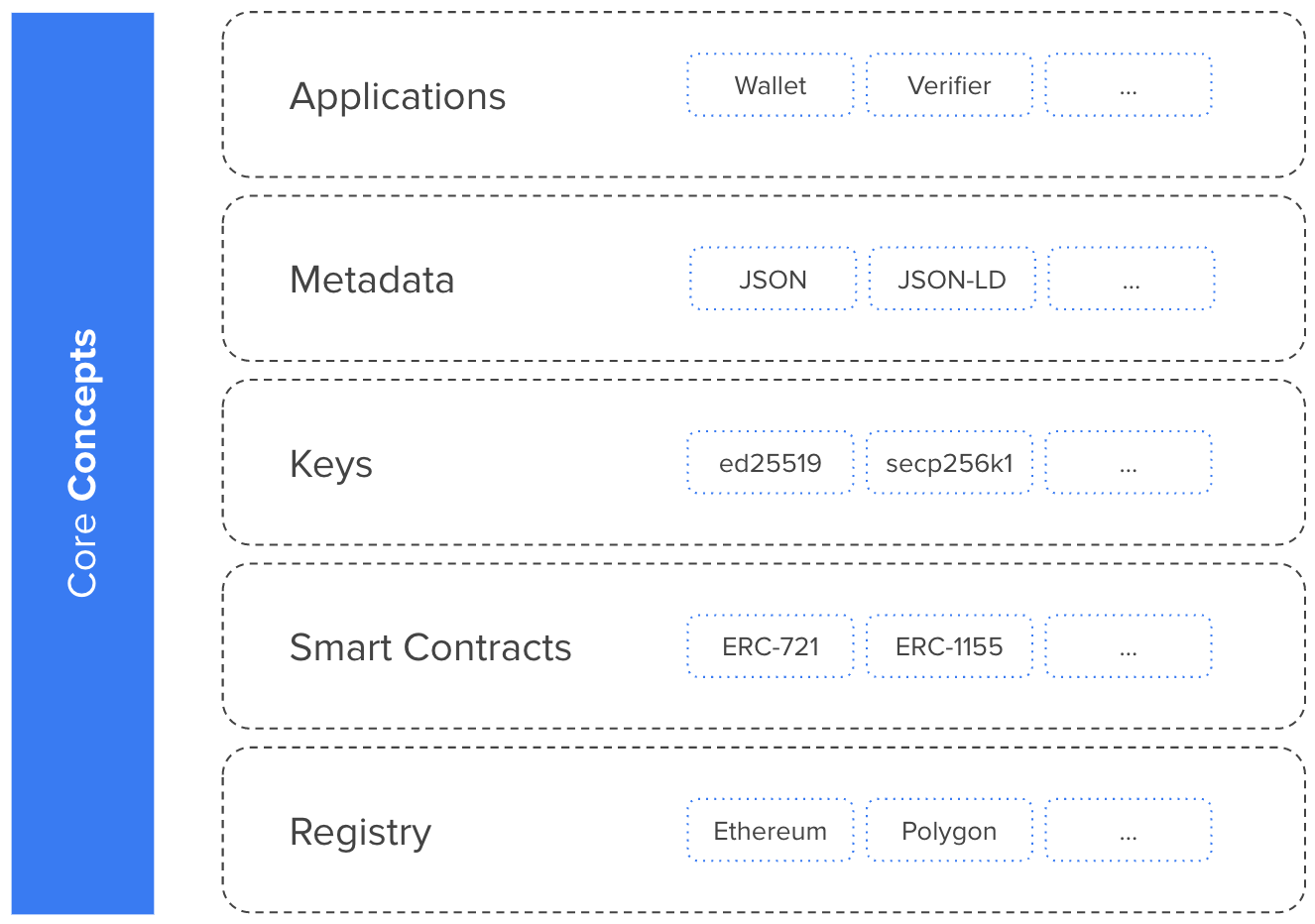
**As a result, there are** **different “flavors” of NFTs** depending on which variations of which building blocks have been used and how they have been put together. The fact that such different flavors exist shows that interoperability is a crucial topic, that is why the development and use of **open standards** are **vital for technology and vendor selection**.
## NFTs for identity?
While NFTs are increasingly used to model digital identity, there are a number of issues that come with this approach. At their core, all issues are rooted in the fact that **ownership and identity are two entirely different creatures**:
### Ownership vs. Identity
**For ownership** it is fine to exclusively rely on decentralized systems like blockchains, because **all you need is an immutable record of transactions**. If you have such a record you can simply view the history of all transactions to verify the state of ownership at any given point in time. **You do not need to trust anyone else**. You only need to trust the technology (and incentive structures).
**With identity this is not the case**. Having an immutable history of records is not enough. Consider the following example:
_If I tell you that my name is Luke Skywalker, you probably won’t believe me, regardless of whether there is a record of this on a blockchain. Even if I manage to find a couple (or even thousands) of people to confirm that I’m Luke Skywalker, you cannot be sure that this is true. To be sure, you need to see an official identity document, like my passport, which was issued by an authority that you trust._
Here’s the problem. You cannot rely on people to tell the truth about their own identity, which means that **identity must always be asserted or vouched for by someone else**,typically an authority that enjoys very high levels of trust in the given context - like a government for your core identity or a university for your diploma.
A blockchain can only tell you about the ownership distribution of things anchored on it. It cannot tell you whether the things are in a sense “true”. (Garbage in, garbage out.) This is also the reason why plagiarism is a big problem for NFTs: While a blockchain can tell you that there is only one NFT and who owns it, it cannot tell you whether the NFT represents, for example, a real crypto punk or merely a copy. To know this you need a trusted authority that verifies a crypto punk’s authenticity such as by verifying if the crypto punk has really been minted by the original artist.
### Why you should not use NFTs for digital identity
There are least four reasons why NFTs are typically not a good solution for identity use cases:
- **Insufficiency**: While NFTs are good for modeling ownership of assets, they are not sufficient for modeling digital identity in all its facettes.
- **Privacy**: NFTs are typically anchored on _public_ blockchains which creates obvious privacy issues if used for any type of identity data.
- **Compliance**: Using NFTs to model the identity of _individuals_ will typically violate data protection regulations considering the tensions between individual data rights (e.g. GDPR’s right to be forgotten) and blockchains inherent properties (e.g. immutability).
- **Costs and scalability**: The use of blockchains in the context of NFTs implies transaction costs and potential scalability issues.
In a nutshell, **NFTs are good for modeling what you own, but not for modeling who you are.**
### Identity use cases for NFTs
Even though NFTs are not the right solution for most identity use cases, there is at least one set of use cases that makes a lot of sense: **Ownership-based access management.**
When we talk about ownership-based access management, we mean **use cases where access to information, services, products** or any other benefits **depend only on what you own, not on who you are**. Here are some examples to illustrate the diversity of applications:
- Content, like articles or podcasts, that can only be accessed by people who already hold NFTs from the respective creator.
- Special discounts for or early access to new products that can only be claimed by holders of NFTs from a special series.
- New maps or challenges in online games that can only be played by holders of NFTs that represent certain digital assets like skins or trophies.
Also, there is an important difference between ownership- and identity-based access management that completely changes use case dynamics:
In the first case (ownership) the **right to access and benefits is _tradable_***,* which is not possible if access rights are tied to one’s identity. In other words, NFTs allow us to model access rights as a commodity that can be bought and sold **and** **exists independently of its owner’s identity**.
Picking up the examples above, creators may choose to create content, art, gaming experiences or offer discounts that can only be accessed by a limited number of people without determining who these people are. Clearly, NFTs that come with special access rights can become incredibly valuable. Just think about what someone would pay for the privilege of being one in only a hundred people on this planet able to hear a special song by their favorite artist or to play a special map or challenge in an online game.
Next to ownership-based access management, NFTs could be used for **use cases which do not involve people and their personal data** and, therefore, do not trigger privacy and compliance issues. In other words, NFTs could be used for modeling the digital identity of **legal entities or machines** (IoT), however, even here NFTs are usually not the best option considering the advantages of other approaches like Self-Sovereign Identity.
## How to get started?
Based on our experience, the best way to get started is to **collect practical experience by building pilot projects**. This will help you to quickly **build-up knowledge** and **prove the value (ROI) of NFTs for your organization**.
If it turns out that NFTs are not the right technology for solving your problem (which is typically the case if you’re trying to solve identity-related problems) you can check out our **Pilot Playbook** which guides you through the process of planning and building pilots with SSI in five steps:
1. **Identify Use Cases**: A framework and examples to help you discover opportunities.
2. **Select Use Cases**: A matrix and different selection criteria will help you analyze and prioritize use cases.
3. **Select an Ecosystem**: An elaboration of ecosystems and a simple approach for selecting the right one for your organization’s operating model.
4. **Plan your Implementation**: Guidance on setting project requirements and the technology selection and the question of “buy vs. build”.
5. **Implement your Pilot**: Guidance to ensure the successful implementation of your project.
Get your [free copy of the Pilot Playbook](https://walt.id/playbooks.md).
### Download this White Paper
Get the white paper as PDF [here](https://mvtrosz5a6vgwqrp.public.blob.vercel-storage.com/introduction-to-nfts-for-identity-waltid.pdf).
### Any Questions?
[Write us](https://walt.id/contact.md), we are happy to help.
### Further Readings
Introductions to [Digital Identity](https://walt.id/white-paper/digital-identity.md) | [Self-Sovereign Identity (SSI)](https://walt.id/white-paper/self-sovereign-identity-ssi.md)
---
title: "Introduction to Self-Sovereign Identity. — walt.id White Papers"
meta:
"og:title": "Introduction to Self-Sovereign Identity. — walt.id White Papers"
source_url: "https://walt.id/white-paper/self-sovereign-identity-ssi"
stack: "Applies to both the Community Stack and the Enterprise Stack"
docs: "https://docs.walt.id"
llms_index: "https://walt.id/llms.txt"
generated: "2026-11-23"
---
> Markdown mirror of https://walt.id/white-paper/self-sovereign-identity-ssi — Applies to both the Community Stack and the Enterprise Stack. Technical docs: https://docs.walt.id (AI index: https://docs.walt.id/llms.txt).
[← All white papers](https://walt.id/white-paper.md)
White Paper
# Introduction to Self-Sovereign Identity.
Dominik BeronMarch 10, 2022
### Summary | TL;DR
#### What is Self-Sovereign Identity?
Self-Sovereign Identity (SSI) **gives people and organizations full control over their data** and allows them to “**bring their own identity**”. As a result, SSI enables anyone to prove who they are and potentially anything about them in online and offline interactions.
#### Why use SSI?
SSI offers numerous **advantages over traditional approaches to digital identity**, which is true for people and organizations. For example, user interactions become more effortless which creates better experiences for people while minimizing the friction of onboarding for service providers, such as by replacing the need for usernames, passwords, forms or online identification processes. As a result, online fraud and identity theft can be prevented and security improved.
At the end of the day, the **use cases are endless**: From official identity documents required for travel or KYC (“know your customer”) to diplomas and certifications required to offer certain services or social information for creating more individual and unique experiences.
Moreover, **governments across the globe** from the Americas to Europe and APAC and **businesses across industries** **are adopting this new identity paradigm**. Emerging regulations, like Europe’s “eIDAS 2”, will even force the adoption of user-centric and user-controlled identity.
#### How SSI works
From a functional perspective, SSI enables governments and businesses to issue **digital identity documents** to citizens, users and other stakeholders in the form of “Verifiable Credentials”. These credentials can be anything (like a passport, diploma or bus ticket). They are stored and **managed via digital wallets** and **can be reliably verified by anyone they are shared with**.
From a technical perspective, SSI requires a number of concepts (like Trust Registries, keys, Decentralized Identifiers, Verifiable Credentials, authentication protocols) which can be thought of as building blocks that are available in different variations and can be put together in different ways. As a result, there are **different “flavors” or ways to implement SSI** which makes a basic understanding of the technologies particularly important.
#### How to get started?
Based on our experience, **building a pilot** is the best way to get started and the most effective way to quickly **build-up knowledge** and **prove the value (ROI) of SSI for your organization**.
## What is Self-Sovereign Identity (SSI) ?
Self-Sovereign Identity (SSI) is a user-centric approach to digital identity that **gives people and organizations full control over their data**. As a result, SSI enables anyone to easily share their data and reliably prove their identity (i.e. who they are and anything about them) without sacrificing security or privacy.
In other words, SSI enables you to “**bring your own identity**” and this is true for potentially any type of information - from your core identity (e.g. name, age, address) to your education and work records, your health and insurance data, bank account and financial information, etc.
Moreover, SSI cannot only be used to model the **digital identities of people**, but also of **organizations** and **things** (IoT).
At the end of the day, SSI promises a digital world in which interactions are effortless and worry-free. It is **simply the next evolutionary step** in identity management, a new paradigm in which our digital identities are no longer fragmented and locked into silos that are under someone else’s control, but only at our own disposal to be shared securely and privately.
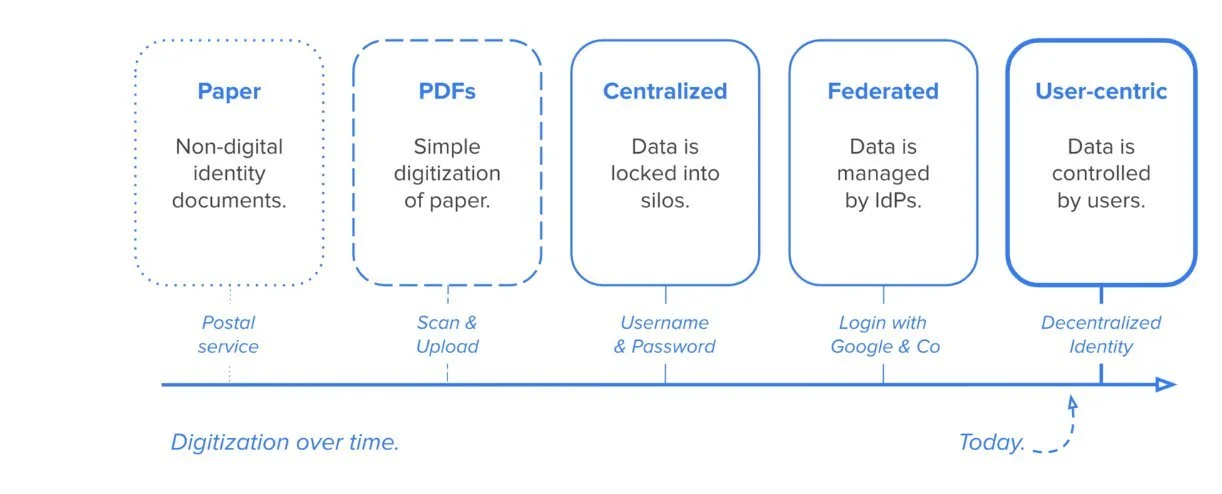If you want to learn more about the evolution of digital identity and understand how SSI differs from traditional approaches like Federated Identity (“login with Google & Co"), check out our [Introduction to Digital Identity](https://walt.id/white-paper/digital-identity.md).
## Why use Self-Sovereign Identity?
For a few decades, we are witnessing a process of digitisation that is unfolding globally and across industries. While this process started humbly, it accelerated with the emergence of smartphones which put the digital world in our pockets and more drastically with the outbreak of **COVID** which **forced the world to move from in-person interactions to digital ones**.
However, it is no secret that the **internet was built without an identity layer**, so as the world is growing more digital, **we are confronted with seemingly insurmountable issues.** In other words, while digitisation has many upsides it comes at a price:
- Lack of control over data: Power is aggregated in the hands of a few companies, which effectively control data and lock-in users.
- Privacy issues: As a result of users not being in control of their data, we witnessed privacy scandals and diminishing trust in data aggregators.
- Compliance issues: Online service providers must store and manage user data centrally which opens them up to regulatory scrutiny.
- Security issues: Conventional ways for securing access to services and user data - particularly password-based authentication - proved to be unreliable and caused countless large-scale data breaches.
- Fraud and identity theft: Due to the lack of reliable authentication and identification tools, identity theft and other types of fraud are thriving. Online service providers and marketplaces are struggling to ensure trustworthy interactions.
- Cumbersome user experience: Users are forced to juggle various authentication methods (e.g. passwords) and go through lengthy online identification processes.
**SSI promises to solve these problems** by putting users in control of their data and by enabling them to share their data seamlessly, privately, securely and on their own terms.
### Value for people
SSI puts people in control of their data and enables trusted, effortless digital interactions:
- User experience: SSI makes it effortless for people to share their data with others. Traditional approaches for data sharing like forms and uploads are replaced with simple one click experiences.
- Control: SSI’s user-centric architecture gives people full control over data in terms of storage, access and portability.
- Independence: Being in control of data also means that people are no longer locked in because they enjoy data portability and can take their data with them wherever they go.
- Trustworthy interactions: One of SSI’s biggest advantages is that it makes potentially any type of data verifiable in order to prevent scams and fraud including identity theft.
- Security: SSI mitigates the risk of data breaches or leaks by eliminating major attack vectors such as passwords or the centralized storage of data.
- Privacy: The user-centric design of SSI and its support for selective disclosure and other data minimisation techniques ensure privacy.
### Value for organizations
SSI allows organizations to improve to offering, streamline processes and mitigate various business risks:
- Conversion and stakeholder satisfaction: Organizations can offer their stakeholders more seamless access to services or products leading to increased conversion rates, decreased help desk requests and overall higher stakeholder satisfaction.
- Data quality: SSI enables organizations to receive reliable data about their stakeholders that is verified and signed by trusted third parties.
- Fraud prevention: Organizations can prevent various types of malicious behavior ranging from SPAM to identity theft and document forgery.
- Security: Organizations can mitigate the risk of or even prevent data breaches by eliminating the risk factors like passwords and aggregated data storage.
- Compliance: Organizations comply with privacy and data protection regulations by default due to user-centric data and consent management.
### Use Cases
Digital identity is important for every government and every business. There is no sector or industry that would not require it. As a result, the **use cases are endless**.
Examples range from official identity documents required for travel or KYC (“know your customer”) to diplomas and certifications required to offer certain services or social information for creating more individual and unique experiences.
### Adoption
Major players from the public and private sector are adopting SSI, a process that is facilitated by emerging regulations and the global standardization of underlying technologies and protocols:
- **Public sector** - Supranational organizations (European Union) and individual governments in Europe, the Americas (US, Latin America) and Asia (APAC) are subsidizing the development of solutions, adapting regulatory frameworks and building pilot projects.
- **Private Sector** - Globally, start-ups, scale-ups and large enterprises are launching projects across almost every vertical, such as banking, financial services, insurance, education, HR/employment, commerce, supply chain, health care, mobility, hospitality, among others.
Selected examples of adopters include:
- **European Union**: The Commission and all Member States have created the “European Self-Sovereign Identity Framework (ESSIF)” and the “European Blockchain Service Infrastructure (EBSI)” which provides standards for a European SSI ecosystem. Moreover, a new regulation called “eIDAS 2” has been announced that will force the adoption of European identity wallets (EUID wallets) and with them a user-centric identity ecosystem.
Based on these developments, countries like Germany, France, Spain, Netherlands, Belgium, Slovakia, Slowenia, Luxemburg, Lithuania, Greece, Finland, Romania, Croatia are building pilot projects and some are already planning the introduction of production systems within the next 2 years.
- **The Americas**: The United States of America is subsidizing the development of SSI solutions for specific public sector use cases (e.g. visas, customs) via the US Department of Homeland Security. Regional governments in Canada (British Columbia, Ontario) already launched projects (e.g. a public directory of verifiable company data). In South America identity ecosystems such as “LACChain” are emerging.
- **APAC**: Recently, projects in countries like Singapore and Australia became public which further illustrates the global reach of SSI and the fact that public officials understand the advantages of this new identity paradigm as well as their role as drivers of adoption.
- **Private Sector**: On a global level, companies of all sizes started to invest in SSI. Examples include a growing number of banks and financial service providers, tech companies like Microsoft, Workday, Salesforce, SAP and organizations from almost every other industry.
The following graphic _from our_ [White Paper with the Boston Consulting Group (BCG)](https://walt.id/white-paper.md)shows selected use cases and their expected time to adoption relative to each other:
## How it works
To build a mental model of SSI and understand how it works, you must consider two perspectives:
The **functional perspective** which is about understanding the implications of SSI for its adopters and for the market, particularly what SSI enables one to do (that could not be done without SSI).
The **technical perspective**, which is about understanding the technologies on which SSI is built and and their properties which give rise to SSI’s functionality in the first place.
### Functional perspective
SSI allows us to **model digital identity just like we are used to the way identity works in the non-digital world** based on paper documents and cards. There are just some minor twists.
For example, instead of our identity documents being made of paper or plastic, they are digital credentials made of bits and bytes and instead of storing them in wallets made of leather, they are stored in digital wallets on our phones. Importantly, these digital credentials can be reliably verified by anyone they are shared with online or offline.
In doing so, SSI enables decentralized ecosystems in which different parties can exchange and verify identity-related information. These ecosystems look like three-sided marketplaces, so that every party can take on three roles:
- **Issuers** - Parties who “issue” identity-related data to people or organizations (“Holders”) in the form of digital credentials. They are the original data sources of an SSI ecosystem. _For example, a government issues digital passports to citizens or a university issues digital diplomas to graduates._
- **Holders** - Individuals or organizations who receive digital credentials that contain data about themselves from various sources (“Issuers”). By aggregating and storing such credentials in digital wallets, Holders can build holistic digital identities that are under their control and can easily be shared with third parties ("Verifiers").
- **Verifiers** - Parties who rely on data to provide products and services can reliably verify and process data that has been provided by others (“Holders”). Verifiers, also called “Relying Parties”, are usually organizations or individuals in their professional capacity.
The three roles required for SSI ecosystems:
Importantly, a single party can act as Issuer, Holder and Verifier depending on the use case. For example, a university may issue diplomas to graduates (Issuer), manage their own accreditations (Holder) and request education records from incoming students (Verifier).
### Technical Perspective
Understanding SSI from a technological perspective requires the understanding of a **few core concepts**:
- **Trust Registries**, which serve as a shared and trusted record of certain information. In other words, they serve as a “layer of trust” and a “single source of truth”.
- **Cryptographic keys**, which convey control over digital identities and enable core functionality such as encryption and authentication.
- **Decentralized Identifiers (DIDs)**, which establish a public key infrastructure by linking keys to unique identifiers that allow different parties to find and interact with each other.
- **Verifiable Credentials** **(VCs)** which are digital identity documents that can easily and securely be shared with and verified (incl. validity, integrity, authenticity, provenance) by anyone in a privacy preserving way. Importantly, they are never (!) stored on a blockchain due to privacy and compliance reasons.
- **Wallets**, which store our keys (control) and VCs (identity data) and enable the management and sharing of our digital identities and data via easy-to-use applications.
The following graphic shows how SSI works and highlights the core concepts (in blue).
**Think of these core concepts as different building blocks** that are **available in different variations** and **can be put together in different ways**. For example:
Different technologies can be used to establish Trust Registries like blockchains (EBSI, Ethereum) or the domain name service (DNS). SSI even works (for certain use cases) without any Trust Registries but purely on a peer-to-peer basis. Similarly different types of DIDs, keys, proofs, credential formats, authentication and data exchange protocols can be used.
**As a result, there are** **different “flavors” of SSI** depending on which variations of which building blocks have been used and how they have been put together.
Importantly, the differences in terms of technologies that are being used illustrate why interoperability has always been one of the most important topics within the industry and why the development and use of **open standards** (e.g. by the W3C, Decentralized Identity Foundation, OpenID Foundation and others) **are vital for technology and vendor selection**.
You can find more technical information in [our documentation](https://docs.walt.id).
## How to get started?
Based on our experience, the best way to get started is to **collect practical experience by building pilot projects**. This will help you to quickly build-up knowledge and prove the value (ROI) of SSI for your organization.
To help you with this, we wrote the **Pilot Playbook** which guides you through the process of planning and building pilots with SSI in five steps:
1. **Identify Use Cases**: A framework and examples to help you discover opportunities.
2. **Select Use Cases**: A matrix and different selection criteria will help you analyze and prioritize use cases.
3. **Select an Ecosystem**: An elaboration of ecosystems and a simple approach for selecting the right one for your organization’s operating model.
4. **Plan your Implementation**: Guidance on setting project requirements and the technology selection and the question of “buy vs. build”.
5. **Implement your Pilot**: Guidance to ensure the successful implementation of your project.
Get your [free copy of the Pilot Playbook](https://walt.id/playbooks.md).
### Download this White Paper
Get the white paper as PDF [here](https://mvtrosz5a6vgwqrp.public.blob.vercel-storage.com/introduction-to-self-sovereign-identity-waltid.pdf).
### Any Questions?
[Write us](https://walt.id/contact.md), we are happy to help.
### Further Readings
Introductions to [Digital Identity](https://walt.id/white-paper/digital-identity.md) | [Non-Fungible tokens (NFTs)](https://walt.id/white-paper/nfts-for-identity.md)
---
title: "Decentralized Identity & Data Monetization. — walt.id White Papers"
meta:
"og:title": "Decentralized Identity & Data Monetization. — walt.id White Papers"
source_url: "https://walt.id/white-paper/ssi-data-monetization"
stack: "Applies to both the Community Stack and the Enterprise Stack"
docs: "https://docs.walt.id"
llms_index: "https://walt.id/llms.txt"
generated: "2026-11-23"
---
> Markdown mirror of https://walt.id/white-paper/ssi-data-monetization — Applies to both the Community Stack and the Enterprise Stack. Technical docs: https://docs.walt.id (AI index: https://docs.walt.id/llms.txt).
[← All white papers](https://walt.id/white-paper.md)
White Paper
# Decentralized Identity & Data Monetization.
Dominik BeronMay 3, 2022
## **Summary | TL;DR**
#### What is Decentralized Identity?
The idea behind decentralized identity is to enable people and organizations to “bring their own identity” and control their data. Today, different approaches are used to build such systems like Self-Sovereign Identity (SSI) or Non-fungible tokens (NFTs). While both approaches have their unique strengths, a rule of thumb is to pick SSI for proving who you are (e.g. identity verification) and NFTs for proving what you own (e.g. ownership-based access management)
#### Why monetize identity data?
At the end of the day, decentralized identity requires the creation of decentralized data ecosystems, which look a lot like three-sided marketplaces consisting of “Issuers” (data sources), “Holders” (data owners) and “Verifiers” (data consumers). Just like the success of marketplaces, the success of ecosystems depends on incentive structures that are aligned with and push its growth. This is where payments come in. They are a way to incentivize the most important early participants of identity ecosystems - i.e., the Issuer aka the supply side of the marketplace - to join, onboard users and provide them with re-usable identity credentials.
#### How to monetize data?
We can differentiate between three different approaches for monetizing identity data:
- Direct monetization based on peer-to-peer transactions;
- Indirect monetization via a settlement layer which can be implemented via a wallet-based or a registry-based model;
- Hybrid models that combine peer-to-peer payments with a settlement layer.
#### Comparing different monetization models.
While direct monetization models come with strong privacy features, are highly scalable and independent from third parties or external technical infrastructure, this approach comes with certain disadvantages such as that they are suboptimal for incentivizing credential life cycle management by Issuers and require consumers to pay for their data which creates barriers for adoption. On the other hand, indirect monetization approaches come with strong incentive structures but introduce privacy, security and dependency challenges.
---
### Further Readings
On [Digital Identity](https://walt.id/white-paper/digital-identity.md), [Self-Sovereign Identity (SSI)](https://walt.id/white-paper/self-sovereign-identity-ssi.md); [Non-Fungible tokens (NFTs)](https://walt.id/white-paper/nfts-for-identity.md); [SSI vs. NFTs](https://walt.id/white-paper/ssi-vs-nfts.md)
---
## **What is Decentralized Identity?**
While there are many different flavors and ways to implement digital identity, we can distinguish at least two decentralized approaches that received mainstream attention: Self-Sovereign Identity (SSI) and Non-Fungible Tokens (NFTs).
### Self-Sovereign Identity (SSI)
Self-Sovereign Identity (SSI) is a user-centric approach to digital identity that **gives people and organizations full control over their data**. As a result, SSI enables anyone to easily share their data and reliably prove their identity (i.e. who they are and anything about them) without sacrificing security or privacy.
In other words, SSI enables you to “**bring your own identity**” and this is true for potentially any type of information - from your core identity (e.g. name, age, address) to your education and work records, your health and insurance data, bank account and financial information, etc.
Moreover, SSI cannot only be used to model the **digital identities of people**, but also of **organizations** and **things** (IoT).
At the end of the day, SSI promises a digital world in which interactions are effortless and worry-free. It is **simply the next evolutionary step** in identity management, a new paradigm in which our digital identities are no longer fragmented and locked into silos that are under someone else’s control, but only at our own disposal to be shared securely and privately.
_If you want to learn more about the evolution of digital identity and understand how SSI differs from traditional approaches like Federated Identity (“login with Google & Co"), check out our_ [_Introduction to Digital Identity_](https://walt.id/white-paper/digital-identity.md)_._
Digital identity is important for every government and every business. There is no sector or industry that would not require it. As a result, the **use cases are endless**.
Examples range from official identity documents required for travel or KYC (“know your customer”) to diplomas and certifications required to offer certain services or social information for creating more individual and unique experiences.
Read more about the [evolution of digital identity](https://walt.id/white-paper/digital-identity.md) and [Self-Sovereign Identity (SSI)](https://walt.id/white-paper/self-sovereign-identity-ssi.md)
### Non-Fungible Tokens (NFTs)
In a nutshell, **a non-fungible token (NFT) represents ownership of something**. Let’s unpack this:
First, **non-fungible** means that a token is unique in a sense that there is no other thing just like it. This means that **every NFT is one of a kind** just like there is only one painting that is the real Mona Lisa. A _fungible_ token, on the other hand, is not unique. It would not make any difference if a fungible token would be exchanged for another token of the same kind such as a Bitcoin.
Second, representing ownership implies that **an NFTs is treated as the actual thing that it stands for** so that by selling an NFT you are also selling “the real thing” that it represents.
Third, **NFTs** **can represent anything** from physical things (like a house) to natively digital assets (like a crypto punk) or even ideas (think of intellectual property).
Once you put these properties together you can understand why people are excited about NFTs: Until recently, everyone thought that digital assets are necessarily fungible because any digital asset can simply be copied. In other words, the mainstream assumption was that digital assets are inherently abundant and cannot be scarce. As a result, digital assets could not really be “owned” by someone (since anyone can just make a copy) and if they cannot be owned, then they cannot really have value like scarce physical things do. **NFTs** change that. They **introduce digital scarcity**, **which means that digital assets can be just as valuable** (or even more valuable) **as physical things because they can be unique**:
For example, there can be NFTs that represent physical things and, therefore, have the same value as the thing they represent like an NFT that represents my actual car. However, there can also be NFTs that represent natively digital things. Their value would not be bound to any physical thing at all, which means that they could have any value. For example, an NFT that represents a handbag of which there is only one kind could be worth more than any physical handbag simply because of its uniqueness.
While SSI allows us to model identity in a digital way using a special type of digital credentials, **NFTs allow us to model ownership of any type of asset in a digital way**. Moreover, since NFTs are anchored on blockchains, they are grounded in an immutable registry of records that cannot be manipulated or controlled by any single entity or by malicious actors, which gives NFTs reliability in the sense that anyone can trust that they show the correct ownership distribution of assets.
Obviously, potential **use cases for NFTs are endless** and can be found wherever there’s a need to digitally model ownership. As a result, NFTs will be among the most important **building blocks on which the digital world** (or something like a metaverse) **will be built upon**. Remember, NFTs can be anything which means that any type of asset will likely be encoded in NFTs, from something as intangible as ideas to physical assets that are digitized or natively digital assets that are given the quality of scarcity.
While NFTs are not a solution to most identity-related problems, one exciting set of use cases for NFTs is **ownership-based access management** or potentially also use cases which do not involve people and their personal dataand, therefore, do not trigger privacy and compliance issues such as identity use cases for legal entities or machines (IoT).
Read more about [NFTs for identity](https://walt.id/white-paper/nfts-for-identity.md) or learn about the [differences between SSI and NFTs](https://walt.id/white-paper/ssi-vs-nfts.md).
## **Why monetize identity data?**
### Identity and Payments
The internet was built without identity and payment layers. While we made good progress on building a layer for digital payments (PayPal, Visa, Stripe) and are seeing natively digital payment and property layers for money and assets emerge (blockchain ecosystems), we are still missing a natively digital identity layer: Our data is still fragmented across various data silos and hard to utilize. However, Self-Sovereign Identity (SSI) offers a promising approach for natively digital identity that is being built out and adopted by the private and public sector on a global scale.
Why is this important? Well, once we solve digital identity and payments every digital interaction will be trusted and effortless. Consider the following examples:
- User experiences will be seamless as information, products and services will be accessible with one click.
- Fraud will be preventable so that identity theft, SPAM, scams or document forgery will be a thing of the past.
- Compliance with diverse regulations from privacy and data protection to AML (anti-money laundering) will be ensured by design.
### Incentives for building Ecosystems
Incentive structures are crucial for the success of new innovations. This is particularly true for decentralized solutions which are based on ecosystems that cannot be controlled by any single party like Self-Sovereign Identity (SSI). Here is why:
SSI enables decentralized ecosystems in which different parties can exchange and verify identity-related information. Importantly, these ecosystems look like three-sided marketplaces, so that every party can take on three roles:
- **Issuers** - Parties who “issue” identity-related data to other parties (“Holders”) via digital credentials. They are the original data sources of an SSI ecosystem.
- **Holders** - Parties who receive digital credentials that contain identity data from “Issuers”. By aggregating credentials in digital wallets, Holders can build holistic digital identities.
- **Verifiers** - Parties who rely on data to provide products and services can reliably verify data that has been provided by “Holders”.The three roles required for SSI ecosystems:
While all three types of actors must be present for SSI to function, Issuers play the most crucial role because they are the data suppliers of any ecosystem and capable of onboarding “Holders” by simply rolling out wallets and credentials to their stakeholders (users, clients, employees).
The problem is that Issuers are typically least incentivized to adopt SSI. In some cases, doing so could even disrupt their existing business models. This is why incentives for Issuers are important and where payments come in.
From today’s perspective we see two types of incentives strong enough to convert a significant number of Issuers to bootstrap a global SSI ecosystem:
- Regulatory Incentives - the idea that regulations facilitate or even force adoption like the EU’s emerging laws on digital identity wallets (eIDAS 2, AMLR).
- Financial Incentives - the idea that Issuers are being paid for supplying ecosystems with reusable identity data.
While we know that regulations will bring identity wallets (at least to Europe) within the next few years, financial incentives would enable ecosystems more rapidly and likely unlock more diverse use cases (assuming that not every potential Issuer will be forced to act as such under regulations). In other words, enabling organizations to earn money for acting as “Issuers” could significantly speed up the adoption of decentralized ecosystems and SSI.
With regards to the merits of incentivizing Issuers, it is important to understand that the value that is being monetized lies not in the data itself (which belongs to Holders) but in the reliability of an attestation of identity data which is directly linked to the trust that third parties bestow upon the Issuer. It is not the content of identity credentials that someone would pay for, but the fact that the contents have been attested by someone who is trusted to tell the truth. In other words, it is not the data that is monetized, but the trust that Issuers have built over time.
## **How to monetize identity data?**
Today, we are basically seeing three different approaches for monetizing identity data:
- Direct Monetization (peer-to-peer)
- Indirect Monetization (via a settlement layer)
- Hybrid Model (combining peer-to-peer payments with a settlement layer)
### Direct Monetization
The idea of direct monetization is that identity and payment flows are inherently linked so that:
- “Holders” pay “Issuers” (for issuing data)
- “Verifiers” _may_ pay “Holders” (for presenting data)
Just like identity data is exchanged directly between two parties, payment flows happen directly between two parties in a peer-to-peer fashion, possibly preceding the exchange of identity data:
caption id="" align="alignnone" width="1288"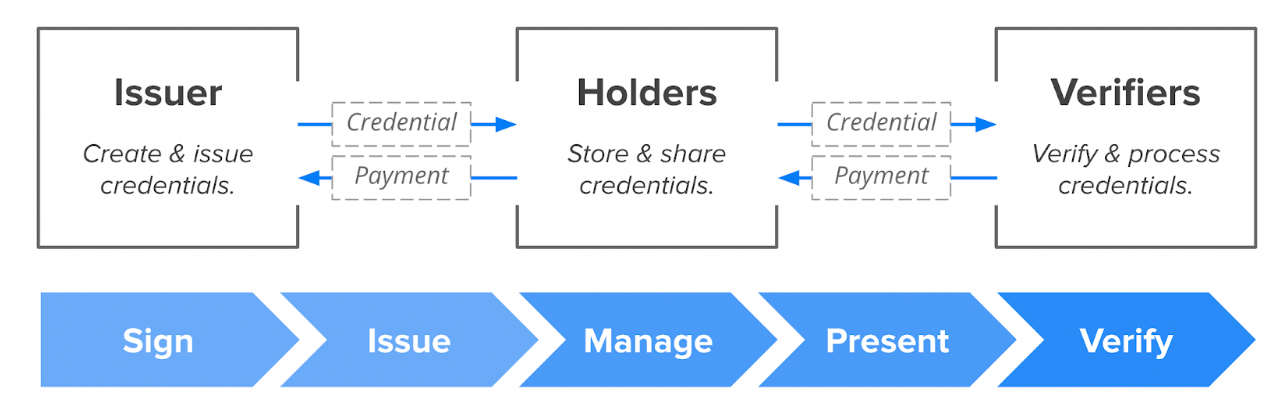 For many use cases, this approach is also aligned with user expectations considering that people and businesses are often paying for their identity documents today already. /caption
### Indirect Monetization
The idea behind indirect monetization is that only the parties who benefit most from reliable identity data should pay. In other words, “Verifiers” - like providers of information, products or services who request identity data from customers - pay “Issuers”.
### How it works
There are two different models for implementing indirect monetization:
- Wallet-based model, which requires the wallet to enable payment settlement.
- Registry-based model, which requires private registries to enable settlements.
#### Wallet-Based Model
In this model, settlements are performed by a third party, which can be a legal entity (like a business) or a technology that is not controlled by a single party (like a blockchain). We can refer to this trusted third party as the “settlement layer”.
The wallet is crucial in this architecture because it provides the settlement layer with information required for executing payments, such as transaction logs. Consequently, the settlement layer must know all involved parties, particularly the “Verifiers” who are supposed to pay for reliable identity data. To enforce payments, the settlement layer must have legal contracts with “Verifiers” or collect payments in advance (held in an escrow account).
As a result, it makes sense for the settlement layer to also perform other tasks beyond enforcing payments such as attracting and onboarding stakeholders into the ecosystem, setting up governance and legal frameworks (e.g. to handle liability questions) or collecting debts.
Looking at today's banking and financial services sector, this model can be seen as an extension of open banking ecosystems that switch from centralized to user-centric identity paradigms.
_Illustration of the wallet-based model:_
#### Registry-Based Model
In this model, payments are also enforced by a “settlement layer” (like in the wallet-based model). However, instead of relying on wallets for enabling settlements, information that is required to verify identity data is written to a registry that is hidden behind a “paywall”. In other words, Verifiers must pay to access information without which they could not rely on data provided by “Holders”. For example, information required to evaluate
- data provenance, authenticity, integrity and authority (e.g. public keys or accreditations).
- data validity (e.g. revocation or suspension data)
- standard conformance (e.g. data models)
- machine-readability (e.g. semantic vocabulary, contexts)
In this model, the settlement layer only needs to know “Issuers” of an ecosystem, who typically help with the creation and maintenance of the registries in order to create and maintain payment incentives. “Verifiers” must not be known in advance. They can simply pay per use, without having to go through an onboarding process that includes the conclusion of legal contracts or advanced payments.
The main role of the settlement layer is to collect payments by Verifiers (for accessing information) and redistribute the payments to Issuers. As a result, this model is generally more aligned with the design of emerging decentralized ecosystems (web3).
_Illustration of the registry-based model:_
### Hybrid Model
The hybrid model, leverages ideas from direct and indirect monetization by combining
- a settlement layer for payments from “Verifiers” to “Issuers”
- peer-to-peer payments from “Verifiers” to “Holders”.
With regards to the settlement layer, both versions of the indirect monetization model (wallet- or registry-based) can be used.
_Illustration of the hybrid model:_
caption id="" align="alignnone" width="1104"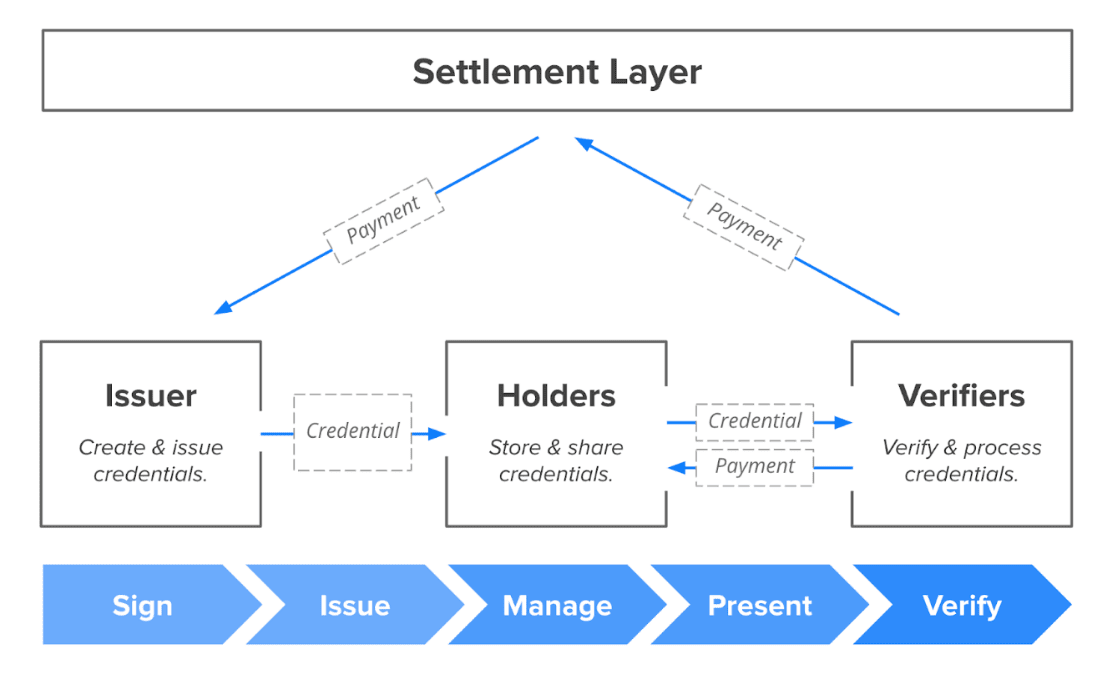 The main reason for adopting this hybrid model is to enable “Holders” to get financial benefits for sharing data while incentivizing Issuer’s to manage the life cycle of data because they can monetize more than once. /caption
## **Comparing Monetization Models**
The following table compares the different data monetization approaches outlined in the last chapter across various dimensions in an effort to facilitate and deepen the understanding of their advantages and disadvantages:
### **Note on Payments**
Financial incentives can be created with any form of money, from FIAT ($, €) over stable coins (USDT/C) or other “crypto currencies” (BTC, ETH) to more novel token types (NFTs). Each of these assets can potentially be used to incentivize issuers.
In all of these cases, wallets can be used to trigger such payments, for example via
- external payment service providers
- PSD2 (directly from within the wallet)
- relevant blockchains (e.g. BTC, ETH, DOT, SOL, NEAR)
- Payment protocols like the interledger protocol
Importantly, if a registry-based approach is chosen (indirect monetization, hybrid model) ecosystems that maintain the registries may introduce their own tokens and economies for identity verification (like the Velocity Network).
Moreover, you can find more detailed information about the Interledger Protocol and how to use it for peer-to-peer payments during identity data exchange flows in our whitepaper “ [Decentralized Identity & Interledger Protocol](https://drive.google.com/file/d/1bnKq3SEKldNGKo_u6LP21yyGgBoHVjNg/view?usp=sharing)”.
### Download this White Paper
Get the eBook as PDF [here](https://mvtrosz5a6vgwqrp.public.blob.vercel-storage.com/decentralized-identity-and-data-monetization.pdf).
### Any Questions?
[Write us](https://walt.id/contact.md), we are happy to help.
---
title: "The future of Decentralized Identity: SSI vs NFTs. — walt.id White Papers"
meta:
"og:title": "The future of Decentralized Identity: SSI vs NFTs. — walt.id White Papers"
source_url: "https://walt.id/white-paper/ssi-vs-nfts"
stack: "Applies to both the Community Stack and the Enterprise Stack"
docs: "https://docs.walt.id"
llms_index: "https://walt.id/llms.txt"
generated: "2026-11-23"
---
> Markdown mirror of https://walt.id/white-paper/ssi-vs-nfts — Applies to both the Community Stack and the Enterprise Stack. Technical docs: https://docs.walt.id (AI index: https://docs.walt.id/llms.txt).
[← All white papers](https://walt.id/white-paper.md)
White Paper
# The future of Decentralized Identity: SSI vs NFTs.
Dominik BeronMarch 22, 2022
### Summary | TL;DR
#### What is SSI and what are NFTs?
Self-Sovereign Identity or **SSI** is a **new approach to digital identity** that enables people and organizations to control and “**bring their own identity**” in the form of digital identity credentials.
A Non-Fungible Token or **NFT** is a **digital thing that represents ownership of something and can be traded**. An NFT can represent anything like a physical thing (house), a digital thing (crypto punk) or even an idea (intellectual property).
#### Comparing SSI and NFTs
While SSI has been developed to model digital identity, NFTs are used to model digital ownership. As a result, the concepts and technologies on which each approach is based differ with far reaching consequences. For example, while NFTs require blockchains, SSI can be used with or without them which is particularly important in the context of compliance and privacy.
In a nutshell: **SSI is for proving who you are, NFTs are for proving what you own.**
#### Choosing between SSI and NFTs
**SSI** is a solution for **all types of identity-related problems**. I can, for example, use SSI for identity access management (e.g. logging into a service), identity verification (e.g. opening a bank account) or to digitize and prove any other type of identity-related information from education and work records to health and insurance or financial data. Moreover, SSI can be used **for** **people**, **organizations** and **things** (IoT).
While using **NFTs** for identity use cases comes with issues (privacy, compliance, costs, scalability), they enable **ownership-based access management** - the idea that ownership of an asset comes with access to services, products or other benefits. This is exciting because **access rights are becoming tradable** and are no longer tied to a person or their identity.
#### How to get started?
Based on our experience, **building a pilot** is the best way to get started and the most effective way to quickly **build-up knowledge** and **prove the value (ROI) of SSI for your organization**.
## What is SSI and what are NFTs?
The **digitization of our world** is a phenomenon that **is unfolding globally and across industries**. This process is driven not only by technological innovations but also other factors that have nothing to do with technology, such as the outbreak of COVID which forced digitization of every industry. Today, people do everything online.
Now, in an increasingly digital world, it is **necessary to** **model identity and ownership in a digital way.** Self-Sovereign Identity (SSI) and Non-Fungible Tokens (NFTs) allow us to do just that. Due to their unique properties **SSI and NFTs offer a way to encode identity and ownership in a verifiable and trusted digital format**.
This white paper elaborates what SSI and NFTs are, explains their differences and provides guidance on where and how to use them.
### Introduction to SSI
#### What is SSI?
Self-Sovereign Identity (SSI) is a user-centric approach to digital identity that **gives people and organizations full control over their data**. As a result, SSI enables anyone to easily share their data and reliably prove their identity (i.e. who they are and anything about them) without sacrificing security or privacy.
In other words, SSI enables you to “**bring your own identity**” and this is true for potentially any type of information - from your core identity (e.g. name, age, address) to your education and work records, your health and insurance data, bank account and financial information, etc.
Moreover, SSI cannot only be used to model the **digital identities of people**, but also of **organizations** and **things** (IoT).
At the end of the day, SSI promises a digital world in which interactions are effortless and worry-free. It is **simply the next evolutionary step** in identity management, a new paradigm in which our digital identities are no longer fragmented and locked into silos that are under someone else’s control, but only at our own disposal to be shared securely and privately.
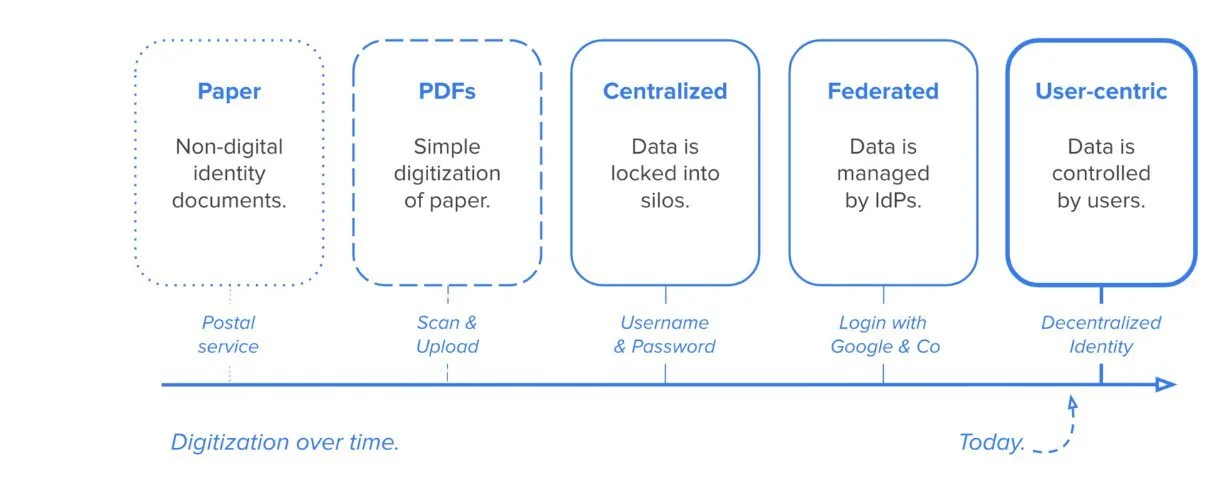If you want to learn more about the evolution of digital identity and understand how SSI differs from traditional approaches like Federated Identity (“login with Google & Co"), check out our [Introduction to Digital Identity](https://walt.id/white-paper/digital-identity.md).
#### Why use SSI?
SSI offers numerous **advantages over traditional approaches to digital identity**, which is true for people and organizations. For example, user interactions become more effortless which creates better experiences for people while minimizing the friction of onboarding for service providers, such as by replacing the need for usernames, passwords, forms or online identification processes. As a result, online fraud and identity theft can be prevented and security improved.
At the end of the day, the **use cases are endless**: From official identity documents required for travel or KYC (“know your customer”) to diplomas and certifications required to offer certain services or social information for creating more individual and unique experiences.
Moreover, **major players from the public and private sector are adopting SSI**, facilitated by emerging regulations and the standardization of underlying technologies. For example
- **Public sector** - Supranational organizations (European Union) and individual governments in Europe, the Americas (US, Latin America) and Asia (APAC) are subsidizing the development of solutions, adapting regulatory frameworks and building pilot projects.
- **Private Sector** - Globally, start-ups, scale-ups and large enterprises are launching projects across almost every vertical, such as banking, financial services, insurance, education, HR/employment, commerce, supply chain, health care, mobility, hospitality, among others.
#### How does SSI work?
SSI enables governments and businesses to issue **digital identity documents** to citizens, users and other stakeholders in the form of “Verifiable Credentials”. These credentials can be anything like a passport, diploma or a bus ticket. They are stored and **managed via digital wallets and can be reliably verified by anyone they are shared with.**
Putting it differently, SSI allows us to model digital identity just like we are used to the way identity works in the non-digital world based on paper documents and cards. There are just some minor twists: Instead of our identity documents being made of paper or plastic, they are digital credentials made of bits and bytes and instead of storing them in wallets made of leather, they are stored in digital wallets on our phones.
You can find more information in [Introduction to Self-Sovereign Identity (SSI)](https://walt.id/white-paper/self-sovereign-identity-ssi.md)
### Introduction to NFTs
#### What are NFTs?
In a nutshell, **a non-fungible token (NFT) represents ownership of something**. Let’s unpack this:
First, **non-fungible** means that a token is unique in a sense that there is no other thing just like it. This means that **every NFT is one of a kind** just like there is only one painting that is the real Mona Lisa. A _fungible_ token, on the other hand, is not unique. It would not make any difference if a fungible token would be exchanged for another token of the same kind such as a Bitcoin.
Second, representing ownership implies that **an NFTs is treated as the actual thing that it stands for** so that by selling an NFT you are also selling “the real thing” that it represents.
Third, **NFTs** **can represent anything** from physical things (like a house) to natively digital assets (like a crypto punk) or even ideas (think of intellectual property).
Once you put these properties together you can understand why people are excited about NFTs: Until recently, everyone thought that digital assets are necessarily fungible because any digital asset can simply be copied. In other words, the mainstream assumption was that digital assets are inherently abundant and cannot be scarce. As a result, digital assets could not really be “owned” by someone (since anyone can just make a copy) and if they cannot be owned, then they cannot really have value like scarce physical things do. **NFTs** change that. They **introduce digital scarcity**, **which means that digital assets can be just as valuable** (or even more valuable) **as physical things because they can be unique**:
For example, there can be NFTs that represent physical things and, therefore, have the same value as the thing they represent like an NFT that represents my actual car. However, there can also be NFTs that represent natively digital things. Their value would not be bound to any physical thing at all, which means that they could have any value. For example, an NFT that represents a handbag of which there is only one kind could be worth more than any physical handbag simply because of its uniqueness.
#### Why use NFTs?
While SSI allows us to model identity in a digital way using a special type of digital credentials, **NFTs allow us to model ownership of any type of asset in a digital way**. Moreover, since NFTs are anchored on blockchains, they are grounded in an immutable registry of records that cannot be manipulated or controlled by any single entity or by malicious actors, which gives NFTs reliability in the sense that anyone can trust that they show the correct ownership distribution of assets.
Obviously, potential **use cases for NFTs are endless** and can be found wherever there’s a need to digitally model ownership. As a result, NFTs will be among the most important **building blocks on which the digital world** (or something like a metaverse) **will be built upon**. Remember, NFTs can be anything which means that any type of asset will likely be encoded in NFTs, from something as intangible as ideas to physical assets that are digitized or natively digital assets that are given the quality of scarcity.
While NFTs are not a solution to most identity-related problems, one exciting set of use cases for NFTs is **ownership-based access management** or potentially also use cases which do not involve people and their personal dataand, therefore, do not trigger privacy and compliance issues such as identity use cases for legal entities or machines (IoT). But more on this below…
#### How do NFTs work?
NFTs enable organizations or people to **create tokens that act as digital representations of potentially anything** in a way that these representations are unique, trustworthy (or at least a tamper proof record of ownership) and can be traded. NFTs are stored and **managed via digital wallets** and **can be traded.** Also, anyone can **verify which wallet controls an NFT**, without having to know who controls the wallet.
In other words, anyone can “mint” (create) NFTs and transfer them to any wallet. Whoever controls this wallet also controls the NFT, can trade and transfer it to a new wallet.
You can find more information in our [Introduction to NFTs for identity](https://walt.id/white-paper/self-sovereign-identity-ssi.md).
## Comparing SSI and NFTs
To build accurate mental models and understand how SSI and NFTs work, you must consider two perspectives:
- **Functional perspective** which is about understanding the implications of SSI and NFTs for adopters and the market, particularly what these technologies enable one to do.
- **Technical perspective**, which is about understanding the technologies on which SSI and NFTs are built and their properties which give rise to SSI’s functionality in the first place.
We’ll start with the technical perspective to provide a solid foundation for the functional analysis.
### Technology
The following table shows a high level view of the core technical concepts behind SSI and NFTs.
#### Deep Dive: The SSI Tech Stack
Understanding SSI requires the understanding of a few core concepts:
**1. Trust Registries**
Trust Registries serve as a single source of truth in which all participants of an SSI ecosystem can trust. Depending on the ecosystem, registries make information accessible to anyone or just a limited group.
Registries are important because they serve as a mechanism to publish and distribute keys - establishing a Public Key Infrastructure (PKI) - and other important information such as data about legal entities (Issuers, Verifiers) or about semantics (data models, semantic contexts, policies) to ensure that different parties can trust each other and the identity-related data they exchange.
Different technologies can be used to implement Registries. For example:
- **Blockchains**: Typically blockchains are used because it is unfeasible (or even impossible) to tamper with them. The fact that no single organization can change the contents of a blockchain or manipulate the terms by which it is governed are very aligned with the requirements for identity ecosystems. Today, we see a growing number of developers and organizations focusing on so-called permissioned blockchains (i.e. only a selected group can “write”) like Ethereum Quorum/Enterprise. Permissionless blockchains, like Ethereum, are still used, but less than the permissioned alternatives for a variety of reasons like scalability, costs, lack of customisable governance frameworks.
- **Domain Name Service (DNS)**: Considering certain drawbacks of blockchains, DNS can be used to serve as a Registry. Though it is not fully decentralized (considering its underlying governance framework), DNS has many advantages like its maturity and global adoption.
Importantly, SSI can be implemented with and without Trust Registries (incl. blockchains) or even by using hybrid approaches (e.g. data of legal entities is stored on-chain but data of individuals is only stored off-chain).
**2. Keys and Public Key Infrastructure**
Keys typically come in pairs so that there is a public key and a private key. While public keys are shared with others, private keys are never shared because they convey control over digital identities. Also, different types of keys exist which come with unique advantages and disadvantages such as ed25519, secp256k1, RSA.
Given the importance of keys, they are stored securely in specialized applications which are called “wallets”.
A (distributed) public key infrastructure or (D)PKI is simply a mechanism to distribute public keys so that they can easily be found. For example, by using a public blockchain to establish a DPKI, public keys are automatically accessible to potentially anyone.
Together, keys and (D)PKI enable core functionality like encryption, authentication and signatures.
**3. Decentralized Identifiers (DIDs)**
DIDs are unique identifiers (URIs) which are standardized by the [W3C](https://www.w3.org/TR/did-core). They are typically linked to "DID Documents" which contain metadata like keys or service endpoints. Thus, DIDs can be understood as an abstraction layer for establishing a (distributed) public key infrastructure.
A variety of “DID methods'', which are different implementations of the DID specification, exist. Considering that DID methods differ in terms of how they are created, registered and resolved, different methods come with unique properties. For example, did:web leverages DNS for key distribution, while did:key enables pure peer-to-peer key distribution. In other words, everybody can create new types of DIDs which can have different advantages or disadvantages.
Note that DIDs and public keys are considered pseudonyms and, therefore, protected under the GDPR (EU’s General Data Protection Regulation), which is why DIDs and keys of people cannot be stored on a blockchain without compliance and privacy issues.
**4. Verifiable Credentials (VCs) and Verifiable Presentations (VPs)**
Verifiable Credentials (VCs) and Verifiable Presentations (VPs) are digital credentials that contain actual identity data of people or organizations (e.g. name, address, licenses, VAT numbers) and are standardized by the W3C. They are the digital equivalents of paper-based identity documents like passports or diplomas and as such never stored on a blockchain due to privacy and compliance reasons.
VCs are created and signed by “Issuers'' in order to provide people or other organizations with a way to prove identity-related attributes. In other words, Issuers are the data sources within an SSI ecosystem and they are typically organizations like governments, universities or banks.
VCs are usually standardized by identity ecosystems and/or industry consortia. However, they typically contain at least an Issuer’s DID, the recipient’s DID (also called “Holder”), the recipient’s identity attributes (e.g. name, age, address, …) and information about the VC’s validity (e.g. expiration date, references to revocation mechanisms) among other things.
VPs are composed and signed by “Holders”. They can contain identity information from one or multiple VCs and are signed by the Holder for the purpose of presenting them to a “Verifier”. In other words, VPs are the format with which the contents of VCs are shared by the person or organization that is described by the VCs.
**5. Data Exchange Protocols**
Different authentication and data exchange protocols are used to securely transfer identity data (e.g. VCs, VPs) between parties (e.g. from an Issuer to a Holder). They typically establish a mutually authenticated and encrypted data channel between the communicating parties.
The most common data exchange protocols used for SSI are:
- OIDC4SSI / SIOP (Self-Issued OpenID Connect Provider): An extension of a mature authentication and authorization protocol called "OpenID Connect" (OIDC).
- DIDComm: A novel protocol specifically designed for SSI and maintained by the Decentralized Identity Foundation (DIF).
The following graphic illustrates how SSI works:
#### Deep Dive: The NFT Tech Stack
This section elaborates the technologies and concepts underpinning NFTs in more detail.
**1. Blockchain**
A blockchain is a highly secure, reliable, and decentralized infrastructure that is used to store data, exchange value and record transaction activity in a shared ledger that is not controlled by any central authority, but instead maintained by multiple parties.
Today, a variety of blockchains exist like Ethereum, Binance Smart Chain, Polygon, Solana, Cardano, Bitcoin, Avalanche, Algorand and Flow among others. Moreover, we witness the emergence of a growing number of so-called “Layer 2” networks which sit on top of blockchains and aggregate data before anchoring it in order to circumvent common challenges of permissionless blockchains like scalability and cost issues.
In the context of NFTs, it is important to mention that the most mature ecosystem is made up of blockchains that are compatible with the Ethereum Virtual Machine (EVM).
**2. Smart contracts**
Smart contracts are computer programs that automatically execute all or parts of an agreement between parties without the need of a trusted third party. Smart contracts are stored and executed on a blockchain.
**3. Keys**
Private keys are how we control and prove ownership of tokens. For more information on keys, see the last chapter (Deep Dive: The SSI Tech Stack).
**4. Token**
An NFT is mainly composed of two distinct parts: a token and metadata. A token is a unit of value. They are used to represent value in the digital world typically using blockchain infrastructure. Tokens are programmed using smart contracts and used to distinguish NFTs in a smart contract instance on a blockchain.
**5. Metadata**
Metadata is a set of data that describes and provides information about potentially anything. In the NFTs space, metadata is the actual content and the description of what the token represents. This is what gives meaning to an NFT.
NFT metadata is one of the core components of an NFT. It is typically a JSON document that contains attributes like name, description and traits among others.
Metadata can be stored on-chain or off-chain (e.g. using decentralized storage systems like IPFS or even private storage). However, in order to reliably model ownership of assets, metadata (or at least a hash) should be stored on-chain so that it cannot be tampered with.
The following graphic illustrates how SSI works and highlights the main concepts (blue):
### Functionality
Based on the technical elaborations, we can compare SSI and NFTs on various dimensions to understand their potential applicability for identity use cases.
## Choosing between SSI vs NFTs
As a rule of thumb, we can say that **SSI is for proving who you are** and **NFTs are for proving what you own.** You can use this principle to guide technology selection for different use cases.
#### When to choose SSI
SSI is a solution for all types of identity-related problems. Consider the following examples:
- **Identity Proofing / Verification** - SSI can be used to identify people, organizations or even things in order to provide them with information, services or products. Identity proofing is particularly important in the AML (anti-money launder) regulated industries, but is seeing growing adoption by non-regulated industries and platforms to prevent fraud, SPAM and other malicious behavior. Simply put, you can use SSI to identify stakeholders you do not yet know.
- **Identity and Access Management** (IAM, CIAM) - SSI can be used to enable your users, customers, employees or partners to access information, services or products. In other words, you can SSI to authenticate stakeholders you already know.
- **Risk and Compliance Checks -** SSI can be used to verify any identity-related information beyond a person’s or company’s core identity, which can be important when evaluating risks or performing compliance assessments. For example, you can use SSI for employment background checks (education, work, criminal history) or financial due diligence (bank account information, liquidity events, credit ratings) or to verify potentially any other type of information required for transactions from insurance or health data to social proofs like ratings or recommendations.
- **Digital Credentials -** SSI can be used to digitize any type of identity-related data in order to replace physical identity documents such as paper documents or cards with digital documents that are easier to manage, share and verify as well as harder to forge. For example, think about official public sector documents such as identity certificates or about licenses or certificates that convey allowance to perform regulated activities.
- **Identity Wallets -** Finally, SSI can be used to offer new types of identity wallets or to extend applications like today’s wallet solutions with the SSI capabilities.
#### When to choose NFTs
While **NFTs** are not designed to solve identity problems, they can be used for at least two different types of use cases:
- **Ownership-based access management**: The idea is that ownership of an asset comes with access to information, services, products or other benefits. This is exciting because access rights are becoming tradable and are no longer tied to a person or their identity. In other words, NFTs unlock new types of use cases where access depends only on what you own, not on who you are. For example:
- Content, like articles or podcasts, can only be accessed by people who already hold NFTs from the respective creator.
- Special discounts for or early access to new products that can only be claimed by holders of NFTs from a special series.
- New maps or challenges in online games that can only be played by holders of NFTs that represent certain digital assets like skins or trophies.
- **Non-human identity (maybe)** -NFTs may be used to model the digital identity of non-human entities like organizations or things considering that data protection laws and privacy issues only concern individuals. In other words, for use cases in which data about organizations or things must be public or even stored on-chain, NFTs may offer a solution. In such cases, concepts from NFTs and SSI may even be merged such as by combining the concepts of DIDs and token IDs or by encoding VCs as NFT meta data.
You can find more information on these use cases in our [Introduction to NFTs for Identity](https://walt.id/white-paper/nfts-for-identity.md).
### How to get started?
Based on our experience, the best way to get started is to **collect practical experience by building pilot projects**. This will help you to quickly **build-up knowledge** and **prove the value (ROI) of SSI or NFTs for your organization**.
If it turns out that NFTs are not the right technology for solving your problem (which is typically the case if you’re trying to solve identity-related problems) you can check out our **Pilot Playbook** which guides you through the process of planning and building pilots with SSI in five steps:
1. **Identify Use Cases**: A framework and examples to help you discover opportunities.
2. **Select Use Cases**: A matrix and different selection criteria will help you analyze and prioritize use cases.
3. **Select an Ecosystem**: An elaboration of ecosystems and a simple approach for selecting the right one for your organization’s operating model.
4. **Plan your Implementation**: Guidance on setting project requirements and the technology selection and the question of “buy vs. build”.
5. **Implement your Pilot**: Guidance to ensure the successful implementation of your project.
View and download a [free copy of the Pilot Playbook.](https://walt.id/playbooks.md)
### Download this White Paper
Get the eBook as PDF [here](https://mvtrosz5a6vgwqrp.public.blob.vercel-storage.com/ssi-vs-nfts.pdf).
### Any Questions?
[Write us](https://walt.id/contact.md), we are happy to help.
### Further Readings
Introductions to [Digital Identity](https://walt.id/white-paper/digital-identity.md) | [Self-Sovereign Identity (SSI)](https://walt.id/white-paper/self-sovereign-identity-ssi.md) | [Non-Fungible Tokens (NFTs)](https://walt.id/white-paper/nfts-for-identity.md)
---
title: "The rise of identity ecosystems — walt.id White Papers"
meta:
"og:title": "The rise of identity ecosystems — walt.id White Papers"
source_url: "https://walt.id/white-paper/the-rise-of-identity-ecosystems"
stack: "Applies to both the Community Stack and the Enterprise Stack"
docs: "https://docs.walt.id"
llms_index: "https://walt.id/llms.txt"
generated: "2026-11-23"
---
> Markdown mirror of https://walt.id/white-paper/the-rise-of-identity-ecosystems — Applies to both the Community Stack and the Enterprise Stack. Technical docs: https://docs.walt.id (AI index: https://docs.walt.id/llms.txt).
[← All white papers](https://walt.id/white-paper.md)
White Paper
# The rise of identity ecosystems
Dominik BeronMay 11, 2023
This blog post explains “identity ecosystems”, which are transforming the identity industry by enabling user-centric, decentralized identity systems on a global scale. You will learn what identity ecosystems are, why they are important, how they work and see practical examples driven by governments as well as the private sector.
Let’s dive in.
### The paradigm shift: From silos to ecosystems
The internet was built without a native identity layer, which means that everybody who has built websites and apps over the last decades had to take care of identity themselves. As a result, digital identity has been built on top of centralized databases that ultimately enable visitors of a website or an app to create an account and populate it with data. This organic development of millions of identity systems that effectively establish “walled data gardens”, created a digital world in which user data is siloed, fragmented and disconnected.
However, the world is changing and so is the identity industry and its underlying infrastructure. The reason for this is simple: User data is moving from apps (traditional model) to the users (wallet-centric model). It is this paradigm shift that enables a digital world in which users “bring their own identity”. As a result, data is user-controlled, easy to share, reliably verifiable and always up to date.
Considering that traditional approaches and technologies cannot enable such user-centric identity systems, the industry is moving from closed data silos to open data ecosystems - the topic of this blog post.
### Why are identity ecosystems important?
When we talk about identity ecosystems, we refer to open, user-centric systems that enable people and organizations to interact directly with each other and freely exchange identity information. Identity ecosystems can be more or less decentralized, however, what is important is that users are in full control of their data and that there is no dependency on middlemen like today's large tech platforms.
As such, identity ecosystems establish the foundation on which new user-centric identity solutions are being built that will extend (and potentially even replace) traditional, centralized solutions (“data silos”). By freeing data from silos, identity ecosystems create various benefits compared to traditional approaches:
- People benefit from a superior user experience, enhanced privacy and security as well as full control over their data and independence from third parties.
- Organizations benefit from higher conversion rates as data sharing becomes easier, more reliable data as well as less fraud, data breaches and compliance-by-design.
### What is an identity ecosystem?
One can think of identity ecosystems as a framework for creating trust between people and organizations that typically don’t know each other - particularly trust that the identity information that originates from the ecosystem is correct. Identity ecosystems have two major components: One is technology (“Trust Registries”), the other is a shared set of rules (“Governance and Trust Framework”).
**Trust registries**
The main purpose of Trust Registries is to enable the verification of identity data. As such, they are the single source of truth - and act like a shared database - for information that members of an identity ecosystem consult in order to trust each other (based on the identity data that is being exchanged).
Trust Registries can be implemented with different technologies, such as
- Domain Name Service,
- Permissioned/consortium blockchains,
- Public/unpermissioned blockchains.
_(While traditional databases could be used, they come with the drawback that the whole identity ecosystem would have to rely on the database provider, who would effectively know and control everything, which is hardly ever an option.)_
Apart from the technology, there are different types of Trust Registries, each of which enables the verification of identity data across a different dimension. For example:
- “Organization Registries” verify and provide information about organizations that act in different roles such as data sources (“Issuers”) or data consumers (“Verifiers”).
- “Schema Registries” establish standards for and provide information about semantics and data models to ensure reusability and interoperability of data sets.
- “Revocation Registries” are used to manage the lifecycle of data. In particular, they enable data sources (“Issuers”) to revoke data if it becomes invalid.
**Governance and Trust Frameworks**
Technology itself is not sufficient to establish trust between different parties in the context of identity. _(For example, anyone can use technology to claim to be Elon Musk, but others will trust this claim only if it comes from a trusted third party like a government.)_
To effectively establish trust, one needs Governance and Trust Frameworks which are like the constitution of the identity ecosystem. They establish a shared set of rules and practices which ensure that identity data that originates from (Issuers of) the identity ecosystem can be relied upon.
Governance and Trust Frameworks typically regulate topics such as:
- Governing bodies and processes (e.g. responsibilities for maintaining the ecosystem)
- Onboarding and accreditation (e.g. processes by which people or organizations can join the ecosystem)
- Liability and enforceability (e.g. consequences of protocol breaches)
- Trust and assurance levels (e.g. rules for Trust Registries maintenance, standards for technologies and processes like digital signatures)
- Privacy and data protection (e.g. rules for data requests and utilization)
- Security (e.g. standards managing data and secrets like keys).
- Interoperability (e.g. technical standards and specifications).
Finally, Governance and Trust Frameworks must also be aligned with regulations that impact the identity industry like data protection and privacy (GDPR), anti-money laundering (AMLR6), eID (eIDAS2) or crypto (TFR) regulations.
### How do identity ecosystems work?
To enable the digitization, exchange and verification of data within an identity ecosystem, different approaches and technologies can be used like Self-Sovereign Identity (SSI), mobile drivers license (m-docs) or non-fungible and soulbound tokens (NFTs, SBTs). You can find more information about these approaches [here](https://walt.id/white-paper.md).
Regardless of which approach is used, there are always three different roles a party can play in an identity ecosystem:
- Issuer - The party who digitizes and “issues” identity data to a Holder.
- Holder - The party who controls and shares their identity data.
- Verifier - The party who verifies identity data presented by a Holder.
Note that a single party can take on different roles in different interactions. For example, a university may issue diplomas to graduates (Issuer), manage their own accreditations (Holder) and request education records from incoming students (Verifier).
To sum up, an identity ecosystem works by combining Trust Registries and other technologies (e.g. SSI, NFTs/SBTs) with a Governance and Trust Framework according to which different parties operate and participate in the ecosystem.
### Which identity ecosystems exist?
The concept of identity ecosystems is fairly new, however, the rise of decentralized identity (based on SSI and NFTs/SBTs) automatically leads to the emergence of more and more identity ecosystems all over the globe. A useful way to think about different ecosystems is by putting them into two buckets: public and private ecosystems.
**Public ecosystems**
Public ecosystems are created by governments or supranational organizations (e.g. European Union) and are typically based on regulations and policies. As such, the public sector is becoming a major driver of decentralized identity by forcing the adoption of user-centric identity and wallets across industries.
Examples include Europe’s decentralized identity ecosystems based on “ [EBSI](https://walt.id/ebsi.md)” (the EU Blockchain) as well as its emerging eID ecosystem (based on the eIDAS2 regulation). Similarly, new identity ecosystems are emerging in the UK, US, New Zealand, Australia, South Korea and Africa.
**Private ecosystems**
Private ecosystemsare created by private sector entities like industry consortia. They are based on contracts (not regulations and policies) that only bind organizations and people who consent to their Governance and Trust Frameworks which are typically determined by industry or even use case specific requirements.
Today, we can distinguish two types of these ecosystems: First, consortium-based ones like the [Velocity](https://walt.id/index.md) Network, Alastria or ID Union. Second, open and permissionless ones like [IOTA](https://walt.id/index.md), [CHEQD](https://walt.id/index.md) on the Cosmos network, identity-specific parachains on [Polkadot](https://walt.id/index.md) as well as ecosystems built on blockchains like [Ethereum](https://walt.id/index.md), [Polygon](https://walt.id/index.md), EVM-compatible “Layer 2s”, [Near](https://walt.id/index.md), [Tezos](https://walt.id/index.md), Flow and others.
### Takeaway: Get ready for a “multi ecosystem” future
As outlined, identity ecosystems are a useful concept to make sense of what the future of digital identity will look like, because they establish the foundation on which new (decentralized) identity systems are being built. By acknowledging that different use cases come with different requirements depending on the jurisdictions in which they are realized (shaped by regulations) as well as their nature (shaped by customer needs and business models), it is evident that we are looking at a future in which a great number of identity ecosystems will exist - each with different Trust Registries, Governance and Trust Frameworks and consequently different flavors of decentralized identity technologies like SSI, m-docs and NFTs/SBTs.
To make decentralized identity useful on a global scale and across industries, it is necessary to build solutions that abstract all of these differences and resulting complexities for organizations and people. At the end of the day, identity should simply work, regardless of where users are and with whom they interact.
### About walt.id
We are building open source decentralized identity and wallet infrastructure that supports various identity ecosystems and is used by thousands of developers as well as governments, cities, public authorities, DAOs and businesses across industries.
[Get in touch](https://walt.id/contact.md) with us to learn more or join our community on [Discord](https://discord.com/invite/AW8AgqJthZ).
---
### Download this White Paper
Get the eBook as PDF [here](https://mvtrosz5a6vgwqrp.public.blob.vercel-storage.com/the-future-is-multi-ecosystem-waltid.pdf).
### Further Readings
On [Digital Identity](https://walt.id/white-paper/digital-identity.md), [Self-Sovereign Identity (SSI)](https://walt.id/white-paper/self-sovereign-identity-ssi.md); [Non-Fungible tokens (NFTs)](https://walt.id/white-paper/nfts-for-identity.md); [SSI vs. NFTs](https://walt.id/white-paper/ssi-vs-nfts.md)
---
title: "The role of blockchains for decentralized identity — walt.id White Papers"
meta:
"og:title": "The role of blockchains for decentralized identity — walt.id White Papers"
source_url: "https://walt.id/white-paper/the-role-of-blockchains-for-decentralized-identity"
stack: "Applies to both the Community Stack and the Enterprise Stack"
docs: "https://docs.walt.id"
llms_index: "https://walt.id/llms.txt"
generated: "2026-11-23"
---
> Markdown mirror of https://walt.id/white-paper/the-role-of-blockchains-for-decentralized-identity — Applies to both the Community Stack and the Enterprise Stack. Technical docs: https://docs.walt.id (AI index: https://docs.walt.id/llms.txt).
[← All white papers](https://walt.id/white-paper.md)
White Paper
# The role of blockchains for decentralized identity
Dominik BeronMay 12, 2023
This blog post explains the role of blockchains for decentralized identity, which is changing the face of the identity landscape by enabling more convenient, private, secure and trusted digital interactions. You will learn what blockchains and decentralized identity are, why and how these concepts often go together and what to consider when building real world blockchain-based identity solutions.
Let’s dive in.
### What is a blockchain ?
A blockchain is a decentralized, immutable ledger that records transactions using cryptography, creating a chain of blocks that are linked together through cryptographic hashes, providing security and transparency.
Here’s a more easy way to think about it:
Imagine a group of people who want to keep track of things they own and things they've done, like a shared record book. Instead of one person keeping the book and being responsible for it, everyone in the group keeps their own copy of the book and every time someone wants to add or change something, everyone else gets a copy of the new book. This way, everyone always has the same information, no one can cheat or change things without everyone else noticing, and there's no need to trust just one person to keep the book safe. That's basically how a blockchain works - it's a shared digital record book that's kept by lots of people, and when someone adds or changes something, everyone else gets a copy of the updated book. This makes it really secure and transparent because everyone has the same information and no one can change things without everyone else noticing.
### What is decentralized identity?
Decentralized identity is a concept that emphasizes giving people (and organizations) greater control over their personal information online. Rather than relying on a central authority to manage their identity (as it is today), anyone can keep their own digital wallet that stores their personal information and identity documents like passports, diplomas, work records, financial or insurance information. This provides people and organizations with the ability to choose when and with whom they share their information, improving their privacy and security online, such as when they sign up for a new service or buy something. By using decentralized identity, anyone can maintain control over their personal data and reduce the risk of identity theft and other types of online fraud. It is a solution that empowers individuals and organizations and puts them in charge of their own digital identity.
Importantly, there are different technologies or types of decentralized identity systems (which will be explored later) each of which come with different advantages and disadvantages like:
- Self-Sovereign Identity (SSI)
- Mobile Drivers License (MDL)
- Non-Fungible and Soulbound Tokens (NFTs, SBTs)
### Why are blockchains important for decentralized identity?
Generally, decentralized identity typically requires so-called “identity ecosystems”, which can be understood as frameworks for creating trust between people and organizations that typically don’t know each other (by ensuring that the identity data that originates from the ecosystem is reliable). You can read more about identity ecosystems [here](https://walt.id/white-paper/the-rise-of-identity-ecosystems.md).
One important component of every identity ecosystem are “Trust Registries”, which are the single source of truth - and act like a shared database - for information that is required to reliably verify identity data across different dimensions like data provenance, authenticity, integrity, validity and so on.
Blockchains are the preferred technology to implement Trust Registries because of their decentralization, immutability, transparency, security and efficiency. Blockchains’ strength of providing a permanent record that can be easily audited without the need for an intermediary that can control or manipulate Trust Registries is perfectly aligned with the requirements of Trust Registries in general.
However, as we will see later, there are certain challenges that come with the use of blockchains. Moreover, different types of decentralized identity systems require blockchain to a different degree. As a result, we can say that blockchains are not a necessary component of decentralized identity systems, but definitely a useful one.
### How are blockchains used in decentralized identity?
As outlined, blockchains can enable decentralized identity systems by providing a secure and transparent way to store and manage certain information without relying on a central authority - like the information typically contained in Trust Registries, for example:
- Public Keys: Decentralized identity systems use public/private key cryptography to ensure the authenticity of identity claims and to allow individuals to control their personal data. For this to work, public keys must be made public and blockchains are often used to achieve exactly that: establish a decentralized public key infrastructure (DPKI).
- Organization data: In order to reliably verify identity data, one needs to know who the sources of identity data are and if they can be trusted. Similarly, before sharing data, one should know who the party that is requesting data is. In both cases, blockchains can act as a public company registry that provides all of this information.
- Data objects and semantics: In order to ensure reusability and interoperability of data sets, it needs standardized data models and guidelines on semantics. Blockchains can act as a shared database with which these standardized data objects can be communicated efficiently.
- Lifecycle data: Most identity data changes or invalidates over time. Consequently, there is a need to manage the lifecycle of data, particularly to enable data sources to revoke data. As blockchains are not controlled by a single party (like the data source), they can be used to publish information that allows the verification of data validity. As a result, data can be validated by interacting with a blockchain, instead of the data source, which would introduce a single point of failure and compromise the privacy of data subjects.
Apart from Trust Registries, different types of decentralized identity systems, require blockchains to a different degree:
- Self-Sovereign Identity (SSI) has been specifically designed for identity use cases, and is, therefore, suitable for sharing data-rich identity credentials privately and off-chain. SSI can be implemented with or without blockchains. If blockchains are used, their main purpose is typically to establish Trust Registries aligned with data protection regulations.
- Non-Fungible and Soulbound Tokens (NFTs, SBTs) have been initially designed for the tokenization of assets, not for identity use cases. As a result, this approach is suitable for data that is not protected by regulations (like information about organizations) or for use cases that require only minimal or anonymized data proofs (aligned with privacy considerations), or use cases in which access to a service is not necessarily linked to one’s identity (like tickets). While certain data associated with NFTs/SBTs can be stored off-chain, this approach can only be implemented with blockchains.
- Mobile drivers license (MDL): This approach is the most traditional one and has been developed without considering blockchains as a native component. While blockchains could theoretically be used in combination with MDL, they have not been used in practice.
You can learn more about these technologies [here](https://walt.id/white-paper/self-sovereign-identity-ssi.md) and [here](https://walt.id/white-paper/nfts-for-identity.md).
### What are the challenges of using blockchains for decentralized identity?
The main challenges that come with the use of blockchains in the context of identity can be put into four buckets: costs, scalability, privacy and compliance. While all of these challenges can be resolved by using the right types of decentralized identity systems (e.g. SSI, MDL, NFTs/SBTs) for the right use cases, it is still important to understand their implications:
- A byproduct of blockchains’ strengths like security and decentralization are transaction fees. While these fees are becoming cheaper and cheaper due to technological advances, they typically exceed costs for off-chain operations.
- Similar as with costs, blockchains may introduce scalability issues such as due to the time required for settling and executing transactions.
- Another concern are privacy issues which are particularly important to consider when using public blockchains (which are accessible to anyone). This is because the transparency of transactions can be potentially used to infer information from processes like data correlation. Hence, it is important to consider which information is handled on-chain vs off-chain.
- As the digital world is increasingly regulated, particularly privacy and data protection laws (like EU’s General Data Protection Regulation, GDPR) create potential compliance issues. For example, the immutable nature of blockchains creates a tension with the GDPR’s “right to be forgotten”.
Finally, note that these challenges mainly arise if so-called “unpermissioned” or “permissionless” blockchains are being used (as explained in the next section).
### Which blockchains are being used for decentralized identity systems?
While different blockchains can be used to enable decentralized identity it is useful to distinguish between two types: Permissioned and permissionless blockchains. The main difference lies in their access control and governance model. While permissioned blockchains are restricted to a specific group of participants who are granted rights to access and participate in the network, permissionless blockchains are open to anyone. Consequently, permissioned blockchains tend to be more centralized and controlled, with known validators and pre-defined rules, while permissionless blockchains are more decentralized and rely on consensus mechanisms to validate transactions and maintain the integrity of the network.
Examples of permissioned blockchain technologies:
- Hyperledger Besu, which is used by the EU Blockchain Service Infrastructure ([EBSI](https://walt.id/ebsi.md)) and the [Velocity Network](https://walt.id/index.md).
- Hyperledger Indy, which has been used early on in the development of SSI systems such as by the Sovrin network.
- Hedera Hashgraph, which is used by consortia in various industries.
Examples of permissionless blockchains:
- [Ethereum](https://walt.id/index.md)
- [Polygon](https://walt.id/index.md)
- [Near](https://walt.id/index.md)
- [Polkadot](https://walt.id/index.md)
- [Flow](https://walt.id/index.md)
- [Tezos](https://walt.id/index.md)
### Takeaway: Get ready for a “multi blockchain” future
Considering that different blockchains have different advantages which make them more or less suitable for different use cases as well as the fact that the number of identity ecosystems (which often rely blockchains to establish Trust Registries) is growing, it is safe to say that we are looking at a multi-blockchain future.
Consequently, decentralized identity solutions must support various blockchains in a way that abstracts all complexities for developers, businesses and consumers. (Solutions should even go beyond this and support alternative technologies like traditional PKI systems or the Domain Name Service.) Moreover, as many new blockchains have emerged over the last years and are still emerging, it is not clear which ones will remain relevant in the long term. By limiting decentralized identity solutions to certain blockchains, implementers may be faced with big problems down the line if the blockchains they used turn out to not be amongst the “winners”. Therefore, only blockchain-agnostic solutions can be considered future-proof and as such provide implementers with the piece of mind they need to build use cases across industries.
### About walt.id
We are building open source decentralized identity and wallet infrastructure that supports various blockchains and is used by thousands of developers as well as governments, cities, public authorities, DAOs and businesses across industries.
[Get in touch](https://walt.id/contact.md) with us to learn more or join our community on [Discord](https://discord.com/invite/AW8AgqJthZ).
---
### Download this White Paper
Get the eBook as PDF [here](https://mvtrosz5a6vgwqrp.public.blob.vercel-storage.com/the-role-of-blockchains-for-decentralized-identity-waltid.pdf).
### Further Readings
On [Digital Identity](https://walt.id/white-paper/digital-identity.md), [Self-Sovereign Identity (SSI)](https://walt.id/white-paper/self-sovereign-identity-ssi.md); [Non-Fungible tokens (NFTs)](https://walt.id/white-paper/nfts-for-identity.md); [SSI vs. NFTs](https://walt.id/white-paper/ssi-vs-nfts.md)
---
title: "Why Digital Identity Wallets Will Take Off In 2026 (And Why Previous Attempts Failed) — walt.id White Papers"
meta:
description: "The technology has existed since 2016. This paper explains why previous attempts at digital identity wallets failed, and why the next 24 months are structurally different."
"og:description": "The technology has existed since 2016. This paper explains why previous attempts at digital identity wallets failed, and why the next 24 months are structurally different."
"og:title": "Why Digital Identity Wallets Will Take Off In 2026 (And Why Previous Attempts Failed) — walt.id White Papers"
source_url: "https://walt.id/white-paper/why-digital-identity-wallets-will-take-off-in-2026"
stack: "Applies to both the Community Stack and the Enterprise Stack"
docs: "https://docs.walt.id"
llms_index: "https://walt.id/llms.txt"
generated: "2026-11-23"
---
> Markdown mirror of https://walt.id/white-paper/why-digital-identity-wallets-will-take-off-in-2026 — Applies to both the Community Stack and the Enterprise Stack. Technical docs: https://docs.walt.id (AI index: https://docs.walt.id/llms.txt).
[← All white papers](https://walt.id/white-paper.md)
White Paper
# Why Digital Identity Wallets Will Take Off In 2026 (And Why Previous Attempts Failed)
Dominik BeronApril 15, 2026
The technology has existed since 2016. This paper explains why previous attempts at digital identity wallets failed, and why the next 24 months are structurally different.
The technology has existed since 2016. The question is why it didn't succeed then — and why the next 24 months are structurally different.
Get the PDF
Sign up to receive the complete guide as PDF straight to your inbox.
---
## Introduction
Previous efforts to mainstream digital identity failed for three structural reasons: there was no legal mandate to supply them, no obligation for businesses to accept them, and no interoperability standard to connect them.
As of 2026, the three roadblocks that prevented the adoption of ID wallets have completely flipped:
- **Distribution is mandated** (e.g. EU: 450M citizens)
- **Acceptance is mandated** (regulated relying parties)
- **Standards are production-ready** (interoperability)
ID wallets are now structurally inevitable.
| Factor | The Past — Why It Failed | Today (2026 & Beyond) — The New Reality |
| --- | --- | --- |
| **Supply Side** | No EU member state was required to issue a wallet or ID credentials. Businesses had no clear incentive to offer ID wallets. | • Every EU member state must issue a wallet and provide ID credentials by 2026 ([eIDAS 2](https://walt.id/eidas2.md)).
• 21 US states have ID wallets (40 by EOY).
• Apple, Google, Samsung, PayPal, ID.me distribute ID wallets to hundreds of millions. |
| **Demand Side** | Businesses could ignore digital IDs and ID wallets. | Businesses must accept EUDI wallets by end of 2027 (eIDAS 2).
Similar frameworks: US REAL ID, UK DIATF, NZ DISTF. |
| **Business ROI** | Lack of regulatory-enabled use cases at scale in banking, travel, eCommerce. | Digital IDs become part of mandatory KYC, age verification, user onboarding, and strong customer authentication (login, payments).
Digital IDs accepted at 250 US airports nationwide (TSA REAL ID). |
| **Interoperability** | Fragmented standards, lack of interoperability. | Convergence on common standards: ISO 18013-5/7, W3C VCs, SD-JWT VC, OpenID4VC, DC API. |
## Five Structural Reasons This Time Is Different
### 1. Binding law, not voluntary participation
**EU Regulation 2024/1183 entered into force May 2024**
Unlike eIDAS 2014, the new framework is compulsory on both supply and demand. Every EU member state must offer at least one certified [EUDI Wallet](https://walt.id/eidas2/eudi-wallet.md) by November 2026. By November 2027, all businesses that require customer identification must accept it. This is not a pilot — it is law across 27 countries and 450 million citizens. The European Commission has set an explicit target of 80% of EU citizens actively using EUDI wallets by 2030, backed by enforcement mechanisms.
The EU's ID wallet adoption is building on a strong foundation (Eurostat data, 2025):
- **72% of EU citizens** (>16y) = 230M used online public services
- **52% of EU citizens** (>16y) = 165–175M were actively using eID — i.e. they already have a trigger and a good reason to use ID wallets
### 2. The chicken-and-egg problem is solved by mandate
**Supply, demand, and acceptance are legislated in parallel**
Every previous identity wallet effort died because of the classic supply and demand gap: users won't adopt without places to use it, and businesses won't accept it without users.
The EU has mandated both sides simultaneously. In the US, TSA REAL ID enforcement created the first nation-wide acceptance point for digital IDs for domestic air travel (starting in 2025). Results are already visible:
- **Louisiana**: 2.5M ID wallet users (45% of the population)
- **Colorado**: 1.9M ID wallet users (39% of adult population)
- **Arizona**: 1.1M mobile driver's licence holders (23% of eligible drivers)
- **California**: Originally capped at 1.5 million, the pilot programme's limit was expanded to 4.2 million participants to accommodate rising demand
Similar regulatory and trust frameworks are being rolled out globally — UK, Australia, New Zealand, Japan, Thailand, South Africa, among others.
### 3. Hyperscalers are now the distribution channel
**Apple Wallet and Google Wallet transformed the scale of distribution**
Apple and Google offer their wallets as free distribution infrastructure, reaching ~95% of smartphone users with zero marginal friction. Both companies are expanding beyond their home market. Apple launched age verification via their wallet in the UK. Google is deeply involved in the EU large-scale pilots (eIDAS 2). Together, these companies have 450M users in the US and EU alone.
On top of that, major ID app providers such as ID.me had already issued 139 million digital wallets to federal IAL2 standards by February 2025 and are now looking to "upgrade" their wallet offerings to standards-based ID wallets.
### 4. Standards convergence after a decade of fragmentation
**ISO 18013, W3C VCs, OpenID4VC, and eIDAS 2.0 now align**
The past was defined by incompatible competing standards. That era is over. The core standards for ID wallets — credential formats (ISO 18013-5/7, W3C VC, IETF SD-JWT VC) and protocols for data exchange (OID4VCI, Digital Credentials API) — are defined. **The standardization problem is now a solved problem.**
### 5. AI-driven fraud creates urgent enterprise pull
**Deepfakes and synthetic IDs make verifiable credentials non-optional**
Today, a large majority of banks report identity-based attacks as a primary threat vector. Between May 2024 and April 2025, AI-enabled fraud schemes in banking and insurance increased by 456% (Benavides et al., 2026). Generative AI has made deepfakes and synthetic ID fraud easily accessible, breaking traditional KYC/AML processes built on document uploads and video calls.
Cryptographically signed verifiable credentials — used in ID wallets — are the only fraud-resistant alternative at scale. Financial institutions, healthcare providers, and governments are simultaneously under regulatory pressure (AML6, KYC reform) and operational threat from AI-powered fraud. This creates an enterprise pull entirely independent of the regulatory mandate.
## Use Cases — The Business ROI
ID wallets bring immense value to every industry through lower costs, lower friction and drop-off rates, lower fraud rates, better user experience, and compliance with identity and data protection regulations.
### Banking — User Onboarding & KYC
Businesses must comply with laws, but more importantly, they move to eliminate the "KYC Tax."
| Dimension | Today (Traditional KYC) | ID Wallet |
| --- | --- | --- |
| **User flow** | Upload ID, selfie/video, manual review | Share verified credential (PID) |
| **Time (user)** | 5–15 minutes | Near-zero (QR Code, NFC) |
| **Conversion rate** | ~60% completion | 80–95% completion |
| **Cost per verification** | €2–€30 | <€0.20 |
| **Compliance & fraud risk** | High (deepfakes, synthetic IDs) | Low (cryptographic proof, eIDAS 2 compliant) |
| **Reusability** | None (repeat per bank) | High (reusable across institutions) |
| **Operational effort** | Manual review + vendor tools | Automated |
| **User experience** | Friction-heavy, repetitive | One-click, seamless |
### Travel — Flight, Car Rental, Hotel
Businesses are moving to eliminate the NPS tax.
| Dimension | Today (Manual ID Checks) | ID Wallet |
| --- | --- | --- |
| **User flow** | Show passport repeatedly, manual entry | Share identity via QR/NFC |
| **Time (airport)** | 5–20 min cumulative checks | Near-zero / Touch-free |
| **Time (car rental)** | 10–15 minutes | Near-zero / Touch-free |
| **Time (hotel)** | 3–10 min check-in | Near-zero / Touch-free |
| **Operational cost** | High (staff-heavy verification) | Reduced staffing needs |
| **Error rate** | Manual entry errors possible | Automated, accurate |
| **User experience** | Queues, repeated friction | Seamless, contactless |
| **Privacy** | Full document exposure | Selective disclosure |
| **Scalability** | Limited by staff | Scales digitally |
### eCommerce — Age Verification & Fraud
Businesses must comply with laws and reduce fraud on platforms.
| Dimension | Today (Existing Methods) | ID Wallet |
| --- | --- | --- |
| **User flow** | Self-declare, ID upload, 3rd-party check | Share "over 18" credential |
| **Time** | 0 sec (weak) → minutes (strict) | Near-zero (QR code) |
| **Conversion impact** | −10–30% with stricter checks | Near baseline (low friction) |
| **Fraud / bypass risk** | High (easy to fake) | Very low (cryptographic proof) |
| **Compliance strength** | Weak to moderate | Strong, auditable |
| **Privacy** | Over-sharing (full ID) | Minimal disclosure |
| **Integration complexity** | Multiple vendors / APIs | Standardised protocol |
| **User experience** | Either weak or painful | Strong + seamless |
## Take Away: Act Now
The transition from fragmented identity systems to unified, open standards is no longer a future prediction — it is the present reality. The legal mandates are set, the standards are defined, and the window to secure a competitive advantage is open today.
Organisations must act urgently to meet these deadlines and combat rising fraud, but acting now does not require building everything from scratch. In fact, attempting to build the entire identity stack in-house — wrestling with credential standards, complex exchange protocols, key management, and revocation — is often a trap. It introduces high complexity, massive technical risk, and significant ongoing maintenance costs.
Instead of reinventing the wheel, the most successful enterprises focus on building applications and choose one of two proven paths for the underlying ID infrastructure:
**Build Apps, Own the Infra (The Open-Source Route)**
Use open-source infrastructure like the [walt.id Community Stack](https://walt.id/community-stack.md) (used by +70K developers & organisations). Own the full stack and retain maximum control, while offloading the protocol implementation to a proven open-source solution.
**Build Apps, Buy the Infra (The Enterprise Route)**
Only build UI and applications. Outsource the technical complexity to a proven, standards-compliant provider like the [walt.id Enterprise Stack](https://walt.id/enterprise-stack.md). Maximum speed to market with minimum technical risk.
---
### Any Questions?
[Write us](https://walt.id/contact.md) — we are happy to help.
### Further Reading
[The EUDI Wallet explained](https://walt.id/eidas2/eudi-wallet.md) · [eIDAS 2 overview](https://walt.id/eidas2.md) · [eIDAS 2 Implementers Guide](https://walt.id/white-paper/eidas2-implementers-guide.md)
========================================================================
SECTION: CASE STUDIES
========================================================================
---
title: "Case Studies — walt.id"
meta:
description: "Real-world deployments of walt.id infrastructure across industries and governments."
"og:description": "Real-world deployments of walt.id infrastructure across industries and governments."
"og:title": "Case Studies — walt.id"
source_url: "https://walt.id/case-studies"
stack: "Applies to both the Community Stack and the Enterprise Stack"
docs: "https://docs.walt.id"
llms_index: "https://walt.id/llms.txt"
generated: "2026-11-23"
---
> Markdown mirror of https://walt.id/case-studies — Applies to both the Community Stack and the Enterprise Stack. Technical docs: https://docs.walt.id (AI index: https://docs.walt.id/llms.txt).
# Case Studies
Real-world deployments of walt.id infrastructure across industries and governments.
# Case Studies
[Case StudyHow a Core Banking Provider Made Hundreds of Banks EUDI Wallet-Ready Under eIDAS 2
Enabling PID onboarding and strong customer authentication (SCA) via the EUDI Wallet with walt.id. November 23, 2026Read →](https://walt.id/case-studies/core-banking-eudi-wallet.md) [Case StudyPowering NEC's Global Digital Identity Ecosystem
How NEC built a versatile Identity-as-a-Service (IDaaS) platform and on-premises solutions with walt.id. November 11, 2026Read →](https://walt.id/case-studies/nec-idaas-platform.md) [Case StudyDigitizing Thailand’s National Identity Infrastructure
How NDID extends its national digital identity platform into self-sovereign identity using walt.id March 24, 2026Read →](https://walt.id/case-studies/building-national-digital-identity-platform.md) [Case StudyBuilding next-gen ID & ID wallet platforms for clients
How a leading digital transformation company uses walt.id to build next-generation digital ID and ID wallet platforms. March 2, 2026Read →](https://walt.id/case-studies/building-id-wallet-platforms.md)
---
title: "Building next-gen ID & ID wallet platforms for clients — walt.id Case Studies"
meta:
description: "How a leading digital transformation company uses walt.id to build next-generation digital ID and ID wallet platforms."
"og:description": "How a leading digital transformation company uses walt.id to build next-generation digital ID and ID wallet platforms."
"og:title": "Building next-gen ID & ID wallet platforms for clients — walt.id Case Studies"
source_url: "https://walt.id/case-studies/building-id-wallet-platforms"
stack: "Applies to both the Community Stack and the Enterprise Stack"
docs: "https://docs.walt.id"
llms_index: "https://walt.id/llms.txt"
generated: "2026-11-23"
---
> Markdown mirror of https://walt.id/case-studies/building-id-wallet-platforms — Applies to both the Community Stack and the Enterprise Stack. Technical docs: https://docs.walt.id (AI index: https://docs.walt.id/llms.txt).
[← All case studies](https://walt.id/case-studies.md)
Case Study
# Building next-gen ID & ID wallet platforms for clients
March 2, 2026
How a leading digital transformation company uses walt.id to build next-generation digital ID and ID wallet platforms.
## Executive Summary
A leading global digital transformation company partnered with walt.id to solve the complex "plumbing" challenges of decentralized identity. They required a powerful, all-in-one infrastructure to enable end-to-end (E2E) solutions—from Issuance to Verification and Wallet-as-a-Service—tailored for government and large-scale enterprise clients.
By leveraging The Enterprise Stack by walt.id, the partner developed versatile digital identity platforms that enable their clients to issue and verify digital credentials and provide ID wallets with speed and regulatory certainty. This platform allows for the launch of standards-compliant identity ecosystems across industries like travel, hospitality, and education, ensuring seamless digital experiences for millions of users worldwide.
| Project Summary | |
| --- | --- |
| Partner | Leading Digital Transformation Company |
| Roll-Out | Millions of users; Global (APAC, EMEA, Americas) |
| Industries | Government, Travel, Hospitality, Education |
| Core Use Cases | IDaaS, ID Wallets, Customer Onboarding, KYC |
| Standards | OID4VC, W3C VC, SD-JWT VC |
| Infrastructure | “The Enterprise Stack” by walt.id |
## The Challenge: Digital Transformation at Scale
As a top-tier digital consultant, the partner works with clients who require high-stakes solutions and cannot afford to deal with the volatility of immature technology. They identified several critical pain points in the market:
- **Protocol Complexity**: Manually implementing maturing standards like OpenID4VC and SD-JWT is high-risk and resource-intensive.
- **Deployment Variety**: Clients demand high flexibility, ranging from cloud-based IDaaS to self-managed on-premise solutions for strict data sovereignty.
- **Regulatory Compliance**: With global frameworks like eIDAS 2.0 emerging, the partner needed a core that was compliant "out of the box".
- **Modular Customization**: The partner required a developer-first, modular architecture to build highly customized, branded apps for their clients rather than a "black box" SaaS.
## The Solution: ID Infrastructure for Builders
The partner chose “The Enterprise Stack” as their foundational identity engine, allowing them to focus on high-level UX and business transformation while walt.id handles the underlying technology and protocols. Key strategic reasons for the partnership included:
- **All-in-One E2E Solution**: A single stack for Issuers, Wallets, and Verifiers enables the fast building of complex use cases.
- **Regulatory Readiness**: Built-in support for global ecosystems (eIDAS 2.0, DISTF, NIST) ensures global market reach.
- **Control & Sovereignty**: An "Open Core" model ensures no vendor lock-in, giving the partner and its clients full control over keys and data.
- **Industry Expertise**: First-class support ensures production systems meet the highest standards of stability.
## Use Cases
The platform built on walt.id’s infrastructure enables various use cases:
- **Government Services**: Building secure citizen ID wallets that streamline everything from tax filings to social benefit access.
- **Education & Credentials**: Issuing digital diplomas and certifications that can be instantly verified by employers globally.
- **Travel & Hospitality**: Enabling seamless, paperless check-in and travel experiences.
- **Age Verification**: Enabling privacy-preserving age verification without exposing unnecessary personal details.
## Impact & Outlook
By leveraging walt.id’s infrastructure, the partner is set to empower governments and thousands of businesses to meet upcoming regulatory mandates while providing superior, privacy-first user experiences.
---
About [walt.id](https://walt.id/index.md)
walt.id is the leading provider of open source digital ID and ID wallet infrastructure used by +70.000 developers and organizations - including governments and major businesses globally across +15 industries.
The company enables public sector and business clients to introduce wallet-based identity solutions compliant with standards and regulations.
walt.id’s products for Issuers, ID Wallet Providers and Verifiers are available in two product editions: The Community Stack, which is the industry’s leading open source solution and the Enterprise Stack, which is walt.id’s scalable, enterprise-grade solution for large organizations, complex use cases and providers of new IDaaS platforms.
For more information visit [walt.id](https://walt.id/index.md) or [get in touch](https://walt.id/contact.md).
---
title: "Digitizing Thailand’s National Identity Infrastructure — walt.id Case Studies"
meta:
description: "How NDID extends its national digital identity platform into self-sovereign identity using walt.id"
"og:description": "How NDID extends its national digital identity platform into self-sovereign identity using walt.id"
"og:title": "Digitizing Thailand’s National Identity Infrastructure — walt.id Case Studies"
source_url: "https://walt.id/case-studies/building-national-digital-identity-platform"
stack: "Applies to both the Community Stack and the Enterprise Stack"
docs: "https://docs.walt.id"
llms_index: "https://walt.id/llms.txt"
generated: "2026-11-23"
---
> Markdown mirror of https://walt.id/case-studies/building-national-digital-identity-platform — Applies to both the Community Stack and the Enterprise Stack. Technical docs: https://docs.walt.id (AI index: https://docs.walt.id/llms.txt).
[← All case studies](https://walt.id/case-studies.md)
Case Study
# Digitizing Thailand’s National Identity Infrastructure
March 24, 2026
How NDID extends its national digital identity platform into self-sovereign identity using walt.id
## Executive Summary
Thailand is at the forefront of the global digital identity revolution. To transition from legacy paper-based systems to a digital economy, National Digital ID (NDID) partnered with walt.id to build a user-centric digital identity platform.
By leveraging walt.id’s industry leading open source solution ([The Community Stack](https://walt.id/community-stack.md)), NDID has built an identity platform that enables the local government and businesses - including major banks - to leverage wallet-based identity and make secure and private digital identity available to millions of citizens.
| Project Summary | |
| --- | --- |
| User Base | 34 Million digital ID user accounts |
| Roll-Out | 20 Million+ consumers & 5-6 major banks |
| Industries | Government, Banking & Financial Services, … |
| Use Cases | ID wallet, ID Verification, Money Lending |
| Standards | OpenID4VC, W3C VC, did:ndid |
| Infrastructure | “The Community Stack” by walt.id |
| Go-Live | 2025-2026 |
## The Challenge: From Paper to User-Centric ID
Despite having a robust digital ID system, many critical processes — such as bank loan applications — still rely on paper-based supporting documentation.
That being said, paper-based identity documents and traditional processes come with a number of challenges and problems:
1. **Fraud**: Banks received income and tax data in physical form, which was prone to forgery, difficult to verify, and required manual processing.
2. **Operational Friction**: Manual verification of paper documents is slow, costly and cumbersome for everyone involved.
3. **Data Accuracy & Reliability**: Paper documents must be physically obtained from the tax authority and are not available through an online process, making verification cumbersome and often resulting in outdated information. In contrast, digital credentials can provide real-time, accurate data.
4. **Regulatory Compliance**: Relevant regulations do not explicitly authorize direct sharing of sensitive data (e.g., tax or income information) with third parties. As a result, agencies tend to exercise caution, although such information can be issued directly to the data subject upon request.
As a result, NDID needed to move toward a user-centric digital identity architecture enabling secure and machine-readable identity credentials, compliant with emerging international standards and regulatory frameworks.
## The Solution: ID platform based on walt.id
NDID chose walt.id to provide the "plumbing" for their national identity ecosystem. By leveraging walt.id’s Community Stack, NDID can extend its national digital identity platform to support specific data-sharing requirements for the government and businesses - including major banks - without the risks of vendor lock-in or "black box" proprietary software.
NDID decided to partner with walt.id for several reasons:
1. **Open Source**: The Community Stack is open source and available via the permissive Apache 2 license, allowing NDID to own and customize their platform without downstream risks or limitations.
2. **End-to-end solution**: The Community Stack provides a holistic, all-in-one solution for Issuers, Wallets and Verifiers, allowing NDID to build end-to-end use cases fast and with ease.
3. **Modular & Customizable**: The Community Stack is built on a flexible, modular architecture, allowing NDID to customize and extend the solution to align with specific local requirements, such as their own DID method ( `did:ndid`).
4. **Support & Services**: While starting with open source, NDID utilizes walt.id support to ensure the reliability and stability.
5. **Sovereignty**: The NDID ecosystem needed to remain in control of keys, data and a solution that works with its existing IT systems and infrastructure.
_"We needed a vendor that offered the most advanced and holistic open-source solution. walt.id allowed us to extend our own platform on top of a proven, developer-first infrastructure without being locked into a proprietary 'black box'." - Chakan Pramkaew, CTO_
## Use Cases
The initial roll-out focused on a high-impact loop between the government, citizens, and the banking sector - seeking to introduce digital ID wallets as well as streamlined access to financial services:
1. **Issuance**: The Thai Government issues digital credentials such as official tax documents in the form of machine-readable, digital identity credentials.
2. **Storage**: Citizens can claim and store these identity credentials in their secure digital ID wallets.
3. **Verification**: When accessing financial services, such as applying for a loan, users can easily share their digital credential with the Bank (Verifier) by clicking on a link or scanning a QR code. The bank can instantly verify the data contained in the digital credential, enabling faster and more accurate decisions at lower cost while providing a superior user experience to bank clients.
Technical Deep Dive
| Component | Technology |
| --- | --- |
| Protocols | OpenID for Verifiable Credentials (OID4VC) |
| Credentials | W3C Verifiable Credentials (JWT) |
| PKI | DIDs (did:ndid); DPKI (Permissioned Blockchain) |
| Deployment | Nodes are self-managed by ecosystem members based on their roles |
| Products | _NDID API layer (Issuer, Wallet, Verifier) built on top of walt.id_ |
| Product Edition | The Community Stack _by walt.id_ |
## Impact & Outlook
With the Issuer, Wallet, and Verifier now in production, the ecosystem is set for a significant expansion in 2026 involving the government and major local banks, reaching over 20 million consumers and thousands of businesses.
Once in place, the holistic digital identity ecosystem built by NDID creates a solid foundation for use case expansion across various industries - beyond banking and non-bank lenders - such as online age verification and juristic-person use cases.
_"New technologies, standards and regulatory frameworks take time to master. By partnering with a provider with deep expertise across these areas and adopting solutions aligned with major global identity standards and regulations, we ensured our infrastructure remain future-ready as the market matures." - Chakan Pramkaew, CTO_
## Lessons Learned
1. **Standard Complexity**: Implementing new digital identity technology takes time, yet standards evolve fast so that staying compliant requires deep expertise and a robust infrastructure.
2. **Regulation is Key**: Successful digital ID adoption is driven by strong regulatory frameworks that define clear standards for both government and business.
---
**About NDID**
National Digital ID (NDID) is Thailand’s ID verification platform, established through a collaborative initiative between the public and private sectors.
NDID enables 34 million digital ID user accounts to access 100% online services — incl. banking, insurance, and government filings — without redundant paperwork.
The platform is a regional leader in decentralized identity and eKYC infrastructure. By integrating with major financial institutions as well as government agencies, NDID continues to drive Thailand’s transition toward a user-centric, self-sovereign digital economy.
For more information visit [NDID’s website](https://ndid.co.th/en/home-english/).
**About [walt.id](https://walt.id/index.md)**
walt.id is the leading provider of open source digital ID and ID wallet infrastructure used by +70.000 developers and organizations - including governments and major businesses globally across +15 industries.
The company enables public sector and business clients to introduce wallet-based identity solutions compliant with standards and regulations.
walt.id’s products for Issuers, ID Wallet Providers and Verifiers are available in two product editions: The Community Stack, which is the industry’s leading open source solution and the Enterprise Stack, which is walt.id’s scalable, enterprise-grade solution for large organizations, complex use cases and providers of new IDaaS platforms.
For more information visit [walt.id](https://walt.id/index.md) or [get in touch](https://walt.id/contact.md).
---
title: "How a Core Banking Provider Made Hundreds of Banks EUDI Wallet-Ready Under eIDAS 2 — walt.id Case Studies"
meta:
description: "Enabling PID onboarding and strong customer authentication (SCA) via the EUDI Wallet with walt.id."
"og:description": "Enabling PID onboarding and strong customer authentication (SCA) via the EUDI Wallet with walt.id."
"og:title": "How a Core Banking Provider Made Hundreds of Banks EUDI Wallet-Ready Under eIDAS 2 — walt.id Case Studies"
source_url: "https://walt.id/case-studies/core-banking-eudi-wallet"
stack: "Applies to both the Community Stack and the Enterprise Stack"
docs: "https://docs.walt.id"
llms_index: "https://walt.id/llms.txt"
generated: "2026-11-23"
---
> Markdown mirror of https://walt.id/case-studies/core-banking-eudi-wallet — Applies to both the Community Stack and the Enterprise Stack. Technical docs: https://docs.walt.id (AI index: https://docs.walt.id/llms.txt).
[← All case studies](https://walt.id/case-studies.md)
Case Study
# How a Core Banking Provider Made Hundreds of Banks EUDI Wallet-Ready Under eIDAS 2
November 23, 2026
Enabling PID onboarding and strong customer authentication (SCA) via the EUDI Wallet with walt.id.
## Executive Summary
A leading European core banking infrastructure provider chose the walt.id [Enterprise Stack](https://walt.id/enterprise-stack.md) as its central "EUDI module", so that hundreds of banks can accept the EU Digital Identity Wallet (EUDI Wallet) for customer onboarding (KYC) and strong customer authentication (SCA) under eIDAS 2.
The EUDI module is the interface between the banks' existing core banking systems and the eIDAS 2 ecosystem. Through it, each bank verifies Person Identification Data (PID) from a customer's EUDI Wallet at account opening, and can issue its own SCA attestations into the wallet for login and payment approval.
The module runs on the provider's own infrastructure (on premises) and serves all of its member banks as tenants of one platform. Banks get wallet acceptance ahead of the 2027 legal deadline without changing their core banking systems.
| Project Summary | |
| --- | --- |
| Client | Leading Core Banking Infrastructure Provider |
| Roll-Out | Hundreds of banks; millions of end customers (EU) |
| Industry | Banking, Financial Services |
| Core Use Cases | PID Verification (Customer Onboarding / KYC), Strong Customer Authentication (Login, Payments, 3-D Secure), Issuance of Bank Attestations |
| Standards | OpenID4VCI, OpenID4VP, SD-JWT VC, ISO/IEC 18013-5 (mdoc) |
| Regulatory Frameworks | eIDAS 2 (EU), PSD2 (SCA), DORA |
| Infrastructure | "The Enterprise Stack" by walt.id |
## The Challenge: Wallet Acceptance for Hundreds of Banks, on a Fixed Deadline
By the end of 2027, banks in the EU must accept the EUDI Wallet for strong user authentication, including onboarding processes such as account opening. As the digitalisation partner of several hundred banks, the provider had to solve this once, centrally, for all of them.
Its core banking and IT systems were not designed to exchange identity proofs under eIDAS 2.0. The provider therefore evaluated both open-source and commercial options for a module that could provide:
- **Full ARF Conformance**: Support for the protocols and standards in the Architecture Reference Framework, today and as it evolves, including verification of wallet authenticity and of Person Identification Data (PID), electronic attestations of attributes (EAA), qualified EAAs (QEAA) and qualified electronic signatures (QES).
- **Verification and Issuance in One Module**: Banks act as verifiers of wallet credentials and as issuers of their own attestations, with status management, expiration and revocation across the credential lifecycle.
- **Banking-Grade Scale**: Capacity for millions of daily active users and thousands of requests per minute at peak, with SCA volumes far above those of onboarding.
- **Data Sovereignty**: On-premises operation in the provider's own environment, integrated with its container platform, HSMs and databases.
- **Multi-Tenant Operations**: Automatable tenant management for each bank, role-based access control, webhooks, key and certificate import, audit trails and embedded disclosure policies.
- **Regulated-Sector Readiness**: Evidence of regulatory compliance, experience in the financial sector with a view to DORA, customisable SLAs and a long-term product roadmap.
- **Speed**: A production-ready product, so banks can accept the wallet well before the regulatory deadline.
## The Solution: Why the Provider Chose the walt.id Enterprise Stack
The provider selected the walt.id Enterprise Stack as the foundation of its EUDI module. walt.id handles cryptography, credential formats, protocols and trust management. The provider's teams focus on integrating wallet flows into banking processes and customer journeys.
The Enterprise Stack was chosen for several key reasons:
- **Requirements Met Out of the Box**: The provider's core functional requirements are covered by the standard product, from ARF protocol support and wallet attestation checks to audit trails, status management and disclosure policies.
- **Verifier and Issuer on One Foundation**: The same stack verifies PID, EAA, QEAA and QES and issues EAAs and QEAAs, including deferred issuance.
- **Built for Multi-Bank Operation**: Multi-tenancy, role-based access control, webhooks and key and certificate import are part of the Enterprise Stack. Building these on an open-source core would have meant substantial development effort.
- **Runs in the Provider's Data Centre**: The stack deploys on-premises on OpenShift and Kubernetes and integrates with existing HSMs and databases.
- **API-First Integration**: Documented APIs with usage examples let the provider connect its systems directly, without a proprietary SDK layer.
- **Partnership, Not Just Product**: Integration support, standard and customisable SLAs, and a say in the product roadmap.
## Use Case 1: Customer Onboarding (KYC) with EUDI Wallet PID Verification
The first use case is acceptance of Person Identification Data (PID) from the EUDI Wallet for KYC-relevant processes such as account opening.
1. **Request**: A customer starts an account opening in the bank's online or mobile channel. The bank's system asks the EUDI module for a PID presentation and receives a QR code or deep link.
2. **Consent**: The customer opens their EUDI Wallet, sees which bank is asking for which attributes and approves the disclosure.
3. **Verification**: The module checks the wallet's authenticity, the PID issuer's trust status, the signature and the revocation status. It then applies the bank's disclosure policy.
4. **Hand-Over**: Verified attributes are mapped to the bank's data model and passed to the onboarding process via API or webhook. Every step is logged for audit.
## Use Case 2: Strong Customer Authentication (SCA) with the EUDI Wallet
The second use case turns the bank into an issuer. It is the high-volume one, covering the SCA that PSD2 requires for login, payment approval and 3-D Secure.
1. **Issuance**: After identifying the customer, the bank issues an SCA attestation to the customer's wallet through the EUDI module.
2. **Presentation**: At login or payment, the bank requests the attestation together with the transaction details, such as amount and payee. The customer confirms in their wallet, and the response is bound to exactly these details (dynamic linking, as defined in TS12).
3. **Verification**: The module verifies the presentation and the attestation's status and returns the result to the banking system.
4. **Lifecycle**: The bank manages expiration and revocation of issued attestations centrally, for example when a device is lost.
Technical Deep Dive
| Component | Technology |
| --- | --- |
| Protocols | OpenID4VC (OpenID4VCI / OpenID4VP) as specified in the ARF |
| Credentials | PID, EAA, QEAA; SD-JWT VC and mdoc (ISO/IEC 18013-5) |
| Trust | X.509 PKI, wallet and relying party authentication, status and revocation management |
| Deployment | On-premises (self-managed) on OpenShift / Kubernetes |
| Integrations | Existing HSMs and databases; REST APIs and webhooks into core banking |
| Operations | Multi-tenancy per bank, role-based access control, audit trails, metrics |
| Products | [Issuer API](https://walt.id/issuer.md), [Verifier API](https://walt.id/verifier.md) _by walt.id_ |
| Product Edition | [The Enterprise Stack](https://walt.id/enterprise-stack.md) _by walt.id_ |
## Impact & Outlook
With the EUDI module in place, the provider's banks can accept the EUDI Wallet for onboarding before the 2027 obligation takes effect. They do so through one central integration instead of several hundred individual projects.
The same module moves banks beyond compliance. As issuers of their own attestations, they can use the wallet for login, payment approval and 3-D Secure, and later offer bank-specific proofs as new trust-based services.
---
**About [walt.id](https://walt.id/index.md)**
walt.id provides open-source digital identity and wallet infrastructure used by +70.000 developers and organisations, including governments and enterprises across more than 15 industries.
Its products for issuers, wallet providers and verifiers come in two editions: the open-source [Community Stack](https://walt.id/community-stack.md) and the [Enterprise Stack](https://walt.id/enterprise-stack.md) for large organisations, complex use cases and identity platforms.
For more information visit [walt.id](https://walt.id/index.md) or [get in touch](https://walt.id/contact.md).
---
title: "Powering NEC's Global Digital Identity Ecosystem — walt.id Case Studies"
meta:
description: "How NEC built a versatile Identity-as-a-Service (IDaaS) platform and on-premises solutions with walt.id."
"og:description": "How NEC built a versatile Identity-as-a-Service (IDaaS) platform and on-premises solutions with walt.id."
"og:title": "Powering NEC's Global Digital Identity Ecosystem — walt.id Case Studies"
source_url: "https://walt.id/case-studies/nec-idaas-platform"
stack: "Applies to both the Community Stack and the Enterprise Stack"
docs: "https://docs.walt.id"
llms_index: "https://walt.id/llms.txt"
generated: "2026-11-23"
---
> Markdown mirror of https://walt.id/case-studies/nec-idaas-platform — Applies to both the Community Stack and the Enterprise Stack. Technical docs: https://docs.walt.id (AI index: https://docs.walt.id/llms.txt).
[← All case studies](https://walt.id/case-studies.md)
Case Study
# Powering NEC's Global Digital Identity Ecosystem
November 11, 2026
How NEC built a versatile Identity-as-a-Service (IDaaS) platform and on-premises solutions with walt.id.
## Executive Summary
NEC built a scalable identity-as-a-service (IDaaS) platform using the walt.id [Enterprise Stack](https://walt.id/enterprise-stack.md) that serves users globally. It gives issuers, wallets and verifiers an end-to-end digital identity ecosystem for use cases such as Age-Verifiable-Credentials within self-sovereign digital ID wallets.
Intended for use in sectors such as government, banking, travel and hospitality across global markets, NEC offers both its hosted IDaaS platform as well as on-premises deployments built using the same walt.id foundation.
| Project Summary | |
| --- | --- |
| Partner | NEC Corporation, NEC Corporation of America |
| Roll-Out | Millions of potential users |
| Industries | Government, Travel, Hospitality, Banking, ... |
| Core Use Cases | ID Wallets, ID and Age Verification, Onboarding |
| Standards | OpenID for Verifiable Credentials (OID4VC), W3C Verifiable Credentials, SD-JWT IETF Credentials |
| Regulatory Frameworks | eIDAS 2 (EU), DISTF (New Zealand) |
| Infrastructure | “The Enterprise Stack” by walt.id |
| Go-Live | 2025-2026 |
## The Challenge: Building for Global Versatility
As a global digital identity service and Digital Identity Verifiable Credentials solution provider, NEC faced the challenge of providing identity solutions that could adapt to vastly different regulatory environments and deployment requirements.
Instead of "reinventing the wheel" by building a decentralized identity core from scratch, NEC sought a partner that could provide:
- **Deployment Flexibility**: A solution enabling NEC to roll-out a scalable SaaS platform and/or a self-managed/on-premises installation for clients with strict data sovereignty requirements.
- **Standard Conformance**: The infrastructure had to support emerging global standards (e.g., OpenID for Verifiable Credentials – OID4VC and [SD-JWT VCs](https://walt.id/sd-jwt-vc.md)) and ensure interoperability.
- **Regulatory Navigation**: With a global customer base (often operating in regulated industries), NEC needed a regulatory-compliant solution as well as a team with deep expertise to ensure compliance with diverse ID frameworks like [eIDAS 2](https://walt.id/eidas2.md) (EU) and DISTF (NZ).
- **Market Speed**: NEC needed to enrich their existing product portfolio and expand their market presence without the long lead times of internal R&D for core identity protocols.
- **No "Black Boxes"**: A modular architecture was essential to allow NEC to customize the solution and embed identity wallets directly into existing third-party applications.
## The Solution: Why NEC Chose the walt.id Enterprise Stack
NEC chose the walt.id Enterprise Stack as the foundation for their global wallet-based identity offering. This "plumbing" allows NEC to focus on high-level application logic and customer experience while walt.id handles the underlying infrastructure complexity of cryptography, credential standards and protocols.
NEC partnered with walt.id for several key reasons:
- **Enterprise-Grade Reliability**: The Enterprise Stack provides the scalability and stability required for NEC's "Enabler" business model, supporting millions of transactions.
- **Compliance Ready**: Built-in support for major frameworks like eIDAS 2.0 (Europe) and readiness for DISTF (New Zealand) ensures NEC can deploy globally with confidence.
- **White Label Capabilities**: NEC utilizes walt.id's modular APIs and SDKs to build white label portals and wallets, maintaining their brand identity across different use cases.
- **First-Class Support**: Direct access to walt.id's technical expertise ensures reliable production roll-outs and long-term maintenance.
_"By choosing a modular, developer-first infrastructure, we've built a platform that scales across industries. walt.id provides a robust foundation that allows us to deliver secure, sovereign identity solutions to our clients anywhere in the world." - Venkat Madalli, Principal Architect_
## Use Case: Digital Proof-of-Age in Hospitality
One of the first high-impact implementations of NEC's walt.id-powered platform is the Digital Proof-of-Age credential.
1. **Issuance**: A trusted authority issues a digital credential (based on a passport or driver's license) to a user's mobile wallet.
2. **Wallet**: The user stores the credential securely, with the ability to share only necessary data (e.g., "Over 18" status) without revealing their full identity.
3. **Verification**: Hospitality venues (bars, clubs, hotels) verify the credential instantly via a QR code scan. This eliminates the risk of physical ID theft or forgery while streamlining entry for customers.
Technical Deep Dive
| Component | Technology |
| --- | --- |
| Protocols | OpenID4VC (OID4VCI / OID4VP), Digital Credentials API |
| Credentials | W3C VC, SD-JWT VC, mDL (ISO/IEC 18013-5) |
| PKI | Traditional PKI (e.g. x509 certs); DPKI (e.g. DIDs) |
| Deployment | IDaaS (managed service); On-Premises (Self-Managed) |
| Integrations | Works with any Cloud, KMS, and Registry |
| Products | [Issuer API](https://walt.id/issuer.md), [Wallet API](https://walt.id/wallet.md), [Verifier API](https://walt.id/verifier.md) _by walt.id_ |
| Product Edition | [The Enterprise Stack](https://walt.id/enterprise-stack.md) _by walt.id_ |
## Impact & Outlook
With the platform now live, NEC is positioned as a primary Identity Provider for the decentralized era. The solution is already being rolled out to government and business clients, with a focus on public sector, travel and online-first experiences.
By utilizing walt.id as their core infrastructure, NEC has successfully transitioned from traditional identity systems to a wallet-centric model, driving global adoption and ensuring their technology remains future-proof as new standards emerge.
_"Our engineers were issuing and verifying credentials within days, not months. Because walt.id supports OID4VCI, OID4VP and SD-JWT VC out of the box, we could focus on the application layer and our customers' use cases, instead of worrying about standards and interoperability." - Kannan Veeranan Gandhi, Senior Director Digital ID Products_
## Lessons Learned
1. **Scalable and Battle-Tested**: The walt.id Enterprise Stack is scalable, built on an open-source core used by +70K developers, and validated through security testing and interop events.
2. **Full Data Sovereignty and Zero Lock-In**: walt.id runs on-premises or in any cloud, with any KMS/HSM and DB, meeting high-security requirements without tying clients to a single vendor.
3. **Compliance Built In**: walt.id continuously aligns its solution with evolving ID standards and frameworks globally.
---
**About NEC**
NEC Corporation is a leader in the integration of IT and network technologies that benefit businesses and people around the world. With more than 125 years of expertise in technological innovation, NEC provides solutions for society that promote the safety, security, efficiency, and equality of society.
For more information visit [NEC's website](https://www.nec.com/).
**About [walt.id](https://walt.id/index.md)**
walt.id is the leading provider of open source digital ID and ID wallet infrastructure used by +70.000 developers and organizations - including governments and major businesses globally across +15 industries.
The company enables public sector and business clients to introduce wallet-based identity solutions compliant with standards and regulations.
walt.id’s products for Issuers, ID Wallet Providers and Verifiers are available in two product editions: The Community Stack, which is the industry’s leading open source solution and the Enterprise Stack, which is walt.id’s scalable, enterprise-grade solution for large organizations, complex use cases and providers of new IDaaS platforms.
For more information visit [walt.id](https://walt.id/index.md) or [get in touch](https://walt.id/contact.md).
========================================================================
SECTION: BLOG
========================================================================
---
title: "Blog — walt.id"
meta:
description: "Insights, tutorials, and updates from the walt.id team."
"og:description": "Insights, tutorials, and updates from the walt.id team."
"og:title": "Blog — walt.id"
source_url: "https://walt.id/blog"
stack: "Applies to both the Community Stack and the Enterprise Stack"
docs: "https://docs.walt.id"
llms_index: "https://walt.id/llms.txt"
generated: "2026-11-23"
---
> Markdown mirror of https://walt.id/blog — Applies to both the Community Stack and the Enterprise Stack. Technical docs: https://docs.walt.id (AI index: https://docs.walt.id/llms.txt).
# Blog
Insights, tutorials, and updates from the walt.id team.
# Blog
[Product UpdatesProduct Update #34
Oct 20, 2026Read →](https://walt.id/blog/product-update-34.md) [Product UpdatesProduct Update #33
Oct 1, 2026Read →](https://walt.id/blog/product-update-33.md) [Product UpdatesProduct Update #32
Aug 25, 2026Read →](https://walt.id/blog/product-update-32.md) [Product UpdatesProduct Update #31
Jul 15, 2026Read →](https://walt.id/blog/product-update-31.md) [Product UpdatesProduct Update #30
Jun 17, 2026Read →](https://walt.id/blog/product-update-30.md) [Product UpdatesProduct Update #29
May 12, 2026Read →](https://walt.id/blog/product-update-29.md) [Product UpdatesProduct Update #28
Mar 17, 2026Read →](https://walt.id/blog/product-update-28.md) [CompanyThe state of identity & walt.id 2025
Mar 3, 2026Read →](https://walt.id/blog/the-state-of-identity-and-waltid-2025.md) [Product UpdatesProduct Update #27
Jan 27, 2026Read →](https://walt.id/blog/product-update-27.md) [Product UpdatesProduct Update #26
Dec 9, 2025Read →](https://walt.id/blog/product-update-26.md) [Product UpdatesProduct Update #25
Aug 7, 2025Read →](https://walt.id/blog/product-update-25.md) [Product UpdatesProduct Update #24
May 22, 2025Read →](https://walt.id/blog/product-update-24.md) [Product UpdatesProduct Update #23
Mar 9, 2025Read →](https://walt.id/blog/product-update-23.md) [Product UpdatesProduct Update #22
Feb 10, 2025Read →](https://walt.id/blog/product-update-22.md) [CompanyState of identity & walt.id 2024
Jan 8, 2025Read →](https://walt.id/blog/the-state-of-identity-and-waltid-2024.md) [IntegrationAzure Key Vault integration
Jan 7, 2025Read →](https://walt.id/blog/azure-key-vault.md) [Product UpdatesProduct Update #21
Dec 23, 2024Read →](https://walt.id/blog/product-update-21.md) [Product UpdatesProduct Update #20
Nov 13, 2024Read →](https://walt.id/blog/product-update-20.md) [IntegrationAWS KMS integration
Nov 13, 2024Read →](https://walt.id/blog/aws-kms.md) [Product UpdatesProduct Update #19
Oct 3, 2024Read →](https://walt.id/blog/product-update-19.md) [Product UpdatesProduct Update #18
Sep 24, 2024Read →](https://walt.id/blog/product-update-18.md) [Product UpdatesProduct Update #17
Aug 14, 2024Read →](https://walt.id/blog/product-update-17.md) [Product UpdatesProduct Update #16
Jul 18, 2024Read →](https://walt.id/blog/product-update-16.md) [Product UpdatesProduct Update #15
Jul 1, 2024Read →](https://walt.id/blog/product-update-15.md) [IntegrationIDnow integration
Jun 25, 2024Read →](https://walt.id/blog/idnow.md) [IntegrationHashiCorp Vault Integration
Jun 22, 2024Read →](https://walt.id/blog/hashicorp-vault.md) [IntegrationID Verification integrations
Jun 13, 2024Read →](https://walt.id/blog/id-verification.md) [Product UpdatesProduct Update #14
May 16, 2024Read →](https://walt.id/blog/product-update-14.md) [IntegrationOracle Cloud KMS integration
May 14, 2024Read →](https://walt.id/blog/oracle-cloud-kms.md) [IntegrationKMS INTEGRATIONS
Apr 16, 2024Read →](https://walt.id/blog/kms.md) [Product UpdatesProduct Update #13
Mar 19, 2024Read →](https://walt.id/blog/product-update-13.md) [IntegrationMicrosoft Entra Verified ID integration
Feb 28, 2024Read →](https://walt.id/blog/microsoft-entra.md) [Product UpdatesProduct Update #12
Feb 21, 2024Read →](https://walt.id/blog/product-update-12.md) [Product UpdatesProduct Update #11
Jan 17, 2024Read →](https://walt.id/blog/product-update-11.md) [CompanyState of identity & walt.id 2023
Dec 20, 2023Read →](https://walt.id/blog/the-state-of-identity-and-waltid.md) [Product UpdatesProduct Update #10
Oct 6, 2023Read →](https://walt.id/blog/product-update-10.md) [Product UpdatesProduct Update #9
Sep 4, 2023Read →](https://walt.id/blog/product-update-9.md) [Product UpdatesProduct Update #8
Aug 2, 2023Read →](https://walt.id/blog/product-update-8.md) [Product UpdatesProduct Update #7
Jul 4, 2023Read →](https://walt.id/blog/product-update-7.md) [CompanyWalt.id goes Multi-Platform
Jul 3, 2023Read →](https://walt.id/blog/we-go-multi-platform.md) [Product UpdatesProduct Update #6
May 31, 2023Read →](https://walt.id/blog/product-update-6.md) [Product UpdatesProduct Update #5
May 10, 2023Read →](https://walt.id/blog/product-update-5.md) [Product UpdatesProduct Update #4
Apr 10, 2023Read →](https://walt.id/blog/product-update-4.md) [Product UpdatesProduct Update #3
Jan 26, 2023Read →](https://walt.id/blog/product-update-3.md) [Product UpdatesProduct Update #2
Dec 7, 2022Read →](https://walt.id/blog/product-update-2.md) [Product UpdatesProduct Update #1
Nov 9, 2022Read →](https://walt.id/blog/product-update-1.md) [CompanyWhy we are an Open Source Company.
Nov 24, 2021Read →](https://walt.id/blog/we-are-an-open-source-company.md) [CompanyHello world. It’s walt.id
Nov 8, 2021Read →](https://walt.id/blog/hello-world-its-walt-id.md)
---
title: "AWS KMS integration — walt.id Blog"
meta:
"og:title": "AWS KMS integration"
source_url: "https://walt.id/blog/aws-kms"
stack: "Applies to both the Community Stack and the Enterprise Stack"
docs: "https://docs.walt.id"
llms_index: "https://walt.id/llms.txt"
generated: "2026-11-23"
---
> Markdown mirror of https://walt.id/blog/aws-kms — Applies to both the Community Stack and the Enterprise Stack. Technical docs: https://docs.walt.id (AI index: https://docs.walt.id/llms.txt).
[← All posts](https://walt.id/blog.md)
Blog
# AWS KMS integration
November 13, 2024
We are proud to announce that starting today, governments and businesses that are already using or plan to use the AWS Key Management Service (KMS) infrastructure can now operate it together with the walt.id stack to offer highly secure digital identity and wallet solutions for businesses and individuals.
## The Developers Dilemma (why the AWS KMS Integration)
Many of our customers already use the AWS KMS to secure cryptographic key material for their offerings. But until today, if they also wanted to secure their digital identity products powered by walt.id via the AWS KMS, manual processes and custom developments were required. This caused not only frustration and a longer time to market but also introduced security issues as keys needed to be transferred between systems.
That’s why we built the integration, to make it easier for businesses and governments who already use or want to use AWS secure KMS setup and make it work with the walt.id stack. This will enable a faster launch of highly secure digital identity products without headaches. No more manual setups taking up weeks, just one easy configuration written in minutes. Since we’ve decided to open-source it (via the Community Stack), everyone will get access and will enjoy complete flexibility and extensibility.
### What does the integration offer?
Here’s an overview of the most important capabilities this integration enables:
**Identity Wallets:** Keys powering the digital identity wallets created via the walt.id wallet SDKs and APIs are now created and stored in the highly secure AWS KMS environment.
**Digital Signatures:** Signatures required for the issuance and presentation of digital credentials initiated via the walt.id issuer, wallet, or verifier APIs and SDKs are now created inside the secure environment of AWS KMS.
### How it works?
When using AWS as an external KMS (Key Management System) in the walt.id stack, keys for wallets will be created and stored there. Signatures for issuance and presentation of digital credentials are also created in the AWS environment. The walt.id system only provides key metadata, required access credentials, and the content to be signed. With this process, private keys never leave the secure AWS KMS environment, reducing the risk of private key exposure and theft.
### Get started
- [Issuer](https://docs.walt.id/community-stack/issuer/api/manage-keys/aws/overview.md) - Sign & issue credentials using keys stored in an AWS KMS via the walt.id Issuer API
- [Wallet](https://docs.walt.id/community-stack/wallet/api/keys/aws.md) - Store and manage holder keys via the AWS KMS integration in the Wallet API.
- [Wallet UI](https://wallet.walt.id/login) - Holders can create & use keys stored in an AWS-KMS.
---
title: "Azure Key Vault integration — walt.id Blog"
meta:
"og:title": "Azure Key Vault integration"
source_url: "https://walt.id/blog/azure-key-vault"
stack: "Applies to both the Community Stack and the Enterprise Stack"
docs: "https://docs.walt.id"
llms_index: "https://walt.id/llms.txt"
generated: "2026-11-23"
---
> Markdown mirror of https://walt.id/blog/azure-key-vault — Applies to both the Community Stack and the Enterprise Stack. Technical docs: https://docs.walt.id (AI index: https://docs.walt.id/llms.txt).
[← All posts](https://walt.id/blog.md)
Blog
# Azure Key Vault integration
January 7, 2025
We are proud to announce that starting today, governments and businesses that are already using or plan to use the Azure Key Vault infrastructure can now operate it together with the walt.id stack to offer highly secure digital identity and wallet solutions for businesses and individuals.
## The Developers Dilemma (why the Azure Key Vault Integration)
Many of our customers already use Azure Key Vault to secure cryptographic key material for their offerings. But until today, if they also wanted to secure their digital identity products powered by walt.id via Azure Key Vault, manual processes and custom developments were required. This caused not only frustration and a longer time to market but also introduced security issues as keys needed to be transferred between systems.
That’s why we built the integration, to make it easier for businesses and governments who already use or want to use Microsoft Azure secure Key Vault setup and make it work with the walt.id stack. This will enable a faster launch of highly secure digital identity products without headaches. No more manual setups taking up weeks, just one easy configuration written in minutes. Since we’ve decided to open-source it (via the [Community Stack](https://walt.id/community-stack.md)), everyone will get access and will enjoy complete flexibility and extensibility.
### What does the integration offer?
Here’s an overview of the most important capabilities this integration enables:
**Identity Wallets:** Keys powering the digital identity wallets created via the walt.id wallet SDKs and APIs are now created and stored in the highly secure Azure Key Vault environment.
**Digital Signatures:** Signatures required for the issuance and presentation of digital credentials initiated via the walt.id issuer, wallet, or verifier APIs and SDKs are now created inside the secure environment of Azure Key Vault.
### How it works?
When using Microsoft Azure as an external KMS (Key Management System) in the walt.id stack, keys for wallets will be created and stored there. Signatures for issuance and presentation of digital credentials are also created in the Azure environment. The walt.id system only provides key metadata, required access credentials, and the content to be signed. With this process, private keys never leave the secure Azure Key Vault environment, reducing the risk of private key exposure and theft.
### Get started
- [Issuer API](https://docs.walt.id/community-stack/issuer/api/manage-keys/azure-key-vault.md) - Sign & issue credentials using keys stored in Azure Key Vault via the walt.id Issuer API
- [Wallet API](https://docs.walt.id/community-stack/wallet/api/keys/azure-key-vault.md) - Store and manage holder keys via the Azure Key Vault integration in the Wallet API.
- [Web Wallet UI](https://wallet.walt.id/login) - Holders can create & use keys stored in Microsoft via Azure Key Vault.
---
title: "HashiCorp Vault Integration — walt.id Blog"
meta:
"og:title": "HashiCorp Vault Integration"
source_url: "https://walt.id/blog/hashicorp-vault"
stack: "Applies to both the Community Stack and the Enterprise Stack"
docs: "https://docs.walt.id"
llms_index: "https://walt.id/llms.txt"
generated: "2026-11-23"
---
> Markdown mirror of https://walt.id/blog/hashicorp-vault — Applies to both the Community Stack and the Enterprise Stack. Technical docs: https://docs.walt.id (AI index: https://docs.walt.id/llms.txt).
[← All posts](https://walt.id/blog.md)
Blog
# HashiCorp Vault Integration
June 22, 2024
We are proud to announce that starting today, governments and businesses that are already using or plan to use the HashiCorp Vault Key Management Service (KMS) infrastructure can now operate it together with the walt.id stack to offer highly secure digital identity and wallet solutions for businesses and individuals.
## The Developers Dilemma (why the HashiCorp Vault Integration)
Many of our customers already use HashiCorp Vault to secure cryptographic key material for their offerings. But until today, if they also wanted to secure their digital identity products powered by walt.id via the HashiCorp Vault, manual processes and custom developments were required. This caused not only frustration and a longer time to market but also introduced security issues as keys needed to be transferred between systems.
That’s why we built the integration, to make it easier for businesses and governments who already use or want to use HasiCorp Vault’s secure KMS setup and make it work with the walt.id stack. This will enable a faster launch of highly secure digital identity products without headaches. No more manual setups taking up weeks, just one easy configuration written in minutes. Since we’ve decided to open-source it (via the Community Stack), everyone will get access and will enjoy complete flexibility and extensibility.
### What does the integration offer?
Here’s an overview of the most important capabilities this integration enables:
**Identity Wallets:** Keys powering the digital identity wallets created via the walt.id wallet SDKs and APIs are now created and stored in the highly secure HashiCorp Vault KMS environment.
**Digital Signatures:** Signatures required for the issuance and presentation of digital credentials initiated via the walt.id issuer, wallet, or verifier APIs and SDKs are now created inside the secure environment of HashiCorp Vault.
### How it works?
When using HashiCorp Vault as an external KMS (Key Management System) in the walt.id stack, keys for wallets will be created and stored there. Signatures for issuance and presentation of digital credentials are also created in the HashiCorp Vault environment. The walt.id system only provides key metadata, required access credentials, and the content to be signed. With this process, private keys never leave the secure HashiCorp Vault environment, reducing the risk of private key exposure and theft.
### Get started
- [**Issuer**](https://docs.walt.id/community-stack/issuer/api/manage-keys/hashicorp-vault.md) - Create keys in Hashicorp Vault and use them to sign and issue credentials.
- [**Wallet**](https://docs.walt.id/community-stack/wallet/api/keys/hashicorp-vault.md) - Create highly secure digital wallets with Hashicorp Vault-protected keys.
- [**Core Crypto Lib**](https://github.com/walt-id/waltid-identity/tree/main/waltid-crypto) - Sign any content in Kotlin/Java using keys from Hashicorp Vault.
---
title: "Hello world. It’s walt.id — walt.id Blog"
meta:
"og:title": "Hello world. It’s walt.id"
source_url: "https://walt.id/blog/hello-world-its-walt-id"
stack: "Applies to both the Community Stack and the Enterprise Stack"
docs: "https://docs.walt.id"
llms_index: "https://walt.id/llms.txt"
generated: "2026-11-23"
---
> Markdown mirror of https://walt.id/blog/hello-world-its-walt-id — Applies to both the Community Stack and the Enterprise Stack. Technical docs: https://docs.walt.id (AI index: https://docs.walt.id/llms.txt).
[← All posts](https://walt.id/blog.md)
Blog
# Hello world. It’s walt.id
November 8, 2021
This is our first official blog post and we are already excited to share more about us and our work in the future.
But first things first …
## Why are we here?
We have been working on Self-Sovereign Identity (SSI) for a few years and if experience has told us one thing it is this: **Building an identity layer for the digital world is a hard thing to do**.
SSI is not easy. It is a set of complex new technologies and we’re still early. Yet, **SSI is inevitable**, **because it enables** and ties intoa fundamental shift that is already changing how the digital world works: **the** **shift from data silos to data ecosystems**.
Today, we are witnessing the emergence of decentralised systems that are reshaping the way we model identity and establish trust. These systems do not only work for everyone on equal terms butare also **more resilient, secure, scalable, reliable, faster and cheaper** than existing alternatives, simply because there is no single organisation that can monopolise control, siphon off value and abuse its power.
It is our goal to make SSI simple and accessible: to **enable every developer and organisation to build identity and trust into the web and their applications.** Ultimately, this will transform every digital interaction into an effortless and worry-free experience.
## Our Approach.
**#1** We believe **the future of software is open source**. That is why we are publishing all our products under the permissive **Apache 2** license. In other words: Anyone can use our software free of charge and without strings attached.
**#2** We believe that **developers are the key to driving any large scale shift** - including the shift from data silos to ecosystems. It is the builders who determine the success of one paradigm (e.g. SSI) over another (e.g. centralised/federated ID). That is why we are **striving to nail the developer experience of products** - from documentation to complexity abstraction and composability to support and services.
**#3** SSI is ultimately about building identity ecosystems which function like multi-sided marketplaces, i.e. you need data sources (Issuers), data controllers (Holders) and data consumers (Verifiers). **Supporting the right ecosystems early** and helping them to reach the critical mass of participants **is crucial for SSI’s success**. We believe that **Europe has the potential to become a global leader** in SSI for various reasons - including strong public sector engagement, existing and emerging regulatory frameworks and accelerating traction in the private sector across industries.
## Get in touch!
You can reach out via [**mail**](mailto:office@walt.id) or [**discord**](https://discord.gg/zUnxncExF5). Also, we are on [**Twitter**](https://twitter.com/walt_id) and [**LinkedIn**](https://linkedin.com/company/walt-id).
Find our [**documentation**](https://docs.walt.id) and [**GitHub**](https://github.com/walt-id). If you want to join our community, [**here**](https://walt.id/community.md) is everything you need to know.
_Category: The Company Published: November 8th 2021_
---
title: "ID Verification integrations — walt.id Blog"
meta:
"og:title": "ID Verification integrations"
source_url: "https://walt.id/blog/id-verification"
stack: "Applies to both the Community Stack and the Enterprise Stack"
docs: "https://docs.walt.id"
llms_index: "https://walt.id/llms.txt"
generated: "2026-11-23"
---
> Markdown mirror of https://walt.id/blog/id-verification — Applies to both the Community Stack and the Enterprise Stack. Technical docs: https://docs.walt.id (AI index: https://docs.walt.id/llms.txt).
[← All posts](https://walt.id/blog.md)
Blog
# ID Verification integrations
June 13, 2024
We are proud to announce that governments and businesses can use traditional identity verification (IDV) solutions from our IDV partners via the walt.id stack. By this we make it easy for organizations to offer seamless user onboarding flows for ID wallets and to provide users with digital ID credentials that can be reused across all aspects of life.
## The Developers Dilemma (why IDV integrations)
Many of our customers already use traditional identity verification services (e.g. video identification) to verify their users identity online and onboard them to their platforms, products and services. In the past, combining traditional ID verification and decentralized identity solutions required manual processes, custom development and separate commercial negotiations. Not only were the technical aspects highly complex, but the whole process was incredibly time-consuming.
That’s why we built IDV integrations, to enable organizations to offer traditional ID verification capabilities via the walt.id stack quickly and without the need for manual processes or custom development.
In other words, with walt.id’s IDV integrations organizations can build use cases like
- traditional verification of users’ identity (who do not yet have ID wallets)
- onboarding users to ID wallets
- providing users with reusable ID credentials both off-chain (Verifiable Credentials, SD-JWTs, mdocs) and on-chain (non-fungible or soulbound tokens)
- compliance with regulations like AML (KYC, KYB) or TFR (transfer of funds).
### What does the integration offer?
Here’s an overview of the most important capabilities this integration enables:
**Compliant & Simplified Onboarding:** After a successful check with a supported IDV provider, users receive an identity credential (e.g., core ID, KYC, date of birth, address, …) or soulbound token (SBT) holding the results of the passed verification. In subsequent onboardings, the KYC credentials and tokens can then be shared and verified, simplifying the whole onboarding process.
**Credential & Token Issuance:** The identity credential can be issued as a digital credential in different formats (Verifiable Credential, mdoc, SD-JWT) or even as a Soulbound Token (SBT) to any EVM-compatible crypto wallet. Users can leverage these credentials or tokens to onboard quickly in web2 and web3 environments.
**Versatile & Easy Verification:** Through walt.id’s verifier APIs and SDKs, the verification of identity credentials and tokens can be achieved in various web2 or web3 native environments from Apps, Websites, and dApps.
### How it works?
[Demo Video](https://youtu.be/dXKDN6uJRNc)
When the IDV integration is configured, governments and businesses can enable KYC checks based on credentials or tokens for various issuance, verification, or wallet flows offered by the walt.id stack. They can perform on-demand verification with one of our trusted IDV providers (e.g. if the user does not yet have a KYC credential or token) which will result in the issuance of a KYC credential or token that can be reused in future transitions.
**Verification of a KYC credential or token**
If the user already holds a KYC credential or token, walt.id simply requests and verifies the KYC credential or verifies token ownership.
**Issuance of a KYC credential or token**
If the user does not yet have a credential or token, the on-demand verification is triggered.The end-user will get redirected to our IDV partner. The IDV then requests and processes all required data from the user depending on the identity checks requested like document verification, PEP or sanctions checks among others. (Which checks are performed can be configured during the KYC integration setup.)
Once the data is processed and verified, walt.id can retrieve verified data and create credentials or tokens based on it. Credentials can include either the complete verified information of the user or simple boolean conditions like the user passing AML without stating any concrete identity information. They can be issued in W3C (JWT, SD-JWT) or mdoc format.
If, however, a token is issued on one of the walt.id’s compatible blockchain ecosystems (e.g. Ethereum, Polygon), only a reference ID will be placed in the issued token metadata, as no personal data should be written on the blockchain. The reference ID can later be used to retrieve data that was originally verified by the trusted IDV provider if required. Also, the issued token is soul-bound, meaning it can only ever be held by one blockchain address (account) and never transferred to another.
While credentials are a great fit for various use cases in web2, soul-bound tokens enable KYC in native web3 environments where dApps can now simplify onboarding and provide access to regulated services without the need to rely on external services. One simple call to check the ownership of a KYC token can do the job.
### Getting Started
[Reach out](https://walt.id/contact.md) if you want to leverage our IDV integration in your use-case.
---
title: "IDnow integration — walt.id Blog"
meta:
"og:title": "IDnow integration"
source_url: "https://walt.id/blog/idnow"
stack: "Applies to both the Community Stack and the Enterprise Stack"
docs: "https://docs.walt.id"
llms_index: "https://walt.id/llms.txt"
generated: "2026-11-23"
---
> Markdown mirror of https://walt.id/blog/idnow — Applies to both the Community Stack and the Enterprise Stack. Technical docs: https://docs.walt.id (AI index: https://docs.walt.id/llms.txt).
[← All posts](https://walt.id/blog.md)
Blog
# IDnow integration
June 25, 2024
We are proud to announce that governments and businesses can use [IDnow](https://www.idnow.io/)’s solution via the walt.id stack. By this we make it easy for organizations to offer seamless user onboarding flows for ID wallets and to provide users with digital ID credentials that can be reused across all aspects of life.
## The Developers Dilemma (why IDnow integration)
Many of our customers already use traditional identity verification services (such as IDnow) to verify their users identity online and onboard them to their platforms, products and services. In the past, combining traditional ID verification and decentralized identity solutions required manual processes, custom development and separate commercial negotiations. Not only were the technical aspects highly complex, but the whole process was incredibly time-consuming.
That’s why we built the IDnow integration, to enable organizations to offer ID verification capabilities via the walt.id stack quickly and without the need for manual processes or custom development.
In other words, with walt.id’s IDnow integration organizations can build use cases like:
- traditional verification of users’ identity (who do not yet have ID wallets)
- onboarding users to ID wallets
- providing users with reusable ID credentials both off-chain (Verifiable Credentials, SD-JWTs, mdocs) and on-chain (non-fungible or soulbound tokens)
- compliance with regulations like AML (KYC, KYB) or TFR (transfer of funds).
### What does the integration offer?
Here’s an overview of the most important capabilities this integration enables:
**Compliant & Simplified Onboarding:** After a successful check with IDnow, users receive an identity credential (e.g., core ID, KYC, date of birth, address, …) or soulbound token (SBT) holding the results of the passed verification. In subsequent onboardings, the KYC credentials and tokens can then be shared and verified, simplifying the whole onboarding process.
**Credential & Token Issuance:** The identity credential can be issued as a digital credential in different formats (Verifiable Credential, mdoc, SD-JWT) or even as a Soulbound Token (SBT) to any EVM-compatible crypto wallet. Users can leverage these credentials or tokens to onboard quickly in web2 and web3 environments.
**Versatile & Easy Verification:** Through walt.id’s verifier APIs and SDKs, the verification of identity credentials and tokens can be achieved in various web2 or web3 native environments from Apps, Websites, and dApps.
### How it works?
When the IDV integration is configured, governments and businesses can enable KYC checks based on credentials or tokens for various issuance, verification, or wallet flows offered by the walt.id stack. They can perform on-demand verification with [IDnow](https://www.idnow.io/), being one of our trusted IDV providers (e.g. if the user does not yet have a KYC credential or token) which will result in the issuance of a KYC credential or token that can be reused in future transitions.
**Verification of a KYC credential or token**
If the user already holds a KYC credential or token, walt.id simply requests and verifies the KYC credential or verifies token ownership.
**Issuance of a KYC credential or token**
If the user does not yet have a credential or token, the on-demand verification is triggered.The end-user will get redirected to IDnow. The IDV then requests and processes all required data from the user depending on the identity checks requested like document verification, PEP or sanctions checks among others. (Which checks are performed can be configured during the KYC integration setup.)
Once the data is processed and verified, walt.id can retrieve verified data and create credentials or tokens based on it. Credentials can include either the complete verified information of the user or simple boolean conditions like the user passing AML without stating any concrete identity information. They can be issued in W3C (JWT, SD-JWT) or mdoc format.
If, however, a token is issued on one of the walt.id’s compatible blockchain ecosystems (e.g. Ethereum, Polygon), only a reference ID will be placed in the issued token metadata, as no personal data should be written on the blockchain. The reference ID can later be used to retrieve data that was originally verified by IDnow if required. Also, the issued token is soul-bound, meaning it can only ever be held by one blockchain address (account) and never transferred to another.
While credentials are a great fit for various use cases in web2, soul-bound tokens enable KYC in native web3 environments where dApps can now simplify onboarding and provide access to regulated services without the need to rely on external services. One simple call to check the ownership of a KYC token can do the job.
### Getting Started
[Reach out](https://walt.id/contact.md) if you want to leverage our IDV integration in your use-case.
---
title: "KMS INTEGRATIONS — walt.id Blog"
meta:
"og:title": "KMS INTEGRATIONS"
source_url: "https://walt.id/blog/kms"
stack: "Applies to both the Community Stack and the Enterprise Stack"
docs: "https://docs.walt.id"
llms_index: "https://walt.id/llms.txt"
generated: "2026-11-23"
---
> Markdown mirror of https://walt.id/blog/kms — Applies to both the Community Stack and the Enterprise Stack. Technical docs: https://docs.walt.id (AI index: https://docs.walt.id/llms.txt).
[← All posts](https://walt.id/blog.md)
Blog
# KMS INTEGRATIONS
April 16, 2024
We are proud to announce that starting today, governments and businesses that are already using or plan to use external Key Management Services (KMS) providers like Hashicorp Vault, Oracle Cloud, and others, can now operate them together with the walt.id stack to offer highly secure digital identity and wallet solutions for businesses and individuals.
## The Developers Dilemma (why KMS Integrations)
Many of our customers already use external KMS providers to secure cryptographic key material for their offerings. But until today, if they also wanted to secure their digital identity products powered by [walt.id](https://walt.id/index.md) via the same KMS system, manual processes, and custom developments were required. This caused not only frustration and a longer time to market but also introduced security issues as keys needed to be transferred between systems.
That’s why we built the integration, to make it easier for businesses and governments who already use or want to use their external KMS setups and make it work with the walt.id stack. This will enable a faster launch of highly secure digital identity products without headaches. No more manual setups taking up weeks, just one easy configuration written in minutes. Since we’ve decided to open-source all KMS integrations (via the Community Stack), everyone will get access and will enjoy complete flexibility and extensibility.
## What do KMS integrations offer?
Here’s an overview of the most important capabilities the KMS integrations enable:
**Identity Wallets:** Keys powering the digital identity wallets created via the walt.id wallet SDKs and APIs are now created and stored in the highly secure KMS environment.
**Digital Signatures:** Signatures required for the issuance and presentation of digital credentials initiated via the walt.id issuer, wallet, or verifier APIs and SDKs are now created inside the secure environment of the KMS provider.
## How it works?
When using an external KMS (Key Management System) in the walt.id stack, keys for wallets will be created and stored there. Signatures for issuance and presentation of digital credentials are also created in the KMS environment. The walt.id system only provides key metadata, required access credentials, and the content to be signed. With this process, private keys never leave the secure KMS environment, reducing the risk of private key exposure and theft.
## KMS Providers
Below is a list of the KMS providers we currently support. If there's one you would like to use but which is not already listed, please let us know [here](mailto:office@walt.id?).
- [Hashicorp Vault](https://walt.id/integrations/hashicorp-vault.md)
- [Oracle KMS](https://walt.id/integrations/oracle-kms.md)
---
title: "Microsoft Entra Verified ID integration — walt.id Blog"
meta:
"og:title": "Microsoft Entra Verified ID integration"
source_url: "https://walt.id/blog/microsoft-entra"
stack: "Applies to both the Community Stack and the Enterprise Stack"
docs: "https://docs.walt.id"
llms_index: "https://walt.id/llms.txt"
generated: "2026-11-23"
---
> Markdown mirror of https://walt.id/blog/microsoft-entra — Applies to both the Community Stack and the Enterprise Stack. Technical docs: https://docs.walt.id (AI index: https://docs.walt.id/llms.txt).
[← All posts](https://walt.id/blog.md)
Blog
# Microsoft Entra Verified ID integration
February 28, 2024
We are proud to announce that starting today, governments and businesses that currently use or plan to use ID Credentials from Microsoft’s suite of identity products can now do so without leaving walt.id’s open-source ecosystem.
## The Developers’ Dilemma (why the Microsoft Entra Verified ID Integration)
Many of our customers already use or plan to use Microsoft for their enterprise and identity infrastructure. Until today, Microsoft and walt.id have been two separate systems, which made it difficult to use and get the best of both worlds like support for various identity ecosystems and credential standards or data exchange protocols, white label wallets or customizable verification policies.
That’s why we build the integration: Developers and organizations can now use both platforms via walt.id’s unified and easy-to-use interfaces to build use cases with Issuer, Verifier and Wallet applications across industries. Since we decided to open source this integration (via The Community Stack) organizations have full control and enjoy flexible hosting options like on-premise, multi-cloud or hybrid deployments.
## What does the integration offer?
Here’s an overview of the most important capabilities this integration enables:
- Issue IDs from Microsoft using standard and custom templates via one API call to the broadly used Microsoft Authenticator App or the walt.id web wallet.
- Verify IDs utilizing walt.id’s pre-built and custom policies, enabling a fine-grained verification experience.
- Build issuer, verifier, and wallet solutions that work with Microsoft IDs and other common ID credential standards, such as W3C SD-JWTs and Mobile Driver's Licenses (ISO/IEC 18013-5 mDL).
- Launch your own white-label wallet solution.
- Launch white-label issuer and verifier apps for your end-to-end use-case.
## Get started
- [Issuer](https://docs.oss.walt.id/issuer/api/entra/overview) - Issue Microsoft ID Credentials using our issuer API.
- [Verifier](https://docs.oss.walt.id/verifier/api/entra/overview) - Verify Microsoft ID Credentials using our verifier API.
- [Wallet](https://docs.oss.walt.id/wallet/api/getting-started) - Create branded wallets for Microsoft IDs and other credentials.
---
title: "Oracle Cloud KMS integration — walt.id Blog"
meta:
"og:title": "Oracle Cloud KMS integration"
source_url: "https://walt.id/blog/oracle-cloud-kms"
stack: "Applies to both the Community Stack and the Enterprise Stack"
docs: "https://docs.walt.id"
llms_index: "https://walt.id/llms.txt"
generated: "2026-11-23"
---
> Markdown mirror of https://walt.id/blog/oracle-cloud-kms — Applies to both the Community Stack and the Enterprise Stack. Technical docs: https://docs.walt.id (AI index: https://docs.walt.id/llms.txt).
[← All posts](https://walt.id/blog.md)
Blog
# Oracle Cloud KMS integration
May 14, 2024
We are proud to announce that starting today, governments and businesses that are already using or plan to use the Oracle Cloud Key Management Service (KMS) infrastructure can now operate it together with the walt.id stack to offer highly secure digital identity and wallet solutions for businesses and individuals.
## The Developers Dilemma (why the Oracle KMS Integration)
Many of our customers already use the Oracle Cloud KMS to secure cryptographic key material for their offerings. But until today, if they also wanted to secure their digital identity products powered by walt.id via the Oracle Cloud KMS, manual processes and custom developments were required. This caused not only frustration and a longer time to market but also introduced security issues as keys needed to be transferred between systems.
That’s why we built the integration, to make it easier for businesses and governments who already use or want to use Oracle Cloud’s secure KMS setup and make it work with the walt.id stack. This will enable a faster launch of highly secure digital identity products without headaches. No more manual setups taking up weeks, just one easy configuration written in minutes. Since we’ve decided to open-source it (via the Community Stack), everyone will get access and will enjoy complete flexibility and extensibility.
### What does the integration offer?
Here’s an overview of the most important capabilities this integration enables:
**Identity Wallets:** Keys powering the digital identity wallets created via the walt.id wallet SDKs and APIs are now created and stored in the highly secure Oracle Cloud KMS environment.
**Digital Signatures:** Signatures required for the issuance and presentation of digital credentials initiated via the walt.id issuer, wallet, or verifier APIs and SDKs are now created inside the secure environment of Oracle Cloud KMS.
### How it works?
When using Oracle Cloud as an external KMS (Key Management System) in the walt.id stack, keys for wallets will be created and stored there. Signatures for issuance and presentation of digital credentials are also created in the Oracle Cloud environment. The walt.id system only provides key metadata, required access credentials, and the content to be signed. With this process, private keys never leave the secure Oracle Cloud KMS environment, reducing the risk of private key exposure and theft.
### Get started
- [Issuer](https://docs.walt.id/community-stack/issuer/api/manage-keys/oci-vault.md) - Create keys in the Oracle Cloud KMS and use them to sign and issue credentials.
- [Wallet](https://docs.walt.id/community-stack/wallet/api/keys/oracle-vault/oci-vault.md) - Create highly secure digital wallets with Oracle Cloud KMS protected keys.
- [Core Crypto Lib](https://github.com/walt-id/waltid-identity/tree/main/waltid-libraries/crypto/waltid-crypto) - Sign any content in Kotlin/Java using keys from the Oracle Cloud KMS.
---
title: "Product Update #1 — walt.id Blog"
meta:
"og:title": "Product Update #1"
source_url: "https://walt.id/blog/product-update-1"
stack: "Applies to both the Community Stack and the Enterprise Stack"
docs: "https://docs.walt.id"
llms_index: "https://walt.id/llms.txt"
generated: "2026-11-23"
---
> Markdown mirror of https://walt.id/blog/product-update-1 — Applies to both the Community Stack and the Enterprise Stack. Technical docs: https://docs.walt.id (AI index: https://docs.walt.id/llms.txt).
[← All posts](https://walt.id/blog.md)
Blog
# Product Update #1
November 9, 2022
Hey friends,
at walt.id we provide enterprise-grade infrastructure tooling for SSI, NFTs, wallets and zero-trust data storage. Latest product and community updates are collected in this post. Thanks to all members for sharing their feedback, contributing and being a part!
---
### Product Updates
The SSI-Kit enables developers to issue, hold and verify identity credentials (based on Self-Sovereign Identity)
- Added support to onboard and use the Gaia-x ecosystem - ([demo](https://www.youtube.com/watch?v=8b9DrpExmPo))
- Use OPA (Open Policy Agent) to dynamically validate Gaia-X SDs - ([demo](https://www.youtube.com/watch?v=oV8pY6nHcIk))
- Added secp256r1 key type
- did:key method updated to support key types: secp256k1, secp256r1
- Added did:jwt method
- Added JsonWebSignature2020 as Id signature type
- Added more examples in the REST-API Documentation
- Now compliant with OIDC4VCI - supporting the authorized and pre-authorized code flow
[Learn more about the SSI-Kit](https://walt-id.notion.site/SSI-Kit-f3d37494951347dbb4ec292c901297b0)
The NFT-Kit enables developers to mint, hold, distribute and verify tokenized assets (incl. NFTs)
- Added NFT metadata verification using OPA (Open-Policy-Agent) - ([docs](https://docs.walt.id/v/nft-kit/usage-examples/nft-verification-with-opa.md))
[Learn more about the NFT-Kit](https://walt-id.notion.site/NFT-Kit-fa3f1cb2c8304323afc38e7784887c68)
The Web-Wallet is White-label identity (SSI) and token (N/FT) web wallet
- NFTs can now be displayed from the Ethereum, Polygon or Mumbai network - ([wallet](https://wallet.walt-test.cloud/login))
- Support for onboarding and participation in the Gaia-x trust framework - ([demo](https://www.youtube.com/watch?v=xXz94AK5UaE))
- Now compliant with OIDC4VCI - supporting the authorized and pre-authorized code flow
[Learn more about the Wallet-Kit](https://walt-id.notion.site/Web-Wallet-App-PGA-1487435018e54a6f993763719e32bbbc)
The IDP-Kit is an OIDC-compliant identity provider, enabling login with SSI & NFTs in web2 applications
- Added support for VCs from Gaia-X - ([demo](https://www.youtube.com/watch?v=oV8pY6nHcIk))
- Now compliant with OIDC4VCI - supporting the authorized and pre-authorized code flow
[Learn more about the IDP-Kit](https://walt-id.notion.site/IDP-Kit-18bb02fa23024e1195fb923d8905d567)
---
### Events
**Login with IOTA**
A past live event together with IOTA showing how to build a unified and decentralized login solution for web2 and web3 using identity data from IOTA. We covered intros of IOTA and walt.id, demos and a Q&A Session - ([event recording](https://youtu.be/Hz9kiRyTMWM))
**ETH Lisbon Hackathon**
The walt.id team won a bounty from [WalletConnect](https://walletconnect.com) at the hackathon by extending the WalletConnect V2 protocol stack with SSI (exchange of W3C Verifiable Credentials) - ([demo](https://youtu.be/9M9IPrfu7YQ))
---
### Community Contributions
**SSI-Kit JavaScript SDK**
Matteo Casonato from the walt.id community did a remarkable job at making the functionalities of the SSI Kit available for TS/JS - ([code](https://github.com/0xCaso/waltid-ssikit-sdk))
---
### General
**Verifiable Credential Demo by EBSI**
Watch how easy it will be in real life for an EU Student to apply for a Bachelor/Master or PhD degree in a foreign university using the walt.id wallet - ([demo](https://www.linkedin.com/posts/eublockchainserviceinfrastructure_watch-the-demo-activity-6993531213709742080-7hY0/))
---
### Share an idea, ask a question, or chat?
---
title: "Product Update #10 — walt.id Blog"
meta:
"og:title": "Product Update #10"
source_url: "https://walt.id/blog/product-update-10"
stack: "Applies to both the Community Stack and the Enterprise Stack"
docs: "https://docs.walt.id"
llms_index: "https://walt.id/llms.txt"
generated: "2026-11-23"
---
> Markdown mirror of https://walt.id/blog/product-update-10 — Applies to both the Community Stack and the Enterprise Stack. Technical docs: https://docs.walt.id (AI index: https://docs.walt.id/llms.txt).
[← All posts](https://walt.id/blog.md)
Blog
# Product Update #10
October 6, 2023
Hey friends,
At walt.id we provide enterprise-grade infrastructure tooling for SSI, NFTs, wallets and zero-trust data storage. Latest product and community updates are collected in this post. Thanks to all members for sharing their feedback, contributing and being a part!
## Announcements
#### The Community Stack by walt.id
We're soon announcing the next big thing, The Community Stack. A rebuild of our current open-source offering, bringing developers and organisations even more options when it comes to building identity and wallet solutions across ecosystems. A list of new white-label apps as well as multi-platform solutions that work in Java/Kotlin, JavaScript and more are awaiting.
Stay tuned for updates!
---
## Product Updates Web-Wallet
New
- Upgraded web3 login to support Wallet Connect v2 | [Commit](https://github.com/walt-id/waltid-web-wallet/commit/53a86ce9b6927eb160fb6369c71ecbde653a04f4)
- Extended DID functionality. Users can view details about a DID and the related key, as well as delete them directly from the UI. | [Commit](https://github.com/walt-id/waltid-web-wallet/commit/67461e86a6c00e2c37bbaa622c2c7986c89bedb0)
- User can now configure a default DID and select to which DID the credential should be issued.
Fixes
- Project startup via Docker compose now works again on Mac/Windows
### SD-JWT Info Web Page
A page inspired by [jwt.io](http://jwt.io) to decode and verify sd-jwts. [Visit](https://sdjwt.info/)
New
- You can now edit the payload directly in the forms fields
### SSI-Kit
New
- Added MultiSignaturePolicy | [Commit](https://github.com/walt-id/waltid-ssikit/releases/tag/v1.2309221938.0)
Fixes
- setting the expiry date when issuing credential via rest v1 credentialsissue | [#347](https://github.com/walt-id/waltid-ssikit/pull/347)
- invalid openapi file for custodian endpoint | [#346](https://github.com/walt-id/waltid-ssikit/pull/346)
- null pointer exception when deleting a didjwk | [#345](https://github.com/walt-id/waltid-ssikit/pull/345) [7d7119a](https://github.com/walt-id/waltid-ssikit/commit/7d7119afccc1029a79b2ef89c9d6b7ed3ec7027d)
- cant generate a did with an existing key | [#344](https://github.com/walt-id/waltid-ssikit/pull/344)
### NFT-Kit
Fixes
- fix swagger not rendering | [Commit](https://github.com/walt-id/waltid-nftkit/compare/v1.2309120804.0...v1.2309131344.0)
- fix from JSON string conversion | [Commit](https://github.com/walt-id/waltid-nftkit/compare/v1.2309131344.0...v1.2309131441.0)
- Updated Tezos metadata parsing | [Commit](https://github.com/walt-id/waltid-nftkit/releases/tag/v1.2309120804.0)
---
## Community Favourites
**Building on Algorand**
A 10-min demo showcasing what you can build with walt.id and Algorand [Demo](https://www.youtube.com/watch?v=wzWHVVEYFOg)
**Interoperability Demo: Walt.id Web Wallet at JFF Plugfest3**
See how the walt.id web wallet can be used with other identity providers to receive and present credentials.
[Demo](https://youtu.be/teMGCaB26nQ)
**Keynote on Decentralised Identity**
Walt.id’s CEO, Dominik Beron at the 2023 BLOCKCHANCE conference – On-chain, off-chain and everything in between. Discover how the identity world is shifting from an app-centric into a wallet-centric world.
[Video](https://www.youtube.com/watch?v=29SqWcAnfuI)
---
### Feature Friday
Explore walt.id’s identity features with the feature Friday series, past episodes below:
- [SBTs](https://www.youtube.com/watch?v=X9XoHvMnkLo) - explore SoulBound Tokens (SBTs), which are non-transferable unique digital tokens, stored on the blockchain, created by a smart contract and owned by a web3 address.
---
### Feature List
An easy overview of all the features and benefits of each of our products | [Overview](https://www.notion.so/Feature-List-5177a61c9d9c410ab1912a0e8574f014?pvs=4)
---
### Share an idea, ask a question, or chat?
---
title: "Product Update #11 — walt.id Blog"
meta:
"og:title": "Product Update #11"
source_url: "https://walt.id/blog/product-update-11"
stack: "Applies to both the Community Stack and the Enterprise Stack"
docs: "https://docs.walt.id"
llms_index: "https://walt.id/llms.txt"
generated: "2026-11-23"
---
> Markdown mirror of https://walt.id/blog/product-update-11 — Applies to both the Community Stack and the Enterprise Stack. Technical docs: https://docs.walt.id (AI index: https://docs.walt.id/llms.txt).
[← All posts](https://walt.id/blog.md)
Blog
# Product Update #11
January 17, 2024
Hey friends,
At walt.id we provide enterprise-grade infrastructure tooling for SSI, NFTs, wallets and zero-trust data storage. Latest product and community updates are collected in this post. Thanks to all members for sharing their feedback, contributing and being a part!
## Say hello to The Community Stack
In December, we open-sourced the community stack: A set of purpose-driven libraries, powerful APIs, and easy-to-use white-label apps all combined in our new _walled-identity_ repo. If you enjoy the new repo, please [leave a star](https://github.com/walt-id/waltid-identity) ✨
Please note that the identity-repo is currently in a pre-release state. Not all features of the old stack are yet available. Reaching full feature parity is planned for the upcoming months, with the first official version being planned for the beginning of February.
Explore the identity repo below or watch our intro video [here](https://youtu.be/5T7M63apfdg).
---
### The identity repo Multi-Platform Libraries
Available for Kotlin/Java and JavaScript environments.
- [Crypto](https://github.com/walt-id/waltid-identity/blob/main/waltid-crypto/README.md) - create and use keys based on different algorithms.
- [DID](https://github.com/walt-id/waltid-identity/blob/main/waltid-did/README.md) - create, register, and resolve DIDs on different ecosystems.
- [Verifiable Credentials](https://github.com/walt-id/waltid-identity/tree/main/waltid-verifiable-credentials) - issue and verify W3C credentials as JWTs and SD-JWTs.
- [mdoc Credentials](https://github.com/walt-id/waltid-identity/tree/main/waltid-mdoc-credentials) - issue and verify mdoc credentials (mDL ISO/IEC 18013-5).
- [OpenID4VC](https://github.com/walt-id/waltid-identity/blob/main/waltid-openid4vc/README.md) - implementation of the OID4VCI and OIDC4VP protocols.
- [SD-JWT](https://github.com/walt-id/waltid-identity/blob/main/waltid-sdjwt/README.md) - create and verify Selective Disclosure JWTs.
---
### Services
A set of APIs to build issuer, verifier, and wallet capabilities into any app.
- **Issuer API** ([Docs](https://docs.oss.walt.id/issuer/api/getting-started) | [GitHub](https://github.com/walt-id/waltid-identity/tree/main/waltid-issuer-api)) - enable apps to issue credentials (W3C JWTs and SD-JWTs) via OID4VC.
- **Verifier API** ([Docs](https://docs.oss.walt.id/verifier/api/getting-started) | [GitHub](https://github.com/walt-id/waltid-identity/tree/main/waltid-verifier-api)) - enable apps to verify credentials (W3C JWTs and SD-JWTs) via OID4VP/SIOPv2.
- **Wallet API** ([Docs](https://docs.oss.walt.id/wallet/api/getting-started) | [GitHub](https://github.com/walt-id/waltid-identity/tree/main/waltid-wallet-api)) - extend apps with wallet capabilities to collect, store, manage and share identity credentials and tokens.
---
### Apps
A set of white-label apps to get started in no time.
- [Web-Wallet](https://github.com/walt-id/waltid-identity/tree/main/waltid-web-wallet) - A custodial web-wallet (PWA) solution for credentials and tokens.
- [Portal](https://github.com/walt-id/waltid-identity/tree/main/waltid-web-portal) - An issuer and verifier portal for credentials, which are managed [here](https://github.com/walt-id/waltid-credentials).
---
### Deep Dive
Learn hands-on about our new APIs with the videos below.
- [Intro Issuer API](https://youtu.be/uywefBo4XL0)
- [Intro Verifier API](https://youtu.be/RpAiWkbqb2c)
- [Intro Wallet API](https://youtu.be/ILaSAxjoHbw)
---
## Transition
To make the transition from the old to the new stack easier, we’ve prepared a transition guide for the SSI-Kit and Wallet-Kit.
- [SSI-Kit Transition](https://docs.walt.id/v/ssikit/ssi-kit/transition-to-the-community-stack.md)
- [Wallet-Kit Transition](https://docs.walt.id/v/web-wallet/wallet-kit/transition-to-the-community-stack.md)
---
### 2023 In Review
It’s been more than five years since we started to work on decentralized identity and two years since we launched walt.id.
Looking back, this past year (2023) has been truly remarkable, which is why we decided to share our thoughts about the state of digital identity together with some insights drawn from our experience of building one of the leading open-source companies in the space.
Check out the article [here](https://walt.id/blog/the-state-of-identity-and-waltid.md).
---
## New Feature List & Roadmap
We’ve expanded our feature list to a roadmap.
Check out the updated version [here](https://www.notion.so/Feature-List-walt-id-95f6741fe34747b5a1d3a3d68b07a6f1?pvs=21).
---
### Share an idea, ask a question, or chat?
---
title: "Product Update #12 — walt.id Blog"
meta:
"og:title": "Product Update #12"
source_url: "https://walt.id/blog/product-update-12"
stack: "Applies to both the Community Stack and the Enterprise Stack"
docs: "https://docs.walt.id"
llms_index: "https://walt.id/llms.txt"
generated: "2026-11-23"
---
> Markdown mirror of https://walt.id/blog/product-update-12 — Applies to both the Community Stack and the Enterprise Stack. Technical docs: https://docs.walt.id (AI index: https://docs.walt.id/llms.txt).
[← All posts](https://walt.id/blog.md)
Blog
# Product Update #12
February 21, 2024
Hey friends,
In the past month, we made many updates and improvements in the identity library based on feedback and our goal to reach full feature parity with the old stack.
We expanded our [**documentation**](https://docs.oss.walt.id/home), added support for Microsoft Entra Verified ID credential issuance and verification, and built an extension that lets you use an OIDC Provider (e.g., Keycloak) to authenticate user accounts in our wallet service. Below, you find a full list of all the features that are now available and links to the respective documentation to get started.
Let’s dive in.
## Identity Lib (v0.1.0)
Below are all features available through v0.1.0 of the identity lib. Want to learn more about the identity lib in general? Check out our [**intro video**](https://youtu.be/5T7M63apfdg).
---
### Create and Manage Cryptographic Keys
Using the walt.id crypto lib (Kotlin/Java) or the Wallet API, cryptographic keys (ed15519, secp256k1, secp256r1, rsa) can be created, stored, and used for sign and verification operations. Exports in PEM or JWK formats are also supported.
**Get Started**
- [Kotlin/Java](https://docs.oss.walt.id/issuer/sdks/manage-keys/overview)
- [API](https://docs.oss.walt.id/wallet/api/keys/overview)
### Create and Resolve Decentralised Identifiers (DIDs)
Using the walt.id DID Lib (Kotlin/Java) or the Wallet API, decentralised identifiers (DIDs) using various methods (did:key, did:jwk, did:web, did:ebsi, did:iota, did:cheqd) can be created, anchored and resolved. The DID Lib/API can also utilise a Uni Registrar/Resolver instance to enable even more did:methods.
**Get Started**
- [Kotlin/Java](https://docs.oss.walt.id/issuer/sdks/manage-dids/overview)
- [API](https://docs.oss.walt.id/wallet/api/dids/overview)
### Create and Sign W3C Credentials as JWTs/SD-JWTs
Using the walt.id verifiable credentials lib or the Issuer API, verifiable credentials (W3C) can be constructed easily via the **CredentialBuilder** in Kotlin/Java or via a dynamic API call. Signatures can be created using various key pairs (Create And Manage Cryptographic Keys) and DIDs (Create and Resolve DIDs). Data functions can be utilized for dynamic data insertion to ensure that issued credentials always contain the most current and accurate information.
**Get Started**
- [Kotlin/Java](https://docs.oss.walt.id/issuer/sdks/manage-credentials/overview)
- [Issuer API](https://issuer.portal.walt.id/swagger/index.html#/Credential%20Issuance/post_raw_jwt_sign)
### Issue Singed W3C Credentials as JWTs/SD-JWTs via OID4VC
Using the walt.id Openid4vc Lib or the Issuer API, verifiable credentials (W3C) can be issued via the OID4VC protocol to any compliant wallet (e.g., walt.id web wallet).
**Get Started**
- [Kotlin/Java](https://github.com/walt-id/waltid-identity/tree/main/waltid-openid4vc)
- [Issuer API](https://docs.oss.walt.id/issuer/api/vc-oid4vc)
### Verify W3C Credentials signed as JWTs/SD-JWTs
Using the walt.id verifiable credentials lib (Kotlin/Java) or the Verifier API, verifiable credentials (W3C), which were signed as JWTs/SD-JWTs, can be verified using various policies. (e.g., Signature, Expired, Schema, and many more).
**Get Started**
- [Kotlin/Java](https://docs.oss.walt.id/verifier/sdks/w3c-credentials/overview)
### Request and Verify W3C JWT/SD-JWT Credentials via OID4VP
Using the walt.id verifiable credentials lib, the openid4vc lib, and the verifier API, verifiable credentials (W3C) can be requested via OID4VP and verified using various policies. (e.g., Signature, Expired, Schema, and many more).
**Get Started**
- [Verifiable-Credentials Lib](https://github.com/walt-id/waltid-identity/tree/main/waltid-verifiable-credentials)
- [OpenID4VC Lib](https://github.com/walt-id/waltid-identity/tree/main/waltid-openid4vc)
- [Verifier API](https://docs.oss.walt.id/verifier/api/vc-oid4vc)
### Create and Manage Identity Wallets For Users
Create and manage identity wallets for users via the walt.id wallet API. Users can create and manage different keys and DIDs and receive and present Verifiable Credentials (W3C - JWT, SD-JWT, and Microsoft Entra/Verified ID credentials) via OID4VC and OID4VP. Optionally, by using the walt.id web-wallet (white-label), a wallet frontend can also be offered with its own branding.
**Get Started**
- [**Wallet API**](https://docs.oss.walt.id/wallet/api/getting-started)
### Microsoft Entra / Verified ID Integration
Issue and verify credentials via Microsoft Entra by using the walt.id issuer and verifier interfaces. Extent Microsoft Entra’s verification capabilities via walt.id verification policies. Receive Microsoft Entra credentials into the Microsoft Authenticator.
**Get Started**
- [Issuance](https://docs.oss.walt.id/issuer/api/entra/overview)
- [Verification](https://docs.oss.walt.id/verifier/api/entra/overview)
### Updated Port Ranges For API Services And Frontends
We’ve updated the port ranges on which the issuer, verifier, and wallet-API, as well as the related frontend projects, are run in the docker-compose and the related docker images.
- Find updated ports [**here**](https://github.com/walt-id/waltid-identity/tree/main/docker-compose).
### Use Any OIDC Provider To Manage Wallet User Accounts
User accounts in the wallet-api and waltid-web-wallet can now be managed via any external OIDC provider, e.g. Keycloak, next to our already supported authentication mechanisms email/password and web3 accounts.
**Get Started**
- [**Configure OIDC Provider**](https://docs.oss.walt.id/wallet/api/auth/oidc-auth)
---
## Compliance Service Project
The compliance service is a web3 native identity verification that uses reusable KYC to onboard users to any dApp or app — seamless, efficient, and fully compliant with regulatory standards. This project came together with the creation of a consortium which includes [IOTA](https://www.linkedin.com/company/iotafoundation/) , [IDnow](https://www.linkedin.com/company/idnow/), [bloom wallet](https://bloomwallet.io/) and [SPYCE.5](https://www.linkedin.com/company/spyce5/).
- [**Checkout Demo**](https://youtu.be/NU-NeR0Tymg)
---
## Community Favourites
**The future of identity series**
- [Episode 1](https://www.youtube.com/watch?v=zMbhSIkrgWs) - delves into blockchain's role in the transforming landscape of identity in the digital age, the ecosystem of decentralized identities, and potential opportunities.
- [Episode 2](https://www.youtube.com/watch?v=RRoB5kz_LDc) - explore singular and plural identity ecosystems, government roles in Self-Sovereign Identity (SSI), accessibility, trust, transparency, standards, and interoperability.
- [Episode 3](https://www.linkedin.com/posts/walt-id_the-future-of-identity-enablers-of-ssi-activity-7158390275839557633--Nvn) - focusing on SSI enablers, digital wallet interoperability, technologies missing pieces today, and common schemas.
- [Episode 4](https://www.linkedin.com/posts/walt-id_the-future-of-identity-on-chain-identity-activity-7160932025367937024-2v4c) - exploring on-chain identity, the future of reusable identity, Selective Disclosure & Zero Knowledge Proof, and more.
walt.id API Demos
- [Issuer API](https://youtu.be/uywefBo4XL0)
- [Verifier API](https://youtu.be/RpAiWkbqb2c)
- [Wallet API](https://youtu.be/ILaSAxjoHbw)
**Tutorials**
- [How To Issue SD-JWTs via API](https://youtu.be/AwNPKudJJo8?si=lPvzwlDDddXKfEu9)
---
## Feature List & Roadmap
[**Overview**](https://docs.walt.id/feature-list.md) - product features today and upcoming
---
PS: If you enjoy working with our tools, make sure to leave us a ⭐ [on GitHub](https://github.com/walt-id/waltid-identity)
### Share an idea, ask a question, or chat?
---
title: "Product Update #13 — walt.id Blog"
meta:
"og:title": "Product Update #13"
source_url: "https://walt.id/blog/product-update-13"
stack: "Applies to both the Community Stack and the Enterprise Stack"
docs: "https://docs.walt.id"
llms_index: "https://walt.id/llms.txt"
generated: "2026-11-23"
---
> Markdown mirror of https://walt.id/blog/product-update-13 — Applies to both the Community Stack and the Enterprise Stack. Technical docs: https://docs.walt.id (AI index: https://docs.walt.id/llms.txt).
[← All posts](https://walt.id/blog.md)
Blog
# Product Update #13
March 19, 2024
Hey friends,
In the past month, we made many updates and improvements in the identity library based on feedback and our goal to reach full feature parity with the old stack.
We integrated with [Hashicorp Vault](https://www.vaultproject.io/) as one other option to secure your cryptographic keys. Published our first version of the walt.id CLI that brings digital identity features directly to your command line and many other features. Below, you find a full list of all the features that are now available and links to the respective documentation to get started.
Let’s dive in.
## Identity Lib (v0.2.0)
Below are all features available through v0.2.0 of the identity lib. Checkout the full change log [here](https://github.com/walt-id/waltid-identity/releases/tag/v0.2.0). Want to learn more about the identity lib in general? Check out our [intro video](https://youtu.be/5T7M63apfdg).
---
### Hashicorp Vault integration
To ensure secure key management, utilize Hashicorp Vault in the issuer API to sign credentials. This integration also works with the core crypto library.
[Get Started](https://docs.oss.walt.id/issuer/api/manage-keys/hashicorp-vault)
### Issuer setup
Quickly create a set of keys and DIDs based on various algorithms and DID methods used to sign credentials. It also works with Hashicorp Vault.
[Get Started](https://docs.oss.walt.id/issuer/api/vc-oid4vc#step-1-get-a-signing-key-issuer-did)
### DID web registry
The walt.id wallet-API and web-wallet now have a build in did:web registry. This makes any did:web created publicly resolvable without the burden to host an external host.
[Get Started](https://docs.oss.walt.id/wallet/api/dids/did-web-registry)
### Walt CLI
Access digital identity features, thereunder the creation of keys based on various algorithms, DID for different ecosystems and the creation and signing of Verifiable Credentials (W3C) in JWT and SD-JWT format directly from the command line. In this 0.2.0 release, we are publishing the first set of commands, which include the creation and import as well as export of keys.
[Get Started](https://github.com/walt-id/waltid-identity/tree/main/waltid-cli)
### Custom OIDC Auth Module In Wallet-API
With this authentication strategy you can simply provide a valid JWT with a unique subject claim and the wallet-api will create or login a user to their wallet account. This way you can use your own authentication flows and just provide the result (valid JWT) to the [walt.id](http://walt.id/) system. To verify the JWT provided is coming from your auth server, you need to configure the relevant OIDC endpoints via a config.
[Get Started](https://docs.oss.walt.id/wallet/api/auth/oidc-unique-sub-auth)
---
## Community favourites
**Demos**
- [Entra Verified ID Integration Demo](https://youtu.be/CJhBA5225SI)
- [SD-JWT Demo](https://youtu.be/uSlQgNQHkc0)
- [Microsoft Entra Verified ID Integration Announcement Post](https://walt.id/integrations/microsoft-entra.md)
---
## Feature List & Roadmap
[**Overview**](https://docs.walt.id/feature-list.md) - product features today and upcoming
---
PS: If you enjoy working with our tools, make sure to leave us a ⭐ [**on GitHub**](https://github.com/walt-id/waltid-identity)
### Share an idea, ask a question, or chat?
---
title: "Product Update #14 — walt.id Blog"
meta:
"og:title": "Product Update #14"
source_url: "https://walt.id/blog/product-update-14"
stack: "Applies to both the Community Stack and the Enterprise Stack"
docs: "https://docs.walt.id"
llms_index: "https://walt.id/llms.txt"
generated: "2026-11-23"
---
> Markdown mirror of https://walt.id/blog/product-update-14 — Applies to both the Community Stack and the Enterprise Stack. Technical docs: https://docs.walt.id (AI index: https://docs.walt.id/llms.txt).
[← All posts](https://walt.id/blog.md)
Blog
# Product Update #14
May 16, 2024
Hey friends,
This month, we added callbacks in the verifier API, enabled the configuration of default keys and DIDs in new wallets, expanded the commands available via the CLI, and much more.
Let’s dive in.
## Identity Lib (v0.3.0)
Below are all features available through v0.3.0 of the identity lib. Checkout the full change log [here](https://github.com/walt-id/waltid-identity/releases/tag/v0.3.0). Want to learn more about the identity lib in general? Check out our [intro video](https://youtu.be/5T7M63apfdg).
---
### Callback Support For Verifier API
When creating the OIDC presentation request, you can now receive verification results via callback by providing a URL to be called.
[Learn more](https://docs.oss.walt.id/verifier/api/vc-oid4vc#example-verification-request-1-basic)
### Wallet Defaults | Wallet API
When creating a new account through the Wallet API, a key and associated DID are generated for the default wallet of this account. Using a configuration, it can now be specified which algorithm for key creation and which method for DID initialization will be used.
[Configurations](https://docs.oss.walt.id/wallet/api/configurations/wallet-defaults)
### walt CLI
The walt.id CLI now supports more commands to create a did:key, sign a Verifiable Credential (JWT), and verify it using various policies.
[Get started](https://github.com/walt-id/waltid-identity/tree/main/waltid-cli)
### Configure Issuer metadata
The supported credentials in the [credential issuer metadata](https://openid.net/specs/openid-4-verifiable-credential-issuance-1_0.html#name-credential-issuer-metadata) exposed via the `/.well-known/openid-credential-issuer` endpoint can now be adjusted via a config file.
[Get started](https://docs.oss.walt.id/issuer/api/config/credential-issuer-metadata)
### Oracle KMS Integration | Wallet API & Issuer API
To ensure the secure management of keys, utilize the Oracle KMS for holders in the wallet-API and for the issuer to sign credentials in the issuer-API. This integration also works with the core crypto library.
**Get Started**
- [Wallet API](https://docs.oss.walt.id/wallet/api/keys/oci-vault)
- [Issuer API](https://docs.oss.walt.id/issuer/api/manage-keys/oci-vault)
### HashiCorp Vault Integration | Wallet API
To ensure the secure management of keys, utilize Hashicorp Vault for holders in the wallet-API, next to the already support for issuers to sign credentials in the issuer-API. This integration also works with the core crypto library.
[Wallet API](https://docs.oss.walt.id/wallet/api/keys/hashicorp-vault)
### Auth0 To Secure User Wallets | Wallet API
User accounts in the wallet-API and wanted-web-wallet can now be managed via auth0 by configuring it as an external OIDC provider.
[Get started](https://docs.oss.walt.id/wallet/api/auth/jwt-oidc/auth0/overview)
### EBSI v3 Compliance for Issuers
You can now issue EBSI-compliant credentials using our issuer API. To conform with the timestamp format required by the EBSI standard, please use the EBSI-specified data functions listed here.
[Get started](https://docs.oss.walt.id/issuer/api/ecosystems/ebsi/overview)
### Presentation Definition Parsing in the Wallet API
When using the `/matchCredentialsForPresentationDefinition` endpoint, the wallet API now understands and parses the full presentation definition and returns the matching credentials. Before this, only matches for the credential type parameter were processed.
[Try it out](https://wallet.walt.id/swagger/index.html#/WalletCredential%20exchange/post_wallet_api_wallet__wallet__exchange_matchCredentialsForPresentationDefinition)
### OIDC4VC Upgrades
We’ve upgraded the Openid4vc Lib, issuer, verifier, and Wallet API to now use the latest versions of the OID4VC spec (OpenID for Verifiable Credential Issuance - draft 13 OpenID for Verifiable Presentations - draft 20)
[Checkout the lib](https://github.com/walt-id/waltid-identity/tree/main/waltid-openid4vc)
---
## Breaking changes
**LocalKey Becomes JWKKey**
Kotlin/Java SDKs
- The `LocalKey, LocalKeyMetadata` classes in our Kotlin/Java SDKs were renamed to `JWKKey, JWKKeyMetadata`
Issuer API
- When creating a JWK key and related DID using the onboard endpoint. The key type specified in the body is no longer `local` but `jwk`
- When providing a JWK key as issuance key to the sign/issue commands, the key type is no longer `local` but `jwk`
Wallet API
- When creating a new key that should be stored in the database, the backend to specify is no longer `local` but `jwk`
**A New Required Argument in the Issuance Request**
Based on the latest OID4VC spec changes, the issuance request now requires the `credentialConfigurationId` argument. This newly introduced argument streamlines the credential request process by uniquely identifying pre-defined credential configurations in the issuer's metadata. This simplifies requests, ensuring clarity and consistency in communications between wallets and credential issuers.
If you want to learn how this new argument is defined and used in the issuer API, please go [here](https://docs.oss.walt.id/issuer/api/vc-oid4vc).
All those changes are also reflected in the docs and swagger examples of the [issuer](https://issuer.portal.walt-test.cloud/swagger/index.html#/Credential%20Issuance/post_openid4vc_jwt_issue) and [wallet](https://wallet.walt-test.cloud/swagger/index.html#/) API, respectively.
---
## Community favourites
**The** [**eIDAS2 is here**](https://www.linkedin.com/posts/walt-id_eidas2-is-here-waltid-trustscape-activity-7178408199941742592-Aq5A) **ebook**
This document - co-authored by [TrustScape](https://www.linkedin.com/company/trustscape/) - explains everything you need to know about eIDAS2 and its impact on individuals, governments and businesses across industries.
**walt.id Demos**
- [Hashicorp Vault Integration](https://www.youtube.com/watch?v=htSvJ-rIHUk)
---
## Feature List & Roadmap
[**Overview**](https://docs.walt.id/feature-list.md) - product features today and upcoming
---
PS: If you enjoy working with our tools, make sure to leave us a ⭐ [**on GitHub**](https://github.com/walt-id/waltid-identity)
### Share an idea, ask a question, or chat?
---
title: "Product Update #15 — walt.id Blog"
meta:
"og:title": "Product Update #15"
source_url: "https://walt.id/blog/product-update-15"
stack: "Applies to both the Community Stack and the Enterprise Stack"
docs: "https://docs.walt.id"
llms_index: "https://walt.id/llms.txt"
generated: "2026-11-23"
---
> Markdown mirror of https://walt.id/blog/product-update-15 — Applies to both the Community Stack and the Enterprise Stack. Technical docs: https://docs.walt.id (AI index: https://docs.walt.id/llms.txt).
[← All posts](https://walt.id/blog.md)
Blog
# Product Update #15
July 1, 2024
Hey friends,
This month, we introduced a new feature system, our android Demo, EBSI v3 compliant credential verification, and much more.
Let’s dive in.
## Identity Lib (v0.4.0)
Below are all features available through v0.4.0 of the identity lib. Checkout the full change log [here](https://github.com/walt-id/waltid-identity/releases/tag/v0.4.0#full-changelog). Want to learn more about the identity lib in general? Check out our [intro video](https://youtu.be/5T7M63apfdg).
---
### walt.id Identity Lib Hierarchy Refactor
Libs, services, and applications are now grouped in the new walt.id identity project hierarchy:
- **waltid-libraries:** Multiplatform libs like crypto, did, credentials and others.
- **waltid-services:** REST services like Issuer, Verifier and Wallet API.
- **waltid-applications:** Apps like the walt.id web-wallet and portal.
[See updated hierarchy](https://github.com/walt-id/waltid-identity)
### New Feature & Config System
Our new and updated feature and config system introduced through the "waltid-service-commons" module simplifies and improves how walt.id services are configured and run. Solving issues like mental complexity, broken services due to missing files, and general misconfigurations of the issuer, verifier, or wallet API.
Now each API service is equipped with a set of toggle-able features, each with its own settings. Base features are always enabled, while optional features can be turned on or off. Some optional features can be enabled without any extra setup (e.g., health checks), while others require specific setups to function (Microsoft Entra Verified ID support, custom OID Auth Provider)
By using the new feature and config systems, users can rest assured that they can configure the service to serve only what is needed for their use case. Error messages give insight early on if configs might be off and the walt.id default setup gives you the best starting point for most use cases.
Please refer to the breaking changes section for required config file updates.
Learn more:
- [Issuer API](https://docs.oss.walt.id/issuer/api/configurations/feature-manager)
- [Verifier API](https://docs.oss.walt.id/verifier/api/configurations/feature-manager)
- [Wallet API](https://docs.oss.walt.id/wallet/api/configurations/feature-manager)
### Advanced Service Logging
Multiplatform-based, the new logging service enables dynamic reconfigurations, multiple log outputs, and integrations with log aggregator systems supporting various log output formats. Next to that, structured logging instead of plain messages and context login (similar to MDC) are supported.
Create custom logging configurations without the need to recompile modules via HOCON or JSON formatted files or use one of our pre-defined logging setups.
Learn more [here](https://docs.oss.walt.id/issuer/api/configurations/logging)
### Debug Endpoints & Healthchecks
All walt.id services are now equipped with a set of debugging and health-check endpoints which can be enabled through the walt.id [feature manager](https://docs.oss.walt.id/issuer/api/configurations/feature-manager).
You can inspect them by visiting our [issuer](https://issuer.portal.walt.id/swagger/index.html), [verifier](https://verifier.portal.walt.id/swagger/index.html), and [wallet API](https://wallet.walt.id/swagger/index.html#/). Activate them in your own environment using the [feature manager](https://docs.oss.walt.id/issuer/api/configurations/feature-manager) of the related service.
### EBSI v3 Compliance for Verifiers
You can now verify EBSI-compliant credentials using our verifier API.
[Get started](https://docs.oss.walt.id/verifier/api/ecosystems/ebsi/overview)
### Walt.id Android Demo
The walt.id Android Sample Project demonstrates walt.id identity lib’s ability to generate keys, sign text, create Decentralized Identifiers (DIDs), and verify signed content through various algorithms and methods in an Android environment.
[Learn more](https://github.com/walt-id/waltid-identity/tree/main/waltid-applications/waltid-android)
### Multi DID Support on walt.id Portal
Sign & issue credentials using different DID methods by choosing from various supported ones on the walt.id portal's issuance configuration page.
Methods supported: did:key, did:jwk, did:ebsi, did:web and did:cheqd.
[Try it out](https://portal.walt.id/)
### New E2E Testing System
The new E2E testing system resolves the shortcomings of the old one by using an actual HTTP server for real requests, running all tests in the same context for faster performance, and simplifying the addition of new test cases by reducing re-contexting and boilerplate.
Have a look [here](https://github.com/walt-id/waltid-identity/tree/main/waltid-services/waltid-e2e-tests)
### Kotlin 2.0.0
The source code was updated to now be able to be compiled with Kotlin K2 compiler, which became the new default with Kotlin 2.0.0.
### Swagger improvements
Swagger UI library was updated to the latest release, which introduced a new JSON schema generator which is capable of producing cleaner and more predictable schemas in the spec.
### Issuer API Interface Updates
- `Sign` / `Issue` Endpoints now accept the `issuerKey` parameter as a `JWK` object. Previously, it could only be passed as a string.
- Updated `onboard` endpoint to return key as `JWK` object, not as string.
---
## Breaking changes
**Database Config (waltid-wallet-api)**
- Unified `db.sqlite.conf`, `db.postgres.conf`, `db.mssql.conf`, `db.conf` (referencing either of the first 3) to just `db.conf`
- remove your `db.conf` (which only contains the link to any of the other config files)
- rename your `db.sqlite.conf`/ `db.postgres.conf`/ `db.mssql.conf` (whichever you actively use) to `db.conf`
- rename `hikariDataSource` to `dataSource`
**OCI integration (waltid-wallet-api)**
- Moved functionality of individual oci.conf / oci-rest-api.conf to key-generation-defaults.conf.
**OIDC (waltid-wallet-api)**
- Moved `publicBaseUrl` from `web.conf` to `oidc.conf` -> now only required to be set when OIDC login is used → [see feature system](https://docs.oss.walt.id/wallet/api/configurations/feature-manager)
**Credential issuance metadata (waltid-issuer-api)**
- Simplified `credential-issuer-metadata.conf` configuration structure for `supportedCredentialTypes`
**(Non-breaking) No longer needed configurations (waltid-wallet-api)**
- You can remove the no longer needed files:
- `wallet.conf` (was remote-wallet-configuration)
- `marketplace.conf`
- `chainexplorer.conf`
- You can remove the no longer needed attributes:
- `enableOidcLogin` from `oidc.conf` (now handled as feature switch)
All those changes are also reflected in the docs and swagger examples of the [issuer](https://issuer.portal.walt-test.cloud/swagger/index.html#/Credential%20Issuance/post_openid4vc_jwt_issue) and [wallet](https://wallet.walt-test.cloud/swagger/index.html#/) API, respectively.
---
## Community favourites
**Decentralized Identity Playbook**
This playbook provides you with everything you need to adopt a decentralized identity and identity wallet.
[Read the playbook](https://mvtrosz5a6vgwqrp.public.blob.vercel-storage.com/decentralized-identity-playbook.pdf)
**Build on walt.id**
Check out the build on walt.id section in our discord channel.
[Take me there](https://discord.com/channels/950664482877763656/1220331486977327144)
**ID Verification integrations**
We are proud to announce that governments and businesses can use traditional identity verification (IDV) solutions from our IDV partners via our stack.
By this we make it easy for organizations to offer seamless user onboarding flows for ID wallets and to provide users with digital ID credentials that can be reused across all aspects of life.
Learn more [here](https://walt.id/blog/id-verification.md)
---
## Feature List & Roadmap
[**Overview**](https://docs.walt.id/feature-list.md) - product features today and upcoming
---
PS: If you enjoy working with our tools, make sure to leave us a ⭐ [**on GitHub**](https://github.com/walt-id/waltid-identity)
### Share an idea, ask a question, or chat?
---
title: "Product Update #16 — walt.id Blog"
meta:
"og:title": "Product Update #16"
source_url: "https://walt.id/blog/product-update-16"
stack: "Applies to both the Community Stack and the Enterprise Stack"
docs: "https://docs.walt.id"
llms_index: "https://walt.id/llms.txt"
generated: "2026-11-23"
---
> Markdown mirror of https://walt.id/blog/product-update-16 — Applies to both the Community Stack and the Enterprise Stack. Technical docs: https://docs.walt.id (AI index: https://docs.walt.id/llms.txt).
[← All posts](https://walt.id/blog.md)
Blog
# Product Update #16
July 18, 2024
Hey friends,
Our latest release introduced new authentication methods for the Hashicorp Vault Integration.
## Identity Lib (v0.5.0)
Below are all features available through v0.5.0 of the identity lib. Checkout the full change log [here](https://github.com/walt-id/waltid-identity/releases/tag/v0.5.0). Want to learn more about the identity lib in general? Check out our [intro video](https://youtu.be/5T7M63apfdg).
---
## New Features
### New Auth Methods | Hashicorp Vault Integration
The Hashicorp Vault Integration now supports both the App Role and User/Pass authentication method. They can be used via the crypto-library or the issuer and wallet API.
Get Started
- [Issuer API](https://docs.oss.walt.id/issuer/api/manage-keys/hashicorp-vault)
- [Wallet API](https://docs.oss.walt.id/wallet/api/keys/hashicorp-vault)
---
## Breaking Changes
### Issuer API Interface Updates
The Sign / Issue Endpoints now require the issuerKey parameter to be provided as a JWK object instead of a string.
---
PS: If you enjoy working with our tools, make sure to leave us a ⭐ [**on GitHub**](https://github.com/walt-id/waltid-identity)
### Share an idea, ask a question, or chat?
---
title: "Product Update #17 — walt.id Blog"
meta:
"og:title": "Product Update #17"
source_url: "https://walt.id/blog/product-update-17"
stack: "Applies to both the Community Stack and the Enterprise Stack"
docs: "https://docs.walt.id"
llms_index: "https://walt.id/llms.txt"
generated: "2026-11-23"
---
> Markdown mirror of https://walt.id/blog/product-update-17 — Applies to both the Community Stack and the Enterprise Stack. Technical docs: https://docs.walt.id (AI index: https://docs.walt.id/llms.txt).
[← All posts](https://walt.id/blog.md)
Blog
# Product Update #17
August 14, 2024
Hey friends,
This month, we introduced support for two new credential standards (SD-JWT VC & mDL), improved error codes, distributed OID4VC session management, and much more.
## Identity Lib (v0.6.0)
Below are all features available through v0.6.0 of the identity lib. Checkout the full change log [here](https://github.com/walt-id/waltid-identity/releases/tag/v0.6.0). Want to learn more about the identity lib in general? Check out our [intro video](https://youtu.be/5T7M63apfdg).
---
## New Features
### mDL Support For Issuer, Verifier & Wallet API
Issue, receive, present and verify mDL credentials via our issuer, verifier and wallet API services using the OID4VC/VP protocol.
**Get Started:**
- [Issuer API](https://docs.walt.id/issuer/api/credential-issuance/mdl-oid4vc.md)
- [Verifier API](https://docs.walt.id/verifier/api/credential-verification/mdl-oid4vc.md)
- [Wallet API](https://docs.walt.id/wallet/api/credentials/guides/receive-and-store-mdl-oid4vci.md)
### SD-JWT VC Support For Issuer, Verifier & Wallet API
Issue, receive, present and verify [SD-JWT VC](https://datatracker.ietf.org/doc/draft-ietf-oauth-sd-jwt-vc/) credentials via our issuer, verifier and wallet API services using the OID4VC/VP protocol.
**Get Started:**
- [Issuer API](https://docs.walt.id/issuer/api/credential-issuance/sd-jwt-vc-oid4vc.md)
- [Verifier API](https://docs.walt.id/verifier/api/credential-verification/sd-jwt-vc-oid4vc.md)
- [Wallet API](https://docs.walt.id/wallet/api/credentials/guides/receive-and-store-vc-oid4vci.md)
### Distributed Session Management
OID4VC sessions required for issuance and verification can now be managed and stored in a distributed manner using solutions like Redis. This enables you to run multiple instances of the issuer or verifier service while sharing the OID4VC session data among them.
Learn more [here](https://docs.walt.id/issuer/api/configurations/distributed-architecture.md).
### IOS Demo Apps
We now have two IOS sample apps demonstrating walt.id identity lib’s ability to generate keys, sign text, create Decentralized Identifiers (DIDs), and receive and share verifiable credentials in an IOS environment. It was contributed by an open-source user last month.
To enable the build of IOS components in your local environment, please set `enableIosBuild` to true in the `gradle.properties` file. You can find it [here](https://github.com/walt-id/waltid-identity/blob/main/gradle.properties).
Get Started
- [IOS crypto example app](https://github.com/walt-id/waltid-identity/tree/main/waltid-applications/waltid-crypto-ios-testApp)
- [IOS openid4vc example app](https://github.com/walt-id/waltid-identity/tree/main/waltid-applications/waltid-openid4vc-ios-testApp)
### Improved Error Responses In Wallet API
The wallet API now offers improved error codes and messages.
### New Documentation Version
We currently maintain two versions of our documentation. The first version always reflects the state of the most recent official release, which is 0.6.0 in the document you are currently reviewing. The second version is a release candidate that contains documentation for upcoming changes. This version captures changes that are currently exclusive to the latest main branch updates not yet part of a release.
Check out the updated docs [here](https://docs.oss.walt.id/).
---
## Breaking Changes
### Metadata issuer API
The metadata of the issuer, located at `.well-known/openid-credential-issuer`, has undergone a change where the key `credentials_supported` has been updated to `credential_configurations_supported`. Additionally, the data associated with this key is now structured as an object instead of an array.
### Presentation session info verifier API
The OIDC presentation info endpoint of the verifier API, located at `/openid4vc/session/{id}`, has undergone an update in the response data model where the `policies` field that contains the array of policy objects with their results has been renamed to `policyResults` .
---
## Community Favourites
### Digital ID Demos
- [Boarding Pass Demo](https://www.youtube.com/watch?v=C84m5UicAGQ) - The demo video shows how a citizen can request his boarding pass (as a verifiable credential) directly from his digital identity wallet.
- [Bank Account Opening & Border Control](https://www.youtube.com/watch?v=FxLYn_KVaaM) - This demo shows how VCs can streamline bank onboarding and border control.
- [Taveller ID demo](https://www.youtube.com/watch?v=5cDSbCOuB78&feature=youtu.be#decentralizedidentity) - This demo video illustrates the use case of a Canadian traveling to Austria using Verifiable Credentials for document exchange and verification (such as hotel reservation, an Alps tour and a verifiable tax receipt).
### eIDAS2 Interop Event
These EU event series aim to demonstrate interoperability between ID solutions using SD-JWT VC and mDL credential standards. Partners include [Panasonic,](https://www.linkedin.com/company/panasonic/) [IDEMIA,](https://www.linkedin.com/company/idemiagroup/) [Scytáles AB](https://www.linkedin.com/company/scytales-ab/) and more.
Learn more:
- **SD-JWT VC:** [issuance](https://www.linkedin.com/posts/walt-id_eidas2-interop-event-issuing-sd-jwt-activity-7214916107348963328-FUgl) and [verification](https://www.linkedin.com/posts/walt-id_eidas2-interop-event-sd-jwt-verification-activity-7209869274478223360--sHo)
- **mDL:** [issuance](https://www.linkedin.com/posts/walt-id_eidas-2-interop-event-series-45-activity-7212451110911946753-Dm6c) and [verification](https://www.linkedin.com/posts/walt-id_eidas2-interop-event-mdoc-x-oid4vp-activity-7199695766599139329-vxIP)
---
## Feature List & Roadmap
[Overview](https://www.notion.so/95f6741fe34747b5a1d3a3d68b07a6f1?pvs=21) - product features today and upcoming
---
PS: If you enjoy working with our tools, make sure to leave us a ⭐ [**on GitHub**](https://github.com/walt-id/waltid-identity)
### Share an idea, ask a question, or chat?
---
title: "Product Update #18 — walt.id Blog"
meta:
"og:title": "Product Update #18"
source_url: "https://walt.id/blog/product-update-18"
stack: "Applies to both the Community Stack and the Enterprise Stack"
docs: "https://docs.walt.id"
llms_index: "https://walt.id/llms.txt"
generated: "2026-11-23"
---
> Markdown mirror of https://walt.id/blog/product-update-18 — Applies to both the Community Stack and the Enterprise Stack. Technical docs: https://docs.walt.id (AI index: https://docs.walt.id/llms.txt).
[← All posts](https://walt.id/blog.md)
Blog
# Product Update #18
September 24, 2024
Hey friends,
This month, we introduced callbacks in the issuer API, a new web-wallet design, the option to sign SD-JWT VCs with an x.509 certificate and much more.
## Identity Lib (v0.7.0)
Below are all features available through v0.7.0 of the identity lib. Checkout the full change log [here](https://github.com/walt-id/waltid-identity/releases/tag/v0.7.0). Want to learn more about the identity lib in general? Check out our [intro video](https://youtu.be/5T7M63apfdg):
---
## New Features
### Callbacks In Issuer API
When initiating a credential issuance via the issuer API, provide a callback URL to receive updates on various events during the issuance flow.
You can find updated issuance examples using the callback [here](https://docs.walt.id/issuer/api/credential-issuance/vc-oid4vc.md#step-2-issue-the-credential)
### Extended Issuer Metadata Config Options | Issuer API
In `credential-issuer-metadata.conf`, users can now specify next to the supported credential types, cryptographic binding methods, credential signing algorithm values, supported proof types, and other relevant options for the issuer metadata.
Learn more [here](https://docs.walt.id/issuer/api/configurations/config-files/credential-issuer-metadata.md)
### New Web-Wallet UI
Our web wallet has undergone a UI update. It now offers two variations (Dev & Demo Wallet).
1. **The Dev Wallet** (UI as you know it today) exposes detailed information about keys, DIDs, and credentials while allowing users via various functions to create and import keys based on various types and linking those to specific DIDs. [Visit Dev Wallet](https://wallet-dev.walt.id/)
2. **The Demo Wallet** offers a simplified UI with an updated look that only exposes the most relevant information for the end-user. [Visit Demo Wallet](https://wallet.walt.id/)
### JavaScript Frontend SDK for Demos
Vue and React components to quickly build out issuance and verification flows for demos and proof of concepts.
Check out the SDK [here](https://github.com/walt-id/waltid-js-sdk)
### Sign SD-JWT VC with x.509 certificate
The issuer API now also supports signing SD-JWT VCs with a x.509 certificate.
Learn more [here](https://docs.walt.id/issuer/api/credential-issuance/sd-jwt-vc-oid4vc.md#issuing-a-credential)
### External Signatures for Receiving & Presenting Credentials in Wallet API
For cases where the private keys (associated with wallet DIDs) are stored externally of the wallet API system, the API now provides endpoints enabling external signatures for receiving and presenting credentials. At this point, it only supports the following credential formats: W3C JWT, mDL
This feature can be enabled by providing `external-signature-endpoints` in the `enabledFeatures` array in the `features.conf` of the wallet API.
Learn more about it:
- [Receive Credentials](https://docs.walt.id/wallet/api/credentials/guides/receive-and-store-digital-credentials-w3c-mdl-external-signatures.md)
- [Present Credentials](https://docs.walt.id/wallet/api/credentials/guides/present-w3c-mdl-oid4vp-external-signatures.md)
### JWT X5C-Based Authentication As New Additional Authentication Method In Wallet API
This new authentication method allows clients possessing a X.509 certificate (signed by a CA that is trusted by the Wallet API) to access wallet accounts by signing JWTs themselves. In this process, clients should populate the x5c header appropriately. The Wallet API is set up with a list of trusted CA certificates, which are specified in the `trusted-ca.conf` file. Client certificates are then verified for validity and trustworthiness against this list.
This feature can be enabled by providing `trusted-ca` in the `enabledFeatures` array in the `features.conf` of the wallet API.
Learn more [here](https://docs.walt.id/wallet/api/auth/x.509-certificate)
### Option to Turn off Default DID and Key Creation in Wallet API
In the past, the wallet API always created a default set of key and DID when a new account got created. This can now be disabled by providing `registration-defaults` in the `disabledFeatures` array of the `features.conf` file in the Wallet API.
Learn more about it [here](https://docs.walt.id/wallet/api/configurations/config-files/registration-defaults.md)
### Error Messages
The issuer and verifier API now provide more specific error messages.
### Kotlin 2.0.20
The identity lib was upgraded to now use Kotlin version 2.0.20.
---
## Breaking Changes
**Changed endpoint name for new account in wallet API**
`wallet-api/auth/create` becomes `wallet-api/auth/register`
**Verifier API interface update**
To have a clearer distinction between credential formats / types that should be requested, the `request_credentials` array in the body of the verify request no longer takes the credential types as string but as an object with more specific information about the credential.
E.g. a VerifiableId (W3C credential) will now be requested as such:
You can find updated examples for [W3C](https://docs.walt.id/verifier/api/credential-verification/vc-oid4vc.md), [SD-JWT VC](https://docs.walt.id/verifier/api/credential-verification/sd-jwt-vc-oid4vc.md) and [mDL](https://docs.walt.id/verifier/api/credential-verification/mdl-oid4vc.md) in the respective verifier API sections in the docs.
---
## Feature List & Roadmap
[Overview](https://www.notion.so/95f6741fe34747b5a1d3a3d68b07a6f1?pvs=21) - product features today and upcoming
---
PS: If you enjoy working with our tools, make sure to leave us a ⭐ [**on GitHub**](https://github.com/walt-id/waltid-identity)
### Share an idea, ask a question, or chat?
---
title: "Product Update #19 — walt.id Blog"
meta:
"og:title": "Product Update #19"
source_url: "https://walt.id/blog/product-update-19"
stack: "Applies to both the Community Stack and the Enterprise Stack"
docs: "https://docs.walt.id"
llms_index: "https://walt.id/llms.txt"
generated: "2026-11-23"
---
> Markdown mirror of https://walt.id/blog/product-update-19 — Applies to both the Community Stack and the Enterprise Stack. Technical docs: https://docs.walt.id (AI index: https://docs.walt.id/llms.txt).
[← All posts](https://walt.id/blog.md)
Blog
# Product Update #19
October 3, 2024
Hey friends,
This month, we introduced updates to our DID web interface, extracted our verification policies into an own lib, launched the first version of the waltid-ktor-authnz lib enabling authentication in Ktor applications and much more.
## Identity Lib (v0.8.0)
Below are all features available through v0.8.0 of the identity lib. Checkout the full change log [here](https://github.com/walt-id/waltid-identity/releases/tag/v0.8.0). Want to learn more about the identity lib in general? Check out our [intro video](https://youtu.be/5T7M63apfdg).
---
## New Features
### SD-JWT VC & W3C SD-JWT Support for External Signatures for Receiving & Presenting Credentials in Wallet API
Receive and present credentials using external signatures now in SD-JWT VC and W3C SD-JWT format next to the already supported W3C JWT.
Learn more about it:
- [Receive Credentials](https://docs.walt.id/wallet/api/credentials/guides/receive-and-store-digital-credentials-w3c-mdl-external-signatures.md)
- [Present Credentials](https://docs.walt.id/wallet/api/credentials/guides/present-w3c-mdl-oid4vp-external-signatures.md)
### DID Lib updates
We've extended the did:web interface to now support:
- Multiple keys to be included in the resulting DID document.
- Fine-grained control on which property (e.g., `assertionMethod`, `capabilityInvocation` etc.) each input key will be assigned towards.
- Service blocks.
- Other custom attributes.
- Key rotation.
Updated usage examples for Kotlin can be found [here](https://github.com/walt-id/waltid-examples/tree/main/src/main/kotlin/did)
### Updated Presentation Definition Policy in Verifier API
Request and verify specific claims (even if they are selectively disclosable) by using the updated presentation definition policy and the input descriptor.
You can find an example in verifier API Swagger Docs called "SD-JWT-VC verification example with mandatory fields" [here](https://verifier.portal.walt.id/swagger/index.html#/Credential%20Verification/post_openid4vc_verify)
### New libraries
#### Policy Lib
We've extracted our verification policy logic into a new library, making it more flexible for various credential formats.
Learn more [here](https://github.com/walt-id/waltid-identity/tree/main/waltid-libraries/credentials/waltid-verification-policies)
#### waltid-ktor-authnz
Add various authentication methods (OIDC, Email/Password, TOTP, and more) standalone or combined (via auth flows) via the **waltid-ktor-authnz library** to your Ktor project.
Learn more [here](https://github.com/walt-id/waltid-identity/tree/main/waltid-libraries/auth/waltid-ktor-authnz)
#### walt.id Permissions
Enable fine-grained authorisation patterns in your application using **waltid-permissions**.
Learn more [here](https://github.com/walt-id/waltid-identity/tree/main/waltid-libraries/auth/waltid-permissions)
### Improvements
Error message improvements in our libraries (crypto, DID and credentials).
---
## Breaking Changes
#### Wallet API
External signatures presentation submit endpoint:
- Removal of `resolvedAuthReq` parameter
- `presentedCredentialIdList` renamed to `presentedCredentialIdList`
- `signedVP` becomes `w3cJwtVpProof` for W3C credentials
---
## Community Favourites
#### New Web-Wallet Demo
Discover our new identity web wallet design, available via our open source identity repo.
[Watch Demo](https://www.youtube.com/watch?v=9zMWR9oUaoA)
---
## Feature List & Roadmap
[Overview](https://www.notion.so/95f6741fe34747b5a1d3a3d68b07a6f1?pvs=21) - product features today and upcoming
---
PS: If you enjoy working with our tools, make sure to leave us a ⭐ [**on GitHub**](https://github.com/walt-id/waltid-identity)
### Share an idea, ask a question, or chat?
---
title: "Product Update #2 — walt.id Blog"
meta:
"og:title": "Product Update #2"
source_url: "https://walt.id/blog/product-update-2"
stack: "Applies to both the Community Stack and the Enterprise Stack"
docs: "https://docs.walt.id"
llms_index: "https://walt.id/llms.txt"
generated: "2026-11-23"
---
> Markdown mirror of https://walt.id/blog/product-update-2 — Applies to both the Community Stack and the Enterprise Stack. Technical docs: https://docs.walt.id (AI index: https://docs.walt.id/llms.txt).
[← All posts](https://walt.id/blog.md)
Blog
# Product Update #2
December 7, 2022
Hey friends,
at walt.id we provide enterprise-grade infrastructure tooling for SSI, NFTs, wallets and zero-trust data storage. Latest product and community updates are collected in this post. Thanks to all members for sharing their feedback, contributing and being a part!
---
### Product Updates
The SSI-Kit enables developers to issue, hold and verify identity credentials (based on Self-Sovereign Identity)
- Added support for did:iota - ([docs](https://docs.walt.id/v/ssikit/ecosystems/iota.md))
- Added support for did:jwk
- Implemented Open-Badge v3 credential in conformance to the latest specs - ([specs](https://docs.google.com/document/d/1EXsmkKQtWOjdJVdYYcQYBkwMabqV-D9E/edit))
Fixes:
- did:key ECDSA keys broken - ([#179](https://github.com/walt-id/waltid-ssikit/issues/179))
- JWK key import depending on optional alg field - ([#190](https://github.com/walt-id/waltid-ssikit/issues/190))
- Added support for ARM64 in the Docker container (if libsodium wasn't installed) to fix compilation error
[Learn more about the SSI-Kit](https://walt-id.notion.site/SSI-Kit-f3d37494951347dbb4ec292c901297b0)
The NFT-Kit enables developers to mint, hold, distribute and verify tokenized assets (incl. NFTs)
- Now supporting the Tezos blockchain. Mint and verify NFTs - (docs coming soon)
[Learn more about the NFT-Kit](https://walt-id.notion.site/NFT-Kit-fa3f1cb2c8304323afc38e7784887c68)
The Web-Wallet is White-label identity (SSI) and token (N/FT) web wallet
- Added support to create a did:iota | onboarding - ([demo](https://youtu.be/GD8O3BgF9o0))
- View your Tezos NFTs from main and testnet - (docs coming soon)
[Learn more about the Wallet-Kit](https://walt-id.notion.site/Web-Wallet-App-PGA-1487435018e54a6f993763719e32bbbc)
The IDP-Kit is an OIDC-compliant identity provider, enabling login with SSI & NFTs in web2 applications
- Added support to log in with credentials using did:iota - ([docs](https://docs.walt.id/v/ssikit/ecosystems/iota.md))
- Added support to log in with NFTs from Tezos - (docs coming soon)
[Learn more about the IDP-Kit](https://walt-id.notion.site/IDP-Kit-18bb02fa23024e1195fb923d8905d567)
---
### Events
**Ensuring Interoperability with other SSI providers**
Walt.id took part in the Interoperability Plugfest 2 by JFF (Jobs for the Future) 2022 as credential issuer provider, making issuance of credentials possible in conformance to the specs and protocols defined in [**NGI Atlantic project Next Generation SSI Standards**](https://ngiatlantic.info/) and to test cross compatibility with participating wallet providers. [Endpoint](https://jff.walt.id) for interop testing.
---
### General
**EBSI compliant wallet**
We are excited to share that our Wallet solution has been approved by European Blockchain Services Infrastructure (EBSI) with the latest compliance specifications. Our EBSI conformant wallet enables you to store, verify and share information across Europe.
This reflects our commitment to stay on top of new technologies, regulations and compliance standards and our constant efforts to update our products and open-source kits.
Discover more [here](https://ec.europa.eu/digital-building-blocks/wikis/display/EBSI/Conformant+wallets)
---
### Share an idea, ask a question, or chat?
---
title: "Product Update #20 — walt.id Blog"
meta:
"og:title": "Product Update #20"
source_url: "https://walt.id/blog/product-update-20"
stack: "Applies to both the Community Stack and the Enterprise Stack"
docs: "https://docs.walt.id"
llms_index: "https://walt.id/llms.txt"
generated: "2026-11-23"
---
> Markdown mirror of https://walt.id/blog/product-update-20 — Applies to both the Community Stack and the Enterprise Stack. Technical docs: https://docs.walt.id (AI index: https://docs.walt.id/llms.txt).
[← All posts](https://walt.id/blog.md)
Blog
# Product Update #20
November 13, 2024
Hey friends,
This month, we launched [the Enterprise Stack](https://walt.id/enterprise-stack.md), the AWS KMS integration, and added some improvements in our Openid4vc lib.
## The Enterprise Stack
Last week we introduced **The Enterprise Stack**. It’s our most powerful product yet, built to enable businesses and governments to offer reliable and secure digital ID and wallet solutions at scale.
Learn more in [our blog](https://walt.id/enterprise-stack.md) or watch this intro video:
## Identity Lib (v0.9.0)
Below are all features available through v0.9.0 of the identity lib. Checkout the full change log [here](https://github.com/walt-id/waltid-identity/releases/tag/v0.9.0). Want to learn more about the identity lib in general? Check out our [intro video](https://youtu.be/5T7M63apfdg).
---
## New Features
### Issuer API | AWS KMS Integration
Sign & issue credentials using keys stored in an AWS KMS via the walt.id Issuer API
Learn more [here](https://docs-rc.oss.walt.id/issuer/api/manage-keys/aws)
### Wallet API | AWS KMS Integration
Store and manage holder keys via the AWS KMS integration in the Wallet API.
Learn more [here](https://docs-rc.oss.walt.id/wallet/api/keys/aws)
### Wallet UI (Dev Version) | AWS KMS Integration
Holders can create & use keys stored in an AWS-KMS.
---
## Improvements
### Openid4vc Lib
Introduced utility objects OpenID4VC, OpenID4VCI, and OpenID4VP that provide stateless isolated utility functions to perform data transformations required for the OpenID protocol flows for issuance and verification.
---
## Community Favourites
#### The Enterprise Stack introduction video
Learn more about our new product - The Enterprise Stack, its key benefits and what it enables.
[Watch the video](https://youtu.be/FKzoD9F23VE)
---
## Feature List & Roadmap
[Overview](https://www.notion.so/95f6741fe34747b5a1d3a3d68b07a6f1?pvs=21) - product features today and upcoming
---
PS: If you enjoy working with our tools, make sure to leave us a ⭐ [**on GitHub**](https://github.com/walt-id/waltid-identity)
### Share an idea, ask a question, or chat?
---
title: "Product Update #21 — walt.id Blog"
meta:
"og:title": "Product Update #21"
source_url: "https://walt.id/blog/product-update-21"
stack: "Applies to both the Community Stack and the Enterprise Stack"
docs: "https://docs.walt.id"
llms_index: "https://walt.id/llms.txt"
generated: "2026-11-23"
---
> Markdown mirror of https://walt.id/blog/product-update-21 — Applies to both the Community Stack and the Enterprise Stack. Technical docs: https://docs.walt.id (AI index: https://docs.walt.id/llms.txt).
[← All posts](https://walt.id/blog.md)
Blog
# Product Update #21
December 23, 2024
Hey friends,
This month, we added support for Azure Key Vault, enabled a new auth method for the AWS KMS integration, and provided endpoints and functions to delete created keys via the AWS KMS integration.
## Identity Lib (v0.10.0)
Below are all features available through v0.10.0 of the identity lib. Checkout the full change log [here](https://github.com/walt-id/waltid-identity/releases/tag/v0.10.0). Want to learn more about the identity lib in general? Check out our [intro video](https://youtu.be/5T7M63apfdg).
---
## Features
### Issuer API
- Support for OpenID4VCI Draft 11 & 13: The issuer API now supports two OID4VCI versions. By default, the API will use Draft13 when creating issuance requests, but it can be configured via the `standardVersion` option in the body of the issuance request. Find an example [here](https://issuer.portal.walt.id/swagger/index.html#/Credential%20Issuance/post_openid4vc_jwt_issue). Please note Draft 11 only works with W3C credentials.
- The onboard endpoint now supports the creation of key & DID using AWS as an external KMS. Find an example [here](https://docs-rc.walt.id/community-stack/issuer/api/manage-keys/aws/aws-sdk#creation-via-issuer-api).
- The onboard endpoint now supports the creation of key & DID using Azure as an external KMS. Find an example [here](https://docs.walt.id/community-stack/issuer/api/manage-keys/azure-key-vault.md)
### Wallet API
- Create & secure holder keys via Azure as an external KMS. Learn more [here](https://docs.walt.id/community-stack/wallet/api/keys/azure-key-vault.md).
### AWS KMS integration
- New Auth Method: AWS authentication using EC2 Instance Metadata Service (IMDSv2) by requiring the user to pass a `RoleName` when generating keys. This is available in the crypto lib and the issuer/wallet APIs. Learn more [here](https://docs-rc.walt.id/community-stack/issuer/api/manage-keys/aws/aws-sdk).
- Delete Key Feature: Delete keys from the AWS KMS using the crypto lib or the Wallet API.
---
## Fixes & Improvements
### Revocation policy
- Revocation policy available via the policy lib and verifier API no longer throws IllegalStateException error.
---
## Breaking Changes
### Issuer API
OpenID4VCI endpoints now have standard version prefix, e.g., draft11 or draft13. Clients use these endpoints, such as the wallet, to facilitate the credential exchange. The endpoints used to create credentials offers use by default draft13 for issuance, if no standardVersion parameter is provided.
---
## Community favorites
### Enterprise Stack Intro Video
Features and capabilities of the Enterprise Stack in 5 min.
[Watch Intro](https://youtu.be/FKzoD9F23VE)
### Community Stack Intro Video
Features and capabilities of the Community Stack in 5 min.
[Watch Intro](https://youtu.be/KINBsck7Jzg)
---
## Feature List & Roadmap
[Overview](https://www.notion.so/95f6741fe34747b5a1d3a3d68b07a6f1?pvs=21) - product features today and upcoming
---
PS: If you enjoy working with our tools, make sure to leave us a ⭐ [**on GitHub**](https://github.com/walt-id/waltid-identity)
### Share an idea, ask a question, or chat?
---
title: "Product Update #22 — walt.id Blog"
meta:
"og:title": "Product Update #22"
source_url: "https://walt.id/blog/product-update-22"
stack: "Applies to both the Community Stack and the Enterprise Stack"
docs: "https://docs.walt.id"
llms_index: "https://walt.id/llms.txt"
generated: "2026-11-23"
---
> Markdown mirror of https://walt.id/blog/product-update-22 — Applies to both the Community Stack and the Enterprise Stack. Technical docs: https://docs.walt.id (AI index: https://docs.walt.id/llms.txt).
[← All posts](https://walt.id/blog.md)
Blog
# Product Update #22
February 10, 2025
Hey friends,
This month, we added support for dynamic policies in the verifier API based on the Open Policy Agent, added the option to sign & verify any type of message in the wallet API and secure your identity wallet with login with Ethereum.
## Identity Lib (v0.11.0)
Below are all features available through v0.11.0 of the identity lib. Checkout the full change log [here](https://github.com/walt-id/waltid-identity/releases/tag/v0.11.0). Want to learn more about the identity lib in general? Check out our [intro video](https://youtu.be/5T7M63apfdg).
---
## Features
### Verifier API
**Dynamic Verification Policies (Open Policy Agent (OPA)) in Verifier API**
- Verify VCs with dynamic verification policies leveraging the Open Policy Agent (OPA) and the rego language. Include your policy inline or by reference. The API evaluates VCs against policies and returns a pass/fail result. Learn more [here](https://docs.walt.id/community-stack/verifier/api/credential-verification/policies/dynamic-verification-policies.md)
### Wallet API
**Option To Sign & Verify Any Message in The Wallet API**
- Users can now sign & verify any type of message using keys in their wallet. Learn more [here](https://docs.walt.id/community-stack/wallet/api/keys/message-signing.md).
**Web3 Authentication for Wallet API**
The wallet API now supports Web3 authentication using Login With Ethereum. This allows users to create and secure their accounts using their Ethereum wallets. Learn more [here](https://docs.walt.id/community-stack/wallet/api/auth/web3-auth.md)
---
## Fixes & Improvements
### Credential Offer URL Handling in Wallet API
We resolved an issue where users were unable to receive credential offers in the wallet. The problem stemmed from a discrepancy in property definitions between draft 11 and draft 13 of the OIDC4VC flow, causing the web page to display a blank screen instead of the expected accept/decline options.
### Invalid Input Descriptors Parsing with mdoc Credentials
We've resolved an issue where input descriptors were incorrectly parsed by the Wallet, leading to issues when wanting to present mdoc credentials. Shoutout to Hoan Hoang for contributing the fix and making us aware!
### Web-wallet IETF SD-JWT VC Presentation Fix
We have resolved an issue where presenting an SD-JWT VC IETF credential with the web-wallet resulted in an error message: "You don't have any credentials matching this presentation definition in your wallet." Now, when you attempt to present credentials of type IETF SD-JWT VC, the credential matching screen correctly displays available credentials.
---
## Enterprise Stack (v0.4.0)
Below are all features available through v0.4.0 of the enterprise stack. Want to learn more about the enterprise stack in general? Check out our [intro video](https://youtu.be/FKzoD9F23VE).
## Features
### Login Token Security
Provide signing and verification keys for login tokens securely stored in an external AWS Key Management Service (KMS). Learn more [here](https://docs.walt.id/enterprise-stack/setup/configurations/config-files/auth.md)
### Issuer API
Support for OpenID4VCI Draft 11 & 13
The Enterprise Issuer API now supports OpenID4VCI Draft 11 and Draft 13, focusing on the PreAuthorized Code Flow. Users can provide an optional `standardVersion` parameter in the issuance request to specify the required protocol version `DRAFT11` or `DRAFT13` . If omitted `DRAFT13` will be used.
Authorization Code Flow in Issuer API
The Issuer API now supports the authorization code flow using `ID_TOKEN` and `VP_TOKEN` as authentication methods for OpenID4VCI Draft 11 and 13. This new feature introduces an authenticationMethod parameter in the `/credentials/issue` request, allowing for explicit specification of the desired authentication method.
---
## Community favorites
### The state of Identity and walt.id: our 2024 year review!
An annual letter to explain what is happening in the market and how this affects our company.
[Read the Letter](https://www.linkedin.com/posts/walt-id_the-state-of-identity-and-waltid-activity-7283042518475145216-DjQf)
### How to run & use the enterprise stack API
Explore our enterprise stack API walkthrough video and learn how to issue & verify credentials with a revocation status property using the Enterprise Stack.
[Watch Video](https://youtu.be/Kwna5YiCnjY?feature=shared)
### The Future of Digital Identity: Key Insights for 2025
The decentralized identity landscape is evolving rapidly, and it's shaping the way we think about security, privacy, and user control. We’ve put together a slide deck highlighting the current state of digital identity, it’s most significant trends and developments.
[View Slides](https://www.linkedin.com/posts/walt-id_the-state-of-identity-by-waltid-activity-7290307725371080704-NXso)
---
## Feature List & Roadmap
[Overview](https://www.notion.so/95f6741fe34747b5a1d3a3d68b07a6f1?pvs=21) - product features today and upcoming
---
PS: If you enjoy working with our tools, make sure to leave us a ⭐ [**on GitHub**](https://github.com/walt-id/waltid-identity)
### Share an idea, ask a question, or chat?
---
title: "Product Update #23 — walt.id Blog"
meta:
"og:title": "Product Update #23"
source_url: "https://walt.id/blog/product-update-23"
stack: "Applies to both the Community Stack and the Enterprise Stack"
docs: "https://docs.walt.id"
llms_index: "https://walt.id/llms.txt"
generated: "2026-11-23"
---
> Markdown mirror of https://walt.id/blog/product-update-23 — Applies to both the Community Stack and the Enterprise Stack. Technical docs: https://docs.walt.id (AI index: https://docs.walt.id/llms.txt).
[← All posts](https://walt.id/blog.md)
Blog
# Product Update #23
March 9, 2025
Hey friends,
This month, we added support for event tracking and metrics in the enterprise stack, shipped the first version of the Enterprise UI, added an open-policy-agent to the identity lib docker-compose and much more.
## Community Stack (v0.12.0)
Below are all features available through v0.12.0 of the identity lib. Checkout the full change log [here](https://github.com/walt-id/waltid-identity/releases/tag/v0.12.0). Want to learn more about the identity lib in general? Check out our [intro video](https://youtu.be/5T7M63apfdg).
---
## Features
### Extend Docker Compose With Open Policy Agent
The dynamic credential policies in the verifier API require a running Open Policy Agent. The docker-compose of the identity lib now automatically starts an open policy agent next to the other services.
---
## Fixes & Improvements
### Misleading Response in usePresentationRequest endpoint | Wallet API
The /usePresentationRequest endpoint previously had inconsistent responses: on success, it correctly populated the redirectUri field, but on failure, it left redirectUri empty and placed the error redirect URL in the errorMessage field. This inconsistency has now been resolved.
### Ktor version upgrade
Upgrade of ktor version in service commons module.
---
## Enterprise Stack (v0.5.0)
Below are all features available through v0.5.0 of the enterprise stack. Want to learn more about the enterprise stack in general? Check out our [intro video](https://youtu.be/FKzoD9F23VE).
## Features
### Events & Metrics
Track events like credential issuance and verification with metadata such as exchange protocol, status, session ID and more. You can also aggregate events for metrics.
[Learn more](https://docs.walt.id/enterprise-stack/administration/events-and-metrics/overview.md)
### Logging
The enterprise stack logs now contain the session IDs of issuance and verification sessions. Also logs can be adjusted to contain custom tracking IDs. This custom IDs can be provided with the credentials/issue and credentials/verify endpoints.
### Enterprise Quickstart CLI
Explore and learn about different Enterprise features with our CLI tool. Execute a single command like "create organization" or use the wizard to get a walkthrough of how to set up the enterprise stack end-to-end.
[Learn more](https://github.com/walt-id/waltid-enterprise-quickstart)
### Enterprise Stack UI
Create tenants, manage them, and utilize services such issuer, verifier, or credential status directly from your browser via the Enterprise UI. The user interface is currently designed for admin users (fain-grained access coming later) and does not yet include the complete range of features available via API. However, feature expansion will come in the following months.
### Credential Status for SD-JWT VC credentials
Enable credential status for SD-JWT VCs using the Token Status List standard.
[Learn more](http://docs.walt.id/enterprise-stack/services/credential-status-service/token-status-list)
### Presentation Request URL Endpoint in Verifier API
Get the credential presentation request URL with the `v1/{target}/verifier-service-api/credentials/sessions/presentation-request-url/view` endpoint.
---
## Community favorites
### How to use the Enterprise Quickstart CLI
A short intro video on how you can use the enterprise quickstart CLI to learn about the most important features of the enterprise stack. Setting up your first org, tenant and/or KMS service via simple commands or the wizard.
[Watch the Intro](https://youtu.be/47KN0km-ONc)
---
## Feature List & Roadmap
[Overview](https://www.notion.so/95f6741fe34747b5a1d3a3d68b07a6f1?pvs=21) - product features today and upcoming
---
PS: If you enjoy working with our tools, make sure to leave us a ⭐ [**on GitHub**](https://github.com/walt-id/waltid-identity)
### Share an idea, ask a question, or chat?
---
title: "Product Update #24 — walt.id Blog"
meta:
"og:title": "Product Update #24"
source_url: "https://walt.id/blog/product-update-24"
stack: "Applies to both the Community Stack and the Enterprise Stack"
docs: "https://docs.walt.id"
llms_index: "https://walt.id/llms.txt"
generated: "2026-11-23"
---
> Markdown mirror of https://walt.id/blog/product-update-24 — Applies to both the Community Stack and the Enterprise Stack. Technical docs: https://docs.walt.id (AI index: https://docs.walt.id/llms.txt).
[← All posts](https://walt.id/blog.md)
Blog
# Product Update #24
May 22, 2025
Hey friends,
This month, we added the new digital credentials lib, expanded the presentation definition policy constraint checks, made improvements in the mDL lib and much more.
## Community Stack (v0.14.0)
Below are all features available through v0.14.0 of the identity lib. Checkout the full change log [here](https://github.com/walt-id/waltid-identity/releases/tag/v0.14.0). Want to learn more about the identity lib in general? Check out our [intro video](https://youtu.be/5T7M63apfdg).
---
## Features
### Digital Credentials Lib
A unified library that simplifies the detection, parsing, and management of W3C, SD-JWT VC, and Mdoc credentials. It does this by integrating the capabilities of the waltid-w3c-credentials, waltid-mdoc-credentials, and waltid-sdjwt libraries.
Checkout the lib [here](https://github.com/walt-id/waltid-identity/tree/main/waltid-libraries/credentials/waltid-digital-credentials)
### W3C VC Credential Display Support in Issuer API
Configure the look and feel of W3C VCs via the issuer API metadata. Provide attributes like textColor, backgroundColor, logo and more. Include display information in the issued credential [via data functions](https://docs-rc.walt.id/community-stack/issuer/api/credential-issuance/data-functions#display). See examples [here](https://docs-rc.walt.id/community-stack/issuer/api/configurations/config-files/credential-issuer-metadata#example-config)
### Presentation-Definition-Policy constraints
Implementation of Relational Constraint Feature for the Presentation Definition policy. The new support constraints are subject_is_issuer, is_holder and same_subject. Learn more [here](https://github.com/walt-id/waltid-identity/pull/1035)
### mDL Lib
Added support for device engagement, new data retrieval extensions, parsing to json for UI and status support.
Checkout the lib [here](https://github.com/walt-id/waltid-identity/tree/main/waltid-libraries/credentials/waltid-mdoc-credentials)
---
## Community favorites
### Digital Identity Standards & Ecosystems White-Paper
As digital interactions reshape our lives, identity is transforming from centralized systems to decentralized ecosystems. This shift empowers individuals with control and enables seamless interoperability across platforms and borders. Learn more [here](https://www.linkedin.com/posts/walt-id_digital-id-and-id-wallet-standards-and-ecosystems-activity-7318185166688980992-0qU3?rcm=ACoAACI7EE4BNzco60MeI0RU6hY8QXCAPfAI4no)
---
PS: If you enjoy working with our tools, make sure to leave us a ⭐ [**on GitHub**](https://github.com/walt-id/waltid-identity)
### Share an idea, ask a question, or chat?
---
title: "Product Update #25 — walt.id Blog"
meta:
"og:title": "Product Update #25"
source_url: "https://walt.id/blog/product-update-25"
stack: "Applies to both the Community Stack and the Enterprise Stack"
docs: "https://docs.walt.id"
llms_index: "https://walt.id/llms.txt"
generated: "2026-11-23"
---
> Markdown mirror of https://walt.id/blog/product-update-25 — Applies to both the Community Stack and the Enterprise Stack. Technical docs: https://docs.walt.id (AI index: https://docs.walt.id/llms.txt).
[← All posts](https://walt.id/blog.md)
Blog
# Product Update #25
August 7, 2025
Hey friends,
With the latest release, we added support for the pre-auth transaction pin in the wallet API, added onboarding endpoints for IACA & Document Signers for mDL issuance in the Issuer API, introduced a new status policy and much more.
## Community Stack (v0.15.0/0.15.1)
Below are all features available through v0.15.0/0.15.1 of the identity lib. Checkout the full change log [here](https://github.com/walt-id/waltid-identity/releases/tag/v0.15.0) and [here](https://github.com/walt-id/waltid-identity/releases/tag/v0.15.1). Want to learn more about the identity lib in general? Check out our [intro video](https://youtu.be/5T7M63apfdg).
---
## Features
**Wallet API**
Pre-Auth Flow Transaction Pin Support
Credential issuance now accepts an optional `pinOrTxCode` parameter when calling `POST /exchange/useOfferRequest`. Supply a PIN or transaction code from the issuer when required.
Extension of Microsoft Entra ID OIDC Login Handling
The wallet API now attempts to redeem an authorization code for an id_token when a JWT cannot be validated, improving compatibility with providers returning opaque tokens. Trace logging has been added around OIDC login routes and authentication flows to aid debugging. Configuration changes require publicBaseUrl to be set in `oidc.conf`; `keycloakUserApi` is now optional.
Support for signing flattened JWS+Json
The wallet API’s `/keys/{keyId}/sign` endpoint now understands Flattened JWS JSON payloads. More info in this PR [here](https://github.com/walt-id/waltid-identity/pull/1079).
**Wallet UI**
Credential Display
Visual rendering of credential cards was updated to show issuer logos and support background images.
Multiple Matching Credentials Handling
When multiple credentials of the same type match a presentation request, the web wallet now groups them and prompts users to choose one.
Credential Deletion Logic
Deleting a credential from the web-wallet permanently removes it by default (uses `permanent=true`).
**Issuer API**
IACA & Document Signer Onboarding for mDL Issuance
New onboarding endpoints to generate a self‑signed Issuing Authority Certification Authority certificate ([docu link](https://docs.walt.id/community-stack/issuer/api/credential-issuance/mdl-oid4vc.md#step-1-onboard-an-issuing-authority-certification-authority-iaca)) and issue Document Signer certificates bound to an IACA ([docu link](https://docs.walt.id/community-stack/issuer/api/credential-issuance/mdl-oid4vc.md#step-2-onboard-a-document-signer)).
Credential Branding
Credential branding capabilities were extended. Issuer metadata can now specify an optional `secondary_image` alongside existing logo and background fields. [Example metadata.](https://github.com/walt-id/waltid-identity/blob/main/waltid-services/waltid-issuer-api/config/credential-issuer-metadata.conf)
**Verifier API**
Status Policy
A flexible status policy to validate common status types like revocation or suspension, but also custom reasons based on the BitstringStatusList, StatusList2021, RevocationList2020, TokenStatusList standards. Learn more [here](https://docs.walt.id/community-stack/verifier/api/credential-verification/policies/parameterized-verification-policies.md#credential-status).
---
## Fixes & Improvements
EBSI Environment Updates
DID resolution works now with both the conformance & pilot registries. Update to handle nested descriptor objects in presentation verification. Link to PR [here](https://github.com/walt-id/waltid-identity/pull/1052) and [here](https://github.com/walt-id/waltid-identity/pull/1053).
Wallet UI
The wallet interface now truncates long user names with an ellipsis and shows the full name on hover. This prevents layout issues when the user name is unusually long. [Link to PR](https://github.com/walt-id/waltid-identity/pull/1054).
Presentation Definition Parsing Improvement
Credentials containing arrays are now correctly matched when the filter specifies a string type. [Link to PR](https://github.com/walt-id/waltid-identity/pull/1061).
SD-JWT VC Presentation Handling
The verifier can now process presentations containing SD‑JWT credentials directly or embedded in W3C VPs. [Link to PR](https://github.com/walt-id/waltid-identity/pull/1071).
EBSI - Cannot sign IDToken response
Improved key resolution: signing a message now accepts a key ID, DID or verification method ID. Signatures now include the JWT type header by default and support partially formed JWS JSON data. [Link to PR.](https://github.com/walt-id/waltid-identity/pull/1073)
Multiple Keys Support for DID Resolution
The DID resolution libraries and verifier now handle DID documents containing several keys. Verification of SD‑JWT credentials and general JWS signatures iterates over every resolved key, improving compatibility with multi‑key DID documents. [Link to PR](https://github.com/walt-id/waltid-identity/pull/986).
SD-JWT credential format parsing
The library now handles credential_format values containing spaces (e.g., vc sd-jwt) in addition to the standard vc+sd-jwt representation. [Link to PR](https://github.com/walt-id/waltid-identity/pull/1107).
Spec implementation for BitstringStatusList on list encoding
The verification library now properly distinguishes between regular and multibase Base64‑URL status lists. [Link to PR](https://github.com/walt-id/waltid-identity/pull/1132)
---
## Docs / Docker Compose
mDoc Lib Documentation Expansion
Detailed guidance on encoding revocation status with IETF Status or Identifier Lists, new examples for NFC, BLE, and Wi-Fi Aware to create and parse DeviceEngagement structures, and expanded instructions for signing documents and incorporating revocation data. Find docs [here](https://github.com/walt-id/waltid-identity/tree/main/waltid-libraries/credentials/waltid-mdoc-credentials).
Docker Compose
Docker images now reference version and repository settings from the `.env` file, allowing you to change image sources and host names without editing `docker-compose.yaml`. Ensure you set the new `IMAGE_PREFIX`, `SERVICE_HOST`, and version variables (`VERSION_OPA`, `VERSION_VAULT`, `VERSION_VC_REPO`) when running the services. [Link to PR](https://github.com/walt-id/waltid-identity/pull/1059)
---
## Breaking Changes
SD-JWT VC Lib
Any code calling `SDJwtVC.sign(...)`, `SDJwtVC.doSign(...)`, or `SDJwtVC.defaultPayloadProperties(...)` must now provide the `status` parameter as a `JsonObject?` instead of a `String?`.
---
## Enterprise Stack (v0.7.0)
Below are all features available through v0.7.0 of the enterprise stack. Want to learn more about the enterprise stack in general? Check out our [intro video](https://youtu.be/FKzoD9F23VE).
## Features
Holder Policies for [Silent Wallet Flows](https://docs.walt.id/enterprise-stack/services/wallet-service/silent-issuance-verification/overview.md)
Use holder policies to allow users to set granular sharing rules for credentials, ensuring consent-first data sharing during silent issuance and verification flows. Learn more [here](https://docs.walt.id/enterprise-stack/services/holder-policy-store-service/overview.md).
New Status Policy in Verifier Service
A flexible status policy to validate common status types like revocation or suspension, but also custom reasons based on the BitstringStatusList, StatusList2021, RevocationList2020, TokenStatusList standards. Learn more [here](https://docs.walt.id/enterprise-stack/services/verifier-service/policies/parameterized-verification-policies.md#credential-status).
Support for Non-Expiring Issuance Sessions
The Issuer Service API now allows for the creation of non-expiring issuance sessions. When you call POST `/issuer-service-api/credentials/issue`, you can set the session to remain active indefinitely by including the parameter `expiresInSeconds`: -1. If you prefer a session with a specific duration, you can specify the desired length in seconds using the expiresInSeconds parameter. By default, if this parameter is omitted, the session will expire after five minutes.
mDL Issuance Simplified
The mDL issuance request no longer requires the `trustedRootCAs` field. Also, the OpenAPI examples have been updated.
Credential Branding Extension
Issuers can now provide a secondary image for the credential branding information when setting up an issuer service. See an updated example in the SWAGGER docs [here](https://enterprise-sandbox.waltid.dev/swagger/index.html#/Service%20%7C%20Resource/post_v1__target__resource_api_services_create). Example Name -> Create Issuer with credential branding information
Enterprise UI Updates
- The management of service configuration in JSON format has been implemented for the following services: DID registry, KMS, Status, Credential Store, DID Store, Verifier, and Wallet.
- Improved Authorization Request handling when presenting credentials via the wallet service UI.
## Fixes
SD-JWT VC Display Info Loading
When you issue an SD-JWT VC credential using the `credentials/issue` endpoint of the issuer service, the display information will now be correctly retrieved from the issuer service configuration. This happens if you do not provide any display information directly in your issuance request.
Wallet Service Key Enforcement
The wallet presentation flow no longer enforces that holder keys must be secp256r1. Applications can now present non‑MDOC credentials with other key types.
## Docs
OpenAPI documentation improved
Each endpoint now features clearer descriptions, and the OpenID4VCI specifications include the standardVersion as a path parameter. These updates ensure that clients generated from api.json accurately reflect the API behavior.
---
## Community favorites
### How To Video Series
- [How to Present SD-JWT VC Credentials from an ID Wallet](https://youtu.be/IF47BrKqIXc)
- [How to Present W3C Credentials from an ID Wallet](https://youtu.be/lbrI6BERI8o)
- [How to Receive SD-JWT VC Credentials in an ID Wallet](https://youtu.be/zS-TCygE6Nc)
- [How to Receive W3C Credentials in an ID Wallet](https://youtu.be/tyNv9uPn9HM)
### Community Stack Tutorial
In our latest video tutorial, learn to build an end-to-end digital ID use-case with the walt.id Community Stack by setting up a custodial wallet, issuing and storing a W3C-compliant University Degree Credential, and securely verifying it using the Issuer, Wallet, and Verifier APIs;
[Checkout the video](https://www.youtube.com/watch?v=1Qbj2kVMee8)
---
## Feature List & Roadmap
[Overview](https://www.notion.so/95f6741fe34747b5a1d3a3d68b07a6f1?pvs=21) - product features today and upcoming
---
PS: If you enjoy working with our tools, make sure to leave us a ⭐ [**on GitHub**](https://github.com/walt-id/waltid-identity)
### Share an idea, ask a question, or chat?
---
title: "Product Update #26 — walt.id Blog"
meta:
"og:title": "Product Update #26"
source_url: "https://walt.id/blog/product-update-26"
stack: "Applies to both the Community Stack and the Enterprise Stack"
docs: "https://docs.walt.id"
llms_index: "https://walt.id/llms.txt"
generated: "2026-11-23"
---
> Markdown mirror of https://walt.id/blog/product-update-26 — Applies to both the Community Stack and the Enterprise Stack. Technical docs: https://docs.walt.id (AI index: https://docs.walt.id/llms.txt).
[← All posts](https://walt.id/blog.md)
Blog
# Product Update #26
December 9, 2025
## TL;DR
- **New release** - OIDVP v1, Digital Credentials API, enhanced mDoc support, new verification policies and much more.
- **Docs redesign** – faster navigation, global search and new roadmap + feature comparison pages.
- **Concepts** – explainer pieces on protocols, credential types and digital ID fundamentals.
- **eIDAS2** – a practical implementers guide to turn regulation into a concrete roadmap.
## Latest Release Highlights (Community Stack)
Below are all features available through v0.16.0 of the identity lib. Check out the full change log [here](https://github.com/walt-id/waltid-identity/releases/tag/v0.16.0). Want to learn more about the identity lib in general? Check out our [intro video](https://youtu.be/5T7M63apfdg).
---
**OID4VP v1 Support for the Verifier**
The community stack now offers a new verifier API (verifier 2). It includes an improved verification interfaces, new policies and full compliance with the latest OID4VP v1 version. The verifier 2 will replace our current verifier implementation, which is scheduled to be deprecated by Q2 2026. To power the new API, we created various underlying libs to enable v1 support like the DCQL parser lib, openid4vp and openid4vp-verifier lib.
The Verifier 2 docs for the Community Stack aren’t published yet, but its interfaces closely follow the Enterprise Stack. To explore the updated structure, check out the Enterprise Stack documentation [here](http://docs.walt.id/enterprise-stack/services/verifier2-service/overview).
_Note: OID4VP v1.0 is not yet supported in the wallet or demo apps. Big updates are planned for the new year._
**Enhanced mDoc & ISO 18013-5/7 support with JSON→CBOR data adaptation**
Expanded **mDoc** support with consolidated tests and maintenance in the mDoc credentials library, plus fixes for ISO 18013-7 profile handling. A configurable JSON→CBOR mapping layer was added with namespace builders, typed namespace data, and recursive translators, giving issuers a robust way to model mDoc namespaces and keep payloads consistent across implementations and interop tests.
**Digital Credentials API for OID4VP v1**
Use the new Verifier 2 API to verify credentials via OID4VP v1 and the Digital Credentials API. We’ve also published a demo portal and JS components to make building verification flows with walt.id and the Digital Credentials API easier. You can check out the portal and JS components [here](https://digital-credentials.walt.id) and [here](https://github.com/walt-id/waltid-digital-credentials-button).
**Automated OpenID4VP conformance runners**
Automated test running against the official OpenID Foundation OpenID4VP conformance suite ensure our verifier OID4VP v1 implementations stay aligned.
**COSE and VICAL crypto libraries & trust tooling**
Released `waltid-cose`, a multiplatform library for COSE signing and verification built on `waltid-crypto` and `kotlinx-serialization`, plus `waltid-vical` for issuing and verifying **VICAL** (Verified Issuer Certificate Authority Lists) as defined in ISO/IEC 18013-5.
**READMEs**
Rewrote the entire README set for every library/application to ensure up-to-date information, new examples and comparison tables.
**Enhanced Verification Policies**
Added a VP-level policy to require multiple credential types in one presentation, a VICAL policy, fixed SD-JWT VC x5c key parsing, and surfaced DCQL credential metadata so enterprise verifiers can render richer headers.
**Enhanced the waltid-ktor-authnz**
Updates to the lib include: a re-engineered OIDC auth method with dynamic discovery, multi-step session flows, front- and back-channel logout, safer token handling, and HTML-based redirects.
**Wallet API and Web Wallet improvements**
Users can assign aliases when generating or importing keys. DID import is now supported in the Wallet API. Parsing of VCTs in the web wallet was corrected to ensure credential metadata renders reliably.
---
## Latest Release Highlights (Enterprise Stack)
Below are all features available through v0.16.0 of the Enterprise Stack. Checkout the full change log [here](http://docs.walt.id/enterprise-stack/release-notes/releases/0.0.16.0). Want to learn more about the enterprise stack in general? Check out our [intro video](https://youtu.be/FKzoD9F23VE).
_Notice: You might be wondering why this release is v0.16.0 when the last Enterprise version was v0.7.0. Since we now release Enterprise and Community together, we’ve aligned their versions—so with the latest Community Stack at v0.15.1, the Enterprise Stack has been bumped to v0.16.0 to match going forward._
**OID4VP v1 Support for Wallet & Verifier**
The enterprise stack now offers a new verifier service (verifier 2). It includes an improved verification interfaces, new policies and full compliance with the latest OID4VP v1 version. The verifier 2 will replace our current verifier implementation, which is scheduled to be deprecated by Q2 2026. Also we’ve updated the wallet service to now be fully compliant with OID4VP v1.
You can checkout the new verifier2 service interfaces [here](http://docs.walt.id/enterprise-stack/services/verifier2-service/overview).
**mDL/mdoc enhancements**
Added full mDoc parsing, device authentication and presentation validation based on CBOR/COSE libraries, including selective disclosure handling for mDoc presentations.
**Credential Status Service, and mDL/mDoc Status Integration**
- Added configurable, signed-URL generation for status endpoints with expiry support and cloud-specific URL providers, and updated registry utilities to work with cloud-native clients.
- Linked stored issuance sessions to credential status indices and refreshed status update APIs so status changes can be automated from issuance flows and traced back to the original session.
- Extended issuer and verifier support for mDL/mDoc credentials using a unified status property backed by TokenStatusList/Credential Status List, including multiple status values per credential.
- Introduced a Credential Status List view in the Enterprise UI
**SD-JWT VC Issuance and Verification**
- Implemented SD-JWT VC schema validation in the Enterprise Issuer, ensuring issued SD-JWT VCs conform to expected structures before they are returned to clients.
- Fixed missing `_sd_alg` parameters in SD-JWT payloads and updated x5c handling to support certificate chains (with dedicated X509 parsing utilities).
- Updated issuer responses to include cNonce plus expiry and to transcode uploaded PEM certificate chains into base64 DER for SD-JWT and W3C x5c headers, improving interoperability with external wallets/verifiers.
- Tightened handling of `client_id` and `response_mode` for SD-JWT and related flows using stricter enums and validation rules to match current standards.
**Enterprise UI Improvements**
- Added a logout button
- Implemented session-expiry detection with a modal and client-side handling so token expiry is surfaced clearly and users are guided to re-authenticate in the admin UI
- Improved login page with clearer error messages and loading states
- Introduced policy settings on the wallet “receive VC” screen, enabling per-wallet policy configuration when receiving credentials
- Added tenant deletion with confirmation flows, improved configuration views and clarified “Danger Zone” messaging for sensitive operations such as credential deletion.
- Provided UI for Verifier2 and holder policies so operators can configure and review holder-related policy behavior directly from the Enterprise console
- Added tenant registry options, dynamic page titles and safer default selection for DID stores, improving overall admin guidance and reducing misconfiguration risk
**Idempotent Issuer, Verifier and Resource APIs**
Made resource creation, credential issuance and verification-session endpoints idempotent, so repeated client calls (e.g. retries) do not result in duplicate resources or sessions.
**Open Telemetry Support**
OpenTelemetry configuration via `telemetry.conf`, including exporter wiring, instrumentation toggles and feature flags for Enterprise services. Learn more [here](http://docs.walt.id/enterprise-stack/setup/configurations/config-files/telemetry).
**Session PII data retention & auto-purge**
Configurable issuer/verifier session retention via `data-retention.conf` and the `data-retention` feature flag, including scheduled auto-purge, dry-run mode, and logging to limit stored PII. Lear more [here](http://docs.walt.id/enterprise-stack/setup/configurations/config-files/data-retention).
---
## Docs Redesign & New Features
We’ve refreshed [docs.walt.id](http://docs.walt.id) to make it faster to find what you need and understand how our products fit together.
**What’s new on** [**docs.walt.id**](http://docs.walt.id)
- **Navigation** – Cleaner structure, no more edition switcher. Community & Enterprise Stack are always visible, wherever you are.
- **Search** – New global search (⌘K) to jump straight to APIs, guides and concepts.
- **Roadmap** – A roadmap page that shows what’s live, what we’re working on and what’s coming next.
- **Feature lists** – Side-by-side comparison of issuer, verifier and wallet across Community vs. Enterprise Stack.
- **Product pages** – Dedicated pages for issuer, verifier and wallet with capabilities, use cases and FAQs.
- **TL;DR blocks** – Many pages now start with an expandable TL;DR so you can quickly see what you’ll learn and which digital ID concepts are involved.
- **Docs home** – A new landing page that helps newcomers get oriented and pick the right starting point.
- **Content updates** – Clearer structure, shorter paragraphs and more lists so docs are easier to scan and read.
**What’s new in our Swagger docs**
- **Descriptions** – Updated endpoint descriptions with clearer context and common use cases.
- **References** – Links from endpoints to the relevant [docs.walt.id](http://docs.walt.id) sections so you can dive deeper.
- **Response codes** – Added missing response codes for more predictable integrations.
**Curious?** Check out our new docs [here](https://docs.walt.id/).
---
## Concepts – Learn the Digital ID Fundamentals
We’ve expanded our **Concepts** section on [docs.walt.id](http://docs.walt.id) to help you (and your team) get up to speed on the core building blocks of decentralized ID — without having to dig through specs first.
Today, you’ll find short, focused explainers on things like:
- [**Decentralized identity**](https://docs.walt.id/concepts/decentralized-identity.md) & [**ID ecosystems**](https://docs.walt.id/concepts/id-ecosystems.md) – how issuers, wallets and verifiers fit together.
- [**DIDs (Decentralized Identifiers)**](https://docs.walt.id/concepts/decentralised-identifiers.md) – what they are, how they’re structured and where they’re used.
- [**Digital credential types**](https://docs.walt.id/concepts/digital-credentials.md) – W3C Verifiable Credentials, mDL/mdoc, SD-JWT VC and mono-claim credentials.
- [**Credential exchange protocols**](https://docs.walt.id/concepts/data-exchange-protocols.md) – OpenID4VCI (issuance) and OpenID4VP (presentation).
- [**Lifecycle & exchange basics**](https://docs.walt.id/concepts/credential-lifecycle/credential-status-and-revocation.md) – revocation, status, and how credentials move between parties.
In the next months, we’ll roll out deeper dives on:
- **Selective Disclosure -** what it is, which credentials enable it and common use-cases.
- **ID Wallets** – how identity wallets work and how they integrate with issuers and verifiers.
If you’re new to digital ID, this is a great starting point. If you’re already building, it’s a handy reference you can share with colleagues who are just joining the project.
---
## eIDAS2 Compliance eBook
We’ve published a new **eIDAS2 Implementers Guide** – a practical eBook that explains what eIDAS2, the ARF and the Large-Scale Pilots actually mean in practice and how to become compliant.
Inside, you’ll get:
- **An overview** of eIDAS2, the ARF, LSPs, implementing acts and the different attestation types like the PID – plus a clear timeline so you know exactly when different obligations kick in.
- **Role-based guidance** for Issuers, Verifiers and Wallet Providers, including responsibilities, requirements and go-to-market options depending on your role.
- **Technical checklists** that map each role to concrete standards (OID4VCI/OID4VP, ISO/IEC 18013-5/-7, SD-JWT VC, W3C VC, etc.) and help you design compliant wallet, issuance and verification flows.
If you’re working on digital ID strategy, product or compliance, this gives you a shared reference you can circulate across teams and use to kick off your eIDAS2 roadmap.
Check out the eBook [here](https://mvtrosz5a6vgwqrp.public.blob.vercel-storage.com/the-eidas2-implementers-guide.pdf).
---
PS: If you enjoy working with our tools, make sure to leave us a ⭐ [**on GitHub**](https://github.com/walt-id/waltid-identity)
### Share an idea, ask a question, or chat?
---
title: "Product Update #27 — walt.id Blog"
meta:
"og:title": "Product Update #27"
source_url: "https://walt.id/blog/product-update-27"
stack: "Applies to both the Community Stack and the Enterprise Stack"
docs: "https://docs.walt.id"
llms_index: "https://walt.id/llms.txt"
generated: "2026-11-23"
---
> Markdown mirror of https://walt.id/blog/product-update-27 — Applies to both the Community Stack and the Enterprise Stack. Technical docs: https://docs.walt.id (AI index: https://docs.walt.id/llms.txt).
[← All posts](https://walt.id/blog.md)
Blog
# Product Update #27
January 27, 2026
## TL;DR
- **New release** - OID4VCI v1, x.509 Lib, credential status in CWT format, tags for keys and much more.
- **eIDAS2 Implementers Series** – A series exploring eIDAS2 technical terms, timelines, use-cases and requirements for governments and businesses.
- **Concepts** – explainer pieces on selective disclosure and the digital credentials API.
## Community Stack (0.17.1)
Below are the highlights available through 0.17.1 of the identity lib. Checkout the full change log for 0.17.0 [here](https://github.com/walt-id/waltid-identity/releases/tag/v0.17.0) and for 0.17.1 [here](https://github.com/walt-id/waltid-identity/releases/tag/v0.17.1). Want to learn more about the identity lib in general? Check out our [intro video](https://youtu.be/5T7M63apfdg).
---
### Features
**The X.509 Lib**
The X.509 library is a tiny, pragmatic toolkit you can use to work with X.509 certificates with a KMP-first API. On JVM/Android, it supports PKIX certificate chain validation (order independent path building, pluggable trust anchors) plus ISO/IEC 18013-5 X.509 certificate tooling to generate, parse, and validate IACA and Document Signer certificates, with clear, context rich validation exceptions.
Learn more [here](https://github.com/walt-id/waltid-identity/tree/main/waltid-libraries/crypto/waltid-x509)
**OpenID4VCI Lib**
Introduced an initial OpenID4VCI baseline library as a starting point for issuer flows and follow-up interoperability work for OID4VCI v1.
Learn more [here](https://github.com/walt-id/waltid-identity/tree/main/waltid-libraries/protocols/waltid-openid4vci)
**Tags for Keys**
Added support for tagging keys at creation time in AWS and Azure integrations
Learn more [here](https://docs.walt.id/community-stack/issuer/key-management/azure-kms/sdk.md#key-generation)
**Extended Azure Key Vault Support**
Added additional Azure Key Vault support as a new cryptographic backend, enabling key management and signing operations against Azure-managed keys using Managed Identity rather than explicit authentication
Learn more [here](https://docs.walt.id/community-stack/issuer/key-management/azure-kms/sdk.md)
### Deployment & Infrastructure
Added comprehensive Helm charts for deploying WaltID components in Kubernetes environments.
Learn more [here](https://github.com/walt-id/waltid-identity/tree/main/helm-charts)
### Fixes
**Wallet / Runtime / Sessions**
Fixed web wallet startup when ktor-auth is enabled and the Valkey session store is not reachable, improving failure-mode clarity and local dev ergonomics
**Crypto**
- Corrected `hasPrivateKey` semantics for AWS, Azure, OCI, and TSE key implementations to avoid incorrect capability checks in higher-level flows
- Improved external key serialization registration by dynamically tracking registered key types, reducing brittleness when integrating new key providers
### Breaking Changes
**Certificate Validation & X.509**
- Onboarding now requires explicit `notBefore`/ `notAfter` timestamps in certificate request payloads
- Altered request/response shapes for certificate operations to support the new builder-based approach
---
## Enterprise Stack (0.17.1)
Below are the new feature highlights available through 0.17.1 of the Enterprise Stack. Checkout the full change log [here](https://docs.walt.id/enterprise-stack/release-notes/releases/0.17.x). Want to learn more about the enterprise stack in general? Check out our [intro video](https://youtu.be/FKzoD9F23VE).
### Features
**Issuer2 and OpenID4VCI 1.0**
Added support for OpenID4VCI 1.0 through the Issuer2 API, including support for the Authorization Code Flow and Pre-Authorized Code Flow.
Learn more [here](https://docs.walt.id/enterprise-stack/services/issuer2-service/overview.md)
**Tags for managed Keys**
Attach metadata to keys for easier organization and retrieval.
Learn more [here](https://docs.walt.id/enterprise-stack/services/key-management-service/overview.md)
**Credential Status & CWT Support**
Credential Status handling was extended from JWT-only to also support CWT (CBOR Web Token), improving interoperability with status list standards.
Learn more [here](https://docs.walt.id/enterprise-stack/services/credential-status-service/overview.md)
**Verifier / Metadata**
Added support for RFC7591-style client metadata in Verifier2 OpenID metadata, including language-tagged variants and extended OpenAPI examples.
Learn more [here](https://docs.walt.id/enterprise-stack/services/verifier2-service/configurations/openid-metadata.md)
**Data Retention Service**
Enhanced logging with run IDs for audit trails and debugging, using lambda-based evaluation to ensure log messages are only constructed when the log level is enabled.
Learn more [here](https://docs.walt.id/enterprise-stack/setup/configurations/config-files/data-retention.md)
**Tenant Isolation & Security Framework**
Tenant isolation and the security framework were strengthened by enforcing permission based filtering across resources and events, ensuring proper multi tenant data isolation and a more secure audit trail.
**OpenAPI Specification Management**
Added OpenAPI spec generation and comparison tooling to automatically detect breaking API contract changes and warn early about compatibility risks.
**Certificate Validation Alignment**
Aligned certificate validation system with the OSS implementation to ensure consistency across platforms, including minor wording and alignment improvements in OpenAPI documentation.
**Managed Identity Authentication for Azure Key Vault**
Added support for Managed Identity authentication for key management with Azure Key Vault, improving security and ease of use.
Learn more [here](https://docs.walt.id/enterprise-stack/services/key-management-service/azure-key-vault.md)
**Crypto Onboarding Improvements**
Improved crypto onboarding with Azure key-management examples and initialization to accelerate multi-cloud deployments.
Learn more [here](https://docs.walt.id/enterprise-stack/services/key-management-service/azure-key-vault.md)
**In-Memory Storage for Status Credentials**
Added an in-memory implementation for credential-status storage and reorganized storage strategy/configuration to make deployments easier to reason about, improving separation of concerns and configurability.
### Fixes
**AWS SDK Auth Parameter**
Fixed AWS SDK auth parameter naming to match the expected initialization contract, ensuring reliable key management integration with AWS KMS.
### Breaking Changes
**Azure Key Management**
Azure key management now distinguish between SDK-based and REST-based backends. Existing deployments using Azure Keys should review their key configuration and authentication methods. Also, migration scripts must be run to update keys to new formats.
Learn more [here](https://docs.walt.id/enterprise-stack/release-notes/releases/0.17.x#azure-key-management-behavior)
**AWS Key Management**
- To better align our request bodies, a new auth property has been added to the config object for the AWS key management service created with the SDK.
- If you are using the AWS key management service created with the SDK only utilising the region property, you will need to update your configuration to include the auth property. If you were previously using the Access Keys or RoleNames you will not be affected by this change.
Learn more [here](https://docs.walt.id/enterprise-stack/release-notes/releases/0.17.x#aws-key-management-behavior)
---
## eIDAS2 Implementers Series
Explore our eIDAS2 implementers series below:
- [eIDAS2 – what is it?](https://www.linkedin.com/feed/update/urn:li:activity:7399804688998735872)
- [The Architecture & Reference Framework (ARF)](https://www.linkedin.com/feed/update/urn:li:activity:7402364807145861120)
- [The Implementing Acts](https://www.linkedin.com/feed/update/urn:li:activity:7404885006034235392)
- [PID & LPID](https://www.linkedin.com/feed/update/urn:li:activity:7407436182063669248)
- [PuB-EAAs, QEAAs and EAAs](https://www.linkedin.com/feed/update/urn:li:activity:7414954031808258048)
- [The eIDAS2 Timeline](https://www.linkedin.com/feed/update/urn:li:activity:7417490733420519426)
- [eIDAS2 Use Cases](https://www.linkedin.com/feed/update/urn:li:activity:7420039657356361728)
---
## Concepts – Learn the Digital ID Fundamentals
We’ve expanded our **Concepts** section on [docs.walt.id](http://docs.walt.id/) to help you (and your team) get up to speed on the core building blocks of decentralized ID — without having to dig through specs first.
Latest additions include:
- [Selective Disclosure & SD-JWTs](https://docs.walt.id/concepts/selective-disclosure.md) - A Guide to Privacy-Preserving Digital Identity
- [DC API](https://docs.walt.id/concepts/data-exchange-protocols/dc-api.md) - A Guide on the Digital Credential API
---
PS: If you enjoy working with our tools, make sure to leave us a ⭐ [**on GitHub**](https://github.com/walt-id/waltid-identity)
### Share an idea, ask a question, or chat?
---
title: "Product Update #28 — walt.id Blog"
meta:
"og:title": "Product Update #28"
source_url: "https://walt.id/blog/product-update-28"
stack: "Applies to both the Community Stack and the Enterprise Stack"
docs: "https://docs.walt.id"
llms_index: "https://walt.id/llms.txt"
generated: "2026-11-23"
---
> Markdown mirror of https://walt.id/blog/product-update-28 — Applies to both the Community Stack and the Enterprise Stack. Technical docs: https://docs.walt.id (AI index: https://docs.walt.id/llms.txt).
[← All posts](https://walt.id/blog.md)
Blog
# Product Update #28
March 17, 2026
## **TL;DR**
- **New release** - Enterprise Auth OIDC integrations, data minimization mode and much more
- **The state of identity & walt.id 2025** – The state of the digital identity market - including insights, learnings and stats and how this affects our company - walt.id.
- **eIDAS2 explained** – One page explaining everything you need to know about EU’s digital identity regulation.
- **New walt.id website** – We've completely redesigned our website.
---
## Community Stack (0.18.0)
Below are the highlights available through 0.18.0 of the identity lib. Check out the full changelog for 0.18.0 [here](https://github.com/walt-id/waltid-identity/releases/tag/v0.18.0). Want to learn more about the identity lib in general? Check out our [intro video](https://youtu.be/5T7M63apfdg).
### Highlights
**CWT Support for TokenStatusList**
Verifiers can now validate CWT-based TokenStatusList credentials via our verification policies.
**Digital Credential API Test App**
Try out the Digital Credentials API with walt.id’s verifier for credential verification with our open-source test web-app. Inspect and edit DC API payloads and view logs during credential presentation flows.
[Try it here](https://digital-credentials.walt.id/)
**mDoc Issuance Improvements**
Update include extended key support, birth date serialization fixes, and refined `cnf` claim value assignment with improved holder key resolution.
**Improved X.509 / IACA certificate utilities**
Added PEM parsing, IACA certificate info extraction helpers, ISO country code validation and more.
[Learn more here](https://github.com/walt-id/waltid-identity/pull/1515)
**Upgraded key dependencies**
Updates included Kotlin, KotlinCrypto, nimbus-jose-jwt, and Next.js (security patches), reducing vulnerability exposure across the stack.
### Full changelog
To learn more about other updates to the issuer, verifier, authentication, sessions, and more, please see the full changelog.
[Full changelog](https://github.com/walt-id/waltid-identity/releases/tag/v0.18.0)
---
## Enterprise Stack (0.18.0)
Below are the new feature highlights available through 0.18.0 of the Enterprise Stack. Check out the full changelog [here](https://docs.walt.id/enterprise-stack/release-notes/releases/0.18.x). Want to learn more about the enterprise stack in general? Check out our [intro video](https://youtu.be/FKzoD9F23VE).
### Highlights
**OIDC Integration & Role Mapping**
The Enterprise Auth API now supports OIDC as an authentication flow, including external role mapping from identity providers (e.g., Keycloak) to Enterprise Stack roles.
Learn more [here](https://docs.walt.id/enterprise-stack/administration/access-and-permissions/iam-integration.md)
**Zero-Retention / Data Minimisation Mode**
A configurable zero-retention mode has been introduced for PII data in issuance and verification sessions. When enabled, session data is not persisted beyond the immediate transaction.
Learn more [here](https://docs.walt.id/enterprise-stack/setup/configurations/config-files/data-retention.md#zero-retention-mode-maxage-0s)
**TokenStatusList Draft 15 Upgrade**
TokenStatusList support has been upgraded to IETF Draft 15.
Learn more [here](https://docs.walt.id/enterprise-stack/services/credential-status-service/overview.md)
**Annex C (DC API) Flow Support**
Annex C (DC API) has been integrated into Enterprise Verifier2 Service.
**X.509 Service / Store Enhancements**
Updates include: stored certificate ID collision pre-checks, VICAL entry metadata validation, and certificate persistence to linked X.509 stores.
Learn more about the service and store [here](https://docs.walt.id/enterprise-stack/services/x509-service/overview.md) and [here](https://docs.walt.id/enterprise-stack/services/x509-store-service/overview.md)
### Breaking changes
**TokenStatusList upgraded to Draft 15**
Status value ranges and compression behaviour have changed. Existing status list configurations should be reviewed against the Draft 15 specification before upgrading.
### Full changelog
To learn more about other changes, such as database profiles, permission enforcement, system config overrides, and more, please see the full changelog.
[Full changelog](https://docs.walt.id/enterprise-stack/release-notes/releases/0.18.x)
---
## **The state of identity & walt.id 2025**
Our annual blog post on the state of the digital identity market - including insights, learnings and stats to make sense of what is happening in the wallet-centric identity market and how this affects our company - [walt.id](http://walt.id/).
Learn more [here](https://walt.id/blog/the-state-of-identity-and-waltid-2025.md)
## **eIDAS2 explained**
One page explaining everything you need to know about EU’s digital identity regulation, including timelines, key terms, and role-based requirements.
Learn more [here](https://walt.id/eidas2.md)
## **Our new website is live!**
We are thrilled to announce the launch of the newly redesigned walt.id website. Navigating our products, resources, and documentation is now easier than ever.
Check it out [here](https://walt.id/index.md)
---
PS: If you enjoy working with our tools, make sure to leave us a ⭐ [on GitHub](https://github.com/walt-id/waltid-identity)
---
title: "Product Update #29 — walt.id Blog"
meta:
description: "OID4VCI v1 in Enterprise Stack Issuer & Wallet, W3C VCDM 2.0, Trust Registry Lib and Service, VICALs, Certificate Stores and much more."
"og:description": "OID4VCI v1 in Enterprise Stack Issuer & Wallet, W3C VCDM 2.0, Trust Registry Lib and Service, VICALs, Certificate Stores and much more."
"og:title": "Product Update #29"
source_url: "https://walt.id/blog/product-update-29"
stack: "Applies to both the Community Stack and the Enterprise Stack"
docs: "https://docs.walt.id"
llms_index: "https://walt.id/llms.txt"
generated: "2026-11-23"
---
> Markdown mirror of https://walt.id/blog/product-update-29 — Applies to both the Community Stack and the Enterprise Stack. Technical docs: https://docs.walt.id (AI index: https://docs.walt.id/llms.txt).
[← All posts](https://walt.id/blog.md)
Blog
# Product Update #29
May 12, 2026
OID4VCI v1 in Enterprise Stack Issuer & Wallet, W3C VCDM 2.0, Trust Registry Lib and Service, VICALs, Certificate Stores and much more.
## **TL;DR**
- **New release** - OID4VCI v1 in Enterprise Stack Issuer & Wallet, W3C VCDM 2.0, Trust Registry Lib and Service, VICALs, Certificate Stores and much more.
- **eIDAS2** – high-level overview of the EU’s digital identity regulation.
- **Concepts** – explainer pieces on HAIP, Trust Systems, Wallets Attestations and more.
## Community Stack (0.19.0 & 0.20.0)
---
Below are the highlights available through 0.19.0 and 0.20.0 of the identity lib. Check out the full change log for 0.19.0 [here](https://github.com/walt-id/waltid-identity/releases/tag/v0.19.0) and for 0.20.0 [here](https://github.com/walt-id/waltid-identity/releases/tag/v0.20.0). Want to learn more about the identity lib in general? Check out our [intro video](https://youtu.be/5T7M63apfdg).
## 0.19.0
### Features
**OID4VCI Issuer Lib**
Shipped a substantial **OpenID4VCI-oriented issuer library** with multi-format credential issuance (SD-JWT VC, JWT VC, LDP, MSO mdoc), credential endpoint flows, authorization server metadata, `txCode` support, and pluggable issuance handlers.
Learn more [here](https://github.com/walt-id/waltid-identity/tree/main/waltid-libraries/protocols/waltid-openid4vci)
**ISO / mdoc example templates**
Added **ISO / mdoc example templates** to accelerate mobile-document and interop testing.
Learn more [here](https://github.com/walt-id/waltid-identity/tree/main/waltid-applications/waltid-credentials/src/content/1.iso-mdoc-credentials)
**Revocation / status-list verification policies**
Hardened **revocation / status-list verification policies** with signature checks for status lists in verification-policies-2, coordinated with enterprise credential-status work.
Learn more [here](https://github.com/walt-id/waltid-identity/pull/1633)
**Issuer metadata and serialization**
Continued **issuer metadata and serialization** refactors (credential configurations, OAuth/OIDC metadata, optional notification/deferred endpoints) to reduce integration friction for wallet and issuer clients
Learn more [here](https://github.com/walt-id/waltid-identity/pull/1469)
**Credential-status and OAuth ergonomics**
Expanded **credential-status and OAuth ergonomics** with a status-list aggregation endpoint, improved default authorization-server metadata (including PKCE-oriented defaults), and OAuth `expires_in` handling, alongside clearer logging for the notification framework.
### Fixes
**Presentation Definition**
Fixed **Presentation Definition** parsing so optional field constraints are honored when paths are missing, aligning behavior with DIF Presentation Exchange expectations
Learn more [here](https://github.com/walt-id/waltid-identity/pull/1631)
## 0.20.0
### Features
**W3C VCDM 2.0 support**
Introduced **W3C VCDM 2.0 support** with automatic version detection, field mapping (`validFrom`/`validUntil`), and correct JWT/SD-JWT envelope handling for both V1.1 and V2.0 credentials.
Learn more [here](https://github.com/walt-id/waltid-identity/pull/1687)
**Trust Registry library**
Added a new **Trust Registry library** supporting EU Trusted Lists (TSL XML) and EUDI Lists of Trusted Entities (LoTE JSON/XML) with certificate-based trust resolution and XMLDSig signature validation.
Learn more [here](https://github.com/walt-id/waltid-identity/tree/main/waltid-libraries/credentials/waltid-trust-registry).
**Credential Status Policies**
Enhanced credential status policies to support multiple allowed status values and improved CWT binary/hex encoding consistency.
Learn more [here](https://docs.walt.id/community-stack/verifier2/policies/available-policies.md#credential-status).
**OpenID4VCI wallet library**
Added OpenID4VCI wallet library for Kotlin Multiplatform with credential offer parsing, issuer metadata resolution, OAuth flows, token exchange, and JWT proof generation
Learn more [here](https://github.com/walt-id/waltid-identity/tree/main/waltid-libraries/protocols/waltid-openid4vci-wallet)
**Unified Web Data Fetching Abstraction**
Shipped **unified web data fetching abstraction** with configurable HTTP engines (CIO default), centralized timeout/retry settings, and platform-specific implementations for improved load testing and cross-platform consistency.
Learn more [here](https://github.com/walt-id/waltid-identity/pull/1675)
### Fixes
- Fixed credential metadata display issues ([#1667](https://github.com/walt-id/waltid-identity/pull/1667)).
- Pinned react-qr-code version to 2.0.14 to resolve dependency issues ([#1681](https://github.com/walt-id/waltid-identity/pull/1681)).
- Updated clientId in verifier-service configuration for development and production environments ([#1686](https://github.com/walt-id/waltid-identity/pull/1686)).
---
## Enterprise Stack (0.19.0 & 0.20.0)
Below are the new feature highlights available through 0.19.0 and 0.20.0 of the Enterprise Stack. Check out the full change log for 0.19.0 [here](https://docs.walt.id/enterprise-stack/release-notes/releases/0.19.x) and for 0.20.0 [here](https://docs.walt.id/enterprise-stack/release-notes/releases/0.20.x). Want to learn more about the enterprise stack in general? Check out our [intro video](https://youtu.be/FKzoD9F23VE).
## 0.19.0
### Features
**Issuer2 and OpenID4VCI v1**
Issue credentials aligned with the OID4VCI v1 version with our new issuer2 service in the Enterprise Stack. Next to core capabilities such as tx-code support for pre-auth flows and wallet-initiated issuance, the issuer2 also comes with an improved general interface, including a profile system to issue credentials.
Learn more [here](https://docs.walt.id/enterprise-stack/services/issuer2-service/overview.md).
**VICAL, X.509 store, and X.509 service**
Replaced the legacy VICAL and certificate-store stack with new and improved versions. Additional capabilities include publication-time validation, signer chain rules, and registry retrieval for the latest and version-specific artifacts.
Learn more about the new services: [VICAL](https://docs.walt.id/enterprise-stack/services/vical-service/overview.md), [X.509 Store](https://docs.walt.id/enterprise-stack/services/x509-store-service/overview.md), [X.509 Service](https://docs.walt.id/enterprise-stack/services/x509-service/overview.md)
**Credential status**
Fixed CWT encoding (binary vs hex), added **`x5c`**-oriented token status list support, and corrected JWT/CWT **`kid`** generation for status-list credentials. Made content-type for status-list cloud storage configurable. Added delete endpoint for status lists.
Learn more [here](https://docs.walt.id/enterprise-stack/services/credential-status-service/overview.md)
### Fixes an improvements
- In-memory persistence adapter: nested JSON path sorting, **`EncodeDefault`** fixes, and calculation corrections.
- Swagger and documentation improvements for CWT status list surfaces.
- Various test harness cleanups and dependency-related test coverage for VICAL publication flows.
### Breaking Changes
- **VICAL and X.509 certificate store**: Legacy VICAL registry and certificate-store APIs and resources were removed in favor of the new service model, storage layout, and permission mappings. Deployments and clients using the old VICAL or certificate-store endpoints must migrate to the new publication/registry APIs and updated X.509 service configuration (#399).
- **Fixes to the Bitsting Status List**: Due to the changes made to fix the Bitstring Status List, you may need to update your status list configuration or republish your status lists. Please review [**the accompanying breaking change guide**](https://github.com/walt-id/waltid-enterprise-quickstart/breaking-changes-helper/0.19.0/BITSTRING_STATUS_LIST_MIGRATION_GUIDE.md) and select the appropriate migration path based on your existing setup.
## 0.20.0
### Features
**OpenIDVCI 1.0 Support in the Wallet Service**
OID4VCI V1 support in the wallet marks the completion of our 1.0 support across all enterprise stack services.
Learn more [here](https://docs.walt.id/enterprise-stack/services/wallet-service/credential-receiving/openid4vci-1.0/credential-receive.md).
**New Trust Registry Service**
Added a new service for managing ETSI trust lists (TSL, LoTE) for credential verification against official trust frameworks.
Learn more [here](https://docs.walt.id/enterprise-stack/services/trust-registry-service/overview.md)
**New Client Attestation Service**
Added new service for issuing and verifying wallet attestations for secure credential issuance flows.
Learn more [here](https://docs.walt.id/enterprise-stack/services/client-attestation-service/overview.md)
**Improved external IAM integration & External Role Mapping**
Authentication using external IAM integrations has been improved, and the new capability to map external IAM roles onto Enterprise Stack API roles has been added.
Learn more [here](https://docs.walt.id/enterprise-stack/administration/access-and-permissions/external-role-mapping.md)
**Enterprise Service security refactoring**
For Issuer 1/2, Verifier 1/2, and Wallet services with interface-based implementations, automatic dependency detection, and granular permission control. Major architectural improvement enabling better testability and security isolation.
**X.509 Store and VICAL services**
rebuilt with proper persistence, user-permission proxies, and service-level certificate storage with cross-store linking support. Certificate IDs are now derived from target paths with full delete support.
Learn more about the services: [VICAL](https://docs.walt.id/enterprise-stack/services/vical-service/overview.md), [X.509 Store](https://docs.walt.id/enterprise-stack/services/x509-store-service/overview.md), [X.509 Service](https://docs.walt.id/enterprise-stack/services/x509-service/overview.md)
### Fixes and improvements
- Fixed BSON issue in enterprise services.
- Fixed credential metadata display.
- Fixed assignRoleToApiKey double-stringify in demo app.
- Fixed coroutine context conflict in tenant permissions listing.
- Fixed old reference in credential status.
- Added Swagger examples for creating plain KMS and generating keys.
- Updated OpenAPI docs and examples for X.509 service and VICAL storage behavior.
- Fixed integration tests workflows.
### Breaking Changes
- **X.509 Store API**: The X.509 store add/update flows now use service-level targets with certificate IDs derived from the target path. Clients using the old certificate store APIs must migrate to the new request models.
---
## **eIDAS2**
Get a high-level overview of the EU’s digital identity regulation. Explore the regulation, upcoming deadlines, and the technical requirements for issuers, verifiers, and wallet providers.
[Learn more](https://walt.id/eidas2.md)
## **The EUDI Wallet Explained**
A complete overview of the EU's new digital identity app. Discover its core capabilities—from storing IDs and professional credentials to qualified electronic signatures.
[Learn more](https://walt.id/eidas2/eudi-wallet.md)
## Concepts – Learn the Digital ID Fundamentals
We’ve expanded our **Concepts** section on [docs.walt.id](http://docs.walt.id/) to help you (and your team) get up to speed on the core building blocks of decentralized ID — without having to dig through specs first.
Latest additions include:
- [HAIP Profile](https://docs.walt.id/concepts/data-exchange-protocols/haip.md) – A Guide to High-Assurance Profile for OpenID4VC
- [Trust Systems](https://docs.walt.id/concepts/trust-systems.md) – A Guide to the Architectural Foundations of Digital Trust
- [EU Trust Lists](https://docs.walt.id/concepts/trust-systems/eu-trust-lists.md) – A Guide on eIDAS-Compliant Governance for Digital Identity
- [ISO Trust VICals](https://docs.walt.id/concepts/trust-systems/iso-trust-vicals.md) – A Guide to Global Interoperability for Mobile Driver's Licenses
- [Wallet Attestations](https://docs.walt.id/concepts/trust-systems/wallet-attestations.md) – A Guide to Securing Integrity and Trust for Identity Wallets
- [DCQL](https://docs.walt.id/concepts/data-exchange-protocols/dcql.md) - The Digital Credentials Query Language Used in OID4VP Explained
---
PS: If you enjoy working with our tools, make sure to leave us a ⭐ [on GitHub](https://github.com/walt-id/waltid-identity)
---
title: "Product Update #3 — walt.id Blog"
meta:
"og:title": "Product Update #3"
source_url: "https://walt.id/blog/product-update-3"
stack: "Applies to both the Community Stack and the Enterprise Stack"
docs: "https://docs.walt.id"
llms_index: "https://walt.id/llms.txt"
generated: "2026-11-23"
---
> Markdown mirror of https://walt.id/blog/product-update-3 — Applies to both the Community Stack and the Enterprise Stack. Technical docs: https://docs.walt.id (AI index: https://docs.walt.id/llms.txt).
[← All posts](https://walt.id/blog.md)
Blog
# Product Update #3
January 26, 2023
Hey friends,
at [walt.id](http://walt.id/) we provide enterprise-grade infrastructure tooling for SSI, NFTs, wallets and zero-trust data storage. Latest product and community updates are collected in this post. Thanks to all members for sharing their feedback, contributing and being a part!
---
### Product Updates
The SSI-Kit enables developers to issue, hold and verify identity credentials (based on Self-Sovereign Identity)
- Generic Verifiable Credential (VC) templates: Define your own use-case specific Verifiable Credential type with custom fields. Issue VCs based on it n times, replacing values where needed and otherwise leaving the defaults defined in the template. | [Docs](https://docs.walt.id/v/ssikit/getting-started/rest-apis/signatory-api.md#import-template) + [Tutorial](https://youtu.be/RjM0RyUQDR0)
- Implementation documentation for the OIDC4VP profile for Login-with-IOTA | [Docs](https://docs.walt.id/v/ssikit/ecosystems/iota/oidc4vp-profile.md)
- EBSI v2 DID method support | [Doc](https://ec.europa.eu/digital-building-blocks/wikis/display/EBSIDOC/EBSI+DID+Method)
[Learn more about the SSI-Kit](https://walt-id.notion.site/SSI-Kit-f3d37494951347dbb4ec292c901297b0)
Supercharge your app with SSI, NFTs or fungible tokens
- How to become an EBSI conformant wallet | [Guide](https://github.com/walt-id/.github/discussions/35)
- Multi tenancy support: Run one instance of the wallet-kit serving multiple customers, known as tenants, with each tenant having their own config + state | [Docs](https://docs.walt.id/v/web-wallet/getting-started/rest-apis/issuer-configuration.md)
- Manage and use generic Verifiable Credential templates, which are use-case specific Verifiable Credential types with custom fields. Issue VCs based on then n times, replacing values where needed and otherwise leaving the defaults defined in the template | [Docs](https://docs.walt.id/v/web-wallet/getting-started/rest-apis/credential-templates.md)
- Intersecting the Verifiable Credential verification flow via a webhook: This allows a developer to change how the system decides if a shared credential is valid by adding their own custom logic, overriding the results of the regular verification process. | [Docs](https://docs.walt.id/v/web-wallet/getting-started/rest-apis/credential-verification.md#verification-callbacks)
- EBSI v2 DID method support | [Doc](https://ec.europa.eu/digital-building-blocks/wikis/display/EBSIDOC/EBSI+DID+Method)
[Learn more about the Wallet-Kit](https://github.com/walt-id/waltid-walletkit)
The Web-Wallet is White-label identity (SSI) and token (N/FT) web wallet
- Delete user account and all associated data with one click, this can be of great help when testing solutions using the wallet | [Demo](https://www.loom.com/share/786a357577a94b479c53ee24ce0bf43e)
[Learn more about the Web-Wallet](https://github.com/walt-id/waltid-web-wallet)
The IDP-Kit is an OIDC-compliant identity provider, enabling login with SSI & NFTs in web2 applications
- EBSI v2 DID method support | [Doc](https://ec.europa.eu/digital-building-blocks/wikis/display/EBSIDOC/EBSI+DID+Method)
[Learn more about the IDP-Kit](https://walt-id.notion.site/IDP-Kit-18bb02fa23024e1195fb923d8905d567)
---
### Events
**Building on EBSI**
A past live event showing how to **build SSI solutions on the European Blockchain Services Infrastructure (EBSI) with ease** using walt.id, no matter the role - Issuer, Holder or Verifier.
[Video Recording](https://youtu.be/gny50cXLaUY)
**Walt.id joined Ocean Builders**
Ocean Protocol’s live event, featuring walt.id and others, on building solutions on their platform
[Video Recording](https://www.crowdcast.io/c/oceanbuilders-edition2)
---
### Community Favourites
**Login With IOTA Demo**
Authenticate yourself against an app with a Verifiable Credential based on a did:iota | [Demo](https://youtu.be/samp2o65nX8)
**Mint an NFT with Walt.id and Filebase**
Learn how to mint your first NFT with our open-source NFT Kit and Filebase's decentralized storage platform | [Tutorial](https://docs.filebase.com/web3-education/web3-tutorials/walt.id/walt.id-mint-an-nft-with-walt.id-and-filebase)
**Walt.id added to Alchemy Dapp Store**
Find us under the Identity and Decentralized Identity Tools category | [Page](https://www.alchemy.com/dapps/walt-id)
---
### General
**Feature List**
An easy overview of all the features and benefits of each of our products | [Overview](https://docs.walt.id/feature-list.md)
---
### Share an idea, ask a question, or chat?
---
title: "Product Update #30 — walt.id Blog"
meta:
description: "OID4VCI v1 in Community Stack Issuer, transaction data authorization for payment flows, automated status list rollover, and much more."
"og:description": "OID4VCI v1 in Community Stack Issuer, transaction data authorization for payment flows, automated status list rollover, and much more."
"og:title": "Product Update #30"
source_url: "https://walt.id/blog/product-update-30"
stack: "Applies to both the Community Stack and the Enterprise Stack"
docs: "https://docs.walt.id"
llms_index: "https://walt.id/llms.txt"
generated: "2026-11-23"
---
> Markdown mirror of https://walt.id/blog/product-update-30 — Applies to both the Community Stack and the Enterprise Stack. Technical docs: https://docs.walt.id (AI index: https://docs.walt.id/llms.txt).
[← All posts](https://walt.id/blog.md)
Blog
# Product Update #30
June 17, 2026
OID4VCI v1 in Community Stack Issuer, transaction data authorization for payment flows, automated status list rollover, and much more.
# TL;DR
- **New release** - OID4VCI v1 in Community Stack Issuer, transaction data authorization for payment flows, automated status list rollover, and much more.
- **New resources** – eIDAS 2 guide for financial services, interactive DCQL Builder tool for credential requests.
## Community Stack (0.21.0)
---
Below are the highlights available through 0.21.0 of the identity lib. Check out the full change log for 0.21.0 [here](https://github.com/walt-id/waltid-identity/releases/tag/v0.21.0). Want to learn more about the identity lib in general? Check out our [intro video](https://youtu.be/5T7M63apfdg).
## 0.21.0
### Features
**Issuer 2**
Issue credentials aligned with the OID4VCI v1 version with our new issuer2 service in the Community Stack. Next to core capabilities such as tx-code support for pre-auth flows and wallet-initiated issuance, the issuer2 also comes with an improved general interface, including a profile system to issue credentials.
Learn more [here](https://docs.walt.id/community-stack/issuer2/getting-started.md)
**Transaction Data Support In the Verifier 2**
Bind credential presentations to specific transaction data in the Community Stack Verifier, aligned with the [EUDI TS-12 Strong Customer Authentication specification](https://github.com/eu-digital-identity-wallet/eudi-doc-standards-and-technical-specifications/blob/main/docs/technical-specifications/ts12-electronic-payments-SCA-implementation-with-wallet.md). Enable payment authorizations, account access requests, and custom transaction types. It supports SD-JWT VC and mDL credentials via configurable transaction data profiles.
Learn more [here](https://docs.walt.id/community-stack/verifier2/credential-verification/sd-jwt-vc-oid4vp.md#transaction-data-authorization)
**OpenID4VP 1.0 holder support**
Added OpenID4VP 1.0 holder support with draft compatibility, including request_uri POST metadata/nonce validation, unified VP format capabilities, and hardened request object handling
Learn more [here](https://github.com/walt-id/waltid-identity/pull/1694)
**X.509 Certificate Signing Request (CSR) support**
Added X.509 Certificate Signing Request (CSR) support in the x509 library for certificate generation workflows
Learn more [here](https://github.com/walt-id/waltid-identity/pull/1753)
**x5c support for W3C Credentials**
Added x5c support for W3C Credentials, enabling X.509 certificate chain embedding in credential signatures
Learn more [here](https://github.com/walt-id/waltid-identity/pull/1742)
**Ktor/Gradle Upgrades**
Upgraded to Ktor 3.4.3 and Gradle 9 with conformance test improvements, vulnerability fixes, and enhanced error handling
**Metadata Resolution**
Simplified metadata URL construction and resolution logic. Added path-aware metadata URL resolution for OpenID4VCI wallet. Improved error body logging in IssuerMetadataResolver.
**Conformance / Testing**
Upgraded conformance tests with Ktor 3.4.3 migration. Added KB IAT check policy for SD-JWT. Updated certificates and trust anchors for conformance tests. Improved presentation verification error messages. Fixed vulnerable transient dependency of Azure library.
**Infrastructure / Deployment**
Refactored kubeconfig and updated deployment configurations. Updated ingress class from nginx to Traefik across services. Updated storageClass references for cloud deployments. Removed initContainers from wallet-api deployment. Fixed Docker Compose setup.
### Fixes
- Fixed typo in codebase (#1780).
- Fixed stale import (#1785).
- Fixed WebDataFetcher JVM hang by moving to companion object.
- Fixed database transaction context for KeysService.list() calls.
- Fixed SD-JWT verification with issuer key set.
- Fixed status list debug logging (thousands of 0s).
---
## Enterprise Stack (0.21.0)
Below are the new feature highlights available through 0.21.0 of the Enterprise Stack. Check out the full change log for 0.21.0 [here](https://docs.walt.id/enterprise-stack/release-notes/releases/0.21.x). Want to learn more about the enterprise stack in general? Check out our [intro video](https://youtu.be/FKzoD9F23VE).
## 0.21.0
### Features
**Transaction Data Support In the Verifier 2**
Bind credential presentations to specific transaction data in the Community Stack Verifier, aligned with the [EUDI TS-12 Strong Customer Authentication specification](https://github.com/eu-digital-identity-wallet/eudi-doc-standards-and-technical-specifications/blob/main/docs/technical-specifications/ts12-electronic-payments-SCA-implementation-with-wallet.md). Enable payment authorizations, account access requests, and custom transaction types. It supports SD-JWT VC and mDL credentials via configurable transaction data profiles.
Learn more [here](https://docs.walt.id/enterprise-stack/services/verifier2-service/credential-verification/sd-jwt-vc-oid4vp.md#transaction-data-authorization)
**Status List Capacity & Auto-Rollover via the Credential Status Service**
Manage credential status at scale with configurable capacity monitoring and automatic rollover for status lists in the Enterprise Stack. Set warning and critical thresholds to track usage, and enable auto-rollover to seamlessly create new status lists when reaching capacity limits—ensuring uninterrupted credential lifecycle management for high-volume issuance scenarios.
Learn more [here](https://docs.walt.id/enterprise-stack/services/credential-status-service/setup.md#capacity-configuration)
**Certificate Signing Request (CSR) Workflows**
Generate and process PKCS#10 Certificate Signing Requests with the X.509 Certificate Service in the Enterprise Stack. Enable proof-of-possession workflows where requesters prove control of private keys before certificate issuance—supporting both generic certificates and ISO Document Signer certificates.
Learn more here
**Improved Issuer2 UI**
Streamline credential issuance workflows with improved Enterprise UI for the Issuer2 service.
**Database Migration Framework**
Deploy schema updates safely across multi-node clusters with our new database migration framework. Featuring cluster-aware coordination, dry-run validation, rollback capabilities, and automatic recovery from node restarts—ensuring zero-downtime migrations and consistent database state across distributed Enterprise Stack deployments.
**Resource Timestamps**
Track resource lifecycle with automatic timestamps in the Enterprise Stack. All resources now include server-side createdAt and updatedAt timestamps with indexed sorting support. Migration to populate existing data with timestamp fields is also supported.
### Fixes an improvements
- Fixed issuerState handling for preauthorized offers.
- Updated token and credential endpoint errors.
- Upgraded to Ktor 3.4 with associated fixes.
- Removed openid metadata endpoint.
- Fixed OIDC metadata compatibility.
- Updated MongoDB connection strings for new infrastructure.
- Updated ingress class from nginx to Traefik.
- Updated kubeconfig secret references.
- Updated helm and k8s deployment workflow references.
- Fixed policy field comparison to avoid timestamp mismatch in tests.
- Fixed Sonar findings and code cleanup.
- Reduced code duplication across services.
- Removed unnecessary try-catch blocks.
- Fixed duplicate imports after merge.
---
## Digital Government Demo: Credential Issuance, Verification & Trust
Our latest demo shows how the walt.id products enable everything from credential issuance and verification to handling the underlying ecosystem trust layer in a digital government portal.
Watch the full demo [here](https://youtu.be/nh4ieB7IVAI)
## **eIDAS 2 for Financial Services**
A complete guide for banks navigating wallet acceptance, Strong Customer Authentication, and the 2027 compliance deadline. Understand the three roles banks play under eIDAS 2, how wallet-based SCA works under PSD2 with TS12, reusable KYC for customer onboarding, and qualified e-signatures for contracts.
Learn [more](https://walt.id/eidas2/financial-services.md)
## **DCQL Builder by walt.id**
Define the credentials you want to request and get a valid DCQL query instantly. Our interactive tool generates standards-compliant Digital Credentials Query Language queries for OpenID4VP credential verification—supporting SD-JWT VC, mDL, and W3C VC formats with real-time validation and seamless integration to the walt.id Verifier.
[Try the DCQL Builder](https://dcql.walt.id/)
---
PS: If you enjoy working with our tools, make sure to leave us a ⭐ [on GitHub](https://github.com/walt-id/waltid-identity)
---
title: "Product Update #31 — walt.id Blog"
meta:
description: "Wallet2 API, OIDC bridge, issuer2 updates and more"
"og:description": "Wallet2 API, OIDC bridge, issuer2 updates and more"
"og:title": "Product Update #31"
source_url: "https://walt.id/blog/product-update-31"
stack: "Applies to both the Community Stack and the Enterprise Stack"
docs: "https://docs.walt.id"
llms_index: "https://walt.id/llms.txt"
generated: "2026-11-23"
---
> Markdown mirror of https://walt.id/blog/product-update-31 — Applies to both the Community Stack and the Enterprise Stack. Technical docs: https://docs.walt.id (AI index: https://docs.walt.id/llms.txt).
[← All posts](https://walt.id/blog.md)
Blog
# Product Update #31
July 15, 2026
Wallet2 API, OIDC bridge, issuer2 updates and more
# **TL;DR**
- **New release** - Wallet2 API, OIDC bridge, issuer2 updates and more
- **Resources** – A 3-minute eIDAS2 explainer video, and notes from dice 2026
## Community Stack (0.22.0)
---
Below are the highlights available through 0.22.0 of the identity lib. Check out the full change log for 0.22.0 [here](https://github.com/walt-id/waltid-identity/releases/tag/v0.22.0). Want to learn more about the identity lib in general? Check out our [intro video](https://youtu.be/5T7M63apfdg).
## 0.22.0
### Features
**Wallet API v2**
Build digital ID wallets on the latest standards with the new Wallet API v2 in the Community Stack. It implements the finalized OID4VCI 1.0 and OID4VP 1.0 specifications with DCQL for credential matching, supporting SD-JWT VC, W3C VC, and ISO 18013-5 mDL credentials. Persistence and authentication are optional and pluggable, so you can run it stateless or with SQLite-backed storage depending on your setup.
Learn more [here](https://docs.walt.id/community-stack/wallet2/getting-started.md)
**New Issuer/Verifier Portal**
We launched a new issuer/verifier portal based on the issuer2 and verifier2.
Checkout the portal [here](https://portal2.demo.walt.id/)
**OpenID4VCI, issuer2, and wallet runtime**
- Added refresh-token support and tests for issuer2 flows, including persistent refresh-token handling in the coordinated enterprise release ([#1806](https://github.com/walt-id/waltid-identity/pull/1806)).
- Added `authorization_details` support to the token request builder for richer OAuth/OIDC token requests ([#1803](https://github.com/walt-id/waltid-identity/pull/1803)).
- Advanced pushed authorization request work for issuer2 (WAL-853) ([#1774](https://github.com/walt-id/waltid-identity/pull/1774)).
- Added issuer2 JWT VC metadata well-known path coverage for the 0.22 release line (WAL-985) ([#1868](https://github.com/walt-id/waltid-identity/pull/1868)).
- Refactored OpenID4VCI base64 handling to use shared crypto utilities (WAL-1091) ([#1867](https://github.com/walt-id/waltid-identity/pull/1867)).
- Fixed wallet-api/wallet-api2 routing and local SQLite directory creation issues that affected runtime deployments ([#1809](https://github.com/walt-id/waltid-identity/pull/1809), [#1814](https://github.com/walt-id/waltid-identity/pull/1814), [#1851](https://github.com/walt-id/waltid-identity/pull/1851)).
**Verifier, policies, and credential status**
- Added policy exceptions for verifier policy handling (WAL-975) ([#1863](https://github.com/walt-id/waltid-identity/pull/1863)).
- Updated conformance and wallet flows, coordinated with the enterprise conformance work ([#1746](https://github.com/walt-id/waltid-identity/pull/1746)).
- Improved DID document key resolution when multiple keys are present and added regression coverage ([#1857](https://github.com/walt-id/waltid-identity/pull/1857)).
- Updated TSE support and error messaging for clearer verifier/runtime failures ([#1855](https://github.com/walt-id/waltid-identity/pull/1855)).
- Accepted additional token status list states and fixed x5c/x5chain protected-header handling for CWT status lists (WAL-1119) ([#1848](https://github.com/walt-id/waltid-identity/pull/1848), [#1854](https://github.com/walt-id/waltid-identity/pull/1854)).
- Fixed broken trust-list examples and issuer2 test profile assumptions to keep examples and regression fixtures aligned ([#1801](https://github.com/walt-id/waltid-identity/pull/1801), [#1847](https://github.com/walt-id/waltid-identity/pull/1847)).
**Mobile wallet SDK, demo apps, and crypto**
- Added the KMP mobile wallet SDK, mobile/server persistence split, shared wallet server adapter, Android and iOS native demo apps, and platform test utilities for issuance and presentation flows (WAL-1033) ([#1748](https://github.com/walt-id/waltid-identity/pull/1748), [#1766](https://github.com/walt-id/waltid-identity/pull/1766)).
- Added a Compose Multiplatform wallet demo with shared UI/state, Android and iOS targets, EUDI/local enterprise fixtures, and expanded CI diagnostics (WAL-748) ([#1800](https://github.com/walt-id/waltid-identity/pull/1800)).
- Reworked mobile crypto onto shared Signum/Supreme plumbing, added mobile software keys, fixed iOS JWK/public-key handling, and enabled Ed25519 and secp256k1 support for mobile wallets (WAL-447) ([#1761](https://github.com/walt-id/waltid-identity/pull/1761), [#1768](https://github.com/walt-id/waltid-identity/pull/1768)).
- Closed iOS implementation gaps for DID JSON canonicalization, async policy verification, and COSE_Sign1 CWT proof verification (WAL-1033) ([#1823](https://github.com/walt-id/waltid-identity/pull/1823)).
- Added wallet SDK KDoc and mobile docs CI checks so generated documentation remains part of the release workflow (WAL-1071, WAL-1065) ([#1836](https://github.com/walt-id/waltid-identity/pull/1836)).
**Deployment, docs, and CI**
- Consolidated Helm charts around the api-service/portal setup, added verifier2 and wallet-api2 deployment artifacts, and pulled service Kubernetes configuration into the release workflows (WAL-1101, WAL-1108, WAL-1110) ([#1822](https://github.com/walt-id/waltid-identity/pull/1822), [#1837](https://github.com/walt-id/waltid-identity/pull/1837)).
- Added TLS configuration for OPA ingress and wallet-api OpenAPI path routing ([#1788](https://github.com/walt-id/waltid-identity/pull/1788), [#1814](https://github.com/walt-id/waltid-identity/pull/1814)).
- Refactored Gradle build steps, workflow references, and issuer2 CI wiring for the release branch ([#1802](https://github.com/walt-id/waltid-identity/pull/1802), [#1812](https://github.com/walt-id/waltid-identity/pull/1812)).
- Fixed OpenAPI schema generation for serialized names containing `/` and JSON element examples ([#1824](https://github.com/walt-id/waltid-identity/pull/1824)).
- Moved EBSI tests to the Java HTTP client to satisfy TLS 1.3 requirements ([#1805](https://github.com/walt-id/waltid-identity/pull/1805)).
- Temporarily skipped, then re-enabled, EUDI mobile integration tests around the expired backend certificate window ([#1856](https://github.com/walt-id/waltid-identity/pull/1856), [#1865](https://github.com/walt-id/waltid-identity/pull/1865)).
- Fixed protocol-library README rendering ([#1872](https://github.com/walt-id/waltid-identity/pull/1872)).
---
## Enterprise Stack (0.22.0)
Below are the new feature highlights available through 0.22.0 of the Enterprise Stack. Check out the full change log for 0.22.0 [here](https://docs.walt.id/enterprise-stack/release-notes/releases/0.22.x). Want to learn more about the enterprise stack in general? Check out our [intro video](https://youtu.be/FKzoD9F23VE).
## 0.22.0
### Features
**Wallet Service v2 (OID4VCI / OID4VP 1.0)**
The Enterprise Wallet Service OID4VC 1.0 support has been refactored from its earlier, early-stage implementation into a stable v2. It runs alongside v1 on the same wallet resource—sharing the same keys, DIDs, and stored credentials—so you can adopt DCQL-based presentation matching for SD-JWT VC, W3C VC, and mDL credentials without migrating existing integrations off the v1 (Draft 11/13 OID4VCI, Draft 14/20 OID4VP) endpoints.
Learn more [here](https://docs.walt.id/enterprise-stack/services/wallet-service/overview.md)
**OIDC Bridge Service**
Integrate Verifiable Credentials into existing IAM systems with our new OIDC Bridge service in the Enterprise Stack. Enable passwordless authentication using mDL, SD-JWT VC, or W3C credentials in Keycloak and Ory as well as other OIDC-compliant platforms—supporting cross-device QR flows, browser-native Digital Credentials API, and flexible claim mapping with zero custom integration required.
Learn more [here](https://docs.walt.id/enterprise-stack/services/oidc-bridge-service/overview.md)
**List Pagination & Sorting Across the Enterprise Stack**
Query large result sets efficiently across every list endpoint in the Enterprise Stack—including resources, credentials, DIDs, keys, X.509 certificates, issuer and verifier sessions, policies, and status lists. Control page size and offset via limit/offset query parameters, with configurable default and maximum limits, and sort supported endpoints by creation or update time in ascending or descending order.
Learn more [here](https://docs.walt.id/enterprise-stack/setup/configurations/config-files/pagination.md)
**Multi-Region KMS Keys with Automatic Failover for AWS**
Use high-availability signing keys in the Enterprise Stack KMS service using AWS KMS multi-region keys. Create a primary key with replicas across additional AWS regions, and enable automatic failover so signing operations transparently retry in a replica region if the primary becomes unavailable.
Learn more [here](https://docs.walt.id/enterprise-stack/services/key-management-service/aws-kms.md#with-irsa-environment-credentials-recommended)
**Issuer2 Updates**
- Added issuer2 refresh-token persistence and enterprise/keycloak refresh-grant coverage
- Added PAR flow support for issuer2, aligned with RFC 9126
- Added hard delete of credential profiles
- Added issuer2 resource migrations and regression tests
- Added custom session-id handling and issuer-state callback resolution for issuer2 pre-authorized and auth-code flows
- Added JWT VC issuer metadata well-known path coverage for tenant-scoped issuer services
Explore the issuer2 docs [here](https://docs.walt.id/enterprise-stack/services/issuer2-service/overview.md)
**Mobile Wallet SDK**
- Aligned enterprise tests and service adapters with the OSS mobile wallet SDK release, including Android/iOS mobile test coverage and enterprise companion work.
- Enables the building of hybrid wallets using both the Enterprise Stack Wallet API as well as the wallet SDK.
**Service Initialization**
Added OpenBadgeCredential examples, OpenBadge ecosystem init configuration, and service/resource initialization improvements used by enterprise setup flows.
**Credential Status, KMS, and Database Operations**
- Fixed AWS DocumentDB migration behavior and default-port issuer URL handling.
- Fixed MongoDB clustered access, collation settings for the AWS DocumentDB 8 profile, recreate-database handling, docker-compose startup, and migration 0006 gaps.
- Added profile configuration for AWS DocumentDB in deployment/config files and updated Helm values for AWS DocumentDB environments.
- Accepted additional token status list states and moved x5chain to protected COSE headers for ISO 18013-5 compliance.
- Fixed credential status full database scans and clarified **`expiresIn`** naming.
- Added AWS multi-region KMS Swagger documentation and Azure key rotation test coverage.
### Fixes an improvements
- Refactored enterprise wallet2 adapters and controller routes to align with OSS API changes and conformance updates.
- Reduced duplicate Keycloak test code and updated Keycloak tests for credential issuer and nonce endpoint metadata.
- Removed obsolete issuer initialization models and stale submodule references while keeping the new init/resource APIs current.
- Updated deployment workflow references, Helm values, and Kubernetes service configuration for the 0.22 branch.
- Improved status-list and issuer2 regression coverage with test vectors, custom session tests, and well-known metadata tests.
- Pinned Vue/reka-ui dependencies to stabilize the enterprise UI build.
### Breaking Changes
Some v2 routes for the wallet api (specifically the isolated receive endpoints) have been deprecated in favor of our finalized versions which work similarly but have different paths and slightly different payloads. You can find more details in the Swagger regarding these changes
---
## **eIDAS2 in 3 Minutes**
Our eIDAS2 video breaks down the European Digital Identity Wallet (EUDI Wallet) and what eIDAS 2 requires. You will learn: What eIDAS2 is, Who has to comply and by when, the three roles in the ecosystem and how to become compliant.
[Watch the Video](https://youtu.be/p-5hI9PkRPk)
## **Notes from dice 2026**
Charalampos from our engineering team attended dice 2026 — the Digital Identity unConference Europe — in Copenhagen.
A few highlights from the sessions:
- **DC API** was one of the hottest topics, alongside strong interest in EUDI, trusted issuers and verifiers
- **OpenID4VP/VCI updates** (HPKE, IAE, nested flows, credential metadata after issuance) are nearing completion.
- The conversation has clearly shifted from defining standards to **deploying production-ready EUDI Wallet ecosystems**, with interoperability, governance, and certification now the central challenges
- **Business wallets** and delegated AI agent identities came up repeatedly as open questions/emerging topics not yet answered.

---
PS: If you enjoy working with our tools, make sure to leave us a ⭐ on GitHub
---
title: "Product Update #32 — walt.id Blog"
meta:
description: "Community & Enterprise Stack V1, OID4VCI/VP V1 and HAIP conformance and more"
"og:description": "Community & Enterprise Stack V1, OID4VCI/VP V1 and HAIP conformance and more"
"og:title": "Product Update #32"
source_url: "https://walt.id/blog/product-update-32"
stack: "Applies to both the Community Stack and the Enterprise Stack"
docs: "https://docs.walt.id"
llms_index: "https://walt.id/llms.txt"
generated: "2026-11-23"
---
> Markdown mirror of https://walt.id/blog/product-update-32 — Applies to both the Community Stack and the Enterprise Stack. Technical docs: https://docs.walt.id (AI index: https://docs.walt.id/llms.txt).
[← All posts](https://walt.id/blog.md)
Blog
# Product Update #32
August 25, 2026
Community & Enterprise Stack V1, OID4VCI/VP V1 and HAIP conformance and more
# **TL;DR**
- **New release** - Community & Enterprise Stack V1, Crypto2, and more.
- **Events** – OID4VCI/VP V1 and HAIP conformance test passing, France Identité Interop.
## Introducing the Community and Enterprise Stack V1 Editions
We are happy to announce the V1 of the [walt.id](http://walt.id) Community and Enterprise Stack.
Explore the latest version of our Issuer, Verifier and Wallet products, supporting OID4VCI and OID4VP v1 across our two stacks:
**Community Stack**
- [Issuer](https://docs.walt.id/community-stack/issuer2/getting-started.md)
- [Verifier](https://docs.walt.id/community-stack/verifier2/getting-started.md)
- [Wallet](https://docs.walt.id/community-stack/wallet2/getting-started.md)
Do you want build an end-to-end digital ID use case? Explore our new tutorial [here](https://docs.walt.id/community-stack/home/tutorial-30-min-v2.md).
**Enterprise Stack**
- [Issuer](https://docs.walt.id/enterprise-stack/services/issuer2-service/overview.md)
- [Verifier](https://docs.walt.id/enterprise-stack/services/verifier2-service/overview.md)
- [Wallet](https://docs.walt.id/enterprise-stack/services/wallet2-service/overview.md)
Do you want build an end-to-end digital ID use case? Explore our new tutorial [here](https://docs.walt.id/enterprise-stack/home/tutorial-30-min-v2.md)
Changes for each stack since our last release can be found below.
## Community Stack (1.0)
---
Below are the highlights available through 1.0 of the identity lib. Check out the full change log for v1.0 [here](https://docs.walt.id/enterprise-stack/release-notes/releases/1.0.x). Want to learn more about the identity lib in general? Check out our [intro video](https://youtu.be/5T7M63apfdg).
## 1.0
### Features
**Crypto V2**
We are happy to introduce crypto2, the next generation of our crypto lib for the [walt.id](http://walt.id/) stack. It re-architects key handling and extends multiplatform reach to more platforms incl. Android and iOS. It also introduces coroutine-native APIs, versioned key persistence, and pluggable software, device, remote-KMS, and HSM (PKCS#11) providers. A migration path for existing v1 keys is available.
Learn more [here](https://github.com/walt-id/waltid-identity/tree/main/waltid-libraries/crypto/waltid-crypto2).
### Improvements
**Verifier2 / OpenID4VP**
- Made Verifier2 session bodies consistent: `core` is now `core_flow` for every flow, including DC API ([#1821](https://github.com/walt-id/waltid-identity/pull/1821)).
- Unified rate-limit configuration and applied it to verifier protocol endpoints ([#1994](https://github.com/walt-id/waltid-identity/pull/1994)).
- Added signed-request nonce-binding coverage for `request_uri` POST ([#2015](https://github.com/walt-id/waltid-identity/pull/2015)).
- Replaced annex labels with protocol names for verification session creation parameters. DC API sessions use `dc_api_openid4vp` (OpenID4VP Annex D) or `dc_api_18013_7` (ISO 18013-7 Annex C). For 18013-7, `requestedElements` is an alternative to `dcql_query` . ([#1821](https://github.com/walt-id/waltid-identity/pull/1821))
Checkout the updated Verifier2 documentation [here](https://docs.walt.id/community-stack/verifier2/getting-started.md).
**Wallet API 2**
- Added isolated presentation endpoints (preview claims, reject, then build/submit) ([#1970](https://github.com/walt-id/waltid-identity/pull/1970)). You can also learn more [here](https://docs.walt.id/community-stack/wallet2/credential-presenting/isolated-flow.md) in our docs.
- Stored issuer and request metadata with received credentials ([#1970](https://github.com/walt-id/waltid-identity/pull/1970)).
- Extended DID creation support in Wallet2 ([#1980](https://github.com/walt-id/waltid-identity/pull/1980)).
- Wired transaction-data type profiles into Wallet2 present/preview/build/send, including `urn:eudi:sca:payment:1`, and kept Wallet2 route-handler overloads binary-compatible ([#2084](https://github.com/walt-id/waltid-identity/pull/2084), [#2076](https://github.com/walt-id/waltid-identity/pull/2076), [#2088](https://github.com/walt-id/waltid-identity/pull/2088)). You can learn more about the transaction data profiles [here](https://docs.walt.id/community-stack/wallet2/configurations/config-files/transaction-data-profiles.md).
Checkout the updated Wallet2 documentation [here](https://docs.walt.id/community-stack/wallet2/getting-started.md).
**Issuer / OpenID4VCI**
- Published stage and failure events across the OpenID4VCI issuance flow so integrators can observe stalls (PIN, rejected wallet, unusable IdP response) instead of waiting for session expiry ([#2080](https://github.com/walt-id/waltid-identity/pull/2080)).
- Consumed pre-authorized grants atomically so a second token request with the same code returns `invalid_grant`. Invalid `tx_code` does not burn the grant ([#2074](https://github.com/walt-id/waltid-identity/pull/2074)) (Legacy Issuer, issuer2 already included this functionality)
- Removed leftover issuer2 `c_nonce` compatibility paths ([#2010](https://github.com/walt-id/waltid-identity/pull/2010)).
- Added EdDSA to the default `proofSigningAlgValuesSupported` ([#2008](https://github.com/walt-id/waltid-identity/pull/2008)).
Checkout the updated Issuer2 documentation [here](https://docs.walt.id/community-stack/issuer2/getting-started.md).
**Trust Registry**
- Added ETSI TS 119 612 national TSL and EU LoTL XML support, source-assurance/acceptance policies, and official schema validation. Removed legacy [walt.id](http://walt.id/) JSON/XML pilot formats ([#1931](https://github.com/walt-id/waltid-identity/pull/1931)).
**Crypto / KMS / X.509**
- Move to Crypto2 across the stack (KMS, credential-status signing, protocol crypto) and aligned ABI baselines for non-Android builds. Stored local v1 JWK keys migrate automatically; remote KMS keys stay on their cloud backends ([#1954](https://github.com/walt-id/waltid-identity/pull/1954), [#2044](https://github.com/walt-id/waltid-identity/pull/2044)).
- Stopped publishing Azure Key Vault / external-KMS URLs as JWT, JAR, JWKS, or DID `kid` values; public identifiers are JWK thumbprints or DID URL fragments ([#2031](https://github.com/walt-id/waltid-identity/pull/2031)).
- Normalised Azure Key Vault EC `signRaw` output to ASN.1 DER, matching every other crypto backend ([#2072](https://github.com/walt-id/waltid-identity/pull/2072)).
- Added an X.509 certificate util library for creating and signing CSRs and certificates ([#1901](https://github.com/walt-id/waltid-identity/pull/1901)).
- Corrected the CWT status-list label (label 16) ([#2021](https://github.com/walt-id/waltid-identity/pull/2021)).
- Returned clearer 400 messages when request bodies fail to decode ([#2014](https://github.com/walt-id/waltid-identity/pull/2014)).
### Breaking Changes
**Verifier2 session create**
- `flow_type: "dc_api"` is removed. Use `"dc_api_openid4vp"` or `"dc_api_18013_7"`.
- Nested config field `core` is now `core_flow` for all flows.
- `expectedOrigins` must be HTTPS secure-context origins (no trailing slash).
- Omitting clientId on unsigned cross-device sessions now sets redirect_uri:. Signed requests must supply a real clientId (not the redirect_uri: prefix).
**Legacy Issuer API**
- Pre-authorized codes without `tx_code` are single-use. A second token exchange returns `invalid_grant`.
- `POST /onboard/iso-mdl/document-signers`: `iacaSigner` requires the root CA PEM ([#1901](https://github.com/walt-id/waltid-identity/pull/1901)).
**External KMS / DID**
- Published `kid` values are thumbprints / DID URLs, not vault or KMS locator URLs ([#2031](https://github.com/walt-id/waltid-identity/pull/2031)).
- Newly issued did:jwk JWTs use kid {did}#0. Verifiers still accept older non-#0 kids (#2115, #2136).
**Certificates**
- mdoc and SD-JWT profiles no longer share one end-entity certificate. mdoc uses a Document Signer leaf; SD-JWT uses a separate leaf. IACA stays a verifier trust anchor, not part of `x5Chain` (#2118).
---
## Enterprise Stack (1.0)
Below are the new feature highlights available through 1.0 of the Enterprise Stack. Check out the full change log for 1.0 [here](https://docs.walt.id/enterprise-stack/release-notes/releases/0.22.x). Want to learn more about the enterprise stack in general? Check out our [intro video](https://youtu.be/FKzoD9F23VE).
## 1.0
### Features
**Wallet2 as the default wallet**
Wallet2 capabilities are now available under the `/v2` paths. Updates include:
- Migrated Enterprise UI and protocol routes to Wallet2 under `/v2/{target}/wallet-service-api/...`.
- Added isolated presentation steps (preview claims, reject, then build/submit).
- Added `urn:eudi:sca:payment:1` transaction-data support, authorized mdoc data types, and Wallet2 transaction-data profile discovery.
Checkout the new wallet2 docs [here](https://docs.walt.id/enterprise-stack/services/wallet2-service/overview.md)
**Verifier2**
- Aligned verification-session create bodies across flow types, including Digital Credentials API.
- Applied the shared rate-limit config to verifier protocol endpoints.
Checkout the updated Verifier2 docs [here](https://docs.walt.id/enterprise-stack/services/verifier2-service/overview.md)
**Issuer2**
- Published stage and failure events across the OpenID4VCI issuance flow so integrators can observe why issuance stalled.
- Added EdDSA to default `proofSigningAlgValuesSupported`.
- Removed leftover `c_nonce` compatibility paths.
Checkout the updated Issuer2 docs [here](https://docs.walt.id/enterprise-stack/services/issuer2-service/overview.md)
**PKCS#11 Support**
Store and use signing keys on a PKCS#11 token through the Enterprise Stack Key Management Service.
Learn more [here](https://docs.walt.id/enterprise-stack/services/key-management-service/pkcs11.md).
**eIDAS2 Audit Logging**
The eIDAS Audit Log records compliance evidence for credential issuance and presentation verification in the Enterprise Stack.
Learn more [here](https://docs.walt.id/enterprise-stack/administration/events-and-metrics/eidas-audit-log/overview.md).
**Licensing**
The Enterprise Stack now requires an active license to run. Choose an online activation via OpenID credential offer, or an offline .waltlicense bundle for air-gapped environments. The new /license/status endpoint gives super admins visibility into activation state, entitlements, and expiry.
Learn more [here](https://docs.walt.id/enterprise-stack/setup/licensing.md).
**General**
- Added an endpoint to list all supported permissions. Learn more [here](https://docs.walt.id/enterprise-stack/administration/access-and-permissions/permissions/overview.md).
- Superadmin registration now uses a typed request object. Learn more [here](https://docs.walt.id/enterprise-stack/administration/access-and-permissions/super-admin/activate.md).
**Crypto / KMS / X.509**
- Moved KMS, credential-status signing (CWT/JWT/W3C), client attestation, and Issuer2/Verifier2/Wallet2 crypto features over to the new Crypto2 lib.
- Stored local v1 JWK keys are migrated automatically; remote KMS keys stay attached through the Enterprise KMS adapter.
- PKCS#11 / HSM and cloud KMS paths run on the Crypto2 backends.
- Published JWT/JAR/JWKS/DID `kid` values for external KMS keys are JWK thumbprints or DID URLs, not cloud-KMS locator URLs.
- Added X.509 certificate helpers (CSR and certificate create/sign). ISO mDL document-signer onboarding requires the IACA root CA PEM.
### Fixes an improvements
- Mapped Wallet2 token-exchange failures to the upstream OAuth status (or `502`) instead of a generic `500`.
- Friendlier 400 messages when request bodies fail to decode.
- Covered retained KMS keys on verifier `request_uri` POST re-sign.
- Corrected the CWT status-list content-type label (label 16).
### Breaking Changes
Review these before upgrading. Legacy v1 protocol routes can still be turned on with feature flags where noted.
**License required to run**
The Enterprise API does not serve traffic without an active license. Unlicensed or restricted nodes return `503` on all routes except `/livez`, login/logout, `GET /license/status`, and usage-report export. Learn more [here](https://docs.walt.id/enterprise-stack/setup/licensing.md).
**Legacy services disabled by default**
- **Issuer v1**, **Verifier v1**, and **Wallet v1** protocol routes are off unless the corresponding feature flag is enabled ( `wallet-draft-routes` for Wallet1).
- New deployments should use **Issuer2**, **Verifier2**, and **Wallet2**.
**Wallet**
`init-wallet` removed
- Old: `POST /v1/{org}.{tenant}/wallet-service-api/init-wallet`
- New: `POST /v1/{org}.{tenant}/resource-api/services/init` with a composable `wallet` payload (optional KMS, DID store/service, credential store).
- Response is a `wallet` result object. The service type is `wallet2`, not `wallet`.
Protocol routes moved to `/v2`
- Wallet2 receive, present, client attestation, and dependency routes are `/v2/{target}/wallet-service-api/...`, not `/v1`.
- Examples: `.../credentials/receive/pre-authorized`, `.../credentials/present`, `.../client-attestation/obtain`.
Receive body and response
- `useClientAttestation` and `runPolicies` are no longer request fields. Client attestation is used automatically when the issuer advertises it and the wallet has a linked client attester.
- Provide `offerUrl` (or `offerJson`) and optional `keyReference` / `did`.
- Response is an object `{ "credentialIds": [...], "deferredTransactionIds": {} }`, not an array of stored credentials.
Present body
- `didReference` is now `did` (inline DID string or DID-store reference).
- The full-flow present endpoint no longer accepts a `credentials` array; it DCQL-matches from the wallet credential store.
- To present inline credentials, use `POST /v2/{wallet}/wallet-service-api/credentials/present/isolated`.
**Verifier2**
Protocol routes moved to `/v2/.../verifier-service-api`
- Old: `/v1/{target}/verifier2-service-api/{endpoint}`
- New: `/v2/{target}/verifier-service-api/{endpoint}`
- Service create is unchanged: `POST /v1/{target}/resource-api/services/create` with `"type": "verifier2"`.
DC API session body
- `flow_type: "dc_api"` is removed. Use `"dc_api_openid4vp"` or `"dc_api_18013_7"`.
- Nested config field is `core_flow`, not `core`.
- `expectedOrigins` must be HTTPS secure-context origins (no trailing slash). HTTP local origins are rejected.
Client ID
- Omitting `clientId` on unsigned cross-device sessions now sets `redirect_uri:`. Signed requests must supply a real `clientId`.
**DID service**
- Create DID fields `keyId` / `keyIdSet` are now `keyReference` / `keyReferenceSet`.
- You may pass an inline `key` (JWK) instead of a stored-key reference.
- URLs unchanged ( `POST /v1/{did-service}/did-service-api/dids/create/key|jwk|web`).
**Superadmin registration**
- The registration token is no longer a raw string. Send:
```
{
"token": "superadmin-token"
}
```
**Service dependencies**
- `POST .../dependencies/add` no longer accepts a raw path string. Send:
```
{
"dependency": "org.tenant.kms"
}
```
**Dev setup**
- `POST /v1/admin/initial-setup` is gone. Use `POST /v1/dev/initial-setup` (requires the `dev-mode` feature).
**Data Retention service removed**
- Session and OAuth artefact expiry is handled by ****data ejection**** / TTLs. Remove Data Retention service configuration and calls. Learn more [here](https://docs.walt.id/enterprise-stack/setup/configurations/config-files/session-data-ejection.md).
**External KMS key IDs**
- Published `kid` values in JWT, JAR, JWKS, and DID documents are thumbprints or DID URLs, not vault/KMS locator URLs.
**ISO mDL document-signer onboarding**
- `iacaSigner` requires the IACA root CA PEM.
**X.509 certificate store**
- `PUT /v1/{target}/x509-store-api/certificates` inserts or updates and returns the certificate.
- `POST /v1/{target}/x509-store-api/certificates` inserts only and fails if the certificate id already exists.
- The store no longer validates the certificate. `type` is ignored. Use `metadata` instead of deprecated `complementaryMetadata` for VICAL entries.
**eIDAS audit**
- The durable eIDAS audit log is off unless the `eidas-audit` feature is enabled. Audit HTTP routes are absent when the feature is off.
**Certificates**
- mdoc and SD-JWT issuance examples/profiles no longer share one end-entity certificate. mdoc uses a Document Signer leaf; SD-JWT uses a separate leaf. IACA stays a verifier trust anchor, not part of `x5Chain
---
## OID4VCI/VP V1 & HAIP Compliance
Our latest Verifier and Issuer successfully passed the official conformance tests for OpenID4VCI, OpenID4VP and the OpenID4VC HAIP profiles.
Our wallet APIs and SDK also pass the official conformance tests for OpenID4VCI and OpenID4VP, as well as select test plans for OpenID4VC HAIP (support will be expanded via future releases)
## [walt.id](http://walt.id/) x France Identité Wallet
The [walt.id](http://walt.id/) Verifier now works with the France Identité Wallet. Verify PIDs and Age Verification Credentials. Learn more about on the France Identité marketplace [here](https://playground.france-identite.gouv.fr/marketplace/issuers/waltid/).
[Watch the video](https://youtu.be/t7dI1t5Bfu0)
---
PS: If you enjoy working with our tools, make sure to leave us a ⭐ [on GitHub](https://github.com/walt-id/waltid-identity)
---
title: "Product Update #33 — walt.id Blog"
meta:
description: "Demo Web and Mobile Wallets, Batch Issuance, and more"
"og:description": "Demo Web and Mobile Wallets, Batch Issuance, and more"
"og:title": "Product Update #33"
source_url: "https://walt.id/blog/product-update-33"
stack: "Applies to both the Community Stack and the Enterprise Stack"
docs: "https://docs.walt.id"
llms_index: "https://walt.id/llms.txt"
generated: "2026-11-23"
---
> Markdown mirror of https://walt.id/blog/product-update-33 — Applies to both the Community Stack and the Enterprise Stack. Technical docs: https://docs.walt.id (AI index: https://docs.walt.id/llms.txt).
[← All posts](https://walt.id/blog.md)
Blog
# Product Update #33
October 1, 2026
Demo Web and Mobile Wallets, Batch Issuance, and more
# **TL;DR**
- **New release** - Demo Web and Mobile Wallets, Batch Issuance, and more
- **New eIDAS 2 industry guides** – Guides for 10 industries, from public sector and financial services to telecom, healthcare and online platforms.
- **Events** – WeBuild Pilot payments demo with Authologic, Visa and Mastercard at GDC
## Community Stack (1.1.1)
---
Below are the highlights available through 1.1.1 of the identity lib. Check out the full change log for v1.1.1 [here](https://github.com/walt-id/waltid-identity/releases/tag/v1.1.1). Note, also the 1.1.0 version was published this week. Want to learn more about the identity lib in general? Check out our [intro video](https://youtu.be/5T7M63apfdg).
## 1.1.1
### Features
**Demo Web Wallet**
Receive and present credentials via our new demo web wallet built on the wallet2 API.
[Try it out](https://wallet2.demo.walt.id/)
**Demo Mobile Wallet for Android & iOS**
Test the full credential lifecycle on a mobile device with our new open-source reference wallet apps for Android and iOS, including in-person mDL sharing via NFC or Bluetooth. The apps are build on our upcoming Wallet SDK, which is still in development.
[Learn more](https://docs.walt.id/community-stack/mobile-wallet/getting-started.md)
**OpenID4VP request authentication in Wallet2**
Wallets now check who is asking before they show or share anything. Signed requests are verified against certificates you trust, and registered clients are matched against the metadata you stored.
[Learn more](https://docs.walt.id/community-stack/wallet2/configurations/config-files/wallet-service.md#clientidtrust)
**Batch Issuance on Issuer2**
Put several credentials into one offer, or let a wallet request multiple proof-bound copies of a credential in a single call. Existing single-credential offers work exactly as before.
[Learn more](https://docs.walt.id/community-stack/issuer2/credential-offers/create-offer.md#multiple-credentials)
**Control the Validity of Issued mDocs**
Set when an mDoc becomes valid, when it expires, and when wallets should expect a refresh, once on the profile or per offer. Values can be fixed timestamps or timestamp data functions, resolved when the wallet claims the credential.
[Learn more](https://docs.walt.id/community-stack/issuer2/configurations/config-files/issuer-profiles.md#mso-validity-msodata)
**Trust Issuers Registered by Public Key, and EUDI Certificate Profiles**
ETSI trust lists can now match issuers that have a public key but no certificate, typical for did:web. The X.509 library also gained EUDI profiles for PID Provider, Wallet Provider and Wallet Relying Party certificates.
**Safer Verifier2 Memory Use**
Verifier2 now bounds its in-memory sessions (2,000 sessions and 256 MiB by default, configurable), stores large byte values compactly, and reports an unreachable dependency as a temporary 503 instead of a client error.
**Namespace Mapping and Date Functions for mDocs**
mapping now reaches the claims inside mDoc namespaces, including ISO full-date claims via the new , and functions. A mapping key that doesn't match an existing namespace is rejected with a clear error.
### Fixes and Improvements
- Stricter x509_hash client IDs. The request's certificate chain is validated, the signature is checked against the leaf certificate, and the leaf's hash must equal the hash in the client ID. Otherwise the request is rejected. [#2193](https://github.com/walt-id/waltid-identity/pull/2193)
- Verifier2: Omitting clientId keeps working. An unsigned Verifier2 session without a clientId still binds to redirect_uri:, and the config loads correctly. [#2170](https://github.com/walt-id/waltid-identity/pull/2170)
- Client-bound OpenID4VCI proofs include iss, set to the OAuth client_id. Anonymous pre-authorized proofs omit it, and Issuer2 checks it only when present. [#2246](https://github.com/walt-id/waltid-identity/pull/2246)
- Issued mdocs stay bound to the holder key that created the device signature. Isolated issuance must pass that key id; presentation no longer falls back to a wallet-default key. [#2154](https://github.com/walt-id/waltid-identity/pull/2154)
- Policy-result event fires once. credential_policy_results_available is emitted from a single place per verification session. [#2153](https://github.com/walt-id/waltid-identity/pull/2153)
- Verifier2 and wallet presentation do one DCQL selection per presentation, and crypto2 key restore caches the private/public consistency proof [#2209](https://github.com/walt-id/waltid-identity/pull/2209)
- Portrait capture dates are full timestamps in newly issued mDocs. Date-only input is still accepted. [#2192](https://github.com/walt-id/waltid-identity/pull/2192)
- One status-list codec for all formats. Token Status List, Bitstring Status List, StatusList2021 and RevocationList2020 share one library, and the verification policies use it. [#2248](https://github.com/walt-id/waltid-identity/pull/2248)
- Issuer2 and Verifier2 can register a subset of protocol routes. Unregistered groups are absent from the routing tree and return 404. Full deployments keep the full route set [#2158](https://github.com/walt-id/waltid-identity/pull/2158)
- Portal2 keeps signing keys server-side. Signed PID presets read their keys from NUXT_PID_* environment variables, unsigned basic-pid is unchanged, and the Helm deployment can supply the secret. [#2186](https://github.com/walt-id/waltid-identity/pull/2186) · [#2219](https://github.com/walt-id/waltid-identity/pull/2219)
- Portal2 issuance shows a credential card grid. The bundled Issuer2 sample catalog now carries card display metadata. [#2252](https://github.com/walt-id/waltid-identity/pull/2252)
- Certificate issuance can copy the CSR subject DN as a binary distinguished name, validates basic constraints, and has a Java-facing helper for certificate and Crypto2 key creation
---
## Enterprise Stack (1.1.1)
Below are the new feature highlights available through 1.1.1 of the Enterprise Stack. Check out the full change log for 1.1.1 [here](https://docs.walt.id/enterprise-stack/release-notes/releases/1.1.x). Note, also the 1.1.0 version was published this week. Want to learn more about the enterprise stack in general? Check out our [intro video](https://youtu.be/FKzoD9F23VE).
## 1.1.1
### Features
**OpenID4VP request authentication in Wallet2**
Wallet2 now checks who is asking before it shows or shares anything. Signed OpenID4VP requests must match certificates specified, relying parties from a linked Trust Registry, or clients you registered. Otherwise they're refused.
[Learn more](https://docs.walt.id/enterprise-stack/services/trust-registry-service/wallet2-integration.md)
**Issuer2 Batch Issuance**
Put several credentials in one offer, or let a wallet request multiple proof-bound copies of the same credential in one go. Existing single-credential offers keep working unchanged.
[Learn more](https://docs.walt.id/enterprise-stack/services/issuer2-service/credential-offers/create-offer.md#multiple-credentials)
**Control mDoc Validity with msoData**
Decide when an issued mDoc becomes valid, when it expires, and when wallets should expect a refresh. Set it once on the profile, or override it per offer. Values can be fixed timestamps or timestamp data functions, resolved when the wallet claims the credential.
[Learn more](https://docs.walt.id/enterprise-stack/services/issuer2-service/credential-profiles/create-profile.md#mso-validity-msodata)
**Default Requests for Services**
Store the settings that never change on the service itself, such as verifier flow type, signing and keys. Then send only what differs per call. Works on Verifier2, Wallet2, the X.509 service, DID service, VICAL, Client Attestation and Trust Registry.
[Learn more](https://docs.walt.id/enterprise-stack/administration/services/configuration/default-requests.md)
**EUDI Certificate Profiles in the X.509 Service**
Issue PID Provider, Wallet Provider and Wallet Relying Party Access certificates, and create or replace any certificate at a known ID. A draft Wallet Relying Party Registration profile is included.
[Learn more](https://docs.walt.id/enterprise-stack/services/x509-service/issue-certificates.md)
**One-Call X.509 Issuer Onboarding**
Bootstrap a complete X.509 issuer in a single init request: KMS keys, X.509 service and store, an IACA (or your existing one) and a document signer.
**Trust Issuers That Only Have a Public Key**
Issuers registered on an ETSI trust list by key alone, typical for did:web, can now be trusted. Verifier2 resolves their key and matches it against the list automatically, and you can also query it directly.
[Learn more](https://docs.walt.id/enterprise-stack/services/trust-registry-service/trust-resolution.md#resolve-by-public-key)
**Read a Credential's Status**
Look up the current status of an issued credential by its issuance session or its status-list index.
[Learn more](https://docs.walt.id/enterprise-stack/services/credential-status-service/manage.md#get-a-credential-status)
**Sign with Stored Certificates**
Verifier2 and credential-status signing can now use certificates from an X.509 Store, so you don't paste chains into configs.
[Learn more](https://docs.walt.id/enterprise-stack/services/verifier2-service/setup.md)
**Clearer Licensing Limits**
Monthly usage limits now say so in the error, so you can tell them from hourly caps. Offline licenses step down gradually as usage grows, and an installation can recover from an expired license using its seed.
**Safer Defaults for Dev Mode and Superadmin Setup**
Dev-mode routes now need a secret token, and superadmin bootstrap tokens work only in dev mode unless you mark them for production.
[Learn more](https://docs.walt.id/enterprise-stack/setup/configurations/config-files/dev-mode-access.md)
### Fixes an improvements
- Verifier2 logs the verification session id on session updates.
- Webhook coverage locks issuer2 event order for the v1 and v2 issuance and presentation paths.
- Document Signer certificate creation rejects an out-of-window validity period and a subject DN that does not match the IACA.
- **`PUT`** of a certificate through the X.509 service succeeds when no store is attached only on the paths that still allow a local write. A composite store with nothing attached returns 405.
- EUDI examples, Annex C verifier setup, and pinned certificate validity in tests were aligned with the current X.509 and signed-request rules.
- Trivy HIGH **`fast-uri`** findings in the Enterprise UI dependency tree are patched.
- ZAP baseline scanning runs on pull requests. The daily scan fails on High or Medium findings that are not in the rules file.
- CLI integration tests run on pull requests that change the API.
- Security scan workflows run on the shared runner pool again, and the **`devalue`** advisory in the UI tree is updated.
- Sonar findings were cleared, including example logo URIs served over HTTPS.
- Load-test runs can place worker nodes on spot capacity, size MongoDB from the node type, and generate load from inside the cluster. The API process exits non-zero when startup fails. PostgreSQL engine capabilities match what that profile can actually do.
### Breaking Changes
These are request, response, or deployment changes that affect running integrations.
**Wallet2 request authentication**
Wallet2 rejects an Authorization Request that 1.0.0 would have presented.
- A signed request with **`x509_san_dns`**, **`x509_hash`**, a DID, **`verifier_attestation`**, or **`pre-registered`** fails closed unless trust material matches (PEM pins, a linked Trust Registry, or stored JWKS for **`pre-registered`**).
- An unsigned **`pre-registered`** request without stored **`redirect_uris`** that match the destination fails with **`invalid_client`**.
- Unsigned **`redirect_uri`** requests fetched via **`request_uri`** are unchanged.
- No presentation route was removed. There is no configuration flag to skip the check.
**X.509 certificate API**
- **`PUT /v1/{target}/x509-service-api/certificates`** requires the **`ES_X509_SERVICE_UPSERT_CERTIFICATE`** permission.
- Certificate creation (generic certificates and ISO document signers) returns 400 when the validity window is inconsistent or a document-signer subject DN does not match its IACA.
- **`PUT`** against a composite certificate store that has no store attached returns **`405 Method Not Allowed`**.
**Superadmin bootstrap**
- A registration token with **`devModeOnly`** omitted or set to **`true`** works only while **`dev-mode`** is enabled. Production tokens must set **`devModeOnly`** to **`false`**.
- **`POST /v1/superadmin/create-by-token`** may return 429 after 5 requests per minute from one client address.
**Dev mode**
- A deployment with **`dev-mode`** enabled and no **`accessToken`** in **`dev-mode-access.conf`** refuses **`/v1/dev/*`** with 503 until the token is set.
- **`accessToken`** set to **`replace-with-a-per-deployment-secret`** prevents the process from starting.
- With **`dev-mode`** enabled, the shipped **`dev-mode.conf`** is loaded, including **`enableDidWebResolverHttps = false`**.
---
## **eIDAS 2 Industry Guides**
We published dedicated guides on what eIDAS 2 and the EUDI Wallet mean for different industries, which deadlines apply, and how to become compliant.
- **[Public Sector](https://walt.id/eidas2/public-sector.md)** – Mandatory wallet acceptance and issuing official documents as digital credentials.
- **[Financial Services](https://walt.id/eidas2/financial-services.md)** – Wallet acceptance, wallet-based SCA under PSD2 with TS12, reusable KYC, and the 2027 deadline.
- **[Insurance](https://walt.id/eidas2/insurance.md)** – Customer due diligence, wallet-based onboarding, underwriting from verified credentials, and proof of cover.
- **[Healthcare](https://walt.id/eidas2/healthcare.md)** – Identifying patients and clinicians, the European Health Data Space, cross-border care and the digital EHIC.
- **[Education](https://walt.id/eidas2/education.md)** – Wallet acceptance for institutions, issuing diplomas and micro-credentials into wallets, and the link to Europass and European Digital Credentials.
- **[Telecommunications](https://walt.id/eidas2/telecommunications.md)** – Customer onboarding and SIM registration, cross-border sign-up, and SIM-swap and porting protection.
- **[Transport & Mobility](https://walt.id/eidas2/transport-mobility.md)** – The EU digital driving licence in the EUDI Wallet, verifying licences and entitlements in seconds, and digital travel credentials.
- **[Energy & Utilities](https://walt.id/eidas2/energy-utilities.md)** – Faster customer onboarding, proving eligibility for support, and issuing proof of supply.
- **[Postal & Delivery Services](https://walt.id/eidas2/postal-delivery.md)** – Online identification, verifying recipients at collection and handover, and age-restricted deliveries.
- **[Very Large Online Platforms](https://walt.id/eidas2/very-large-online-platforms.md)** – What the wallet acceptance obligation requires, verified accounts for people and businesses, age assurance and trader verification.
The full picture is available in our [eIDAS 2 hub](https://walt.id/eidas2.md).
---
## **WeBuild Pilot Payments Demo at GDC**
As part of the GDC conference, we worked together with Authologic, Visa and Mastercard to demonstrate upcoming WeBuild Pilot use cases for payments, with walt.id acting as a Wallet Provider.
The demo showcases:
- DPC & mDL issuance
- Payment authentications & age check
using the cross-device flow (mobile phone & desktop) and the Digital Credentials API.
[See the demo on LinkedIn](https://lnkd.in/p/duAemS_w)
---
PS: If you enjoy working with our tools, make sure to leave us a ⭐ [on GitHub](https://github.com/walt-id/waltid-identity)
---
title: "Product Update #34 — walt.id Blog"
meta:
description: "Key Attestation, Wallet2 Batch Issuance, Mandatory PAR, and more"
"og:description": "Key Attestation, Wallet2 Batch Issuance, Mandatory PAR, and more"
"og:title": "Product Update #34"
source_url: "https://walt.id/blog/product-update-34"
stack: "Applies to both the Community Stack and the Enterprise Stack"
docs: "https://docs.walt.id"
llms_index: "https://walt.id/llms.txt"
generated: "2026-11-23"
---
> Markdown mirror of https://walt.id/blog/product-update-34 — Applies to both the Community Stack and the Enterprise Stack. Technical docs: https://docs.walt.id (AI index: https://docs.walt.id/llms.txt).
[← All posts](https://walt.id/blog.md)
Blog
# Product Update #34
October 20, 2026
Key Attestation, Wallet2 Batch Issuance, Mandatory PAR, and more
# **TL;DR**
- **New release** - Key Attestation, Wallet2 Batch Issuance, Mandatory PAR, and more
- **walt.id Verifier x Google Wallet** – Demo showcasing the request of a digital credential from the Google Wallet
## Community Stack (1.2.0)
Below are the highlights available through 1.2.0 of the identity lib. Check out the full change log for 1.2.0 [here](https://github.com/walt-id/waltid-identity/releases/tag/v1.2.0). Want to learn more about the identity lib in general? Check out our [intro video](https://youtu.be/5T7M63apfdg).
## 1.2.0
### Features
**Require Key Attestations in Issuer2**
Issuer2 can now verify a key attestation carried in a JWT proof or sent as a standalone attestation proof. Set the trusted attester once in `keyAttestationConfig` with a public JWK or trusted X.509 CA certificates, and use `key_attestations_required` to make an attestation mandatory for a credential configuration. OAuth client attestation stays a separate configuration.
[Learn more](https://docs.walt.id/community-stack/issuer2/configurations/config-files/credential-issuer-metadata.md#binding-methods-and-proof-types)
**Batch Issuance in Wallet2**
Choose which offered credentials to receive and request several copies of one, each bound to its own holder key. Copies of one credential go out in a single Credential Request with several JWT proofs, while different credentials stay separate requests. Without a selection, Wallet2 still receives every granted credential once with a single holder binding.
[Learn more](https://docs.walt.id/community-stack/wallet2/credential-receiving/batch-issuance.md#select-targets-and-copies)
**Enforce Pushed Authorization Requests (PAR) in Issuer2**
Set `enforcePushedAuthorizationRequests` to `true` in `issuer-service.conf` and wallets must post the authorization parameters to the PAR endpoint before opening the authorization endpoint. Direct authorization requests are rejected. The default is `false`, so existing issuers keep allowing both.
[Learn more](https://docs.walt.id/community-stack/issuer2/configurations/config-files/issuer-service.md#enforcepushedauthorizationrequests)
**Choose the Signing Key for Signed Metadata in Issuer2**
Pick the key and certificate chain Issuer2 uses to sign its Credential Issuer metadata. The same `signedMetadata` configuration now also signs OAuth authorization server metadata. Leave it out and Issuer2 keeps signing Credential Issuer metadata with its token key.
[Learn more](https://docs.walt.id/community-stack/issuer2/configurations/config-files/issuer-service.md#signedmetadata)
### Fixes and Improvements
- Verifier2 accepts an IETF Token Status List signed by the same x5c leaf certificate as the credential, in addition to matching DID and https issuers. [#2272](https://github.com/walt-id/waltid-identity/pull/2272)
- Verifier2 reuses a fetched status list while its `Cache-Control: max-age` is current. [#2327](https://github.com/walt-id/waltid-identity/pull/2327)
- W3C credentials whose `@context` mixes URLs with inline JSON-LD objects, as Gaia-X credentials do, no longer fail on import or VC Data Model 2.0 issuance. [#2344](https://github.com/walt-id/waltid-identity/pull/2344)
- DCQL `type_values` now match W3C types after JSON-LD `@context` expansion, so a query for an expanded IRI matches a compact type such as `gx:LegalPerson`. Compact values such as `VerifiableCredential` still match. [#2345](https://github.com/walt-id/waltid-identity/pull/2345)
- Wallet2 accepts `jwt_vc_json-ld` and `jwt_vc` credentials again. JWT-secured W3C credentials stay stored as `jwt_vc_json`. [#2378](https://github.com/walt-id/waltid-identity/pull/2378)
- A presentation is signed with the holder key stored on that credential. Sending a different key fails before the verifier sees the proof, while one OpenID4VP request can still ask for several credentials bound to different keys. [#2336](https://github.com/walt-id/waltid-identity/pull/2336)
- Issuer2 credential responses are marked `Cache-Control: no-store`, and iOS wallets bypass Foundation’s HTTP cache for credential responses. [#2299](https://github.com/walt-id/waltid-identity/pull/2299)
- Authorization and credential request timestamps are always encoded, so `requestedAt` is no longer dropped by a same-tick clock comparison. [#2371](https://github.com/walt-id/waltid-identity/pull/2371)
- Issuer2 Swagger examples for transaction-code and runtime-override offers match the JSON the API accepts. [#2334](https://github.com/walt-id/waltid-identity/pull/2334)
- X.509 certificate and PKCS#10 CSR signatures are interpreted with the algorithm the object declares. [#2322](https://github.com/walt-id/waltid-identity/pull/2322)
- A trust store can hold several CAs with the same subject DN and different keys. Path validation selects the CA by key, and certificates are no longer stored only by serial number. [#2349](https://github.com/walt-id/waltid-identity/pull/2349)
- `ktor-authnz` uses one Valkey connection for session and token stores. Failed LDAP and Web3 logins return 401 and failed logins are rate limited. Opaque tokens end with their session, a used TOTP code is refused inside its validity window, and new OIDC accounts get a random account id instead of `sub`. [#2310](https://github.com/walt-id/waltid-identity/pull/2310)
- Reopening a mobile wallet initializes DID resolvers again, so a signed DID presentation request works after a process restart. [#2314](https://github.com/walt-id/waltid-identity/pull/2314)
- When a presentation error cannot be reported safely, the original OpenID4VP error is preserved instead of being replaced by the reporting failure. [#2317](https://github.com/walt-id/waltid-identity/pull/2317)
- TestFlight builds of the native and Compose wallet demos are no longer killed on suspend for holding a SQLCipher shared-memory lock. [#2346](https://github.com/walt-id/waltid-identity/pull/2346)
- A superseded Android biometric signing check is cancelled off the main thread, so activity recreation no longer closes an in-flight HTTP call. [#2341](https://github.com/walt-id/waltid-identity/pull/2341)
- The Compose web wallet can target the Enterprise Wallet API with `WALLET_API_FLAVOR` and `WALLET_API2_PUBLIC_URL`. The open-source API remains the default. [#2335](https://github.com/walt-id/waltid-identity/pull/2335)
- The Compose and native iOS demo wallets can attach a test key attestation for the known ITB and EUDI test issuers. This is demo-only. [#2351](https://github.com/walt-id/waltid-identity/pull/2351)
---
## Enterprise Stack (1.2.0)
Below are the new feature highlights available through 1.2.0 of the Enterprise Stack. Check out the full change log for 1.2.0 [here](https://docs.walt.id/enterprise-stack/release-notes/releases/1.2.x). Want to learn more about the enterprise stack in general? Check out our [intro video](https://youtu.be/FKzoD9F23VE).
## 1.2.0
### Features
**Require Key Attestations in Issuer2**
Issuer2 can now verify a key attestation carried in a JWT proof or sent as a standalone attestation proof, and a credential configuration can require one with `key_attestations_required`. Set the trusted attester in `keyAttestationConfig` as a public JWK, trusted X.509 root certificates, or a KMS verification key.
[Learn more](https://docs.walt.id/enterprise-stack/services/issuer2-service/configurations/credential-types.md#binding-methods-and-proof-types)
**Batch Issuance in Wallet2**
One receive call can select offered credential configurations and request several copies, each bound to its own holder key. Copies of one credential go out as one Credential Request with several JWT proofs, while different configurations stay separate requests. A single holder binding remains the default.
[Learn more](https://docs.walt.id/enterprise-stack/services/wallet2-service/credential-receiving/batch-issuance.md#select-targets-and-copies)
**Enforce Pushed Authorization Requests (PAR) in Issuer2**
Set `requirePushedAuthorizationRequests` to `true` when you create or update an Issuer2 service and wallets must post the authorization parameters to the pushed authorization endpoint first. Direct authorization requests are rejected with `invalid_request`. The default is `false`, so existing issuers keep allowing both.
[Learn more](https://docs.walt.id/enterprise-stack/services/issuer2-service/setup.md#create-an-issuer2-service)
**Choose the Signing Key for Signed Metadata in Issuer2**
Choose the key that signs Credential Issuer metadata with `signedMetadata`: an inline JWK, an inline PEM key with a certificate chain, or a KMS key, optionally with `x5c` certificates from the X.509 store. The same configuration now also signs OAuth authorization server metadata. Leave it out and Issuer2 keeps signing Credential Issuer metadata with `tokenKeyId`.
[Learn more](https://docs.walt.id/enterprise-stack/services/issuer2-service/configurations/signed-metadata.md#configure-metadata-signing)
**Maintenance Mode for Organizations and Tenants**
Make an organization, or a single tenant, read-only for a time-boxed window while reads keep working. A window lasts 1 day by default and at most 30 days, and you can end it early. It is off unless the `maintenance` feature is enabled, and accounts holding `organization-management-maintenance-override`, which the `all` permission includes, can keep writing.
[Learn more](https://docs.walt.id/enterprise-stack/administration/maintenance-mode.md)
**Status List Lifetime and Rollover in the Credential Status Service**
Set `ttl` in seconds on an IETF Token Status List configuration. The published token uses it, objects in S3, Azure Blob Storage and Google Cloud Storage carry a matching `Cache-Control: public, max-age`, and Verifier2 reuses a downloaded list until it elapses. Creating a status entry now returns `statusListRef`, the list that holds the new index, and after automatic rollover later index updates must use that list.
[Learn more](https://docs.walt.id/enterprise-stack/services/credential-status-service/manage.md#create-a-status-credential-configuration)
### Fixes and Improvements
- Wallet2 pre-authorized receive on DocumentDB no longer fails with a storage error after the issuer has already returned the credential.
- Concurrent receives into one Wallet2 wallet retry a contended credential write instead of failing an issuance that already succeeded.
- A presentation is signed with the holder key the credential was issued to. A different key is rejected before it is sent.
- Revoking or reading a status index after automatic rollover now works on the list that holds that index, not the base list that allocated earlier entries.
- Verifier2 accepts an external IETF status list whose `x5c` leaf matches the credential. Lists hosted by this deployment stay allowed as well.
- Issuer2 credential responses, including failures before the response writer, send `Cache-Control: no-store`.
- Deleting an organization also removes its host aliases, role entries on accounts, events and Issuer2 OAuth state. The accounts remain and the eIDAS audit chain is kept.
- Assigning a role to a user or API key requires every permission that role grants. Removing a deny rule requires the permission it withheld, while removing a grant does not.
- Wallet2 receive defaults `clientId` to the wallet client id the wallet library uses, so an authorization-code exchange no longer fails with a client mismatch.
- Issuer2 OpenAPI examples match the request bodies the API accepts.
- Listing tenant accounts checks that the tenant path is inside the authenticated organization.
- The admin organization list honors the advertised pagination parameters and rejects invalid ones.
- Organization and tenant configuration updates validate organization ids and DID registry references and return the documented errors.
- A migration scheduling bug found while documenting PostgreSQL is fixed, and database profile fields that the API never read are marked unused. Profile behavior is otherwise unchanged.
---
## **walt.id Verifier x Google Wallet**
This demo shows interoperability between the [walt.id](https://walt.id/index.md) Verifier API and Google Wallet.
[Watch the video](https://www.youtube.com/watch?v=48qc71JA12w)
---
## **Digital ID End-to-End Tutorial**
A practical, end-to-end tutorial with the [walt.id](https://walt.id/index.md) Community Stack, showing how Issuer, Wallet and Verifier work together to issue, hold and verify digital credentials. You will start the stack with Docker Compose, issue a W3C Open Badge Credential via OID4VCI, and request and verify it with OID4VP and verification policies.
[Watch the video](https://www.youtube.com/watch?v=lWSF_S-ID9Y)
---
PS: If you enjoy working with our tools, make sure to leave us a ⭐ [on GitHub](https://github.com/walt-id/waltid-identity)
---
title: "Product Update #4 — walt.id Blog"
meta:
"og:title": "Product Update #4"
source_url: "https://walt.id/blog/product-update-4"
stack: "Applies to both the Community Stack and the Enterprise Stack"
docs: "https://docs.walt.id"
llms_index: "https://walt.id/llms.txt"
generated: "2026-11-23"
---
> Markdown mirror of https://walt.id/blog/product-update-4 — Applies to both the Community Stack and the Enterprise Stack. Technical docs: https://docs.walt.id (AI index: https://docs.walt.id/llms.txt).
[← All posts](https://walt.id/blog.md)
Blog
# Product Update #4
April 10, 2023
Hey friends,
At [walt.id](http://walt.id/) we provide enterprise-grade infrastructure tooling for SSI, NFTs, wallets and zero-trust data storage. Latest product and community updates are collected in this post. Thanks to all members for sharing their feedback, contributing and being a part!
---
### Product Updates
The SSI-Kit enables developers to issue, hold and verify identity credentials (based on Self-Sovereign Identity)
- Cheqd - Create and manage DIDs with the cheqd method - [Docs](https://docs.walt.id/v/ssikit/ecosystems/cheqd.md)
- EBSI API v4 - Up-to-date with latest API version from EBSI - [EBSI Docs](https://api-pilot.ebsi.eu/docs/apis)
[Learn more about the SSI-Kit](https://walt-id.notion.site/SSI-Kit-f3d37494951347dbb4ec292c901297b0)
Supercharge your app with SSI, NFTs or fungible tokens
- Quick Setup API endpoint - Quickly set up an issuer and verifier tenant, with a DID for each - [Swagger Doc](https://wallet.walt-test.cloud/api/swagger#/Quick-Setup/run)
[Learn more about the Wallet-Kit](https://github.com/walt-id/waltid-walletkit)
White-label identity (SSI) and token (N/FT) web wallet
- Near - View your Near NFTs - [Docs](https://docs.walt.id/v/nft-kit/ecosystems/near-protocol/nft-or-wallet.md)
[Learn more about the Web-Wallet](https://github.com/walt-id/waltid-web-wallet)
An OIDC-compliant identity provider, enabling login with SSI & NFTs in web2 applications.
- Identity provision with NFTs on Tezos - Learn how to launch an OIDC-compliant identity provider with Tezos support, enabling users to onboard web2 apps with their Tezos wallet. [Docs](https://docs.walt.id/v/idpkit/idpkit/readme.md) | [Tutorial](https://docs.walt.id/v/idpkit/tutorials/login-with-nfts-on-tezos-or-next.js)
- Identity provision with NFTs on Near - Learn how to launch an OIDC-compliant identity provider with Near support, enabling users to onboard web2 apps with their Near wallet. [Docs](https://docs.walt.id/v/idpkit/idpkit/readme.md) | [Tutorial](https://docs.walt.id/v/idpkit/tutorials/login-withe-nfts-on-near-protocol-or-next.js)
- Sign-In with Tezos - read about our own implementation for Sign-In with Tezos, based on the idea of Sign-In with Ethereum. [Docs](https://docs.walt.id/v/idpkit/concepts/identity-provision-via-nfts-with-tezos/sign-in-with-tezos-siwt.md)
[Learn more about the IDP-Kit](https://walt-id.notion.site/IDP-Kit-18bb02fa23024e1195fb923d8905d567)
Enables developers to mint, hold, distribute and verify tokenized assets (incl. NFTs)
- Tezos - Mint and Verify NFTs on Tezos - [Docs](https://docs.walt.id/v/nft-kit/ecosystems/tezos.md) | [Tutorial](https://docs.walt.id/v/nft-kit/ecosystems/tezos/tutorials/minting-nfts-on-tezos.md)
- Near - Mint and verify NFTs on Near - [Docs](https://docs.walt.id/v/nft-kit/ecosystems/near-protocol.md) | [Tutorial](https://docs.walt.id/v/nft-kit/ecosystems/near-protocol/tutorials.md)
[Learn more about the NFT-Kit](https://walt-id.notion.site/NFT-Kit-fa3f1cb2c8304323afc38e7784887c68)
---
### Events
**Building on Tezos**
A past live event showing how to **build NFT solutions on Tezos with ease** using walt.id
[Video Recording](https://www.youtube.com/watch?v=NtZVtVQ0-MY)
**ETH Denver Hackathon - Web3 Auth Flows**
We took part in the ETH Denver Hackathon and build out an Authentication use case leveraging on-chain identity (NFT) and off-chain identity (SSI).
[Learn more](https://app.buidlbox.io/projects/web3-auth-platform) | [watch the demo](https://www.loom.com/share/70e21963c6c942d4a0333e72356d4817)
---
### Community Favourites
**My First VC**
Tutorial on how to issue and verify a Verifiable Credential - [My First VC](https://docs.walt.id/v/ssikit/tutorials/my-first-vc.md)
**Cheqd Twitter Space**
Identity data 4 users | cheqd ID [walt.id](http://walt.id/) Leap Wallet - [cheqd twitter space](https://twitter.com/cheqd_io/status/1635589751179825152?s=20)
**Moonaco podcast**
Walt.id and IOTA collaboration for seamless Sign-In to the world - [Moonaco Podcast](https://twitter.com/walt_id/status/1631276908288651264?s=20)
---
### General
**Feature List**
An easy overview of all the features and benefits of each of our products | [Overview](https://docs.walt.id/feature-list.md)
---
### Share an idea, ask a question, or chat?
---
title: "Product Update #5 — walt.id Blog"
meta:
"og:title": "Product Update #5"
source_url: "https://walt.id/blog/product-update-5"
stack: "Applies to both the Community Stack and the Enterprise Stack"
docs: "https://docs.walt.id"
llms_index: "https://walt.id/llms.txt"
generated: "2026-11-23"
---
> Markdown mirror of https://walt.id/blog/product-update-5 — Applies to both the Community Stack and the Enterprise Stack. Technical docs: https://docs.walt.id (AI index: https://docs.walt.id/llms.txt).
[← All posts](https://walt.id/blog.md)
Blog
# Product Update #5
May 10, 2023
Hey friends,
At [walt.id](http://walt.id/) we provide enterprise-grade infrastructure tooling for SSI, NFTs, wallets and zero-trust data storage. Latest product and community updates are collected in this post. Thanks to all members for sharing their feedback, contributing and being a part!
---
### Product Updates
The SSI-Kit enables developers to issue, hold and verify identity credentials (based on Self-Sovereign Identity)
New
- Credential revocation ([StatusList2021](https://www.w3.org/TR/2023/WD-vc-status-list-20230427/)) - Issue, manage and verify Verifiable Credentials using the revocation option described in the StatusList2021 specification - [Docs](https://docs.walt.id/v/ssikit/concepts/credential-statuses/status-list-2021-entry.md)
- Impl. EbsiTrustedSchemaRegistryPolicy - checks if the credential schema of the provided credential is present in the EBSI schema registry ([#282](https://github.com/walt-id/waltid-ssikit/pull/282))
Fixes / Refactors
- Don’t apply trusted issuer did policy on VPs ([#291](https://github.com/walt-id/waltid-ssikit/commit/f41b255a49760eb4ff8ae4b5f347d79dd5aa5cb9))
- EBSI trusted issuer Policy - updated to check for ebsi type did ([#290](https://github.com/walt-id/waltid-ssikit/pull/290))
- Update verification policy result serialization ([#289](https://github.com/walt-id/waltid-ssikit/pull/289))
- Implement operation-result-pattern for verification-policy-result ([#272](https://github.com/walt-id/waltid-ssikit/pull/272))
- VCTemplateService now respects configured resource path in service-matrix.properties ([#275](https://github.com/walt-id/waltid-ssikit/issues/275))
- Verification Policy ([#282](https://github.com/walt-id/waltid-ssikit/pull/282))
- Http clients now close on exit ([#281](https://github.com/walt-id/waltid-ssikit/pull/281))
[Learn more about the SSI-Kit](https://walt-id.notion.site/SSI-Kit-f3d37494951347dbb4ec292c901297b0)
White-label identity (SSI) and token (N/FT) web wallet
- Polkadot - View your Near NFTs - [Docs](https://docs.walt.id/v/nft-kit/ecosystems/polkadot/nft-or-wallet.md)
[Learn more about the Web-Wallet](https://github.com/walt-id/waltid-web-wallet)
An OIDC-compliant identity provider, enabling login with SSI & NFTs in web2 applications.
- Identity provision with NFTs on Polkadot - Learn how to launch an OIDC-compliant identity provider with Polkadot support, enabling users to onboard web2 apps with their Polkadot wallet. [Docs](https://docs.walt.id/v/idpkit/idpkit/readme.md) | [Tutorial](https://docs.walt.id/v/idpkit/tutorials/login-withe-nfts-on-polkadot-next.js)
[Learn more about the IDP-Kit](https://walt-id.notion.site/IDP-Kit-18bb02fa23024e1195fb923d8905d567)
Enables developers to mint, hold, distribute and verify tokenized assets (incl. NFTs and SBTs) on different blockchains
New
- Polkadot - Verify NFTs on Polkadot (unique, astar, moonbeam) - [Docs](https://docs.walt.id/v/nft-kit/ecosystems/polkadot/nft-or-ownership-verification.md)
- Ethereum | Sepolia test-net support ([#98](https://github.com/walt-id/waltid-nftkit/pull/98))
Fixes / Refactors
- Removal of not needed NFTMetadata in NearNFTService ([#98](https://github.com/walt-id/waltid-nftkit/pull/98))
- Update of alchemy conf ([#96](https://github.com/walt-id/waltid-nftkit/pull/96))
[Learn more about the NFT-Kit](https://walt-id.notion.site/NFT-Kit-fa3f1cb2c8304323afc38e7784887c68)
---
### Events
**Building on cheqd**
Join us for “Building on cheqd” on May 17 and learn how to build SSI solutions on the cheqd ecosystem using walt.id.
[Register](https://walt.id/index.md)
---
### Community Favourites
**Near tutorial**
[Minting NFTs on Near](https://docs.walt.id/v/nft-kit/ecosystems/near-protocol/tutorials/minting-nft-on-near-protocol.md) - Learn how to use the NFT-Kit to mint and verify your first NFT
---
### Contributors
A special thanks go to our contributors of the month
- Thomas Diesler - contributed to the SSI-Kit
- Lan-Phan - contributed to the NFT-Kit
### General
**Feature List**
An easy overview of all the features and benefits of each of our products | [Overview](https://docs.walt.id/feature-list.md)
---
### Share an idea, ask a question, or chat?
---
title: "Product Update #6 — walt.id Blog"
meta:
"og:title": "Product Update #6"
source_url: "https://walt.id/blog/product-update-6"
stack: "Applies to both the Community Stack and the Enterprise Stack"
docs: "https://docs.walt.id"
llms_index: "https://walt.id/llms.txt"
generated: "2026-11-23"
---
> Markdown mirror of https://walt.id/blog/product-update-6 — Applies to both the Community Stack and the Enterprise Stack. Technical docs: https://docs.walt.id (AI index: https://docs.walt.id/llms.txt).
[← All posts](https://walt.id/blog.md)
Blog
# Product Update #6
May 31, 2023
Hey friends,
At walt.id we provide enterprise-grade infrastructure tooling for SSI, NFTs, wallets and zero-trust data storage. Latest product and community updates are collected in this post. Thanks to all members for sharing their feedback, contributing and being a part!
---
### Product Updates
The SSI-Kit enables developers to issue, hold and verify identity credentials (based on Self-Sovereign Identity)
New
- Template for StudentId credential ([#306](https://github.com/walt-id/waltid-ssikit/pull/306))
Fixes / Refactors
- Persistent revocation data ([#304](https://github.com/walt-id/waltid-ssikit/pull/304))
- Updated storage location for status-list-credential ([#305](https://github.com/walt-id/waltid-ssikit/pull/305))
[Learn more about the SSI-Kit](https://walt-id.notion.site/SSI-Kit-f3d37494951347dbb4ec292c901297b0)
Supercharge your app with SSI, NFTs or fungible tokens.
Fixes / Refactors
- Discovering User Ecosystem → Fixing Blockchain Wallet Login Error ([#147](https://github.com/walt-id/waltid-walletkit/pull/147))
- Update dependency versions ([#150](https://github.com/walt-id/waltid-walletkit/pull/150))
- Docker compose fix ([#151](https://github.com/walt-id/waltid-walletkit/pull/151))
[Learn more about the Web-Wallet](https://github.com/walt-id/waltid-web-wallet)
An OIDC-compliant identity provider, enabling login with SSI & NFTs in web2 applications.
Fixes / Refactors
- Dependency, package versions updates and added subscan key field in config ([v1.2305](https://github.com/walt-id/waltid-idpkit/releases/tag/v1.2305241014.0))
[Learn more about the IDP-Kit](https://walt-id.notion.site/IDP-Kit-18bb02fa23024e1195fb923d8905d567)
Enables developers to mint, hold, distribute and verify tokenized assets (incl. NFTs and SBTs) on different blockchains
New
- Flow - Verify NFTs and query information about them - [Docs](https://docs.walt.id/v/nft-kit/ecosystems/flow.md)
[Learn more about the NFT-Kit](https://walt-id.notion.site/NFT-Kit-fa3f1cb2c8304323afc38e7784887c68)
---
### Events
**Building on Polkadot**
Join us for “Building on Polkadot” on June 20 and learn how to use walt.id’s open-source tools to create identity solutions like onboarding, token gating and authentication on [Polkadot](https://walt.id/index.md) using NFTs. We support the Unique Network, Astar, and Moonbeam parachains.
[Register](https://www.eventbrite.co.uk/e/building-on-polkadot-tickets-636367832317) **Building on cheqd**
Learn how to build SSI solutions on the [cheqd](https://walt.id/index.md) ecosystem using walt.id.
[Watch Event Recording](https://youtube.com/live/M8n4FghNRUQ?feature=share)
---
### Community Favourites
**Walt.id tools featured during the GaiaX TechX conference**
SSI-Kit & IDP-Kit featured by Gaia-X Association for Data and Cloud (AISBL) during the GaiaX TechX conference - [Post](https://www.linkedin.com/posts/walt-id_ssi-idp-gaiax-activity-7060151067296059392-k59k)
---
### General
**Feature Friday -** Your weekly dose of identity with walt.id
Learn about new identity features, what they enable and how you can leverage them using walt.id tools, through our weekly feature Friday post.
**Feature List**
An easy overview of all the features and benefits of each of our products | [Overview](https://walt-id.notion.site/Feature-List-5177a61c9d9c410ab1912a0e8574f014)
---
### Share an idea, ask a question, or chat?
---
title: "Product Update #7 — walt.id Blog"
meta:
"og:title": "Product Update #7"
source_url: "https://walt.id/blog/product-update-7"
stack: "Applies to both the Community Stack and the Enterprise Stack"
docs: "https://docs.walt.id"
llms_index: "https://walt.id/llms.txt"
generated: "2026-11-23"
---
> Markdown mirror of https://walt.id/blog/product-update-7 — Applies to both the Community Stack and the Enterprise Stack. Technical docs: https://docs.walt.id (AI index: https://docs.walt.id/llms.txt).
[← All posts](https://walt.id/blog.md)
Blog
# Product Update #7
July 4, 2023
Hey friends,
At walt.id we provide enterprise-grade infrastructure tooling for SSI, NFTs, wallets and zero-trust data storage. Latest product and community updates are collected in this post. Thanks to all members for sharing their feedback, contributing and being a part!
## Walt.id goes multi-platform
We're excited to announce a significant update to our solutions! Our new SD-JWT multi-platform library now allowing you to create and manage JSON Web Tokens (JWTs) with Selective Disclosure support natively in Kotlin, Java, and JavaScript. A first step towards offering our whole feature set across multiple languages. Checkout our [announcement post](https://walt.id/blog/we-go-multi-platform.md) to learn more, or get started with our [docs](https://docs.walt.id/).
---
### Product Updates
The SSI-Kit enables developers to issue, hold and verify identity credentials (based on Self-Sovereign Identity)
New
- Selective Disclosure for VCs - Added SD-JWT credential proof type supporting selective disclosures - [Video](https://www.youtube.com/watch?v=fo5JxPszCqY) | [Docs](https://docs.walt.id/v/ssikit/concepts/selective-disclosure.md)
- Support did:key with JWK_JCS-pub - required for EBSI Natural Person DIDs - [Docs](https://docs.walt.id/v/ssikit/getting-started/cli-command-line-interface/decentralized-identifiers.md#create-did) | [EBSI Spec](https://api-conformance.ebsi.eu/docs/specs/did-methods/did-method-for-natural-person)
Fixes / Refactors
- did:web-based alias to load keys ([#313](https://github.com/walt-id/waltid-ssikit/pull/313))
- updated did-key-create-options parameter name ([#324](https://github.com/walt-id/waltid-ssikit/pull/324))
- fix did create command output ([commit](https://github.com/walt-id/waltid-ssikit/commit/96ce5088e07e089231abe063621ab132f468f2d1))
- vc-revocation cli - hint on connect-exception ([commit](https://github.com/walt-id/waltid-ssikit/commit/2d90242a8d55e9f40836f93835f337938fbdbccf))
- RSA implementation for JWT sign and verify ([commit](https://github.com/walt-id/waltid-ssikit/commit/51c9fa605f180bb64f44345aa6e024ab072b96df))
Testing
- added k6 performance testing for VC issuance using REST API ([commit](https://github.com/walt-id/waltid-ssikit/commit/83a9084ffe92f8d5f9b7edfe50c7944dca346269))
[Learn more about the SSI-Kit](https://walt-id.notion.site/SSI-Kit-f3d37494951347dbb4ec292c901297b0)
Supercharge your app with SSI, NFTs or fungible tokens.
Features
- Flow NFT display support - Let users view their NFTs on flow by connecting their wallet. [Docs](https://docs.walt.id/v/nft-kit/ecosystems/flow/nft-or-wallet.md)
Fixes / Refactors
- added user info near account [(#165](https://github.com/walt-id/waltid-walletkit/pull/165))
- updated did-key-creation-request parameter name ([#163](https://github.com/walt-id/waltid-walletkit/pull/163))
- swagger-docs unreachable [(#161](https://github.com/walt-id/waltid-walletkit/pull/161))
- create-did did:key jwk_jcs-pub ([#159](https://github.com/walt-id/waltid-walletkit/pull/159))
- Don't throw null pointer exception when no error message is provided ([commit](https://github.com/walt-id/waltid-walletkit/commit/56837d874b44bfc458d0425c22bc125e4db56255))
[Learn more about the Web-Wallet](https://github.com/walt-id/waltid-web-wallet)
An OIDC-compliant identity provider, enabling login with SSI & NFTs in web2 applications.
New
- Identity provision with NFTs on Flow - Learn how to launch an OIDC-compliant identity provider with Flow support, enabling users to onboard web2 apps with their Flow wallet. [Docs](https://docs.walt.id/v/idpkit/idpkit/readme.md) | [Tutorial](https://docs.walt.id/v/idpkit/concepts/identity-provision-via-nfts-with-flow.md)
[Learn more about the IDP-Kit](https://walt-id.notion.site/IDP-Kit-18bb02fa23024e1195fb923d8905d567)
Enables developers to mint, hold, distribute and verify tokenized assets (incl. NFTs and SBTs) on different blockchains
Fixes / Refactors
- FlowNFTMetadata Class ([commit](https://github.com/walt-id/waltid-nftkit/commit/6e37617850cf7ca01c65467e580715647d8e6463))
[Learn more about the NFT-Kit](https://walt-id.notion.site/NFT-Kit-fa3f1cb2c8304323afc38e7784887c68)
---
## SD-JWT Info Website
We’ve created a website that helps you decode and verify SD-JWTs.
[Try it out](https://www.sdjwt.info/)
---
### Events
**Building on Polkadot**
Learn how to build SSI solutions on the Polkadot ecosystem using walt.id tools.
[Watch Event Recording](https://youtube.com/live/4CiHZCtfLeg?feature=share)
---
### Community Favourites
[**Intro to walt.id video**](https://youtu.be/Cy8BSMmEt8U)**:** learn what you can do with our stack in 5 minutes. [Video](https://youtu.be/Cy8BSMmEt8U)
[**Demystifying DID Web**](https://youtu.be/yqzsw3Ffzhs)**:** this video was created to demystify DID web and serve as an introduction and “how-to” guide for developers, businesses and decentralized identity curious. [Video](https://youtu.be/yqzsw3Ffzhs)
**Winning BLOCKCHANCE Award:** we're delighted to share our recent win at the Blockchance Europe conference. Recognized for our innovation in the field of Decentralized Identity and GovTech, we were honoured with one of the Blockchance Awards. [Post](https://www.linkedin.com/posts/blockchance1_bc23-activity-7080463683637682176-b_6U)
---
### General
**Feature Friday -** Your weekly dose of identity with walt.id
Explore walt.id’s identity features with the feature Friday series, past episodes below:
- [**Decentralized Identifiers (DIDs)**](https://docs.walt.id/concepts/decentralised-identifiers) - explore decentralised identifiers (DIDs), self-sovereign, globally unique digital identifiers for individuals, companies, and devices.
- [**Verifiable Credentials (VCs)**](https://walt.id/verifiable-credentials.md) - explore Verifiable Credentials, a digital version of physical credentials. Protected from tampering and secured by cryptography, they are easy to verify and almost impossible to fake.
- [**Status of Verifiable Credentials**](https://docs.walt.id/concepts/credential-lifecycle/credential-status-and-revocation) - explore the “Status” property of Verifiable Credentials (VCs), bolstering digital trust and agility by enabling real-time validation and rapid response to changes in the state of an issued VC.
- [**Selective Disclosure**](https://walt.id/sd-jwt-vc.md) - explore Selective Disclosure, a privacy-enhancing feature for Verifiable Credentials, that gives individuals granular control on what information they share in a transaction, thereby enhancing trust and reducing identity fraud risks.
- [**Credential Templates**](https://docs.walt.id/community-stack/issuer2/credential-profiles/overview) - explore credential templates, which are customizable, reusable data structures that accelerate and streamline verifiable credential issuance.
- [**Verification Policies**](https://docs.walt.id/community-stack/verifier2/policies/overview) - explore verification policies, which are customizable, adaptable rulesets that simplify the process of verifying credentials in both common and complex use cases.
**Feature List**
An easy overview of all the features and benefits of each of our products | [Overview](https://walt-id.notion.site/Feature-List-5177a61c9d9c410ab1912a0e8574f014)
---
### Share an idea, ask a question, or chat?
---
title: "Product Update #8 — walt.id Blog"
meta:
"og:title": "Product Update #8"
source_url: "https://walt.id/blog/product-update-8"
stack: "Applies to both the Community Stack and the Enterprise Stack"
docs: "https://docs.walt.id"
llms_index: "https://walt.id/llms.txt"
generated: "2026-11-23"
---
> Markdown mirror of https://walt.id/blog/product-update-8 — Applies to both the Community Stack and the Enterprise Stack. Technical docs: https://docs.walt.id (AI index: https://docs.walt.id/llms.txt).
[← All posts](https://walt.id/blog.md)
Blog
# Product Update #8
August 2, 2023
Hey friends,
At walt.id we provide enterprise-grade infrastructure tooling for SSI, NFTs, wallets and zero-trust data storage. Latest product and community updates are collected in this post. Thanks to all members for sharing their feedback, contributing and being a part!
## Hello wallet 2
We’re excited to announce our new custodian web wallet white-label solution, the second version of our web-wallet, which you can use to enable users to receive, share and store Verifiable Credentials, manage DIDs and their related keys and view tokens from different blockchain ecosystems. All in one place.
Get started [here](https://docs.walt.id/v/apps/solutions/web-wallet.md).
---
### Algorand Support
A new ecosystem joins. You can now start minting NFTs based on the ARC3 standard and verify NFT ownership on the Algorand main and test net.
Get started [here](https://docs.walt.id/v/nft-kit/ecosystems/algorand.md).
---
### Upcoming Events
**Building on Near:** Learn more about building NFT identity solutions and unlocking web2 capabilities using walt.id tools on Near.
[Register for the event](https://www.eventbrite.co.uk/e/building-on-near-tickets-673032096117?utm-campaign=social&utm-content=attendeeshare&utm-medium=discovery&utm-term=listing&utm-source=cp&aff=ebdsshwebdesktop)
---
### Community Favourites
[**Advanced Credential Tutorial**](https://docs.walt.id/v/ssikit/tutorials/advanced-vc.md)
In this tutorial, we will expand on the ”My first VC tutorial” by now onboarding Emma to a virtual company. With it, you will learn about new concepts such as Custom Credential Templates, The Status Property in Credentials and Dynamic Verification Policies.
[Tutorial](https://docs.walt.id/v/ssikit/tutorials/advanced-vc.md)
---
### Feature Friday
**Feature Friday -** Your weekly dose of identity with walt.id
Explore walt.id’s identity features with the feature Friday series, past episodes below:
- [**Decentralized Identifiers (DIDs)**](https://docs.walt.id/concepts/decentralised-identifiers) - explore decentralised identifiers (DIDs), self-sovereign, globally unique digital identifiers for individuals, companies, and devices.
- [**Verifiable Credentials (VCs)**](https://walt.id/verifiable-credentials.md) - explore Verifiable Credentials, a digital version of physical credentials. Protected from tampering and secured by cryptography, they are easy to verify and almost impossible to fake.
- [**Status of Verifiable Credentials**](https://docs.walt.id/concepts/credential-lifecycle/credential-status-and-revocation) - explore the “Status” property of Verifiable Credentials (VCs), bolstering digital trust and agility by enabling real-time validation and rapid response to changes in the state of an issued VC.
- [**Selective Disclosure**](https://walt.id/sd-jwt-vc.md) - explore Selective Disclosure, a privacy-enhancing feature for Verifiable Credentials, that gives individuals granular control on what information they share in a transaction, thereby enhancing trust and reducing identity fraud risks.
- [**Credential Templates**](https://docs.walt.id/community-stack/issuer2/credential-profiles/overview) - explore credential templates, which are customizable, reusable data structures that accelerate and streamline verifiable credential issuance.
- [**Verification Policies**](https://docs.walt.id/community-stack/verifier2/policies/overview) - explore verification policies, which are customizable, adaptable rulesets that simplify the process of verifying credentials in both common and complex use cases.
- [**Login with SSI in web2**](https://walt.id/blog.md) - A method of authentication where users become their own identity provider, giving them complete control over their data.
- [**NFT Verification**](https://walt.id/blog.md) - Unlock NFT utility, by verifying who owns and asset, if the asset has specific properties and much more.
### Feature List
An easy overview of all the features and benefits of each of our products | [Overview](https://docs.walt.id/feature-list.md)
---
### Share an idea, ask a question, or chat?
---
title: "Product Update #9 — walt.id Blog"
meta:
"og:title": "Product Update #9"
source_url: "https://walt.id/blog/product-update-9"
stack: "Applies to both the Community Stack and the Enterprise Stack"
docs: "https://docs.walt.id"
llms_index: "https://walt.id/llms.txt"
generated: "2026-11-23"
---
> Markdown mirror of https://walt.id/blog/product-update-9 — Applies to both the Community Stack and the Enterprise Stack. Technical docs: https://docs.walt.id (AI index: https://docs.walt.id/llms.txt).
[← All posts](https://walt.id/blog.md)
Blog
# Product Update #9
September 4, 2023
Hey friends,
At walt.id we provide enterprise-grade infrastructure tooling for SSI, NFTs, wallets and zero-trust data storage. Latest product and community updates are collected in this post. Thanks to all members for sharing their feedback, contributing and being a part!
## Hello mDL
Introducing the mdoc library, enabling issuance and verification of Mobile Driver’s Licenses (mDLs), Mobile eIDs, and other credentials in the mdoc format. The library simplifies the complex key handling, signing, encoding, and decoding processes. Written as a KMP Lib (Kotlin Multiplatform Library), you can leverage it’s functionality in Java, Kotlin, and JavaScript.
Get started [here](https://github.com/walt-id/waltid-mdoc)
---
## NFT-Kit x Shimmer Network
A new ecosystem joins. You can now start minting NFTs and verify NFT ownership on EVM shimmer network
Get started [here](https://docs.walt.id/v/nft-kit/ecosystems/ethereum-or-polygon.md).
---
## Past Events
**Building on Near**
Learn more about building NFT identity solutions and unlocking web2 capabilities using our tools and Near.
[Watch the recording](https://youtube.com/live/cIj_5VXKdzY?feature=share)
---
### Community Favourites
**Identity Web Wallet Demo**
Explore our new custodian wallet white-label solution and it’s features in a short video demo. Enable users to receive, share and store Verifiable Credentials, manage DIDs and their related keys and view tokens from different blockchain ecosystems.
[Watch the Demo](https://youtu.be/HW9CNFmRFlI)
**Login With NFT Demo**
A live demo of the IDP-Kit that enables NFT logins for web2 applications. Enhance all common IAM tools (such as Auth0, Keycloak, and others) with a decentralized login option
[Try the demo](https://nft-auth.idp-demo.walt.id/)
---
### Feature Friday
**Feature Friday -** Your weekly dose of identity with walt.id
Explore walt.id’s identity features with the feature Friday series, past episodes below:
- [**Decentralized Identifiers (DIDs)**](https://docs.walt.id/concepts/decentralised-identifiers) - explore decentralised identifiers (DIDs), self-sovereign, globally unique digital identifiers for individuals, companies, and devices.
- [**Verifiable Credentials (VCs)**](https://walt.id/verifiable-credentials.md) - explore Verifiable Credentials, a digital version of physical credentials. Protected from tampering and secured by cryptography, they are easy to verify and almost impossible to fake.
- [**Status of Verifiable Credentials**](https://docs.walt.id/concepts/credential-lifecycle/credential-status-and-revocation) - explore the “Status” property of Verifiable Credentials (VCs), bolstering digital trust and agility by enabling real-time validation and rapid response to changes in the state of an issued VC.
- [**Selective Disclosure**](https://walt.id/sd-jwt-vc.md) - explore Selective Disclosure, a privacy-enhancing feature for Verifiable Credentials, that gives individuals granular control on what information they share in a transaction, thereby enhancing trust and reducing identity fraud risks.
- [**Credential Templates**](https://docs.walt.id/community-stack/issuer2/credential-profiles/overview) - explore credential templates, which are customizable, reusable data structures that accelerate and streamline verifiable credential issuance.
- [**Verification Policies**](https://docs.walt.id/community-stack/verifier2/policies/overview) - explore verification policies, which are customizable, adaptable rulesets that simplify the process of verifying credentials in both common and complex use cases.
- [**Login with SSI in web2**](https://walt.id/blog.md) - A method of authentication where users become their own identity provider, giving them complete control over their data.
- [**NFT Verification**](https://walt.id/blog.md) - Unlock NFT utility, by verifying who owns and asset, if the asset has specific properties and much more.
- [**Wallet 2**](https://walt.id/wallet.md) - Explore our custodian wallet white-label solution.
- [**Login with NFTs in web2**](https://walt.id/blog.md) - A method of authentication where users become their own identity provider, giving them complete control over their data.
- [**mDL**](https://walt.id/mobile-driving-license.md) - Explore the Mobile Driver’s License (ISO/IEC 18013-5, mDL) a new credential type based on the mdoc credential format.
### Feature List
An easy overview of all the features and benefits of each of our products | [Overview](https://docs.walt.id/feature-list.md)
---
### Share an idea, ask a question, or chat?
---
title: "State of identity & walt.id 2023 — walt.id Blog"
meta:
"og:title": "State of identity & walt.id 2023"
source_url: "https://walt.id/blog/the-state-of-identity-and-waltid"
stack: "Applies to both the Community Stack and the Enterprise Stack"
docs: "https://docs.walt.id"
llms_index: "https://walt.id/llms.txt"
generated: "2026-11-23"
---
> Markdown mirror of https://walt.id/blog/the-state-of-identity-and-waltid — Applies to both the Community Stack and the Enterprise Stack. Technical docs: https://docs.walt.id (AI index: https://docs.walt.id/llms.txt).
[← All posts](https://walt.id/blog.md)
Blog
# State of identity & walt.id 2023
December 20, 2023
It’s been more than five years since we started to work on decentralized identity and two years since we’ve launched walt.id. Looking back, this past year (2023) has been truly remarkable which is why we decided to share our thoughts about the state of digital identity together with some insights drawn from our experience of building one of the leading open source companies in the space.
[Download this paper](https://mvtrosz5a6vgwqrp.public.blob.vercel-storage.com/State-of-identity-walt-2023.pdf)
Let’s dive in.
## _The state of identity_
In 2018, there were only a handful of vendors (most notably Evernym), one identity ecosystem (Sovrin), no standards and hardly any awareness (or even pilots) outside of the close-knit identity community.
Five years later, we encountered hundreds of identity startups and saw three (of the five) trillion dollar companies as well as leading incumbents of different identity markets announce decentralized identity products. We witnessed the emergence of and creative experimentation with identity ecosystems as well as regulators pushing new legislation that will force the adoption of identity wallets across the globe.
Decentralized identity is on the rise and it is fundamentally changing our digital world. Making sense of such transformational shifts is complex, so we decided to share our take on the top trends and drivers behind this incredible evolution of a (new) technology category that is creating a multi-billion dollar market.
#### Wallets enable adoption.
Today, there are roughly 3 billion payment wallets - a number that is expected to pass 5 billion by 2026. Digital wallets are becoming ubiquitous and will soon be available to most people on the planet. The wallet infrastructure is already in place (for payments and crypto) and can quickly be extended to include digital identity.
In fact, leading wallet providers (like Google, Apple) already started to roll-out identity features this year, followed by banks, payment providers, tech companies and social networks whose applications are already being used by billions of users.
#### Infrastructure & dev tooling enable builders.
Developers are at the heart of every technological revolution. Creating infrastructure that makes it easier to build applications and use cases unlocks innovation and real world value by spawning new companies and enabling incumbents to leverage decentralized identity. In addition, we foresee identity becoming a commodity, not at least due to the emergence of holistic open source tooling like [The Community Stack](https://walt.id/community-stack.md) we’re building at walt.id.
Five years ago, building decentralized identity solutions took organizations months if not years. Today, developers can build production-grade applications and use cases in less than a week.
#### Standards enable interoperability.
In the early days, vendors invented their own proprietary technology. As a result, solutions were factually centralized and could not live up to the promise of enabling decentralized identity ecosystems in which users can freely share data with anyone. Moreover, there was no backwards compatibility with existing IT infrastructure.
By now, major standardization bodies (e.g. W3C, ISO, IETF, OpenID Foundation, DIF) are driving open standards to a point where interoperability is becoming a reality as demonstrated by a growing number of interop events and even production systems.
#### Identity ecosystems enable trust.
Identity ecosystems are a core building block of decentralized identity. By combining technology (shared data registries) with governance frameworks (rules for establishing trust), they enable the shift away from today’s centralized identity paradigm which created a world of data silos and with them some of the internet's biggest problems like privacy and compliance issues, user lock-in effects, rising fraud and identity theft.
Today, we see international organizations (e.g. EU, GLEIF), governments around the globe (MENA, APAC, Americas), businesses across industries and major blockchains develop a rich variety of identity ecosystems to enable use cases across applications, sectors and borders.
#### Regulations enable markets.
Regulators can make or break new markets. One of the main barriers to the widespread adoption of decentralized identity was the lack of data sources that can issue trustworthy digital identity credentials.
Today, we see identity regulations emerge across the globe, spearheaded by the EU with its eIDAS2, which will pass into law in less than three months. These new regulations are forcing data sources (like governments) to provide digital identity credentials and wallets to users and, at the same time, require the private sector (like banks, utility companies, large online platforms) to accept these credentials for onboarding, authentication and identity verification. As a result, regulations support the solution of the identity industry’s “cold start problem” by unlocking the supply side of the market (i.e. Issuers of identity credentials) and by creating a framework and legal certainty for the large-scale adoption of identity wallets and corresponding credential verification solutions.
## _The state of_ _walt.id_
_After our pre-seed round at the end of 2021 (led by Speedinvest), we have been heads down building products, engaging with customers and the community in an effort to build the best possible open source identity and wallet infrastructure for developers and organizations._
Time to dive deeper with some insights from and a summary of our main achievements over the last two years from our core business areas: Product and technology, go-to-market and our, most importantly, our people:
#### Product & Technology
In 2022, we launched more than five industry-leading open source libraries, including all-in-one toolkits for decentralized identity (SSI, NFTs), identity wallets, zero-trust storage and an identity provider (IdP) to bridge the gap between decentralized and traditional identity infrastructure.
In 2023, we added support for +10 identity ecosystems and all major decentralized identity “flavors” (W3C Verifiable Credentials, ISO/IEC 18013-5 mDL/mdocs, IETF SD-JWTs, various on-chain token standards). We launched white-label applications (wallet, claim and verifier pages) and demonstrated interoperability with +25 other vendors. We integrated with leading traditional identity solutions like identity and access management (IAM) and identity verification (IDVs) tools as well as with key management and custody solutions to offer a more seamless adoption and greater flexibility to our users. On top of that, we did a complete refactoring and launched [The Community Stack](https://walt.id/community-stack.md) which made our solutions more modular, performant, easier to use and brings them to every platform (web, server, mobile desktop and IoT) and programming language (starting with Kotlin, Java and JavaScript). Composed of purpose-driven libraries, powerful APIs and improved white label applications, the Community Stack is open source under the permissive Apache 2 license to maximize the value we create for developers and builders!
#### Go-To-Market & Adoption
In 2022, the market was largely pilot driven and great opportunities were rare. Nevertheless, we saw initial traction from hundreds of developers and had the opportunity to work with early adopters ranging from startups and enterprises (like banks) to public authorities. Most of our traction was coming out of Europe, where we solidified our position in its emerging identity ecosystem (EU Blockchain Service Infrastructure, EBSI) by becoming one of the first vendors to conform to standards and seeing the majority of EBSI early adopters building pilots with our tools across the continent: from Portugal in the west over France, Germany and Luxembourg in the center to the Netherlands, Finland and Lithuania in the north down to Rumania, Croatia and Greece in the east and south.
In 2023, we expanded our work with identity ecosystems into the private sector and outside of Europe (Middle East, Asia, North America). We partnered with most major blockchains and worked with standard bodies to drive interoperability by being among the first standard implementers (e.g. OID4VC protocols) and by demonstrating interoperability in practice (e.g. JFF plugfests, EBSI, customer-driven projects). We started our open source community and invested heavily into creating industry-leading documentation and a great developer experience. As a result, our open source solutions have been used by thousands of developers including startups, SMEs, iconic tech companies, multinationals as well as cities, public authorities and governments. We have built countless pilots in different verticals and moved to production with our first customers.
#### People & Careers
Over the last two years, we have built an amazing core team of developers and technologists following our aspiration to build a company in which product and technology are understood as the core driver’s of our success. We started to hire internationally and became a remote company of people from three different continents united under the common vision of creating a digital world in which every interaction is effortless and worry-free. More importantly, it was this core team of early employees that guided the creation of our values and set the tone for what it means to be a waltian: We are pioneers and builders who thrive in an environment of transparency and autonomy - You can find our values [here](https://mvtrosz5a6vgwqrp.public.blob.vercel-storage.com/culture-deck-2023-walt-id.pdf).
We saw interns grow into core developers and young, driven technologists becoming leaders. We introduced company-wide demo sessions enabling our devs to show off their achievements, knowledge transfer sessions to educate each other and company updates where each month’s progress is laid out and discussed.
We could not be more proud of our team and their accomplishments and we cannot wait to meet the next people who will join us - You can find current jobs [here](https://walt.id/jobs.md).
## _Conclusion & way forward_
Decentralized identity is here. Governments, enterprises and startups are building solutions across verticals and use cases based on developer infrastructure and open source tooling like “The Community Stack”. An existing and fast-growing wallet infrastructure already used by billions can unlock global adoption of identity wallets almost overnight. Standards make open, interoperable and user-centric systems possible. Identity ecosystems emerge and ensure trust based on shared technical infrastructure and governance frameworks. Regulations open up data supply and demand while ensuring privacy and security and legal certainty.
Get more insights [here](https://walt.id/resources.md) or start building [here](https://github.com/walt-id). If you have any questions, [reach out](https://walt.id/contact.md).
Download the PDF version [here](https://mvtrosz5a6vgwqrp.public.blob.vercel-storage.com/State-of-identity-walt-2023.pdf).
## Open Questions?
[_**Contact us**_](https://walt.id/contact.md)_or_[_**join us on Discord**_](https://discord.com/invite/AW8AgqJthZ)_**,**_ _we are happy to help._
---
title: "State of identity & walt.id 2024 — walt.id Blog"
meta:
"og:title": "State of identity & walt.id 2024"
source_url: "https://walt.id/blog/the-state-of-identity-and-waltid-2024"
stack: "Applies to both the Community Stack and the Enterprise Stack"
docs: "https://docs.walt.id"
llms_index: "https://walt.id/llms.txt"
generated: "2026-11-23"
---
> Markdown mirror of https://walt.id/blog/the-state-of-identity-and-waltid-2024 — Applies to both the Community Stack and the Enterprise Stack. Technical docs: https://docs.walt.id (AI index: https://docs.walt.id/llms.txt).
[← All posts](https://walt.id/blog.md)
Blog
# State of identity & walt.id 2024
January 8, 2025
Last year, we published a blog post on the state of the decentralized identity market and about our company. A brief annual recap with some insights, learnings and stats. This year, we decided to make this tradition and publish an annual letter to explain what is happening in the market and how this affects our company - walt.id.
[Download this paper](https://mvtrosz5a6vgwqrp.public.blob.vercel-storage.com/state-of-identity-walt-2024.pdf)
Let’s dive in.
## _The state of identity_
In last year’s letter, we laid out a simple framework for thinking about (the development of) the decentralized identity market. Our framework looks at, what we believe to be, the most important pieces required for enabling the global adoption of decentralized identity and identity wallets. In other words, it describes what must happen in order to arrive at a world in which identity wallets are ubiquitous, used by billions of people, hundreds of thousands of companies and trillions of things to enable potentially any kind of digital or in-person interaction.
The five pillars of our framework correspond to the five main market trends and drivers:
- **Regulations** force the adoption of identity wallets and ensure a solid foundation that can be trusted not only from a technical, but also from a legal perspective. As such, regulations enable markets and the market for decentralized identity and identity wallets is no exception.
- **ID ecosystems** establish the rules of the game such as processes to ensure the integrity and trustworthiness of data. Typically, they also introduce a technical infrastructure for anchoring meta data. In a nutshell, ID ecosystems enable the trust that is required for different parties to accept identity credentials from various sources.
- **Standards** are what makes decentralized identity work in practice. The core idea behind decentralized identity is that data can freely flow from one entity (Issuer) to any wallet and can, then, be presented to and verified by any other entity (Verifier). Without standards there is no interoperability and without interoperability, we’re doomed to relive the horrors of the past - data silos and walled gardens.
- **Infrastructure and dev tooling** are our home turf, the tools that businesses and governments need to build identity-enabled products and services for more seamless, secure, private and trusted digital interactions. In other words, infrastructure and dev tooling, particularly open source software, enables builders to build apps and use cases with decentralized identity technologies.
- **Applications,** particularly wallets, allow users to control and share their identity data. They are the user-friendly interfaces that enable people to use decentralized identity and, as such, enable broad adoption.
#### Time to look at some of the most important developments within each pillar of our framework.
### Regulations enable markets
In 2024, the first regulation that forces the adoption of decentralized identity and identity wallets was published by the European Union. It is called “eIDAS2” and it introduces digital identity wallets for individuals and organizations in order to give them more control over identity data across all aspects of their life. As a result, the eIDAS2 regulation is expected to completely transform the digital landscape in Europe and it is already being copied around the world. You can read more in our [eIDAS2 ebook](https://mvtrosz5a6vgwqrp.public.blob.vercel-storage.com/eidas2-is-here.pdf).
But it is not only European regulators looking at the introduction of identity wallets: In the US, more than 10 states have already introduced mobile driving licenses and wallet apps. For example, Louisiana launched a digital ID in 2018, which is being used by more than 66% of eligible adults. In California, nearly 600,000 residents installed the mobile ID app within the first few months of the program's launch. Similarly, we see a lot of movement from governments in the UK, the middle east, various Asian countries, Australia, New Zealand, South America and Africa.
Overall, there is a clear global trend towards the regulation of identity data and a push for digital identity wallets by lawmakers that will facilitate a global roll-out over the next five to ten years.
### Identity ecosystems enable trust
Identity ecosystems are a core building block of decentralized identity. By combining technology (shared data registries) with governance frameworks (rules for establishing trust), they enable the shift away from today’s centralized identity paradigm which created a world of data silos and with them some of the internet's biggest problems like privacy and compliance issues, user lock-in effects, rising fraud and identity theft.
In 2024, we witnessed one of the EU’s ID ecosystems (the EU Blockchain Service Infrastructure, EBSI) mature, with several so-called “Large Scale Pilots” to demonstrate use cases across borders and industries. New consortia emerged in the private sector, like the Global Acceptance Network (GAN), as well as public and private partnerships in Europe, the US, the middle east and APAC. Moreover, large players in payment, banking and crypto are looking at (or have already started to work on) building their own ID ecosystems as a way to future-proof their business and create new products and services. Lastly, we saw the first consolidation of ID ecosystems when Dock merged with Cheqd.
While it is still early for ID ecosystems, there is also a lot of movement making us optimistic about an exciting multi-ecosystem future over the next two to five years.
### Standards enable interoperability
Just a few years ago, the decentralized identity space looked very different. Every vendor was inventing their own (proprietary) technologies and they did so across the whole decentralized identity tech stack. This situation was born out of the need to fill a gap that had to be filled (there weren’t any agreed upon standards and vendors had to implement something) and fueled by ideology as well as enthusiasm for complex and potent technologies. As a result, solutions were factually centralized. There was no interoperability and without interoperability, the promise of decentralized identity, including the free movement of data, is simply not possible.
Today, the world looks different as global standard bodies (e.g. W3C, ISO, IETF, OIDF, DIF) and early implementors have been working hard on the development of open standards. For example, VCDM 2.0 and related specs reached CR stage and will soon be final, ISO/IEC 18013-7 rev1 got published featuring REST/OID4VP and ISO/IEC 18013-7 rev2 was proposed including W3C Digital Credentials API, OID4VP and OID4VCI new implementer's drafts were published and will be final in Q1 2025 and W3C Digital Credentials was proposed to mitigate issues of custom URL schemes in OID4VP and in the future OID4VCI (which will be supported by browser/platform vendors).
Moreover, regulators (e.g. EU, US, APAC) have been picking up these standards and are enforcing their adoption - such as OID4VC or ISO/IES 18013-5/-7. Finally, interoperability is demonstrated within a growing number of interop events and plug fests (e.g. EU Large Scale Pilots, eIDAS2 interop event series).
While we neither see, nor expect, convergence on a single standard (different technologies come with different advantages which should be utilized), there is a clear and inevitable trend towards the adoption of increasingly robust standards by vendors globally, which makes us optimistic about the future. Interoperability is becoming a reality and with it the promise of decentralized identity and a competitive landscape of vendors that rely on merit instead of lock-in effects.
### Infrastructure & dev tooling enables builders
Developers are at the heart of every technological revolution. It follows that developer infrastructure and tooling are a force multiplier as they make building applications and use cases easier, faster and cheaper. This is particularly true for open source software like our [Community Stack](https://walt.id/community-stack.md).
In 2024, usage of our open source stack grew by more than 30% month over month, indicating a strong expansion of the decentralized identity market as a whole. In line with this observation, we saw new players enter the market. Not only start ups, also incumbents from different digital identity verticals who are raising the stakes as decentralized identity is becoming a clear priority for the future. We also saw the emergence of (and have worked with our customers on) new platforms that offer credential issuance, wallets and verification “as a Service” - either in a generic way or as refined solutions that are tailored to the needs of specific industries. As in the case of ID ecosystems, we saw consolidation in the market, such as by TBD winding down or Trinsic pivoting to an orchestration layer for identity acceptance.
Overall, developer infrastructure and tooling is becoming more robust, interoperable and the rising quality and quantity of open source solutions is really good news for builders, the market and global adoption. Today, building identity infrastructure and tooling in-house hardly ever makes sense. In other words, the foundation is ready, time for the next layer: applications.
### Wallets enable adoption
The big platform owners launched ID wallets including Apple, Google, Samsung and Microsoft. In addition, ID wallets are being worked on or have even already been rolled out by large identity and technology companies as well as major players in banking and finance, crypto, telco, insurance or utility.
In last year’s letter, we noted that there were already roughly 3 billion payment wallets and that this number is expected to pass 5 billion by 2026. In 2024, we saw all major payment wallet providers rolling out ID wallet capabilities - followed by a number of behemoths with gigantic user bases.
Overall, we expect global adoption of identity wallets to proceed quickly and swiftly, thanks to the existing wallet infrastructure (and the learned user behaviour) for payments and, increasingly, crypto. We expect that most people in the world will own phones with identity wallets over the coming 2-3 years, while the utility of these wallets will grow as the market - particularly businesses - adopts decentralized identity (for credential issuances and verification).
## _The state of_ _walt.id_
In 2024, we grew our team and worked hard on our open source solution - [The Community Stack](https://walt.id/community-stack.md) - to ensure that it can serve a solid foundation, not only for our customers but also for a new enterprise-grade product, which we launched in October: [The Enterprise Stack](https://walt.id/enterprise-stack.md). Finally, we significantly grew traction, recurring revenue and the number of strategic distribution partnerships, but more on this later.
Importantly, we stayed true to our strategy. We understand that our strength lies in building infrastructure and developer tools, so we doubled down on our infrastructure products in order to abstract multiple ID ecosystems while ensuring regulatory and standard compliance for our users and customers. Instead of building our own apps (like wallets), we shipped SDKs that make it easy to build apps. Instead of launching our own SaaS solution, we launched the Enterprise Stack, which extends our open source solution with powerful capabilities that make it easy for anyone to build digital ID platforms and offer credentialing, wallets or verification “as a Service” to their own customers.
Time to dive deeper into different business areas: Product and technology, go-to-market and adoption as well as, most importantly, our people.
### Product & Technology
In 2022, we launched more than five open source libraries enabling Self-Sovereign Identity (SSI), NFTs, wallets, zero-trust storage and an Identity Provider (IdP).
In 2023, we did a complete refactoring and launched [The Community Stack](https://walt.id/community-stack.md) which made our solutions more modular, performant, easier to use and brought them to new platforms. Also, we added support for +10 ID ecosystems and all major credential or token standards (e.g. W3C VC, SD-JWT VC, ISO/IEC 18013-5 mDL/mdocs, ERC-721), launched white-label apps (wallet, claim and verifier pages) and demonstrated interoperability with +25 vendors.
In 2024, we published 10 new releases of the Community Stack which added lots of new capabilities, included refactoring of existing libs and APIs, introduced new libs (e.g. policy lib, AuthNZ lib, permissions) and mobile SDKs (iOS, Android) and ensured continuous alignment with evolving standards. Also, we built integrations for third-party infrastructure, for example, major KMS vendors (e.g. Microsoft, AWS, Hashicorp, Oracle) to give our users full flexibility in choosing where and how they want to manage keys. We also improved our dev experience, [docs](https://docs.walt.id) and started to double down on enhancing code quality by improving our (e2e) testing framework, QA and release management. Finally, we demonstrated interoperability with numerous vendors, for example, in the context of customer projects (e.g. Microsoft Entra Verified ID) or within several of the EU’s “Large Scale Pilots” for EBSI and eIDAS2.
On top of this, we launched our new enterprise-grade product, the [Enterprise Stack](https://walt.id/enterprise-stack.md), which extends our “open core” (i.e. the Community Stack) with powerful capabilities for large organizations, businesses who are building SaaS platforms and resellers.
### Go-to-Market & Adoption
In 2022, the market was largely pilot driven and most of our traction came out of Europe.
In 2023, we saw interest in decentralized ID expand beyond Europe and started to work with customers in the Middle East, Asia and North America. We also worked with standardization bodies to help drive interoperability. We started to grow our community, our open source solutions were used by thousands of developers and we moved to production with our first customer.
In 2024:
- We grew adoption of our open source solution - [The Community Stack](https://walt.id/community-stack.md) - by 30% MoM on GitHub (unique clones) and 400% YoY on Docker (pulls), taking our user base to five digits and including start ups, governments and business giants like Oracle.
- We launched our enterprise-grade product - [The Enterprise Stack](https://walt.id/enterprise-stack.md) - which is available via a license (and SLAs) and already used by selected clients who are building powerful apps and SaaS platforms on top of it. (2025 will be a year of big announcements!)
- We grew topline revenue but, more importantly, we introduced support contracts and went from zero to six-figure ARR from customers in Europe, the US, the middle east and Asia.
- We published 36 pieces of content, including [blog posts](https://walt.id/blog.md), [videos](https://www.youtube.com/@walt_id), [two eBooks](https://walt.id/white-paper.md) and were invited to speak at multiple podcasts and conferences.
- We established more than 10 global distribution partnerships with large technology companies, integrators, digital transformation and consulting businesses with whom we are tackling our biggest private and public sector projects.
### People & Careers
We are lucky, in that we have been joined by really, really great people. As a remote company, we hire internationally and are now represented on four continents, yet united under the common vision of creating a digital world in which every interaction is effortless and worry-free. Importantly, we hire, live and are measured against our company’s values and what it means to be a _waltian_: We are pioneers and builders who thrive in an environment of transparency and autonomy. Read more [here](https://mvtrosz5a6vgwqrp.public.blob.vercel-storage.com/our-culture-deck-walt-id.pdf).
Thanks to our growing customer base and revenues, we were able to hire three amazing people in 2024: Ale joined us from Brazil and helped us to build up customer and developer success. Charalampos and Christos joined us from Greece. Christos is an architect and developer with a PhD in and a lot of love for cryptography and clean code. Charalampos quickly grew into his role as developer of our core infrastructure and became an internal champion for standards and interoperability.
We also kept up with our traditions and ceremonies. For example, we had two team retreats, which are basically two weeks of paid vacation with the team where we eat great food, explore and have a good time. The first team retreat was in Istanbul, where the west and east came together to form a beautiful city that is full of life and a really good breakfast.
For our second team retreat, we flew everyone to our home base, Vienna, where we spent a lot of time at traditional Christmas markets and Austrian restaurants. It even snowed briefly on the last day.
Outside of our team retreats we continued our bi-weekly company-wide _demo sessions_ (where devs show off their work) and monthly _company updates_ (where each month’s progress is laid out and discussed). We also added new ceremonies like post-mortems (dev process, release cycle), garbage days (where we clean up code) and holistic product reviews (from architecture and code to devX and docs).
We could not be more proud of our team and their accomplishments and we cannot wait to meet the people who will join us in 2025. You can find current jobs [here](https://walt.id/jobs.md).
## _Conclusion & way forward_
_Decentralized identity is here._ Governments and businesses are building solutions across verticals and use cases via an increasingly sophisticated set of developer infrastructure and open source tooling like The Community Stack. An existing and fast-growing (payment) wallet infrastructure, already used by billions, will unlock global adoption of identity wallets within the next 2-3 years. Standards mature to make open, interoperable and user-centric systems possible. Identity ecosystems emerge and ensure trust based on shared technical infrastructure and governance frameworks. Regulations open up data supply and demand while ensuring privacy and security and legal certainty.
Get more insights [**here**](https://walt.id/resources.md) or start building [**here**](https://github.com/walt-id). If you have any questions, [**reach out**](https://walt.id/contact.md).
Download the PDF version [**here**](https://mvtrosz5a6vgwqrp.public.blob.vercel-storage.com/state-of-identity-walt-2024.pdf)**.**
## Open Questions?
[_**Contact us**_](https://walt.id/contact.md)_or_[_**join us on Discord**_](https://discord.com/invite/AW8AgqJthZ)_**,**_ _we are happy to help._
---
title: "The state of identity & walt.id 2025 — walt.id Blog"
meta:
description: "Our annual blog post on the state of the digital identity market - including insights, learnings and stats to make sense of what is happening in the wallet-centric identity market and how this affects our company - walt.id."
"og:description": "Our annual blog post on the state of the digital identity market - including insights, learnings and stats to make sense of what is happening in the wallet-centric identity market and how this affects our company - walt.id."
"og:title": "The state of identity & walt.id 2025"
source_url: "https://walt.id/blog/the-state-of-identity-and-waltid-2025"
stack: "Applies to both the Community Stack and the Enterprise Stack"
docs: "https://docs.walt.id"
llms_index: "https://walt.id/llms.txt"
generated: "2026-11-23"
---
> Markdown mirror of https://walt.id/blog/the-state-of-identity-and-waltid-2025 — Applies to both the Community Stack and the Enterprise Stack. Technical docs: https://docs.walt.id (AI index: https://docs.walt.id/llms.txt).
[← All posts](https://walt.id/blog.md)
Blog
# The state of identity & walt.id 2025
March 3, 2026
Our annual blog post on the state of the digital identity market - including insights, learnings and stats to make sense of what is happening in the wallet-centric identity market and how this affects our company - walt.id.
Get the PDF
Sign up to receive the state of identity & walt.id 2025 as PDF straight to your inbox.
## The state of identity
In past letters (2023-24), we introduced a framework for thinking about the adoption of wallet-based identity, analyzing the things that have to go right in order to get us to a billion ID wallet users.
The framework has five pillars:
1. Regulations: Establish the legal foundation and trust required to legitimize identity wallets and unlock market adoption.
2. ID Ecosystems: Define the "rules of the game" and technical infrastructure to ensure data integrity and cross-party trust.
3. Standards: Enable global interoperability, preventing data silos by allowing credentials to move freely between Issuers, Wallets, and Verifiers.
4. Infrastructure & Dev Tools: Provide the essential building blocks and (open source) software for developers to create secure, identity-enabled products.
5. Applications: Deliver user-friendly interfaces (like ID wallets) that empower individuals to control their data and drive mass adoption.

Below you’ll find a brief update of each dimension:
### Regulations enable markets
In 2024, the digital identity landscape has been reshaped by a wave of global regulatory movement. In Europe, the eIDAS2 regulation passed into law, mandating the adoption of ID wallets by 2026/27 and setting a precedent for policy makers worldwide. In the US, more than 10 states rolled out mobile driver’s license programs. Globally, new regulatory initiatives were started across the UK, the Americas, the Middle East, Asia-Pacific and Africa.
In 2025, policy makers doubled down and further accelerated to movement to digital identity wallets:
- Europe: A new Architecture Reference Framework (ARF) and technical implementing acts were published. The first set of EU’s Large Scale Pilots concluded (our open source solutions were used across all of them) and the 2nd set of LSPs kicked off (with our participation). Also, a number of countries (e.g. Austria, Italy, France, Belgium) launched ID wallets apps.
- United States: More than 21 states introduced mobile driver’s licenses and almost 50% of the US population lives in a state with an active program.
- APAC: New projects emerged in South-East Asia, Japan, New Zealand and Australia mirrored in pilots, solution procurement and the introduction of new trust frameworks (e.g. NZ’s DISTF).
- Middle East & Africa: The UAE continued to expand its ID app, while Saudi Arabia and Qatar accelerated national strategies for digital IDs. Similarly, the idea of ID wallets for citizens gained traction in several African countries.
### Identity ecosystems enable trust
ID ecosystems combine technology (shared data registries) with governance frameworks (rules for establishing trust) to enable the shift away from today’s centralized identity paradigm which created a world of data silos.
In 2024, we saw the emergence of new decentralized ID ecosystems (e.g. Ayra), the continuation of existing ones (e.g. EU Blockchain Service Infrastructure, EBSI) as well as some market consolidation (e.g. merger of Dock and Cheqd).
In 2025, the emergence of public sector ID ecosystems was accelerated by regulatory action creating frameworks to establish trust and prepare the production roll-out of ID wallets to citizens. From a technology perspective, most movement happened on the side of traditional PKI (not at least due to the rising adoption of mDL/ISO 18013-5). That being said, there is plenty of space for private ID ecosystems, but there was no breakout winner or use case.
Overall, while public sector ecosystems grow and mature, it is still early for private sector ecosystems which will most likely emerge around large players across a number of industries like payments, crypto or commerce.
### Standards enable interoperability
Standards are crucial, because with them there is no interoperability and without interoperability the promise of user-centric identity - especially the free movement of data - is simply not possible.
In 2024, standard bodies and implementers advanced a range of open standards: VCDM 2.0 moved through the CR phase. ISO/IEC TS 18013-7 (1st Edition) was published, featuring REST/OID4VP, while ISO/IEC 18013-7 (2nd Edition) was initiated to include the W3C Digital Credentials API. New implementer's drafts for OID4VP and OID4VCI were released and the W3C Digital Credentials API was promoted by browser and platform vendors to replace traditional custom URL schemes for presentation (OID4VP) and, increasingly, for issuance (OID4VCI).
The adoption of these standards (particularly ISO/IEC 18013-5/-7, IETF SD-JWT VC, OID4VC) was assisted by regulatory acceptance, not at least by the US and the EU. Other regulators followed, facilitating the shift to global interoperability.
In 2025, the standards landscape transitioned from pilot to production-readiness: W3C VCDM v2.0 reached full Recommendation status and OID4VCI v1.0 and OID4VP v1.0 were officially approved as OpenID Final Specifications. From a privacy perspective, SD-JWT (RFC 9901) and SD-JWT VC were published and the W3C BitString Status List v1.0 emerged as the main solution for privacy-preserving, large-scale revocation. Finally, the W3C Digital Credentials API was natively supported by major browsers like Chrome and Safari establishing a new identity layer that handles credential issuance and presentation more seamlessly.
Regulators around the globe launched efforts to introduce ID wallets such as through procurement and the publication of national trust frameworks to guide the market towards standard compliance. As a result, actual interoperability was demonstrated in a growing number of projects, signaling its transition from theory to production-readiness, (e.g. EU Large Scale Pilots, add more).
The trend we described over past years is holding up: While there is no convergence on a single standard (different technologies come with different advantages which should be utilized), there is a clear global movement towards a selected few, increasingly robust standards. Interoperability is becoming a reality and with it the promise of user-centric identity.
### Infrastructure & dev tooling enables builders
Developers are at the heart of every technological revolution in software. As a result, developer infrastructure is a force multiplier, particularly open source software like our [Community Stack](https://docs.walt.id/community-stack/home.md).
In 2024, we witnessed our open source user base grow beyond 10.000 developers and organizations which indicated a continued rise in developers exploring and building wallet-based identity solutions. We also saw new players enter the market, including incumbents from different identity-related verticals, and first transactions and consolidation events happening among the early companies in the space.
In 2025, the roll out of ID wallets (e.g. US), the anticipation of regulatory deadlines (e.g. EU’s eIDAS2 deadlines for 2026/27) and growing market pressure (e.g. enterprise customers starting to ask about wallet-based identity) have taken market adoption to new heights: We added more users in 2025 than in the three years before combined confirming a fast growing demand for developer infrastructure. On the side of vendors, we noticed clearer specialization such as in terms of regional focus, target groups (gov vs. enterprise vs. SME) and products (infra vs. mobile vs. apps).
Developer infrastructure is becoming interoperable, production-ready and open source solutions are expanding (such as our [Community Stack](https://docs.walt.id/community-stack/home.md)), all of which are great news for builders, the market and global adoption.
### Wallets enable adoption
Applications are the interface that enables users to interact with ID ecosystems. They are where the rubber hits the road, the last barrier for mainstream adoption.
In 2024, ID wallets were rolled out in 15 US states and big tech companies (incl. Apple, Google, Samsung, Microsoft) launched and expanded ID wallets through their existing platforms. In Europe and most other parts of the world, ID wallets were still at the pilot stage.
In 2025, ID wallets were available in 21 US states and a growing number of European countries (e.g. Austria, France, Italy, Poland, Belgium) launched national ID wallets ahead of the eIDAS2 regulatory deadlines (2026). The UK transitioned its GOV.UK Wallet into a public "beta-production" stage and governments around the globe started to procure ID wallet solutions.
In our first annual report (2023), we wrote about the fact that roughly 3 billion had payment wallets and that this number was expected to pass 5 billion by 2026. By the end of 2025, we had already passed this milestone (5.3 billion) one year ahead of estimates. Today, more than 60% of the global population are using digital wallets (e.g. Paypal, Amazon Pay), payments wallets (e.g. Apple, Google, Samsung) and super-apps (e.g. WeChat, Alipay, M-Pesa, Paytm) and all of these platforms are now looking at digital identity as the next big frontier.
To sum up: Regulators push for the adoption of digital identity wallets and drive the creation of trust ecosystems to establish the legal and commercial foundation. Standards are production-ready and the same is true for developer infrastructure. Finally, more than half of the world’s population is already using digital wallets which will soon be equipped with identity capabilities. As a result, we believe that more than 500 million people will be using ID wallets within the next 2-3 years. We’re at the cusp of a revolution.
# The state of walt.id
In 2025, we expanded our open source solution (The [Community Stack](https://docs.walt.id/community-stack/home.md)) and hardened our enterprise-grade product (The [Enterprise Stack](https://docs.walt.id/enterprise-stack/home.md)). We more than doubled users (YoY), recurring revenue and onboarded distribution partners to serve our global customer base.
Importantly, we stayed true to our strategy: We understand that our strength lies in building infrastructure and developer tools, so we doubled down on our infrastructure products in order to abstract multiple ID ecosystems while ensuring regulatory and standard compliance for our users and customers. Instead of building our own apps (like wallets), we shipped SDKs that make it easy to build apps. Instead of launching our own SaaS solution, we built the [Enterprise Stack](https://docs.walt.id/enterprise-stack/home.md), which extends our open source solution with powerful capabilities that make it easy for anyone to build digital ID platforms and offer credentialing, wallets or verification “as a Service” to their own customers.

Time to dive deeper into different business areas: Product and technology, go-to-market and adoption as well as, most importantly, our people.
### Product & Technology
In 2024, we shipped 10 Community Stack releases, introducing new libraries and refactored APIs for better alignment with evolving standards. We enhanced the developer experience, code quality, our documentation and built out integrations with lower-level infrastructure like KMS solutions (e.g. AWS, Microsoft, Hashicorp) to maximize our customers’ flexibility. We launched our enterprise-grade product (the [Enterprise Stack](https://docs.walt.id/enterprise-stack/home.md)) which extends our “open core” (the [Community Stack](https://docs.walt.id/community-stack/home.md)) with powerful capabilities for large organizations building IDaaS platforms. Finally, demonstrated interoperability with various vendors through customer projects and EU’s Large Scale Pilots.
In 2025, we significantly expanded our features and capabilities across both the Community and Enterprise Stack while ensuring continued standards alignment and improved reliability for solutions running at scale.
On the Community Stack, we invested heavily in strengthening our open-core libraries. We improved stability, reliability, and developer-facing interfaces across multiple libraries including crypto, digital credentials, policies and protocol modules like OID4VP. We also improved our ISO 18013-5 (mDL/mdoc) support by adding device engagement capabilities, providing onboarding endpoints for IACA and document singers via the API, and enabling VICAL usage within the Enterprise Stack.
On the Enterprise Stack side, we introduced new services like the Enterprise Wallet Service as well as DID and Credential Store enabling fully fledged custodial consumer and business wallets. We also shipped an events and metrics API, enabling admins to monitor analytics across issuance, verification and wallet interactions. We enhanced the logging framework and added OpenTelemetry integrations, so enterprise teams can plug the stack into their existing observability tools and troubleshoot incidents faster with lower operational overhead. New configurable PII retention and automatic purging helps customers meet privacy requirements and reduce breach risk. The new silent issuance and verification flows, enabling more seamless user experiences.
Both the Enterprise Stack and Community Stack received significant protocol upgrades with support for OID4VP v1, the digital credentials API, and full support for the new credential query language DCQL ensuring interoperability with other solutions as standards evolve. For improved handling of credentials with a status like revocation, we introduced a flexible status policy supporting various credential status standards.
Finally, we improved the overall quality of our products by reworking and improving our internal testing framework while building out a compliance test suite to stay confident as standards evolve.
On the developer experience side, we relaunched our docs with a new design, improved navigation, built-in search, and expanded concept sections to help new developers learn the fundamentals of digital identity. We also refreshed the descriptions and examples in our Swagger API docs to make the integration of our products easier.
### Go-to-Market & Adoption
In 2024, we almost doubled open source users, surpassing 10.000 developers from organizations operating across public and private sectors. Moreover, we launched the [Enterprise Stack](https://docs.walt.id/enterprise-stack/home.md) and enabled selected clients to build new IDaaS platforms and apps. We went from zero to six-figure ARR and established 10 key partnerships with technology integrators and consultancies. Finally, we published almost 50 pieces of content, including [blog posts](https://walt.id/blog.md), [videos](https://www.youtube.com/@walt_id), [two eBooks](https://walt.id/white-paper.md) and spoke on podcasts and conferences.
In 2025, we exceeded almost every goal we set ourself:
- We added more open source users than in the three prior years (2022-2024) combined and took our user base to more than 30.000 developers and organizations.
- We expanded our customer base and have a truly global footprint serving clients in the EU, the Americas, the Middle East, Asia, Oceania and Africa.
- We expanded our open source stack and hardened our enterprise product which powers a growing number of new IDaaS and Wallet-as-a-Service platforms.
- We doubled topline revenue and ARR from a growing base of support and enterprise license customers.
- We re-launched our [developer documentation](https://docs.walt.id/) and published almost 50 pieces of content, including our 5 min and 30 min tutorials, plus “how to” guides for common use cases and concept articles for the most important technical building blocks of digital ID like exchange protocols and credential standards. We also published blog posts, videos, and two eBooks, including our “ [Implementers Guide for eIDAS](https://walt.id/white-paper/eidas2-implementers-guide.md)” and a report on the global state of “ [digital Identity Standards and Ecosystems](https://walt.id/white-paper/digital-identity-standards-and-ecosystems.md)”.
### People & Careers
We’re a remote-first company made up of pioneers and builders who value transparency and autonomy. (You can read about our values [here](https://mvtrosz5a6vgwqrp.public.blob.vercel-storage.com/culture-deck-waltid-2026.pdf).) And over the past years we’ve been fortunate enough to attract and build a distributed team of truly amazing people - both professionally and on a personal level.
In 2025, Harald joined us from Austria. With his long-standing experience in building complex enterprise software and his background in payments, he helped us expand our enterprise product. Also, Jake joined as COO from the UK and quickly became the company’s core API: connecting commercial, product and engineering, handling daily operations, streamlining the development process and ensuring the success of our clients.
Importantly, we all came together for our annual team retreat, which took place in Vienna and Budapest and (according to some) it was the best retreat yet. It was one week of vacation for the whole team, five days of just having a good time, growing closer together and forming shared memories of new places we explored, great food we shared and real conversations we had.

Outside of our team retreats we continued our bi-weekly company-wide _Demo Sessions_ (where devs show off their work) and monthly _Company Updates_ (where each month’s progress is laid out and discussed).
In 2025, we introduced bi-weekly _Dev Connect Sessions_ in which our engineering team comes together to share knowledge about updates in the Kotlin or Digital Identity world, demonstrate and teach others about new features they’ve been building and generally discuss company topics. We improved our Linear processes to ensure developers had all the requirements for implementation and as a source of internal documentation. We enforced rules around PRs to help speed up the review process and make it easier for developers to reference previous work.
We’re building an amazing company and we’re at the forefront of the user-centric identity revolution. 2026 will be big and we’re always looking for great people to join us. You can learn more [here](https://walt.id/jobs.md).
Get the PDF
Sign up to receive the state of identity & walt.id 2025 as PDF straight to your inbox.
# Conclusion & way forward
The five factors required to reach a billion digital ID wallet users are finally in place: Regulators drive adoption through new laws and the creation of trustworthy identity ecosystems. Global, open standards reached maturity and developer infrastructure is production-ready. Finally, major governments already launched ID wallets and some of the biggest tech platforms (incl. Google, Apple) started to roll ID wallets out via existing payment wallets demonstrating a clear path towards more than 5 billion users (5.3B payment wallet users in 2025). The wallet-centric identity revolution is here and within the next 2-3 years, it will have reached more than 500 million people.
Get more insights [here](https://walt.id/resources.md) or start building [here](https://github.com/walt-id). If you have any questions, [reach out](https://walt.id/contact.md).
---
title: "Why we are an Open Source Company. — walt.id Blog"
meta:
"og:title": "Why we are an Open Source Company."
source_url: "https://walt.id/blog/we-are-an-open-source-company"
stack: "Applies to both the Community Stack and the Enterprise Stack"
docs: "https://docs.walt.id"
llms_index: "https://walt.id/llms.txt"
generated: "2026-11-23"
---
> Markdown mirror of https://walt.id/blog/we-are-an-open-source-company — Applies to both the Community Stack and the Enterprise Stack. Technical docs: https://docs.walt.id (AI index: https://docs.walt.id/llms.txt).
[← All posts](https://walt.id/blog.md)
Blog
# Why we are an Open Source Company.
November 24, 2021
We founded walt.id to change the (digital) world. We are here to make it better and to transform digital interactions into effortless and worry-free experiences.
We believe the best way to do so is by _enabling developers and organisations to build identity and trust into the web and every application_ using Self-Sovereign Identity (SSI).
Consequently, SSI must be easily accessible for anyone. It must be open source, because this is simply the best way to drive a new technology’s adoption and empower developers to build great things with it.
At the end of the day, anyone should be able to plug into decentralised identity ecosystems and leverage holistic and trustworthy digital identities.
- #### Our License: Apache 2 We publish all our products under the permissive Apache 2 license, which means that you can freely use, modify and distribute our code. _(Find more information_ [_here_](https://github.com/walt-id/waltid-ssikit/blob/master/LICENSE)_.)_We use this license because it opens up many advantages (see below) and is aligned with our history and the company we aspire to build.es here
## Why we _became_ an Open Source Company.
We are true believers in open source from day 1. Here is why we decided to become an open source company:
### Maximise User Value
When we started out, we decided to make our code publicly available for a simple reason:
We wanted to create as much value as possible and we believed that providing developers and organisations with everything they need to adopt Self-Sovereign Identity (SSI) for free and without strings attached is the most effective way of doing this.
Open source is a critical enabler of this goal because it ensures that _anyone_ can benefit from our products. There are no barriers or filters, nothing that could create unnecessary friction.
### Facilitate Change
SSI offers a solution to one of the internet's most fundamental challenges: Giving users the ability to establish trust in potentially any digital interaction.
When adopting SSI, organisations must often rethink their business processes and technological infrastructure, potentially even the way they think about value creation in general.
The underlying issue here is that change is always more difficult than doing nothing. Consequently, the adoption of SSI must be as painless as possible and open source is a great way to reduce friction by elminiting factors like costs, time-consuming contract negotiations, lock-in effects and dependencies from a single vendor.
### Enable Innovation
SSI does not exist in isolation. There are many solutions that aim to narrow down uncertainty with regards to establishing trust online (e.g. authentication, identification, certification). As a result, SSI competes with such solutions for different business problems in different markets. However, SSI will also enable new types of solutions that have not yet been possible with legacy technologies.
We believe that SSI must become a commodity to reach its full potential which is to replace (or extend) today’s solutions with better and more effective alternatives, to enable innovations and create markets that do not yet exist. And what better way to make something a commodity than giving it away for free.
## Why we _remain_ an Open Source Company.
… and we will continue to be an open source company in order to develop better products, build outstanding teams for happy customers.
### Better Products.
Open source allows us to build the best possible products, faster and with less effort.
- #### Achieve Universality We view SSI is an infrastructure on which users can build solutions for their industry specific business problems. As a single organisation, we could never build products to support all use cases across all sectors and verticals. But we can do it together with our developer community, clients and partners.
- #### Improve Quality & Security Making our solutions open source means that anyone can review and test them. At the end of the day, more eyeballs and brains can lead to better code quality and more robust security. (We do not believe in “security through obscurity”.)
- #### Engage Users Open source can be a great way to learn who is using our solutions and how they are being used, as long as our users and clients engage with us openly. There is no one who can teach us more about how our solutions could be better.Also, openness allows our users and clients to steer or even contribute to open source products in order to make them better for other developers and organisations around the globe.
- #### Build a Community Our commitment to open source is intended to send a message to every like-minded developer which is that we are here to collaborate and provide a framework for doing so.Open source makes it possible for potentially anyone to join the movement and contribute code so that SSI can become accessible for everyone.
- #### Ease Collaboration It is quite difficult for proprietary solutions to bring in partners because this usually involves cumbersome overhead (MoUs, NDAs, ...). By committing to open source, we ensure that our partners can participate and collaborate with us using the same structures as everyone else.
- #### Get Insights Based on interactions with users, partners and the community, we can learn a lot about market developments and requirements which helps us to build better products for everyone.
- #### Drive Standards SSI’s core building blocks are based on various private and public sector standards (e.g. W3C, DIF, OIDF, ESSIF).Our solutions are built on these standards to ensure openness and interoperability. However, not all SSI-related functionalities have corresponding standards (yet), which is why we use open source as a way to support great ideas (from inside and outside of walt.id) on their way to becoming standards.
## Better Teams.
Open source helps us to find the best people, help them grow and improve the way we work.
- #### Attract & Find Talent Open source engagement puts us in touch with potential hires who have the required expertise and share our values. It also creates a public portfolio of their work, including their code commits, communication patterns, collaboration style and personality. All of this helps us to find and hire the right people to build a great company.
- #### Help Developers Grow Apart from the fact that (our) developers want to build open source, it is a great way for them to build a public portfolio and showcase their skills and expertise in a widely-used code base. All of this helps them to create more and richer opportunities for their professional development in the future - be it because they want to switch to another employer or found their own company. Open source supports this in ways proprietary pursuits simply cannot.
- #### Improve Collaboration Doing open source effectively requires the removal of collaboration barriers. Adopting and continuously improving structures that enable effective software and product development across organizations or regional boundaries automatically improves our internal collaboration and our effectiveness in delivering value to our users and clients.
### Happier Users.
Open source helps (even forces) us to make the right decisions for users, clients, partners and other stakeholders.
- #### Prevent Lock-In & Confer Independence Open source is an antidote to vendor lock-in and prevents us from acting in a way that is not aligned with maximising value for our users and clients.If we make wrong decisions (about products or services) anyone can use our open source code to provide a replacement without high switching costs.
- #### Ensure Openness & Interoperability A consequence of putting the value maximisation of users and clients first, is that we must commit to open standards in order to make adoption and development easier, faster and cheaper.
- #### Minimise Risks (Code Escrow) Open source is a form of insurance. It is like an escrow of our code itself and of the continued support and investment of our contributors.
- #### Full Transparency We go beyond the transparency of our code base. We keep our processes transparent too. By this our users, clients and partners are assured that everyone can influence the product roadmap on equal terms.
- #### Speed Up Product Development Open source software does not only spread faster than proprietary software, it also allows us to ship products faster, thanks to external ideas and code contributions.
- #### Ease Adoption A permissive open source license allows for more rapid adoption considering that lengthy solution screening processes can be shortened and cumbersome contract negotiations or legal issues circumvented.
- #### Build Reputation Our commitment to open source facilitates the development of our brand. It is a way to continuously improve our reputation and for many a factor in technology selection.
- #### Lower Costs Finally, we do not charge for our software. It is free to take for anyone. (And for those who want services like support or a managed cloud service, we offer flexible pricing.)
## Get in touch!
You can reach out via [**mail**](mailto:office@walt.id) or [**chat**](https://walt.id/index.md)(on our website). Also, we are on [**Twitter**](https://twitter.com/walt_id) and [**LinkedIn**](https://linkedin.com/company/walt-id).
Find our [**documentation**](https://docs.walt.id/) and [**GitHub**](https://github.com/walt-id). If you are interested to join our community of open source contributors, we will onboard you into our dedicated _Slack workspace for developers_.
---
title: "Walt.id goes Multi-Platform — walt.id Blog"
meta:
"og:title": "Walt.id goes Multi-Platform"
source_url: "https://walt.id/blog/we-go-multi-platform"
stack: "Applies to both the Community Stack and the Enterprise Stack"
docs: "https://docs.walt.id"
llms_index: "https://walt.id/llms.txt"
generated: "2026-11-23"
---
> Markdown mirror of https://walt.id/blog/we-go-multi-platform — Applies to both the Community Stack and the Enterprise Stack. Technical docs: https://docs.walt.id (AI index: https://docs.walt.id/llms.txt).
[← All posts](https://walt.id/blog.md)
Blog
# Walt.id goes Multi-Platform
July 3, 2023
We are proud to announce that **from today, you can build decentralized identity solutions natively in more languages**, beginning with our new SD-JWT library for Kotlin, Java, and JavaScript. This library facilitates the creation of [SD-JWTs](https://github.com/walt-id/waltid-identity/tree/main/waltid-libraries/sdjwt) across platforms, and it's just the start.
Our goal is to make our entire product suite multi-platform compatible, **simplifying identity and wallet solution launches across ecosystems, identity flavors, and languages**. This new direction not only offers you **greater freedom**, but also enables the **creation of previously unfeasible solutions**, like full non-custodial wallets for mobile or desktop.
## _The Developers’ Dilemma (why we go Multi-Platform)_
Most disruptive technologies, before widespread adoption, share a common trait: their usage is challenging. This issue stems from the lack of developed infrastructure and user-friendly tools in the early stages. Examples include the early web, initial mobile phones, and now decentralized identity and web3.
Offering **holistic tools that help developers build and launch versatile decentralized identity solutions with ease** has been our goal from the beginning.
Our **current stack is highly flexible**. It's capable of interfacing with different ecosystems and identity flavors. Additionally, it offers regulatory compliance and is compatible with web2. However, there is still room for improvement and expansion. Given our strong commitment to providing an exceptional Developer Experience (DX) and user-friendliness, we now want to take it one step further with our multi-platform change, enabling:
- **Easier Building Processes:** Letting developers build solutions in their preferred language, thereby enhancing productivity.
- **New Feature-Building Possibilities:** Enabling solutions like non-custodial wallets, which provides greater control and security to users.
Starting with SD-JWTs, now working natively in Kotlin, Java, and JavaScript. Our goal is to offer the complete functionality of the [SSI Kit](https://walt.id/index.md), along with our other products, in these languages, while progressively incorporating additional languages like Rust, Go, and more. This multi-platform change is our answer to the Developers' Dilemma, to have a toolset that is easy to use, flexible, extensible, compliant and that works across languages.
## _What is the Multi-Platform Lib?_
_A library that lets you use our identity and wallet solutions, starting with SD-JWTs, across platforms. In the beginning we will offer support for Kotlin, Java and JavaScript, while we plan to add further platforms down the line._
_Here’s the_ _**most important things to know**_ _about the Multi-Platform Lib:_
- _It is_ _**open source (Apache 2)**_ _so that anyone can use the code for free and without limitations._
- _It is_ _**flexible and extensible**_*, allowing you to add, improve functionality and platforms on your own. This openness* _**prevents lock-in**_ _and allows you to build solutions that meet your individual requirements without compromise._
## _How does it work?_
Kotlin Multiplatform (KMP) enables us to share and reuse code across platforms (like Android, Java, JavaScript, etc.). We write common code in a 'shared' module, containing core logic and data models, while using platform-specific APIs where needed. KMP helps us hold a maintainable, consistent, and efficient unified codebase, while minimizing code duplication and error potential. And following our modular architecture approach and the option to extend, you can come and build your own platform extension or functionality addition with ease.
## Get in touch!
[**GitHub**](https://github.com/walt-id/waltid-identity) - how to use the multi-platform lib in your project.
## Open Questions?
[_**Contact us**_](https://walt.id/contact.md)_or_[_**join us on Discord**_](https://discord.com/invite/AW8AgqJthZ)_**,**_ _we are happy to help._
========================================================================
SECTION: COMPANY & COMMUNITY
========================================================================
---
title: "Community | walt.id"
meta:
description: "Join thousands of builders in the walt.id community. Get the latest updates, connect on Discord, explore our docs and contribute to our open-source stack."
"og:description": "Join thousands of builders in the walt.id community. Get the latest updates, connect on Discord, explore our docs and contribute to our open-source stack."
"og:title": "Community | walt.id"
source_url: "https://walt.id/community"
stack: "Applies to both the Community Stack and the Enterprise Stack"
docs: "https://docs.walt.id"
llms_index: "https://walt.id/llms.txt"
generated: "2026-11-23"
---
> Markdown mirror of https://walt.id/community — Applies to both the Community Stack and the Enterprise Stack. Technical docs: https://docs.walt.id (AI index: https://docs.walt.id/llms.txt).
# Welcome to the community 🖐️
Join thousands of builders and get the latest updates and news.
## Why join the community?
🧑💻
### Community
Get in touch with fellow builders.
Join [Discord](https://discord.com/invite/AW8AgqJthZ)
🧠
### Documentation
Learn about our products & ID technologies.
Check our [docs](https://docs.walt.id) and [resources](https://walt.id/resources.md)
🏆
### Collaborate
Contribute to our open source stack.
[Become a contributor](https://github.com/walt-id/waltid-identity/blob/main/CONTRIBUTING.md)
Come and find us.
[GitHub](https://github.com/walt-id)
… or partner with us.
Do you offer consulting or software development services? Do you have tech complementary to our stack? [Check our partner program.](https://walt.id/become-a-partner.md)
---
title: "Partners | walt.id"
meta:
description: "Find consulting, technology, and ecosystem partners to accelerate your adoption of decentralized identity and identity wallets."
"og:description": "Find consulting, technology, and ecosystem partners to accelerate your adoption of decentralized identity and identity wallets."
"og:title": "Partners | walt.id"
source_url: "https://walt.id/partners"
stack: "Applies to both the Community Stack and the Enterprise Stack"
docs: "https://docs.walt.id"
llms_index: "https://walt.id/llms.txt"
generated: "2026-11-23"
---
> Markdown mirror of https://walt.id/partners — Applies to both the Community Stack and the Enterprise Stack. Technical docs: https://docs.walt.id (AI index: https://docs.walt.id/llms.txt).
Decentralized Identity & Wallets are here.
# Accelerate your adoption of decentralized identity.
Our partners provide services and technologies that enable your organization to adopt decentralized identity and identity wallets.

## Find a Partner.
### Consulting & Integrators
We partner with leading consulting firms and integrators to help throughout your journey of adopting decentralized ID.
### Technology Partners
We partner with leading technology providers to ensure that our products work with any application or infrastructure.
### Ecosystem Partners
We partner with ID ecosystems to maximize our solutions' interoperability and composability.
Sounds interesting? [Get in touch](https://walt.id/contact.md) and our experts will help you find the right partner.
## Connect and Learn.
### Community
Connect with other innovators and our team through various channels.
[Learn more](https://walt.id/community.md)
### Resources
Get everything you need to know about decentralized identity via our blog and eBooks.
[Learn more](https://walt.id/resources.md)
### Docs
Everything you need to know about and get started with our products.
[Learn more](https://docs.walt.id)
## Become a partner.
Benefit from access to our growing user base, co-selling, joint marketing activities and more.
[Learn more](https://walt.id/become-a-partner.md)
---
title: "Become a Partner | walt.id"
meta:
description: "Partner with walt.id and provide decentralized identity and identity wallet solutions to your customers."
"og:description": "Partner with walt.id and provide decentralized identity and identity wallet solutions to your customers."
"og:title": "Become a Partner | walt.id"
source_url: "https://walt.id/become-a-partner"
stack: "Applies to both the Community Stack and the Enterprise Stack"
docs: "https://docs.walt.id"
llms_index: "https://walt.id/llms.txt"
generated: "2026-11-23"
---
> Markdown mirror of https://walt.id/become-a-partner — Applies to both the Community Stack and the Enterprise Stack. Technical docs: https://docs.walt.id (AI index: https://docs.walt.id/llms.txt).
Work with us.
# Become a partner.
Partner with us and provide decentralized identity and identity wallet solutions to your customers.

## Who we partner with
### Consulting & Integrators
We partner with leading consulting firms and integrators to help their customers adopt decentralized ID and ID wallets.
### Cloud & SaaS Partners
We partner with organizations who are building digital identity and identity wallet cloud or SaaS platforms based on our stack.
### Resellers & Distribution Partners
We partner with resellers and other distribution partners looking to bring decentralized identity and identity wallets into local markets.
## Why become a partner?
### Attract clients
Offer new products and services.
### Generate revenue
Unlock new revenue streams.
### Leverage co-marketing
Joint marketing engagements.
### Knowledge
Learn with education materials.
### Influence our products
Drive our development roadmap.
### Get premium support
Access to our partnership team.
## Join our partner network.
### Use the form to contact us for partnerships.
---
title: "Careers | walt.id"
meta:
description: "Join our fast-growing, forward-thinking and technically advanced team. Help us build the new digital identity infrastructure for the world."
"og:description": "Join our fast-growing, forward-thinking and technically advanced team. Help us build the new digital identity infrastructure for the world."
"og:title": "Careers | walt.id"
source_url: "https://walt.id/jobs"
stack: "Applies to both the Community Stack and the Enterprise Stack"
docs: "https://docs.walt.id"
llms_index: "https://walt.id/llms.txt"
generated: "2026-11-23"
---
> Markdown mirror of https://walt.id/jobs — Applies to both the Community Stack and the Enterprise Stack. Technical docs: https://docs.walt.id (AI index: https://docs.walt.id/llms.txt).
# Careers
You want to become part of a fast-growing, forward-thinking and technical advanced team? Join us in building the new digital identity infrastructure for the world.
## Our open positions.
### We look forward to your application.
Unsolicited Application: Software Engineer (Java/Kotlin)
Join our technical team of world-class developers working together on cutting edge technologies.
[Learn more](https://walt.id/jobs-software-engineer.md)
Unsolicited Application: Other positions
We are continuously growing and happy to receive your application even if the current open positions do not fit your profile. Things change fast at walt.id.
[Get in touch](mailto:join@walt.id?subject=Unsolicited%20Application&body=Hi%20Fatima%2C%0A%0APlease%20find%20my%20(unsolicited)%20application%20attached.%0A%0AAll%20the%20best%2C%20)
Join us remotely or in person (the alps are close by).
---
title: "Software Engineer (Java/Kotlin) | Careers | walt.id"
meta:
description: "Build the future of identity at walt.id. Join our technical team of world-class developers working on cutting-edge decentralized identity infrastructure."
"og:description": "Build the future of identity at walt.id. Join our technical team of world-class developers working on cutting-edge decentralized identity infrastructure."
"og:title": "Software Engineer (Java/Kotlin) | Careers | walt.id"
source_url: "https://walt.id/jobs-software-engineer"
stack: "Applies to both the Community Stack and the Enterprise Stack"
docs: "https://docs.walt.id"
llms_index: "https://walt.id/llms.txt"
generated: "2026-11-23"
---
> Markdown mirror of https://walt.id/jobs-software-engineer — Applies to both the Community Stack and the Enterprise Stack. Technical docs: https://docs.walt.id (AI index: https://docs.walt.id/llms.txt).
# Software Engineer (Kotlin/Java)
Build the future of identity @ walt.id
## Why join us?
The web is broken. You are not in control of your data. You are dependent on platforms that lock you in. Fraud is flourishing. User experiences are painful (passwords, forms, video identification).
What if you could go back 30 years and fix these issues before they emerge?
We didn't invent a time machine (yet), but we offer you an opportunity to fix the web for good and put your dent in the universe. So if you're passionate about creating a more secure and user-friendly web, this is your chance to make a real impact.
The Company
We started walt.id in 2021. Our founders have been working on decentralized identity since 2018 and our team consists of entrepreneurs and technologists (mostly engineers) from all over the globe. We're a remote company and we're backed by one of Europe's most successful VCs.
We only work on big problems that have the potential to change the world forever. Today, we build the web's missing identity layer. We do so by building the (open source) infrastructure that enables developers and organizations to build identity and trust into the web and their applications.
Find more info in our [blog](https://walt.id/blog.md).
The Culture & Values
- _We are pioneers._ We push the boundaries of what is possible. We invent new technologies and ways of doing things to pave the way for a better future. We are naturally curious, uncompromisingly open-minded and have inquiring minds.
- _We are builders._ We build products that change the world. We turn ideas into reality to solve big problems and create real, lasting impact. We are resourceful, practical, agile and pragmatic to get things done.
- We believe that _transparency_ is vital for our success and a powerful way to leverage our impact on the world. We default to transparency and openness. We are candid and direct.
- We believe in maximizing the _freedom_ of people to govern themselves and the way they work. We are free to design our work environment. We are proactive and seek accountability.
Learn more [here](https://walt.id/about.md).
The Team
We're a global team of company builders and technologists reinventing the way identity and trust works online.
You can learn more and find our team [here](https://walt.id/about.md).
## The Role
What you will be doing.
Every member of our tech team (incl. our CTO) is working multiple areas because we believe that breadth (not hyperspecialization) enables us to build the best possible company and products. For starters, you will be working in the following areas:
- **Engineering:** You'll work on our open source and enterprise products.
- **Dev Experience:** You'll deliver products with industry-leading developer experience and documentation.
- **Dev Ops:** You'll help us shorten our development lifecycle and deliver high quality software.
- **Support:** You'll help our "customers and developer success" team with your expertise and technical support (or potentially even work directly with our customers or the community).
- **R&D:** You'll work with cutting-edge technologies, be involved in research projects, develop proof-of-concepts and implementations that have never been built before.
Over time you'll be able to tweak your role based on your preferences and put a focus on areas that you want to spend more time on.
## Your skills & experience
What you bring to the table.
We're looking for generalists (the jacks and janes of all trades) who are strong technologists:
Must haves
- At least 5 years of experience as a developer _or_ a technical degree (college, university).
- Proficient in Kotlin or Java and the corresponding frameworks.
- Experience in security, privacy, identity.
- Familiar with building and deploying Microservices with Docker and Kubernetes.
- Solid understanding of database modeling and design.
- Ambition to work on Open Source and Linux.
Nice to haves
- Experience with (large-scale) production systems.
- Experience with developing/maintaining open source software/Github repos.
- Experience in fields related to digital ID (e.g. SSI, eID/eIDAS, ID verification).
- Experience with web development.
## Your personality and non-technical skills
What you bring besides technical skills.
- You are a **strong communicator** (and fluent in English). You are candid and direct, yet respectful and kind.
- You are **naturally curious**, **humble**, **open-minded** and have a strong drive to learn (particularly about new technologies) and grow (professionally, personally).
- You are **resourceful**, **agile**, **pragmatic** and you can adapt to new situations quickly which allows you to get things done at the pace of our start up.
- You are **pro-active** and **seek accountability**. If you see a problem, you make sure it is resolved. In return, you'll have a lot of freedom and autonomy.
## The Perks
What we offer (apart from the chance to fix the web).
Work from anywhere
We look for the best people, regardless of where they live. You can work from anywhere. We are remote, yet connected through our digital office and retreats.
Flexible hours
You get to set your working hours flexibly and adjust them to make sure that your work fits into your life outside of work.
Team Retreats (travel the world with us)
We work hard and remotely. This is why, once a year we bring everyone together just to have a good time. It's like paid vacation, a chance to see the world with the team.
Culture of Openness
We believe in transparency. This is why we're building our products out in the open and have company-wide AMA sessions to share company updates and discuss anything.
We help you grow
We made it our mission to help every Waltian grow professionally and personally. If there's one thing we guarantee, it is a steep learning curve.
Build open source software
You get to work on industry-leading open source software that used by thousands of developers and organizations.
Work with novel technologies
You get to work on novel, cutting-edge technologies and emerging standards in crypto and identity.
Compensation & ESOP
We pay competitive salaries and reward excellence. We also offer you the chance to own shares and with them, a part of the company.

## Ready to build the future of identity?
We look forward to your application.
[Send us your CV](mailto:join@walt.id?bcc=fatima%40walt.id%3B%20dominik%40walt.id&subject=Job%20Application%20%7C%20Software%20Engineer%20(Kotlin%2FJava)&body=%0A%0A)
From the team
## What Waltians say.
> "Our team has inquiring minds, we always question everything. We also give each other open and honest feedback."
Waltian Community Advocate
> "I love working on new technologies, only a few people can say they work on SSI and NFTs."
Waltian Business Developer
> "At walt.id, I have had the opportunity to develop myself technologically as well as personally."
Waltian Engineer
> "I have received many offers from other start ups. The thing is they were all taking something old and trying to build it in a new way. Here at walt.id, we are building something completely new and I love it."
Waltian Engineer
---
title: "Contact Us — walt.id"
meta:
description: "Get in touch with the walt.id team. We'd love to hear from you about your identity infrastructure needs."
"og:description": "Get in touch with the walt.id team. We'd love to hear from you about your identity infrastructure needs."
"og:title": "Contact Us — walt.id"
source_url: "https://walt.id/contact"
stack: "Applies to both the Community Stack and the Enterprise Stack"
docs: "https://docs.walt.id"
llms_index: "https://walt.id/llms.txt"
generated: "2026-11-23"
---
> Markdown mirror of https://walt.id/contact — Applies to both the Community Stack and the Enterprise Stack. Technical docs: https://docs.walt.id (AI index: https://docs.walt.id/llms.txt).
# Contact us.
Leave your information. We’ll soon get back to you.
---
title: "Playbooks | walt.id"
meta:
description: "Inspiration and guidance for your decentralized identity projects. Explore our SSI, NFT, DAO and Decentralized Identity playbooks."
"og:description": "Inspiration and guidance for your decentralized identity projects. Explore our SSI, NFT, DAO and Decentralized Identity playbooks."
"og:title": "Playbooks | walt.id"
source_url: "https://walt.id/playbooks"
stack: "Applies to both the Community Stack and the Enterprise Stack"
docs: "https://docs.walt.id"
llms_index: "https://walt.id/llms.txt"
generated: "2026-11-23"
---
> Markdown mirror of https://walt.id/playbooks — Applies to both the Community Stack and the Enterprise Stack. Technical docs: https://docs.walt.id (AI index: https://docs.walt.id/llms.txt).
# Playbooks
Inspiration and guidance for your decentralized identity projects.
## Decentralized Identity Playbook
This playbook provides you with everything you need to start your journey of adopting decentralized identity and identity wallets.
[Read more](https://walt.id/white-paper/decentralized-identity-playbook.md)
## SSI Playbook
This playbook will help you plan and build your projects based on Self-Sovereign Identity (SSI).
[Read more](https://mvtrosz5a6vgwqrp.public.blob.vercel-storage.com/the-pilot-playbook-building-pilots-with-self-sovereign-identity-by-walt-id)
## NFT Playbook
This playbook will help you plan and build your projects based on Non-Fungible-Tokens (NFTs), Soulbound Tokens (SBTs).
[Read more](https://mvtrosz5a6vgwqrp.public.blob.vercel-storage.com/nft-playbook-building-dapps-with-nfts.pdf)
## DAO Playbook
This playbook will help you create your Decentralized Autonomous Organizations (DAO).
[Read more](https://mvtrosz5a6vgwqrp.public.blob.vercel-storage.com/dao-playbook-building-daos.pdf)
---
title: "Resources | walt.id"
meta:
description: "Everything you need to know about Decentralized Identity. Explore our blog, whitepapers, case studies, playbooks and documentation."
"og:description": "Everything you need to know about Decentralized Identity. Explore our blog, whitepapers, case studies, playbooks and documentation."
"og:title": "Resources | walt.id"
source_url: "https://walt.id/resources"
stack: "Applies to both the Community Stack and the Enterprise Stack"
docs: "https://docs.walt.id"
llms_index: "https://walt.id/llms.txt"
generated: "2026-11-23"
---
> Markdown mirror of https://walt.id/resources — Applies to both the Community Stack and the Enterprise Stack. Technical docs: https://docs.walt.id (AI index: https://docs.walt.id/llms.txt).
# Resources
Everything you need to know about Decentralized Identity.
## Blog
Product and community updates, announcements and "Feature Fridays".
[Learn more →](https://walt.id/blog.md)
## Whitepapers
Holistic content explaining basic and advanced concepts for technical and non-technical readers.
[Learn more →](https://walt.id/white-paper.md)
## Case Studies
Selected success stories from industries powered by our decentralized identity solutions.
[Learn more →](https://walt.id/case-studies.md)
## Playbooks
Guidance for planning and implementing your decentralized identity projects.
[Learn more →](https://walt.id/playbooks.md)
## Documentation
Technical documentation for developers, tutorials, sample code and applications.
[Learn more →](https://docs.walt.id)