

Blog
The state of identity & walt.id 2025
Get the PDF
Sign up to receive the state of identity & walt.id 2025 as PDF straight to your inbox.
The state of identity
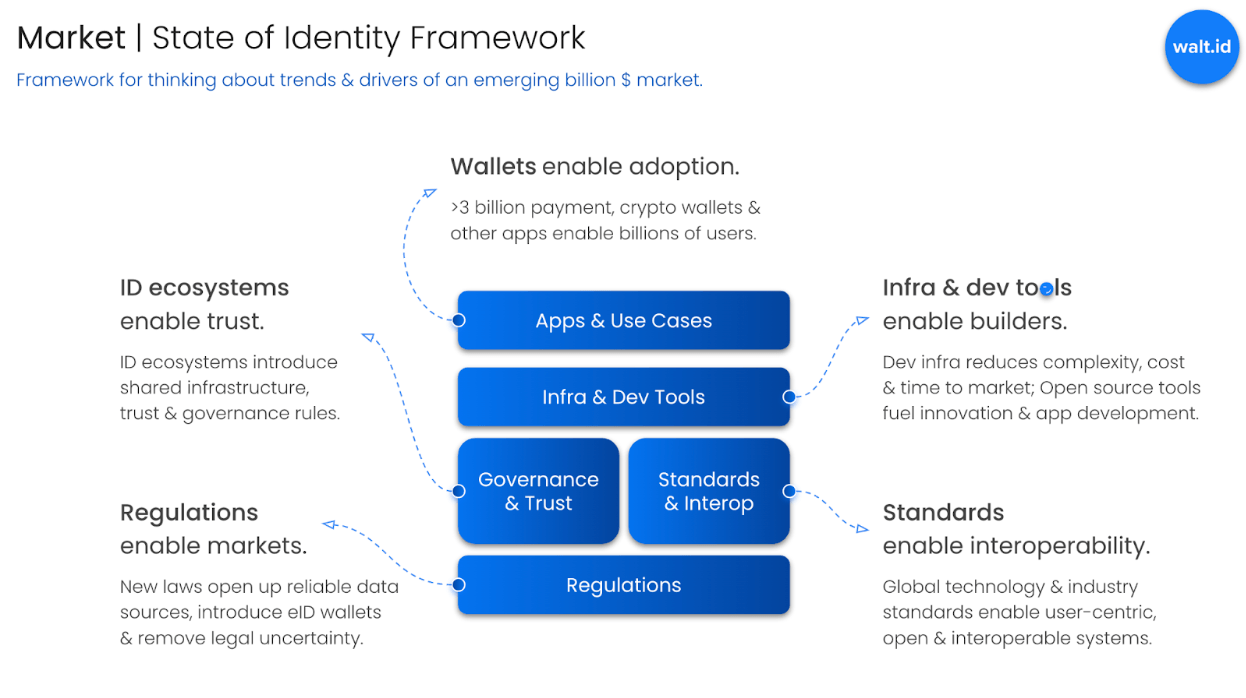
In past letters (2023-24), we introduced a framework for thinking about the adoption of wallet-based identity, analyzing the things that have to go right in order to get us to a billion ID wallet users.
The framework has five pillars:
- Regulations: Establish the legal foundation and trust required to legitimize identity wallets and unlock market adoption.
- ID Ecosystems: Define the "rules of the game" and technical infrastructure to ensure data integrity and cross-party trust.
- Standards: Enable global interoperability, preventing data silos by allowing credentials to move freely between Issuers, Wallets, and Verifiers.
- Infrastructure & Dev Tools: Provide the essential building blocks and (open source) software for developers to create secure, identity-enabled products.
- Applications: Deliver user-friendly interfaces (like ID wallets) that empower individuals to control their data and drive mass adoption.
Below you’ll find a brief update of each dimension:
Regulations enable markets
In 2024, the digital identity landscape has been reshaped by a wave of global regulatory movement. In Europe, the eIDAS2 regulation passed into law, mandating the adoption of ID wallets by 2026/27 and setting a precedent for policy makers worldwide. In the US, more than 10 states rolled out mobile driver’s license programs. Globally, new regulatory initiatives were started across the UK, the Americas, the Middle East, Asia-Pacific and Africa.
In 2025, policy makers doubled down and further accelerated to movement to digital identity wallets:
- Europe: A new Architecture Reference Framework (ARF) and technical implementing acts were published. The first set of EU’s Large Scale Pilots concluded (our open source solutions were used across all of them) and the 2nd set of LSPs kicked off (with our participation). Also, a number of countries (e.g. Austria, Italy, France, Belgium) launched ID wallets apps.
- United States: More than 21 states introduced mobile driver’s licenses and almost 50% of the US population lives in a state with an active program.
- APAC: New projects emerged in South-East Asia, Japan, New Zealand and Australia mirrored in pilots, solution procurement and the introduction of new trust frameworks (e.g. NZ’s DISTF).
- Middle East & Africa: The UAE continued to expand its ID app, while Saudi Arabia and Qatar accelerated national strategies for digital IDs. Similarly, the idea of ID wallets for citizens gained traction in several African countries.
Identity ecosystems enable trust
ID ecosystems combine technology (shared data registries) with governance frameworks (rules for establishing trust) to enable the shift away from today’s centralized identity paradigm which created a world of data silos.
In 2024, we saw the emergence of new decentralized ID ecosystems (e.g. Ayra), the continuation of existing ones (e.g. EU Blockchain Service Infrastructure, EBSI) as well as some market consolidation (e.g. merger of Dock and Cheqd).
In 2025, the emergence of public sector ID ecosystems was accelerated by regulatory action creating frameworks to establish trust and prepare the production roll-out of ID wallets to citizens. From a technology perspective, most movement happened on the side of traditional PKI (not at least due to the rising adoption of mDL/ISO 18013-5). That being said, there is plenty of space for private ID ecosystems, but there was no breakout winner or use case.
Overall, while public sector ecosystems grow and mature, it is still early for private sector ecosystems which will most likely emerge around large players across a number of industries like payments, crypto or commerce.
Standards enable interoperability
Standards are crucial, because with them there is no interoperability and without interoperability the promise of user-centric identity - especially the free movement of data - is simply not possible.
In 2024, standard bodies and implementers advanced a range of open standards: VCDM 2.0 moved through the CR phase. ISO/IEC TS 18013-7 (1st Edition) was published, featuring REST/OID4VP, while ISO/IEC 18013-7 (2nd Edition) was initiated to include the W3C Digital Credentials API. New implementer's drafts for OID4VP and OID4VCI were released and the W3C Digital Credentials API was promoted by browser and platform vendors to replace traditional custom URL schemes for presentation (OID4VP) and, increasingly, for issuance (OID4VCI).
The adoption of these standards (particularly ISO/IEC 18013-5/-7, IETF SD-JWT VC, OID4VC) was assisted by regulatory acceptance, not at least by the US and the EU. Other regulators followed, facilitating the shift to global interoperability.
In 2025, the standards landscape transitioned from pilot to production-readiness: W3C VCDM v2.0 reached full Recommendation status and OID4VCI v1.0 and OID4VP v1.0 were officially approved as OpenID Final Specifications. From a privacy perspective, SD-JWT (RFC 9901) and SD-JWT VC were published and the W3C BitString Status List v1.0 emerged as the main solution for privacy-preserving, large-scale revocation. Finally, the W3C Digital Credentials API was natively supported by major browsers like Chrome and Safari establishing a new identity layer that handles credential issuance and presentation more seamlessly.
Regulators around the globe launched efforts to introduce ID wallets such as through procurement and the publication of national trust frameworks to guide the market towards standard compliance. As a result, actual interoperability was demonstrated in a growing number of projects, signaling its transition from theory to production-readiness, (e.g. EU Large Scale Pilots, add more).
The trend we described over past years is holding up: While there is no convergence on a single standard (different technologies come with different advantages which should be utilized), there is a clear global movement towards a selected few, increasingly robust standards. Interoperability is becoming a reality and with it the promise of user-centric identity.
Infrastructure & dev tooling enables builders
Developers are at the heart of every technological revolution in software. As a result, developer infrastructure is a force multiplier, particularly open source software like our Community Stack.
In 2024, we witnessed our open source user base grow beyond 10.000 developers and organizations which indicated a continued rise in developers exploring and building wallet-based identity solutions. We also saw new players enter the market, including incumbents from different identity-related verticals, and first transactions and consolidation events happening among the early companies in the space.
In 2025, the roll out of ID wallets (e.g. US), the anticipation of regulatory deadlines (e.g. EU’s eIDAS2 deadlines for 2026/27) and growing market pressure (e.g. enterprise customers starting to ask about wallet-based identity) have taken market adoption to new heights: We added more users in 2025 than in the three years before combined confirming a fast growing demand for developer infrastructure. On the side of vendors, we noticed clearer specialization such as in terms of regional focus, target groups (gov vs. enterprise vs. SME) and products (infra vs. mobile vs. apps).
Developer infrastructure is becoming interoperable, production-ready and open source solutions are expanding (such as our Community Stack), all of which are great news for builders, the market and global adoption.
Wallets enable adoption
Applications are the interface that enables users to interact with ID ecosystems. They are where the rubber hits the road, the last barrier for mainstream adoption.
In 2024, ID wallets were rolled out in 15 US states and big tech companies (incl. Apple, Google, Samsung, Microsoft) launched and expanded ID wallets through their existing platforms. In Europe and most other parts of the world, ID wallets were still at the pilot stage.
In 2025, ID wallets were available in 21 US states and a growing number of European countries (e.g. Austria, France, Italy, Poland, Belgium) launched national ID wallets ahead of the eIDAS2 regulatory deadlines (2026). The UK transitioned its GOV.UK Wallet into a public "beta-production" stage and governments around the globe started to procure ID wallet solutions.
In our first annual report (2023), we wrote about the fact that roughly 3 billion had payment wallets and that this number was expected to pass 5 billion by 2026. By the end of 2025, we had already passed this milestone (5.3 billion) one year ahead of estimates. Today, more than 60% of the global population are using digital wallets (e.g. Paypal, Amazon Pay), payments wallets (e.g. Apple, Google, Samsung) and super-apps (e.g. WeChat, Alipay, M-Pesa, Paytm) and all of these platforms are now looking at digital identity as the next big frontier.
To sum up: Regulators push for the adoption of digital identity wallets and drive the creation of trust ecosystems to establish the legal and commercial foundation. Standards are production-ready and the same is true for developer infrastructure. Finally, more than half of the world’s population is already using digital wallets which will soon be equipped with identity capabilities. As a result, we believe that more than 500 million people will be using ID wallets within the next 2-3 years. We’re at the cusp of a revolution.
The state of walt.id
In 2025, we expanded our open source solution (The Community Stack) and hardened our enterprise-grade product (The Enterprise Stack). We more than doubled users (YoY), recurring revenue and onboarded distribution partners to serve our global customer base.
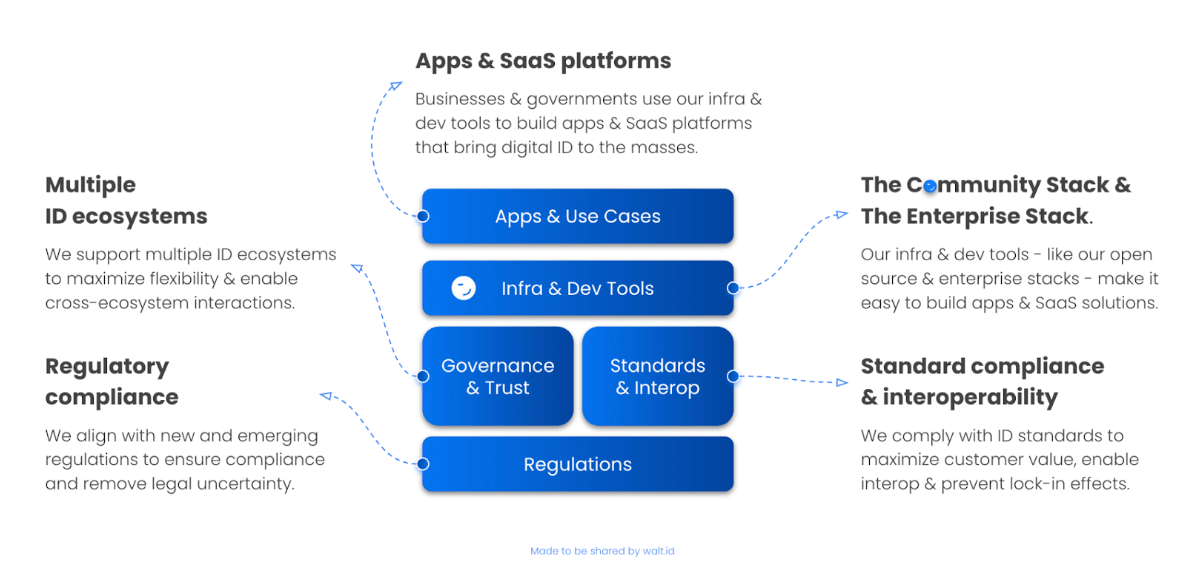
Importantly, we stayed true to our strategy: We understand that our strength lies in building infrastructure and developer tools, so we doubled down on our infrastructure products in order to abstract multiple ID ecosystems while ensuring regulatory and standard compliance for our users and customers. Instead of building our own apps (like wallets), we shipped SDKs that make it easy to build apps. Instead of launching our own SaaS solution, we built the Enterprise Stack, which extends our open source solution with powerful capabilities that make it easy for anyone to build digital ID platforms and offer credentialing, wallets or verification “as a Service” to their own customers.
Time to dive deeper into different business areas: Product and technology, go-to-market and adoption as well as, most importantly, our people.
Product & Technology
In 2024, we shipped 10 Community Stack releases, introducing new libraries and refactored APIs for better alignment with evolving standards. We enhanced the developer experience, code quality, our documentation and built out integrations with lower-level infrastructure like KMS solutions (e.g. AWS, Microsoft, Hashicorp) to maximize our customers’ flexibility. We launched our enterprise-grade product (the Enterprise Stack) which extends our “open core” (the Community Stack) with powerful capabilities for large organizations building IDaaS platforms. Finally, demonstrated interoperability with various vendors through customer projects and EU’s Large Scale Pilots.
In 2025, we significantly expanded our features and capabilities across both the Community and Enterprise Stack while ensuring continued standards alignment and improved reliability for solutions running at scale.
On the Community Stack, we invested heavily in strengthening our open-core libraries. We improved stability, reliability, and developer-facing interfaces across multiple libraries including crypto, digital credentials, policies and protocol modules like OID4VP. We also improved our ISO 18013-5 (mDL/mdoc) support by adding device engagement capabilities, providing onboarding endpoints for IACA and document singers via the API, and enabling VICAL usage within the Enterprise Stack.
On the Enterprise Stack side, we introduced new services like the Enterprise Wallet Service as well as DID and Credential Store enabling fully fledged custodial consumer and business wallets. We also shipped an events and metrics API, enabling admins to monitor analytics across issuance, verification and wallet interactions. We enhanced the logging framework and added OpenTelemetry integrations, so enterprise teams can plug the stack into their existing observability tools and troubleshoot incidents faster with lower operational overhead. New configurable PII retention and automatic purging helps customers meet privacy requirements and reduce breach risk. The new silent issuance and verification flows, enabling more seamless user experiences.
Both the Enterprise Stack and Community Stack received significant protocol upgrades with support for OID4VP v1, the digital credentials API, and full support for the new credential query language DCQL ensuring interoperability with other solutions as standards evolve. For improved handling of credentials with a status like revocation, we introduced a flexible status policy supporting various credential status standards.
Finally, we improved the overall quality of our products by reworking and improving our internal testing framework while building out a compliance test suite to stay confident as standards evolve.
On the developer experience side, we relaunched our docs with a new design, improved navigation, built-in search, and expanded concept sections to help new developers learn the fundamentals of digital identity. We also refreshed the descriptions and examples in our Swagger API docs to make the integration of our products easier.
Go-to-Market & Adoption
In 2024, we almost doubled open source users, surpassing 10.000 developers from organizations operating across public and private sectors. Moreover, we launched the Enterprise Stack and enabled selected clients to build new IDaaS platforms and apps. We went from zero to six-figure ARR and established 10 key partnerships with technology integrators and consultancies. Finally, we published almost 50 pieces of content, including blog posts, videos, two eBooks and spoke on podcasts and conferences.
In 2025, we exceeded almost every goal we set ourself:
- We added more open source users than in the three prior years (2022-2024) combined and took our user base to more than 30.000 developers and organizations.
- We expanded our customer base and have a truly global footprint serving clients in the EU, the Americas, the Middle East, Asia, Oceania and Africa.
- We expanded our open source stack and hardened our enterprise product which powers a growing number of new IDaaS and Wallet-as-a-Service platforms.
- We doubled topline revenue and ARR from a growing base of support and enterprise license customers.
- We re-launched our developer documentation and published almost 50 pieces of content, including our 5 min and 30 min tutorials, plus “how to” guides for common use cases and concept articles for the most important technical building blocks of digital ID like exchange protocols and credential standards. We also published blog posts, videos, and two eBooks, including our “Implementers Guide for eIDAS” and a report on the global state of “digital Identity Standards and Ecosystems”.
People & Careers
We’re a remote-first company made up of pioneers and builders who value transparency and autonomy. (You can read about our values here.) And over the past years we’ve been fortunate enough to attract and build a distributed team of truly amazing people - both professionally and on a personal level.
In 2025, Harald joined us from Austria. With his long-standing experience in building complex enterprise software and his background in payments, he helped us expand our enterprise product. Also, Jake joined as COO from the UK and quickly became the company’s core API: connecting commercial, product and engineering, handling daily operations, streamlining the development process and ensuring the success of our clients.
Importantly, we all came together for our annual team retreat, which took place in Vienna and Budapest and (according to some) it was the best retreat yet. It was one week of vacation for the whole team, five days of just having a good time, growing closer together and forming shared memories of new places we explored, great food we shared and real conversations we had.

Outside of our team retreats we continued our bi-weekly company-wide Demo Sessions (where devs show off their work) and monthly Company Updates (where each month’s progress is laid out and discussed).
In 2025, we introduced bi-weekly Dev Connect Sessions in which our engineering team comes together to share knowledge about updates in the Kotlin or Digital Identity world, demonstrate and teach others about new features they’ve been building and generally discuss company topics. We improved our Linear processes to ensure developers had all the requirements for implementation and as a source of internal documentation. We enforced rules around PRs to help speed up the review process and make it easier for developers to reference previous work.
We’re building an amazing company and we’re at the forefront of the user-centric identity revolution. 2026 will be big and we’re always looking for great people to join us. You can learn more here.
Get the PDF
Sign up to receive the state of identity & walt.id 2025 as PDF straight to your inbox.
Conclusion & way forward
The five factors required to reach a billion digital ID wallet users are finally in place: Regulators drive adoption through new laws and the creation of trustworthy identity ecosystems. Global, open standards reached maturity and developer infrastructure is production-ready. Finally, major governments already launched ID wallets and some of the biggest tech platforms (incl. Google, Apple) started to roll ID wallets out via existing payment wallets demonstrating a clear path towards more than 5 billion users (5.3B payment wallet users in 2025). The wallet-centric identity revolution is here and within the next 2-3 years, it will have reached more than 500 million people.
Get more insights here or start building here. If you have any questions, reach out.